How to Design a Positive Classroom Behavior Plan
Strategies to Empower Educators
By Constance Howard
Teaching 2 Empower All Learners
What is the purpose and components of
a PBIS class room management plan?
Proactive
approach to
delivering
quality
instruction
rules
procedures
Rewards and
consequences
Consistency
Instruction
climate
The primary purpose of establishing a
behavior management system based on
PBIS principles is to prevent undesired
behaviors before they occur.
Reducing undesired behaviors,
increases student engagement and
learning outcomes (Brophy & Evertson,
1976).
Tips for Designing Your Plan
 School and district-wide policy and procedures
 Common language:
Be safe…
Be responsible…
Be respectful…
 Incorporates attributes from the school’s purpose statement. If you school does not
currently have a purpose statement you can create your own. Example: “Today is the
day that I will be respectful to everyone, make safe and responsible choices, so that
everyone experiences success.”
 Upper grade students may be included in the planning of behaviors.
 Think about how rules will be enforced, monitored, and rewarded.
 Develop continuum of rewards (ideas for rewards for students).
 Develop continuum of consequences (ensure it is congruent with school policy).
 State behavior expectations positively
 Must be measurable and observable
Rules
 This is the foundation for expectations, behaviors, rewards, and
consequences that will allow students to develop a sense of community within
the class room.
 3-5 age/developmentally appropriate rules.
 Rules should be stated positively – express what you expect from students.
 Rules should be embedded into the class’s procedures and routines.
 Consistently applied and enforced.
 Taught in the very beginning of the year.
 Functional, facilitates learning, student engagement, and enhances
student/teacher relationship (Evertson, and Emmer, 2008).
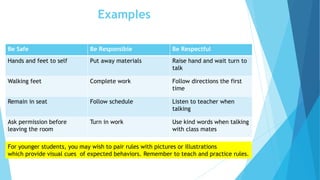
Examples
Be Safe Be Responsible Be Respectful
Hands and feet to self Put away materials Raise hand and wait turn to
talk
Walking feet Complete work Follow directions the first
time
Remain in seat Follow schedule Listen to teacher when
talking
Ask permission before
leaving the room
Turn in work Use kind words when talking
with class mates
For younger students, you may wish to pair rules with pictures or illustrations
which provide visual cues of expected behaviors. Remember to teach and practice rules.
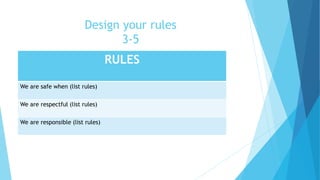
Design your rules
3-5
RULES
We are safe when (list rules)
We are respectful (list rules)
We are responsible (list rules)
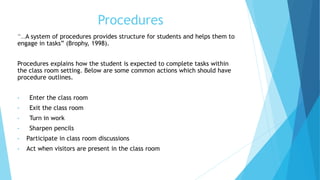
Procedures
“…A system of procedures provides structure for students and helps them to
engage in tasks” (Brophy, 1998).
Procedures explains how the student is expected to complete tasks within
the class room setting. Below are some common actions which should have
procedure outlines.
• Enter the class room
• Exit the class room
• Turn in work
• Sharpen pencils
• Participate in class room discussions
• Act when visitors are present in the class room
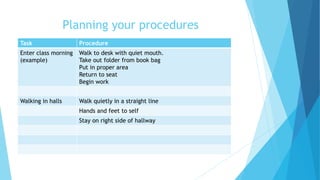
Planning your procedures
Task Procedure
Enter class morning
(example)
Walk to desk with quiet mouth.
Take out folder from book bag
Put in proper area
Return to seat
Begin work
Walking in halls Walk quietly in a straight line
Hands and feet to self
Stay on right side of hallway
Plan for recognizing behaviors
positively:
Reward schedule (how often, very
high frequency when teaching rules).
4 positive interactions for each 1
consequential action.
Vary rewards to ensure valued by
students.
Develop easy-to-use system for
keeping data on students.
Consistently recognize positive
behaviors and follow plan.
Plan for consequences of undesired
behaviors:
Ensure consequence is commensurate
with behavior infraction (see behavior
flow chart).
Consistently apply consequences and
expectations.
Identify ways for student to ‘earn’
back quickly to a neutral state and to
be recognized positively when begins
engaging in instruction or behaviors as
outlined in plan.
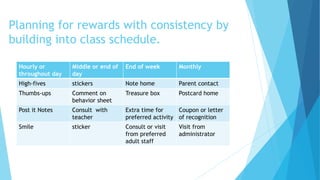
Designing management reward and consequence components
Planning for rewards with consistency by
building into class schedule.
Hourly or
throughout day
Middle or end of
day
End of week Monthly
High-fives stickers Note home Parent contact
Thumbs-ups Comment on
behavior sheet
Treasure box Postcard home
Post it Notes Consult with
teacher
Extra time for
preferred activity
Coupon or letter
of recognition
Smile sticker Consult or visit
from preferred
adult staff
Visit from
administrator
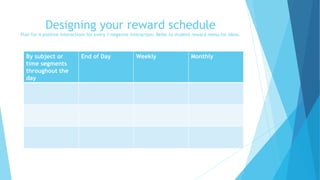
Designing your reward schedule
Plan for 4 positive interactions for every 1 negative interaction. Refer to student reward menu for ideas.
By subject or
time segments
throughout the
day
End of Day Weekly Monthly
Instruction
It may seem obvious to us as educators, social norms and appropriate
behaviors but some students will require direct, explicit instruction.
Taking the time early in the school year will enhance learning outcomes,
reduce undesired behaviors, and promote student engagement(Good &
Brophy, 1987).
Instructional Planning: Teaching Students Behaviors
Teach expected behaviors explicitly and practice
Focus on teaching through positive interactions, role-playing, and reinforcement
Include in lesson plans or consider ‘behavior bites’ short mini-lessons as they naturally present
themselves during course of day
Pair hand or body signals to remind students without having to shout or call out students
Keep data
Use data to collaborate with grade level staff members
Reinforce and reteach as needed
Seek support from successful, experienced teacher’s, or school/district’s behavior support team
members
Class Room Climate
Foster a positive behavior environment through consistency in rule
enforcement, recognition, and consequence hierarchy.
Work with students to set and achieve class behavior goals early in the
year to assist in setting up a ‘team’ attitude rather than ‘one bad apple’
mentality.
Engage students in discussions and personal behavior reflections in a
nurturing, positive interaction session.
Work to problem solve and identify other alternatives to inappropriate
behaviors.
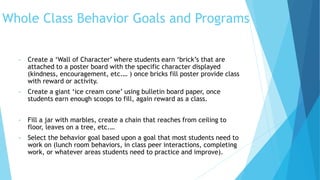
Whole Class Behavior Goals and Programs
• Create a ‘Wall of Character’ where students earn ‘brick’s that are
attached to a poster board with the specific character displayed
(kindness, encouragement, etc.… ) once bricks fill poster provide class
with reward or activity.
• Create a giant ‘ice cream cone’ using bulletin board paper, once
students earn enough scoops to fill, again reward as a class.
• Fill a jar with marbles, create a chain that reaches from ceiling to
floor, leaves on a tree, etc.…
• Select the behavior goal based upon a goal that most students need to
work on (lunch room behaviors, in class peer interactions, completing
work, or whatever areas students need to practice and improve).
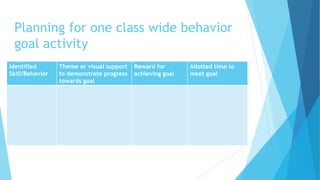
Planning for one class wide behavior
goal activity
Identified
Skill/Behavior
Theme or visual support
to demonstrate progress
towards goal
Reward for
achieving goal
Allotted time to
meet goal
Questions & Answers
References
Brophy, J.H., (1987) Teacher Praise: A functional Analysis.
Review of Educational Research.
Brophy, J., & Evertson, C., (1976). Learning from Teaching: A Developmental
Perspective. Boston, MA: Allyn and Bacon.
Evertson, C., & Emmer, E., (2008). Classroom Management for Elementary
Teachers, (8th ed.) Allyn and Bacon.
Good, T.J., & Brophy, J., (2000) Looking into Classrooms (8th ed.), New York,
NY, Longman Press.

Developing your class room behavior management plan

  • 1.
    How to Designa Positive Classroom Behavior Plan Strategies to Empower Educators By Constance Howard Teaching 2 Empower All Learners
  • 2.
    What is thepurpose and components of a PBIS class room management plan? Proactive approach to delivering quality instruction rules procedures Rewards and consequences Consistency Instruction climate The primary purpose of establishing a behavior management system based on PBIS principles is to prevent undesired behaviors before they occur. Reducing undesired behaviors, increases student engagement and learning outcomes (Brophy & Evertson, 1976).
  • 3.
    Tips for DesigningYour Plan  School and district-wide policy and procedures  Common language: Be safe… Be responsible… Be respectful…  Incorporates attributes from the school’s purpose statement. If you school does not currently have a purpose statement you can create your own. Example: “Today is the day that I will be respectful to everyone, make safe and responsible choices, so that everyone experiences success.”  Upper grade students may be included in the planning of behaviors.  Think about how rules will be enforced, monitored, and rewarded.  Develop continuum of rewards (ideas for rewards for students).  Develop continuum of consequences (ensure it is congruent with school policy).  State behavior expectations positively  Must be measurable and observable
  • 4.
    Rules  This isthe foundation for expectations, behaviors, rewards, and consequences that will allow students to develop a sense of community within the class room.  3-5 age/developmentally appropriate rules.  Rules should be stated positively – express what you expect from students.  Rules should be embedded into the class’s procedures and routines.  Consistently applied and enforced.  Taught in the very beginning of the year.  Functional, facilitates learning, student engagement, and enhances student/teacher relationship (Evertson, and Emmer, 2008).
  • 5.
    Examples Be Safe BeResponsible Be Respectful Hands and feet to self Put away materials Raise hand and wait turn to talk Walking feet Complete work Follow directions the first time Remain in seat Follow schedule Listen to teacher when talking Ask permission before leaving the room Turn in work Use kind words when talking with class mates For younger students, you may wish to pair rules with pictures or illustrations which provide visual cues of expected behaviors. Remember to teach and practice rules.
  • 6.
    Design your rules 3-5 RULES Weare safe when (list rules) We are respectful (list rules) We are responsible (list rules)
  • 7.
    Procedures “…A system ofprocedures provides structure for students and helps them to engage in tasks” (Brophy, 1998). Procedures explains how the student is expected to complete tasks within the class room setting. Below are some common actions which should have procedure outlines. • Enter the class room • Exit the class room • Turn in work • Sharpen pencils • Participate in class room discussions • Act when visitors are present in the class room
  • 8.
    Planning your procedures TaskProcedure Enter class morning (example) Walk to desk with quiet mouth. Take out folder from book bag Put in proper area Return to seat Begin work Walking in halls Walk quietly in a straight line Hands and feet to self Stay on right side of hallway
  • 9.
    Plan for recognizingbehaviors positively: Reward schedule (how often, very high frequency when teaching rules). 4 positive interactions for each 1 consequential action. Vary rewards to ensure valued by students. Develop easy-to-use system for keeping data on students. Consistently recognize positive behaviors and follow plan. Plan for consequences of undesired behaviors: Ensure consequence is commensurate with behavior infraction (see behavior flow chart). Consistently apply consequences and expectations. Identify ways for student to ‘earn’ back quickly to a neutral state and to be recognized positively when begins engaging in instruction or behaviors as outlined in plan. Designing management reward and consequence components
  • 10.
    Planning for rewardswith consistency by building into class schedule. Hourly or throughout day Middle or end of day End of week Monthly High-fives stickers Note home Parent contact Thumbs-ups Comment on behavior sheet Treasure box Postcard home Post it Notes Consult with teacher Extra time for preferred activity Coupon or letter of recognition Smile sticker Consult or visit from preferred adult staff Visit from administrator
  • 11.
    Designing your rewardschedule Plan for 4 positive interactions for every 1 negative interaction. Refer to student reward menu for ideas. By subject or time segments throughout the day End of Day Weekly Monthly
  • 12.
    Instruction It may seemobvious to us as educators, social norms and appropriate behaviors but some students will require direct, explicit instruction. Taking the time early in the school year will enhance learning outcomes, reduce undesired behaviors, and promote student engagement(Good & Brophy, 1987).
  • 13.
    Instructional Planning: TeachingStudents Behaviors Teach expected behaviors explicitly and practice Focus on teaching through positive interactions, role-playing, and reinforcement Include in lesson plans or consider ‘behavior bites’ short mini-lessons as they naturally present themselves during course of day Pair hand or body signals to remind students without having to shout or call out students Keep data Use data to collaborate with grade level staff members Reinforce and reteach as needed Seek support from successful, experienced teacher’s, or school/district’s behavior support team members
  • 14.
    Class Room Climate Fostera positive behavior environment through consistency in rule enforcement, recognition, and consequence hierarchy. Work with students to set and achieve class behavior goals early in the year to assist in setting up a ‘team’ attitude rather than ‘one bad apple’ mentality. Engage students in discussions and personal behavior reflections in a nurturing, positive interaction session. Work to problem solve and identify other alternatives to inappropriate behaviors.
  • 15.
    Whole Class BehaviorGoals and Programs • Create a ‘Wall of Character’ where students earn ‘brick’s that are attached to a poster board with the specific character displayed (kindness, encouragement, etc.… ) once bricks fill poster provide class with reward or activity. • Create a giant ‘ice cream cone’ using bulletin board paper, once students earn enough scoops to fill, again reward as a class. • Fill a jar with marbles, create a chain that reaches from ceiling to floor, leaves on a tree, etc.… • Select the behavior goal based upon a goal that most students need to work on (lunch room behaviors, in class peer interactions, completing work, or whatever areas students need to practice and improve).
  • 16.
    Planning for oneclass wide behavior goal activity Identified Skill/Behavior Theme or visual support to demonstrate progress towards goal Reward for achieving goal Allotted time to meet goal
  • 17.
  • 18.
    References Brophy, J.H., (1987)Teacher Praise: A functional Analysis. Review of Educational Research. Brophy, J., & Evertson, C., (1976). Learning from Teaching: A Developmental Perspective. Boston, MA: Allyn and Bacon. Evertson, C., & Emmer, E., (2008). Classroom Management for Elementary Teachers, (8th ed.) Allyn and Bacon. Good, T.J., & Brophy, J., (2000) Looking into Classrooms (8th ed.), New York, NY, Longman Press.