Welcome!

 While you settle in,
  Write your class rules on a sheet of pink paper
  Connect to the internet

  Download materials from the email from Nicole Darabi

  Write a postcard to a student and their family to praise
   him/her for positive behavior
Classroom Management

           PRESENTED BY:
  AMY INGERSOLL AND NICOLE DARABI,
            PBIS COACHES


       ACKNOWLEDGEMENTS TO:

       LORI NEWCOMER, PH.D.,
       UNIVERSITY OF MISSOURI

THE IRIS CENTER; VANDERBILT UNIVERSITY
Welcome

 Introductions
 Meeting Norms
 Expectations for tonight-
   What would you like to take away?

   What are you hoping to learn?

 Acknowledgements
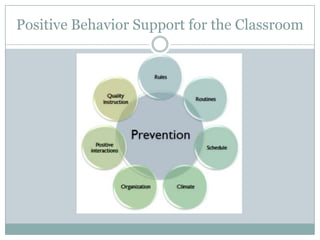
Positive Behavior Support for the Classroom
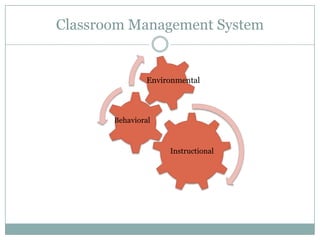
Classroom Management System


               Environmental


       Behavioral


                    Instructional
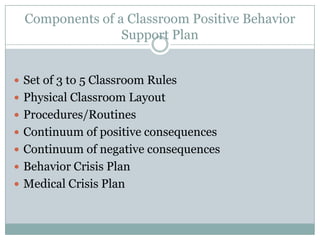
Components of a Classroom Positive Behavior
                 Support Plan


 Set of 3 to 5 Classroom Rules
 Physical Classroom Layout
 Procedures/Routines
 Continuum of positive consequences
 Continuum of negative consequences
 Behavior Crisis Plan
 Medical Crisis Plan
“If a child doesn’t know how to read, we teach.
 If a child doesn’t know how to multiply, we teach.
   If a child doesn’t know how to swim, we teach.
   If a child doesn’t know how to drive, we teach.
If a child doesn’t know how to behave, we ... teach?
                        punish?

     Why can’t we finish the last sentence as
      automatically as we do the others?”
                - Herner, 1998
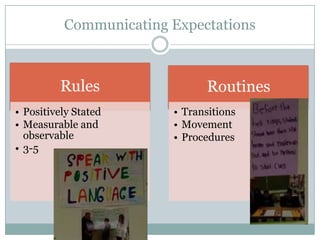
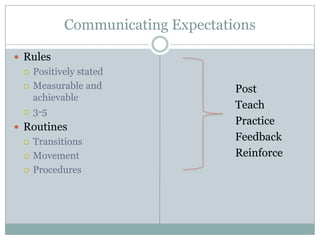
Communicating Expectations


         Rules                 Routines
• Positively Stated     • Transitions
• Measurable and        • Movement
  observable            • Procedures
• 3-5
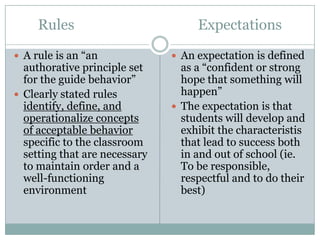
Rules                          Expectations

 A rule is an “an              An expectation is defined
  authorative principle set      as a “confident or strong
  for the guide behavior”        hope that something will
 Clearly stated rules           happen”
  identify, define, and         The expectation is that
  operationalize concepts        students will develop and
  of acceptable behavior         exhibit the characteristis
  specific to the classroom      that lead to success both
  setting that are necessary     in and out of school (ie.
  to maintain order and a        To be responsible,
  well-functioning               respectful and to do their
  environment                    best)
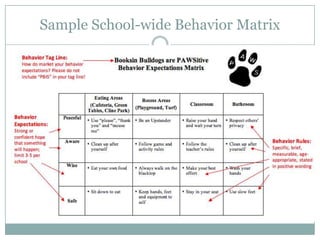
Sample School-wide Behavior Matrix
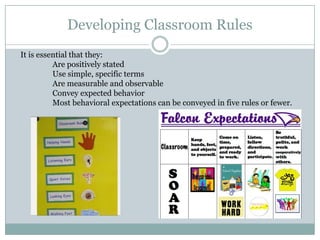
Developing Classroom Rules
It is essential that they:
          Are positively stated
          Use simple, specific terms
          Are measurable and observable
          Convey expected behavior
          Most behavioral expectations can be conveyed in five rules or fewer.
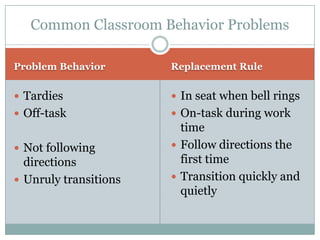
Common Classroom Behavior Problems

Problem Behavior       Replacement Rule


 Tardies               In seat when bell rings
 Off-task              On-task during work
                         time
 Not following         Follow directions the
  directions             first time
 Unruly transitions    Transition quickly and
                         quietly
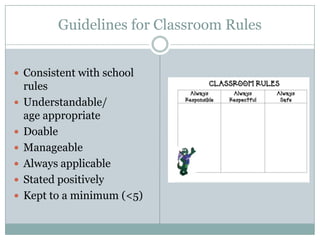
Guidelines for Classroom Rules


 Consistent with school
    rules
   Understandable/
    age appropriate
   Doable
   Manageable
   Always applicable
   Stated positively
   Kept to a minimum (<5)
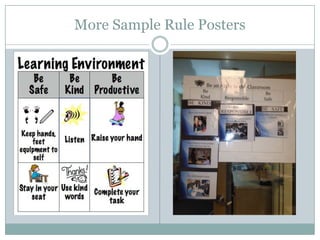
More Sample Rule Posters
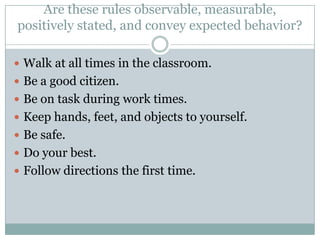
Are these rules observable, measurable,
positively stated, and convey expected behavior?

 Walk at all times in the classroom.
 Be a good citizen.
 Be on task during work times.
 Keep hands, feet, and objects to yourself.
 Be safe.
 Do your best.
 Follow directions the first time.
Partner Talk

 What are your current classroom rules?
 With your partner determine if the rules are:
       Observable

       Measurable

       Positivelystated
       Convey expected behavior

       Kept to a minimum (5 are usually sufficient)

 Identify a problem behavior and the aligned
  replacement rule
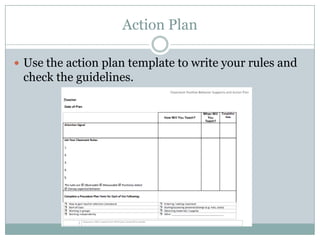
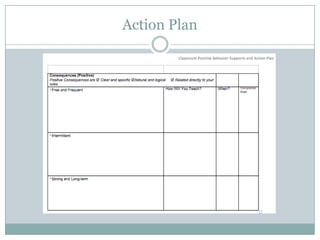
Action Plan

 Use the action plan template to write your rules and
 check the guidelines.
Share Out and Questions

 Examples of classroom rules
 How did you modify a classroom rule-what was the
  before and after?
 Tell us how and when you will teach.
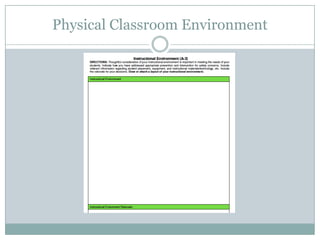
Physical Classroom Environment
Video

 Classroom Management in Action
   Planning and Organization
      Organize Physical Classroom
Classroom Layout Rationale

 How does information from the video and your
 current classroom layout support learning and
 student behavior?
      Furniture
      Materials
      Activities

    Student proximity
        Immediate reinforcement/redirection
    Engagement
    Safety
        See all students
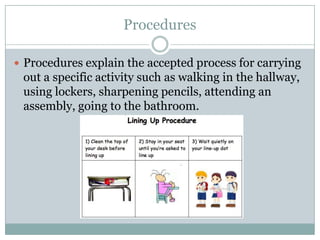
Procedures

 Procedures explain the accepted process for carrying
 out a specific activity such as walking in the hallway,
 using lockers, sharpening pencils, attending an
 assembly, going to the bathroom.
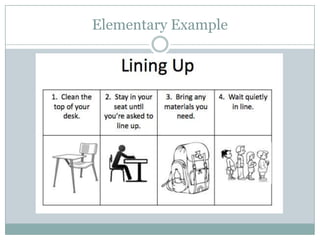
Procedures and Routines

 Determine the desired outcome (ie. Homework
  turned in).
 Decide how students need to complete the task.
 Consider what errors students are likely to make.
 Consider problem areas or problem times- often a
  well designed routine can smooth things out.
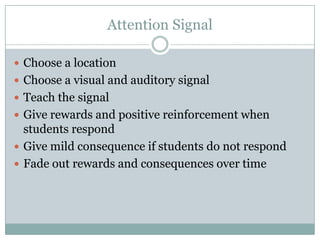
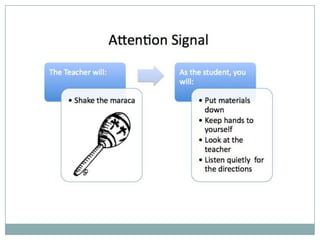
Attention Signal

 Choose a location
 Choose a visual and auditory signal
 Teach the signal
 Give rewards and positive reinforcement when
  students respond
 Give mild consequence if students do not respond
 Fade out rewards and consequences over time
Elementary Example
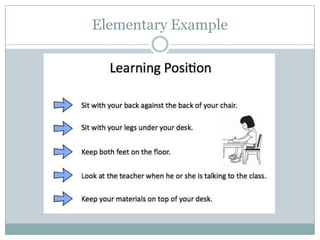
Elementary Example
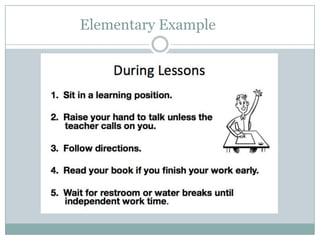
Elementary Example
Secondary Example

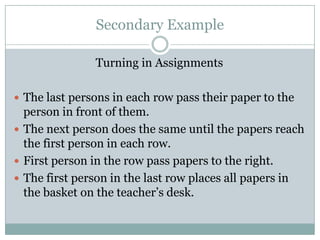
               Turning in Assignments

 The last persons in each row pass their paper to the
  person in front of them.
 The next person does the same until the papers reach
  the first person in each row.
 First person in the row pass papers to the right.
 The first person in the last row places all papers in
  the basket on the teacher’s desk.
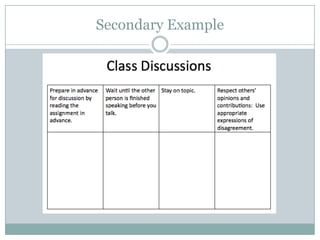
Secondary Example
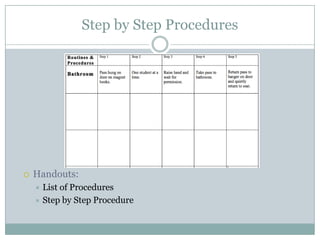
Step by Step Procedures


   Handouts:
     List of Procedures
     Step by Step Procedure
Guided Work Time

 Identify your Attention Signal on page 1 of Action Plan
 Independently review and highlight procedures needed
  in your class (on list of procedures). Write in any others
  needed at the bottom.
 Select 2-3 procedures that can be improved in your
  classroom and list them on your step by step procedures
  sheet in the left column.
 Discuss with your partner the steps involved in 1 of the
  procedures.
 Write down in student-friendly, concise wording what is
  expected for each step of this procedure. Continue
  working on the 2nd and 3rd procedure if there is time.
Communicating Expectations

 Rules
    Positively stated
    Measurable and                Post
     achievable
                                   Teach
    3-5
                                   Practice
 Routines
    Transitions                   Feedback
    Movement                      Reinforce
    Procedures
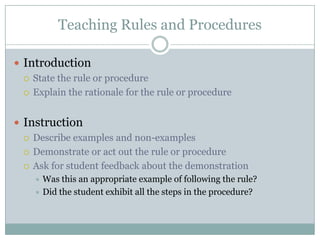
Teaching Rules and Procedures

 Introduction
   State the rule or procedure

   Explain the rationale for the rule or procedure


 Instruction
   Describe examples and non-examples

   Demonstrate or act out the rule or procedure

   Ask for student feedback about the demonstration
     Was this an appropriate example of following the rule?
     Did the student exhibit all the steps in the procedure?
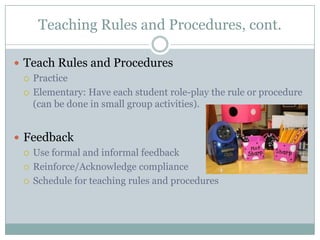
Teaching Rules and Procedures, cont.

 Teach Rules and Procedures
   Practice

   Elementary: Have each student role-play the rule or procedure
    (can be done in small group activities).


 Feedback
   Use formal and informal feedback

   Reinforce/Acknowledge compliance

   Schedule for teaching rules and procedures
Schedule for Teaching Rules and Procedures


 First Grading Period
   Teach rules and procedures for all areas of school during the
    first week
   Provide opportunities for review and practice

   Provide frequent reinforcement/acknowledgement

   After the first week, review rules two or three times per week

   Build in opportunities or activities for students to review and
    practice the rules
Schedule for Teaching Rules and Procedures

 Second Grading Period
   Review rules and procedures once per week

 Students Return from School Breaks (October,
  January, February, April)
     Review rules and procedures the first day that students return
 Remainder of the Year
   Review rules and procedures periodically as needed
Rule Reminders and Helpful Hints

 Signs and posters with pictures or icons associated
  with each rule
 Student-drawn pictures depicting the rules
 Digital pictures of students displaying rule following
  behavior
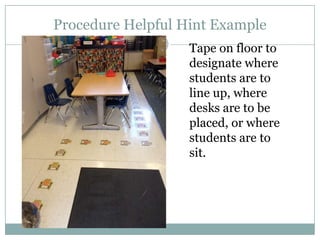
Procedure Helpful Hint Example
                   Tape on floor to
                   designate where
                   students are to
                   line up, where
                   desks are to be
                   placed, or where
                   students are to
                   sit.
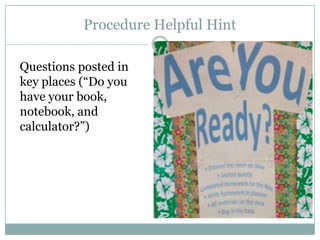
Procedure Helpful Hint

Questions posted in
key places (“Do you
have your book,
notebook, and
calculator?”)
Procedure Reminders and Helpful Hints, cont.

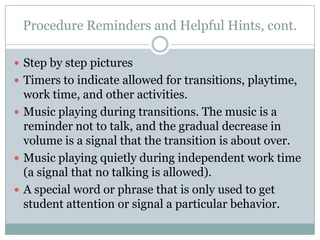
 Step by step pictures
 Timers to indicate allowed for transitions, playtime,
  work time, and other activities.
 Music playing during transitions. The music is a
  reminder not to talk, and the gradual decrease in
  volume is a signal that the transition is about over.
 Music playing quietly during independent work time
  (a signal that no talking is allowed).
 A special word or phrase that is only used to get
  student attention or signal a particular behavior.
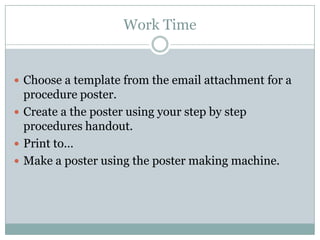
Work Time


 Choose a template from the email attachment for a
  procedure poster.
 Create a the poster using your step by step
  procedures handout.
 Print to…
 Make a poster using the poster making machine.
Big Bang Theory Video Clip
Continuum of Positive and Negative
                Consequences

Understanding Principles of Behavior

 “Behaviorists did not invent positive reinforcement.
      They systematized and named it. Positive
  reinforcement is a naturally occurring process that
   wise teachers understand and learn how to use to
     promote effective management of groups and
                 individual students.”

                              (Schuermann and Hall, 2008)
Consequences

 Behavior is strengthened or weakened by its
  consequences
 Teachers often reinforce the very behaviors that
  disrupt the class.
 Frequent teacher attention in the form of praise is
  more effective than rules or reprimands in
  increasing appropriate behavior.
Consequences, continued…

 Consequences are teacher-based actions that
  respond to appropriate (POSITIVE consequence) or
  inappropriate (NEGATIVE consequence) student
  behavior.

 Consequences work best when they:
   Are clear.

   Relate directly to rules and procedures.

   Possess a range of intensity or hierarchy of alternatives.

   Are natural and logical.
Positive Consequences

 Used to recognize and increase the frequency of
  appropriate behavior.
 Recognize on an intermittent (unpredictable, ever-
  changing) schedule that students are following rules
  and procedures.
 Can be used to develop self-managed behavior.
 Effective when they target a specific behavior and are
  applied immediately, with eye contact and genuine
  enthusiasm.
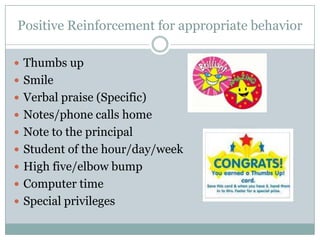
Positive Reinforcement for appropriate behavior

 Thumbs up
 Smile
 Verbal praise (Specific)
 Notes/phone calls home
 Note to the principal
 Student of the hour/day/week
 High five/elbow bump
 Computer time
 Special privileges
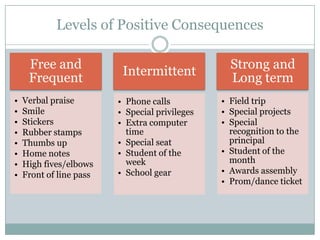
Levels of Positive Consequences

     Free and                                     Strong and
                          Intermittent
     Frequent                                     Long term
•   Verbal praise        • Phone calls          • Field trip
•   Smile                • Special privileges   • Special projects
•   Stickers             • Extra computer       • Special
•   Rubber stamps          time                   recognition to the
•   Thumbs up            • Special seat           principal
•   Home notes           • Student of the       • Student of the
•   High fives/elbows      week                   month
•   Front of line pass   • School gear          • Awards assembly
                                                • Prom/dance ticket
Positive Consequences

Free and                       Strong and
                Intermittent
Frequent                       Long term
Action Plan
Negative Consequences

 Used to decrease problem behavior
 Functional
 Applied in an educative rather than vindictive
  fashion
 Presented in a hierarchy ranging from lesser to
  greater intensity
 Best applied in combination with positive
  consequences
 Important to ensure that they are logical and
  preserve a student’s dignity
Negative consequences

 Verbal reprimand
 Planned ignoring
 Redirection-corrective teaching procedure
 Phone call home
 Response-cost
 Overcorrection
 Time-out from positive reinforcement
When delivering consequences, keep in mind
               that you need to:

 Apply consistency
 Use the power of proximity
 Make direct eye contact
 Use a soft voice
 Be firm and anger-free
 Link the consequences to the expected behaviors
 Never accept excuses, bargaining, or whining
 Be educative, not vindictive
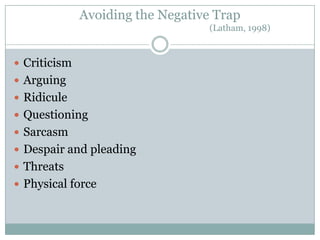
Avoiding the Negative Trap
                                   (Latham, 1998)


 Criticism
 Arguing
 Ridicule
 Questioning
 Sarcasm
 Despair and pleading
 Threats
 Physical force
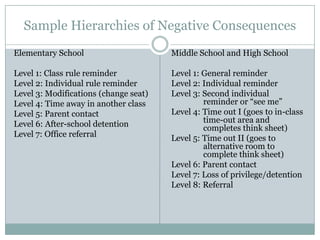
Sample Hierarchies of Negative Consequences
Elementary School                      Middle School and High School

Level 1: Class rule reminder           Level 1: General reminder
Level 2: Individual rule reminder      Level 2: Individual reminder
Level 3: Modifications (change seat)   Level 3: Second individual
Level 4: Time away in another class             reminder or “see me”
Level 5: Parent contact                Level 4: Time out I (goes to in-class
Level 6: After-school detention                 time-out area and
                                                completes think sheet)
Level 7: Office referral               Level 5: Time out II (goes to
                                                alternative room to
                                                complete think sheet)
                                       Level 6: Parent contact
                                       Level 7: Loss of privilege/detention
                                       Level 8: Referral
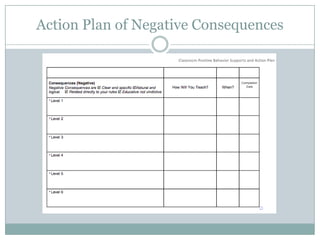
Action Plan of Negative Consequences
Effective Classroom Management


Unless what you are about to say or do has a high
probability for making things better, don’t say it and
                     don’t do it.
Effective Classroom Management

 Helpful hints and reminders:


    Stop, then redirect inappropriate behavior
    The single most commonly used but least effective method for
     stopping consequential behavior is to verbally scold and berate
     the student.

        How can you instead acknowledge the students who are doing the
         appropriate behavior?
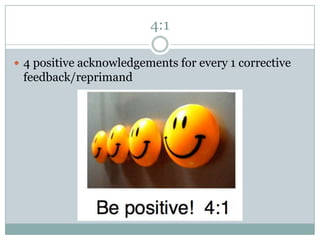
4:1

 4 positive acknowledgements for every 1 corrective
 feedback/reprimand
Behavior and Medical Crisis Plans

          In the event of a behavior or
          medical crisis, know:
             The process of what to do
             Who to call
             How/if to evacuate students
             Be knowledgeable

          At your school, create a written
          behavior and medical crisis plan
             Have it by the phone
             In your sub binder/folder
Thank you for your participation!
 Certificates for professional development hours
  completed
 Evaluation/feedback forms

Classroom Management for BTSA Participants

  • 1.
    Welcome!  While yousettle in,  Write your class rules on a sheet of pink paper  Connect to the internet  Download materials from the email from Nicole Darabi  Write a postcard to a student and their family to praise him/her for positive behavior
  • 2.
    Classroom Management PRESENTED BY: AMY INGERSOLL AND NICOLE DARABI, PBIS COACHES ACKNOWLEDGEMENTS TO: LORI NEWCOMER, PH.D., UNIVERSITY OF MISSOURI THE IRIS CENTER; VANDERBILT UNIVERSITY
  • 3.
    Welcome  Introductions  MeetingNorms  Expectations for tonight-  What would you like to take away?  What are you hoping to learn?  Acknowledgements
  • 4.
    Positive Behavior Supportfor the Classroom
  • 5.
    Classroom Management System Environmental Behavioral Instructional
  • 6.
    Components of aClassroom Positive Behavior Support Plan  Set of 3 to 5 Classroom Rules  Physical Classroom Layout  Procedures/Routines  Continuum of positive consequences  Continuum of negative consequences  Behavior Crisis Plan  Medical Crisis Plan
  • 7.
    “If a childdoesn’t know how to read, we teach. If a child doesn’t know how to multiply, we teach. If a child doesn’t know how to swim, we teach. If a child doesn’t know how to drive, we teach. If a child doesn’t know how to behave, we ... teach? punish? Why can’t we finish the last sentence as automatically as we do the others?” - Herner, 1998
  • 8.
    Communicating Expectations Rules Routines • Positively Stated • Transitions • Measurable and • Movement observable • Procedures • 3-5
  • 9.
    Rules Expectations  A rule is an “an  An expectation is defined authorative principle set as a “confident or strong for the guide behavior” hope that something will  Clearly stated rules happen” identify, define, and  The expectation is that operationalize concepts students will develop and of acceptable behavior exhibit the characteristis specific to the classroom that lead to success both setting that are necessary in and out of school (ie. to maintain order and a To be responsible, well-functioning respectful and to do their environment best)
  • 10.
  • 11.
    Developing Classroom Rules Itis essential that they: Are positively stated Use simple, specific terms Are measurable and observable Convey expected behavior Most behavioral expectations can be conveyed in five rules or fewer.
  • 12.
    Common Classroom BehaviorProblems Problem Behavior Replacement Rule  Tardies  In seat when bell rings  Off-task  On-task during work time  Not following  Follow directions the directions first time  Unruly transitions  Transition quickly and quietly
  • 13.
    Guidelines for ClassroomRules  Consistent with school rules  Understandable/ age appropriate  Doable  Manageable  Always applicable  Stated positively  Kept to a minimum (<5)
  • 14.
  • 15.
    Are these rulesobservable, measurable, positively stated, and convey expected behavior?  Walk at all times in the classroom.  Be a good citizen.  Be on task during work times.  Keep hands, feet, and objects to yourself.  Be safe.  Do your best.  Follow directions the first time.
  • 16.
    Partner Talk  Whatare your current classroom rules?  With your partner determine if the rules are:  Observable  Measurable  Positivelystated  Convey expected behavior  Kept to a minimum (5 are usually sufficient)  Identify a problem behavior and the aligned replacement rule
  • 17.
    Action Plan  Usethe action plan template to write your rules and check the guidelines.
  • 18.
    Share Out andQuestions  Examples of classroom rules  How did you modify a classroom rule-what was the before and after?  Tell us how and when you will teach.
  • 19.
  • 20.
    Video  Classroom Managementin Action  Planning and Organization  Organize Physical Classroom
  • 21.
    Classroom Layout Rationale How does information from the video and your current classroom layout support learning and student behavior?  Furniture  Materials  Activities  Student proximity  Immediate reinforcement/redirection  Engagement  Safety  See all students
  • 22.
    Procedures  Procedures explainthe accepted process for carrying out a specific activity such as walking in the hallway, using lockers, sharpening pencils, attending an assembly, going to the bathroom.
  • 23.
    Procedures and Routines Determine the desired outcome (ie. Homework turned in).  Decide how students need to complete the task.  Consider what errors students are likely to make.  Consider problem areas or problem times- often a well designed routine can smooth things out.
  • 24.
    Attention Signal  Choosea location  Choose a visual and auditory signal  Teach the signal  Give rewards and positive reinforcement when students respond  Give mild consequence if students do not respond  Fade out rewards and consequences over time
  • 25.
  • 26.
  • 27.
  • 28.
    Secondary Example Turning in Assignments  The last persons in each row pass their paper to the person in front of them.  The next person does the same until the papers reach the first person in each row.  First person in the row pass papers to the right.  The first person in the last row places all papers in the basket on the teacher’s desk.
  • 29.
  • 30.
    Step by StepProcedures  Handouts:  List of Procedures  Step by Step Procedure
  • 31.
    Guided Work Time Identify your Attention Signal on page 1 of Action Plan  Independently review and highlight procedures needed in your class (on list of procedures). Write in any others needed at the bottom.  Select 2-3 procedures that can be improved in your classroom and list them on your step by step procedures sheet in the left column.  Discuss with your partner the steps involved in 1 of the procedures.  Write down in student-friendly, concise wording what is expected for each step of this procedure. Continue working on the 2nd and 3rd procedure if there is time.
  • 32.
    Communicating Expectations  Rules  Positively stated  Measurable and Post achievable Teach  3-5 Practice  Routines  Transitions Feedback  Movement Reinforce  Procedures
  • 33.
    Teaching Rules andProcedures  Introduction  State the rule or procedure  Explain the rationale for the rule or procedure  Instruction  Describe examples and non-examples  Demonstrate or act out the rule or procedure  Ask for student feedback about the demonstration  Was this an appropriate example of following the rule?  Did the student exhibit all the steps in the procedure?
  • 34.
    Teaching Rules andProcedures, cont.  Teach Rules and Procedures  Practice  Elementary: Have each student role-play the rule or procedure (can be done in small group activities).  Feedback  Use formal and informal feedback  Reinforce/Acknowledge compliance  Schedule for teaching rules and procedures
  • 35.
    Schedule for TeachingRules and Procedures  First Grading Period  Teach rules and procedures for all areas of school during the first week  Provide opportunities for review and practice  Provide frequent reinforcement/acknowledgement  After the first week, review rules two or three times per week  Build in opportunities or activities for students to review and practice the rules
  • 36.
    Schedule for TeachingRules and Procedures  Second Grading Period  Review rules and procedures once per week  Students Return from School Breaks (October, January, February, April)  Review rules and procedures the first day that students return  Remainder of the Year  Review rules and procedures periodically as needed
  • 37.
    Rule Reminders andHelpful Hints  Signs and posters with pictures or icons associated with each rule  Student-drawn pictures depicting the rules  Digital pictures of students displaying rule following behavior
  • 38.
    Procedure Helpful HintExample Tape on floor to designate where students are to line up, where desks are to be placed, or where students are to sit.
  • 39.
    Procedure Helpful Hint Questionsposted in key places (“Do you have your book, notebook, and calculator?”)
  • 40.
    Procedure Reminders andHelpful Hints, cont.  Step by step pictures  Timers to indicate allowed for transitions, playtime, work time, and other activities.  Music playing during transitions. The music is a reminder not to talk, and the gradual decrease in volume is a signal that the transition is about over.  Music playing quietly during independent work time (a signal that no talking is allowed).  A special word or phrase that is only used to get student attention or signal a particular behavior.
  • 42.
    Work Time  Choosea template from the email attachment for a procedure poster.  Create a the poster using your step by step procedures handout.  Print to…  Make a poster using the poster making machine.
  • 44.
    Big Bang TheoryVideo Clip
  • 45.
    Continuum of Positiveand Negative Consequences Understanding Principles of Behavior “Behaviorists did not invent positive reinforcement. They systematized and named it. Positive reinforcement is a naturally occurring process that wise teachers understand and learn how to use to promote effective management of groups and individual students.” (Schuermann and Hall, 2008)
  • 46.
    Consequences  Behavior isstrengthened or weakened by its consequences  Teachers often reinforce the very behaviors that disrupt the class.  Frequent teacher attention in the form of praise is more effective than rules or reprimands in increasing appropriate behavior.
  • 47.
    Consequences, continued…  Consequencesare teacher-based actions that respond to appropriate (POSITIVE consequence) or inappropriate (NEGATIVE consequence) student behavior.  Consequences work best when they:  Are clear.  Relate directly to rules and procedures.  Possess a range of intensity or hierarchy of alternatives.  Are natural and logical.
  • 48.
    Positive Consequences  Usedto recognize and increase the frequency of appropriate behavior.  Recognize on an intermittent (unpredictable, ever- changing) schedule that students are following rules and procedures.  Can be used to develop self-managed behavior.  Effective when they target a specific behavior and are applied immediately, with eye contact and genuine enthusiasm.
  • 49.
    Positive Reinforcement forappropriate behavior  Thumbs up  Smile  Verbal praise (Specific)  Notes/phone calls home  Note to the principal  Student of the hour/day/week  High five/elbow bump  Computer time  Special privileges
  • 50.
    Levels of PositiveConsequences Free and Strong and Intermittent Frequent Long term • Verbal praise • Phone calls • Field trip • Smile • Special privileges • Special projects • Stickers • Extra computer • Special • Rubber stamps time recognition to the • Thumbs up • Special seat principal • Home notes • Student of the • Student of the • High fives/elbows week month • Front of line pass • School gear • Awards assembly • Prom/dance ticket
  • 51.
    Positive Consequences Free and Strong and Intermittent Frequent Long term
  • 52.
  • 53.
    Negative Consequences  Usedto decrease problem behavior  Functional  Applied in an educative rather than vindictive fashion  Presented in a hierarchy ranging from lesser to greater intensity  Best applied in combination with positive consequences  Important to ensure that they are logical and preserve a student’s dignity
  • 54.
    Negative consequences  Verbalreprimand  Planned ignoring  Redirection-corrective teaching procedure  Phone call home  Response-cost  Overcorrection  Time-out from positive reinforcement
  • 55.
    When delivering consequences,keep in mind that you need to:  Apply consistency  Use the power of proximity  Make direct eye contact  Use a soft voice  Be firm and anger-free  Link the consequences to the expected behaviors  Never accept excuses, bargaining, or whining  Be educative, not vindictive
  • 56.
    Avoiding the NegativeTrap (Latham, 1998)  Criticism  Arguing  Ridicule  Questioning  Sarcasm  Despair and pleading  Threats  Physical force
  • 57.
    Sample Hierarchies ofNegative Consequences Elementary School Middle School and High School Level 1: Class rule reminder Level 1: General reminder Level 2: Individual rule reminder Level 2: Individual reminder Level 3: Modifications (change seat) Level 3: Second individual Level 4: Time away in another class reminder or “see me” Level 5: Parent contact Level 4: Time out I (goes to in-class Level 6: After-school detention time-out area and completes think sheet) Level 7: Office referral Level 5: Time out II (goes to alternative room to complete think sheet) Level 6: Parent contact Level 7: Loss of privilege/detention Level 8: Referral
  • 58.
    Action Plan ofNegative Consequences
  • 59.
    Effective Classroom Management Unlesswhat you are about to say or do has a high probability for making things better, don’t say it and don’t do it.
  • 60.
    Effective Classroom Management Helpful hints and reminders:  Stop, then redirect inappropriate behavior  The single most commonly used but least effective method for stopping consequential behavior is to verbally scold and berate the student.  How can you instead acknowledge the students who are doing the appropriate behavior?
  • 61.
    4:1  4 positiveacknowledgements for every 1 corrective feedback/reprimand
  • 62.
    Behavior and MedicalCrisis Plans  In the event of a behavior or medical crisis, know:  The process of what to do  Who to call  How/if to evacuate students  Be knowledgeable  At your school, create a written behavior and medical crisis plan  Have it by the phone  In your sub binder/folder
  • 63.
    Thank you foryour participation!  Certificates for professional development hours completed  Evaluation/feedback forms

Editor's Notes

  • #4 Survey participants-elementary, middle, high school AND # of years teaching 1st, 2nd, 3-5, 5+
  • #6 Three areas to effective classroom management. During the training series, we will talk about all 3. They all work together to create an effective system
  • #9 Rules-what is the expected behavior?Routines-how where to you put the equipment, what do you do when you complete your task?
  • #10 Rules are the explicit statements of teacher expectations for student behavior in a classroom. Expectations are the desired behaviors or outcomes. Rules and expectations identify, define, and operationalize concepts of acceptable behavior. Rules and expectations also provide guidelines for students to monitor their own behavior, and they remind and motivate students to meet certain standards.
  • #11 70% of PTs are at PBIS schools
  • #14 Consistent-not conflicting; school rules should be in effect in the classroomUnderstandable-stated clearly so students understand. Vocabulary should be consistent with students’ grade/ability levelDoable-students must be capable of following them (within maturation level and mental/physical abilities)Manageable-easily monitored and not require excessive classroom time to hold students accountableAlways applicable-rules should be consistent across situations; they should not vary or changeStated positively-stating rules positively encourages the desired behavior. Most don’ts can be transformed to do’s—no gum can become leave gum at home
  • #22 Other ideas?
  • #24 Procedure handout step by step to creating procedures
  • #26 Take note of how the procedures are broken down step by step.
  • #32 Talk through 1 with a partner about step by step procedure
  • #33 Post-big, bold, and beautifulTeach-explicit instructionPractice and provide feedbackReinforce
  • #38 Picture this!
  • #41 Give info for timers and/or use timers as an example
  • #45 9:20-10:24 Positive Reinforcement
  • #47 When we acknowledge appropriate behavior, we get appropriate behavior. When we acknowledge inappropriate behavior, we get inappropriate behavior. Can you think of a time when your behavior reinforced the behavior you wanted to stop?
  • #50 If need a translator, ask who at school can call for you and be present during the phone call if possible. Talking points for individual students, tables/groups, and whole class reinforcement.
  • #51 Level 1-free and frequentUsed everyday in the classroom involving praise, perhaps stickers….easy things the teacher normally deliverLevel 2-intermittentMore powerful and can be awarded as perhaps a student of the week, student of the month, occasional free timeLevel 3-strong and long termYear-long, or month-long types of recognition that students can work for, perhaps a special trip, working in the office, serving as a peer assistant
  • #52 Talking points for academic vs. behavior rewardsShare out
  • #58 2 min. talk time about their hierarchy
  • #59 If the consequences aren’t working, don’t continue to use the same consequenceReminder isn’t “stop doing that” but reteaching