SIX ASPECTS OF CLASSROOM MANAGEMENT Stephanie Davis Robyn Elizabeth Ewert Ashley Freitas Tracy Turcotte David Thomas Ward Susan Jane Young
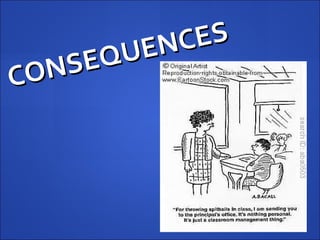
CONSEQUENCES
Importance of Classroom Management The research conducted on  teacher’s  behaviors in the classroom  shows that teachers' actions in their  own classrooms have twice the  influence on student achievement  than school policies. (Marzano, 2003a) It is known that the most crucial and difficult jobs of being a teacher and having an individual classroom is managing the classroom effectively.  Classroom management has the most significant effect on student achievement.
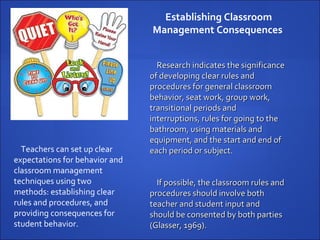
Establishing Classroom Management Consequences  Teachers can set up clear expectations for behavior and classroom management techniques using two methods: establishing clear rules and procedures, and providing consequences for student behavior.  Research indicates the significance of developing clear rules and procedures for general classroom behavior, seat work, group work, transitional periods and interruptions, rules for going to the bathroom, using materials and equipment, and the start and end of each period or subject.  If possible, the classroom rules and procedures should involve both teacher and student input and should be consented by both parties (Glasser, 1969).
Classroom Management Consequences  In addition to designing classroom rules and procedures, it is necessary for the teacher to recognize students' behavior by reinforcing acceptable behavior and providing negative consequences for unacceptable behavior.  ** It is important not to ignore inappropriate behavior or be sidetracked by students denying, arguing, or blaming someone else for the misbehavior. Instead, listen to legitimate explanations**
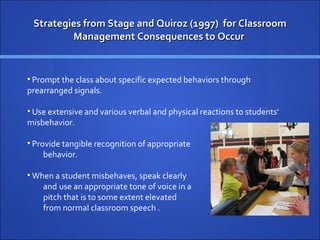
Strategies from Stage and Quiroz (1997)  for Classroom Management Consequences to Occur  Prompt the class about specific expected behaviors through  prearranged signals. Use extensive and various verbal and physical reactions to students'  misbehavior. Provide tangible recognition of appropriate  behavior. When a student misbehaves, speak clearly  and  use an appropriate tone of voice in a  pitch that is to some extent elevated  from normal classroom speech .
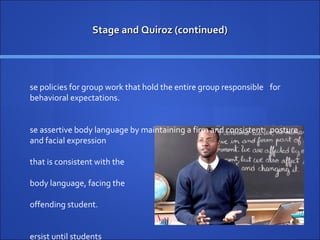
Stage and Quiroz (continued) Use policies for group work that hold the entire group responsible  for behavioral expectations. Use assertive body language by maintaining a firm and consistent  posture and facial expression  that is consistent with the  body language, facing the  offending student. Persist until students  respond with the  appropriate behavior.
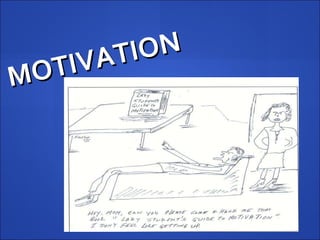
MOTIVATION
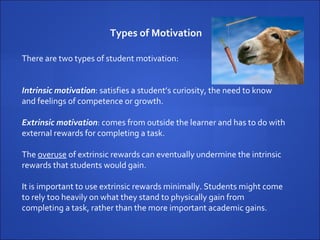
Types of Motivation There are two types of student motivation: Intrinsic motivation : satisfies a student’s curiosity, the need to know and feelings of competence or growth. Extrinsic motivation : comes from outside the learner and has to do with external rewards for completing a task. The  overuse  of extrinsic rewards can eventually undermine the intrinsic rewards that students would gain.  It is important to use extrinsic rewards minimally. Students might come to rely too heavily on what they stand to physically gain from completing a task, rather than the more important academic gains.
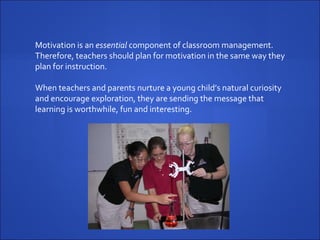
Motivation is an  essential  component of classroom management. Therefore, teachers should plan for motivation in the same way they plan for instruction.  When teachers and parents nurture a young child’s natural curiosity and encourage exploration, they are sending the message that learning is worthwhile, fun and interesting.
Every lesson should plan for student success. When a student can expect to do well at a given task, the need for classroom management intervention is greatly minimized.  Some quick ways that teachers can do this: Meet the motivational needs of students by adjusting praise, guidance  and reinforcement. Treat students as eager learners; they are more likely to behave as eager  learners! Establish a supportive environment – be encouraging and patient, try to  take away negative reinforcement. Monitor the difficulty of the goals and tasks that students choose for  themselves.  Express interest in the content, and project enthusiasm – students often  find motivation knowing that the teacher enjoys the topic. Motivation TIPS!
Having an unmotivated student is not uncommon. It is important that teachers recognize that these students might “not care about their academics” because they are feeling discouraged.  In these situations the teacher should: Help students concentrate on the task at hand, rather than the fear of  performing poorly. Encourage the student to retrace their steps to find the source of the  problem. Promote alternative solutions to each problem rather than giving up on  only one method. Help the student to discover where they are going wrong, be it lack of  effort or information, rather than their supposed lack of ability. Helping Unmotivated Students
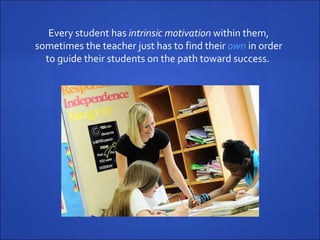
Every student has  intrinsic motivation  within them, sometimes the teacher just has to find their  own  in order to guide their students on the path toward success.
SUPPLY TEACHING
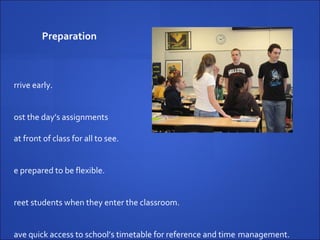
Preparation Arrive early. Post the day’s assignments  at front of class for all to see. Be prepared to be flexible. Greet students when they enter the classroom. Have quick access to school’s timetable for reference and time  management. Have a ‘bag of tricks’  resource kit.
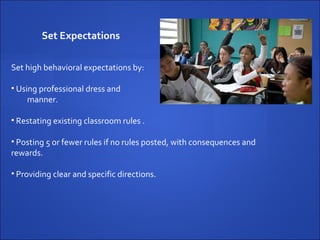
Set Expectations   Set high behavioral expectations by: Using professional dress and  manner. Restating existing classroom rules . Posting 5 or fewer rules if no rules posted, with consequences and  rewards. Providing clear and specific directions.
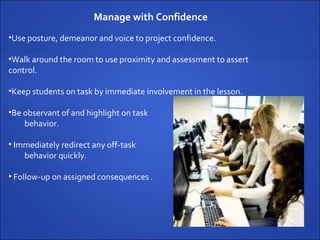
Manage with Confidence   Use posture, demeanor and voice to project confidence. Walk around the room to use proximity and assessment to assert  control. Keep students on task by immediate involvement in the lesson. Be observant of and highlight on task  behavior. Immediately redirect any off-task  behavior quickly. Follow-up on assigned consequences .
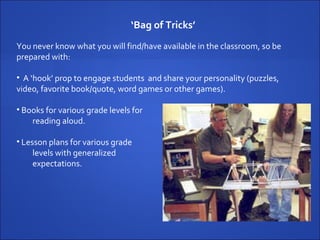
‘ Bag of Tricks’   You never know what you will find/have available in the classroom, so be prepared with:  A ‘hook’ prop to engage students  and share your personality (puzzles,  video, favorite book/quote, word games or other games). Books for various grade levels for  reading aloud. Lesson plans for various grade  levels with generalized  expectations.
Worksheets for various grade  levels, enough for class set (e.g.  crosswords, word matches). A couple of activities that cross  grade levels and strands (ex.  chocolate chip cookie mining). Chalk, whiteboard markers, pens,  paperclips, Kleenex tissue, blank  paper, lined paper, pencils, erasers,  blank overheads, sticky notes.
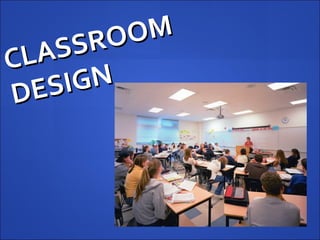
CLASSROOM DESIGN
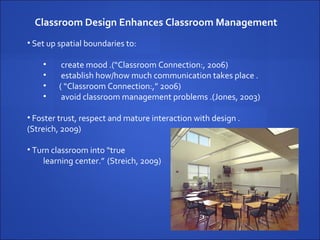
Classroom Design Enhances Classroom Management Set up spatial boundaries to: create mood .(“Classroom Connection:, 2006) establish how/how much communication takes place . ( “Classroom Connection:,” 2006) avoid classroom management problems .(Jones, 2003)  Foster trust, respect and mature interaction with design .  (Streich, 2009) Turn classroom into “true  learning  center.”  (Streich, 2009)
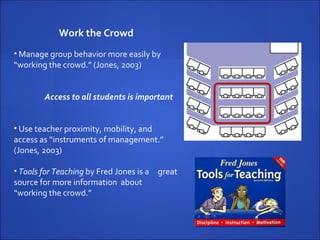
Work the Crowd  Manage group behavior more easily by  “working the crowd.” (Jones, 2003) Access to all students is important  Use teacher proximity, mobility, and  access as “instruments of management.”  (Jones, 2003) Tools for Teaching  by Fred Jones is a  great source for more information  about  “working the crowd.”
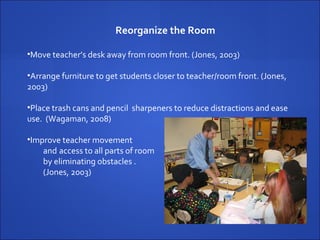
Reorganize the Room Move teacher’s desk away from room front. (Jones, 2003) Arrange furniture to get students closer to teacher/room front. (Jones,  2003)  Place trash cans and pencil  sharpeners to reduce distractions and ease  use.  (Wagaman, 2008) Improve teacher movement  and  access to all parts of room  by eliminating obstacles .  (Jones, 2003)
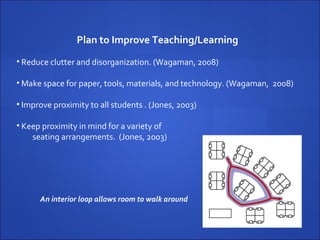
  Plan to Improve Teaching/Learning Reduce clutter and disorganization. (Wagaman, 2008) Make space for paper, tools, materials, and technology. (Wagaman,  2008) Improve proximity to all students . (Jones, 2003) Keep proximity in mind for a variety of  seating arrangements.  (Jones, 2003) An interior loop allows room to walk around
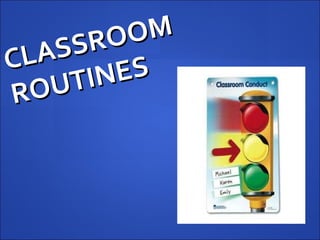
CLASSROOM ROUTINES
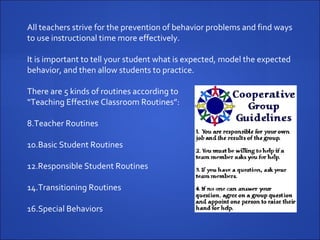
All teachers strive for the prevention of behavior problems and find ways to use instructional time more effectively.  It is important to tell your student what is expected, model the expected behavior, and then allow students to practice. There are 5 kinds of routines according to  “ Teaching Effective Classroom Routines”: Teacher Routines Basic Student Routines Responsible Student Routines Transitioning Routines Special Behaviors
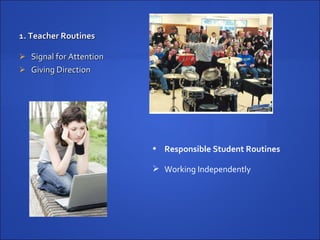
1. Teacher Routines Signal for Attention Giving Direction  Responsible Student Routines Working Independently
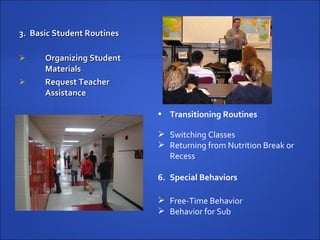
3.  Basic Student Routines Organizing Student Materials Request Teacher Assistance Transitioning Routines Switching Classes Returning from Nutrition Break or Recess  Special Behaviors Free-Time Behavior Behavior for Sub
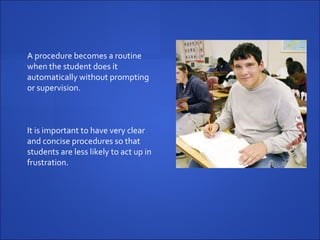
A procedure becomes a routine when the student does it automatically without prompting or supervision.  It is important to have very clear and concise procedures so that students are less likely to act up in frustration.
POSITIVE RECOGNITION
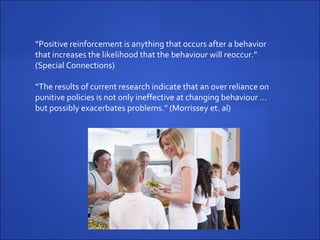
“ Positive reinforcement is anything that occurs after a behavior that increases the likelihood that the behaviour will reoccur.” (Special Connections)   “ The results of current research indicate that an over reliance on punitive policies is not only ineffective at changing behaviour … but possibly exacerbates problems.” (Morrissey et. al)  
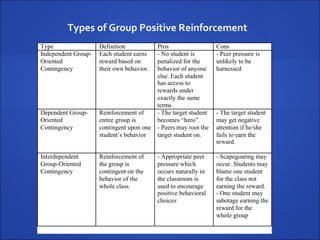
Types of Group Positive Reinforcement
Verbal praise Sounds simple, but often teachers forget how important this is.   Certificates Well Done certificates, bookmarks, stickers  on work.   Class activities  The class collects points that earn them  something, an activity, a reward, pizza party,  trip, movie, etc. “ One approach could be to make one activity contingent on another: students can earn time in one favored activity by performing well in another.” (ERIC)    Reward Systems
Prizes Students get coupons, ballots for good behavior they write their  names on them and enter them into a draw at the end of a given  period of time, for a prize.   Token Economies Students earn points, tokens, or coupons by demonstrating desired  behavior and saving them up to buy prizes or rewards. For more information on setting up a token economy visit  http://www.usu.edu/teachall/text/behavior/LRBIpdfs/Token.pdf
A Different Take on Token Economies Have an auction! Students save up tokens and then have an opportunity to bid on rewards Sample rewards include; using the good chair for a period (teachers chair), 15 minutes in the gym at recess, working in the hall with a partner, having a period on the computer (teacher chooses activity), having a 1-day extension on an assignment, no homework pass, sit with a friend, silent reading in the library, recess extension of 5 minutes for the whole class (one who bid on it got to pick the day), etc.  ** An advantage to using the action system is that the students who consistently demonstrate desired behaviors have more tickets to bid with at the action and usually get the best prizes.  Students can save their tickets for later actions to get better prizes (Jackson)
Reflection Time Keep data to determine whether an approach is working.  Compare behaviour during baseline and treatment phases. (ERIC) For example track how many coupons you are giving out and to whom. (This is also useful when it comes to filling out the “learning skills” section of the report card.) Re-assess effectiveness and make adjustments accordingly. Consider integrating other behavior management techniques.
References Burden, Paul. (2000).  Powerful Classroom Management Strategies: Motivating Students to Learn.  Retrieved on 2010/06/13 from  http://books.google.ca/books?hl=en&lr=&id=BbJJzPLe_9IC&oi=fnd&pg=PP13&dq=motivation+and+classroom+management&ots=gqBAjzlHUI&sig=MsnCguTJQZHNyt2wMpFsUMYtHSU#v=onepage&q=motivation%20and%20classroom%20management&f=false Byer, John L., “A Comprehensive Method for Effective Substitute Teaching,”  Eric.  http://wf2dnvr13.webfeat.org:80/JhBOO11535/url=http://tpdweb.umi.com/tpweb?Did=ED503689&Fmt=1&Mtd=1&Idx=1&Sid=1&RQT=877&EricUrl=http://www.eric.ed.gov/contentdelivery/servlet/ERICServlet?accno=ED503689&TS=1276560463 .  ERIC # ED371506, 1990, Managing Inappropriate Behavior in the Classroom.  Retrieved from  http://www.ericdigests.org/1995-1/behavior.htm Glasser, W. (1969).  Schools without failure.  New York: Harper and Row.   Leadership, 61 (1), 6-13.  Jones, F. . (2003).  Set up an effective room arrangement . Retrieved from  http://office.microsoft.com/en-us/visio-help/set-up-an-effective-room-arrangement-HA001207138.aspx?CTT=5&origin=HA001207150
References continued Levin, James and Nolan, James F., “Principles of Classroom Management: A  Professional Decision-Making Model, Fourth Edition.” Pearson Education, 2009. Lumsden, Linda S. (June 1994). Student Motivation To Learn. ERIC Digest,  Number 92. Retrieved on 2010/06/27 from  http://www.kidsource.com/kidsource/content2/Student_motivatation.html   Marzano, R. J. (2003a).  What works in schools.   Alexandria, VA: ASCD. Marzano, R.J., & Marzano, J.S. (2003).  The Key to Classroom Management.  Educational  Morrissey, Kelly L, Bohanon, Hank,& Fenning, Pamela. Positive Behavior  Support: Teaching and Acknowledging Expected Behaviors in an Urban High School, Teaching Exceptional Children. Reston: May/Jun 2010. Vol. 42, Iss. 5; pg. 26, 10 pgs Odette Jackson, FSL Literacy Resource Teacher with Simcoe County District School Board, personal communication, June 28, 2010 Rutledge Janz, Janice,  Teaching Effective Classroom Routines:  Intervention in School and Clinic v.37 I1 (2001) p.48 Gale Group Special Connections, University of Kansas 2005. Positive Reinforcement.  Retrieved from  http://www.specialconnections.ku.edu/cgi-bin/cgiwrap/specconn/main.php?cat=behavior&section=main&subsection=classroom/positive
References continued Stage, S. A., & Quiroz, D. R. (1997). A meta-analysis of interventions to decrease disruptive classroom behavior in public education settings.  School Psychology Review, 26 (3), 333–368. Streich, M. . (2009, July 20).  First school week in high school classes . Retrieved from  http://classroom- management-tips.suite101.com/article.cfm/first_school_week_in_high_school Classroom connection: classroom configuration. (2006, September).  Techniques: Connection Education & Careers , 7-8. Utah State University PDF handout. Token Economy. Retrieved from  http://www.usu.edu/teachall/text/behavior/LRBIpdfs/Token.pdf Wagaman, J. . (2008, December 4).  Preparing your classroom for the start of  school . Retrieved from  http://classroom-organization.suite101.com/article.cfm/ preparing_your_classroom_for_the_start_of_school Wang, M. C., Haertel, G. D., & Walberg, H. J. (1993). Toward a knowledge  base for school learning.  Review of Educational Research, 63 (3), 249–294.  Wong, Harry  How to Be an Effective Teacher: The First Days of School  (2005) Harry K Wong Publications Inc.

Classroom mgmt sy_rev

  • 1.
    SIX ASPECTS OFCLASSROOM MANAGEMENT Stephanie Davis Robyn Elizabeth Ewert Ashley Freitas Tracy Turcotte David Thomas Ward Susan Jane Young
  • 2.
  • 3.
    Importance of ClassroomManagement The research conducted on teacher’s behaviors in the classroom shows that teachers' actions in their own classrooms have twice the influence on student achievement than school policies. (Marzano, 2003a) It is known that the most crucial and difficult jobs of being a teacher and having an individual classroom is managing the classroom effectively. Classroom management has the most significant effect on student achievement.
  • 4.
    Establishing Classroom ManagementConsequences Teachers can set up clear expectations for behavior and classroom management techniques using two methods: establishing clear rules and procedures, and providing consequences for student behavior. Research indicates the significance of developing clear rules and procedures for general classroom behavior, seat work, group work, transitional periods and interruptions, rules for going to the bathroom, using materials and equipment, and the start and end of each period or subject. If possible, the classroom rules and procedures should involve both teacher and student input and should be consented by both parties (Glasser, 1969).
  • 5.
    Classroom Management Consequences In addition to designing classroom rules and procedures, it is necessary for the teacher to recognize students' behavior by reinforcing acceptable behavior and providing negative consequences for unacceptable behavior. ** It is important not to ignore inappropriate behavior or be sidetracked by students denying, arguing, or blaming someone else for the misbehavior. Instead, listen to legitimate explanations**
  • 6.
    Strategies from Stageand Quiroz (1997) for Classroom Management Consequences to Occur Prompt the class about specific expected behaviors through prearranged signals. Use extensive and various verbal and physical reactions to students' misbehavior. Provide tangible recognition of appropriate behavior. When a student misbehaves, speak clearly and use an appropriate tone of voice in a pitch that is to some extent elevated from normal classroom speech .
  • 7.
    Stage and Quiroz(continued) Use policies for group work that hold the entire group responsible for behavioral expectations. Use assertive body language by maintaining a firm and consistent posture and facial expression that is consistent with the body language, facing the offending student. Persist until students respond with the appropriate behavior.
  • 8.
  • 9.
    Types of MotivationThere are two types of student motivation: Intrinsic motivation : satisfies a student’s curiosity, the need to know and feelings of competence or growth. Extrinsic motivation : comes from outside the learner and has to do with external rewards for completing a task. The overuse of extrinsic rewards can eventually undermine the intrinsic rewards that students would gain. It is important to use extrinsic rewards minimally. Students might come to rely too heavily on what they stand to physically gain from completing a task, rather than the more important academic gains.
  • 10.
    Motivation is an essential component of classroom management. Therefore, teachers should plan for motivation in the same way they plan for instruction. When teachers and parents nurture a young child’s natural curiosity and encourage exploration, they are sending the message that learning is worthwhile, fun and interesting.
  • 11.
    Every lesson shouldplan for student success. When a student can expect to do well at a given task, the need for classroom management intervention is greatly minimized. Some quick ways that teachers can do this: Meet the motivational needs of students by adjusting praise, guidance and reinforcement. Treat students as eager learners; they are more likely to behave as eager learners! Establish a supportive environment – be encouraging and patient, try to take away negative reinforcement. Monitor the difficulty of the goals and tasks that students choose for themselves. Express interest in the content, and project enthusiasm – students often find motivation knowing that the teacher enjoys the topic. Motivation TIPS!
  • 12.
    Having an unmotivatedstudent is not uncommon. It is important that teachers recognize that these students might “not care about their academics” because they are feeling discouraged. In these situations the teacher should: Help students concentrate on the task at hand, rather than the fear of performing poorly. Encourage the student to retrace their steps to find the source of the problem. Promote alternative solutions to each problem rather than giving up on only one method. Help the student to discover where they are going wrong, be it lack of effort or information, rather than their supposed lack of ability. Helping Unmotivated Students
  • 13.
    Every student has intrinsic motivation within them, sometimes the teacher just has to find their own in order to guide their students on the path toward success.
  • 14.
  • 15.
    Preparation Arrive early.Post the day’s assignments at front of class for all to see. Be prepared to be flexible. Greet students when they enter the classroom. Have quick access to school’s timetable for reference and time management. Have a ‘bag of tricks’ resource kit.
  • 16.
    Set Expectations  Set high behavioral expectations by: Using professional dress and manner. Restating existing classroom rules . Posting 5 or fewer rules if no rules posted, with consequences and rewards. Providing clear and specific directions.
  • 17.
    Manage with Confidence  Use posture, demeanor and voice to project confidence. Walk around the room to use proximity and assessment to assert control. Keep students on task by immediate involvement in the lesson. Be observant of and highlight on task behavior. Immediately redirect any off-task behavior quickly. Follow-up on assigned consequences .
  • 18.
    ‘ Bag ofTricks’   You never know what you will find/have available in the classroom, so be prepared with: A ‘hook’ prop to engage students and share your personality (puzzles, video, favorite book/quote, word games or other games). Books for various grade levels for reading aloud. Lesson plans for various grade levels with generalized expectations.
  • 19.
    Worksheets for variousgrade levels, enough for class set (e.g. crosswords, word matches). A couple of activities that cross grade levels and strands (ex. chocolate chip cookie mining). Chalk, whiteboard markers, pens, paperclips, Kleenex tissue, blank paper, lined paper, pencils, erasers, blank overheads, sticky notes.
  • 20.
  • 21.
    Classroom Design EnhancesClassroom Management Set up spatial boundaries to: create mood .(“Classroom Connection:, 2006) establish how/how much communication takes place . ( “Classroom Connection:,” 2006) avoid classroom management problems .(Jones, 2003) Foster trust, respect and mature interaction with design . (Streich, 2009) Turn classroom into “true learning center.” (Streich, 2009)
  • 22.
    Work the Crowd Manage group behavior more easily by “working the crowd.” (Jones, 2003) Access to all students is important Use teacher proximity, mobility, and access as “instruments of management.” (Jones, 2003) Tools for Teaching by Fred Jones is a great source for more information about “working the crowd.”
  • 23.
    Reorganize the RoomMove teacher’s desk away from room front. (Jones, 2003) Arrange furniture to get students closer to teacher/room front. (Jones, 2003) Place trash cans and pencil sharpeners to reduce distractions and ease use. (Wagaman, 2008) Improve teacher movement and access to all parts of room by eliminating obstacles . (Jones, 2003)
  • 24.
      Plan toImprove Teaching/Learning Reduce clutter and disorganization. (Wagaman, 2008) Make space for paper, tools, materials, and technology. (Wagaman, 2008) Improve proximity to all students . (Jones, 2003) Keep proximity in mind for a variety of seating arrangements. (Jones, 2003) An interior loop allows room to walk around
  • 25.
  • 26.
    All teachers strivefor the prevention of behavior problems and find ways to use instructional time more effectively. It is important to tell your student what is expected, model the expected behavior, and then allow students to practice. There are 5 kinds of routines according to “ Teaching Effective Classroom Routines”: Teacher Routines Basic Student Routines Responsible Student Routines Transitioning Routines Special Behaviors
  • 27.
    1. Teacher RoutinesSignal for Attention Giving Direction Responsible Student Routines Working Independently
  • 28.
    3. BasicStudent Routines Organizing Student Materials Request Teacher Assistance Transitioning Routines Switching Classes Returning from Nutrition Break or Recess Special Behaviors Free-Time Behavior Behavior for Sub
  • 29.
    A procedure becomesa routine when the student does it automatically without prompting or supervision. It is important to have very clear and concise procedures so that students are less likely to act up in frustration.
  • 30.
  • 31.
    “ Positive reinforcementis anything that occurs after a behavior that increases the likelihood that the behaviour will reoccur.” (Special Connections)   “ The results of current research indicate that an over reliance on punitive policies is not only ineffective at changing behaviour … but possibly exacerbates problems.” (Morrissey et. al)  
  • 32.
    Types of GroupPositive Reinforcement
  • 33.
    Verbal praise Soundssimple, but often teachers forget how important this is.   Certificates Well Done certificates, bookmarks, stickers on work.   Class activities The class collects points that earn them something, an activity, a reward, pizza party, trip, movie, etc. “ One approach could be to make one activity contingent on another: students can earn time in one favored activity by performing well in another.” (ERIC)   Reward Systems
  • 34.
    Prizes Students getcoupons, ballots for good behavior they write their names on them and enter them into a draw at the end of a given period of time, for a prize.   Token Economies Students earn points, tokens, or coupons by demonstrating desired behavior and saving them up to buy prizes or rewards. For more information on setting up a token economy visit http://www.usu.edu/teachall/text/behavior/LRBIpdfs/Token.pdf
  • 35.
    A Different Takeon Token Economies Have an auction! Students save up tokens and then have an opportunity to bid on rewards Sample rewards include; using the good chair for a period (teachers chair), 15 minutes in the gym at recess, working in the hall with a partner, having a period on the computer (teacher chooses activity), having a 1-day extension on an assignment, no homework pass, sit with a friend, silent reading in the library, recess extension of 5 minutes for the whole class (one who bid on it got to pick the day), etc. ** An advantage to using the action system is that the students who consistently demonstrate desired behaviors have more tickets to bid with at the action and usually get the best prizes. Students can save their tickets for later actions to get better prizes (Jackson)
  • 36.
    Reflection Time Keepdata to determine whether an approach is working. Compare behaviour during baseline and treatment phases. (ERIC) For example track how many coupons you are giving out and to whom. (This is also useful when it comes to filling out the “learning skills” section of the report card.) Re-assess effectiveness and make adjustments accordingly. Consider integrating other behavior management techniques.
  • 37.
    References Burden, Paul.(2000). Powerful Classroom Management Strategies: Motivating Students to Learn. Retrieved on 2010/06/13 from http://books.google.ca/books?hl=en&lr=&id=BbJJzPLe_9IC&oi=fnd&pg=PP13&dq=motivation+and+classroom+management&ots=gqBAjzlHUI&sig=MsnCguTJQZHNyt2wMpFsUMYtHSU#v=onepage&q=motivation%20and%20classroom%20management&f=false Byer, John L., “A Comprehensive Method for Effective Substitute Teaching,” Eric. http://wf2dnvr13.webfeat.org:80/JhBOO11535/url=http://tpdweb.umi.com/tpweb?Did=ED503689&Fmt=1&Mtd=1&Idx=1&Sid=1&RQT=877&EricUrl=http://www.eric.ed.gov/contentdelivery/servlet/ERICServlet?accno=ED503689&TS=1276560463 . ERIC # ED371506, 1990, Managing Inappropriate Behavior in the Classroom. Retrieved from http://www.ericdigests.org/1995-1/behavior.htm Glasser, W. (1969). Schools without failure. New York: Harper and Row. Leadership, 61 (1), 6-13. Jones, F. . (2003). Set up an effective room arrangement . Retrieved from http://office.microsoft.com/en-us/visio-help/set-up-an-effective-room-arrangement-HA001207138.aspx?CTT=5&origin=HA001207150
  • 38.
    References continued Levin,James and Nolan, James F., “Principles of Classroom Management: A Professional Decision-Making Model, Fourth Edition.” Pearson Education, 2009. Lumsden, Linda S. (June 1994). Student Motivation To Learn. ERIC Digest, Number 92. Retrieved on 2010/06/27 from http://www.kidsource.com/kidsource/content2/Student_motivatation.html Marzano, R. J. (2003a). What works in schools. Alexandria, VA: ASCD. Marzano, R.J., & Marzano, J.S. (2003). The Key to Classroom Management. Educational Morrissey, Kelly L, Bohanon, Hank,& Fenning, Pamela. Positive Behavior Support: Teaching and Acknowledging Expected Behaviors in an Urban High School, Teaching Exceptional Children. Reston: May/Jun 2010. Vol. 42, Iss. 5; pg. 26, 10 pgs Odette Jackson, FSL Literacy Resource Teacher with Simcoe County District School Board, personal communication, June 28, 2010 Rutledge Janz, Janice, Teaching Effective Classroom Routines: Intervention in School and Clinic v.37 I1 (2001) p.48 Gale Group Special Connections, University of Kansas 2005. Positive Reinforcement. Retrieved from http://www.specialconnections.ku.edu/cgi-bin/cgiwrap/specconn/main.php?cat=behavior&section=main&subsection=classroom/positive
  • 39.
    References continued Stage,S. A., & Quiroz, D. R. (1997). A meta-analysis of interventions to decrease disruptive classroom behavior in public education settings. School Psychology Review, 26 (3), 333–368. Streich, M. . (2009, July 20). First school week in high school classes . Retrieved from http://classroom- management-tips.suite101.com/article.cfm/first_school_week_in_high_school Classroom connection: classroom configuration. (2006, September). Techniques: Connection Education & Careers , 7-8. Utah State University PDF handout. Token Economy. Retrieved from http://www.usu.edu/teachall/text/behavior/LRBIpdfs/Token.pdf Wagaman, J. . (2008, December 4). Preparing your classroom for the start of school . Retrieved from http://classroom-organization.suite101.com/article.cfm/ preparing_your_classroom_for_the_start_of_school Wang, M. C., Haertel, G. D., & Walberg, H. J. (1993). Toward a knowledge base for school learning. Review of Educational Research, 63 (3), 249–294. Wong, Harry How to Be an Effective Teacher: The First Days of School (2005) Harry K Wong Publications Inc.