CLASSROOM
MANAGEMENT|issues
Nelly Zafeiriades
ELT School Advisor
www.zafeiriades.weebly.com
Teacher’s Reflection
Could this problem
be a result of
inappropriate
curriculum or
teaching strategies?
What do I demand
and prohibit?
Why do certain
behaviors bother
me?
Is this behavior
developmentally
appropriate?
Do I focus on a
behavioral excess or
a deficiency?
Will resolution of the
problem solve
anything else?
Kauffman, J. M. , Hallahan, D. P., Mostert, M.P., Trent, S.C., & Nuttycombe, D.G. (1993). Managing Classroom
Behavior. Boston: Allyn & Bacon
Good Teaching
Instructional goals are clear
Knowledgeable of content and
strategies for teaching it
Student expectations are clearly
described
Provide practice that enrich and clarify
content
Teach metacognitive strategies
Good Teaching
Knowledgeable about student’s
abilities, adapt instruction according to
their needs
Monitor student progress
Provide feedback
Accept responsibility for student
outcomes
Are thoughtful and reflective about their
practice
Teacher Behaviors
Provide frequent positive praise and
reinforcement
Ignore minor misbehaviors
Reward positive behaviors
Avoid power struggles with students
Do students like being in the
classroom?
Students are achieving academic and
social gain
Provide clear expectations
Teacher Behaviors Cont.
Provide clear behavioral expectations -
rules should state what students should
do
Teacher expectations should be high
for all students
Signal control:audible or body language
to cue student
Blocking: teacher moves between two
students to interfere
Selecting Rules
Allow students to give input
Base rules on acceptable behavior
State rules positively
Select 5 or 6 rules
Select rules for academic and social
behaviors
Change rules when necessary
Relate rules to EFL Syllabus goals
Consider cultural differences
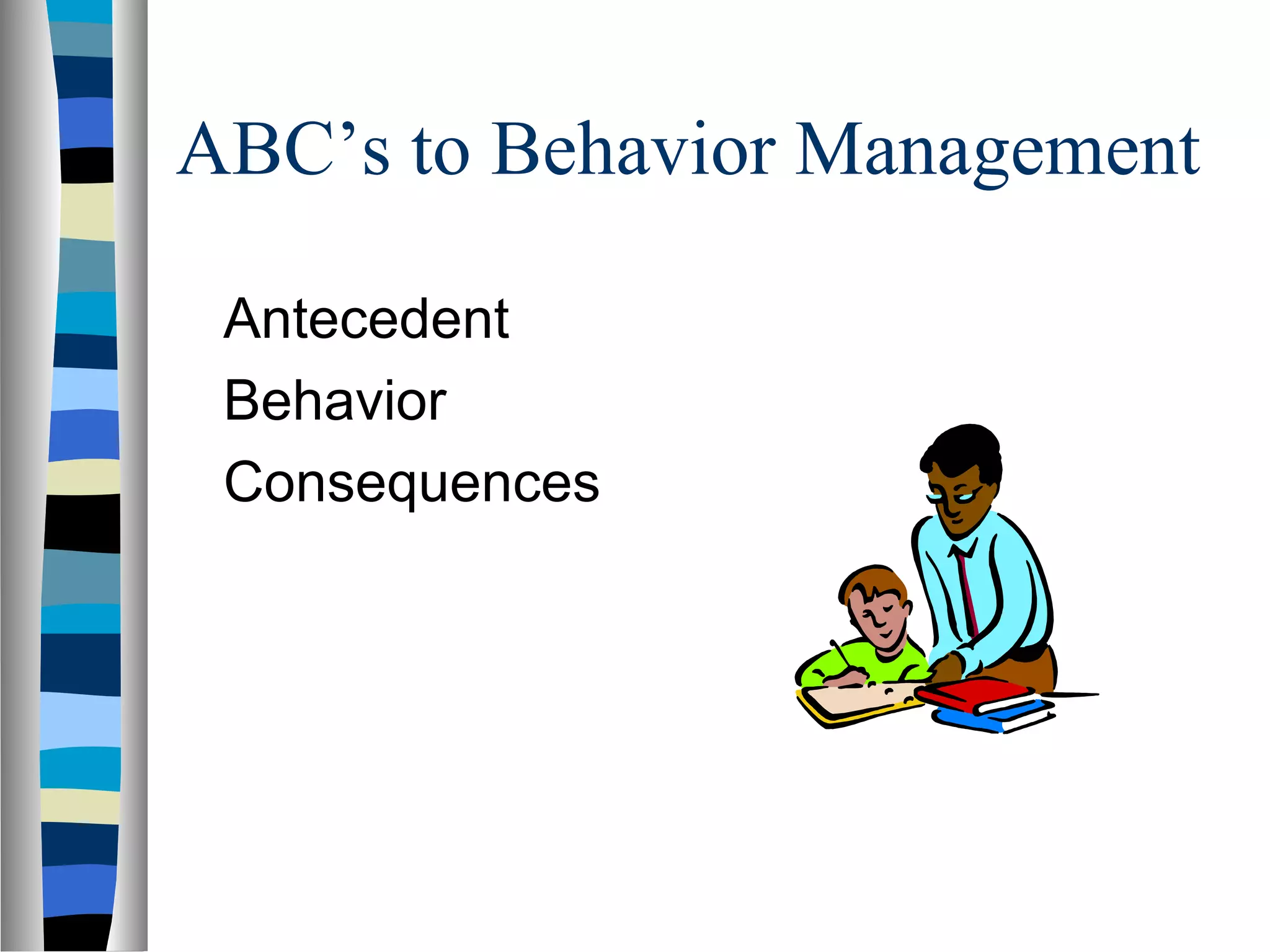
ABC’s to Behavior Management
Antecedent
Behavior
Consequences
Defining Behavior
Describe behavior objectively and
precisely (not: “he irritates me”)
Can you observe the behavior when it
begins and when it stops
– can you count the number of occurrences
each day
– can you measure the duration of the
behavior
Can you observe what happens just
before and just after it occurs
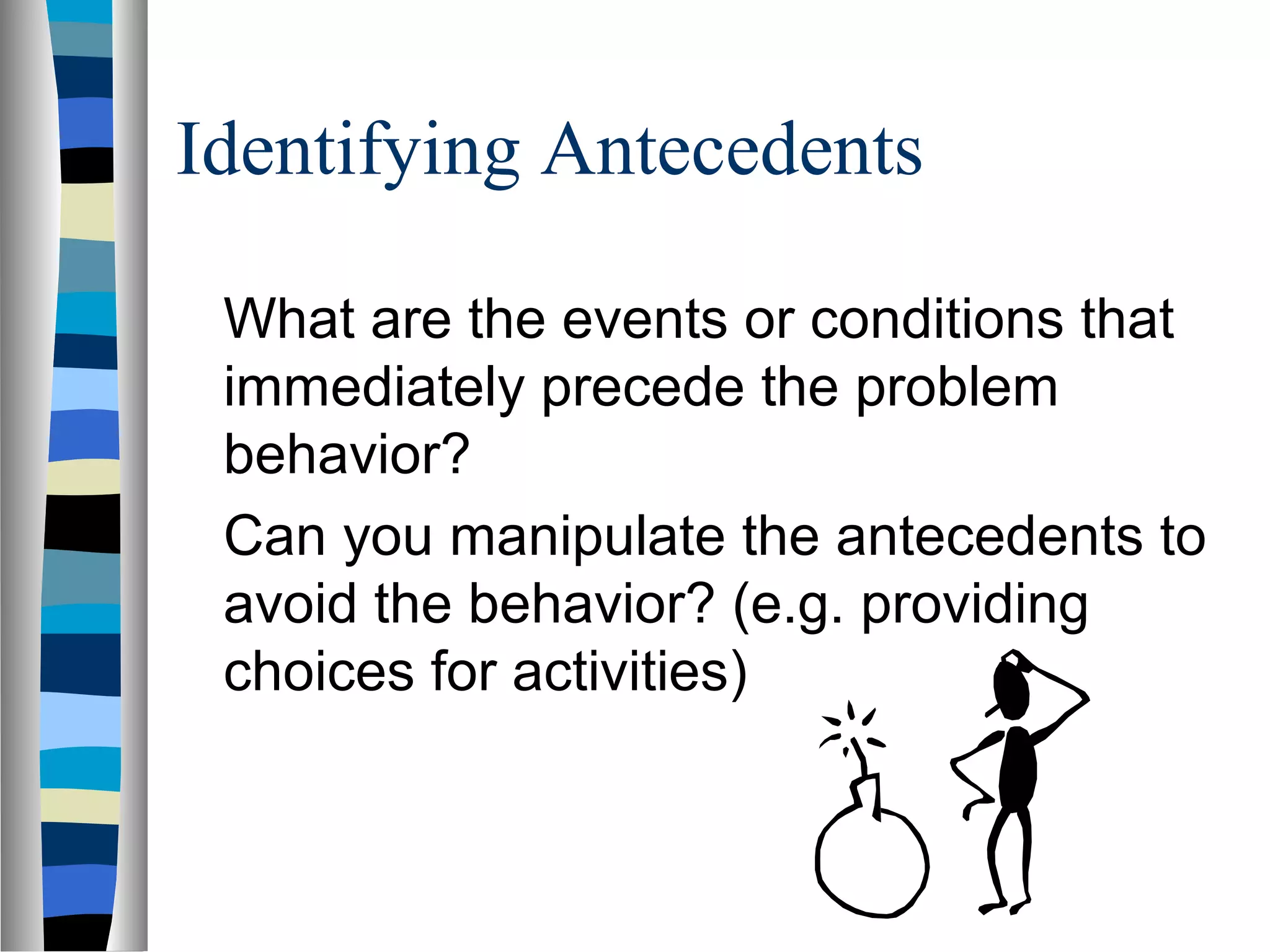
Identifying Antecedents
What are the events or conditions that
immediately precede the problem
behavior?
Can you manipulate the antecedents to
avoid the behavior? (e.g. providing
choices for activities)
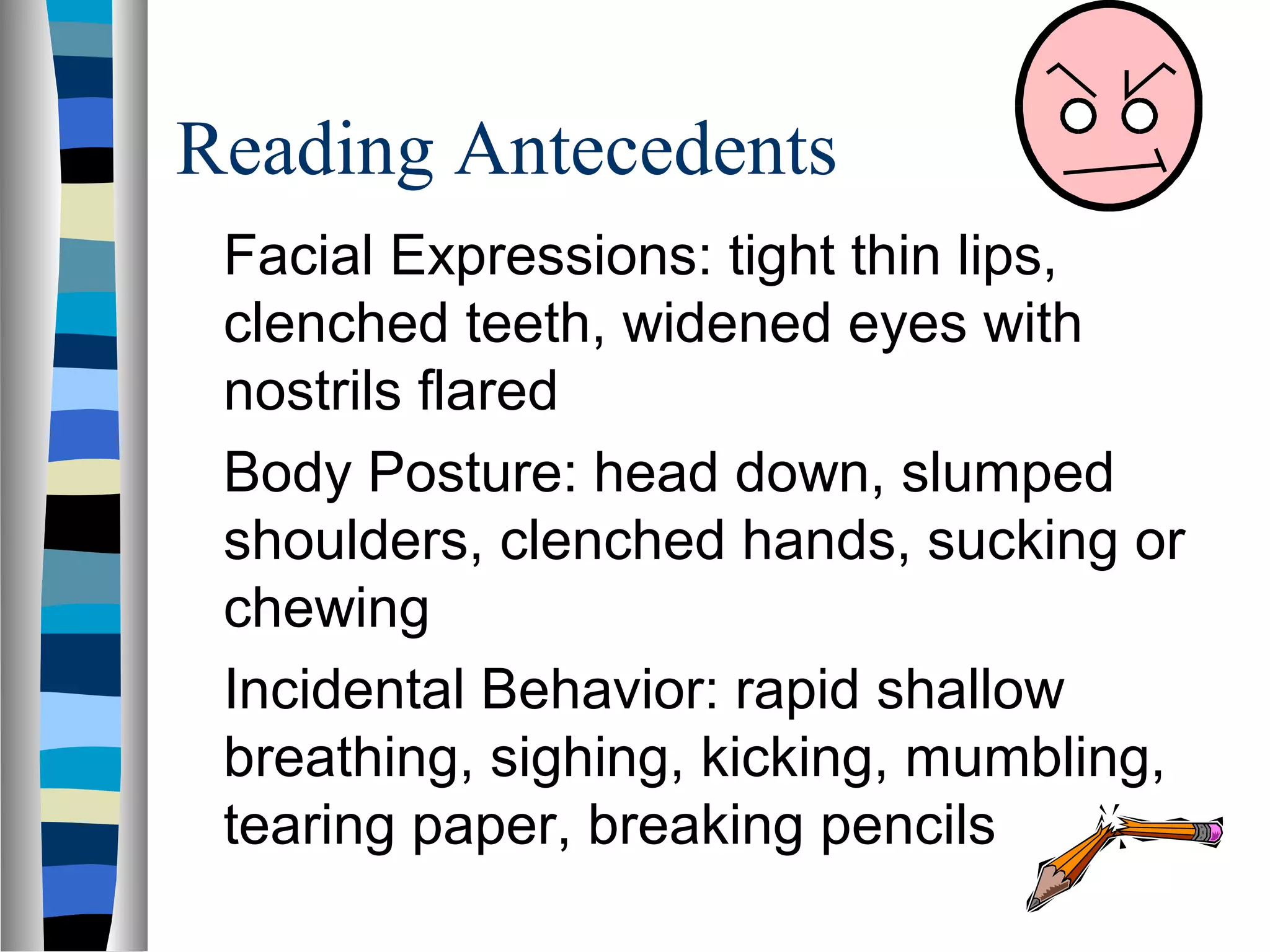
Reading Antecedents
Facial Expressions: tight thin lips,
clenched teeth, widened eyes with
nostrils flared
Body Posture: head down, slumped
shoulders, clenched hands, sucking or
chewing
Incidental Behavior: rapid shallow
breathing, sighing, kicking, mumbling,
tearing paper, breaking pencils
Identifying Consequences
What does the student “get” out of the
behavior?
Are students getting attention, avoiding
work, receiving stimulus, or enjoy
seeing adults upset?
Changing Behavior
Provide instruction with simple and
clear directions
Gain student’s full attention before
giving instructions
Provide one instruction at a time - do
not provide too many different
instructions
Monitor compliance - provide time limits
Provide appropriate consequences for
compliance
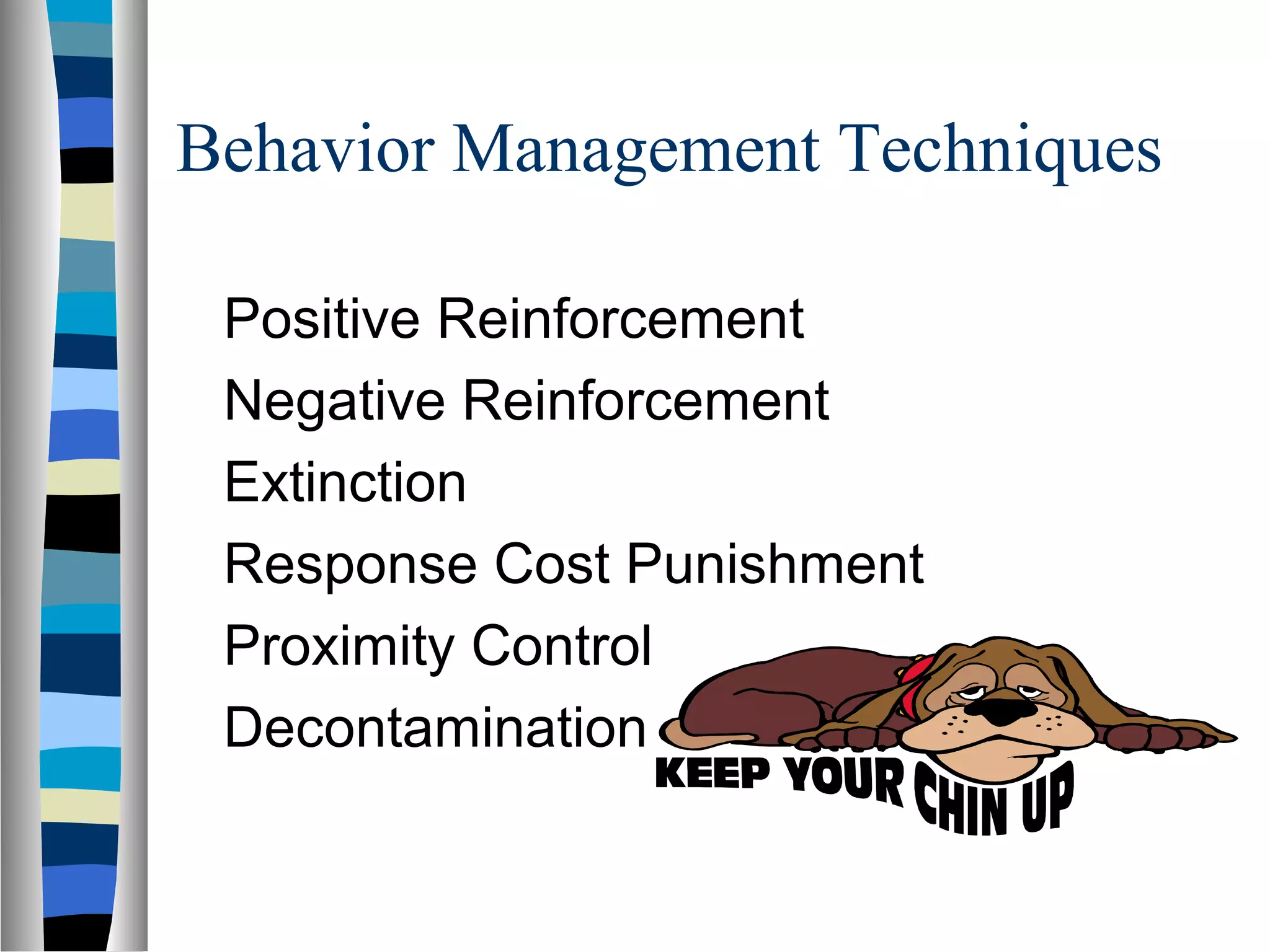
Behavior Management Techniques
Positive Reinforcement
Negative Reinforcement
Extinction
Response Cost Punishment
Proximity Control
Decontamination
Positive Reinforcement
The positive reinforcement must be
rewarding to the student
The reinforcers must be contingent on
the behavior you want to increase
The reinforcers should be delivered
immediately
Provide appropriate units of rewards for
the expected unit of behavior
Negative Reinforcement
Definition: reinforcing a behavior by
removing or preventing something
unpleasant - allows the individual to
escape or avoid a negative
consequence
Not recommended as a prominent part
of classroom management
– negative reinforcement relies on the presence or threat of negative
consequences
– deliberate negative reinforcement sets the stage for
coercion/intimidation
Extinction
To eliminate a behavior - you eliminate
its reinforcement, the behavior no
longer produces the desired effect
(positive or negative)
Disadvantages: slow process and when
extinction procedures are first
implemented, the behavior will likely
become worse before better
Response Cost
The behavior “costs” something by
withholding or withdrawing a positive
reinforcer contingent on a specific
misbehavior
Example: students receive 10 tokens at
the beginning of class, every time a
problem behavior occurs, the teacher
gets 1 token back. The tokens can be
exchanged at the end of the day or
class for free time.
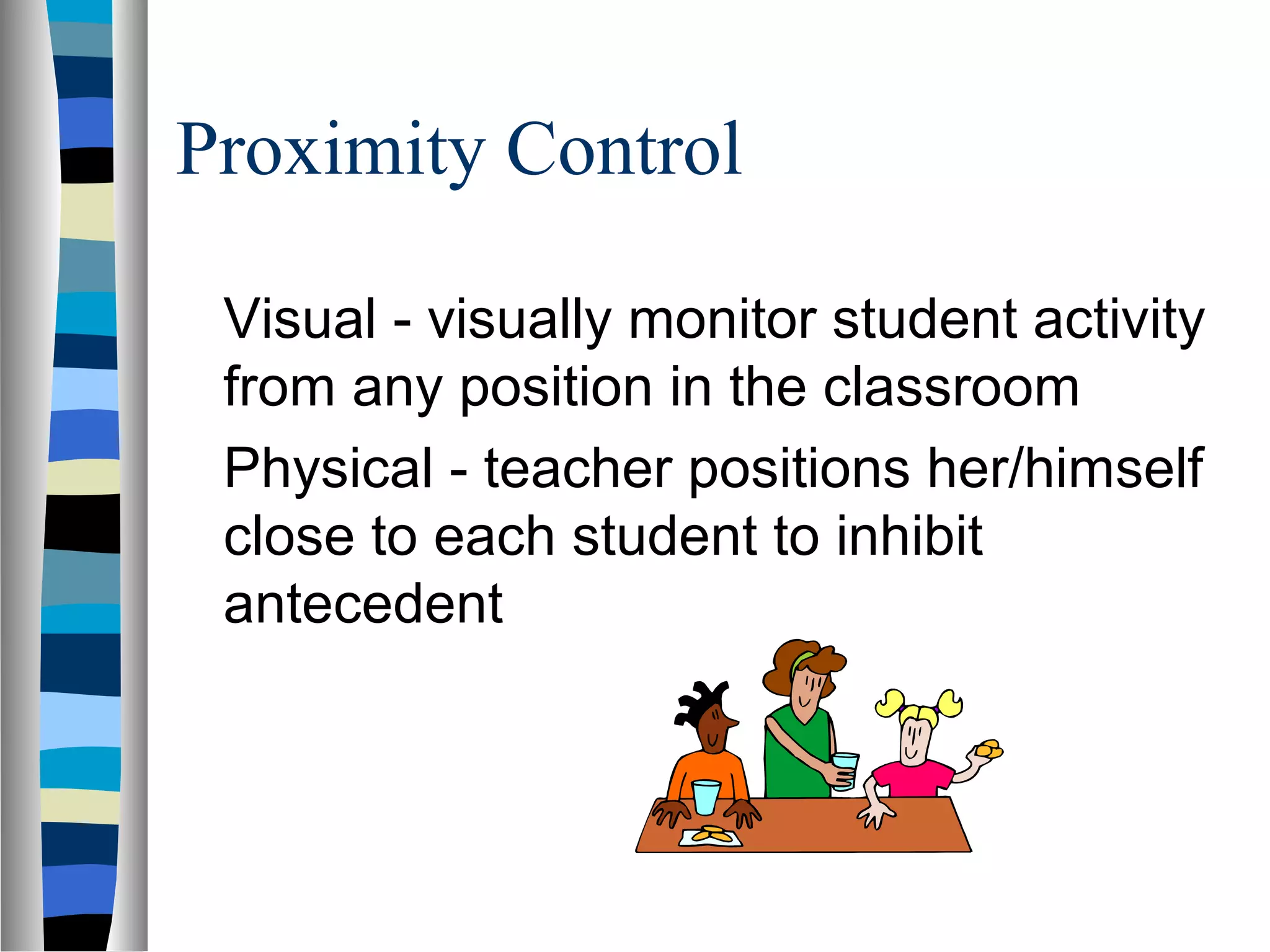
Proximity Control
Visual - visually monitor student activity
from any position in the classroom
Physical - teacher positions her/himself
close to each student to inhibit
antecedent
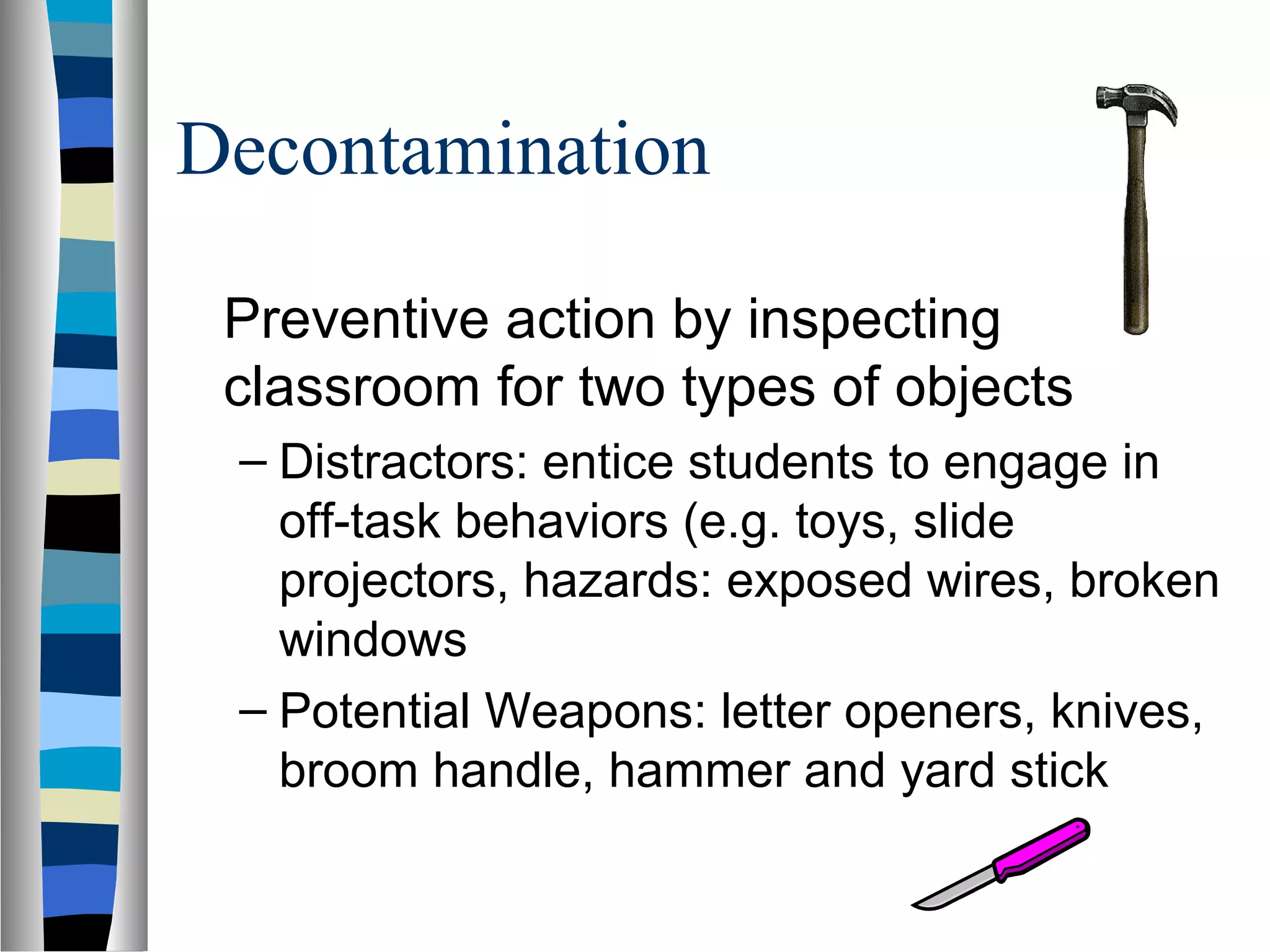
Decontamination
Preventive action by inspecting
classroom for two types of objects
– Distractors: entice students to engage in
off-task behaviors (e.g. toys, slide
projectors, hazards: exposed wires, broken
windows
– Potential Weapons: letter openers, knives,
broom handle, hammer and yard stick
Informal Interventions
Attention for compliance - verbal praise
– Use social praise consistently
– Provide praise only to students who earn it
Ignoring: only appropriate when:
– the target behavior is temporarily tolerable
– the target behavior is under the influence
of a reinforcer that you can control
Structured Interventions
Group Consequences
Individual Consequences
Individual Contracts
Self Management
Group Consequences
Provide a set of behavior rules or
expectations
Determine the interval of time for the
contingency - the longer the interval,
the more valuable the reward
Provide a menu of choices to avoid
satiation
Develop a record keeping system
Determine criterion for reinforcement
Individual Consequences
Surprise Tokens: reinforcers are
delivered at times that are not
predictable by students
Random Drawing: students place their
name on a piece of paper and place
into a jar when they comply to rules, at
the end of the day, conduct a drawing
for prizes
Individual Contracts
An agreement between the teacher and
the student about a desirable change in
behavior
Parts of the contract
– The parties to the contract
– The target behavior
– The goal for the target behavior
– The time period for the contract
– The reward available for meeting the terms
– The penalty for failing to honor the contract
Self Management
Behavioral Definition: help the student
choose a behavior to monitor
Teach the student to record behavior
– Event recording
– Permanent Product recording
Teach the student how to plot the data
Teach the student how to apply self-
reinforcement
Use contracts to provide structure
Identifying Coercive Interactions
Starts with an antecedent that is
aversive and the student tries to escape
or avoid the activity.
Two parties are trying to control each
other.
– How do these interactions start?
– At what point could I avoid the process by disengaging from
it?
– How could I start a different interaction that does not end in
a power struggle?
– How could I try to replace coercive interactions with ones
ending in positive consequences?
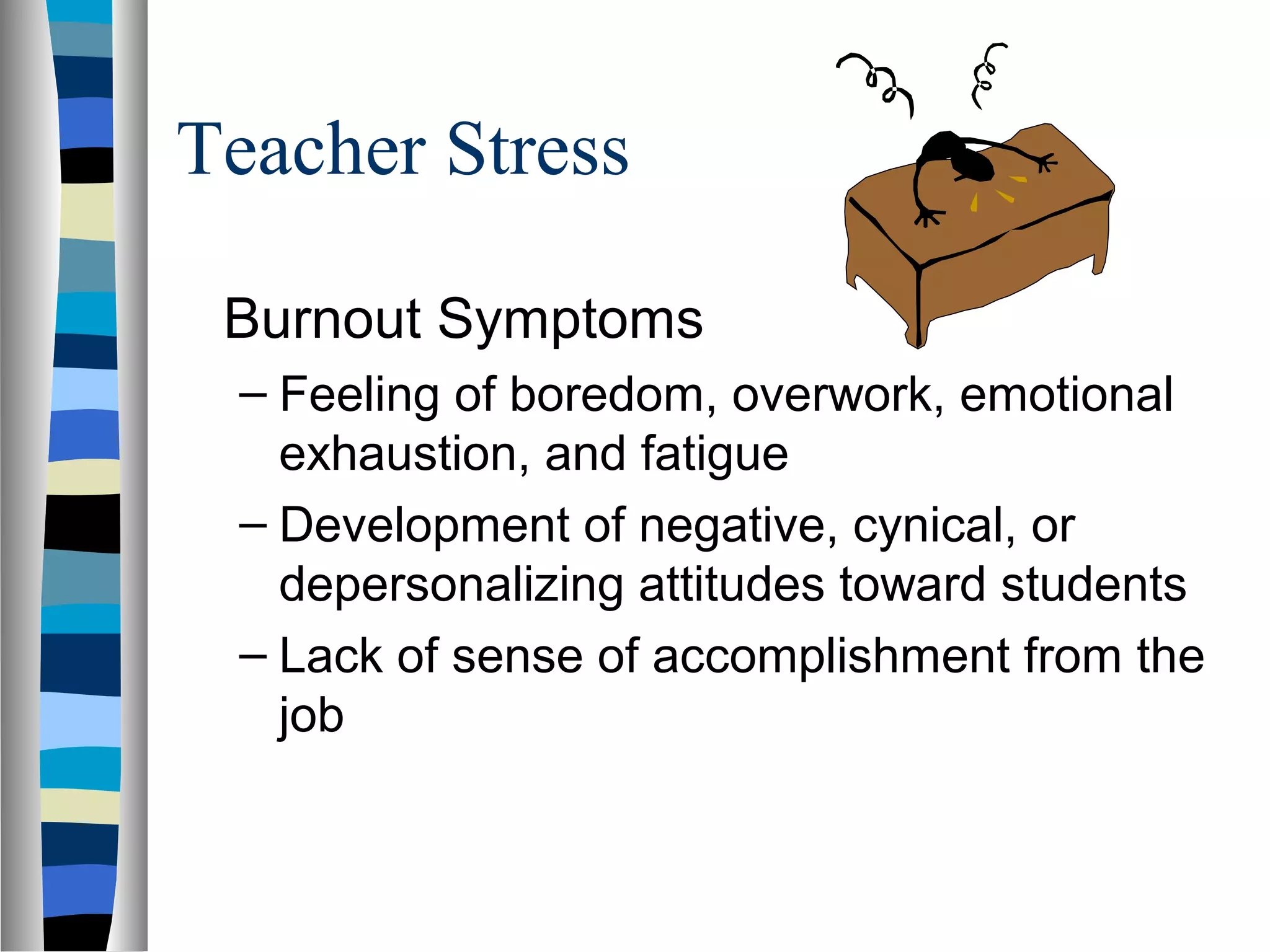
Teacher Stress
Burnout Symptoms
– Feeling of boredom, overwork, emotional
exhaustion, and fatigue
– Development of negative, cynical, or
depersonalizing attitudes toward students
– Lack of sense of accomplishment from the
job
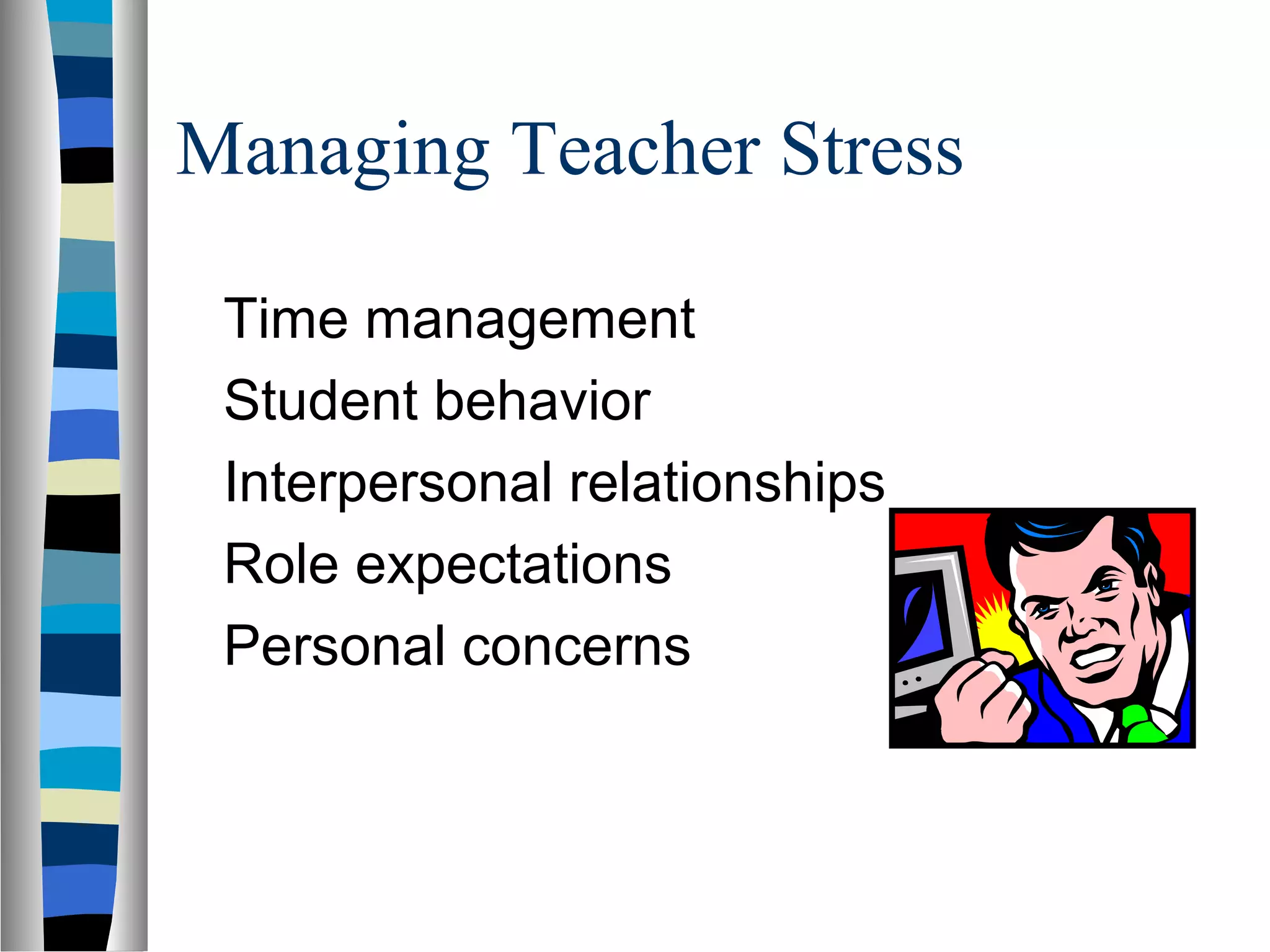
Managing Teacher Stress
Time management
Student behavior
Interpersonal relationships
Role expectations
Personal concerns
Poor Time Management
Uncontrolled rushing
Chronic vacillation between unpleasant
alternatives
Fatigue with many hours of
unproductive activity
Constantly missed deadlines
Insufficient time for rest and personal
relationships
Sense of being overwhelmed
Time Management Techniques
Self-Management
– Time analysis
– Goal setting
– Prioritization
– Delegation
– Action
Interpersonal Concerns
Poor staff relations
Insufficient opportunities for
professional growth
Administrative ineffectiveness
Lack of recognition
Role Expectations
Teachers often set expectations around
being liked, helpful, and in control
Role ambiguity: confusion of the scope
and specific responsibilities of the job
Role conflict: discrepancy between
teacher’s perception of the job and the
perceptions of significant others
Personal Solutions
Relaxation
Compartmentalized Thinking:
separation between work and personal
life
Detached Concern: do not dwell on
things over which you have no control
Personal Time
Cognitive Restructuring: focus on
strengths not weaknesses

Classroom management issues

  • 1.
  • 2.
    Teacher’s Reflection Could thisproblem be a result of inappropriate curriculum or teaching strategies? What do I demand and prohibit? Why do certain behaviors bother me? Is this behavior developmentally appropriate? Do I focus on a behavioral excess or a deficiency? Will resolution of the problem solve anything else? Kauffman, J. M. , Hallahan, D. P., Mostert, M.P., Trent, S.C., & Nuttycombe, D.G. (1993). Managing Classroom Behavior. Boston: Allyn & Bacon
  • 3.
    Good Teaching Instructional goalsare clear Knowledgeable of content and strategies for teaching it Student expectations are clearly described Provide practice that enrich and clarify content Teach metacognitive strategies
  • 4.
    Good Teaching Knowledgeable aboutstudent’s abilities, adapt instruction according to their needs Monitor student progress Provide feedback Accept responsibility for student outcomes Are thoughtful and reflective about their practice
  • 5.
    Teacher Behaviors Provide frequentpositive praise and reinforcement Ignore minor misbehaviors Reward positive behaviors Avoid power struggles with students Do students like being in the classroom? Students are achieving academic and social gain Provide clear expectations
  • 6.
    Teacher Behaviors Cont. Provideclear behavioral expectations - rules should state what students should do Teacher expectations should be high for all students Signal control:audible or body language to cue student Blocking: teacher moves between two students to interfere
  • 7.
    Selecting Rules Allow studentsto give input Base rules on acceptable behavior State rules positively Select 5 or 6 rules Select rules for academic and social behaviors Change rules when necessary Relate rules to EFL Syllabus goals Consider cultural differences
  • 8.
    ABC’s to BehaviorManagement Antecedent Behavior Consequences
  • 9.
    Defining Behavior Describe behaviorobjectively and precisely (not: “he irritates me”) Can you observe the behavior when it begins and when it stops – can you count the number of occurrences each day – can you measure the duration of the behavior Can you observe what happens just before and just after it occurs
  • 10.
    Identifying Antecedents What arethe events or conditions that immediately precede the problem behavior? Can you manipulate the antecedents to avoid the behavior? (e.g. providing choices for activities)
  • 11.
    Reading Antecedents Facial Expressions:tight thin lips, clenched teeth, widened eyes with nostrils flared Body Posture: head down, slumped shoulders, clenched hands, sucking or chewing Incidental Behavior: rapid shallow breathing, sighing, kicking, mumbling, tearing paper, breaking pencils
  • 12.
    Identifying Consequences What doesthe student “get” out of the behavior? Are students getting attention, avoiding work, receiving stimulus, or enjoy seeing adults upset?
  • 13.
    Changing Behavior Provide instructionwith simple and clear directions Gain student’s full attention before giving instructions Provide one instruction at a time - do not provide too many different instructions Monitor compliance - provide time limits Provide appropriate consequences for compliance
  • 14.
    Behavior Management Techniques PositiveReinforcement Negative Reinforcement Extinction Response Cost Punishment Proximity Control Decontamination
  • 15.
    Positive Reinforcement The positivereinforcement must be rewarding to the student The reinforcers must be contingent on the behavior you want to increase The reinforcers should be delivered immediately Provide appropriate units of rewards for the expected unit of behavior
  • 16.
    Negative Reinforcement Definition: reinforcinga behavior by removing or preventing something unpleasant - allows the individual to escape or avoid a negative consequence Not recommended as a prominent part of classroom management – negative reinforcement relies on the presence or threat of negative consequences – deliberate negative reinforcement sets the stage for coercion/intimidation
  • 17.
    Extinction To eliminate abehavior - you eliminate its reinforcement, the behavior no longer produces the desired effect (positive or negative) Disadvantages: slow process and when extinction procedures are first implemented, the behavior will likely become worse before better
  • 18.
    Response Cost The behavior“costs” something by withholding or withdrawing a positive reinforcer contingent on a specific misbehavior Example: students receive 10 tokens at the beginning of class, every time a problem behavior occurs, the teacher gets 1 token back. The tokens can be exchanged at the end of the day or class for free time.
  • 19.
    Proximity Control Visual -visually monitor student activity from any position in the classroom Physical - teacher positions her/himself close to each student to inhibit antecedent
  • 20.
    Decontamination Preventive action byinspecting classroom for two types of objects – Distractors: entice students to engage in off-task behaviors (e.g. toys, slide projectors, hazards: exposed wires, broken windows – Potential Weapons: letter openers, knives, broom handle, hammer and yard stick
  • 21.
    Informal Interventions Attention forcompliance - verbal praise – Use social praise consistently – Provide praise only to students who earn it Ignoring: only appropriate when: – the target behavior is temporarily tolerable – the target behavior is under the influence of a reinforcer that you can control
  • 22.
    Structured Interventions Group Consequences IndividualConsequences Individual Contracts Self Management
  • 23.
    Group Consequences Provide aset of behavior rules or expectations Determine the interval of time for the contingency - the longer the interval, the more valuable the reward Provide a menu of choices to avoid satiation Develop a record keeping system Determine criterion for reinforcement
  • 24.
    Individual Consequences Surprise Tokens:reinforcers are delivered at times that are not predictable by students Random Drawing: students place their name on a piece of paper and place into a jar when they comply to rules, at the end of the day, conduct a drawing for prizes
  • 25.
    Individual Contracts An agreementbetween the teacher and the student about a desirable change in behavior Parts of the contract – The parties to the contract – The target behavior – The goal for the target behavior – The time period for the contract – The reward available for meeting the terms – The penalty for failing to honor the contract
  • 26.
    Self Management Behavioral Definition:help the student choose a behavior to monitor Teach the student to record behavior – Event recording – Permanent Product recording Teach the student how to plot the data Teach the student how to apply self- reinforcement Use contracts to provide structure
  • 27.
    Identifying Coercive Interactions Startswith an antecedent that is aversive and the student tries to escape or avoid the activity. Two parties are trying to control each other. – How do these interactions start? – At what point could I avoid the process by disengaging from it? – How could I start a different interaction that does not end in a power struggle? – How could I try to replace coercive interactions with ones ending in positive consequences?
  • 28.
    Teacher Stress Burnout Symptoms –Feeling of boredom, overwork, emotional exhaustion, and fatigue – Development of negative, cynical, or depersonalizing attitudes toward students – Lack of sense of accomplishment from the job
  • 29.
    Managing Teacher Stress Timemanagement Student behavior Interpersonal relationships Role expectations Personal concerns
  • 30.
    Poor Time Management Uncontrolledrushing Chronic vacillation between unpleasant alternatives Fatigue with many hours of unproductive activity Constantly missed deadlines Insufficient time for rest and personal relationships Sense of being overwhelmed
  • 31.
    Time Management Techniques Self-Management –Time analysis – Goal setting – Prioritization – Delegation – Action
  • 32.
    Interpersonal Concerns Poor staffrelations Insufficient opportunities for professional growth Administrative ineffectiveness Lack of recognition
  • 33.
    Role Expectations Teachers oftenset expectations around being liked, helpful, and in control Role ambiguity: confusion of the scope and specific responsibilities of the job Role conflict: discrepancy between teacher’s perception of the job and the perceptions of significant others
  • 34.
    Personal Solutions Relaxation Compartmentalized Thinking: separationbetween work and personal life Detached Concern: do not dwell on things over which you have no control Personal Time Cognitive Restructuring: focus on strengths not weaknesses