Jornada Escolar Completa
Dirección de Educación Secundaria
CLASSROOM MANAGEMENT
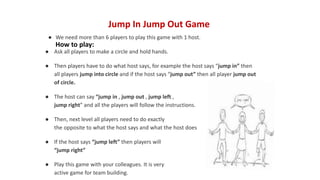
Jump In Jump Out Game
● We need more than 6 players to play this game with 1 host.
● Ask all players to make a circle and hold hands.
● Then players have to do what host says, for example the host says “jump in” then
all players jump into circle and if the host says “jump out” then all player jump out
of circle.
● The host can say “jump in , jump out , jump left ,
jump right” and all the players will follow the instructions.
● Then, next level all players need to do exactly
the opposite to what the host says and what the host does
● If the host says “jump left” then players will
“jump right”
● Play this game with your colleagues. It is very
active game for team building.
How to play:
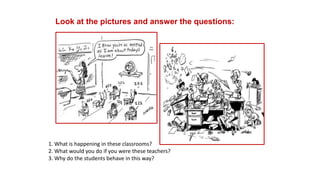
Look at the pictures and answer the questions:
1. What is happening in these classrooms?
2. What would you do if you were these teachers?
3. Why do the students behave in this way?
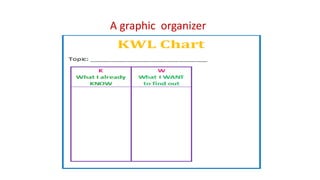
A graphic organizer
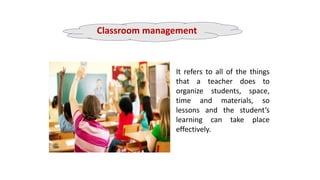
It refers to all of the things
that a teacher does to
organize students, space,
time and materials, so
lessons and the student’s
learning can take place
effectively.
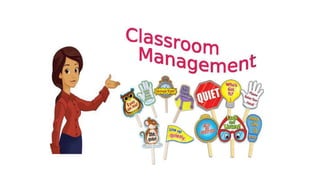
Classroom management
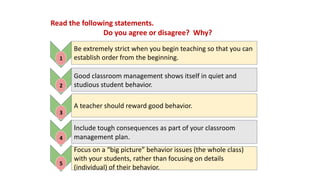
Read the following statements.
Do you agree or disagree? Why?
Be extremely strict when you begin teaching so that you can
establish order from the beginning.
Good classroom management shows itself in quiet and
studious student behavior.
A teacher should reward good behavior.
Include tough consequences as part of your classroom
management plan.
Focus on a “big picture” behavior issues (the whole class)
with your students, rather than focusing on details
(individual) of their behavior.
1
2
3
4
5
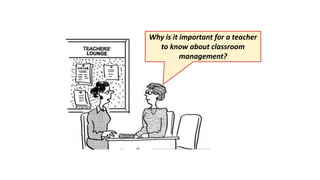
Why is it important for a teacher
to know about classroom
management?
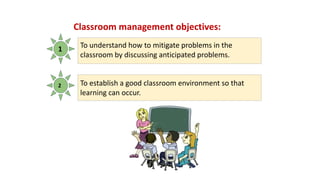
Classroom management objectives:
1
2
To understand how to mitigate problems in the
classroom by discussing anticipated problems.
To establish a good classroom environment so that
learning can occur.
Characteristics of an effective classroom
management
1 Students are deeply involved in their work.
2
Students know what is expected of them and are
generally successful.
There is relatively little wasted time, confusion and
disruption.
3
4
The climate of the classroom is work oriented, but
relaxed and pleasant.
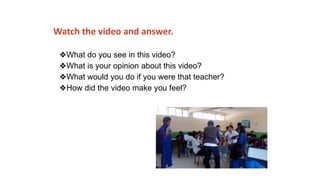
Watch the video and answer.
❖What do you see in this video?
❖What is your opinion about this video?
❖What would you do if you were that teacher?
❖How did the video make you feel?
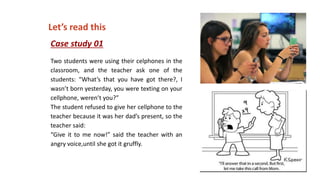
Case study 01
Two students were using their celphones in the
classroom, and the teacher ask one of the
students: “What’s that you have got there?, I
wasn’t born yesterday, you were texting on your
cellphone, weren’t you?”
The student refused to give her cellphone to the
teacher because it was her dad’s present, so the
teacher said:
“Give it to me now!” said the teacher with an
angry voice,until she got it gruffly.
Let’s read this
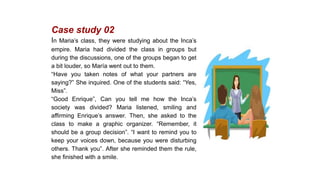
Case study 02
In Maria’s class, they were studying about the Inca’s
empire. Maria had divided the class in groups but
during the discussions, one of the groups began to get
a bit louder, so María went out to them.
“Have you taken notes of what your partners are
saying?” She inquired. One of the students said: “Yes,
Miss”.
“Good Enrique”, Can you tell me how the Inca’s
society was divided? Maria listened, smiling and
affirming Enrique’s answer. Then, she asked to the
class to make a graphic organizer. “Remember, it
should be a group decision”. “I want to remind you to
keep your voices down, because you were disturbing
others. Thank you”. After she reminded them the rule,
she finished with a smile.
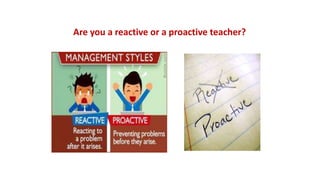
Are you a reactive or a proactive teacher?
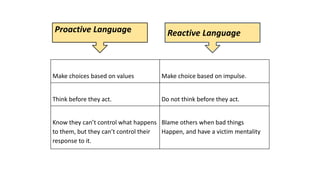
Make choices based on values Make choice based on impulse.
Think before they act. Do not think before they act.
Know they can’t control what happens
to them, but they can’t control their
response to it.
Blame others when bad things
Happen, and have a victim mentality
Proactive Language Reactive Language
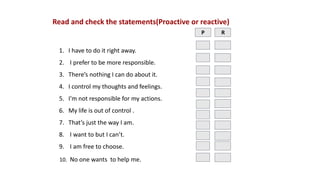
1. I have to do it right away.
2. I prefer to be more responsible.
3. There’s nothing I can do about it.
4. I control my thoughts and feelings.
5. I’m not responsible for my actions.
6. My life is out of control .
7. That’s just the way I am.
8. I want to but I can’t.
9. I am free to choose.
10. No one wants to help me.
Read and check the statements(Proactive or reactive)
P R
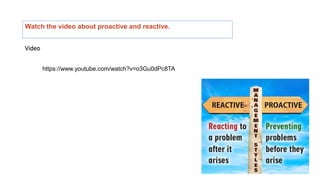
Watch the video about proactive and reactive.
Video
https://www.youtube.com/watch?v=o3Gu0dPc8TA
Which aspects help
you to create a
positive learning
environment?
CLASSROOM MANAGEMENT
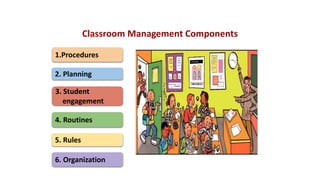
Classroom Management Components
1.Procedures
2. Planning
3. Student
engagement
4. Routines
5. Rules
6. Organization
a method or process for how things
should be done in a classroom.
Procedures
It allows many different activities to
take place efficiently during the
classroom.
What is it?
Why to use it?
It increases on task time and greatly
reduces classroom disruption.
Students learn how things operate in
the classroom.
Component 2: Planning
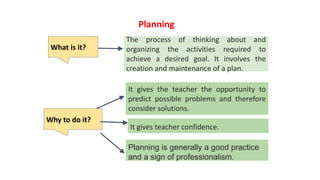
Planning is generally a good practice
and a sign of professionalism.
Planning
The process of thinking about and
organizing the activities required to
achieve a desired goal. It involves the
creation and maintenance of a plan.
What is it?
Why to do it?
It gives the teacher the opportunity to
predict possible problems and therefore
consider solutions.
It gives teacher confidence.
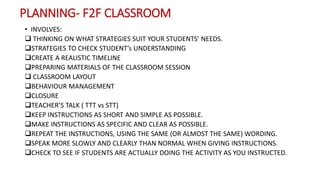
PLANNING- F2F CLASSROOM
• INVOLVES:
 THINKING ON WHAT STRATEGIES SUIT YOUR STUDENTS’ NEEDS.
STRATEGIES TO CHECK STUDENT’s UNDERSTANDING
CREATE A REALISTIC TIMELINE
PREPARING MATERIALS OF THE CLASSROOM SESSION
 CLASSROOM LAYOUT
BEHAVIOUR MANAGEMENT
CLOSURE
TEACHER’S TALK ( TTT vs STT)
KEEP INSTRUCTIONS AS SHORT AND SIMPLE AS POSSIBLE.
MAKE INSTRUCTIONS AS SPECIFIC AND CLEAR AS POSSIBLE.
REPEAT THE INSTRUCTIONS, USING THE SAME (OR ALMOST THE SAME) WORDING.
SPEAK MORE SLOWLY AND CLEARLY THAN NORMAL WHEN GIVING INSTRUCTIONS.
CHECK TO SEE IF STUDENTS ARE ACTUALLY DOING THE ACTIVITY AS YOU INSTRUCTED.
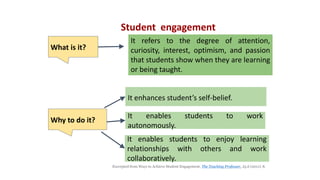
Component 3: Student engagement/ Motivation
It refers to the degree of attention,
curiosity, interest, optimism, and passion
that students show when they are learning
or being taught.
Student engagement
It enhances student’s self-belief.
Excerpted from Ways to Achieve Student Engagement. The Teaching Professor, 25.6 (2011): 8.
What is it?
It enables students to work
autonomously.
It enables students to enjoy learning
relationships with others and work
collaboratively.
Why to do it?
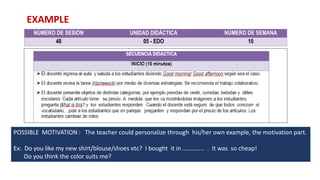
EXAMPLE
POSSIBLE MOTIVATION : The teacher could personalize through his/her own example, the motivation part.
Ex: Do you like my new shirt/blouse/shoes etc? I bought it in ………….. . It was so cheap!
Do you think the color suits me?
NÚMERO DE SESIÓN UNIDAD DIDÁCTICA NÚMERO DE SEMANA
48 05 - EDO 10
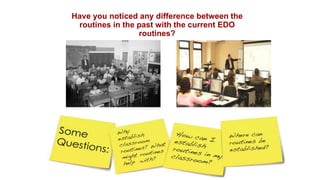
Have you noticed any difference between the
routines in the past with the current EDO
routines?
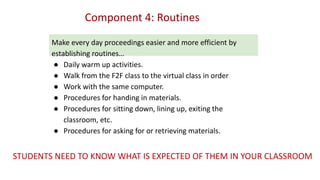
Component 4: Routines
Make every day proceedings easier and more efficient by
establishing routines…
● Daily warm up activities.
● Walk from the F2F class to the virtual class in order
● Work with the same computer.
● Procedures for handing in materials.
● Procedures for sitting down, lining up, exiting the
classroom, etc.
● Procedures for asking for or retrieving materials.
STUDENTS NEED TO KNOW WHAT IS EXPECTED OF THEM IN YOUR CLASSROOM
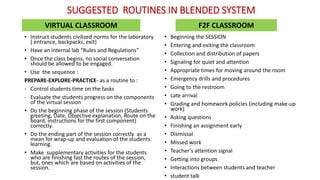
SUGGESTED ROUTINES IN BLENDED SYSTEM
• Instruct students civilized norms for the laboratory
( entrance, backpacks, exit)
• Have an internal lab “Rules and Regulations”
• Once the class begins, no social conversation
should be allowed to be engaged.
• Use the sequence :
PREPARE-EXPLORE-PRACTICE- as a routine to :
- Control students time on the tasks
- Evaluate the students progress on the components
of the virtual session
• Do the beginning phase of the session (Students
greeting, Date, Objective explanation, Route on the
board, instructions for the first component)
correctly.
• Do the ending part of the session correctly as a
mean for wrap-up and evaluation of the students
learning.
• Make supplementary activities for the students
who are finishing fast the routes of the session,
but, ones which are based on activities of the
session.
• Beginning the SESSION
• Entering and exiting the classroom
• Collection and distribution of papers
• Signaling for quiet and attention
• Appropriate times for moving around the room
• Emergency drills and procedures
• Going to the restroom
• Late arrival
• Grading and homework policies (including make-up
work)
• Asking questions
• Finishing an assignment early
• Dismissal
• Missed work
• Teacher’s attention signal
• Getting into groups
• Interactions between students and teacher
• student talk
VIRTUAL CLASSROOM F2F CLASSROOM
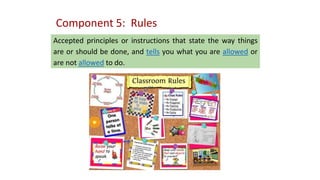
Component 5: Rules
Accepted principles or instructions that state the way things
are or should be done, and tells you what you are allowed or
are not allowed to do.
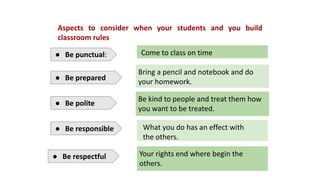
Aspects to consider when your students and you build
classroom rules
Come to class on time
Bring a pencil and notebook and do
your homework.
Be kind to people and treat them how
you want to be treated.
What you do has an effect with
the others.
Your rights end where begin the
others.
● Be punctual:
● Be prepared
● Be polite
● Be responsible
● Be respectful
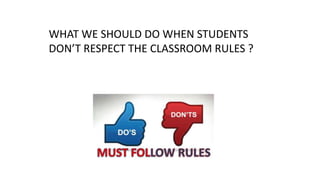
WHAT WE SHOULD DO WHEN STUDENTS
DON’T RESPECT THE CLASSROOM RULES ?
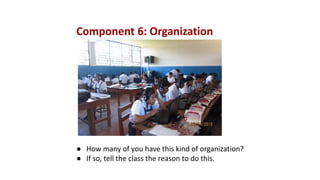
Component 6: Organization
● How many of you have this kind of organization?
● If so, tell the class the reason to do this.
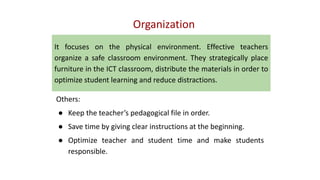
Organization
Others:
● Keep the teacher’s pedagogical file in order.
● Save time by giving clear instructions at the beginning.
● Optimize teacher and student time and make students
responsible.
It focuses on the physical environment. Effective teachers
organize a safe classroom environment. They strategically place
furniture in the ICT classroom, distribute the materials in order to
optimize student learning and reduce distractions.
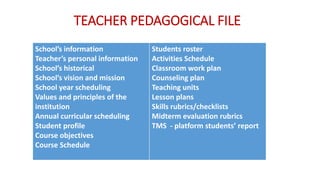
TEACHER PEDAGOGICAL FILE
School’s information
Teacher’s personal information
School’s historical
School’s vision and mission
School year scheduling
Values and principles of the
institution
Annual curricular scheduling
Student profile
Course objectives
Course Schedule
Students roster
Activities Schedule
Classroom work plan
Counseling plan
Teaching units
Lesson plans
Skills rubrics/checklists
Midterm evaluation rubrics
TMS - platform students’ report
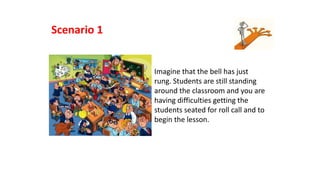
Imagine that the bell has just
rung. Students are still standing
around the classroom and you are
having difficulties getting the
students seated for roll call and to
begin the lesson.
Scenario 1
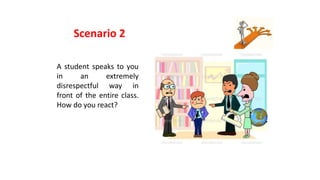
Scenario 2
A student speaks to you
in an extremely
disrespectful way in
front of the entire class.
How do you react?
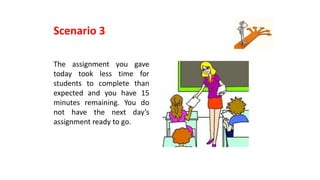
The assignment you gave
today took less time for
students to complete than
expected and you have 15
minutes remaining. You do
not have the next day’s
assignment ready to go.
Scenario 3
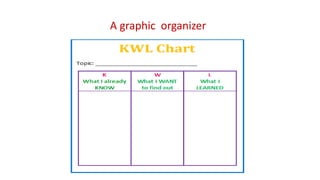
A graphic organizer
Ppt final   2 parte modal classes

Ppt final 2 parte modal classes

  • 1.
    Jornada Escolar Completa Direcciónde Educación Secundaria CLASSROOM MANAGEMENT
  • 2.
    Jump In JumpOut Game ● We need more than 6 players to play this game with 1 host. ● Ask all players to make a circle and hold hands. ● Then players have to do what host says, for example the host says “jump in” then all players jump into circle and if the host says “jump out” then all player jump out of circle. ● The host can say “jump in , jump out , jump left , jump right” and all the players will follow the instructions. ● Then, next level all players need to do exactly the opposite to what the host says and what the host does ● If the host says “jump left” then players will “jump right” ● Play this game with your colleagues. It is very active game for team building. How to play:
  • 3.
    Look at thepictures and answer the questions: 1. What is happening in these classrooms? 2. What would you do if you were these teachers? 3. Why do the students behave in this way?
  • 5.
  • 6.
    It refers toall of the things that a teacher does to organize students, space, time and materials, so lessons and the student’s learning can take place effectively. Classroom management
  • 7.
    Read the followingstatements. Do you agree or disagree? Why? Be extremely strict when you begin teaching so that you can establish order from the beginning. Good classroom management shows itself in quiet and studious student behavior. A teacher should reward good behavior. Include tough consequences as part of your classroom management plan. Focus on a “big picture” behavior issues (the whole class) with your students, rather than focusing on details (individual) of their behavior. 1 2 3 4 5
  • 8.
    Why is itimportant for a teacher to know about classroom management?
  • 9.
    Classroom management objectives: 1 2 Tounderstand how to mitigate problems in the classroom by discussing anticipated problems. To establish a good classroom environment so that learning can occur.
  • 10.
    Characteristics of aneffective classroom management 1 Students are deeply involved in their work. 2 Students know what is expected of them and are generally successful. There is relatively little wasted time, confusion and disruption. 3 4 The climate of the classroom is work oriented, but relaxed and pleasant.
  • 11.
    Watch the videoand answer. ❖What do you see in this video? ❖What is your opinion about this video? ❖What would you do if you were that teacher? ❖How did the video make you feel?
  • 12.
    Case study 01 Twostudents were using their celphones in the classroom, and the teacher ask one of the students: “What’s that you have got there?, I wasn’t born yesterday, you were texting on your cellphone, weren’t you?” The student refused to give her cellphone to the teacher because it was her dad’s present, so the teacher said: “Give it to me now!” said the teacher with an angry voice,until she got it gruffly. Let’s read this
  • 13.
    Case study 02 InMaria’s class, they were studying about the Inca’s empire. Maria had divided the class in groups but during the discussions, one of the groups began to get a bit louder, so María went out to them. “Have you taken notes of what your partners are saying?” She inquired. One of the students said: “Yes, Miss”. “Good Enrique”, Can you tell me how the Inca’s society was divided? Maria listened, smiling and affirming Enrique’s answer. Then, she asked to the class to make a graphic organizer. “Remember, it should be a group decision”. “I want to remind you to keep your voices down, because you were disturbing others. Thank you”. After she reminded them the rule, she finished with a smile.
  • 14.
    Are you areactive or a proactive teacher?
  • 15.
    Make choices basedon values Make choice based on impulse. Think before they act. Do not think before they act. Know they can’t control what happens to them, but they can’t control their response to it. Blame others when bad things Happen, and have a victim mentality Proactive Language Reactive Language
  • 16.
    1. I haveto do it right away. 2. I prefer to be more responsible. 3. There’s nothing I can do about it. 4. I control my thoughts and feelings. 5. I’m not responsible for my actions. 6. My life is out of control . 7. That’s just the way I am. 8. I want to but I can’t. 9. I am free to choose. 10. No one wants to help me. Read and check the statements(Proactive or reactive) P R
  • 17.
    Watch the videoabout proactive and reactive. Video https://www.youtube.com/watch?v=o3Gu0dPc8TA
  • 18.
    Which aspects help youto create a positive learning environment? CLASSROOM MANAGEMENT
  • 19.
    Classroom Management Components 1.Procedures 2.Planning 3. Student engagement 4. Routines 5. Rules 6. Organization
  • 20.
    a method orprocess for how things should be done in a classroom. Procedures It allows many different activities to take place efficiently during the classroom. What is it? Why to use it? It increases on task time and greatly reduces classroom disruption. Students learn how things operate in the classroom.
  • 21.
  • 22.
    Planning is generallya good practice and a sign of professionalism. Planning The process of thinking about and organizing the activities required to achieve a desired goal. It involves the creation and maintenance of a plan. What is it? Why to do it? It gives the teacher the opportunity to predict possible problems and therefore consider solutions. It gives teacher confidence.
  • 23.
    PLANNING- F2F CLASSROOM •INVOLVES:  THINKING ON WHAT STRATEGIES SUIT YOUR STUDENTS’ NEEDS. STRATEGIES TO CHECK STUDENT’s UNDERSTANDING CREATE A REALISTIC TIMELINE PREPARING MATERIALS OF THE CLASSROOM SESSION  CLASSROOM LAYOUT BEHAVIOUR MANAGEMENT CLOSURE TEACHER’S TALK ( TTT vs STT) KEEP INSTRUCTIONS AS SHORT AND SIMPLE AS POSSIBLE. MAKE INSTRUCTIONS AS SPECIFIC AND CLEAR AS POSSIBLE. REPEAT THE INSTRUCTIONS, USING THE SAME (OR ALMOST THE SAME) WORDING. SPEAK MORE SLOWLY AND CLEARLY THAN NORMAL WHEN GIVING INSTRUCTIONS. CHECK TO SEE IF STUDENTS ARE ACTUALLY DOING THE ACTIVITY AS YOU INSTRUCTED.
  • 24.
    Component 3: Studentengagement/ Motivation
  • 25.
    It refers tothe degree of attention, curiosity, interest, optimism, and passion that students show when they are learning or being taught. Student engagement It enhances student’s self-belief. Excerpted from Ways to Achieve Student Engagement. The Teaching Professor, 25.6 (2011): 8. What is it? It enables students to work autonomously. It enables students to enjoy learning relationships with others and work collaboratively. Why to do it?
  • 26.
    EXAMPLE POSSIBLE MOTIVATION :The teacher could personalize through his/her own example, the motivation part. Ex: Do you like my new shirt/blouse/shoes etc? I bought it in ………….. . It was so cheap! Do you think the color suits me? NÚMERO DE SESIÓN UNIDAD DIDÁCTICA NÚMERO DE SEMANA 48 05 - EDO 10
  • 27.
    Have you noticedany difference between the routines in the past with the current EDO routines?
  • 28.
    Component 4: Routines Makeevery day proceedings easier and more efficient by establishing routines… ● Daily warm up activities. ● Walk from the F2F class to the virtual class in order ● Work with the same computer. ● Procedures for handing in materials. ● Procedures for sitting down, lining up, exiting the classroom, etc. ● Procedures for asking for or retrieving materials. STUDENTS NEED TO KNOW WHAT IS EXPECTED OF THEM IN YOUR CLASSROOM
  • 29.
    SUGGESTED ROUTINES INBLENDED SYSTEM • Instruct students civilized norms for the laboratory ( entrance, backpacks, exit) • Have an internal lab “Rules and Regulations” • Once the class begins, no social conversation should be allowed to be engaged. • Use the sequence : PREPARE-EXPLORE-PRACTICE- as a routine to : - Control students time on the tasks - Evaluate the students progress on the components of the virtual session • Do the beginning phase of the session (Students greeting, Date, Objective explanation, Route on the board, instructions for the first component) correctly. • Do the ending part of the session correctly as a mean for wrap-up and evaluation of the students learning. • Make supplementary activities for the students who are finishing fast the routes of the session, but, ones which are based on activities of the session. • Beginning the SESSION • Entering and exiting the classroom • Collection and distribution of papers • Signaling for quiet and attention • Appropriate times for moving around the room • Emergency drills and procedures • Going to the restroom • Late arrival • Grading and homework policies (including make-up work) • Asking questions • Finishing an assignment early • Dismissal • Missed work • Teacher’s attention signal • Getting into groups • Interactions between students and teacher • student talk VIRTUAL CLASSROOM F2F CLASSROOM
  • 30.
    Component 5: Rules Acceptedprinciples or instructions that state the way things are or should be done, and tells you what you are allowed or are not allowed to do.
  • 31.
    Aspects to considerwhen your students and you build classroom rules Come to class on time Bring a pencil and notebook and do your homework. Be kind to people and treat them how you want to be treated. What you do has an effect with the others. Your rights end where begin the others. ● Be punctual: ● Be prepared ● Be polite ● Be responsible ● Be respectful
  • 32.
    WHAT WE SHOULDDO WHEN STUDENTS DON’T RESPECT THE CLASSROOM RULES ?
  • 33.
    Component 6: Organization ●How many of you have this kind of organization? ● If so, tell the class the reason to do this.
  • 34.
    Organization Others: ● Keep theteacher’s pedagogical file in order. ● Save time by giving clear instructions at the beginning. ● Optimize teacher and student time and make students responsible. It focuses on the physical environment. Effective teachers organize a safe classroom environment. They strategically place furniture in the ICT classroom, distribute the materials in order to optimize student learning and reduce distractions.
  • 35.
    TEACHER PEDAGOGICAL FILE School’sinformation Teacher’s personal information School’s historical School’s vision and mission School year scheduling Values and principles of the institution Annual curricular scheduling Student profile Course objectives Course Schedule Students roster Activities Schedule Classroom work plan Counseling plan Teaching units Lesson plans Skills rubrics/checklists Midterm evaluation rubrics TMS - platform students’ report
  • 36.
    Imagine that thebell has just rung. Students are still standing around the classroom and you are having difficulties getting the students seated for roll call and to begin the lesson. Scenario 1
  • 37.
    Scenario 2 A studentspeaks to you in an extremely disrespectful way in front of the entire class. How do you react?
  • 38.
    The assignment yougave today took less time for students to complete than expected and you have 15 minutes remaining. You do not have the next day’s assignment ready to go. Scenario 3
  • 39.