RAPID SEQUENCE
INDUCTION AND
INTUBATION`
By: Dr Nalluru Likhitha
Moderator : Dr Guru Charan
Asst Proff ,MD Anaesthesia
NRIIMS,Sanghivalasa
INTUBATION APPROACHES
2
PRESENTATION
TITLE
3
PRESENTATION
TITLE
EVOLUTION OF
RSII??
4
• 1946- Mendelson described aspiration syndrome in obstetrics.
• 1951 – strategies like positioning and neuromuscular block invented by Morton and
Wylie to avoid pulmonary aspiration.
• 1952- succinylcholine came into existence.
• 1959- snow and nunn reported that aspiration of gastric constents was most
common cause of death assosciated with anesthesia.
• 1961-use of cricoid pressure at induction of anesthesia by Sellick and Lond.
• 1971- Stept and Safar published the first complete description of ‘rapid
induction/intubation’.
5
PRESENTATION
TITLE
WHAT IS RAPID SEQUENCE
INDUCTION AND
INTUBATION??
6
RSII
• Rapid sequence induction and intubation (RSII) is a procedure that aims to
reduce the incidence of pulmonary aspiration during airway management.
7
PRESENTATION
TITLE
WHO ARE AT RISK OF
ASPIRATION ??
8
PRESENTATION
TITLE
RISK FACTORS
Increased risk of regurgitation Increased risk of aspiration
Obesity Positioning
Lithotomy and Trendelenburg
Incompetent lower oesophageal sphincter
Full stomach
Pregnancy
Impaired laryngeal reflexes
Reduced level of consciousness in coma and
anaesthesia
Neuromuscular weakness in inadequate
reversal and bulbar palsy
Delayed gastric emptying
Pain including labour
stress
Acute abdomen
Gastric outlet obstruction
9
WHEN TO PERFORM RSII
1 0
PRESENTATION
TITLE
INDICATION OF RSII
• A-Airway –loss of airway patency
• B-Breathing-inadequate ventilation , respiratory failure or hypoxia
• C-Circulation-improve oxygen delivery in hypovolemia
• D-Disability-neuroprotection particularly in traumatic brain injury , reduced
GCS,status epilepticus,post cardiac arrest protection
• E-Everything else – emergency surgery
1 1
PRESENTATION
TITLE
A B C D E
STEPS TO PERFORM IN RSII
1 2
PRESENTATION
TITLE
PROCESS OF RSI
• Preparation
• Pre-Oxygenation with 100% oxygen
• Pretreatment & Induction
• Paralysis + Cricoid pressure
• Placement of the tube
• Post intubation management & strategy of failed intubation
1 3
PREPARATION
1 4
PRESENTATION
TITLE
PREPARATION
The mnemonic for preparation are SOAP ME
• S- suction working
• O-oxygen (BVM attached to 15lit 02)
• A-Airway cart
• P-position
• M-Medications
• E- Monitoring equipment
1 5
PREOXYGENATION
1 6
PRESENTATION
TITLE
PREOXYGENATION
• It is an attempt to maximise oxygen stores in the body before a period of
pharmacologically induced apnea.
• These stores are within lungs as a part of FRC.
• Incresing oxygen content and volume of FRC can protect patients from
hypoxia during attempts at intubation.
1 7
PRESENTATION
TITLE
1 8
PRESENTATION
TITLE
TECHNIQUES OF
PREOXYEGNATION
PREOXYGENATION
Increased FiO2:
• Major evidences showed that 3-5min tidal ventilation or 8 vital capacity
breaths with 100% oxygen ensuring a tight mask fit and high gas flows
maximise denitrogenation.
1 9
PRESENTATION
TITLE
PREOXYGENATION
• Positive pressure :
• PEEP/CPAP has been showed to reduce absorption atelectasis,improve PaO2 and
increase time to desaturation
• If a patient is already on NIV continuing it for short period of time while setting for
intubation is better protection against desaturation than preoxygenation
• NIV in obese patients has been shown to improve oxygenation
2 0
PRESENTATION
TITLE
Weingart SD, Levitan RM. Preoxygenation and prevention
of desaturation during emergency airway management.
Ann Emerg Med. 2012;59(3):165-75.e1.
doi:10.1016/j.annemergmed.2011.10.002
PREOXYGENATION
Apnoeic oxygenation:
• As a result of O2 and CO2 solubility differences ,once patient is apnoeic more O2
leaves the alveoli and enters bloodstream creating a slight negative pressure and
increasing atelectasis .
• The negative pressure can be used as an advantage by maintaining a patent
airway and continuing administration of oxygen that reaches alveoli in a bulk flow
2 1
PRESENTATION
TITLE
PREOXYGENATION
Positioning:
Adopting head up position(20-25degree) increases FRC thereby improving
preoxygenation.
2 2
PRESENTATION
TITLE
PRETREATMENT
2 3
PRETREATMENT
Goals:
• Mitigate adverse physiologic reactions to intubation
– Sympathetic “pressor response” : Manipulation of airway, ↑ HR/BP,
– Bronchospasm
– Increased ICP
– Muscle Fasciculation
2 4
PRESENTATION
TITLE
2 5
PRESENTATION
TITLE
PARALYTIC AGENTS
2 6
PRESENTATION
TITLE
PARALYSIS/NMB AGENT
Ideal:
• Rapid onset of action to minimize risk of aspiration & hypoxia
• Rapid recovery to facilitate the return of ventilation if intubation fails
• Minimal haemodynamic & systemic effects
2 7
PRESENTATION
TITLE
PARALYTIC AGENTS
2 8
NMB AGENT
• A large meta analysis performed by the Cochrane Collabration reported
succinylcholine was superior to rocuronium in providing excellent and clinically
acceptable intubating conditions
• It has been traditionally used in RSI because of fast onset and offset , even in event
of failure to intubate or ventilate , recovery of spontaneous ventilation may rescue this
condition.
• The average recovery time is 8.5min .
2 9
PRESENTATION
TITLE
NMB AGENT
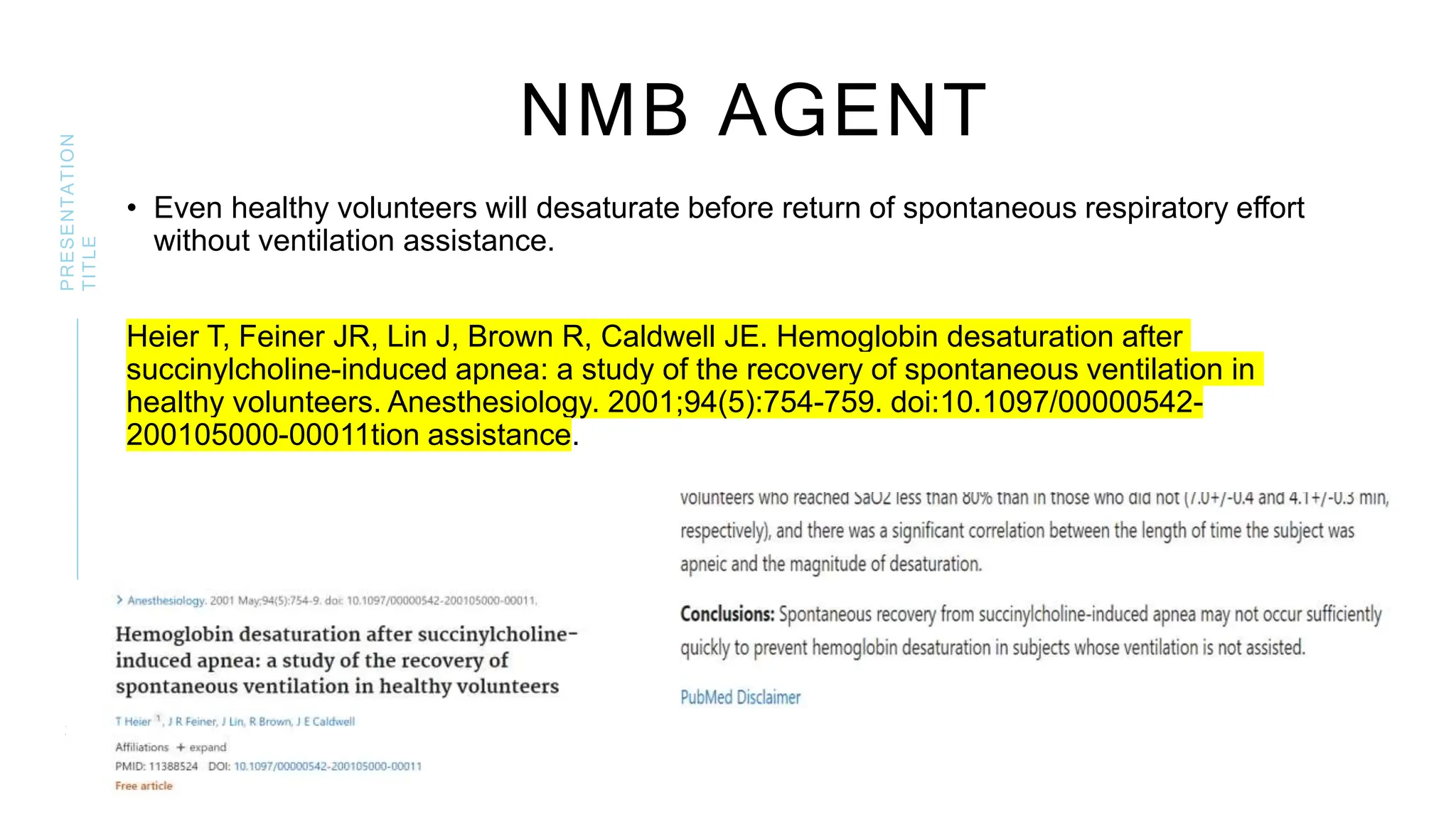
• Even healthy volunteers will desaturate before return of spontaneous respiratory effort
without ventilation assistance.
Heier T, Feiner JR, Lin J, Brown R, Caldwell JE. Hemoglobin desaturation after
succinylcholine-induced apnea: a study of the recovery of spontaneous ventilation in
healthy volunteers. Anesthesiology. 2001;94(5):754-759. doi:10.1097/00000542-
200105000-00011tion assistance.
3 0
PRESENTATION
TITLE
NMB AGENT
• Rocuronium followed by sugammadex results in a comparatively faster return to
spontaneous ventilation.
• However, it is unclear if this would be replicated in actual clinical practice.To facilitate
this, it is suggested that, when using rocuronium in an RSI, the rescue dose of
sugammadex 16 mg /kg should be pre-calculated and immediately available for an
assistant to draw up and administer on instruction.
• Bisschops MM, Holleman C, Huitink JM. Can sugammadex save a patient in a simulated 'cannot
intubate, cannot ventilate' situation?. Anaesthesia. 2010;65(9):936-941. doi:10.1111/j.1365-
2044.2010.06455.x
3 1
PRESENTATION
TITLE
SUCCINYLCHOLINE VS
ROCURONIUM !
• Succinylcholine is a drug with a number of potentially life-threatening side-effects.
Potassium efflux occurs at depolarization; this is increased significantly in conditions
that result in up-regulation of nicotinic receptors, such as burns, crush injuries, and
chronic neurological conditions, including spinal cord injury, stroke, and critical illness
polyneuropathy. It causes malignant hyperthermia in susceptible individuals.
• Rocuronium is a relatively cleaner drug; the only absolute contraindication being
allergy. There is increasing evidence that the incidence of rocuronium allergy is higher
than that of other non-depolarizing neuromuscular blocking agents.
3 2
PRESENTATION
TITLE
Sadleir PH, Clarke RC, Bunning DL, Platt PR. Anaphylaxis
to neuromuscular blocking drugs: incidence and cross-
reactivity in Western Australia from 2002 to 2011. Br J
Anaesth. 2013;110(6):981-987. doi:10.1093/bja/aes506
OPIODS
• Traditionally, opioids were not used as part of an RSI—the belief being that
they could contribute to an increase in the time to recovery of spontaneous
ventilation and consciousness in the event of a ‘wake up’ after a failed RSI
intubation.
• Opioids reduce intraocular, intracranial, and cardiovascular adverse effects
associated with laryngoscopy and should be considered in situations where
these effects could be potentially harmful.
• They also reduce the dose of hypnotic agent required.
• Opiods in RSI has become common practice now a days which remains
optional due to lack of studies.
3 3
3 4
PRESENTATION
TITLE
CRICOID PRESSURE
3 5
PRESENTATION
TITLE
• Cricoid pressure was introduced into clinical practice as a key element of RSI
in 1961, based mainly on a small case series on cadavers.
• It is used to compress the oesophagus and prevent regurgitation of gastric
contents until the airway is secured with a tracheal tube
• a multicentre randomized, double-blind, study conducted in the US was
published in 2019 and demonstrated that in 3472 patients who had
emergency RSI the use of cricoid pressure did not reduce the incidence of
aspiration. It also suggested that intubation was more difficult in the cricoid
pressure group
3 6
PRESENTATION
TITLE
• There is also concern that applying cricoid pressure can cause relaxation of
the lower oesophageal sphincter, thereby increasing the risk of passive
regurgitation.
• .
• In the absence of exact evidences, when considering the potential benefits,
many experts continue to recommend the use of cricoid pressure
3 7
PRESENTATION
TITLE
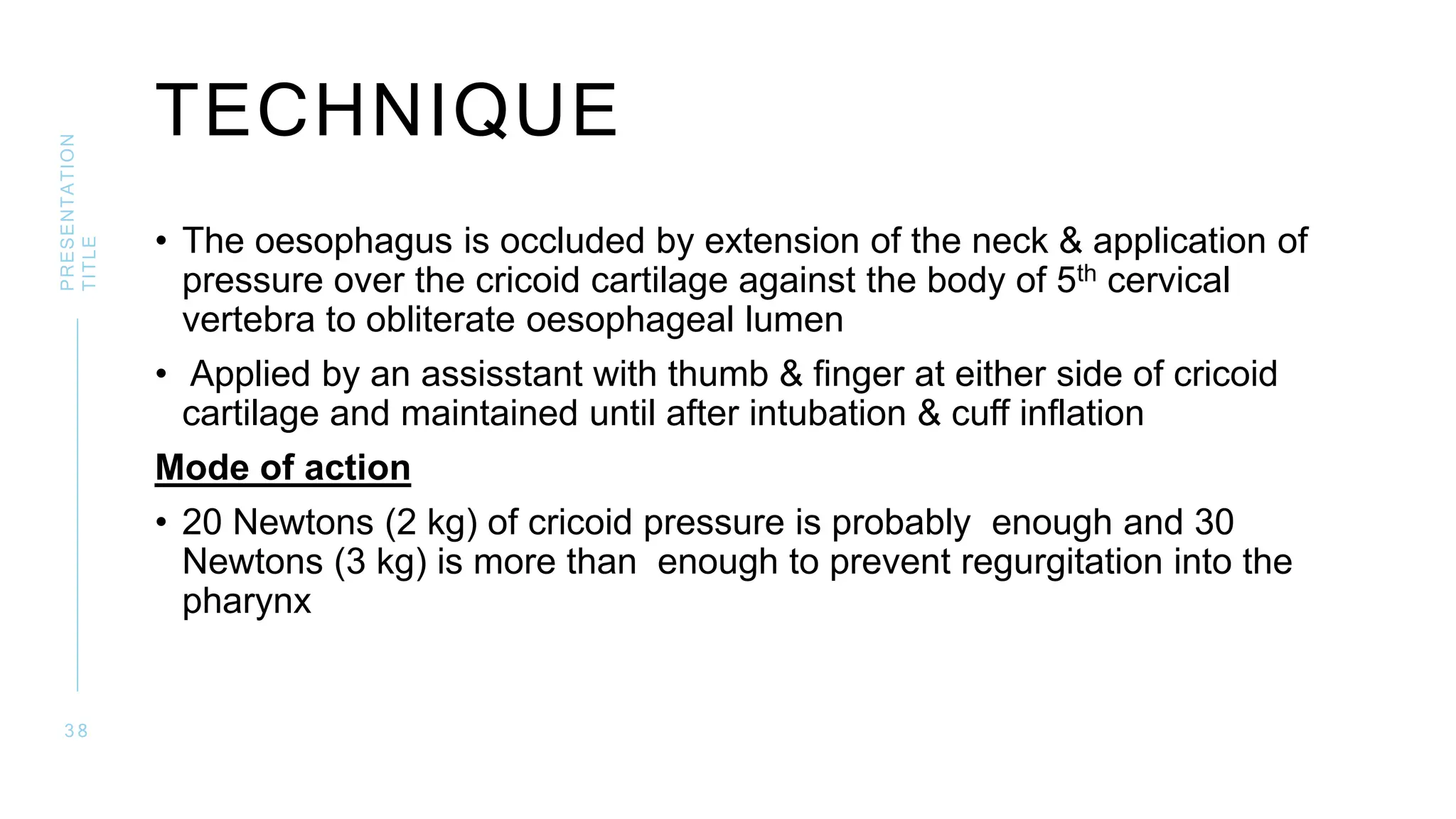
TECHNIQUE
• The oesophagus is occluded by extension of the neck & application of
pressure over the cricoid cartilage against the body of 5th cervical
vertebra to obliterate oesophageal lumen
• Applied by an assisstant with thumb & finger at either side of cricoid
cartilage and maintained until after intubation & cuff inflation
Mode of action
• 20 Newtons (2 kg) of cricoid pressure is probably enough and 30
Newtons (3 kg) is more than enough to prevent regurgitation into the
pharynx
3 8
PRESENTATION
TITLE
3 9
PRESENTATION
TITLE
WHEN ???
• When the pressure is applied ??
When the patient is unconscious
• When should you release?
usually when a cuffed tracheal tube protects the airway and the
anaesthetist confirms this with capnography or when anesthetist say to
do if pressure is obscuring the view.
4 0
PRESENTATION
TITLE
PLACEMENT OF TUBE
4 1
PRESENTATION
TITLE
PLACEMENT OF TUBE
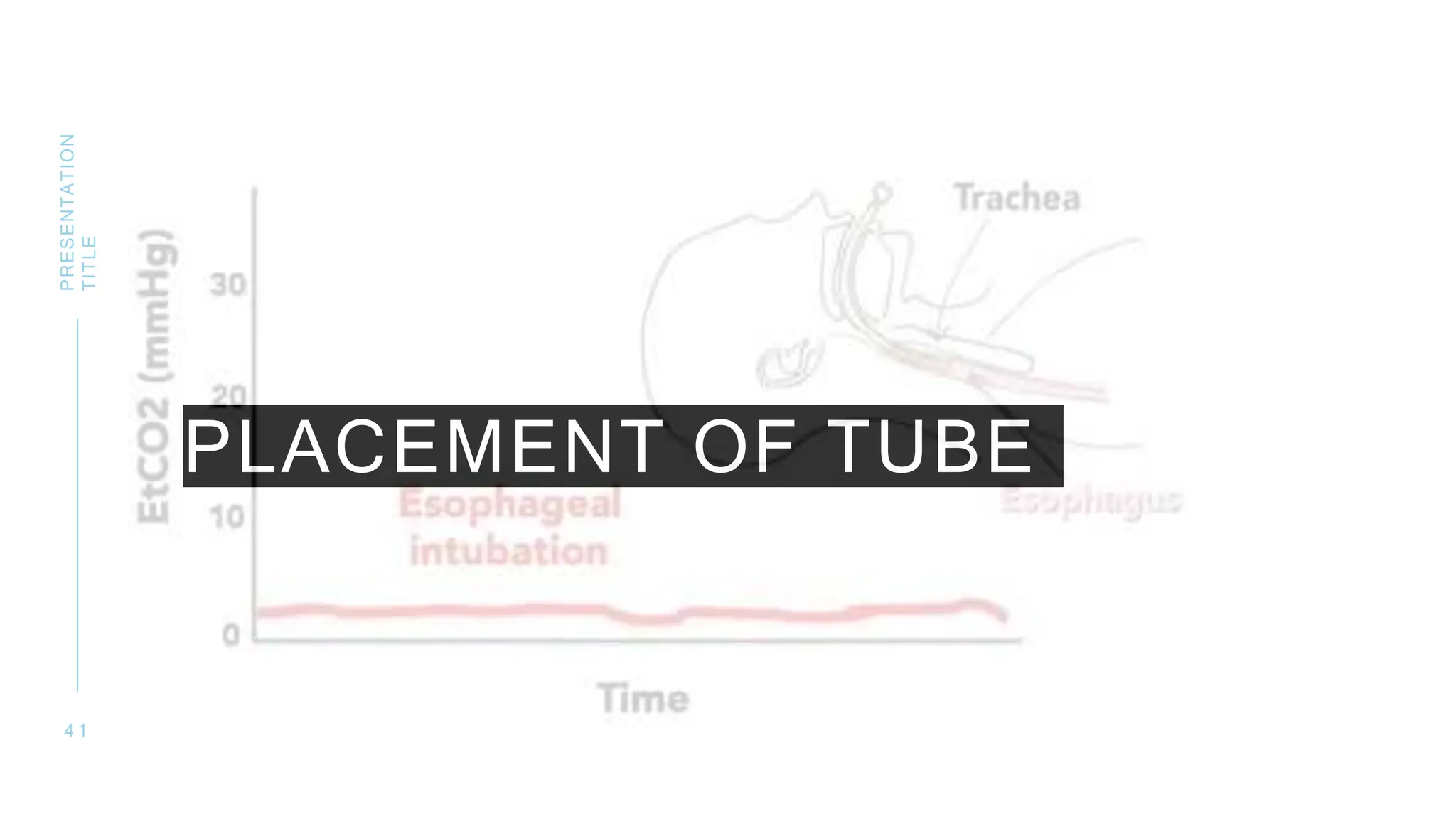
Tube position is confirmed by:
• Direct visualization of ET tube between the vocal cord
• Auscultation: equal air entry
• Capnometer: EtCO2
4 2
PRESENTATION
TITLE
POST INTUBATION CARE
4 3
PRESENTATION
TITLE
POST INTUBATION CARE
• ECG
• SPO2
• NIBP/Art-line
• Capnograph
• Naso/Orogastric tube
• CXR
• ABG Post intubation
• Maintainence of sedation & NMB
4 4
VENTILATION
• Ventilation after apnoea and before intubation is traditionally avoided in RSI
owing to the assumption that such practice increases gastric distension and
the risk of regurgitation.
• .Fit, healthy patients who have normal airway anatomy and are simple to
intubate are unlikely to desaturate, but patients who have increased
metabolic demands, reduced FRC, pre-existing hypoxia, respiratory
pathology, or are not readily intubatable may desaturate before intubation
despite adequate preoxygenation.
• These patients are likely to benefit from gentle ventilation with cricoid
pressure applied before laryngoscopy. This has been referred to as controlled
RSI.
4 5
PRESENTATION
TITLE
TRADITIONAL VSMODIFIED
RAPID SEQUENCE
INTUBATION
4 6
PRESENTATION
TITLE
TRADITIONAL RSII
• Preoxygenation
• Induction with a predetermined dose of Thiopental
• Followed by neuromuscular blocker Succinylcholine
• Application of cricoid pressure at loss of consciousness
• Avoidance of positive pressure ventilation and finally
• Tracheal intubation with cuffed tube before removal of cricoid pressure.
4 7
MODIFIED RSII
• Supine/ramp positioning.
• Titrating the dose of inductions agents to level of unconsciousness.
• Using high dose rocuronium as a NMBA .
• Omitting cricioid pressure.
• BMV before intubation
4 8
PRESENTATION
TITLE
COMPLICATIONS
4 9
PRESENTATION
TITLE
COMPLICATIONS
• Failed to intubate & failed to ventilate
• Risk of anaphylaxis
• Cricoid pressure
– Failure to occlude the oesophagus
– Distortion of larynx --disrupt view
– Oesophageal rupture during active vomiting
5 0
PRESENTATION
TITLE
5 1
PRESENTATION
TITLE
FUTURE DIRECTIONS
5 2
PRESENTATION
TITLE
• Several developments concerning RSII are ongoing.
• The use of paratracheal force has recently been suggested as an alternative
to cricoid pressure.
• Paratracheal pressure has been associated with a reduction in gastric
insufflation of air during positive pressure ventilation and the effects on view at
laryngoscopy may be non-inferior compared with cricoid pressure.
• The investigators also reported easier bag-mask ventilation and lower peak
inspiratory pressures in the paratracheal force group.
• The use of ultrasound to evaluate residual gastric volume is also being
explored. Gastric ultrasound could contribute to the assessment of aspiration
risk for individual patients.
• Fifty years after RSII was first described it still continues to evolve.
5 3
PRESENTATION
TITLE
REFERENCES
• Miller’s 9 edition
• Morgan and Mickail 6 edition
• https://academic.oup.com/bjaed/article/14/3/130/341233
• https://www.ncbi.nlm.nih.gov/pmc/articles/PMC8116824/
• https://litfl.com/rapid-sequence-intubation-rsi/
• Hartsilver EL, Vanner RG. Airway obstruction with cricoid pressure,
Anaesthesia, 2000, vol. 55 (pg. 208-11)
5 4
PRESENTATION
TITLE
5 5
PRESENTATION
TITLE

Rapid sequence induction and intubation.pptx

  • 1.
    RAPID SEQUENCE INDUCTION AND INTUBATION` By:Dr Nalluru Likhitha Moderator : Dr Guru Charan Asst Proff ,MD Anaesthesia NRIIMS,Sanghivalasa
  • 2.
  • 3.
  • 4.
  • 5.
    • 1946- Mendelsondescribed aspiration syndrome in obstetrics. • 1951 – strategies like positioning and neuromuscular block invented by Morton and Wylie to avoid pulmonary aspiration. • 1952- succinylcholine came into existence. • 1959- snow and nunn reported that aspiration of gastric constents was most common cause of death assosciated with anesthesia. • 1961-use of cricoid pressure at induction of anesthesia by Sellick and Lond. • 1971- Stept and Safar published the first complete description of ‘rapid induction/intubation’. 5 PRESENTATION TITLE
  • 6.
    WHAT IS RAPIDSEQUENCE INDUCTION AND INTUBATION?? 6
  • 7.
    RSII • Rapid sequenceinduction and intubation (RSII) is a procedure that aims to reduce the incidence of pulmonary aspiration during airway management. 7 PRESENTATION TITLE
  • 8.
    WHO ARE ATRISK OF ASPIRATION ?? 8 PRESENTATION TITLE
  • 9.
    RISK FACTORS Increased riskof regurgitation Increased risk of aspiration Obesity Positioning Lithotomy and Trendelenburg Incompetent lower oesophageal sphincter Full stomach Pregnancy Impaired laryngeal reflexes Reduced level of consciousness in coma and anaesthesia Neuromuscular weakness in inadequate reversal and bulbar palsy Delayed gastric emptying Pain including labour stress Acute abdomen Gastric outlet obstruction 9
  • 10.
    WHEN TO PERFORMRSII 1 0 PRESENTATION TITLE
  • 11.
    INDICATION OF RSII •A-Airway –loss of airway patency • B-Breathing-inadequate ventilation , respiratory failure or hypoxia • C-Circulation-improve oxygen delivery in hypovolemia • D-Disability-neuroprotection particularly in traumatic brain injury , reduced GCS,status epilepticus,post cardiac arrest protection • E-Everything else – emergency surgery 1 1 PRESENTATION TITLE A B C D E
  • 12.
    STEPS TO PERFORMIN RSII 1 2 PRESENTATION TITLE
  • 13.
    PROCESS OF RSI •Preparation • Pre-Oxygenation with 100% oxygen • Pretreatment & Induction • Paralysis + Cricoid pressure • Placement of the tube • Post intubation management & strategy of failed intubation 1 3
  • 14.
  • 15.
    PREPARATION The mnemonic forpreparation are SOAP ME • S- suction working • O-oxygen (BVM attached to 15lit 02) • A-Airway cart • P-position • M-Medications • E- Monitoring equipment 1 5
  • 16.
  • 17.
    PREOXYGENATION • It isan attempt to maximise oxygen stores in the body before a period of pharmacologically induced apnea. • These stores are within lungs as a part of FRC. • Incresing oxygen content and volume of FRC can protect patients from hypoxia during attempts at intubation. 1 7 PRESENTATION TITLE
  • 18.
  • 19.
    PREOXYGENATION Increased FiO2: • Majorevidences showed that 3-5min tidal ventilation or 8 vital capacity breaths with 100% oxygen ensuring a tight mask fit and high gas flows maximise denitrogenation. 1 9 PRESENTATION TITLE
  • 20.
    PREOXYGENATION • Positive pressure: • PEEP/CPAP has been showed to reduce absorption atelectasis,improve PaO2 and increase time to desaturation • If a patient is already on NIV continuing it for short period of time while setting for intubation is better protection against desaturation than preoxygenation • NIV in obese patients has been shown to improve oxygenation 2 0 PRESENTATION TITLE Weingart SD, Levitan RM. Preoxygenation and prevention of desaturation during emergency airway management. Ann Emerg Med. 2012;59(3):165-75.e1. doi:10.1016/j.annemergmed.2011.10.002
  • 21.
    PREOXYGENATION Apnoeic oxygenation: • Asa result of O2 and CO2 solubility differences ,once patient is apnoeic more O2 leaves the alveoli and enters bloodstream creating a slight negative pressure and increasing atelectasis . • The negative pressure can be used as an advantage by maintaining a patent airway and continuing administration of oxygen that reaches alveoli in a bulk flow 2 1 PRESENTATION TITLE
  • 22.
    PREOXYGENATION Positioning: Adopting head upposition(20-25degree) increases FRC thereby improving preoxygenation. 2 2 PRESENTATION TITLE
  • 23.
  • 24.
    PRETREATMENT Goals: • Mitigate adversephysiologic reactions to intubation – Sympathetic “pressor response” : Manipulation of airway, ↑ HR/BP, – Bronchospasm – Increased ICP – Muscle Fasciculation 2 4 PRESENTATION TITLE
  • 25.
  • 26.
  • 27.
    PARALYSIS/NMB AGENT Ideal: • Rapidonset of action to minimize risk of aspiration & hypoxia • Rapid recovery to facilitate the return of ventilation if intubation fails • Minimal haemodynamic & systemic effects 2 7 PRESENTATION TITLE
  • 28.
  • 29.
    NMB AGENT • Alarge meta analysis performed by the Cochrane Collabration reported succinylcholine was superior to rocuronium in providing excellent and clinically acceptable intubating conditions • It has been traditionally used in RSI because of fast onset and offset , even in event of failure to intubate or ventilate , recovery of spontaneous ventilation may rescue this condition. • The average recovery time is 8.5min . 2 9 PRESENTATION TITLE
  • 30.
    NMB AGENT • Evenhealthy volunteers will desaturate before return of spontaneous respiratory effort without ventilation assistance. Heier T, Feiner JR, Lin J, Brown R, Caldwell JE. Hemoglobin desaturation after succinylcholine-induced apnea: a study of the recovery of spontaneous ventilation in healthy volunteers. Anesthesiology. 2001;94(5):754-759. doi:10.1097/00000542- 200105000-00011tion assistance. 3 0 PRESENTATION TITLE
  • 31.
    NMB AGENT • Rocuroniumfollowed by sugammadex results in a comparatively faster return to spontaneous ventilation. • However, it is unclear if this would be replicated in actual clinical practice.To facilitate this, it is suggested that, when using rocuronium in an RSI, the rescue dose of sugammadex 16 mg /kg should be pre-calculated and immediately available for an assistant to draw up and administer on instruction. • Bisschops MM, Holleman C, Huitink JM. Can sugammadex save a patient in a simulated 'cannot intubate, cannot ventilate' situation?. Anaesthesia. 2010;65(9):936-941. doi:10.1111/j.1365- 2044.2010.06455.x 3 1 PRESENTATION TITLE
  • 32.
    SUCCINYLCHOLINE VS ROCURONIUM ! •Succinylcholine is a drug with a number of potentially life-threatening side-effects. Potassium efflux occurs at depolarization; this is increased significantly in conditions that result in up-regulation of nicotinic receptors, such as burns, crush injuries, and chronic neurological conditions, including spinal cord injury, stroke, and critical illness polyneuropathy. It causes malignant hyperthermia in susceptible individuals. • Rocuronium is a relatively cleaner drug; the only absolute contraindication being allergy. There is increasing evidence that the incidence of rocuronium allergy is higher than that of other non-depolarizing neuromuscular blocking agents. 3 2 PRESENTATION TITLE Sadleir PH, Clarke RC, Bunning DL, Platt PR. Anaphylaxis to neuromuscular blocking drugs: incidence and cross- reactivity in Western Australia from 2002 to 2011. Br J Anaesth. 2013;110(6):981-987. doi:10.1093/bja/aes506
  • 33.
    OPIODS • Traditionally, opioidswere not used as part of an RSI—the belief being that they could contribute to an increase in the time to recovery of spontaneous ventilation and consciousness in the event of a ‘wake up’ after a failed RSI intubation. • Opioids reduce intraocular, intracranial, and cardiovascular adverse effects associated with laryngoscopy and should be considered in situations where these effects could be potentially harmful. • They also reduce the dose of hypnotic agent required. • Opiods in RSI has become common practice now a days which remains optional due to lack of studies. 3 3
  • 34.
  • 35.
  • 36.
    • Cricoid pressurewas introduced into clinical practice as a key element of RSI in 1961, based mainly on a small case series on cadavers. • It is used to compress the oesophagus and prevent regurgitation of gastric contents until the airway is secured with a tracheal tube • a multicentre randomized, double-blind, study conducted in the US was published in 2019 and demonstrated that in 3472 patients who had emergency RSI the use of cricoid pressure did not reduce the incidence of aspiration. It also suggested that intubation was more difficult in the cricoid pressure group 3 6 PRESENTATION TITLE
  • 37.
    • There isalso concern that applying cricoid pressure can cause relaxation of the lower oesophageal sphincter, thereby increasing the risk of passive regurgitation. • . • In the absence of exact evidences, when considering the potential benefits, many experts continue to recommend the use of cricoid pressure 3 7 PRESENTATION TITLE
  • 38.
    TECHNIQUE • The oesophagusis occluded by extension of the neck & application of pressure over the cricoid cartilage against the body of 5th cervical vertebra to obliterate oesophageal lumen • Applied by an assisstant with thumb & finger at either side of cricoid cartilage and maintained until after intubation & cuff inflation Mode of action • 20 Newtons (2 kg) of cricoid pressure is probably enough and 30 Newtons (3 kg) is more than enough to prevent regurgitation into the pharynx 3 8 PRESENTATION TITLE
  • 39.
  • 40.
    WHEN ??? • Whenthe pressure is applied ?? When the patient is unconscious • When should you release? usually when a cuffed tracheal tube protects the airway and the anaesthetist confirms this with capnography or when anesthetist say to do if pressure is obscuring the view. 4 0 PRESENTATION TITLE
  • 41.
    PLACEMENT OF TUBE 41 PRESENTATION TITLE
  • 42.
    PLACEMENT OF TUBE Tubeposition is confirmed by: • Direct visualization of ET tube between the vocal cord • Auscultation: equal air entry • Capnometer: EtCO2 4 2 PRESENTATION TITLE
  • 43.
    POST INTUBATION CARE 43 PRESENTATION TITLE
  • 44.
    POST INTUBATION CARE •ECG • SPO2 • NIBP/Art-line • Capnograph • Naso/Orogastric tube • CXR • ABG Post intubation • Maintainence of sedation & NMB 4 4
  • 45.
    VENTILATION • Ventilation afterapnoea and before intubation is traditionally avoided in RSI owing to the assumption that such practice increases gastric distension and the risk of regurgitation. • .Fit, healthy patients who have normal airway anatomy and are simple to intubate are unlikely to desaturate, but patients who have increased metabolic demands, reduced FRC, pre-existing hypoxia, respiratory pathology, or are not readily intubatable may desaturate before intubation despite adequate preoxygenation. • These patients are likely to benefit from gentle ventilation with cricoid pressure applied before laryngoscopy. This has been referred to as controlled RSI. 4 5 PRESENTATION TITLE
  • 46.
  • 47.
    TRADITIONAL RSII • Preoxygenation •Induction with a predetermined dose of Thiopental • Followed by neuromuscular blocker Succinylcholine • Application of cricoid pressure at loss of consciousness • Avoidance of positive pressure ventilation and finally • Tracheal intubation with cuffed tube before removal of cricoid pressure. 4 7
  • 48.
    MODIFIED RSII • Supine/ramppositioning. • Titrating the dose of inductions agents to level of unconsciousness. • Using high dose rocuronium as a NMBA . • Omitting cricioid pressure. • BMV before intubation 4 8 PRESENTATION TITLE
  • 49.
  • 50.
    COMPLICATIONS • Failed tointubate & failed to ventilate • Risk of anaphylaxis • Cricoid pressure – Failure to occlude the oesophagus – Distortion of larynx --disrupt view – Oesophageal rupture during active vomiting 5 0 PRESENTATION TITLE
  • 51.
  • 52.
  • 53.
    • Several developmentsconcerning RSII are ongoing. • The use of paratracheal force has recently been suggested as an alternative to cricoid pressure. • Paratracheal pressure has been associated with a reduction in gastric insufflation of air during positive pressure ventilation and the effects on view at laryngoscopy may be non-inferior compared with cricoid pressure. • The investigators also reported easier bag-mask ventilation and lower peak inspiratory pressures in the paratracheal force group. • The use of ultrasound to evaluate residual gastric volume is also being explored. Gastric ultrasound could contribute to the assessment of aspiration risk for individual patients. • Fifty years after RSII was first described it still continues to evolve. 5 3 PRESENTATION TITLE
  • 54.
    REFERENCES • Miller’s 9edition • Morgan and Mickail 6 edition • https://academic.oup.com/bjaed/article/14/3/130/341233 • https://www.ncbi.nlm.nih.gov/pmc/articles/PMC8116824/ • https://litfl.com/rapid-sequence-intubation-rsi/ • Hartsilver EL, Vanner RG. Airway obstruction with cricoid pressure, Anaesthesia, 2000, vol. 55 (pg. 208-11) 5 4 PRESENTATION TITLE
  • 55.