Common Paediatric & Adolescent
   Knee Problems
                        Dr. Lyall J. Ashberg, MD
        Specialising in Paediatric and Adolescent Orthopaedics
       Offices at Netcare Blaauwberg & Sea Point Medical Centre
                        Cape Town, South Africa
                   Ph: 021 554 2055 Fax: 021 554 2065
                    Email: Ashbergortho@gmail.com
Growth and Development

✤   Why do young children who fall so frequently not get injured more
    often?

    ✤   Young tissues are more pliable and energy absorbing

✤   Stage of growth and development is essential when evaluating
    paediatric knee problems

✤   Physis (growth plate) is weakest part of child skeleton

✤   Most of growth of lower limb occurs at knee (2/3)
General Principles

✤   Kids are not little adults

✤   Adolescent knee problems are similar to adults unless they are still growing-
    Preadolescent

✤   There is a spectrum of pathology significantly dependent on stage of
    development

✤   One needs to distinguish what is physiologic vs pathologic

✤   Males and females have different biomechanics which leads to different injury
    profiles (ACL epidemic in females)

✤   Preseason training/Strength and conditioning programmes are safe and effective
    in preventing injuries and improving performance in kids
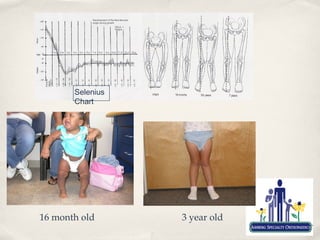
Selenius
       Chart


16 month old      3 year old
Epidemiology

✤   M>F

✤   Adolescent females are approaching males

✤   In the US, there has been a 4 fold increase in female ACL (1:8) injuries

       ✤   Q angle, ligament laxity, genu valgum, ext tib torsion, fem
           Anteversion , inter condylar notch shape, ACL size,
           biomechanics, hormonal influences.

✤   Highest incidence in adolescence 2 to sport
Injury Categories

✤   Acute Trauma vs Overuse syndrome

✤   Areas of injury

     ✤   Muscle

     ✤   Extrarticular Ligaments/Tendon: MCL/LCL-PLC/Extensor mechanism

     ✤   Apophysis

     ✤   Physis

     ✤   Intrarticular structures

          ✤   ACL, PCL, Meniscus, Chondral injury
Overuse Problems: Apophsitis
✤   Apophysis: specialized growth centre/cartilage attached to a tendon
                               or muscle

                    ✤   Much weaker than attached tendon.

               ✤   Thus the terms tendinitis often doesn't apply

      ✤   Examples: tibial tuberosity, olecranon apophysis, Calcaneal
                                   apophysis
Overuse Problems: Apophsitis
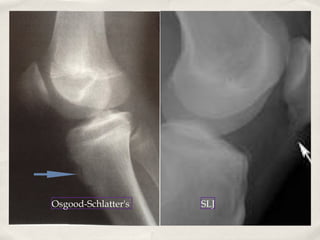
         Traction apophysitis is very common around the knee
                         Osgood Schlatter's: tibial tuberosity
                    Sindig-Larsen-Johannsen: Inferior pole patella

Occurs around age 10-15, earlier in girls
✤


Often very active in sports
✤


     ✤   More common in boys

+/- growth spurt
✤


Relative extensor mechanism inflexibility
✤


Associated with jumping squatting, cutting sports
✤
Osgood-Schlatter's   SLJ
Overuse Problems: Apophsitis
✤   Usually self-limiting

✤   Resolves after skeletal maturity

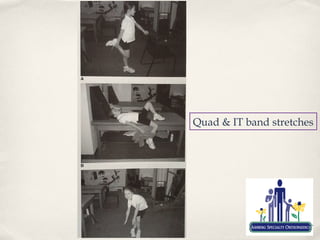
✤   Improved with Extensor Mechanism stretches/physio

✤   Modification of activities

✤   Anti-inflammatories

✤   Rarely surgery is necessary to remove ossicles after skeletal
    maturity

    ✤   Pain with kneeling
Quad & IT band stretches
Patellofemoral Pain


✤   Multiple aetiologies

✤   Often seen in girls

✤   No antecedent trauma or inciting event

✤   Pain at rest and with activity
Patellofemoral Pain


✤   Lateral patellar overload

✤   Chondromalacia patella

✤   Extensor mechanism inflexibility

✤   Patellar maltracking/instability

✤   Congenital plica
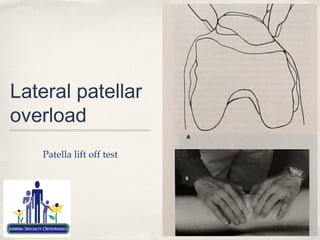
Lateral patellar
overload
   Patella lift off test
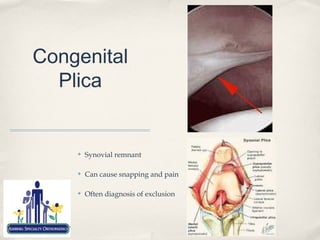
Congenital
  Plica


    ✤   Synovial remnant

    ✤   Can cause snapping and pain

    ✤   Often diagnosis of exclusion
Sddddd
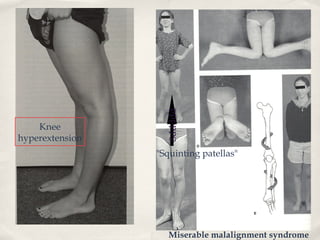
    Knee
hyperextension
                 "Squinting patellas"


                    Miserable malalignment syndrome
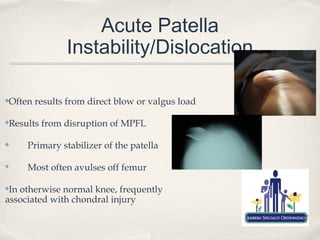
Acute Patella
              Instability/Dislocation

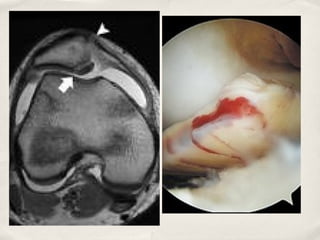
Often results from direct blow or valgus load
✤


Results from disruption of MPFL
✤


✤    Primary stabilizer of the patella

✤    Most often avulses off femur

✤In otherwise normal knee, frequently
associated with chondral injury
Acute Patella
               Instability/Dislocation

✤   Pt usually describes hearing or feeling a "pop"

✤   Immediate, large haemarthrosis

✤   Knee collapsing and unable to bear weight

✤   Tender over course of MPFL & LFC

✤   Often have "Apprehension" with lateral glide test
Patella Dislocation-Treatment

                            ✤   First Time Dislocator

✤   Acute Care

    ✤   +/- evacuate haematoma for comfort

    ✤   Knee immobilizer

    ✤   Xrays/MRI looking for intrarticular loose body

✤   Family given option of non-operative tx

    ✤   Up to 30% fail conservative tx.
Patella Dislocation-Treatment

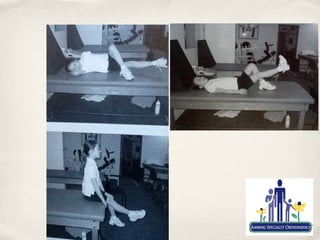
✤   Conservative Treatment

    ✤   Immobilization until quad inhibition resolves (2-4 wks)

    ✤   Physio for Quad (?VMO) strengthening/proprioception

    ✤   Return to sports no sooner than 3 months or until they
        have protective quad/hamstring strength.
Operative Treatment

✤   Very complex decision making

✤   Need to consider

    ✤   Limb alignment and rotation

    ✤   Valgus limbs/Excessive femoral anteversion

    ✤   Q angle

    ✤   Trochlear depth

    ✤   Ligamentous integrity

        ✤   Both generally and MPFL
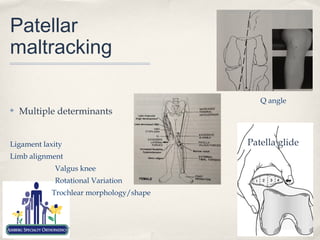
Patellar
maltracking

                                            Q angle
✤   Multiple determinants


Ligament laxity                          Patella glide
Limb alignment
            Valgus knee
            Rotational Variation
            Trochlear morphology/shape
Operative Treatment

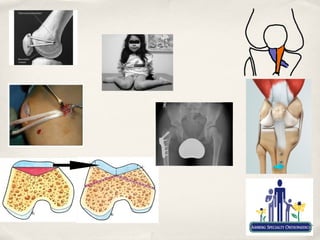
✤   Mainstay is MPFL repair or reconstruction

    ✤   Many different techniques

✤   Roux-Goldwaith procedure in skeletally immature or medialization
    of tibial tubercle in skeletally mature

✤   Insall proximal realignment

✤   Trochlear deepening procedure

✤   Femoral/Tibial derotation
Meniscus Problems

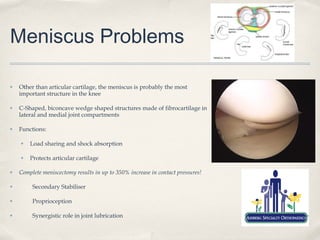
✤   Other than articular cartilage, the meniscus is probably the most
    important structure in the knee

✤   C-Shaped, biconcave wedge shaped structures made of fibrocartilage in
    lateral and medial joint compartments

✤   Functions:

    ✤   Load sharing and shock absorption

    ✤   Protects articular cartilage

✤   Complete meniscectomy results in up to 350% increase in contact pressures!

✤        Secondary Stabiliser

✤        Proprioception

✤        Synergistic role in joint lubrication
Meniscus Problems

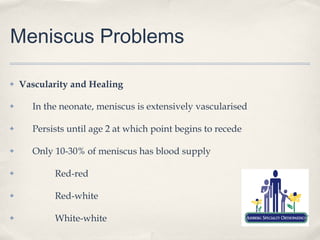
✤   Vascularity and Healing

✤     In the neonate, meniscus is extensively vascularised

✤     Persists until age 2 at which point begins to recede

✤     Only 10-30% of meniscus has blood supply

✤          Red-red

✤          Red-white

✤          White-white
Epidemiology

✤   Traumatic injuries in children younger than 10 are rare

✤   Congenital malformations (Discoid Meniscus) may predispose to
    injury

✤   As children approach adolescence, potential for injury increases

✤   Increase in organised sports has increased the number of serious
    intrarticular knee injuries
Meniscus Problems

✤   History

✤   Often sustain either twisting injury or varus/valgus load on fixed limb

✤   +/- "pop"

✤   Swelling/effusion (51%)

    ✤   Chronic tears may present with intermittent, activity related swelling

✤   Clicking/Popping/locking (bucket handle tear)

✤   Stiffness and pain
Meniscus Problems

✤   Physical

✤   Effusion

✤   Decreased ROM

✤   JOINT LINE TENDERNESS

✤   VALGUS/VARUS ROTATION and STRESS TEST

✤   SQUAT TEST

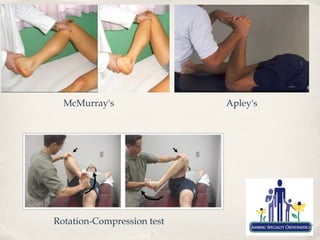
✤   McMurray's/Apley's: only around 58% reliable
McMurray's                Apley's


Rotation-Compression test
Meniscus Problems
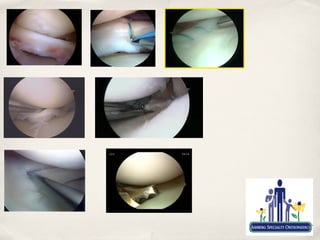
✤   Treatment

✤   Indicated in acute tears and chronic tears with
    mechanical symptoms

✤   In child or adolescent, make every effort to retain child's
    own parts

✤   Partial excision

✤   (Total Excision)

✤   In ACL deficient/unstable knee, MUST address ACL at
    same time or repair will fail
Meniscus Problems

                                                   Rehab
Post Menisectomy
✤


✤      WBAT

✤      ROM

✤      Quad-Hamstring rehab

Post Repair
✤


✤      Non-weightbearing at least 6 weeks

✤      ROM

✤      Quad-Hamstring rehab

✤      No competitive sports at least 3-6 months
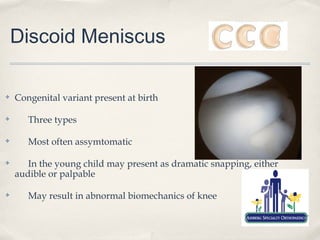
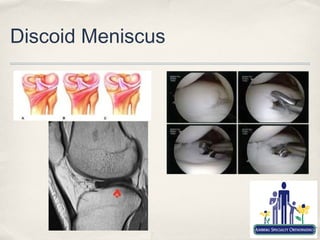
Discoid Meniscus

✤   Congenital variant present at birth

✤      Three types

✤      Most often assymtomatic

✤      In the young child may present as dramatic snapping, either
    audible or palpable

✤      May result in abnormal biomechanics of knee
Discoid Meniscus

✤   Treatment

✤   Assymptomatic children do not require treatment

✤   Will occasionally tear in older child or adolescent

✤   Symptoms of swelling and lateral joint line pain

✤   Saucerization of meniscus and repair/stabilisation

✤   Occasionally associated with OCD of LFC

✤      Addressed as per OCDs
Discoid Meniscus
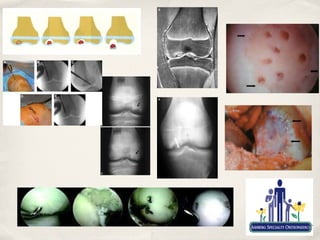
Osteochondritis Dissecans

✤   "Bone-cartilage separation/dissection"

✤   Occurs in Juvenile (5-15) and adult forms (16-50)

✤   More common in males

✤   After skeletal maturity prognosis is much worse

✤   Most often affects lateral aspect of medial femoral condyle

✤   Felt to result from repetitive microtrauma although other
    factors probably contribute

✤   Separation of osteochondral fragment highly likely to result
    in DJD
OCD

✤   Presentation

✤       Depends on lesion stability

✤       Stable lesions

✤                  Aching activity related pain

✤                  No effusion

✤                  Point tenderness over lesion

✤       Unstable Lesions

✤                  More likely to have mechanical symptoms

✤                  Effusion

✤                  More painful
OCD

                                  ✤   Treatment

            ✤   Depends on age of patient and lesion characteristics

✤   Nonoperative

    ✤   Usually involves initial period of immobilisation

    ✤   Rehab

    ✤   Gradual return to sports under close observation

    ✤   Repeat MRI
OCD


✤   Factors associated with failure of non-op treatment

✤      Larger sized lesion

✤      Greater Skeletal maturity

✤      High signal behind lesion on MRI
OCD

                        ✤   Treatment

✤   Operative

✤      Anterograde or retrograde drilling

✤      Lesion Stabilisation

✤      Microfracture

✤      Cartilage "replacement"

✤           OATS/Mosaicplasty/Autologous
    chondrocyte transplantation
ACL Injuries

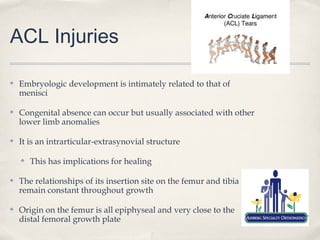
✤   Embryologic development is intimately related to that of
    menisci

✤   Congenital absence can occur but usually associated with other
    lower limb anomalies

✤   It is an intrarticular-extrasynovial structure

    ✤   This has implications for healing

✤   The relationships of its insertion site on the femur and tibia
    remain constant throughout growth

✤   Origin on the femur is all epiphyseal and very close to the
    distal femoral growth plate
ACL Injuries

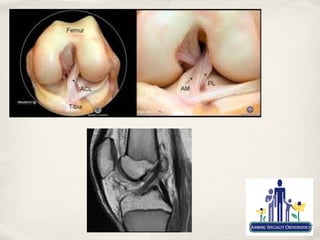
                          ✤   Biomechanics

✤   Primary restraint to anterior translation of the tibia and
    femur

✤   Primary stabiliser during jump, cut and twist sports

✤   Comprised of anteromedial and posterolateral bundles

✤   In the growing knee it is the “middle component” of a
    complex viscoelastic chain
ACL Injuries

                              ✤   Biomechanics

✤   Failure mode depends on a myriad of loading and host characteristics

    ✤   Age of the child

    ✤   Sex

    ✤   Hormonal influences

    ✤   Structural factors
ACL Injuries

                          ✤   Epidemiology and Risk factors

✤   Increasing frequency secondary to participation in organised sports

✤   Major risk factors include

    ✤   High knee-demand sports

    ✤   Female gender

    ✤   Immature neuromuscular development

✤   Concurrent meniscal injury is common

✤   ACL injury is a common cause of haemarthrosis
ACL Injuries

                       ✤   Injury Patterns

✤   Midsubstance tears more common after age 12

✤   Bony avulsion most common at tibial spine and in kids <12

✤   Partial tears are more common in pre-adolescent

✤   Partial tears which are associated with instability are
    “functionally complete” and should be addressed as such
ACL Injuries

                                ✤   Natural History

✤   Developmental and behavioral issues may predispose children with
    ACL-deficient knee to become “non-copers”

✤   Non operative treatment is associated with

    ✤   Recurrent instability

    ✤   Cumulative meniscal and cartilage damage

    ✤   Sports related disability
ACL Injury

✤   History usually reveals a non-contact, rapid deceleration mechanism
    often with a valgus load and rotation of the tibia on femur

✤   Often feel a “pop” and rapid knee swelling and pain

✤   Children’s symptoms tend to resolve quickly and often return to
    activities

✤   Need to distinguish between patellofemoral and ACL type instability

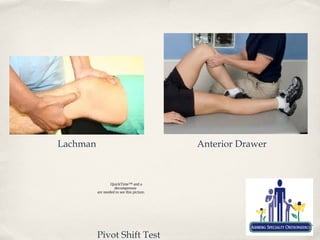
✤   Lachman maneuver is easiest and most sensitive exam

✤   Routine xrays for bony avulsions

✤   MRI to document concurrent injuries to menisci and cartilage
QuickTime™ and a
                   decompressor
         are needed to see this picture.


ACL rupture in female basketball player
Lachman                                     Anterior Drawer


                  QuickTime™ and a
                    decompressor
          are needed to see this picture.


          Pivot Shift Test
ACL Injury
                    ✤   Treatment Considerations

✤   Distal femoral and proximal tibial growth plates are
    responsible for majority of lower extremity growth

✤   Although rare, angular deformities have been described
    following reconstruction

    ✤   Mostly secondary to inappropriately placed fixation or
        bone placed across the physis

✤   Is is better to cause a growth disturbance or allow for
    arthritis?
ACL Injury

                         ✤   Treatment Considerations

✤   When approaching treatment in a child I consider

    ✤   Tanner stage/sexual maturity

    ✤   Bone age

    ✤   Activity level and type of sport

    ✤   Symptomatology during ADLs

    ✤   Family desires
ACL Injury

✤   Treatment Considerations

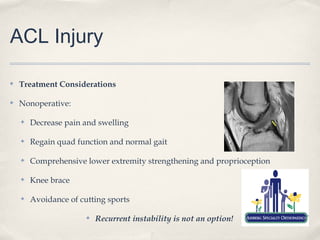
✤   Nonoperative:

    ✤   Decrease pain and swelling

    ✤   Regain quad function and normal gait

    ✤   Comprehensive lower extremity strengthening and proprioception

    ✤   Knee brace

    ✤   Avoidance of cutting sports

                       ✤   Recurrent instability is not an option!
ACL Injury

                             ✤   Treatment Options

✤   Direct Repair

    ✤   Not typically an option as this has a very high failure rate

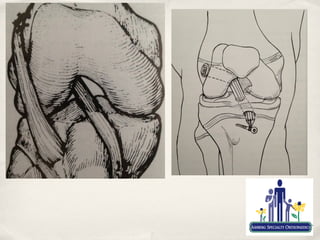
✤   Extrarticular procedures

    ✤   Avoids physis

    ✤   Fixation is outside the knee
ACL Injury

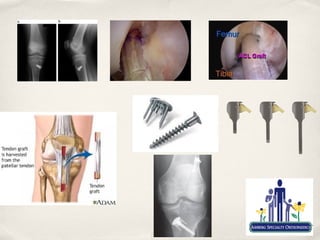
✤   Physeal Sparing procedures

    ✤   Fixation either in epiphysis or across one physis

✤   Transphyseal all soft tissue with extraphyseal fixation

✤   Adult type reconstruction

    ✤   Bone-patella tendon-Bone

    ✤   Hamstrings

    ✤   Allograft

    ✤   Quad Tendon
Other Ligaments

✤   “Children are not small adults”

✤   Again, in pre-adolescent child need to consider the growth
    plate as the “weakest link”

    ✤   Ligaments are more likely to fail at lower rate of load

    ✤   Physis fails at higher rate of load

✤   Beware the PCL/PLC injury in ACL deficient knee

    ✤   Posterolateral rotatory instability

✤   Children’s knees in these injuries tend to be more “forgiving
    and usually amenable to non-operative management
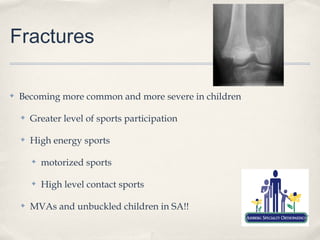
Fractures

✤   Becoming more common and more severe in children

    ✤   Greater level of sports participation

    ✤   High energy sports

        ✤   motorized sports

        ✤   High level contact sports

    ✤   MVAs and unbuckled children in SA!!
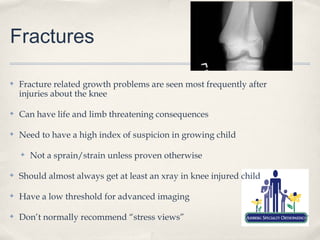
Fractures

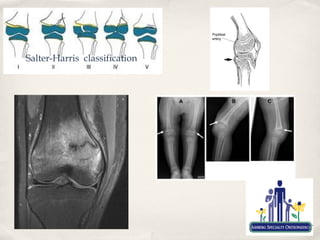
✤   Fracture related growth problems are seen most frequently after
    injuries about the knee

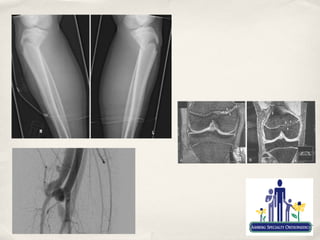
✤   Can have life and limb threatening consequences

✤   Need to have a high index of suspicion in growing child

    ✤   Not a sprain/strain unless proven otherwise

✤   Should almost always get at least an xray in knee injured child

✤   Have a low threshold for advanced imaging

✤   Don’t normally recommend “stress views”
Salter-Harris classification
Fractures

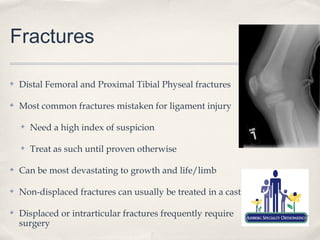
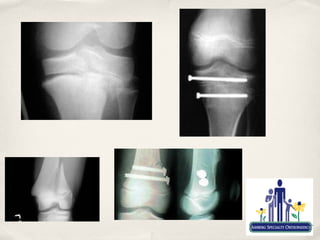
✤   Distal Femoral and Proximal Tibial Physeal fractures

✤   Most common fractures mistaken for ligament injury

    ✤   Need a high index of suspicion

    ✤   Treat as such until proven otherwise

✤   Can be most devastating to growth and life/limb

✤   Non-displaced fractures can usually be treated in a cast

✤   Displaced or intrarticular fractures frequently require
    surgery
Fractures

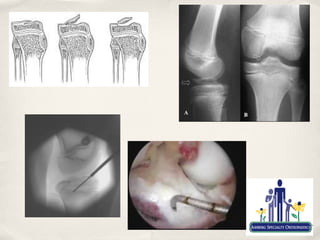
                       Tibial Eminence fractures
 ✤   ACL equivalent in pre-adolescent child

 ✤   Most common in children 8-14 years old

 ✤   3 types-Meyers and Mckeever

     ✤   Type I-II usually amenable to cast immobilisation

     ✤   Type III always operative

 ✤   Not uncommon to have residual, post fixation laxity on objective testing

     ✤   Indicates ACL “stretch”

     ✤   Usually not clinically significant
Fractures

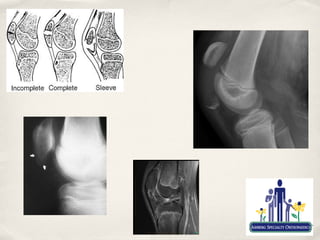
                 ✤   Tibial Tubercle and Patella Sleeve Fractures

✤   Mostly sports related

✤   Typically occur between 12-17 y/o

✤   Usually secondary to violent contraction of quad

    ✤   eg. Landing a jump

✤   At tubercle, fracture occurs at junction of ossified and cartilage growth plate

✤   Sleeve fractures occur because of cartilagenous attachment at inferior pole of
    the patella

    ✤   Difficult to diagnose, but can result in complete disruption of extensor
        mechanism.
Infections

✤   Relatively common in younger children

✤   Can occur from direct injury, haematogenous spread or concurrent
    osteomyelitis

    ✤   Growth plates are intrarticular

✤   Distinguished from

    ✤   Toxic Synovitis - self limiting

    ✤   Septic Prepatellar Bursitis - Extrarticular infection

    ✤   JIA
Infection

✤   Septic Arthritis

    ✤   Often ill looking child

    ✤   Will not bear weight

    ✤   Definitely won’t let you move their knee

    ✤   + Effusion

    ✤   Warm and sometimes red

    ✤   Intrarticular bacterial infection is a surgical emergency!
Take Home Points

✤   Children are not little adults

✤   Need to consider the growth plate and child’s stage of development

    ✤   “The weakest link”

✤   Effusions tend to mean unhappiness is brewing

✤   Beware the occult fracture

✤   Don’t forget about the hip and referred pain
Thank you!
References

1. Micheli, Lyle J. and Kocher, M S: The pediatric and Adolescent Knee. Saunders Elsevier, 2006.
2. Davids JR: Pediatric knee: cliinical assessment and common disorders. Pediatric Clinics North Am 43: 1067-1090, 1996.
3. Arnoczky SP, Warren RF: Microvasculature of the human meniscus. Am J Sports Med 10:90-95,1982.
4. DeLee JC: Ligamentous injury of the knee. In: Drez D (ed): Pediatric and Adolescent Sports Medicine. Philadelphia: WB Saunders
Company, 1994, pp 406-407.
5. American Academy of Pediatrics: Strength and Resistance training by children and adolescents. Pediatrics 107:1470-1472, 2001.
6. Guy J, Micheli L: Strength training for Children and Adolescents. J Am Acad of Orthopaedic Surgery 9:29-35,2001.
7. Barber-Westin SD, Noyes FR, Andrews M: A rigorous comparison between the sexes or results and complications after anterior
cruciate ligament reconstruction. Am J Sport Med 25: 514-526, 1997.
8. Dimeglio A: Growth in pediatric orthopedics. J Pediatr Orthop 21 (4): 549-555, 2001.

Common Paediatric and Adolescent Knee Problems

  • 1.
    Common Paediatric &Adolescent Knee Problems Dr. Lyall J. Ashberg, MD Specialising in Paediatric and Adolescent Orthopaedics Offices at Netcare Blaauwberg & Sea Point Medical Centre Cape Town, South Africa Ph: 021 554 2055 Fax: 021 554 2065 Email: Ashbergortho@gmail.com
  • 2.
    Growth and Development ✤ Why do young children who fall so frequently not get injured more often? ✤ Young tissues are more pliable and energy absorbing ✤ Stage of growth and development is essential when evaluating paediatric knee problems ✤ Physis (growth plate) is weakest part of child skeleton ✤ Most of growth of lower limb occurs at knee (2/3)
  • 3.
    General Principles ✤ Kids are not little adults ✤ Adolescent knee problems are similar to adults unless they are still growing- Preadolescent ✤ There is a spectrum of pathology significantly dependent on stage of development ✤ One needs to distinguish what is physiologic vs pathologic ✤ Males and females have different biomechanics which leads to different injury profiles (ACL epidemic in females) ✤ Preseason training/Strength and conditioning programmes are safe and effective in preventing injuries and improving performance in kids
  • 4.
    Selenius Chart 16 month old 3 year old
  • 5.
    Epidemiology ✤ M>F ✤ Adolescent females are approaching males ✤ In the US, there has been a 4 fold increase in female ACL (1:8) injuries ✤ Q angle, ligament laxity, genu valgum, ext tib torsion, fem Anteversion , inter condylar notch shape, ACL size, biomechanics, hormonal influences. ✤ Highest incidence in adolescence 2 to sport
  • 6.
    Injury Categories ✤ Acute Trauma vs Overuse syndrome ✤ Areas of injury ✤ Muscle ✤ Extrarticular Ligaments/Tendon: MCL/LCL-PLC/Extensor mechanism ✤ Apophysis ✤ Physis ✤ Intrarticular structures ✤ ACL, PCL, Meniscus, Chondral injury
  • 7.
    Overuse Problems: Apophsitis ✤ Apophysis: specialized growth centre/cartilage attached to a tendon or muscle ✤ Much weaker than attached tendon. ✤ Thus the terms tendinitis often doesn't apply ✤ Examples: tibial tuberosity, olecranon apophysis, Calcaneal apophysis
  • 8.
    Overuse Problems: Apophsitis Traction apophysitis is very common around the knee Osgood Schlatter's: tibial tuberosity Sindig-Larsen-Johannsen: Inferior pole patella Occurs around age 10-15, earlier in girls ✤ Often very active in sports ✤ ✤ More common in boys +/- growth spurt ✤ Relative extensor mechanism inflexibility ✤ Associated with jumping squatting, cutting sports ✤
  • 9.
  • 10.
    Overuse Problems: Apophsitis ✤ Usually self-limiting ✤ Resolves after skeletal maturity ✤ Improved with Extensor Mechanism stretches/physio ✤ Modification of activities ✤ Anti-inflammatories ✤ Rarely surgery is necessary to remove ossicles after skeletal maturity ✤ Pain with kneeling
  • 11.
    Quad & ITband stretches
  • 12.
    Patellofemoral Pain ✤ Multiple aetiologies ✤ Often seen in girls ✤ No antecedent trauma or inciting event ✤ Pain at rest and with activity
  • 13.
    Patellofemoral Pain ✤ Lateral patellar overload ✤ Chondromalacia patella ✤ Extensor mechanism inflexibility ✤ Patellar maltracking/instability ✤ Congenital plica
  • 14.
    Lateral patellar overload Patella lift off test
  • 15.
    Congenital Plica ✤ Synovial remnant ✤ Can cause snapping and pain ✤ Often diagnosis of exclusion
  • 16.
    Sddddd Knee hyperextension "Squinting patellas" Miserable malalignment syndrome
  • 17.
    Acute Patella Instability/Dislocation Often results from direct blow or valgus load ✤ Results from disruption of MPFL ✤ ✤ Primary stabilizer of the patella ✤ Most often avulses off femur ✤In otherwise normal knee, frequently associated with chondral injury
  • 18.
    Acute Patella Instability/Dislocation ✤ Pt usually describes hearing or feeling a "pop" ✤ Immediate, large haemarthrosis ✤ Knee collapsing and unable to bear weight ✤ Tender over course of MPFL & LFC ✤ Often have "Apprehension" with lateral glide test
  • 20.
    Patella Dislocation-Treatment ✤ First Time Dislocator ✤ Acute Care ✤ +/- evacuate haematoma for comfort ✤ Knee immobilizer ✤ Xrays/MRI looking for intrarticular loose body ✤ Family given option of non-operative tx ✤ Up to 30% fail conservative tx.
  • 21.
    Patella Dislocation-Treatment ✤ Conservative Treatment ✤ Immobilization until quad inhibition resolves (2-4 wks) ✤ Physio for Quad (?VMO) strengthening/proprioception ✤ Return to sports no sooner than 3 months or until they have protective quad/hamstring strength.
  • 23.
    Operative Treatment ✤ Very complex decision making ✤ Need to consider ✤ Limb alignment and rotation ✤ Valgus limbs/Excessive femoral anteversion ✤ Q angle ✤ Trochlear depth ✤ Ligamentous integrity ✤ Both generally and MPFL
  • 24.
    Patellar maltracking Q angle ✤ Multiple determinants Ligament laxity Patella glide Limb alignment Valgus knee Rotational Variation Trochlear morphology/shape
  • 25.
    Operative Treatment ✤ Mainstay is MPFL repair or reconstruction ✤ Many different techniques ✤ Roux-Goldwaith procedure in skeletally immature or medialization of tibial tubercle in skeletally mature ✤ Insall proximal realignment ✤ Trochlear deepening procedure ✤ Femoral/Tibial derotation
  • 27.
    Meniscus Problems ✤ Other than articular cartilage, the meniscus is probably the most important structure in the knee ✤ C-Shaped, biconcave wedge shaped structures made of fibrocartilage in lateral and medial joint compartments ✤ Functions: ✤ Load sharing and shock absorption ✤ Protects articular cartilage ✤ Complete meniscectomy results in up to 350% increase in contact pressures! ✤ Secondary Stabiliser ✤ Proprioception ✤ Synergistic role in joint lubrication
  • 28.
    Meniscus Problems ✤ Vascularity and Healing ✤ In the neonate, meniscus is extensively vascularised ✤ Persists until age 2 at which point begins to recede ✤ Only 10-30% of meniscus has blood supply ✤ Red-red ✤ Red-white ✤ White-white
  • 29.
    Epidemiology ✤ Traumatic injuries in children younger than 10 are rare ✤ Congenital malformations (Discoid Meniscus) may predispose to injury ✤ As children approach adolescence, potential for injury increases ✤ Increase in organised sports has increased the number of serious intrarticular knee injuries
  • 30.
    Meniscus Problems ✤ History ✤ Often sustain either twisting injury or varus/valgus load on fixed limb ✤ +/- "pop" ✤ Swelling/effusion (51%) ✤ Chronic tears may present with intermittent, activity related swelling ✤ Clicking/Popping/locking (bucket handle tear) ✤ Stiffness and pain
  • 31.
    Meniscus Problems ✤ Physical ✤ Effusion ✤ Decreased ROM ✤ JOINT LINE TENDERNESS ✤ VALGUS/VARUS ROTATION and STRESS TEST ✤ SQUAT TEST ✤ McMurray's/Apley's: only around 58% reliable
  • 32.
    McMurray's Apley's Rotation-Compression test
  • 33.
    Meniscus Problems ✤ Treatment ✤ Indicated in acute tears and chronic tears with mechanical symptoms ✤ In child or adolescent, make every effort to retain child's own parts ✤ Partial excision ✤ (Total Excision) ✤ In ACL deficient/unstable knee, MUST address ACL at same time or repair will fail
  • 35.
    Meniscus Problems Rehab Post Menisectomy ✤ ✤ WBAT ✤ ROM ✤ Quad-Hamstring rehab Post Repair ✤ ✤ Non-weightbearing at least 6 weeks ✤ ROM ✤ Quad-Hamstring rehab ✤ No competitive sports at least 3-6 months
  • 36.
    Discoid Meniscus ✤ Congenital variant present at birth ✤ Three types ✤ Most often assymtomatic ✤ In the young child may present as dramatic snapping, either audible or palpable ✤ May result in abnormal biomechanics of knee
  • 37.
    Discoid Meniscus ✤ Treatment ✤ Assymptomatic children do not require treatment ✤ Will occasionally tear in older child or adolescent ✤ Symptoms of swelling and lateral joint line pain ✤ Saucerization of meniscus and repair/stabilisation ✤ Occasionally associated with OCD of LFC ✤ Addressed as per OCDs
  • 38.
  • 39.
    Osteochondritis Dissecans ✤ "Bone-cartilage separation/dissection" ✤ Occurs in Juvenile (5-15) and adult forms (16-50) ✤ More common in males ✤ After skeletal maturity prognosis is much worse ✤ Most often affects lateral aspect of medial femoral condyle ✤ Felt to result from repetitive microtrauma although other factors probably contribute ✤ Separation of osteochondral fragment highly likely to result in DJD
  • 40.
    OCD ✤ Presentation ✤ Depends on lesion stability ✤ Stable lesions ✤ Aching activity related pain ✤ No effusion ✤ Point tenderness over lesion ✤ Unstable Lesions ✤ More likely to have mechanical symptoms ✤ Effusion ✤ More painful
  • 41.
    OCD ✤ Treatment ✤ Depends on age of patient and lesion characteristics ✤ Nonoperative ✤ Usually involves initial period of immobilisation ✤ Rehab ✤ Gradual return to sports under close observation ✤ Repeat MRI
  • 42.
    OCD ✤ Factors associated with failure of non-op treatment ✤ Larger sized lesion ✤ Greater Skeletal maturity ✤ High signal behind lesion on MRI
  • 43.
    OCD ✤ Treatment ✤ Operative ✤ Anterograde or retrograde drilling ✤ Lesion Stabilisation ✤ Microfracture ✤ Cartilage "replacement" ✤ OATS/Mosaicplasty/Autologous chondrocyte transplantation
  • 45.
    ACL Injuries ✤ Embryologic development is intimately related to that of menisci ✤ Congenital absence can occur but usually associated with other lower limb anomalies ✤ It is an intrarticular-extrasynovial structure ✤ This has implications for healing ✤ The relationships of its insertion site on the femur and tibia remain constant throughout growth ✤ Origin on the femur is all epiphyseal and very close to the distal femoral growth plate
  • 46.
    ACL Injuries ✤ Biomechanics ✤ Primary restraint to anterior translation of the tibia and femur ✤ Primary stabiliser during jump, cut and twist sports ✤ Comprised of anteromedial and posterolateral bundles ✤ In the growing knee it is the “middle component” of a complex viscoelastic chain
  • 48.
    ACL Injuries ✤ Biomechanics ✤ Failure mode depends on a myriad of loading and host characteristics ✤ Age of the child ✤ Sex ✤ Hormonal influences ✤ Structural factors
  • 49.
    ACL Injuries ✤ Epidemiology and Risk factors ✤ Increasing frequency secondary to participation in organised sports ✤ Major risk factors include ✤ High knee-demand sports ✤ Female gender ✤ Immature neuromuscular development ✤ Concurrent meniscal injury is common ✤ ACL injury is a common cause of haemarthrosis
  • 50.
    ACL Injuries ✤ Injury Patterns ✤ Midsubstance tears more common after age 12 ✤ Bony avulsion most common at tibial spine and in kids <12 ✤ Partial tears are more common in pre-adolescent ✤ Partial tears which are associated with instability are “functionally complete” and should be addressed as such
  • 51.
    ACL Injuries ✤ Natural History ✤ Developmental and behavioral issues may predispose children with ACL-deficient knee to become “non-copers” ✤ Non operative treatment is associated with ✤ Recurrent instability ✤ Cumulative meniscal and cartilage damage ✤ Sports related disability
  • 52.
    ACL Injury ✤ History usually reveals a non-contact, rapid deceleration mechanism often with a valgus load and rotation of the tibia on femur ✤ Often feel a “pop” and rapid knee swelling and pain ✤ Children’s symptoms tend to resolve quickly and often return to activities ✤ Need to distinguish between patellofemoral and ACL type instability ✤ Lachman maneuver is easiest and most sensitive exam ✤ Routine xrays for bony avulsions ✤ MRI to document concurrent injuries to menisci and cartilage
  • 53.
    QuickTime™ and a decompressor are needed to see this picture. ACL rupture in female basketball player
  • 54.
    Lachman Anterior Drawer QuickTime™ and a decompressor are needed to see this picture. Pivot Shift Test
  • 55.
    ACL Injury ✤ Treatment Considerations ✤ Distal femoral and proximal tibial growth plates are responsible for majority of lower extremity growth ✤ Although rare, angular deformities have been described following reconstruction ✤ Mostly secondary to inappropriately placed fixation or bone placed across the physis ✤ Is is better to cause a growth disturbance or allow for arthritis?
  • 56.
    ACL Injury ✤ Treatment Considerations ✤ When approaching treatment in a child I consider ✤ Tanner stage/sexual maturity ✤ Bone age ✤ Activity level and type of sport ✤ Symptomatology during ADLs ✤ Family desires
  • 57.
    ACL Injury ✤ Treatment Considerations ✤ Nonoperative: ✤ Decrease pain and swelling ✤ Regain quad function and normal gait ✤ Comprehensive lower extremity strengthening and proprioception ✤ Knee brace ✤ Avoidance of cutting sports ✤ Recurrent instability is not an option!
  • 58.
    ACL Injury ✤ Treatment Options ✤ Direct Repair ✤ Not typically an option as this has a very high failure rate ✤ Extrarticular procedures ✤ Avoids physis ✤ Fixation is outside the knee
  • 60.
    ACL Injury ✤ Physeal Sparing procedures ✤ Fixation either in epiphysis or across one physis ✤ Transphyseal all soft tissue with extraphyseal fixation ✤ Adult type reconstruction ✤ Bone-patella tendon-Bone ✤ Hamstrings ✤ Allograft ✤ Quad Tendon
  • 62.
    Other Ligaments ✤ “Children are not small adults” ✤ Again, in pre-adolescent child need to consider the growth plate as the “weakest link” ✤ Ligaments are more likely to fail at lower rate of load ✤ Physis fails at higher rate of load ✤ Beware the PCL/PLC injury in ACL deficient knee ✤ Posterolateral rotatory instability ✤ Children’s knees in these injuries tend to be more “forgiving and usually amenable to non-operative management
  • 63.
    Fractures ✤ Becoming more common and more severe in children ✤ Greater level of sports participation ✤ High energy sports ✤ motorized sports ✤ High level contact sports ✤ MVAs and unbuckled children in SA!!
  • 64.
    Fractures ✤ Fracture related growth problems are seen most frequently after injuries about the knee ✤ Can have life and limb threatening consequences ✤ Need to have a high index of suspicion in growing child ✤ Not a sprain/strain unless proven otherwise ✤ Should almost always get at least an xray in knee injured child ✤ Have a low threshold for advanced imaging ✤ Don’t normally recommend “stress views”
  • 65.
  • 66.
    Fractures ✤ Distal Femoral and Proximal Tibial Physeal fractures ✤ Most common fractures mistaken for ligament injury ✤ Need a high index of suspicion ✤ Treat as such until proven otherwise ✤ Can be most devastating to growth and life/limb ✤ Non-displaced fractures can usually be treated in a cast ✤ Displaced or intrarticular fractures frequently require surgery
  • 69.
    Fractures Tibial Eminence fractures ✤ ACL equivalent in pre-adolescent child ✤ Most common in children 8-14 years old ✤ 3 types-Meyers and Mckeever ✤ Type I-II usually amenable to cast immobilisation ✤ Type III always operative ✤ Not uncommon to have residual, post fixation laxity on objective testing ✤ Indicates ACL “stretch” ✤ Usually not clinically significant
  • 71.
    Fractures ✤ Tibial Tubercle and Patella Sleeve Fractures ✤ Mostly sports related ✤ Typically occur between 12-17 y/o ✤ Usually secondary to violent contraction of quad ✤ eg. Landing a jump ✤ At tubercle, fracture occurs at junction of ossified and cartilage growth plate ✤ Sleeve fractures occur because of cartilagenous attachment at inferior pole of the patella ✤ Difficult to diagnose, but can result in complete disruption of extensor mechanism.
  • 73.
    Infections ✤ Relatively common in younger children ✤ Can occur from direct injury, haematogenous spread or concurrent osteomyelitis ✤ Growth plates are intrarticular ✤ Distinguished from ✤ Toxic Synovitis - self limiting ✤ Septic Prepatellar Bursitis - Extrarticular infection ✤ JIA
  • 74.
    Infection ✤ Septic Arthritis ✤ Often ill looking child ✤ Will not bear weight ✤ Definitely won’t let you move their knee ✤ + Effusion ✤ Warm and sometimes red ✤ Intrarticular bacterial infection is a surgical emergency!
  • 75.
    Take Home Points ✤ Children are not little adults ✤ Need to consider the growth plate and child’s stage of development ✤ “The weakest link” ✤ Effusions tend to mean unhappiness is brewing ✤ Beware the occult fracture ✤ Don’t forget about the hip and referred pain
  • 76.
  • 77.
    References 1. Micheli, LyleJ. and Kocher, M S: The pediatric and Adolescent Knee. Saunders Elsevier, 2006. 2. Davids JR: Pediatric knee: cliinical assessment and common disorders. Pediatric Clinics North Am 43: 1067-1090, 1996. 3. Arnoczky SP, Warren RF: Microvasculature of the human meniscus. Am J Sports Med 10:90-95,1982. 4. DeLee JC: Ligamentous injury of the knee. In: Drez D (ed): Pediatric and Adolescent Sports Medicine. Philadelphia: WB Saunders Company, 1994, pp 406-407. 5. American Academy of Pediatrics: Strength and Resistance training by children and adolescents. Pediatrics 107:1470-1472, 2001. 6. Guy J, Micheli L: Strength training for Children and Adolescents. J Am Acad of Orthopaedic Surgery 9:29-35,2001. 7. Barber-Westin SD, Noyes FR, Andrews M: A rigorous comparison between the sexes or results and complications after anterior cruciate ligament reconstruction. Am J Sport Med 25: 514-526, 1997. 8. Dimeglio A: Growth in pediatric orthopedics. J Pediatr Orthop 21 (4): 549-555, 2001.