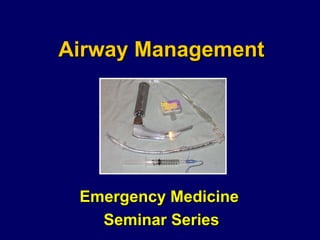
Airway Management Emergency Medicine  Seminar Series
Michael Ha Section of Emergency Medicine  4th year Resident John Sokal Health Sciences Centre 12 years Bob Sweetland Health Sciences Centre 15 years
April 25, 2002 CHURCHILL ASHERN PINE FALLS
April 26, 2002 STEINBACH BOUNDARY  TRAILS
May 2, 2002 BRANDON KILLARNEY PORTAGE
May 3, 2002 RUSSELL DAUPHIN SWAN RIVER
May 14, 2002 FLIN FLON LYNN LAKE THE PAS
eMEDiUM Emergency Medicine  in the U of M emergency.mb.ca Back
CAEP  ACEP
CME Objectives To discuss: the indications for intubation the approach to RSI capnometry bougies
Intubate? RSI vs. Awake Preparing for patient Difficult BVM Difficult Intubation Capnography Laryngoscopy  Tips Bougies Lightwand  - LMA Master Preoxygenation Pretreatment O 2  Delivery Thiopental   Ketamine Propofol Succinylcholine Rocuronium Finish
Intubation Indications Is there a failure of  airway maintenance or protection? Is there a failure of   ventilation or oxygenation? What is the   anticipated clinical course ? Back
HR 125  BP 98/40  RR 20  GCS 8  O 2 Sats 100% (PRB) no injuries Questions? Indication? Awake vs RSI? LOAD? Induction agent? Paralytic agent? cases 45 female  alcoholic beverages empty pill bottles
Cases 60 	VF 44 	MVA 25 	asthma 15 	fall 28 	bull 16	pencil 40	fire 22 	TCA 54	CRF 67	HTN 51 	melena 45  overdose
60 male  IHD AMI  VF - defibrillated 3x HR  110   BP  68 / 40  RR  10 O 2 Sats 90% (BVM)  Questions? Indication? Awake vs RSI? LOAD? Induction agent? Paralytic agent? cases
44 female  MVA  100  kph HR  130  BP  100 / 70  RR  28 O 2 Sats 99% (BVM) GCS 6 Questions? Indication? Awake vs RSI? LOAD? Induction agent? Paralytic agent? cases
25 female  asthma SOB 2 days severe distress HR  145   BP  98 / 42  RR  30 O 2 Sats 80% (PRB) Questions? Indication? Awake vs RSI? LOAD? Induction agent? Paralytic agent? cases
15  female   fell from tree HR  110  BP  100 / 50  RR  20 O 2 Sats 99% (BVM) GCS 8 Questions? Indication? Awake vs RSI? LOAD? Induction agent? Paralytic agent? cases
28 male  playing with bull  blunt trauma HR 130  BP 80 / 60  RR 28 O 2 Sats 99% (PRB) abdomen rigid pelvic fracture Questions? Indication? Awake vs RSI? LOAD? Induction agent? Paralytic agent? cases
16 male   pencil oropharynx 'buddy' pulled it out HR 80  BP 115 / 60  RR 16 O 2 Sats 99% (room) voice change hematoma visible Questions? Indication? Awake vs RSI? LOAD? Induction agent? Paralytic agent? cases
40 female  house fire prolonged exposure HR 115  BP 130 / 60  RR 28 O 2 Sats 96% (PRB) singed facial hair soot in mouth Questions? Indication? Awake vs RSI? LOAD? Induction agent? Paralytic agent? cases
22  female   ingestion amitryptyline quantity unknown HR 145  BP 100 / 42  RR 14 O 2 Sats 99% (PRB) GCS 8 Questions? Indication? Awake vs RSI? LOAD? Induction agent? Paralytic agent? cases
54 male  CRF  DM on dialysis holiday respiratory distress HR 115  BP 200 / 120  RR 36 O 2 Sats 88% (NRB) peaked T's Questions? Indication? Awake vs RSI? LOAD? Induction agent? Paralytic agent? cases
67 female  HTN on ACE inhibitor oral angioedema HR 85  BP 150 / 80  RR 20 O 2 Sats 99% (room) slight stridor Questions? Indication? Awake vs RSI? LOAD? Induction agent? Paralytic agent? cases
51 male  cirrhosis   melena 2 days hematemesis HR  165  BP  50 palpation  RR  28 O 2 Sats 92% (NRB) vomiting red blood Questions? Indication? Awake vs RSI? LOAD? Induction agent? Paralytic agent? cases
68 male  CHF HR 125  BP 180 / 100  RR 32 O 2 Sats 86% (NRB) SOB over 3 days  worsened overnight Questions? Indication? Awake vs RSI? LOAD? Induction agent? Paralytic agent? cases
Intubate? Custom Shows
Intubate? HR 125  BP 98/40  RR 20  GCS 8  O 2 Sats 100% (PRB) no injuries Indication? 45 female  alcoholic beverages empty pill bottles
Intubation Indications Is there a failure of   airway maintenance or protection?
Intubate? HR 135  BP 150/90  RR 10 O 2 Sats 86% (NRB)  'tight'  wheezes bilaterally Indication? 50 yo male  SOB over 2 days  worsened overnight
Intubation Indications Is there a failure of   ventilation or oxygenation ?
Intubate? HR 100  BP 105/60  RR 20  GCS 10 O 2 Sats 100% (PRB)  multiple injuries transfering to HSC  Indication? 34 yo male  MVA ejected from car
Intubation Indications What is the   anticipated clinical course ?
Intubation Indications Is there a failure of  airway maintenance or protection? Is there a failure of   ventilation or oxygenation? What is the   anticipated clinical course ? Back
RSI vs Awake? Custom Shows
Rapid Sequence Intubation a potent  induction agent   followed immediately by   the patient has not fasted at risk of aspiration a rapidly-acting  NMB   to induce unconsciousness and  motor paralysis for intubation.
Rapid Sequence Intubation take nothing that  you cannot return or replace approach every airway as  a potential difficult airway be prepared
The  7  P’s P reparation P reoxygenation P retreatment P aralysis with induction P ositioning with protection P lacement with proof P ostintubation management
Awake Intubations “ Awake” means that patient can: follow simple instructions provide feedback can respond to events sedation – versed, fentanyl topical lidocaine oral, nasotracheal, fiberoptic
Choices… paralyze? Paralysis contraindications prediction of difficulty   difficult BVM difficult intubation lack of equipment unnecessary inexperience
Preparation Difficult   Airways Custom Shows
Preparation STOP IC BARS S staff, suction T tube O oxygen P pharmacology  (meds)
Preparation I intravenous lines C connect to monitors B blades, bougies A alternate  (lightwand)  R rescue  (LMA, combitube) S surgical  (cricothyroidotomy) STOP IC BARS Back
Difficult Mask Ventilation B  eard
Difficult Mask Ventilation O  bese
Difficult Mask Ventilation O  lder T  oothless
Difficult Mask Ventilation S  nores
Preparation Assessment for  Difficult Mask Ventilation BOOTS   B beard O obese O older T toothless S snores Back
Difficult Mask Ventilation reposition OP / NP airway 2 person  change mask ? obstruction Back
Repositioning Oral – Pharyngeal -  Laryngeal Axes
Repositioning Head extended on neck
Repositioning “ Sniffing” position
Repositioning “ Sniffing” with extension Back
Preparation Assessment for a difficult intubation Lemon Law   L look  E evaluate (3-3-1 rule) M Mallampati O obstruction N neck mobility Back
3-3-1 Rule Back 3 3 fingers mouth opening 1 finger anterior jaw  subluxation 3 1 3 fingers hyomental distance (room for tongue)
Mallampati Back
Preparation Preoxygenation Pretreatment
Preoxygenation is the establishment of an  oxygen reservoir. “ no bagging ”  principle of RSI “ apnea time ”  concept 100% O 2  for 5 minutes effect of body size & metabolic demands
Apnea Time Back
Pretreatment is the administration of drugs  to mitigate the adverse effects  associated with intubation. L  idocaine O  piodes A  tropine D  efasciculation Back
Induction Agents
Paralysis after induction thiopental ketamine propofol etomidate versed succinylcholine rocuronium skip drug section
Thiopental cerebroprotective potent vasodilator  myocardial depressant Contraindication: porphyria INDUCTION
Thiopental Back INDUCTION Onset: 15 - 30   seconds Dose: 3 -  5   mg / kg (euvolemic) 1 -  3   mg / kg  (hypovolemic) Duration: 5 - 10   minutes
Ketamine analgesia  -  amnesia  bronchodilation catecholamine release hypovolemic - hypotensive    agent of choice INDUCTION ICP  (significance ?) ( cerebroprotective  ??) stimulating effects: laryngeal reflexes secretions
Ketamine lower dose if profound shock: maximal sympathetic stimulation already - ketamine has intrinsic CV depression Back INDUCTION Onset: 15 - 30   seconds Dose: 1 -  2   mg / kg Duration: 15 - 30   minutes
Propofol dose-dependant sedation - amnesia no analgesic properties airway reflexes: dose-dependant depression  potent vasodilator , myocardial depressant (effect may exceed that of thiopental) cardiac & respiratory depression related to  rate of administration as well as dose INDUCTION cerebroprotective ICP CPP
Propofol Onset: 30 - 40   seconds   1 -  3   mg / kg  (induction) Dose: Duration: 5 - 10   minutes Combo:  ketamine  50 mg propofol  50 mg Back Contraindication: egg, soybean allergies INDUCTION
Etomidate most hemodynamically stable minimal cardiac & respiratory depression cortisol suppression  ( no  ED cases) myoclonus / hiccups 30% - 40%  nausea / vomiting does not block BP response to intubation  INDUCTION cerebroprotective ICP
Etomidate Back Onset: 20 - 30   seconds Dose: 0.2 - 0.3   mg / kg INDUCTION Duration: 5 - 15   minutes
NMB
Choices… paralyze? Paralysis contraindications prediction of difficulty   difficult BVM difficult intubation lack of equipment unnecessary inexperience
Choices… SUX or ROC? SUX contraindications difficult BVM or intubation neuromuscular disorders hyperkalemia 24 hours post-burns 7 days post-crush 7 days post-denervation malignant hyperthermia
Succinylcholine duration of action is dependant on: rapid hydrolysis - pseudocholinesterase diffusion away from motor end plate (no  pseudocholinesterase at end plate) only a fraction of dose ever reaches end plate give large doses no harm giving too much problem when incompletely paralyzed give extra 20%  (2 mg / kg) PARALYSIS depolarizing NMB  fasciculations
Succinylcholine Onset: 10 - 15   seconds  (fasciculations) 45 - 60  seconds (paralysis) Dose: 1  -  2   mg / kg  (adults)   2   mg / kg  (children) 3   mg / kg  (newborns) Duration: 3 -  5   minutes  (some resps) 8 - 10   minutes  (adequate) PARALYSIS
Succinylcholine Side- Effects fasciculations hyperkalemia bradycardia malignant hyperthermia prolonged blockade trismus  -  masseter  muscle spasm Back PARALYSIS
Succinylcholine Fasciculations nicotinic receptor stimulation inhibiting fasciculations - little evidence side-effects occurs same time as  ICP PARALYSIS
Succinylcholine SUX-induced Hyperkalemia under normal situations, increase of:  0.5   mEq/L  K +   small risk of dysrythmia: CRF severe acidosis rhabdomyolysis Preexistent  K +  PARALYSIS
Succinylcholine increased extrajunctional receptors: 5 - 10   mEq/L  K +  prolonged depolarization refractory to non-depolarizing NMB, may require large doses Exaggerated release of K + PARALYSIS
Succinylcholine Exaggerated release of K + functional  denervation  of muscle: stroke spinal cord injury extensive  burns massive  crush  injuries neuromuscular disorders side-effects PARALYSIS
Succinylcholine PARALYSIS Receptor Recruitment & Sensitization Onset: 7   days Duration: 2 - 3   months Crush: Onset: 7   days Duration: 6   months Denervation: Onset: 24   hours Duration: 2   years Burns: (% burn does not determine response)
Succinylcholine Neuromuscular disorders: SUX contraindicated side-effects PARALYSIS Receptor Recruitment & Sensitization If give SUX: intractable cardiac arrest may occur  (even if recognize and treat  K +)
Succinylcholine Bradycardia cardiac muscarinic receptor stimulation succinylmonocholine (a metabolite) sensitizessinus node receptors to repeat doses consider atropine if: age < 10 repeating dose side-effects children have  vagal tone PARALYSIS
Succinylcholine Prolonged Neuromuscular Blockade congenital absence  of pseudocholinesterase presence of an atypical form may last hours PARALYSIS
Succinylcholine acquired absence: cocaine metoclopramide (Maxeran) CRF severe liver disease hypothyroidism malnutrition pregnancy cytotoxic drugs organophosphates Prolonged Neuromuscular Blockade PARALYSIS
Succinylcholine acquired absence: even worst of acquired not reported to last > 25 minutes SUX not contraindicated Prolonged Neuromuscular Blockade side-effects PARALYSIS
Succinylcholine mortality 60%  onset can be acute or delayed for hours Malignant Hyperthermia genetic skeletal muscle abnormality can be triggered by: SUX stress vigorous exercise halothane PARALYSIS
Succinylcholine muscle rigidity autonomic instability hypotension hypoxia severe lactic acidosis myoglobinemia DIC fever -  late  manifestation Malignant Hyperthermia side-effects PARALYSIS
Succinylcholine prevents Ca ++  release from sarcoplasmic  reticulum of skeletal muscle  Dantrolene  for MH essential to resuscitation give as soon as Dx suspected free of serious side-effects side-effects Dose: 2.5   mg/kg  IV  q5min until muscle relaxation, or max 4 doses PARALYSIS
Succinylcholine Trismus - Masseter Muscle Spasm rise in jaw muscle tension is normal should  not  affect laryngoscopy pretreatment will  not  prevent if severe, or progresses to other muscles: consider malignant hyperthermia spasm is  not  pathonomonic for MH if occurs - administer non-depolarizing  NMB  (Rocuronium) side-effects PARALYSIS
Rocuronium Nondepolarizing,  does not stimulate receptor no fasciculations minimal hemodynamic effects do not need priming dose PARALYSIS
Rocuronium Dose: 0.6 - 1.2   mg / kg PARALYSIS Onset: 60 - 90   seconds Duration: 30 - 60   minutes Defasiculating: 0.05   mg / kg
Comparing NMB SUX ROC PARALYSIS ONSET 30 - 60 60 - 90  sec DURATION 3 - 10 20 - 60 min rapid rapid no priming CVS stability advantages precautions K +
Comparing NMB PARALYSIS sec min VEC 150 - 180 25 -  30 no histamine release PAN 120 - 180 60 -  90 histamine release ATRA 120 - 150 20 -  35 histamine release
Positioning Proof
Positioning with protection You are asked to apply: cricoid pressure (Sellick’s maneuver)
BURP B  ackwards U  pwards R  ightward P  ressure distinct from Sellick’s maneuver second assistant first assistant’s other hand
Maneuvers Back
Laryngoscopy
Laryngoscopy
Laryngoscopy
Laryngoscopy
Laryngoscopy
Placement with proof methods of confirmation chest rise air entry fogging of ETT 60 cc syringe * capnometer
Colorimetric Capnometry exhaled CO2   simple color change    from purple   to  yellow
Colorimetric Capnometry NEGATIVE POSITIVE
Colorimetric Capnometry ETCO 2  < 4  mm Hg ETT  not in  trachea inadequate perfusion (ineffective CPR)
Colorimetric Capnometry ETCO 2  15 - 38  mm Hg ETT  in  trachea
Colorimetric Capnometry ETCO 2  4 to < 15  mm Hg retained CO 2  in esophagus low perfusion deliver  6  more breaths
Colorimetric Capnometry Standard of Care Limitations: Back decreased cardiac output low metabolic CO 2  production ex. hypothermia
Bougie Lightwand LMA
Bougie
Epiglottis
Laryngoscopy Grades Cormack Lehane
Bougie
Lightwand
Lightwand Source: Laerdal
Laryngeal Mask Airway Source: LMA North America skip insertion technique
Laryngeal Mask Airway Source: LMA North America deflate the cuff  apply water-soluble lubricant to the  posterior surface place index finger at the junction of the cuff   skip insertion technique
Laryngeal Mask Airway Source: LMA North America press the tip of the cuff upward against the hard  palate and flatten the cuff against it   skip insertion technique
Laryngeal Mask Airway Source: LMA North America use the index finger to guide the LMA,  press backward toward the other hand, which  exerts counter-pressure (do not use force) skip insertion technique
Laryngeal Mask Airway Source: LMA North America advance the LMA into the hypopharynx until a  definite resistance is felt. inflate the cuff   skip insertion technique
7. Postintubation mgmt fix tube in place CXR nasogastric  / orogastric tube lab  etc Back
O2 Delivery Systems
O 2  Delivery Systems Nasal cannulae Double rate - add to room air FiO 2 ex.  3 L / min  +  21 % FiO 2 = 27 % Limitations: rates > 3 L / min uncomfortable mouth breathing
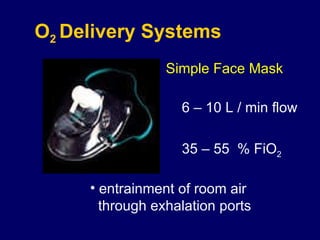
O 2  Delivery Systems Simple Face Mask 6 – 10 L / min flow 35 – 55  % FiO 2 entrainment of room air  through exhalation ports
O 2  Delivery Systems Partial Rebreathing Face Mask reservoir bag first ~ 1/3 of exhaled gas  is directed into bag (that which was in patient’s upper airway) up to 60  % FiO 2
O 2  Delivery Systems Non-Rebreathing Face Mask reservoir bag one-way valves up to 80  % FiO 2  (realistically)
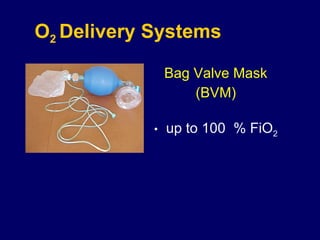
O 2  Delivery Systems Bag Valve Mask (BVM) up to 100  % FiO 2
Summary
Airway Management ? ?
eMEDiUM Emergency Medicine  in the U of M emergency.mb.ca Back
HSC ED  Maryann Cromwell MCromwell @ exchange.hsc.mb.ca phone:  787-2934 fax:  787-2231  Department of Emergency Medicine Health Sciences Centre GF 201-800 Sherbrook Street Winnipeg, MB R3A 1R9 Back
CAEP  ACEP

Airway management

  • 1.
    Airway Management EmergencyMedicine Seminar Series
  • 2.
    Michael Ha Sectionof Emergency Medicine 4th year Resident John Sokal Health Sciences Centre 12 years Bob Sweetland Health Sciences Centre 15 years
  • 3.
    April 25, 2002CHURCHILL ASHERN PINE FALLS
  • 4.
    April 26, 2002STEINBACH BOUNDARY TRAILS
  • 5.
    May 2, 2002BRANDON KILLARNEY PORTAGE
  • 6.
    May 3, 2002RUSSELL DAUPHIN SWAN RIVER
  • 7.
    May 14, 2002FLIN FLON LYNN LAKE THE PAS
  • 8.
    eMEDiUM Emergency Medicine in the U of M emergency.mb.ca Back
  • 9.
  • 10.
    CME Objectives Todiscuss: the indications for intubation the approach to RSI capnometry bougies
  • 11.
    Intubate? RSI vs.Awake Preparing for patient Difficult BVM Difficult Intubation Capnography Laryngoscopy Tips Bougies Lightwand - LMA Master Preoxygenation Pretreatment O 2 Delivery Thiopental Ketamine Propofol Succinylcholine Rocuronium Finish
  • 12.
    Intubation Indications Isthere a failure of airway maintenance or protection? Is there a failure of ventilation or oxygenation? What is the anticipated clinical course ? Back
  • 13.
    HR 125 BP 98/40 RR 20 GCS 8 O 2 Sats 100% (PRB) no injuries Questions? Indication? Awake vs RSI? LOAD? Induction agent? Paralytic agent? cases 45 female alcoholic beverages empty pill bottles
  • 14.
    Cases 60 VF44 MVA 25 asthma 15 fall 28 bull 16 pencil 40 fire 22 TCA 54 CRF 67 HTN 51 melena 45 overdose
  • 15.
    60 male IHD AMI VF - defibrillated 3x HR 110 BP 68 / 40 RR 10 O 2 Sats 90% (BVM) Questions? Indication? Awake vs RSI? LOAD? Induction agent? Paralytic agent? cases
  • 16.
    44 female MVA 100 kph HR 130 BP 100 / 70 RR 28 O 2 Sats 99% (BVM) GCS 6 Questions? Indication? Awake vs RSI? LOAD? Induction agent? Paralytic agent? cases
  • 17.
    25 female asthma SOB 2 days severe distress HR 145 BP 98 / 42 RR 30 O 2 Sats 80% (PRB) Questions? Indication? Awake vs RSI? LOAD? Induction agent? Paralytic agent? cases
  • 18.
    15 female fell from tree HR 110 BP 100 / 50 RR 20 O 2 Sats 99% (BVM) GCS 8 Questions? Indication? Awake vs RSI? LOAD? Induction agent? Paralytic agent? cases
  • 19.
    28 male playing with bull blunt trauma HR 130 BP 80 / 60 RR 28 O 2 Sats 99% (PRB) abdomen rigid pelvic fracture Questions? Indication? Awake vs RSI? LOAD? Induction agent? Paralytic agent? cases
  • 20.
    16 male pencil oropharynx 'buddy' pulled it out HR 80 BP 115 / 60 RR 16 O 2 Sats 99% (room) voice change hematoma visible Questions? Indication? Awake vs RSI? LOAD? Induction agent? Paralytic agent? cases
  • 21.
    40 female house fire prolonged exposure HR 115 BP 130 / 60 RR 28 O 2 Sats 96% (PRB) singed facial hair soot in mouth Questions? Indication? Awake vs RSI? LOAD? Induction agent? Paralytic agent? cases
  • 22.
    22 female ingestion amitryptyline quantity unknown HR 145 BP 100 / 42 RR 14 O 2 Sats 99% (PRB) GCS 8 Questions? Indication? Awake vs RSI? LOAD? Induction agent? Paralytic agent? cases
  • 23.
    54 male CRF DM on dialysis holiday respiratory distress HR 115 BP 200 / 120 RR 36 O 2 Sats 88% (NRB) peaked T's Questions? Indication? Awake vs RSI? LOAD? Induction agent? Paralytic agent? cases
  • 24.
    67 female HTN on ACE inhibitor oral angioedema HR 85 BP 150 / 80 RR 20 O 2 Sats 99% (room) slight stridor Questions? Indication? Awake vs RSI? LOAD? Induction agent? Paralytic agent? cases
  • 25.
    51 male cirrhosis melena 2 days hematemesis HR 165 BP 50 palpation RR 28 O 2 Sats 92% (NRB) vomiting red blood Questions? Indication? Awake vs RSI? LOAD? Induction agent? Paralytic agent? cases
  • 26.
    68 male CHF HR 125 BP 180 / 100 RR 32 O 2 Sats 86% (NRB) SOB over 3 days worsened overnight Questions? Indication? Awake vs RSI? LOAD? Induction agent? Paralytic agent? cases
  • 27.
  • 28.
    Intubate? HR 125 BP 98/40 RR 20 GCS 8 O 2 Sats 100% (PRB) no injuries Indication? 45 female alcoholic beverages empty pill bottles
  • 29.
    Intubation Indications Isthere a failure of airway maintenance or protection?
  • 30.
    Intubate? HR 135 BP 150/90 RR 10 O 2 Sats 86% (NRB) 'tight' wheezes bilaterally Indication? 50 yo male SOB over 2 days worsened overnight
  • 31.
    Intubation Indications Isthere a failure of ventilation or oxygenation ?
  • 32.
    Intubate? HR 100 BP 105/60 RR 20 GCS 10 O 2 Sats 100% (PRB) multiple injuries transfering to HSC Indication? 34 yo male MVA ejected from car
  • 33.
    Intubation Indications Whatis the anticipated clinical course ?
  • 34.
    Intubation Indications Isthere a failure of airway maintenance or protection? Is there a failure of ventilation or oxygenation? What is the anticipated clinical course ? Back
  • 35.
    RSI vs Awake?Custom Shows
  • 36.
    Rapid Sequence Intubationa potent induction agent followed immediately by the patient has not fasted at risk of aspiration a rapidly-acting NMB to induce unconsciousness and motor paralysis for intubation.
  • 37.
    Rapid Sequence Intubationtake nothing that you cannot return or replace approach every airway as a potential difficult airway be prepared
  • 38.
    The 7 P’s P reparation P reoxygenation P retreatment P aralysis with induction P ositioning with protection P lacement with proof P ostintubation management
  • 39.
    Awake Intubations “Awake” means that patient can: follow simple instructions provide feedback can respond to events sedation – versed, fentanyl topical lidocaine oral, nasotracheal, fiberoptic
  • 40.
    Choices… paralyze? Paralysiscontraindications prediction of difficulty difficult BVM difficult intubation lack of equipment unnecessary inexperience
  • 41.
    Preparation Difficult Airways Custom Shows
  • 42.
    Preparation STOP ICBARS S staff, suction T tube O oxygen P pharmacology (meds)
  • 43.
    Preparation I intravenouslines C connect to monitors B blades, bougies A alternate (lightwand) R rescue (LMA, combitube) S surgical (cricothyroidotomy) STOP IC BARS Back
  • 44.
  • 45.
  • 46.
    Difficult Mask VentilationO lder T oothless
  • 47.
  • 48.
    Preparation Assessment for Difficult Mask Ventilation BOOTS B beard O obese O older T toothless S snores Back
  • 49.
    Difficult Mask Ventilationreposition OP / NP airway 2 person change mask ? obstruction Back
  • 50.
    Repositioning Oral –Pharyngeal - Laryngeal Axes
  • 51.
  • 52.
  • 53.
    Repositioning “ Sniffing”with extension Back
  • 54.
    Preparation Assessment fora difficult intubation Lemon Law L look E evaluate (3-3-1 rule) M Mallampati O obstruction N neck mobility Back
  • 55.
    3-3-1 Rule Back3 3 fingers mouth opening 1 finger anterior jaw subluxation 3 1 3 fingers hyomental distance (room for tongue)
  • 56.
  • 57.
  • 58.
    Preoxygenation is theestablishment of an oxygen reservoir. “ no bagging ” principle of RSI “ apnea time ” concept 100% O 2 for 5 minutes effect of body size & metabolic demands
  • 59.
  • 60.
    Pretreatment is theadministration of drugs to mitigate the adverse effects associated with intubation. L idocaine O piodes A tropine D efasciculation Back
  • 61.
  • 62.
    Paralysis after inductionthiopental ketamine propofol etomidate versed succinylcholine rocuronium skip drug section
  • 63.
    Thiopental cerebroprotective potentvasodilator myocardial depressant Contraindication: porphyria INDUCTION
  • 64.
    Thiopental Back INDUCTIONOnset: 15 - 30 seconds Dose: 3 - 5 mg / kg (euvolemic) 1 - 3 mg / kg (hypovolemic) Duration: 5 - 10 minutes
  • 65.
    Ketamine analgesia - amnesia bronchodilation catecholamine release hypovolemic - hypotensive agent of choice INDUCTION ICP (significance ?) ( cerebroprotective ??) stimulating effects: laryngeal reflexes secretions
  • 66.
    Ketamine lower doseif profound shock: maximal sympathetic stimulation already - ketamine has intrinsic CV depression Back INDUCTION Onset: 15 - 30 seconds Dose: 1 - 2 mg / kg Duration: 15 - 30 minutes
  • 67.
    Propofol dose-dependant sedation- amnesia no analgesic properties airway reflexes: dose-dependant depression potent vasodilator , myocardial depressant (effect may exceed that of thiopental) cardiac & respiratory depression related to rate of administration as well as dose INDUCTION cerebroprotective ICP CPP
  • 68.
    Propofol Onset: 30- 40 seconds 1 - 3 mg / kg (induction) Dose: Duration: 5 - 10 minutes Combo: ketamine 50 mg propofol 50 mg Back Contraindication: egg, soybean allergies INDUCTION
  • 69.
    Etomidate most hemodynamicallystable minimal cardiac & respiratory depression cortisol suppression ( no ED cases) myoclonus / hiccups 30% - 40% nausea / vomiting does not block BP response to intubation INDUCTION cerebroprotective ICP
  • 70.
    Etomidate Back Onset:20 - 30 seconds Dose: 0.2 - 0.3 mg / kg INDUCTION Duration: 5 - 15 minutes
  • 71.
  • 72.
    Choices… paralyze? Paralysiscontraindications prediction of difficulty difficult BVM difficult intubation lack of equipment unnecessary inexperience
  • 73.
    Choices… SUX orROC? SUX contraindications difficult BVM or intubation neuromuscular disorders hyperkalemia 24 hours post-burns 7 days post-crush 7 days post-denervation malignant hyperthermia
  • 74.
    Succinylcholine duration ofaction is dependant on: rapid hydrolysis - pseudocholinesterase diffusion away from motor end plate (no pseudocholinesterase at end plate) only a fraction of dose ever reaches end plate give large doses no harm giving too much problem when incompletely paralyzed give extra 20% (2 mg / kg) PARALYSIS depolarizing NMB fasciculations
  • 75.
    Succinylcholine Onset: 10- 15 seconds (fasciculations) 45 - 60 seconds (paralysis) Dose: 1 - 2 mg / kg (adults) 2 mg / kg (children) 3 mg / kg (newborns) Duration: 3 - 5 minutes (some resps) 8 - 10 minutes (adequate) PARALYSIS
  • 76.
    Succinylcholine Side- Effectsfasciculations hyperkalemia bradycardia malignant hyperthermia prolonged blockade trismus - masseter muscle spasm Back PARALYSIS
  • 77.
    Succinylcholine Fasciculations nicotinicreceptor stimulation inhibiting fasciculations - little evidence side-effects occurs same time as ICP PARALYSIS
  • 78.
    Succinylcholine SUX-induced Hyperkalemiaunder normal situations, increase of: 0.5 mEq/L K + small risk of dysrythmia: CRF severe acidosis rhabdomyolysis Preexistent K + PARALYSIS
  • 79.
    Succinylcholine increased extrajunctionalreceptors: 5 - 10 mEq/L K + prolonged depolarization refractory to non-depolarizing NMB, may require large doses Exaggerated release of K + PARALYSIS
  • 80.
    Succinylcholine Exaggerated releaseof K + functional denervation of muscle: stroke spinal cord injury extensive burns massive crush injuries neuromuscular disorders side-effects PARALYSIS
  • 81.
    Succinylcholine PARALYSIS ReceptorRecruitment & Sensitization Onset: 7 days Duration: 2 - 3 months Crush: Onset: 7 days Duration: 6 months Denervation: Onset: 24 hours Duration: 2 years Burns: (% burn does not determine response)
  • 82.
    Succinylcholine Neuromuscular disorders:SUX contraindicated side-effects PARALYSIS Receptor Recruitment & Sensitization If give SUX: intractable cardiac arrest may occur (even if recognize and treat K +)
  • 83.
    Succinylcholine Bradycardia cardiacmuscarinic receptor stimulation succinylmonocholine (a metabolite) sensitizessinus node receptors to repeat doses consider atropine if: age < 10 repeating dose side-effects children have vagal tone PARALYSIS
  • 84.
    Succinylcholine Prolonged NeuromuscularBlockade congenital absence of pseudocholinesterase presence of an atypical form may last hours PARALYSIS
  • 85.
    Succinylcholine acquired absence:cocaine metoclopramide (Maxeran) CRF severe liver disease hypothyroidism malnutrition pregnancy cytotoxic drugs organophosphates Prolonged Neuromuscular Blockade PARALYSIS
  • 86.
    Succinylcholine acquired absence:even worst of acquired not reported to last > 25 minutes SUX not contraindicated Prolonged Neuromuscular Blockade side-effects PARALYSIS
  • 87.
    Succinylcholine mortality 60% onset can be acute or delayed for hours Malignant Hyperthermia genetic skeletal muscle abnormality can be triggered by: SUX stress vigorous exercise halothane PARALYSIS
  • 88.
    Succinylcholine muscle rigidityautonomic instability hypotension hypoxia severe lactic acidosis myoglobinemia DIC fever - late manifestation Malignant Hyperthermia side-effects PARALYSIS
  • 89.
    Succinylcholine prevents Ca++ release from sarcoplasmic reticulum of skeletal muscle Dantrolene for MH essential to resuscitation give as soon as Dx suspected free of serious side-effects side-effects Dose: 2.5 mg/kg IV q5min until muscle relaxation, or max 4 doses PARALYSIS
  • 90.
    Succinylcholine Trismus -Masseter Muscle Spasm rise in jaw muscle tension is normal should not affect laryngoscopy pretreatment will not prevent if severe, or progresses to other muscles: consider malignant hyperthermia spasm is not pathonomonic for MH if occurs - administer non-depolarizing NMB (Rocuronium) side-effects PARALYSIS
  • 91.
    Rocuronium Nondepolarizing, does not stimulate receptor no fasciculations minimal hemodynamic effects do not need priming dose PARALYSIS
  • 92.
    Rocuronium Dose: 0.6- 1.2 mg / kg PARALYSIS Onset: 60 - 90 seconds Duration: 30 - 60 minutes Defasiculating: 0.05 mg / kg
  • 93.
    Comparing NMB SUXROC PARALYSIS ONSET 30 - 60 60 - 90 sec DURATION 3 - 10 20 - 60 min rapid rapid no priming CVS stability advantages precautions K +
  • 94.
    Comparing NMB PARALYSISsec min VEC 150 - 180 25 - 30 no histamine release PAN 120 - 180 60 - 90 histamine release ATRA 120 - 150 20 - 35 histamine release
  • 95.
  • 96.
    Positioning with protectionYou are asked to apply: cricoid pressure (Sellick’s maneuver)
  • 97.
    BURP B ackwards U pwards R ightward P ressure distinct from Sellick’s maneuver second assistant first assistant’s other hand
  • 98.
  • 99.
  • 100.
  • 101.
  • 102.
  • 103.
  • 104.
    Placement with proofmethods of confirmation chest rise air entry fogging of ETT 60 cc syringe * capnometer
  • 105.
    Colorimetric Capnometry exhaledCO2 simple color change from purple to yellow
  • 106.
  • 107.
    Colorimetric Capnometry ETCO2 < 4 mm Hg ETT not in trachea inadequate perfusion (ineffective CPR)
  • 108.
    Colorimetric Capnometry ETCO2 15 - 38 mm Hg ETT in trachea
  • 109.
    Colorimetric Capnometry ETCO2 4 to < 15 mm Hg retained CO 2 in esophagus low perfusion deliver 6 more breaths
  • 110.
    Colorimetric Capnometry Standardof Care Limitations: Back decreased cardiac output low metabolic CO 2 production ex. hypothermia
  • 111.
  • 112.
  • 113.
  • 114.
  • 115.
  • 116.
  • 117.
  • 118.
  • 119.
    Laryngeal Mask AirwaySource: LMA North America skip insertion technique
  • 120.
    Laryngeal Mask AirwaySource: LMA North America deflate the cuff apply water-soluble lubricant to the posterior surface place index finger at the junction of the cuff skip insertion technique
  • 121.
    Laryngeal Mask AirwaySource: LMA North America press the tip of the cuff upward against the hard palate and flatten the cuff against it skip insertion technique
  • 122.
    Laryngeal Mask AirwaySource: LMA North America use the index finger to guide the LMA, press backward toward the other hand, which exerts counter-pressure (do not use force) skip insertion technique
  • 123.
    Laryngeal Mask AirwaySource: LMA North America advance the LMA into the hypopharynx until a definite resistance is felt. inflate the cuff skip insertion technique
  • 124.
    7. Postintubation mgmtfix tube in place CXR nasogastric / orogastric tube lab etc Back
  • 125.
  • 126.
    O 2 Delivery Systems Nasal cannulae Double rate - add to room air FiO 2 ex. 3 L / min + 21 % FiO 2 = 27 % Limitations: rates > 3 L / min uncomfortable mouth breathing
  • 127.
    O 2 Delivery Systems Simple Face Mask 6 – 10 L / min flow 35 – 55 % FiO 2 entrainment of room air through exhalation ports
  • 128.
    O 2 Delivery Systems Partial Rebreathing Face Mask reservoir bag first ~ 1/3 of exhaled gas is directed into bag (that which was in patient’s upper airway) up to 60 % FiO 2
  • 129.
    O 2 Delivery Systems Non-Rebreathing Face Mask reservoir bag one-way valves up to 80 % FiO 2 (realistically)
  • 130.
    O 2 Delivery Systems Bag Valve Mask (BVM) up to 100 % FiO 2
  • 131.
  • 132.
  • 133.
    eMEDiUM Emergency Medicine in the U of M emergency.mb.ca Back
  • 134.
    HSC ED Maryann Cromwell MCromwell @ exchange.hsc.mb.ca phone: 787-2934 fax: 787-2231 Department of Emergency Medicine Health Sciences Centre GF 201-800 Sherbrook Street Winnipeg, MB R3A 1R9 Back
  • 135.

Editor's Notes

  • #2 EM rotation is an opportunity to refine approach. Learning is by discussion &amp; review around cases seen while in ED. “ hit &amp; miss” - may not seen many critically ill patients / resuscitations. The purpose of this seminar is to review the basic aspects of critically ill patient assessment &amp; management and to allow you to practice these skills with simulated cases. Afterwards, hopefully you will feel more comfortable and confident when such patients require your attention on this rotation and subsequently.
  • #3 EM rotation is an opportunity to refine approach. Learning is by discussion &amp; review around cases seen while in ED. “ hit &amp; miss” - may not seen many critically ill patients / resuscitations. The purpose of this seminar is to review the basic aspects of critically ill patient assessment &amp; management and to allow you to practice these skills with simulated cases. Afterwards, hopefully you will feel more comfortable and confident when such patients require your attention on this rotation and subsequently.
  • #4 EM rotation is an opportunity to refine approach. Learning is by discussion &amp; review around cases seen while in ED. “ hit &amp; miss” - may not seen many critically ill patients / resuscitations. The purpose of this seminar is to review the basic aspects of critically ill patient assessment &amp; management and to allow you to practice these skills with simulated cases. Afterwards, hopefully you will feel more comfortable and confident when such patients require your attention on this rotation and subsequently.
  • #5 EM rotation is an opportunity to refine approach. Learning is by discussion &amp; review around cases seen while in ED. “ hit &amp; miss” - may not seen many critically ill patients / resuscitations. The purpose of this seminar is to review the basic aspects of critically ill patient assessment &amp; management and to allow you to practice these skills with simulated cases. Afterwards, hopefully you will feel more comfortable and confident when such patients require your attention on this rotation and subsequently.
  • #6 EM rotation is an opportunity to refine approach. Learning is by discussion &amp; review around cases seen while in ED. “ hit &amp; miss” - may not seen many critically ill patients / resuscitations. The purpose of this seminar is to review the basic aspects of critically ill patient assessment &amp; management and to allow you to practice these skills with simulated cases. Afterwards, hopefully you will feel more comfortable and confident when such patients require your attention on this rotation and subsequently.
  • #7 EM rotation is an opportunity to refine approach. Learning is by discussion &amp; review around cases seen while in ED. “ hit &amp; miss” - may not seen many critically ill patients / resuscitations. The purpose of this seminar is to review the basic aspects of critically ill patient assessment &amp; management and to allow you to practice these skills with simulated cases. Afterwards, hopefully you will feel more comfortable and confident when such patients require your attention on this rotation and subsequently.
  • #8 EM rotation is an opportunity to refine approach. Learning is by discussion &amp; review around cases seen while in ED. “ hit &amp; miss” - may not seen many critically ill patients / resuscitations. The purpose of this seminar is to review the basic aspects of critically ill patient assessment &amp; management and to allow you to practice these skills with simulated cases. Afterwards, hopefully you will feel more comfortable and confident when such patients require your attention on this rotation and subsequently.
  • #9 EM rotation is an opportunity to refine approach. Learning is by discussion &amp; review around cases seen while in ED. “ hit &amp; miss” - may not seen many critically ill patients / resuscitations. The purpose of this seminar is to review the basic aspects of critically ill patient assessment &amp; management and to allow you to practice these skills with simulated cases. Afterwards, hopefully you will feel more comfortable and confident when such patients require your attention on this rotation and subsequently.
  • #10 EM rotation is an opportunity to refine approach. Learning is by discussion &amp; review around cases seen while in ED. “ hit &amp; miss” - may not seen many critically ill patients / resuscitations. The purpose of this seminar is to review the basic aspects of critically ill patient assessment &amp; management and to allow you to practice these skills with simulated cases. Afterwards, hopefully you will feel more comfortable and confident when such patients require your attention on this rotation and subsequently.
  • #14 Time for a case discussion. Think about what your response to this patient will be. Check if they know ambulance codes. (note: change of modes to maintain interest)
  • #16 Time for a case discussion. Think about what your response to this patient will be. Check if they know ambulance codes. (note: change of modes to maintain interest)
  • #17 Time for a case discussion. Think about what your response to this patient will be. Check if they know ambulance codes. (note: change of modes to maintain interest)
  • #18 Time for a case discussion. Think about what your response to this patient will be. Check if they know ambulance codes. (note: change of modes to maintain interest)
  • #19 Time for a case discussion. Think about what your response to this patient will be. Check if they know ambulance codes. (note: change of modes to maintain interest)
  • #20 Time for a case discussion. Think about what your response to this patient will be. Check if they know ambulance codes. (note: change of modes to maintain interest)
  • #21 Time for a case discussion. Think about what your response to this patient will be. Check if they know ambulance codes. (note: change of modes to maintain interest)
  • #22 Time for a case discussion. Think about what your response to this patient will be. Check if they know ambulance codes. (note: change of modes to maintain interest)
  • #23 Time for a case discussion. Think about what your response to this patient will be. Check if they know ambulance codes. (note: change of modes to maintain interest)
  • #24 Time for a case discussion. Think about what your response to this patient will be. Check if they know ambulance codes. (note: change of modes to maintain interest)
  • #25 Time for a case discussion. Think about what your response to this patient will be. Check if they know ambulance codes. (note: change of modes to maintain interest)
  • #26 Time for a case discussion. Think about what your response to this patient will be. Check if they know ambulance codes. (note: change of modes to maintain interest)
  • #27 Time for a case discussion. Think about what your response to this patient will be. Check if they know ambulance codes. (note: change of modes to maintain interest)
  • #28 Time for a case discussion. Think about what your response to this patient will be. Check if they know ambulance codes. (note: change of modes to maintain interest)
  • #29 Time for a case discussion. Think about what your response to this patient will be. Check if they know ambulance codes. (note: change of modes to maintain interest)
  • #31 Time for a case discussion. Think about what your response to this patient will be. Check if they know ambulance codes. (note: change of modes to maintain interest)
  • #33 Time for a case discussion. Think about what your response to this patient will be. Check if they know ambulance codes. (note: change of modes to maintain interest)
  • #36 Time for a case discussion. Think about what your response to this patient will be. Check if they know ambulance codes. (note: change of modes to maintain interest)
  • #42 Time for a case discussion. Think about what your response to this patient will be. Check if they know ambulance codes. (note: change of modes to maintain interest)
  • #45 332 rule – geometry of oral intubation chin/mentum – hyhoid - thyroid Is the mandible large enough to accommodate tongue? (3-4 cm or 3 fingers) a very long mandible elongates the oral axis Length of neck – position of larynx
  • #46 332 rule – geometry of oral intubation chin/mentum – hyhoid - thyroid Is the mandible large enough to accommodate tongue? (3-4 cm or 3 fingers) a very long mandible elongates the oral axis Length of neck – position of larynx
  • #47 332 rule – geometry of oral intubation chin/mentum – hyhoid - thyroid Is the mandible large enough to accommodate tongue? (3-4 cm or 3 fingers) a very long mandible elongates the oral axis Length of neck – position of larynx
  • #48 332 rule – geometry of oral intubation chin/mentum – hyhoid - thyroid Is the mandible large enough to accommodate tongue? (3-4 cm or 3 fingers) a very long mandible elongates the oral axis Length of neck – position of larynx
  • #49 332 rule – geometry of oral intubation chin/mentum – hyhoid - thyroid Is the mandible large enough to accommodate tongue? (3-4 cm or 3 fingers) a very long mandible elongates the oral axis Length of neck – position of larynx
  • #50 332 rule – geometry of oral intubation chin/mentum – hyhoid - thyroid Is the mandible large enough to accommodate tongue? (3-4 cm or 3 fingers) a very long mandible elongates the oral axis Length of neck – position of larynx
  • #55 332 rule – geometry of oral intubation chin/mentum – hyhoid - thyroid Is the mandible large enough to accommodate tongue? (3-4 cm or 3 fingers) a very long mandible elongates the oral axis Length of neck – position of larynx
  • #58 Time for a case discussion. Think about what your response to this patient will be. Check if they know ambulance codes. (note: change of modes to maintain interest)
  • #62 Time for a case discussion. Think about what your response to this patient will be. Check if they know ambulance codes. (note: change of modes to maintain interest)
  • #72 Time for a case discussion. Think about what your response to this patient will be. Check if they know ambulance codes. (note: change of modes to maintain interest)
  • #94 DRUG SUPPLIED: COST Metabolism SUX 20 mg/ml 20 ml $ 0.88 plasma pseudocholinesterase ROC 10 mg/ml 5 ml $ 12.75 hepatic - major renal - 33% unchanged VEC 10 mg vial $ 16.03 hepatobiliary - 50% renal 30% PAN 2 mg/ml 5 ml $ 2.58 renal - unchanged (major) 2 mg/ml 2 ml $ 1.10 biliary - 2% 1 mg/ml 5 ml $ 2.74 ATRA 10 mg vial $ 7.85 Hoffman elimination hydrolysis - nonspecific enzymatic
  • #96 Time for a case discussion. Think about what your response to this patient will be. Check if they know ambulance codes. (note: change of modes to maintain interest)
  • #98 Demonstration &amp; explanation of equipment and technique
  • #99 Demonstration &amp; explanation of equipment and technique
  • #100 Demonstration &amp; explanation of equipment and technique
  • #101 Demonstration &amp; explanation of equipment and technique
  • #102 Demonstration &amp; explanation of equipment and technique
  • #103 Demonstration &amp; explanation of equipment and technique
  • #104 Demonstration &amp; explanation of equipment and technique
  • #106 Accuracy: older generation oximeters – corresponded to oxyhemoglobin dissociation curve – 1-2% on flat portion, 5-6% on steep portion (&lt;90%) More recent generation – above Newer generation – 1-2% across oxyhemoglobin dissociation curve All are kept well calibrated by our RT’s.
  • #107 Accuracy: older generation oximeters – corresponded to oxyhemoglobin dissociation curve – 1-2% on flat portion, 5-6% on steep portion (&lt;90%) More recent generation – above Newer generation – 1-2% across oxyhemoglobin dissociation curve All are kept well calibrated by our RT’s.
  • #108 Accuracy: older generation oximeters – corresponded to oxyhemoglobin dissociation curve – 1-2% on flat portion, 5-6% on steep portion (&lt;90%) More recent generation – above Newer generation – 1-2% across oxyhemoglobin dissociation curve All are kept well calibrated by our RT’s.
  • #109 Accuracy: older generation oximeters – corresponded to oxyhemoglobin dissociation curve – 1-2% on flat portion, 5-6% on steep portion (&lt;90%) More recent generation – above Newer generation – 1-2% across oxyhemoglobin dissociation curve All are kept well calibrated by our RT’s.
  • #110 Accuracy: older generation oximeters – corresponded to oxyhemoglobin dissociation curve – 1-2% on flat portion, 5-6% on steep portion (&lt;90%) More recent generation – above Newer generation – 1-2% across oxyhemoglobin dissociation curve All are kept well calibrated by our RT’s.
  • #111 Accuracy: older generation oximeters – corresponded to oxyhemoglobin dissociation curve – 1-2% on flat portion, 5-6% on steep portion (&lt;90%) More recent generation – above Newer generation – 1-2% across oxyhemoglobin dissociation curve All are kept well calibrated by our RT’s.
  • #112 Time for a case discussion. Think about what your response to this patient will be. Check if they know ambulance codes. (note: change of modes to maintain interest)
  • #115 Demonstration &amp; explanation of equipment and technique
  • #126 Time for a case discussion. Think about what your response to this patient will be. Check if they know ambulance codes. (note: change of modes to maintain interest)
  • #132 Time for a case discussion. Think about what your response to this patient will be. Check if they know ambulance codes. (note: change of modes to maintain interest)
  • #134 EM rotation is an opportunity to refine approach. Learning is by discussion &amp; review around cases seen while in ED. “ hit &amp; miss” - may not seen many critically ill patients / resuscitations. The purpose of this seminar is to review the basic aspects of critically ill patient assessment &amp; management and to allow you to practice these skills with simulated cases. Afterwards, hopefully you will feel more comfortable and confident when such patients require your attention on this rotation and subsequently.
  • #135 EM rotation is an opportunity to refine approach. Learning is by discussion &amp; review around cases seen while in ED. “ hit &amp; miss” - may not seen many critically ill patients / resuscitations. The purpose of this seminar is to review the basic aspects of critically ill patient assessment &amp; management and to allow you to practice these skills with simulated cases. Afterwards, hopefully you will feel more comfortable and confident when such patients require your attention on this rotation and subsequently.
  • #136 EM rotation is an opportunity to refine approach. Learning is by discussion &amp; review around cases seen while in ED. “ hit &amp; miss” - may not seen many critically ill patients / resuscitations. The purpose of this seminar is to review the basic aspects of critically ill patient assessment &amp; management and to allow you to practice these skills with simulated cases. Afterwards, hopefully you will feel more comfortable and confident when such patients require your attention on this rotation and subsequently.