Dr. Shraddha Naik
 Flow is defined as the quantity of a fluid i.e. a gas
  or liquid passing in unit time
  F=Q/t
  F=flow
  Q= quantity of liquid
  T=time
Flow is of three types:
 Laminar flow
 Transitional flow
 Turbulent flow
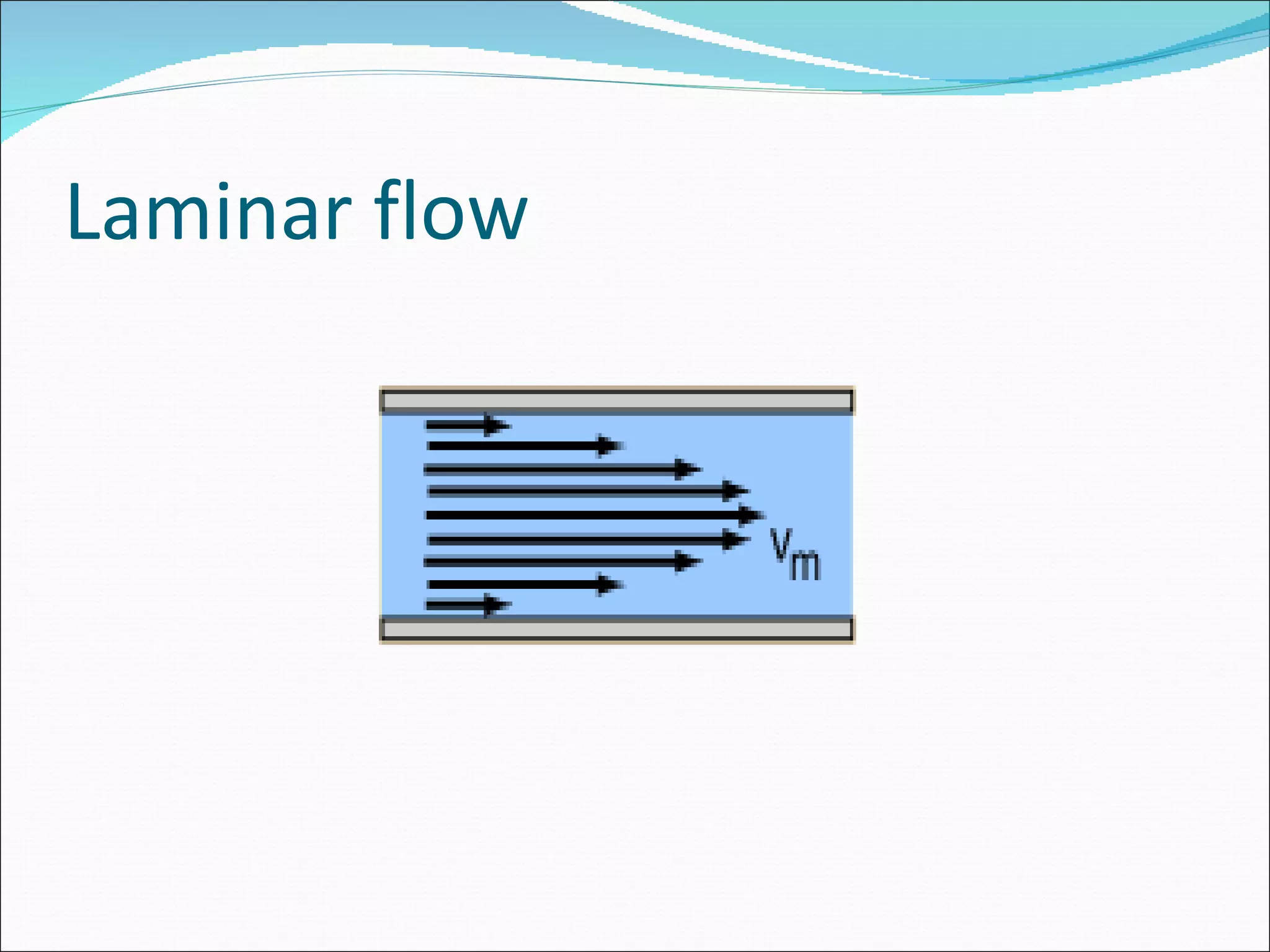
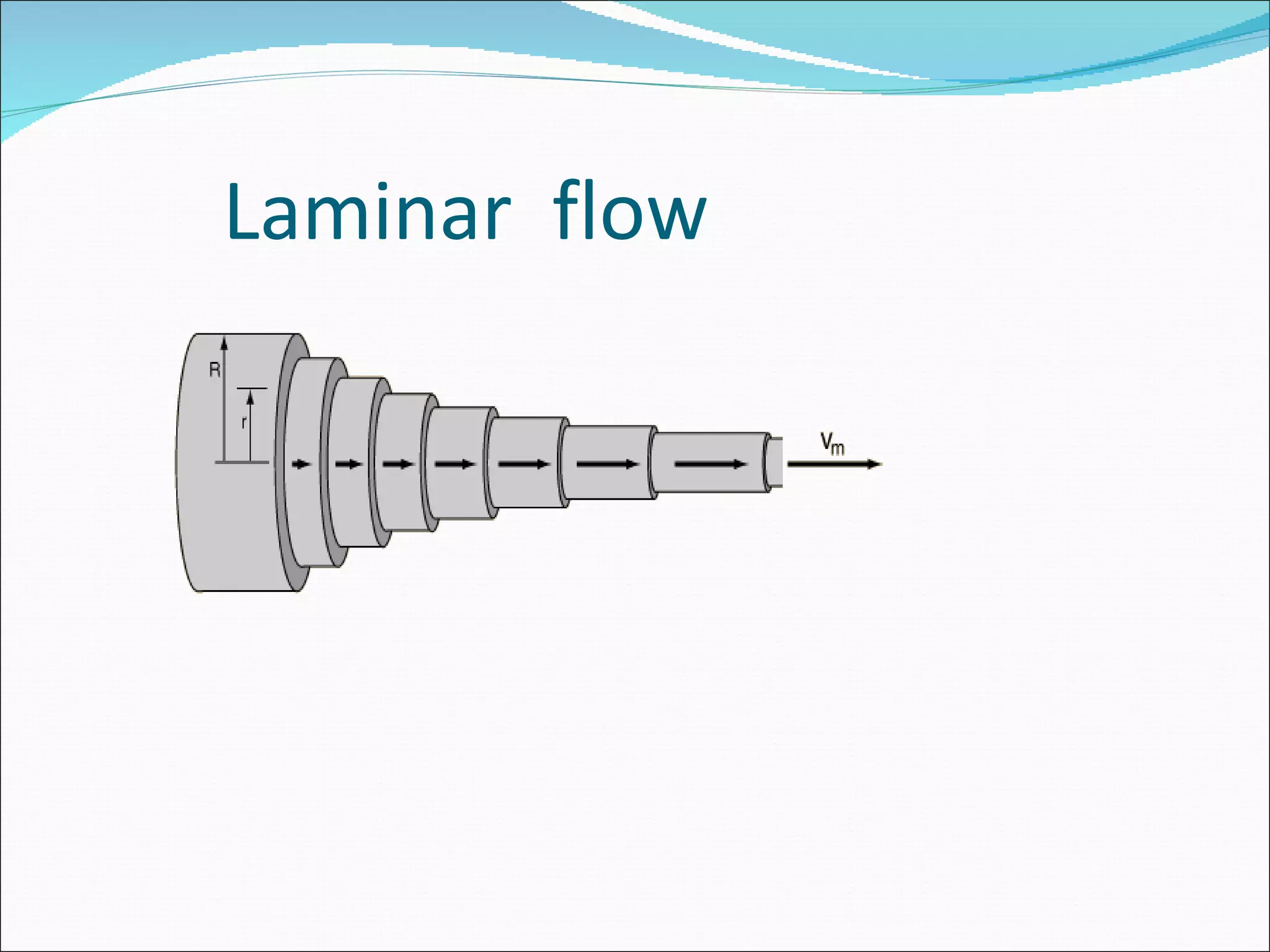
Laminar Flow
 A fluid flows in a steady manner
 No eddies or turbulence
 Present in smooth tubes
 Velocity is low
 Flow is greatest at centre ( 2x mean flow)
 To draw the fluid , a pressure difference must be
 present across the ends of tube.
Laminar flow
 Laminar flow
 Reynold’s number< 2000
 'low' velocity
 Fluid particles move in straight lines
 Simple mathematical analysis possible
Laminar flow
Laminar flow
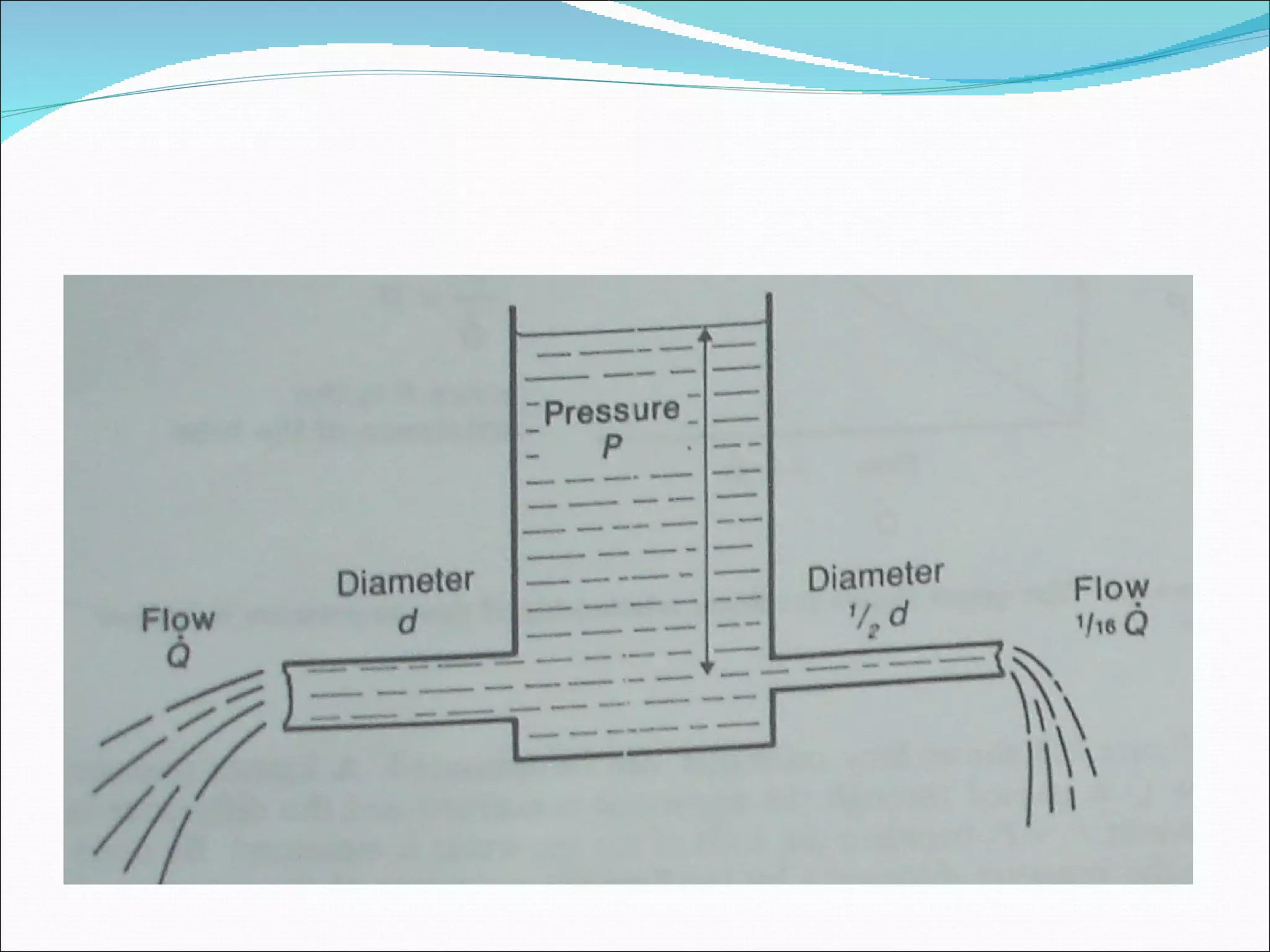
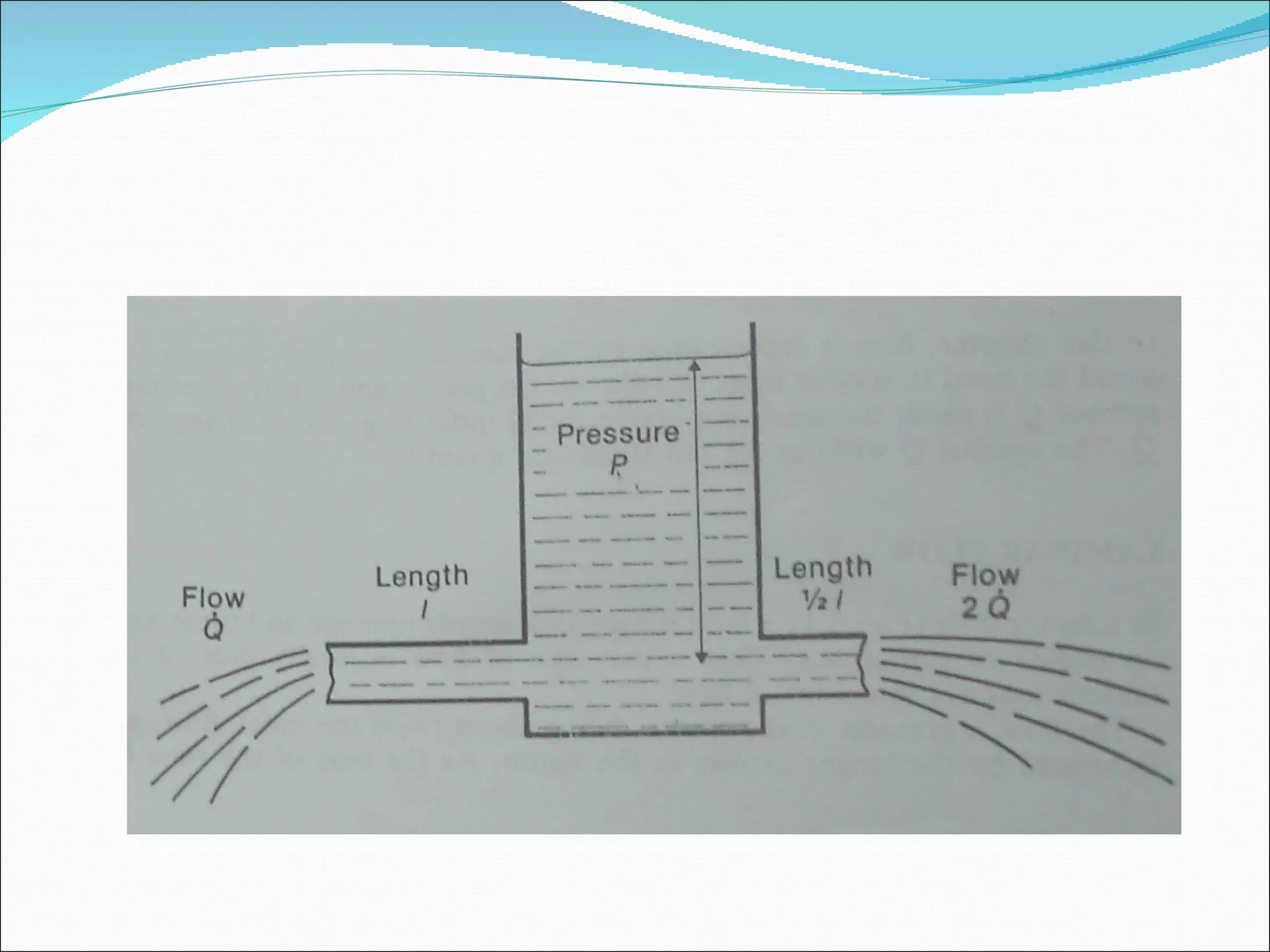
Determinants of laminar flow
 Pressure across tube
 Diameter of tube
 length of tube
 Viscosity of tube
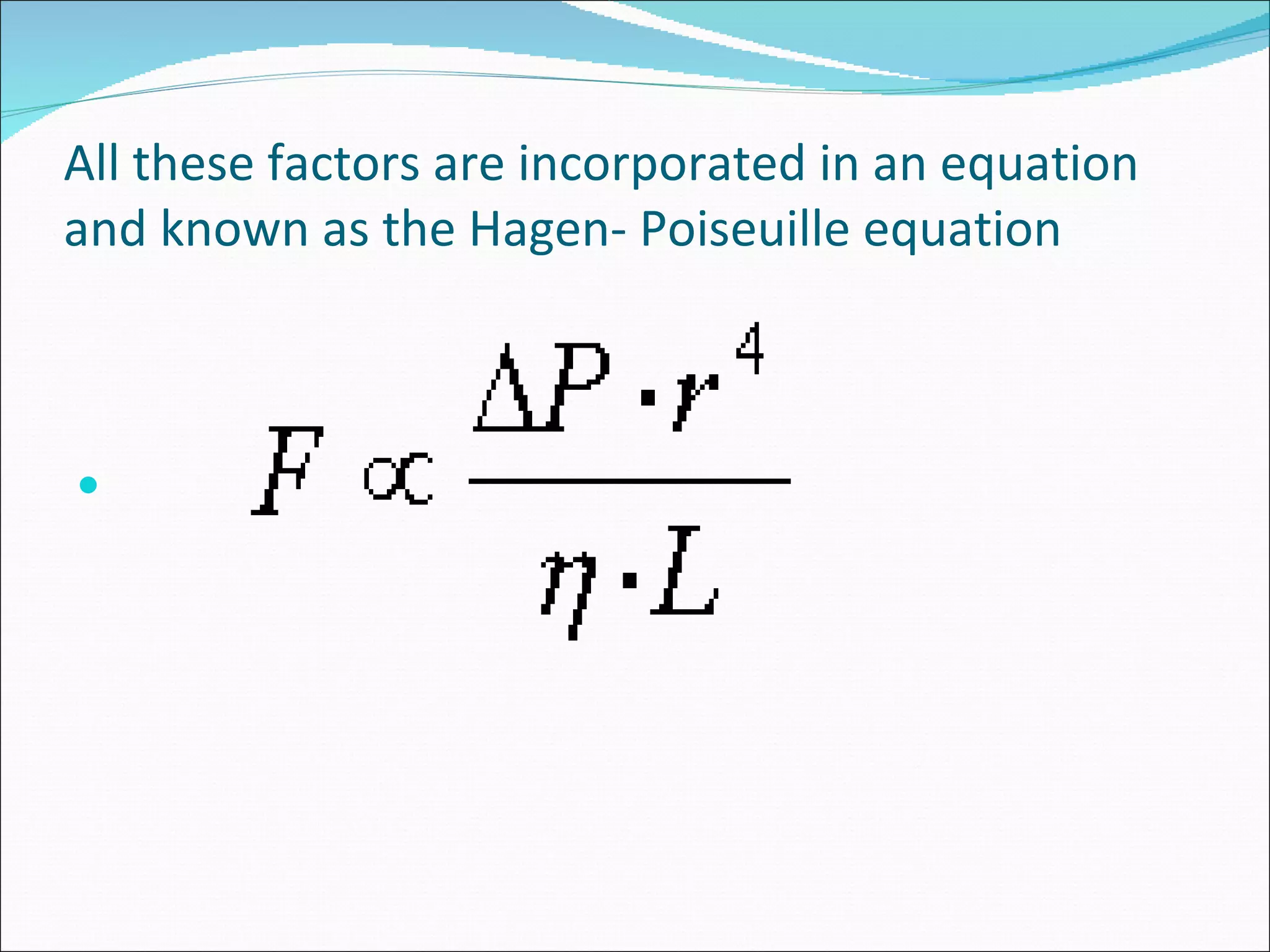
All these factors are incorporated in an equation
and known as the Hagen- Poiseuille equation



Viscosity
 Viscosity of fluid also affects the flow of fluid
 viscosity increase in following condition
      - policythemia
      -Increased fibrinogen level
      - hypothermia
      - cigarette smoking
      - Age
 Increased viscosity leads to increase risk of
  vascular occlusion .
Anaesthetic implication
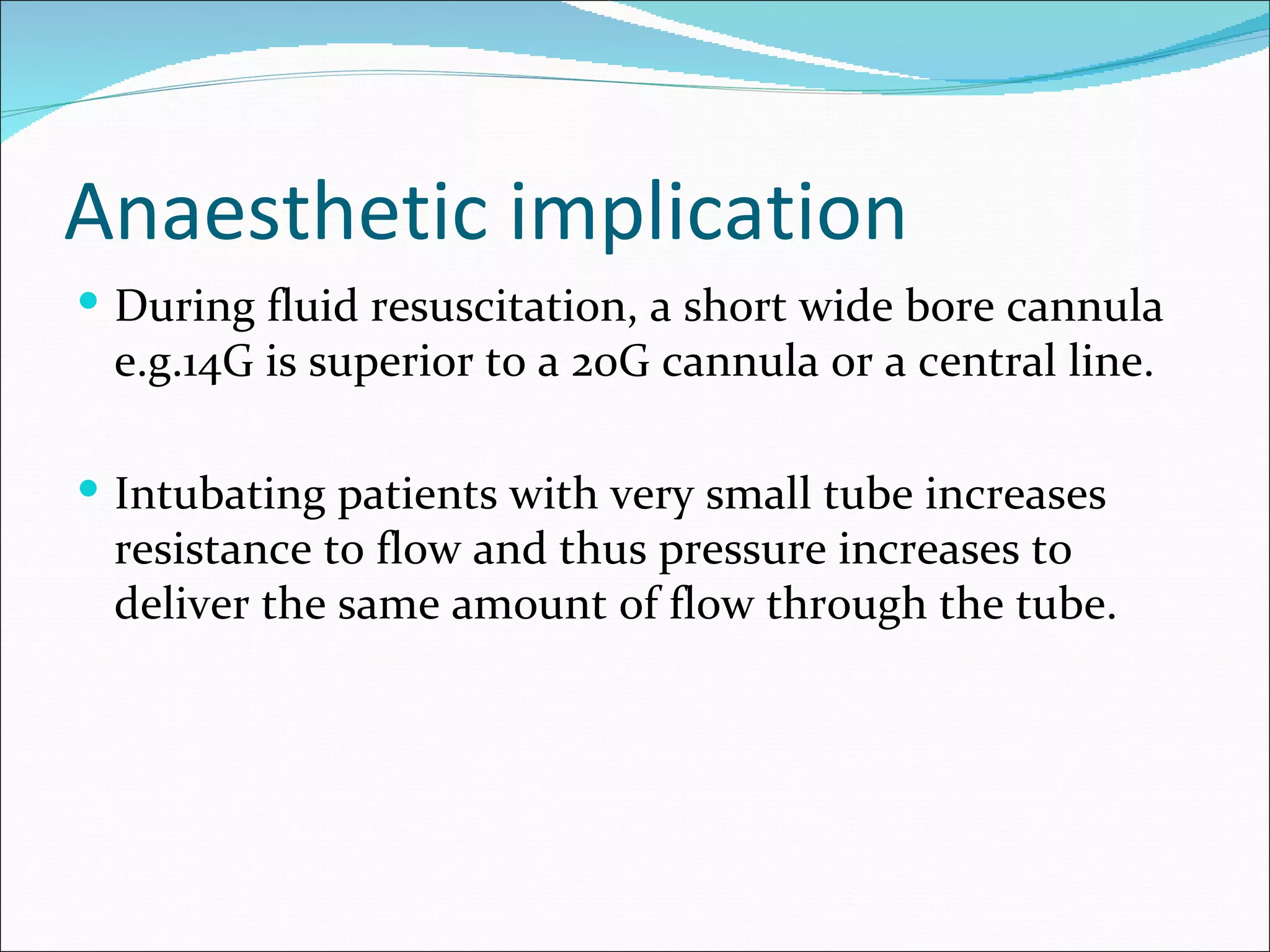
 During fluid resuscitation, a short wide bore cannula
 e.g.14G is superior to a 20G cannula or a central line.

 Intubating patients with very small tube increases
 resistance to flow and thus pressure increases to
 deliver the same amount of flow through the tube.
Critical velocity
 This is the velocity for a given fluid for a given tube
  beyond which laminar flow gets converted into
  turbulent flow.
 When velocity of fluid exceeds this critical velocity ,
  the character of flow changes from laminar to
  turbulent.
 This critical velocity applies only for a given fluid in a
  given tube.
Turbulent flow
 Reynolds's number > 4000
 'high' velocity
 Particle paths completely irregular
 Average motion is in the direction of the flow
 Cannot be seen by the naked eye
 Changes/fluctuations are very difficult to detect.
  Must use laser.
 Mathematical analysis very difficult - so
  experimental measures are used
 Most common type of flow.
Onset of turbulent flow
    Turbulent flow occurs –
2.    Sharp increase of flow
3.   Increase in viscosity or density of the fluid
4.   Decrease in diameter of tube
Turbulent flow
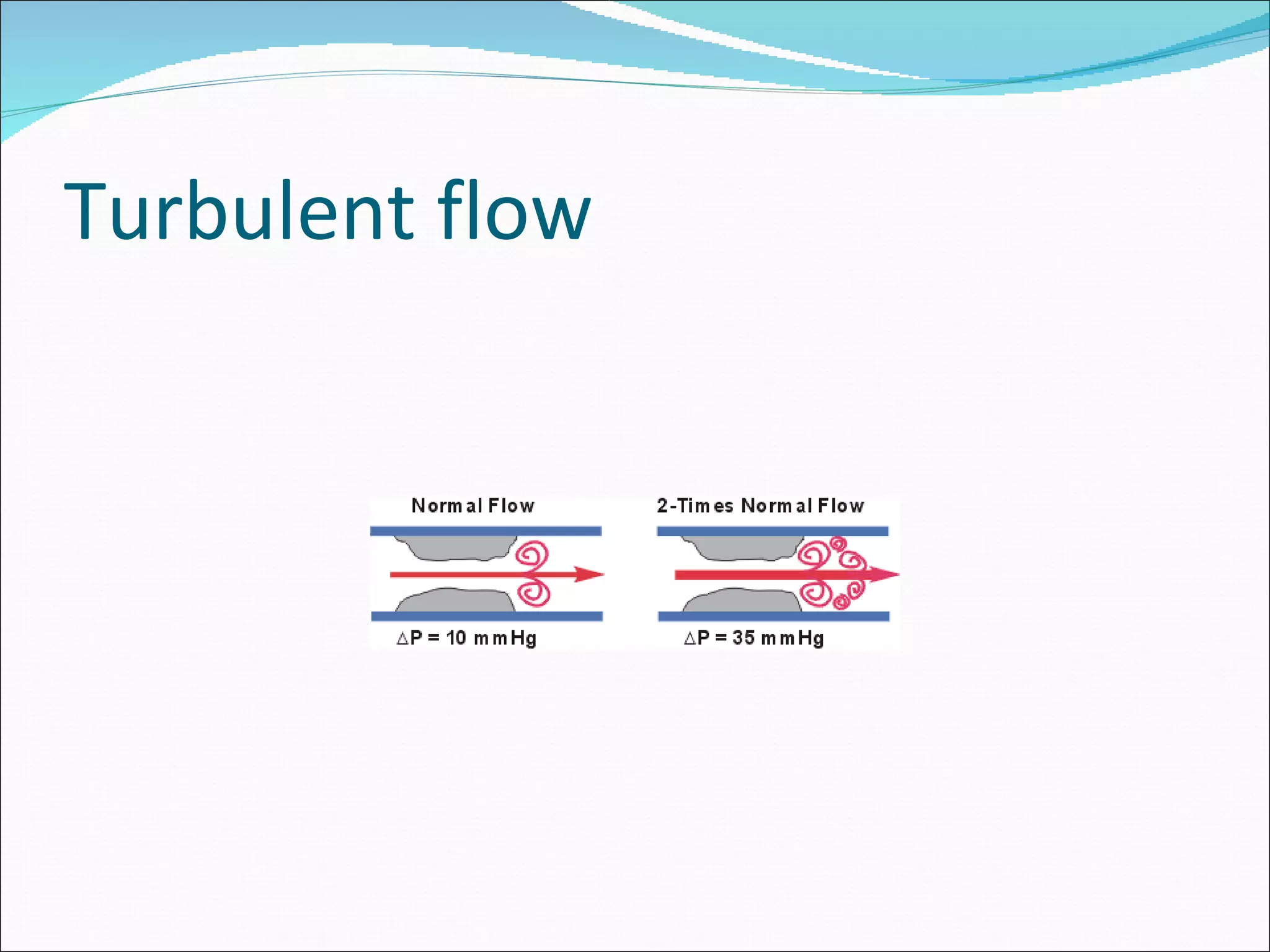
 Laminar flow change to turbulent flow if constriction
    is reached
    Velocity of fluid increases
    Fluid is no longer in a smooth fashion
    Swirls in eddies
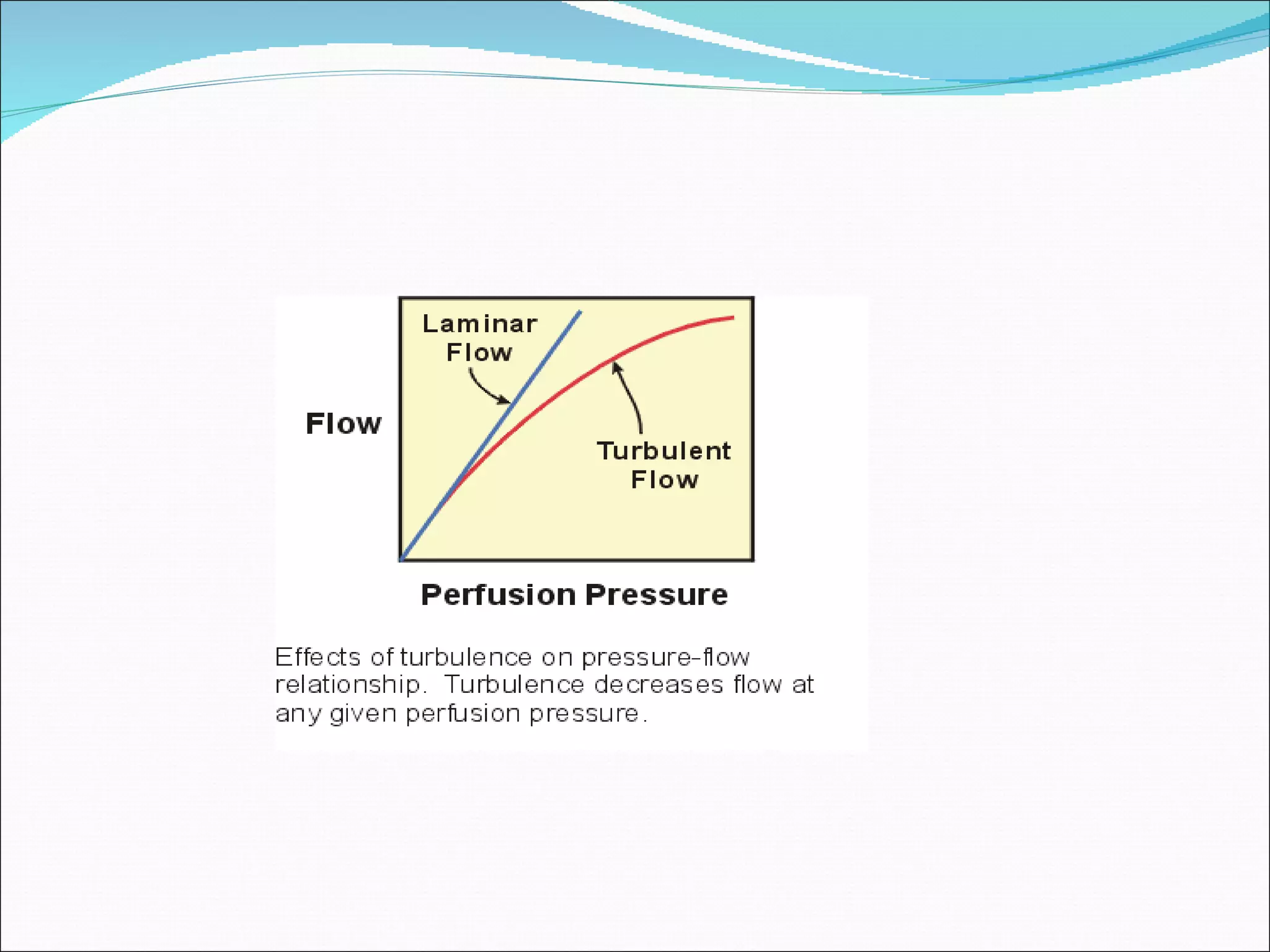
    Resistance is higher than for the same laminar flow .
    Flow is no longer directly proportional to pressure
Turbulent flow
Where turbulent flow is seen ?
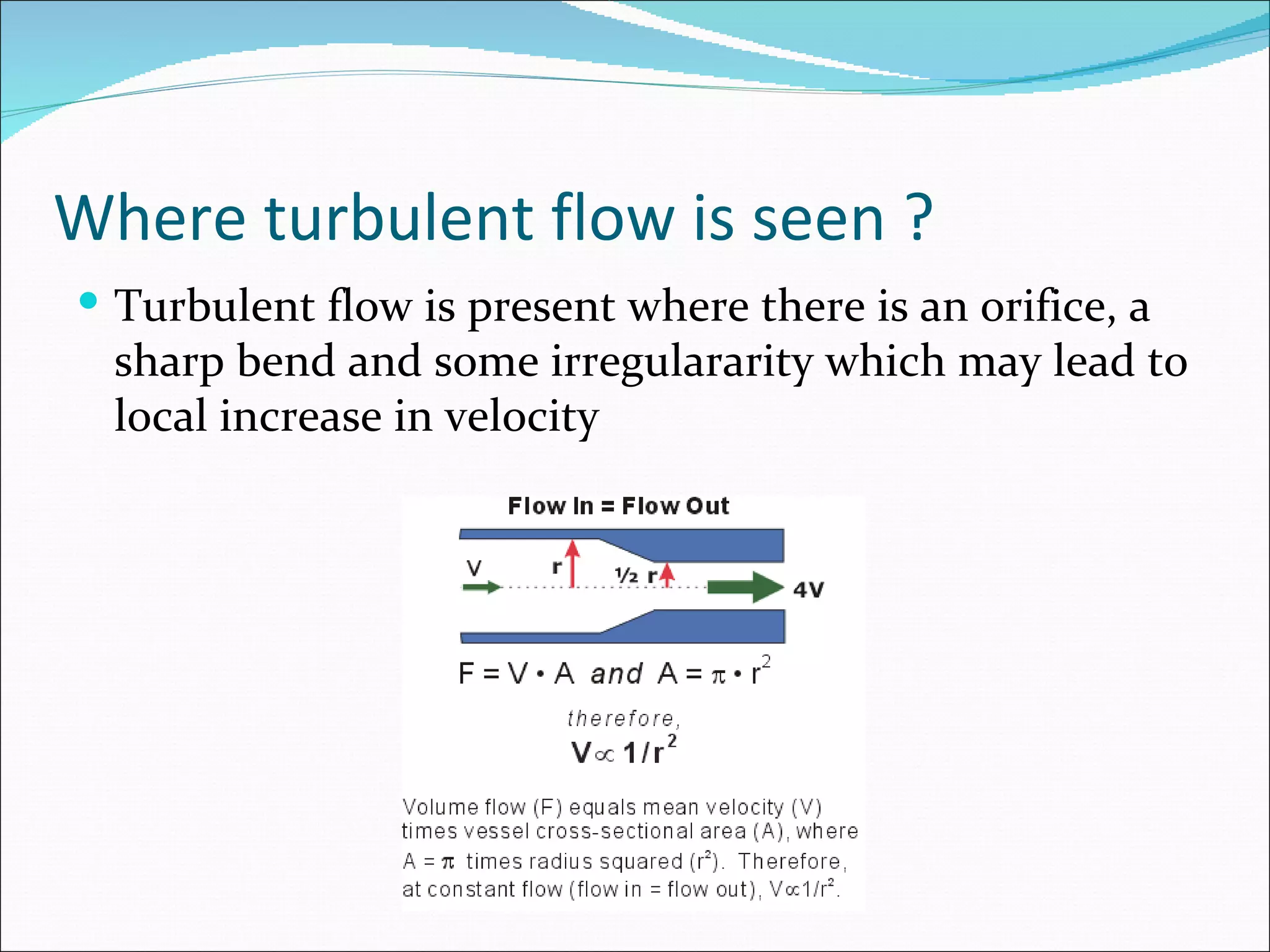
 Turbulent flow is present where there is an orifice, a
  sharp bend and some irregulararity which may lead to
  local increase in velocity
Factors affecting flow and pressure during
turbulent flow
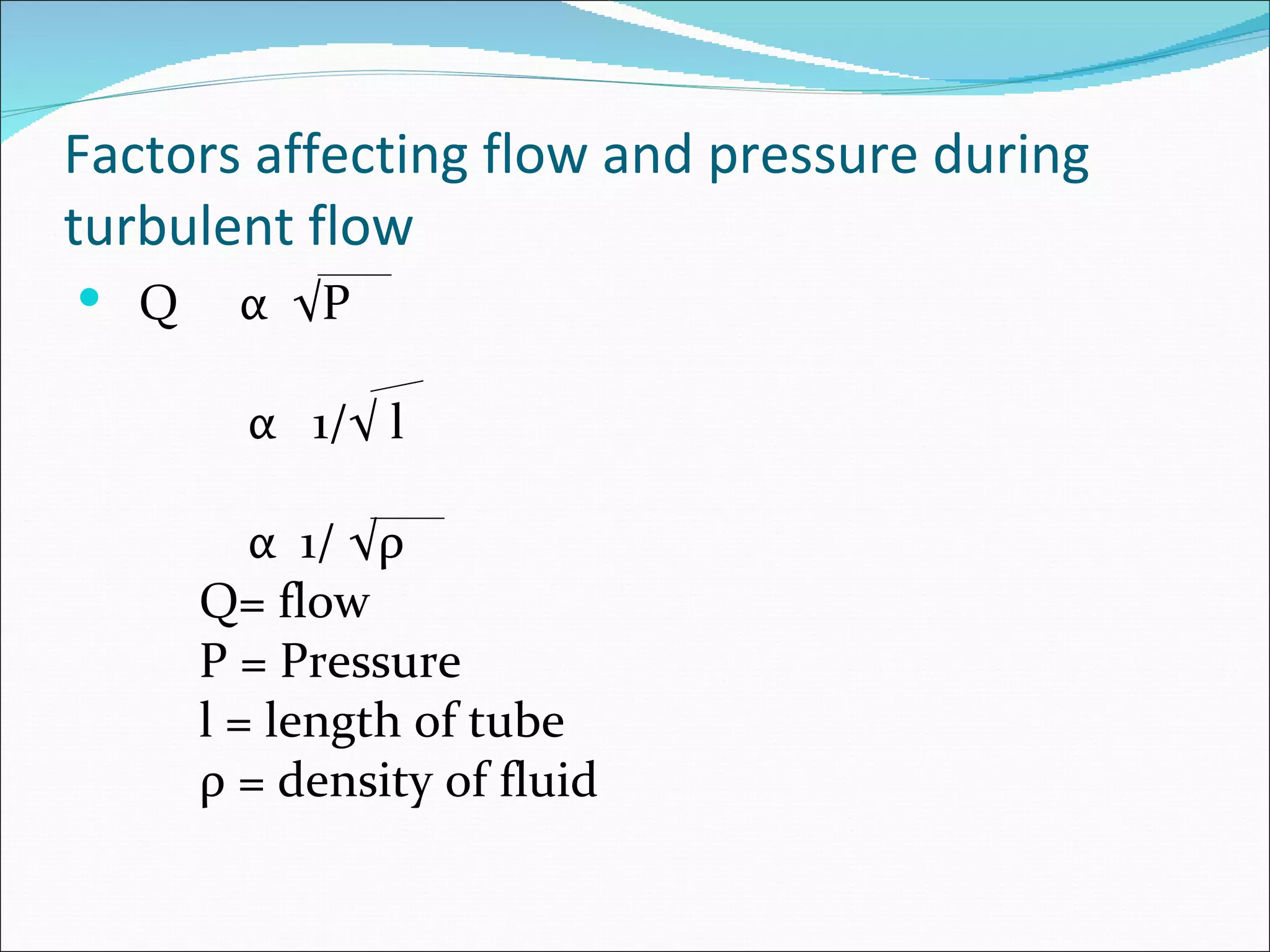
 Q     α √P

        α 1/√ l

         α 1/ √ρ
      Q= flow
      P = Pressure
      l = length of tube
      ρ = density of fluid
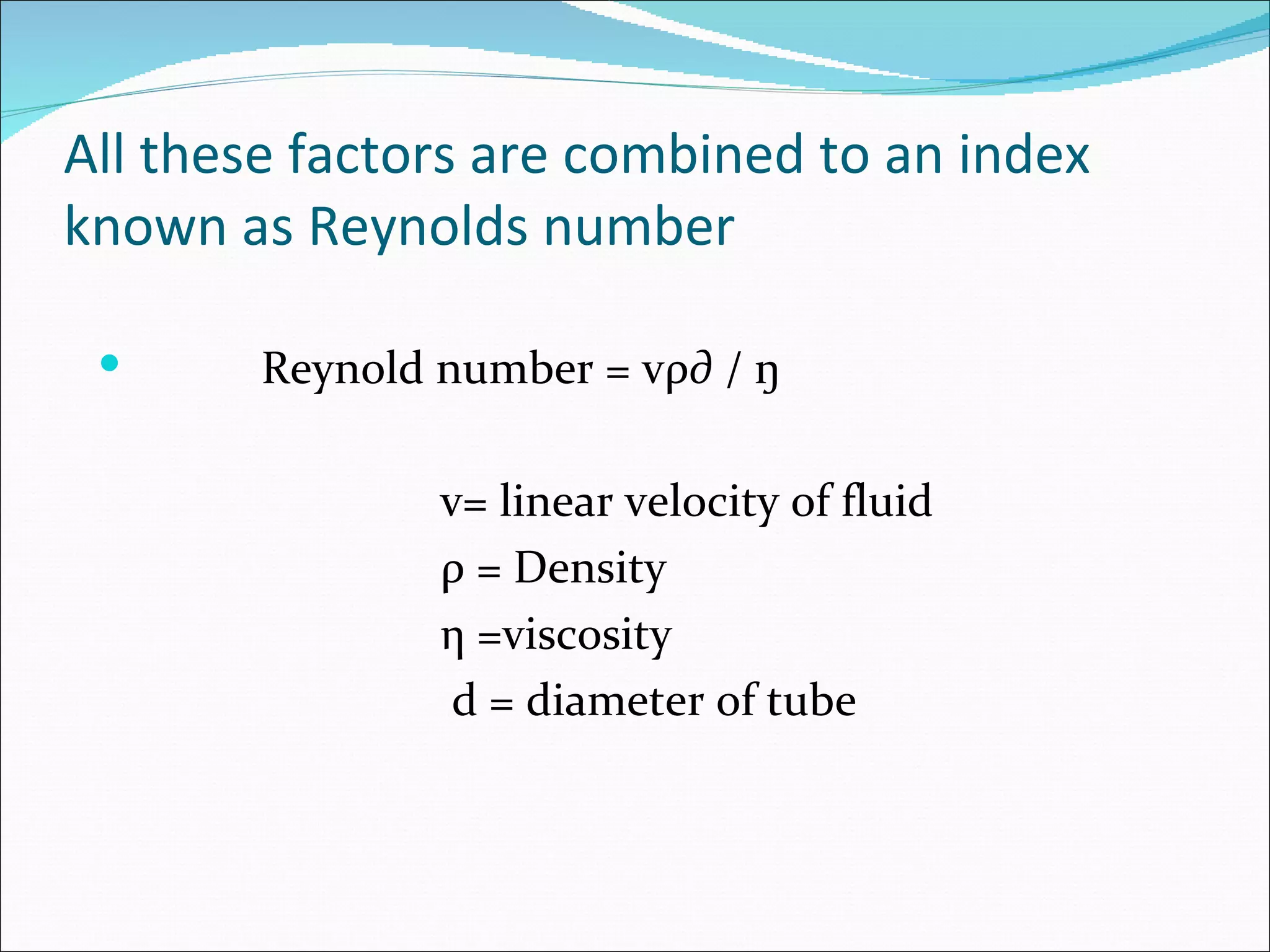
All these factors are combined to an index
known as Reynolds number

       Reynold number = vρ∂ / ŋ

                v= linear velocity of fluid
                ρ = Density
                η =viscosity
                 d = diameter of tube
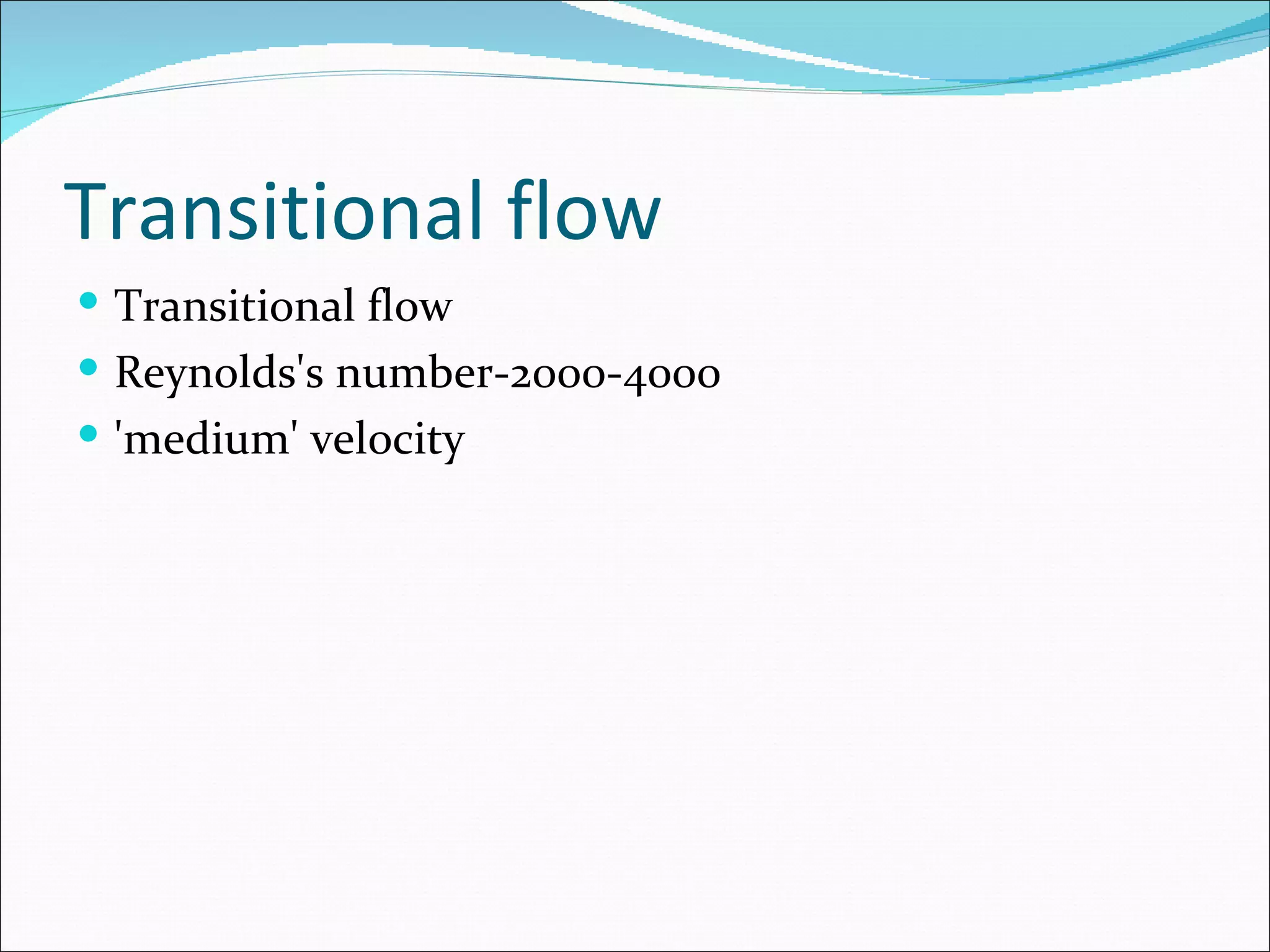
Transitional flow
 Transitional flow
 Reynolds's number-2000-4000
 'medium' velocity
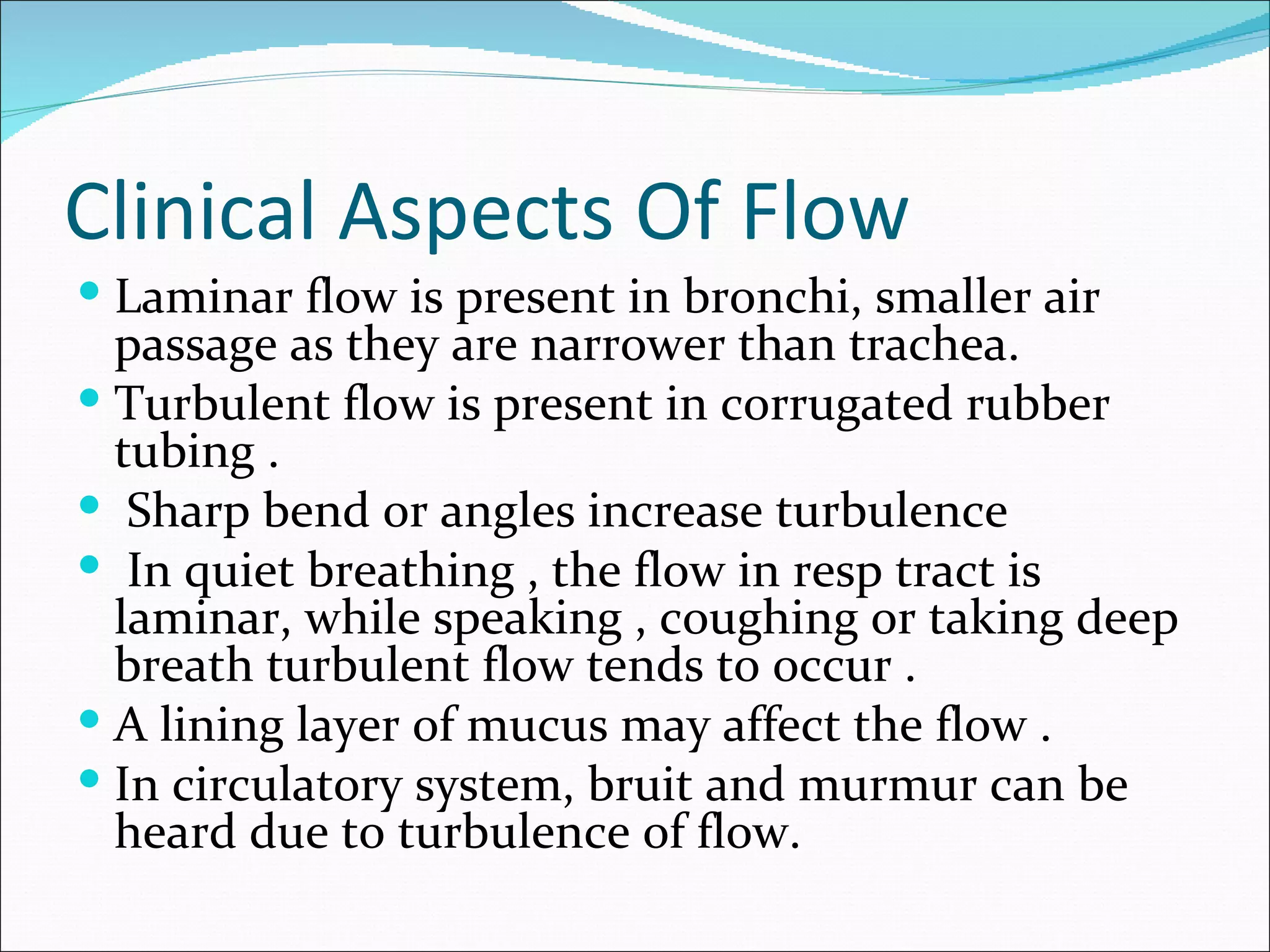
Clinical Aspects Of Flow
 Laminar flow is present in bronchi, smaller air
  passage as they are narrower than trachea.
 Turbulent flow is present in corrugated rubber
  tubing .
 Sharp bend or angles increase turbulence
 In quiet breathing , the flow in resp tract is
  laminar, while speaking , coughing or taking deep
  breath turbulent flow tends to occur .
 A lining layer of mucus may affect the flow .
 In circulatory system, bruit and murmur can be
  heard due to turbulence of flow.
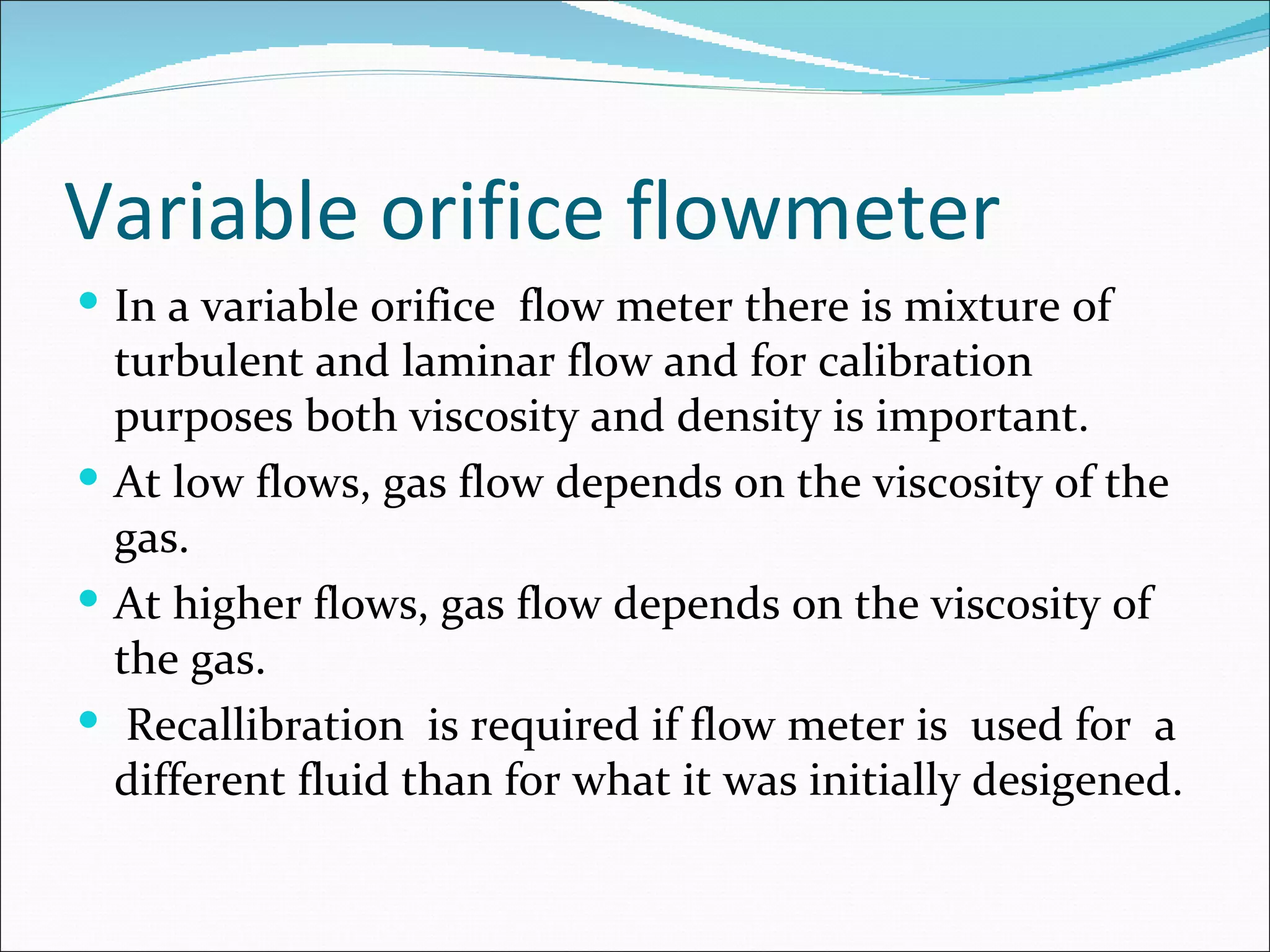
Variable orifice flowmeter
 In a variable orifice flow meter there is mixture of
  turbulent and laminar flow and for calibration
  purposes both viscosity and density is important.
 At low flows, gas flow depends on the viscosity of the
  gas.
 At higher flows, gas flow depends on the viscosity of
  the gas.
 Recallibration is required if flow meter is used for a
  different fluid than for what it was initially desigened.
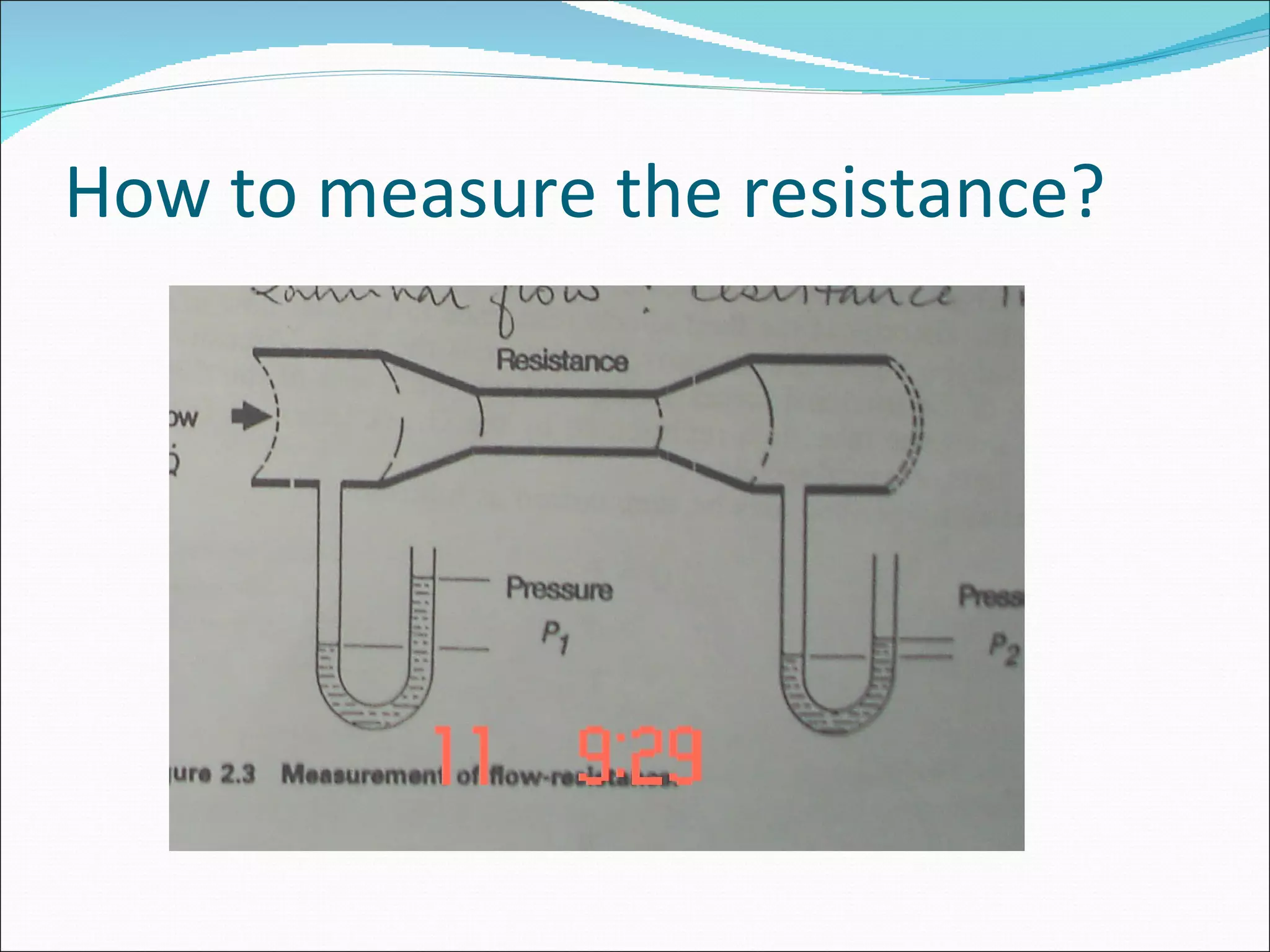
How to measure the resistance
 A constant flow is passed through the apparatus
 Difference in pressure P1-P2 between the ends of
  tube is measured
 By dividing pressure difference by flow
 Provided the flow is laminar , resistance is
  independent of flow
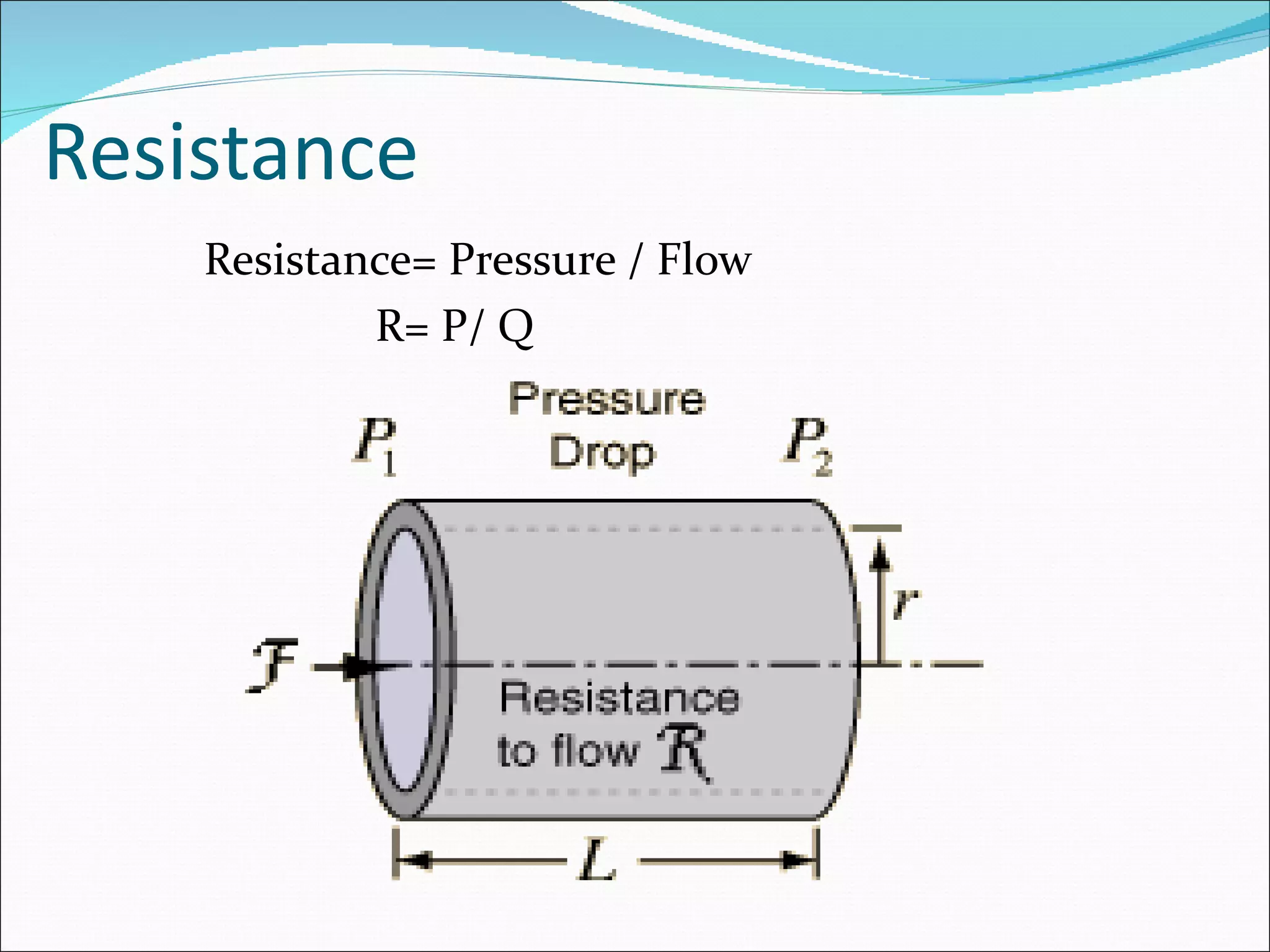
Resistance
    Resistance= Pressure / Flow
            R= P/ Q
How to measure the resistance?
Bernoulli’s Principle
 Describes the relationship between the velocity and
    pressure exerted by a moving liquid.
   Applied to both liquids as well as gases.
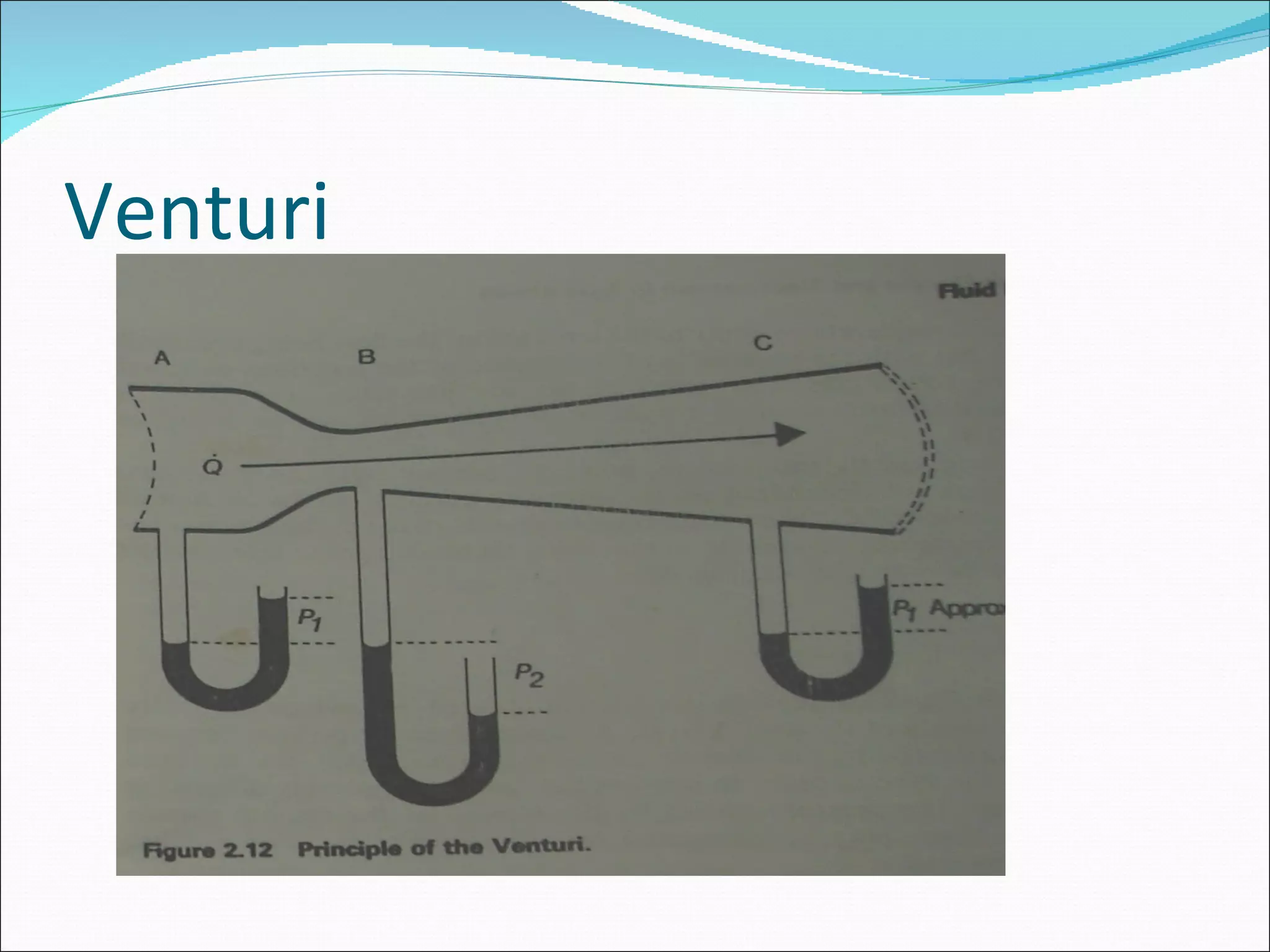
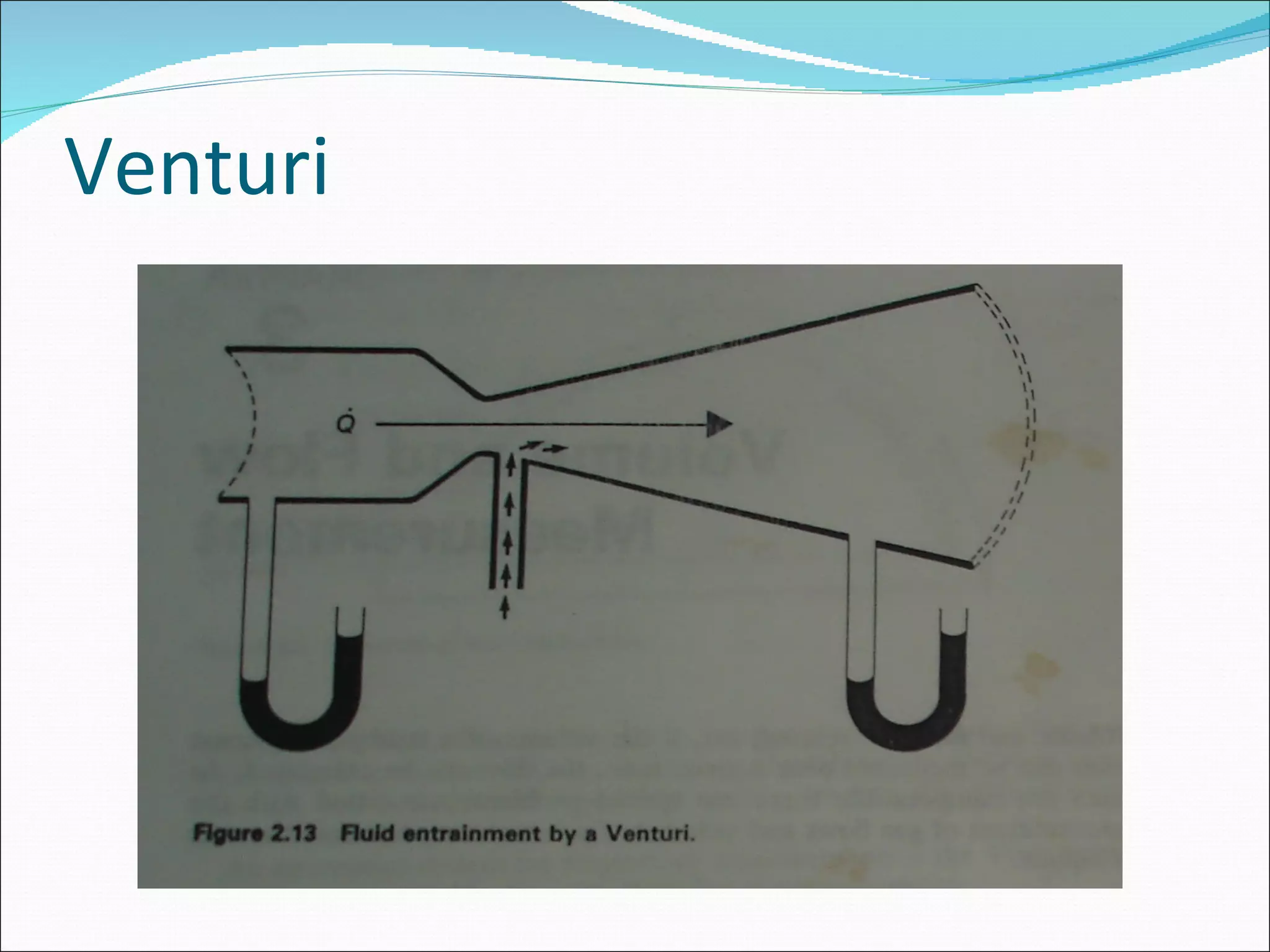
   Venturi effect is based on the Bernoulli’s principle.
   Venturi effect is entrainment of fluid (gas or liquid )
    due to the drop in pressure
   When a fluid flows through a constriction in the tube
    there is reduction in fluid pressure.
   The fluid velocity correspondingly increases in order
    to satisfy the law of conservation of energy.
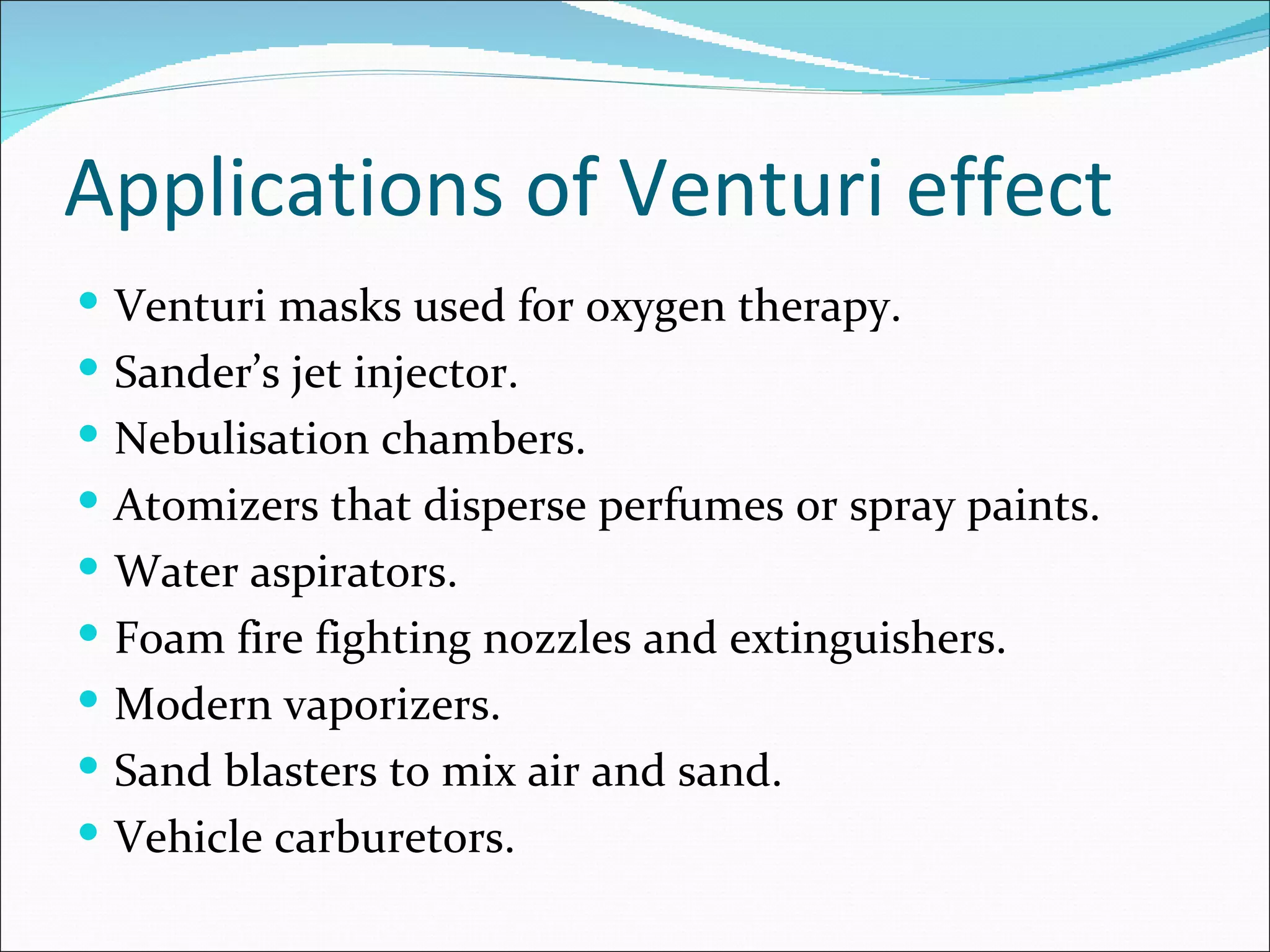
Applications of Venturi effect
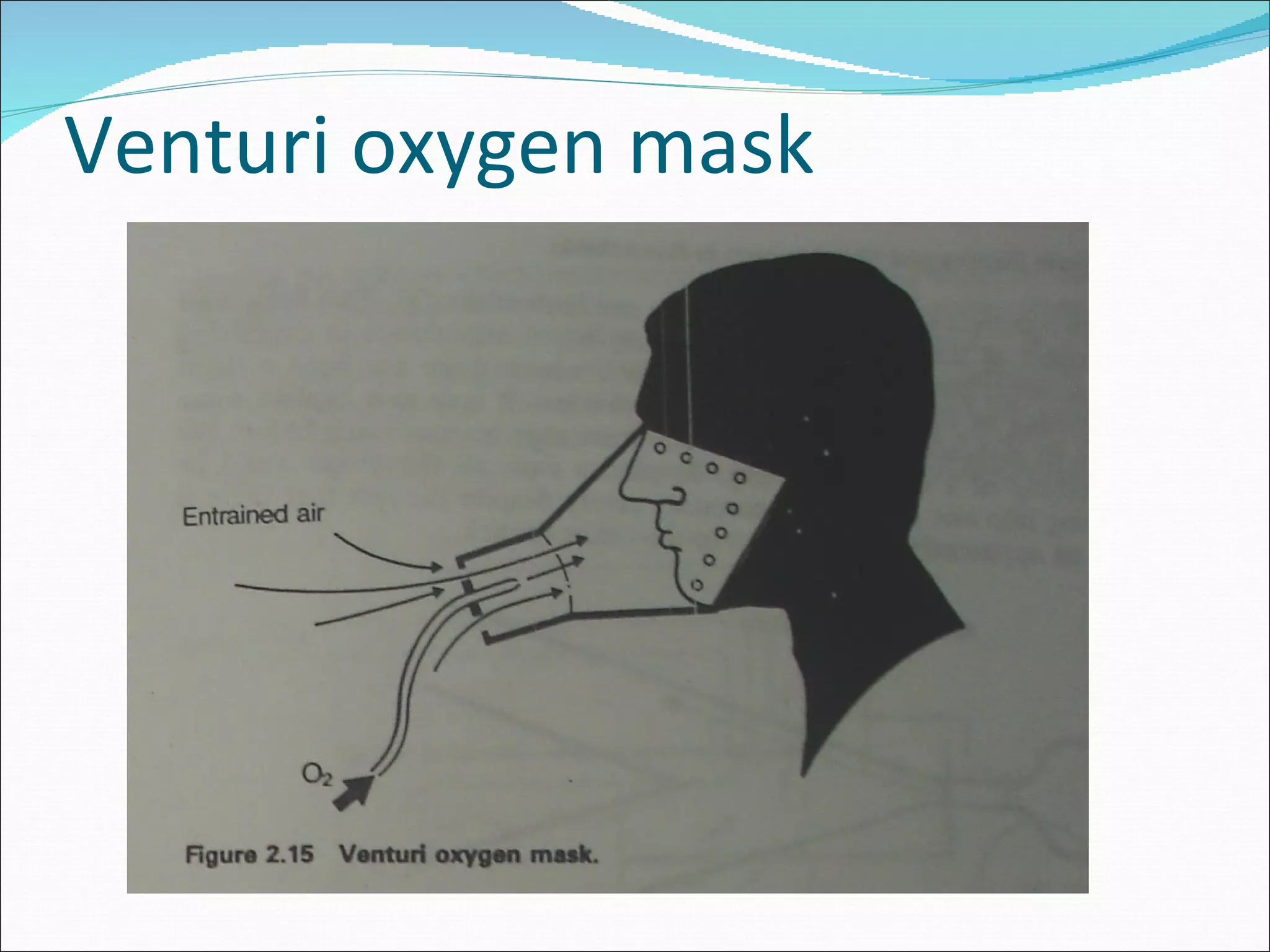
 Venturi masks used for oxygen therapy.
 Sander’s jet injector.
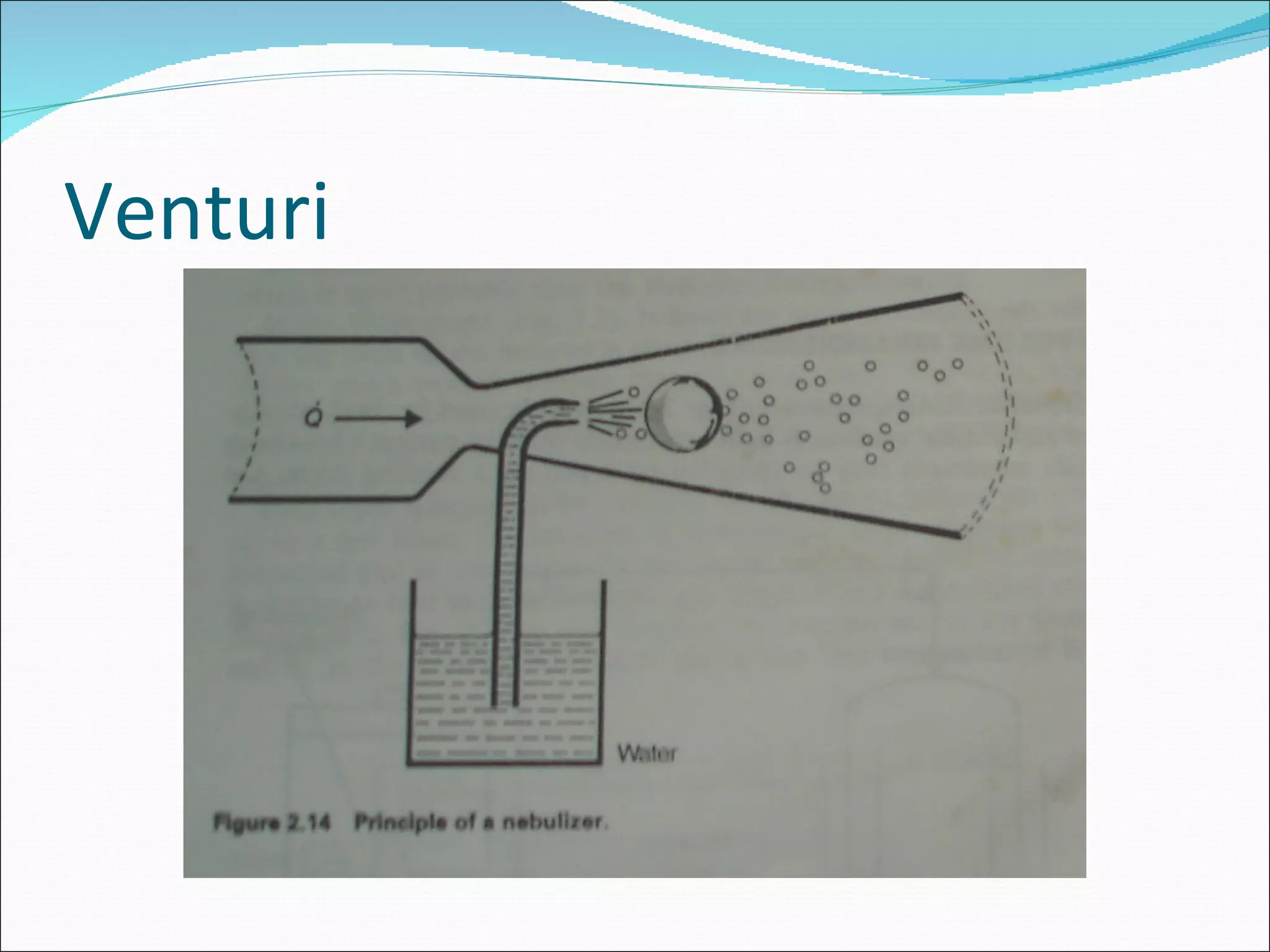
 Nebulisation chambers.
 Atomizers that disperse perfumes or spray paints.
 Water aspirators.
 Foam fire fighting nozzles and extinguishers.
 Modern vaporizers.
 Sand blasters to mix air and sand.
 Vehicle carburetors.
Venturi
Venturi
Venturi
Venturi oxygen mask
Fluid flow  physics and anaesthetic implication

Fluid flow physics and anaesthetic implication

  • 1.
  • 2.
     Flow isdefined as the quantity of a fluid i.e. a gas or liquid passing in unit time F=Q/t F=flow Q= quantity of liquid T=time
  • 3.
    Flow is ofthree types:  Laminar flow  Transitional flow  Turbulent flow
  • 4.
    Laminar Flow  Afluid flows in a steady manner  No eddies or turbulence  Present in smooth tubes  Velocity is low  Flow is greatest at centre ( 2x mean flow)  To draw the fluid , a pressure difference must be present across the ends of tube.
  • 5.
    Laminar flow  Laminarflow  Reynold’s number< 2000  'low' velocity  Fluid particles move in straight lines  Simple mathematical analysis possible
  • 6.
  • 7.
  • 8.
    Determinants of laminarflow  Pressure across tube  Diameter of tube  length of tube  Viscosity of tube
  • 9.
    All these factorsare incorporated in an equation and known as the Hagen- Poiseuille equation 
  • 10.
    Viscosity  Viscosity offluid also affects the flow of fluid  viscosity increase in following condition - policythemia -Increased fibrinogen level - hypothermia - cigarette smoking - Age  Increased viscosity leads to increase risk of vascular occlusion .
  • 13.
    Anaesthetic implication  Duringfluid resuscitation, a short wide bore cannula e.g.14G is superior to a 20G cannula or a central line.  Intubating patients with very small tube increases resistance to flow and thus pressure increases to deliver the same amount of flow through the tube.
  • 15.
    Critical velocity  Thisis the velocity for a given fluid for a given tube beyond which laminar flow gets converted into turbulent flow.  When velocity of fluid exceeds this critical velocity , the character of flow changes from laminar to turbulent.  This critical velocity applies only for a given fluid in a given tube.
  • 16.
    Turbulent flow  Reynolds'snumber > 4000  'high' velocity  Particle paths completely irregular  Average motion is in the direction of the flow  Cannot be seen by the naked eye  Changes/fluctuations are very difficult to detect. Must use laser.  Mathematical analysis very difficult - so experimental measures are used  Most common type of flow.
  • 17.
    Onset of turbulentflow  Turbulent flow occurs – 2. Sharp increase of flow 3. Increase in viscosity or density of the fluid 4. Decrease in diameter of tube
  • 18.
    Turbulent flow  Laminarflow change to turbulent flow if constriction is reached  Velocity of fluid increases  Fluid is no longer in a smooth fashion  Swirls in eddies  Resistance is higher than for the same laminar flow .  Flow is no longer directly proportional to pressure
  • 19.
  • 20.
    Where turbulent flowis seen ?  Turbulent flow is present where there is an orifice, a sharp bend and some irregulararity which may lead to local increase in velocity
  • 21.
    Factors affecting flowand pressure during turbulent flow  Q α √P α 1/√ l α 1/ √ρ Q= flow P = Pressure l = length of tube ρ = density of fluid
  • 22.
    All these factorsare combined to an index known as Reynolds number  Reynold number = vρ∂ / ŋ v= linear velocity of fluid ρ = Density η =viscosity d = diameter of tube
  • 23.
    Transitional flow  Transitionalflow  Reynolds's number-2000-4000  'medium' velocity
  • 24.
    Clinical Aspects OfFlow  Laminar flow is present in bronchi, smaller air passage as they are narrower than trachea.  Turbulent flow is present in corrugated rubber tubing .  Sharp bend or angles increase turbulence  In quiet breathing , the flow in resp tract is laminar, while speaking , coughing or taking deep breath turbulent flow tends to occur .  A lining layer of mucus may affect the flow .  In circulatory system, bruit and murmur can be heard due to turbulence of flow.
  • 25.
    Variable orifice flowmeter In a variable orifice flow meter there is mixture of turbulent and laminar flow and for calibration purposes both viscosity and density is important.  At low flows, gas flow depends on the viscosity of the gas.  At higher flows, gas flow depends on the viscosity of the gas.  Recallibration is required if flow meter is used for a different fluid than for what it was initially desigened.
  • 26.
    How to measurethe resistance  A constant flow is passed through the apparatus  Difference in pressure P1-P2 between the ends of tube is measured  By dividing pressure difference by flow  Provided the flow is laminar , resistance is independent of flow
  • 27.
    Resistance Resistance= Pressure / Flow R= P/ Q
  • 28.
    How to measurethe resistance?
  • 29.
    Bernoulli’s Principle  Describesthe relationship between the velocity and pressure exerted by a moving liquid.  Applied to both liquids as well as gases.  Venturi effect is based on the Bernoulli’s principle.  Venturi effect is entrainment of fluid (gas or liquid ) due to the drop in pressure  When a fluid flows through a constriction in the tube there is reduction in fluid pressure.  The fluid velocity correspondingly increases in order to satisfy the law of conservation of energy.
  • 30.
    Applications of Venturieffect  Venturi masks used for oxygen therapy.  Sander’s jet injector.  Nebulisation chambers.  Atomizers that disperse perfumes or spray paints.  Water aspirators.  Foam fire fighting nozzles and extinguishers.  Modern vaporizers.  Sand blasters to mix air and sand.  Vehicle carburetors.
  • 31.
  • 32.
  • 33.
  • 34.