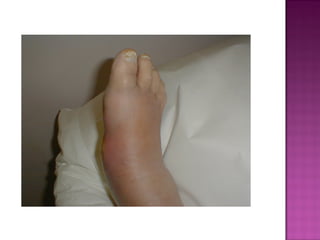
   A 55 year male patient was brought by
    relatives to the ESR with c/o pain and
    swelling over lt foot extending upto below
    knee.Pt also c/o abdominal pain and
    drowsiness since two days.
   O/E:- P:120 bpm, BP:-100/60 mmHg, RR:-
    30cpm, Per abdomen exam reveals
    tenderness.
   General and systemic including airway exam.
   Routine blood investigations:
    Hb:10gm%, CBC: 20200/cu.mm, RFTs &
    LFTs: WNL, RBS: 320mg/dl,
   Serum. electrolytes:- Sr. Na:130mEq/l, Sr. K:
    5mEq/l
   Chest Xray: increased BVM, ECG: NSR, Urine
    routine microscopy;
  Special investigations:
 Serum and urine ketones: ++,
 ABG:- pH:7.25, pO2:90, pCO2:28, Sr
   bicarbonate:15, BE:-9, SO2:97%
If a classic triad of DKA i.e hyperglycemia,
   ketonemia and metabolic acidosis is
   seen,diagnosis
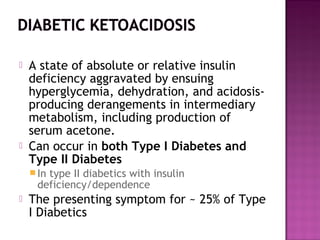
   A state of absolute or relative insulin
    deficiency aggravated by ensuing
    hyperglycemia, dehydration, and acidosis-
    producing derangements in intermediary
    metabolism, including production of
    serum acetone.
   Can occur in both Type I Diabetes and
    Type II Diabetes
     In
       type II diabetics with insulin
     deficiency/dependence
   The presenting symptom for ~ 25% of Type
    I Diabetics
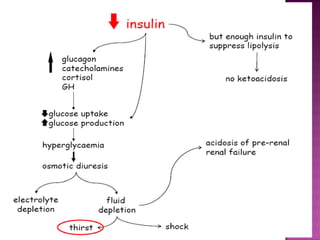
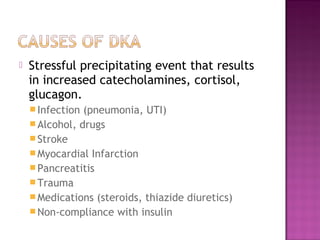
   Stressful precipitating event that results
    in increased catecholamines, cortisol,
    glucagon.
     Infection (pneumonia, UTI)
     Alcohol, drugs
     Stroke
     Myocardial Infarction
     Pancreatitis
     Trauma
     Medications (steroids, thiazide diuretics)
     Non-compliance with insulin
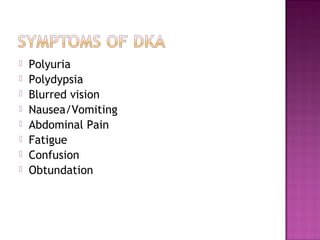
   Polyuria
   Polydypsia
   Blurred vision
   Nausea/Vomiting
   Abdominal Pain
   Fatigue
   Confusion
   Obtundation
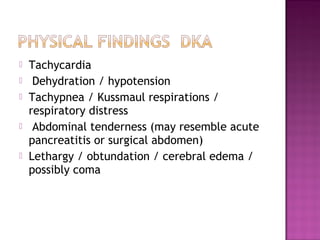
   Tachycardia
    Dehydration / hypotension
   Tachypnea / Kussmaul respirations /
    respiratory distress  
    Abdominal tenderness (may resemble acute
    pancreatitis or surgical abdomen)
   Lethargy / obtundation / cerebral edema /
    possibly coma
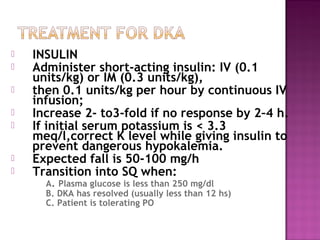
   INSULIN
   Administer short-acting insulin: IV (0.1
    units/kg) or IM (0.3 units/kg),
   then 0.1 units/kg per hour by continuous IV
    infusion;
   Increase 2- to3-fold if no response by 2–4 h.
   If initial serum potassium is < 3.3
    meq/l,correct K level while giving insulin to
    prevent dangerous hypokalemia.
   Expected fall is 50-100 mg/h
   Transition into SQ when:
      A. Plasma glucose is less than 250 mg/dl
      B. DKA has resolved (usually less than 12 hs)
      C. Patient is tolerating PO
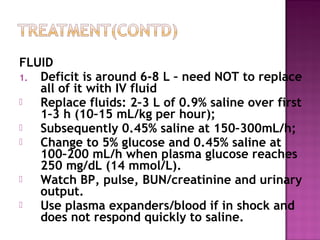
FLUID
1. Deficit is around 6-8 L – need NOT to replace
   all of it with IV fluid
  Replace fluids: 2–3 L of 0.9% saline over first
   1–3 h (10–15 mL/kg per hour);
  Subsequently 0.45% saline at 150–300mL/h;
  Change to 5% glucose and 0.45% saline at
   100–200 mL/h when plasma glucose reaches
   250 mg/dL (14 mmol/L).
  Watch BP, pulse, BUN/creatinine and urinary
   output.
  Use plasma expanders/blood if in shock and
   does not respond quickly to saline.
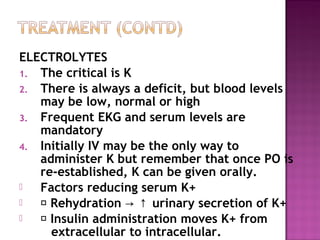
ELECTROLYTES
1. The critical is K
2. There is always a deficit, but blood levels
   may be low, normal or high
3. Frequent EKG and serum levels are
   mandatory
4. Initially IV may be the only way to
   administer K but remember that once PO is
   re-established, K can be given orally.
  Factors reducing serum K+
   􀁺 Rehydration → ↑ urinary secretion of K+
   􀁺 Insulin administration moves K+ from
      extracellular to intracellular.
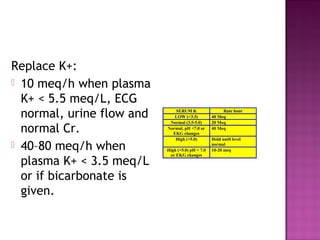
Replace K+:
 10 meq/h when plasma
  K+ < 5.5 meq/L, ECG
  normal, urine flow and      SERUM K
                              LOW (<3.5)
                                                       Rate hour
                                                  40 Meq
                            Normal (3.5-5.0)      20 Meq
  normal Cr.               Normal, pH <7.0 or
                             EKG changes
                                                  40 Meq

                              High (>5.0)         Hold until level
 40–80 meq/h when         High (>5.0) pH < 7.0
                                                  normal
                                                  10-20 meq
                            or EKG changes
  plasma K+ < 3.5 meq/L
  or if bicarbonate is
  given.
BICARBONATE
1. Usually NOT necessary
2. It may even be dangerous and
   precipitate hypokalemia, cerebral
   acidosis and cardiac dysfunction
3. For very severe acidosis (pH <6.9) use
   very small amounts enough to elevate
   pH to 7.0
PHOSPHATE AND OTHER ISSUES
Supplementation only advised if Serum
     phosphate conc <1.0mg/dl or in the
     presence of anemia, cardiac
     dysfunction.
 If needed, 20-30 mEq/l potassium
     phosphate can be given.
 Broad spectrum antibiotic coverage is
     required.
   Measure capillary glucose every 1–2 h;
   electrolytes (especially K+, bicarbonate, phosphate) &
    anion gap every 4 h for first 24 h.
   Monitor BP, pulse, respirations, mental status, fluid intake
    and output every 1–4 h.
   Assess patient:
   What precipitated the episode (noncompliance, infection,
    trauma, infarction, cocaine)?
   Initiate appropriate workup for precipitating event
    (cultures, CXR, ECG).
   Continue above until patient is stable, glucose goal is 150–
    250 mg/dL, and acidosis is resolved.
   Insulin infusion may be decreased to 0.05–0.1 units/kg/hr.
   Cerebral edema                 Pulmonary Edema
       First 24hrs                  and Hypoxemia
     Mental status changes
     Tx: Mannitol
                                   Iatrogenic
     May require intubation
                                    hypoglycemia and
      with hyperventilation         hypokalemia
   Shock
       If not improving with
        fluids   r/o MI
   Vascular
    thrombosis
       Severe dehydration
       Cerebral vessels
       Occurs hours to days
        after DKA
   With a central line already in situ, patient is
    taken inside the O.T. after checking
    starvation and high risk consent.
   Adequate amount of crossmatched blood is
    kept ready.
   The standard monitors attached. HGT,CVP
    and urine output monitoring is essential.
   IV fluid is attached.
   Low dose unilateral sub arachnoid block can
    be given using 0.5%(H) Inj.Bupivacaine and
    Inj. Fentanyl as additive making a total
    volume of 1.2-1.4cc.
   Excellent analgesia.no need to use NSAIDS or
    opiods intra op.
   Hypoglycemia & hyperglycemic coma can be
    detected early.
   Avoidance of ETT & resultant infection.
   Disadvantages:
   Inadvertant higher level of block can result
    in hypotension complicated by autonomic
    neuropathy in DM.
   Sympathetic blockade can impair control of
    insulin secretion.
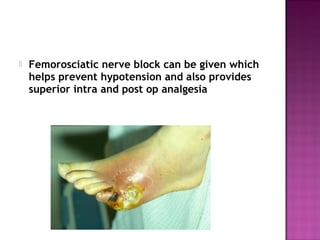
   Femorosciatic nerve block can be given which
    helps prevent hypotension and also provides
    superior intra and post op analgesia
   Epidural anaesthesia either single shot or
    catheter in situ can be used to avoid
    hypotension and also for post op pain relief.
   Disadvantage includes risks of infection and
    vascular damage.
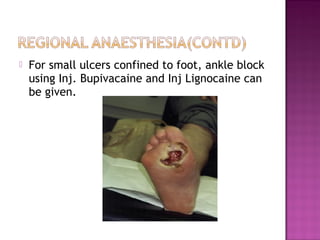
   For small ulcers confined to foot, ankle block
    using Inj. Bupivacaine and Inj Lignocaine can
    be given.
Aspiration prophylaxis is given with antacid
    and antiemetic.
   Rapid sequence induction should be done in
    case of inadequate starvation or autonomic
    neuropathy(gastroparesis).
   Muscle relaxant: Rocuronium should be used
    instead of Sch i/c/o hyperkalemia
   After induction, Inj.midazolam and
    opiod(preferably fentanyl) is given in titrated
    doses for analgesia and sedation.
   Maintenance: oxygen & nitrous oxide and
    sevoflurane or Isoflurane.
   Reversal:routine reversal
   Extubation: after adequate recovery of
    airway reflexes.
   Post op monitoring: blood sugar level,serum
    and urine ketones, serum electrolytes

Diabetic ketoacidosis ppt

  • 1.
    A 55 year male patient was brought by relatives to the ESR with c/o pain and swelling over lt foot extending upto below knee.Pt also c/o abdominal pain and drowsiness since two days.  O/E:- P:120 bpm, BP:-100/60 mmHg, RR:- 30cpm, Per abdomen exam reveals tenderness.
  • 3.
    General and systemic including airway exam.  Routine blood investigations:  Hb:10gm%, CBC: 20200/cu.mm, RFTs & LFTs: WNL, RBS: 320mg/dl,  Serum. electrolytes:- Sr. Na:130mEq/l, Sr. K: 5mEq/l  Chest Xray: increased BVM, ECG: NSR, Urine routine microscopy;
  • 4.
     Specialinvestigations:  Serum and urine ketones: ++,  ABG:- pH:7.25, pO2:90, pCO2:28, Sr bicarbonate:15, BE:-9, SO2:97% If a classic triad of DKA i.e hyperglycemia, ketonemia and metabolic acidosis is seen,diagnosis
  • 5.
    A state of absolute or relative insulin deficiency aggravated by ensuing hyperglycemia, dehydration, and acidosis- producing derangements in intermediary metabolism, including production of serum acetone.  Can occur in both Type I Diabetes and Type II Diabetes  In type II diabetics with insulin deficiency/dependence  The presenting symptom for ~ 25% of Type I Diabetics
  • 7.
    Stressful precipitating event that results in increased catecholamines, cortisol, glucagon.  Infection (pneumonia, UTI)  Alcohol, drugs  Stroke  Myocardial Infarction  Pancreatitis  Trauma  Medications (steroids, thiazide diuretics)  Non-compliance with insulin
  • 8.
    Polyuria  Polydypsia  Blurred vision  Nausea/Vomiting  Abdominal Pain  Fatigue  Confusion  Obtundation
  • 9.
    Tachycardia   Dehydration / hypotension  Tachypnea / Kussmaul respirations / respiratory distress     Abdominal tenderness (may resemble acute pancreatitis or surgical abdomen)  Lethargy / obtundation / cerebral edema / possibly coma
  • 10.
    INSULIN  Administer short-acting insulin: IV (0.1 units/kg) or IM (0.3 units/kg),  then 0.1 units/kg per hour by continuous IV infusion;  Increase 2- to3-fold if no response by 2–4 h.  If initial serum potassium is < 3.3 meq/l,correct K level while giving insulin to prevent dangerous hypokalemia.  Expected fall is 50-100 mg/h  Transition into SQ when: A. Plasma glucose is less than 250 mg/dl B. DKA has resolved (usually less than 12 hs) C. Patient is tolerating PO
  • 11.
    FLUID 1. Deficit isaround 6-8 L – need NOT to replace all of it with IV fluid  Replace fluids: 2–3 L of 0.9% saline over first 1–3 h (10–15 mL/kg per hour);  Subsequently 0.45% saline at 150–300mL/h;  Change to 5% glucose and 0.45% saline at 100–200 mL/h when plasma glucose reaches 250 mg/dL (14 mmol/L).  Watch BP, pulse, BUN/creatinine and urinary output.  Use plasma expanders/blood if in shock and does not respond quickly to saline.
  • 12.
    ELECTROLYTES 1. The criticalis K 2. There is always a deficit, but blood levels may be low, normal or high 3. Frequent EKG and serum levels are mandatory 4. Initially IV may be the only way to administer K but remember that once PO is re-established, K can be given orally.  Factors reducing serum K+  􀁺 Rehydration → ↑ urinary secretion of K+  􀁺 Insulin administration moves K+ from extracellular to intracellular.
  • 13.
    Replace K+:  10meq/h when plasma K+ < 5.5 meq/L, ECG normal, urine flow and SERUM K LOW (<3.5) Rate hour 40 Meq Normal (3.5-5.0) 20 Meq normal Cr. Normal, pH <7.0 or EKG changes 40 Meq High (>5.0) Hold until level  40–80 meq/h when High (>5.0) pH < 7.0 normal 10-20 meq or EKG changes plasma K+ < 3.5 meq/L or if bicarbonate is given.
  • 14.
    BICARBONATE 1. Usually NOTnecessary 2. It may even be dangerous and precipitate hypokalemia, cerebral acidosis and cardiac dysfunction 3. For very severe acidosis (pH <6.9) use very small amounts enough to elevate pH to 7.0
  • 15.
    PHOSPHATE AND OTHERISSUES Supplementation only advised if Serum phosphate conc <1.0mg/dl or in the presence of anemia, cardiac dysfunction. If needed, 20-30 mEq/l potassium phosphate can be given. Broad spectrum antibiotic coverage is required.
  • 16.
    Measure capillary glucose every 1–2 h;  electrolytes (especially K+, bicarbonate, phosphate) & anion gap every 4 h for first 24 h.  Monitor BP, pulse, respirations, mental status, fluid intake and output every 1–4 h.  Assess patient:  What precipitated the episode (noncompliance, infection, trauma, infarction, cocaine)?  Initiate appropriate workup for precipitating event (cultures, CXR, ECG).  Continue above until patient is stable, glucose goal is 150– 250 mg/dL, and acidosis is resolved.  Insulin infusion may be decreased to 0.05–0.1 units/kg/hr.
  • 17.
    Cerebral edema  Pulmonary Edema First 24hrs and Hypoxemia  Mental status changes  Tx: Mannitol  Iatrogenic  May require intubation hypoglycemia and with hyperventilation hypokalemia  Shock  If not improving with fluids r/o MI  Vascular thrombosis  Severe dehydration  Cerebral vessels  Occurs hours to days after DKA
  • 18.
    With a central line already in situ, patient is taken inside the O.T. after checking starvation and high risk consent.  Adequate amount of crossmatched blood is kept ready.  The standard monitors attached. HGT,CVP and urine output monitoring is essential.  IV fluid is attached.
  • 19.
    Low dose unilateral sub arachnoid block can be given using 0.5%(H) Inj.Bupivacaine and Inj. Fentanyl as additive making a total volume of 1.2-1.4cc.  Excellent analgesia.no need to use NSAIDS or opiods intra op.  Hypoglycemia & hyperglycemic coma can be detected early.  Avoidance of ETT & resultant infection.
  • 20.
    Disadvantages:  Inadvertant higher level of block can result in hypotension complicated by autonomic neuropathy in DM.  Sympathetic blockade can impair control of insulin secretion.
  • 21.
    Femorosciatic nerve block can be given which helps prevent hypotension and also provides superior intra and post op analgesia
  • 22.
    Epidural anaesthesia either single shot or catheter in situ can be used to avoid hypotension and also for post op pain relief.  Disadvantage includes risks of infection and vascular damage.
  • 23.
    For small ulcers confined to foot, ankle block using Inj. Bupivacaine and Inj Lignocaine can be given.
  • 24.
    Aspiration prophylaxis isgiven with antacid and antiemetic.  Rapid sequence induction should be done in case of inadequate starvation or autonomic neuropathy(gastroparesis).  Muscle relaxant: Rocuronium should be used instead of Sch i/c/o hyperkalemia  After induction, Inj.midazolam and opiod(preferably fentanyl) is given in titrated doses for analgesia and sedation.
  • 25.
    Maintenance: oxygen & nitrous oxide and sevoflurane or Isoflurane.  Reversal:routine reversal  Extubation: after adequate recovery of airway reflexes.  Post op monitoring: blood sugar level,serum and urine ketones, serum electrolytes