RSAAlgorithm
By: Dr. Kapil Gupta
1
CONTENTS
• Symmetric Encryption
• Symmetric Cipher Model
• Asymmetric Encryption
• Asymmetric Cipher Model
• RSAAlgorithm
2
Symmetric Encryption
• Conventional / Private-key / Single-key
• sender and recipient share a common key
• all classical encryption algorithms are private-
key
• was only type prior to invention of public-key
in 1970’s
• most widely used
3
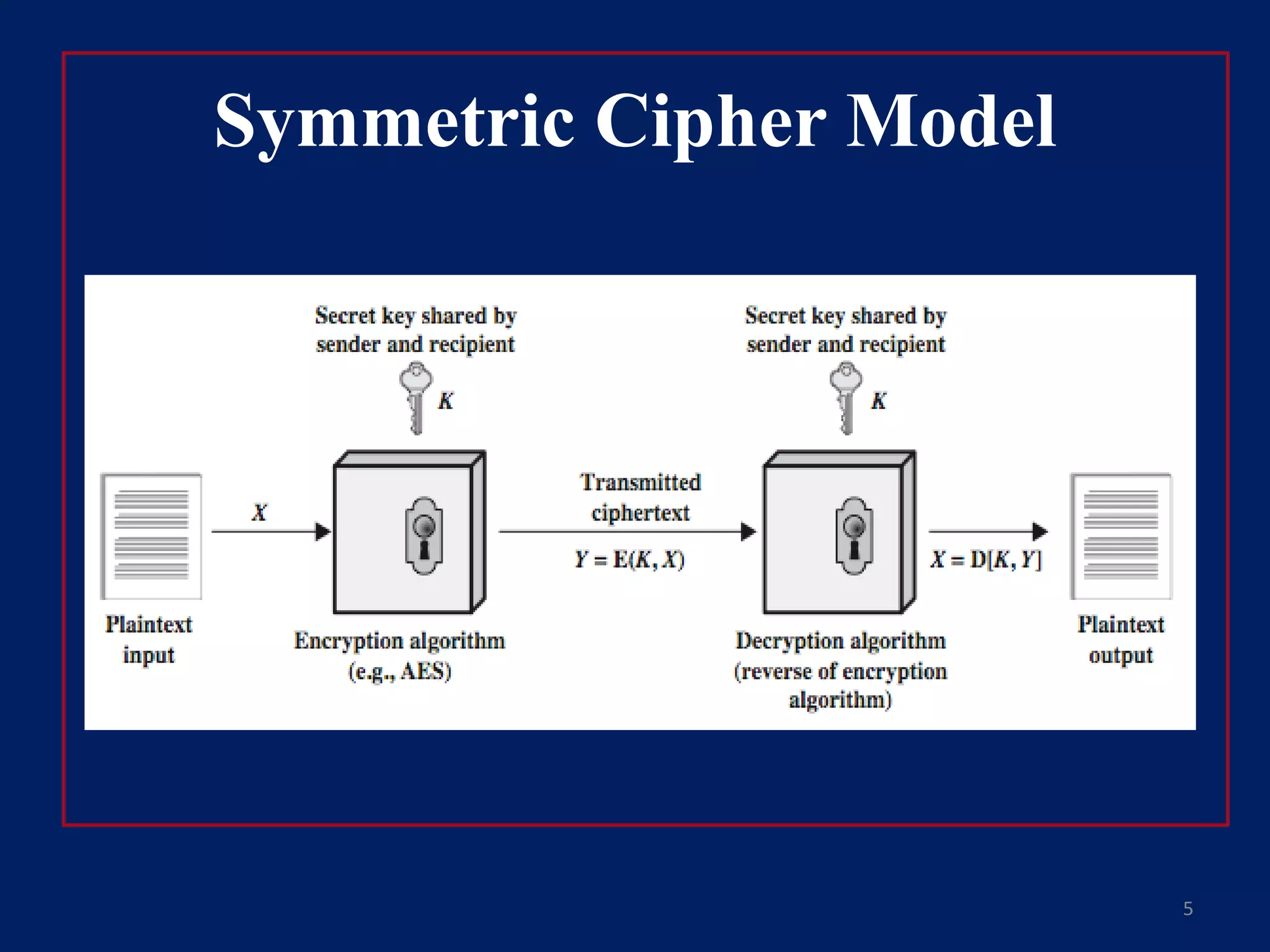
• Conventional Encryption: encryption and
decryption are performed using the same key.
• Symmetric encryption transforms plaintext
into ciphertext using a secret key and an
encryption algorithm.
• Using the same key and a decryption
algorithm, the plaintext is recovered from the
ciphertext.
4
Symmetric Cipher Model
5
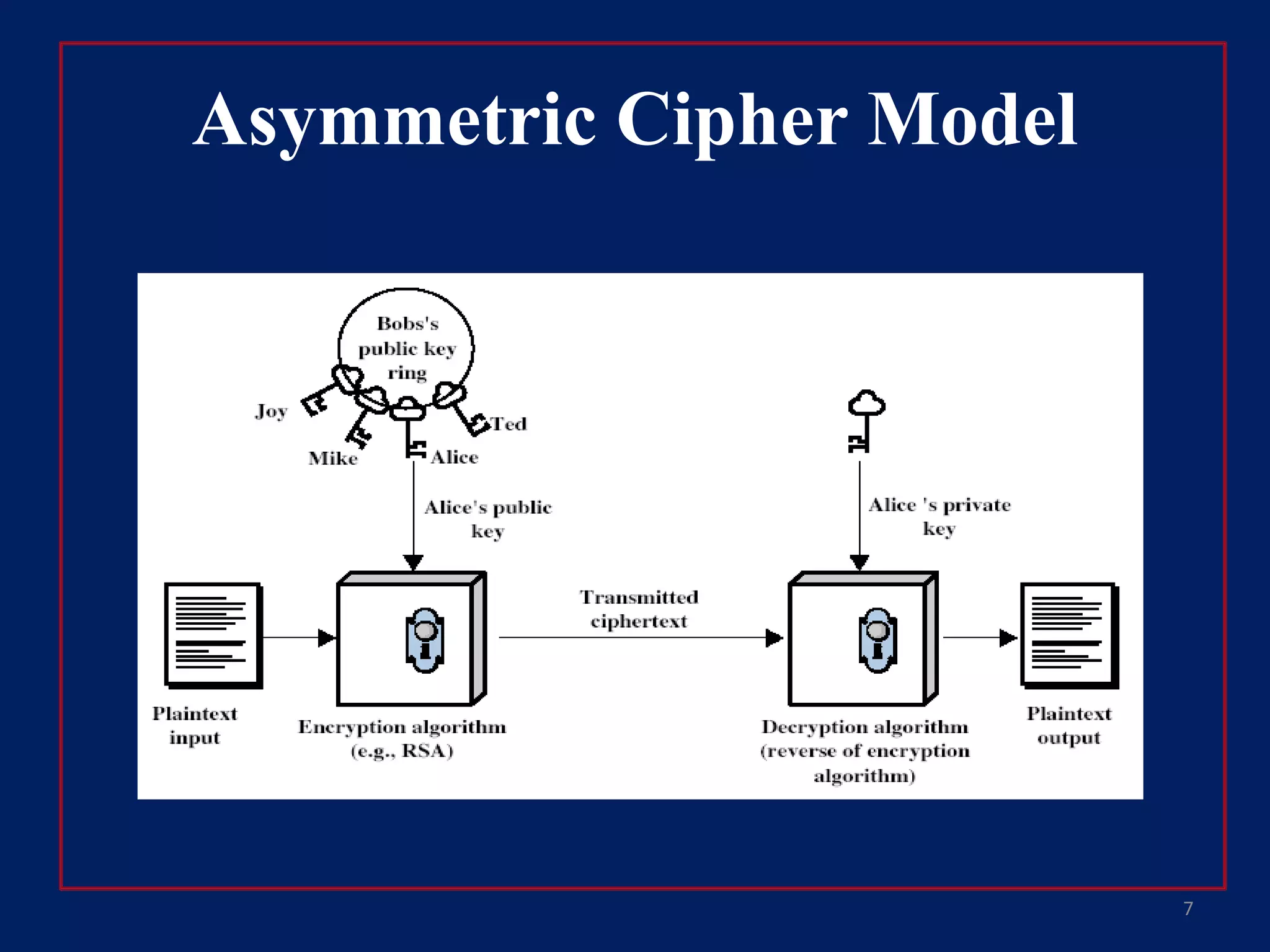
Asymmetric Encryption
• public-key/two-key/asymmetric cryptography
involves the use of two keys:
– a public-key, which may be known by anybody, and can be
used to encrypt messages, and verify signatures
– a private-key, known only to the recipient, used to decrypt
messages, and sign (create) signatures
• why asymmetric ?
– those who encrypt messages or verify signatures cannot
decrypt messages or create signatures
6
Asymmetric Cipher Model
7
• RSA (Rivest–Shamir–Adleman) is one of the first public-key
cryptosystems and is widely used for secure data transmission.
• In such a cryptosystem, the encryption key is public and
distinct from the decryption key which is kept secret (private).
• In RSA, this asymmetry is based on the practical difficulty
of factoring the product of two large prime numbers, the
"factoring problem".
• The RSA algorithm is the most popular and proven
asymmetric key cryptographic algorithm.
• The RSA algorithm is based on the mathematical fact that
it is easy to find and multiply large prime numbers
together, but it is extremely difficult to factor their
product.
RSAAlgorithm
8
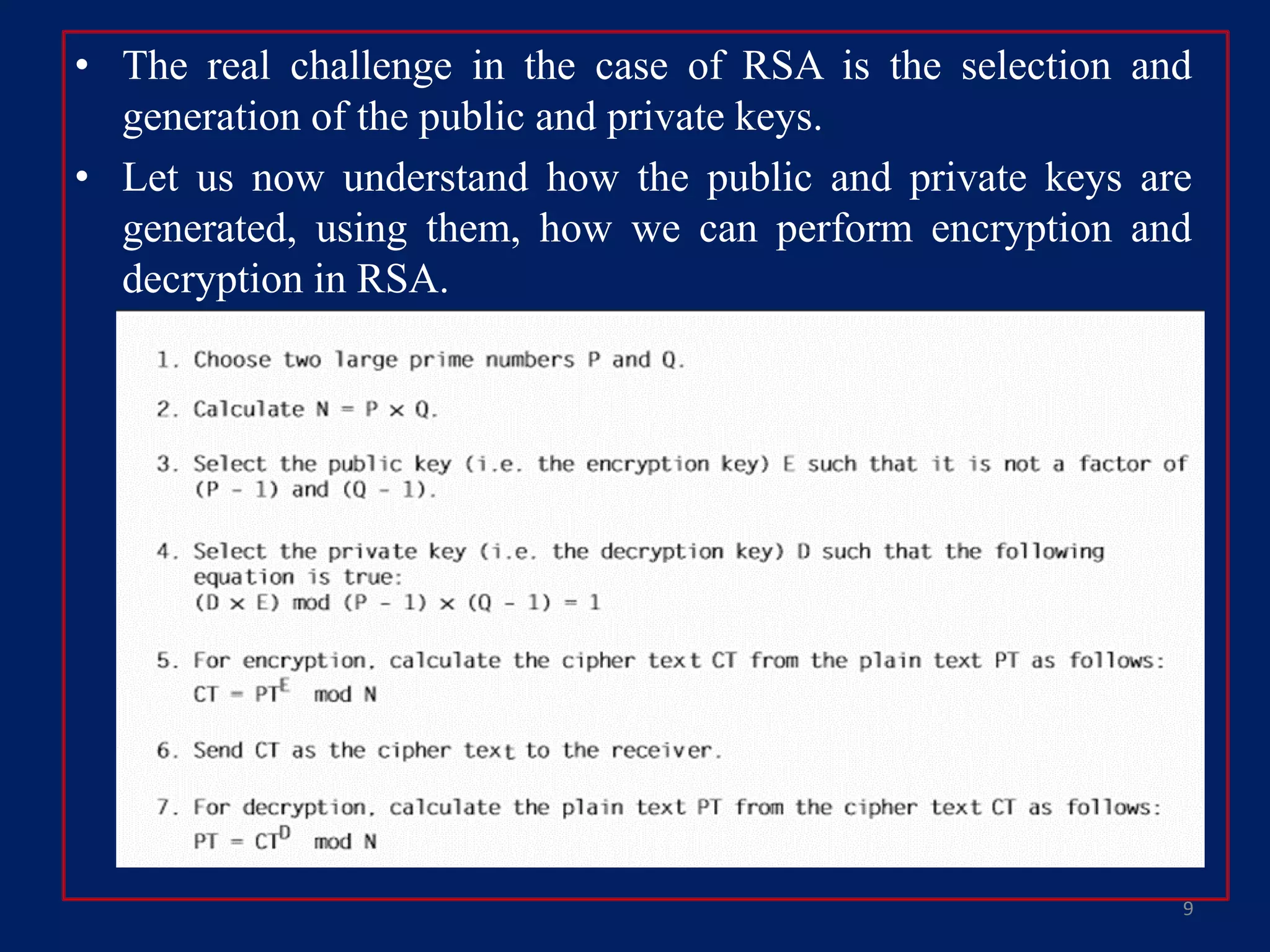
• The real challenge in the case of RSA is the selection and
generation of the public and private keys.
• Let us now understand how the public and private keys are
generated, using them, how we can perform encryption and
decryption in RSA.
9
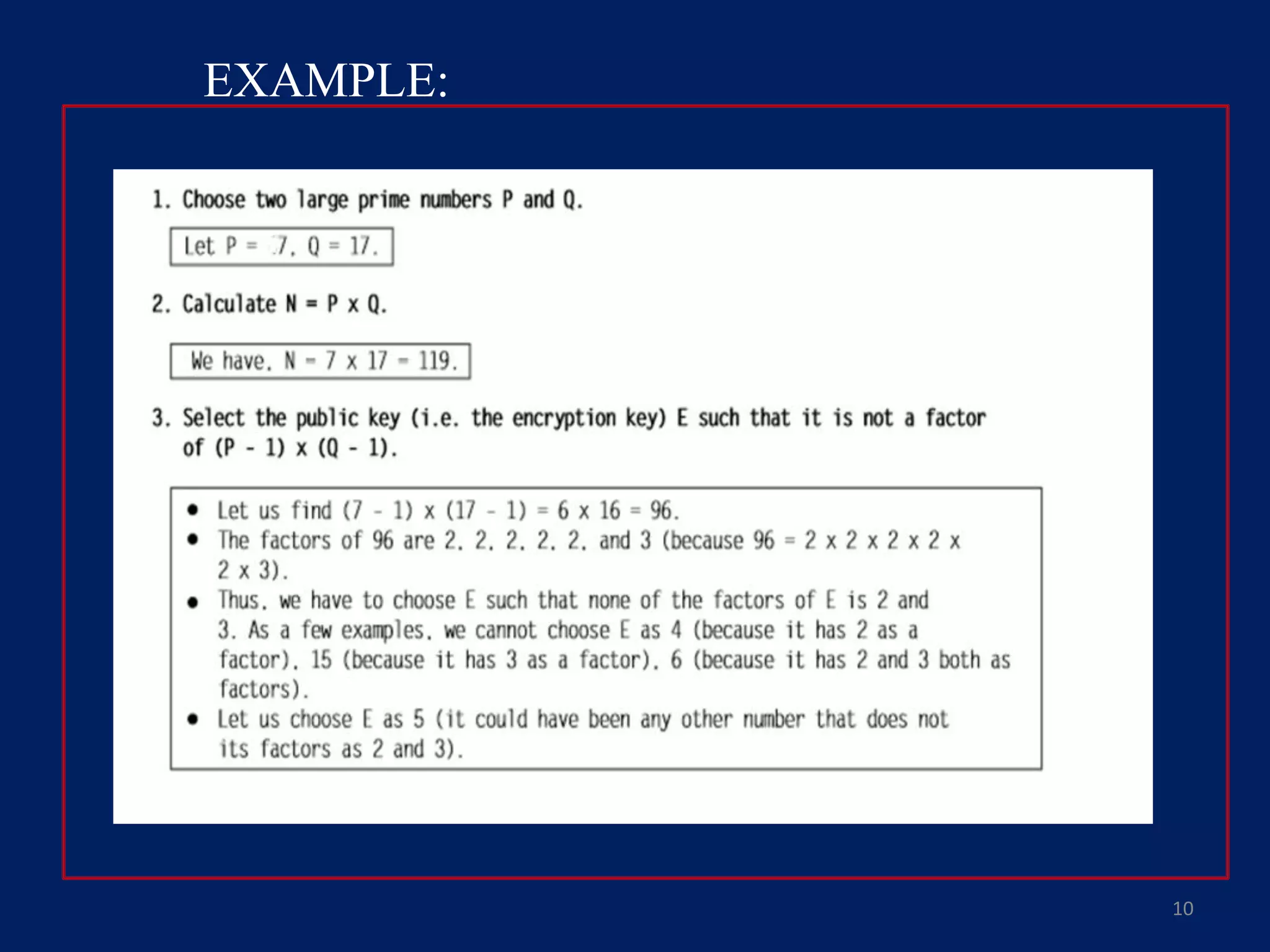
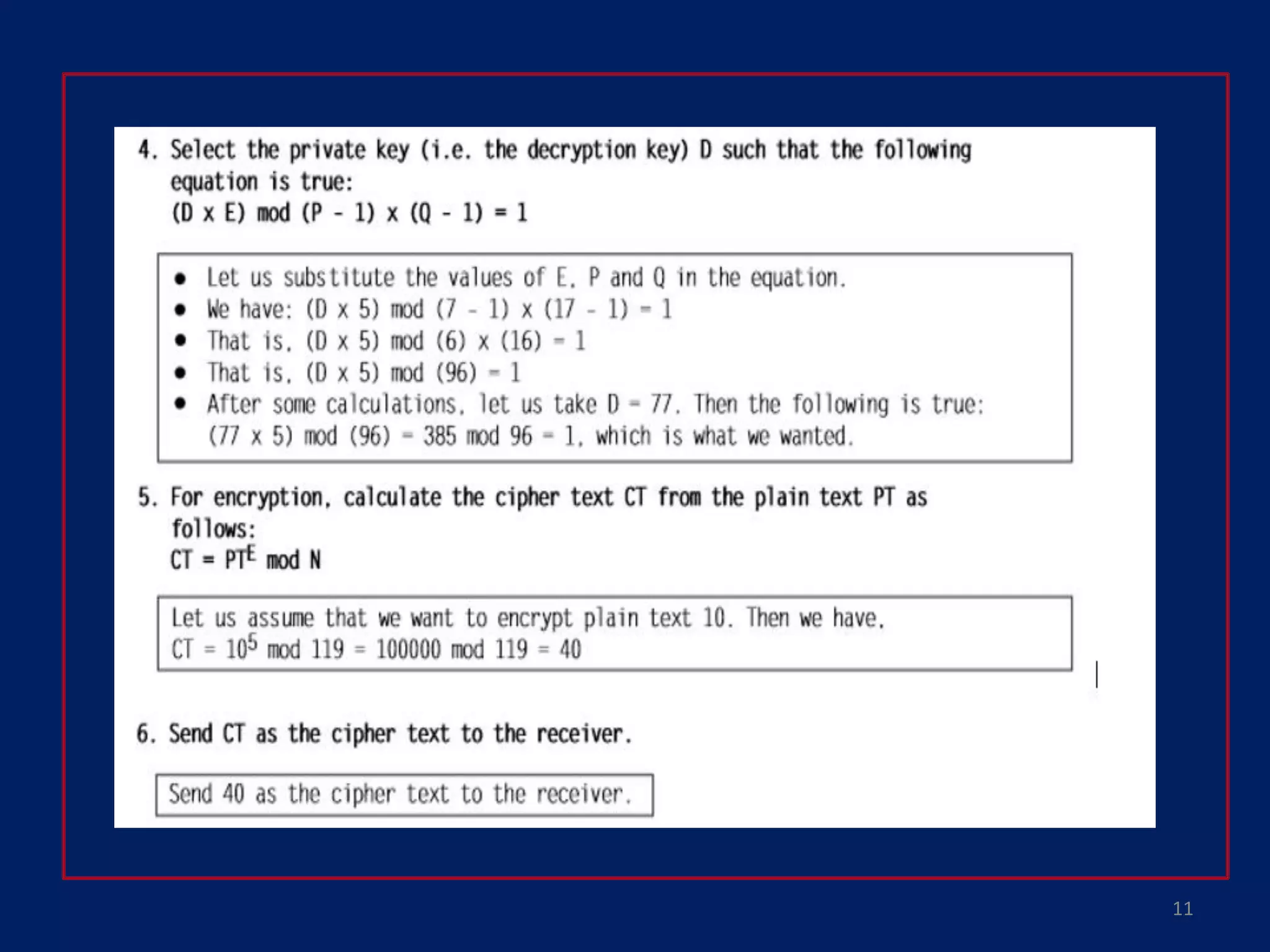
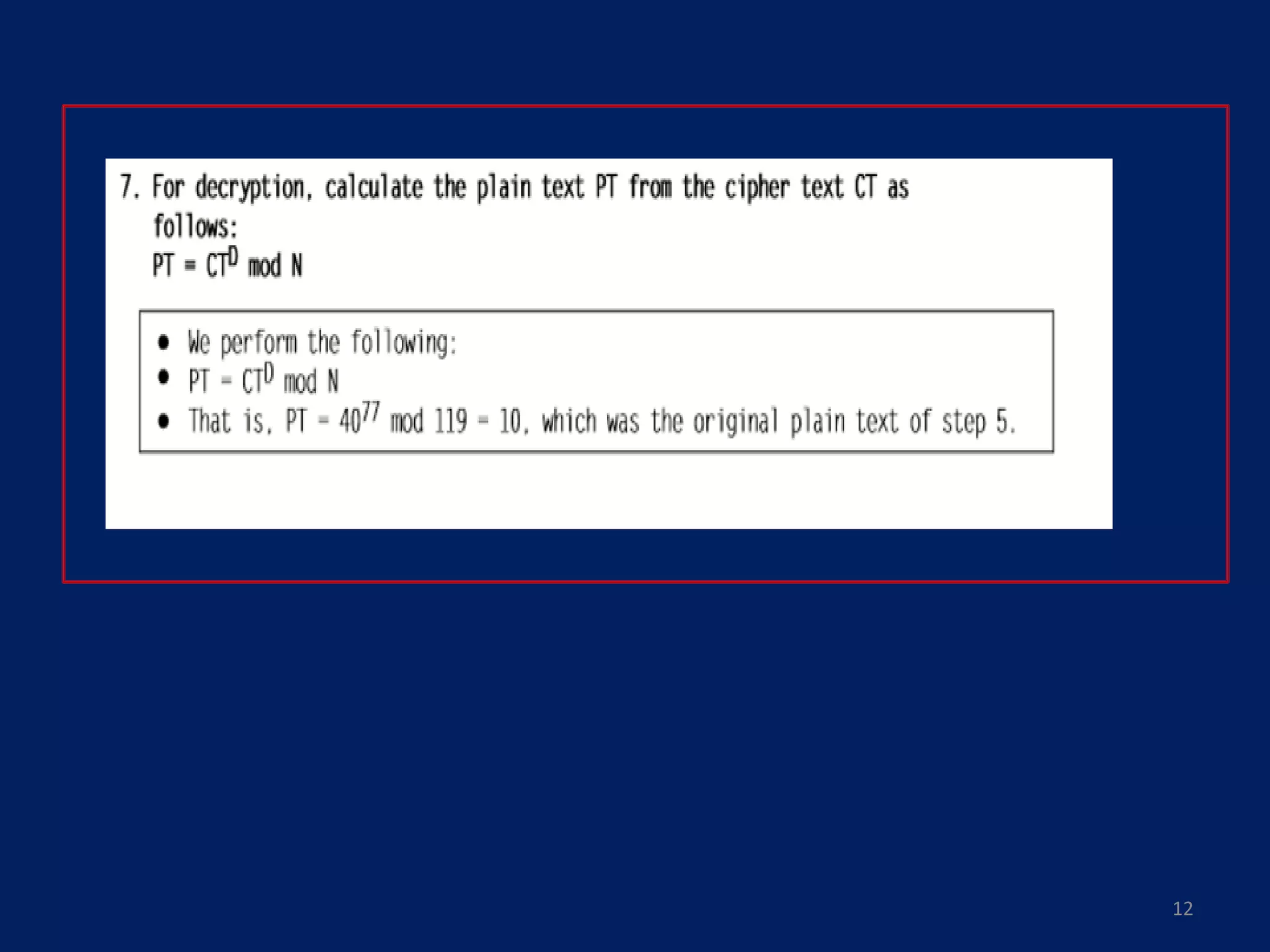
EXAMPLE:
10
11
12
REFERENCES
1. Cryptography and Network Security by
Atul Kahate.
2. Cryptography and Network Security by
William Stallings.
13
Thank You
14

RSA Algoritmn

  • 1.
  • 2.
    CONTENTS • Symmetric Encryption •Symmetric Cipher Model • Asymmetric Encryption • Asymmetric Cipher Model • RSAAlgorithm 2
  • 3.
    Symmetric Encryption • Conventional/ Private-key / Single-key • sender and recipient share a common key • all classical encryption algorithms are private- key • was only type prior to invention of public-key in 1970’s • most widely used 3
  • 4.
    • Conventional Encryption:encryption and decryption are performed using the same key. • Symmetric encryption transforms plaintext into ciphertext using a secret key and an encryption algorithm. • Using the same key and a decryption algorithm, the plaintext is recovered from the ciphertext. 4
  • 5.
  • 6.
    Asymmetric Encryption • public-key/two-key/asymmetriccryptography involves the use of two keys: – a public-key, which may be known by anybody, and can be used to encrypt messages, and verify signatures – a private-key, known only to the recipient, used to decrypt messages, and sign (create) signatures • why asymmetric ? – those who encrypt messages or verify signatures cannot decrypt messages or create signatures 6
  • 7.
  • 8.
    • RSA (Rivest–Shamir–Adleman)is one of the first public-key cryptosystems and is widely used for secure data transmission. • In such a cryptosystem, the encryption key is public and distinct from the decryption key which is kept secret (private). • In RSA, this asymmetry is based on the practical difficulty of factoring the product of two large prime numbers, the "factoring problem". • The RSA algorithm is the most popular and proven asymmetric key cryptographic algorithm. • The RSA algorithm is based on the mathematical fact that it is easy to find and multiply large prime numbers together, but it is extremely difficult to factor their product. RSAAlgorithm 8
  • 9.
    • The realchallenge in the case of RSA is the selection and generation of the public and private keys. • Let us now understand how the public and private keys are generated, using them, how we can perform encryption and decryption in RSA. 9
  • 10.
  • 11.
  • 12.
  • 13.
    REFERENCES 1. Cryptography andNetwork Security by Atul Kahate. 2. Cryptography and Network Security by William Stallings. 13
  • 14.