Information Security
Mamoona Jabbar
Information Security
Topic: Cryptology
Types of Cryptosystem
1. Symmetric key Encryption
2. Asymmetric key Encryption
Symmetric key Encryption
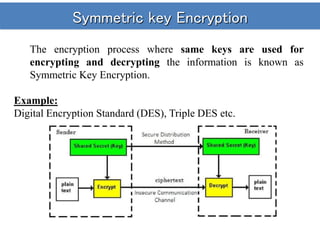
The encryption process where same keys are used for
encrypting and decrypting the information is known as
Symmetric Key Encryption.
Example:
Digital Encryption Standard (DES), Triple DES etc.
Symmetric key Encryption
Features of cryptosystem based on symmetric key encryption are:
• Share a common key proceeding to exchange of information
• Keys are changed regularly to prevent any attack on the system
• Expensive and cumbersome
• Keys required for a group is n x (n-1)/2 for n people
Challenge of Symmetric key Cryptosystem:
• Key establishment
• Trust issue
Symmetric key Encryption
Limitations of Symmetric key encryption:
These two challenges are highly restraining for modern day
communication. Today, people need to exchange information with
non-familiar and non-trusted parties.
For example, a communication between online seller and customer.
These limitations of symmetric key encryption gave rise to
asymmetric key encryption schemes.
Asymmetric key Encryption
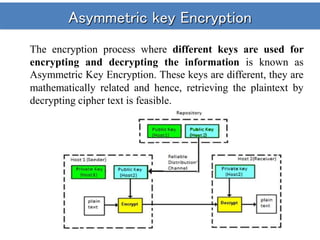
The encryption process where different keys are used for
encrypting and decrypting the information is known as
Asymmetric Key Encryption. These keys are different, they are
mathematically related and hence, retrieving the plaintext by
decrypting cipher text is feasible.
Asymmetric key Encryption
Features of cryptosystem based on Asymmetric key encryption are:
• Everyone have a pair of dissimilar keys. (private key and public
key)
• It requires to put the public key in public repository and the private
key as a well-guarded secret. Hence, this scheme of encryption is also
called Public Key Encryption.
• Strength: Both keys of the user are related. Not feasible to find one
from another.
• When Host1 needs to send data to Host2, he obtains the public key of
Host2 from repository, encrypts the data, and transmits.
• Host2 uses his private key to extract the plaintext
• Length of Keys (number of bits) in this encryption is large and hence,
the process of encryption-decryption is slower than symmetric key
encryption.
• Processing power of computer system required to run asymmetric
algorithm is higher.
Asymmetric key Encryption
Challenge of Public key Cryptosystem
• The user needs to trust that the public key that he is using in
communications with a person really is the public key of that person and has
not been spoofed by a malicious third party.
This is usually accomplished through a Public Key Infrastructure (PKI)
consisting a trusted third party. The third party securely manages and attests to
the authenticity of public keys. When the third party is requested to provide the
public key for any communicating person X, they are trusted to provide the
correct public key.
The third party satisfies itself about user identity by the process of attestation,
notarization, or some other process − that X is the one and only, or globally
unique, X. The most common method of making the verified public keys
available is to embed them in a certificate which is digitally signed by the trusted
third party.
Kerckhoff’s Principle for Cryptosystem
Kerckhoff stated that a cryptographic system should be secure even if
everything about the system, except the key, is public knowledge. The six
design principles defined by Kerckhoff for cryptosystem are :
1. The cryptosystem should be unbreakable practically, if not
mathematically.
2. Falling of the cryptosystem in the hands of an intruder should not
lead to any compromise of the system, preventing any inconvenience
to the user.
3. The key should be easily communicable, memorable, and
changeable.
4. The cipher text should be transmissible by telegraph, an unsecure
channel.
5. The encryption apparatus and documents should be portable and
operable by a single person.
6. Finally, it is necessary that the system be easy to use, requiring
neither mental strain nor the knowledge of a long series of rules to
observe.
Kerckhoff’s Principle for Cryptosystem
The second rule is currently known as Kerckhoff principle. It is
applied in virtually all the contemporary encryption algorithms
such as DES, AES, etc. These public algorithms are considered to
be thoroughly secure. The security of the encrypted message
depends solely on the security of the secret encryption key.
Attacks in Cryptology
Attacks are typically categorized based on the action performed
by the attacker.
1. Passive Attack
2. Active Attack
Passive Attack
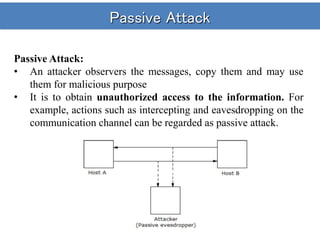
Passive Attack:
• An attacker observers the messages, copy them and may use
them for malicious purpose
• It is to obtain unauthorized access to the information. For
example, actions such as intercepting and eavesdropping on the
communication channel can be regarded as passive attack.
Active Attack
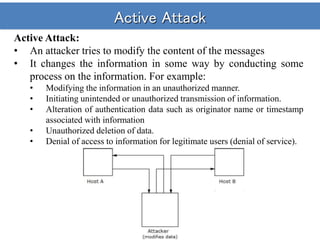
Active Attack:
• An attacker tries to modify the content of the messages
• It changes the information in some way by conducting some
process on the information. For example:
• Modifying the information in an unauthorized manner.
• Initiating unintended or unauthorized transmission of information.
• Alteration of authentication data such as originator name or timestamp
associated with information
• Unauthorized deletion of data.
• Denial of access to information for legitimate users (denial of service).
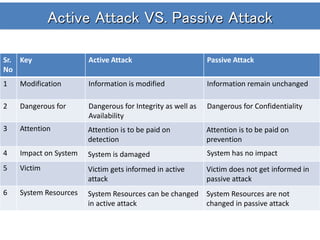
Active Attack VS. Passive Attack
Sr.
No
Key Active Attack Passive Attack
1 Modification Information is modified Information remain unchanged
2 Dangerous for Dangerous for Integrity as well as
Availability
Dangerous for Confidentiality
3 Attention Attention is to be paid on
detection
Attention is to be paid on
prevention
4 Impact on System System is damaged System has no impact
5 Victim Victim gets informed in active
attack
Victim does not get informed in
passive attack
6 System Resources System Resources can be changed
in active attack
System Resources are not
changed in passive attack
Assumptions of Attacker
While considering possible attacks on the cryptosystem, it is
necessary to know the cryptosystems environment. The attacker’s
assumptions and knowledge about the environment decides his
capabilities. These three assumptions are made
about security environment and attacker’s capabilities:
1. Details of the Encryption Scheme
2. Availability of Cipher text
3. Availability of Plain text and Cipher text
Assumptions of Attacker
1. Details of the Encryption Scheme:
The design of a cryptosystem is based on the following two
cryptography algorithms:
• Public Algorithms: With this option, all the details of the
algorithm are in the public domain, known to everyone.
• Proprietary algorithms: The details of the algorithm are only
known by the system designers and users.
2. Availability of Cipher text
Once the plaintext is encrypted into cipher text, it is put on unsecure
public channel (say email) for transmission. Thus, the attacker can
obviously assume that it has access to the cipher text generated by
the cryptosystem.
Assumptions of Attacker
3. Availability of Plaintext and Cipher text
This assumption is not as obvious as other. However, there may be
situations where an attacker can have access to plaintext and
corresponding ciphertext. Some such possible circumstances are:
• The attacker influences the sender to convert plaintext of
his choice and obtains the cipher text.
• The receiver may divulge the plaintext to the attacker
inadvertently. The attacker has access to corresponding
cipher text gathered from open channel.
• In a public-key cryptosystem, the encryption key is in
open domain and is known to any potential attacker. Using
this key, he can generate pairs of corresponding plaintexts
and cipher texts.
Cryptographic Attack
The basic intention of an attacker is to break a cryptosystem and to find the
plaintext from the cipher text. To obtain the plaintext, the attacker only needs to find
out the secret decryption key, as the algorithm is already in public domain.
Hence, he applies maximum effort towards finding out the secret key used in the
cryptosystem. Once the attacker is able to determine the key, the attacked system is
considered as broken or compromised.
Based on the methodology used, attacks on cryptosystems are categorized
as follows:
• Cipher text Only Attacks (COA)
• Known Plaintext Attack (KPA)
• Chosen Plaintext Attack (CPA)
• Dictionary Attack
• Brute Force Attack (BFA)
• Man in Middle Attack (MIM)
• Side Channel Attack (SCA)
• Fault analysis Attack
Cryptographic Attack
Cipher text Only Attacks (COA)
In this method, the attacker has access to a set of cipher text(s). He
does not have access to corresponding plaintext. COA is said to be
successful when the corresponding plaintext can be determined
from a given set of cipher text. Occasionally, the encryption key
can be determined from this attack. Modern cryptosystems are
guarded against cipher text-only attacks.
Cryptographic Attack
Known Plaintext Attack (KPA)
In this method, the attacker knows the plaintext for some parts
of the cipher text. The task is to decrypt the rest of the cipher
text using this information. This may be done by determining
the key or via some other method. The best example of this
attack is linear cryptanalysis against block ciphers.
Cryptographic Attack
Chosen Plaintext Attack (CPA)
In this method, the attacker has the text of his choice encrypted.
So he has the cipher text-plaintext pair of his choice. This
simplifies his task of determining the encryption key. An example
of this attack is differential cryptanalysis applied against block
ciphers as well as hash functions. A popular public key
cryptosystem, RSA is also vulnerable to chosen-plaintext attacks.
Cryptographic Attack
Dictionary Attack
This attack has many variants, all of which involve compiling a
‘dictionary’. In simplest method of this attack, attacker builds a
dictionary of cipher texts and corresponding plaintexts that he has
learnt over a period of time. In future, when an attacker gets the
cipher text, he refers the dictionary to find the corresponding
plaintext.
Cryptographic Attack
Brute Force Attack (BFA)
In this method, the attacker tries to determine the key by attempting
all possible keys. If the key is 8 bits long, then the number of
possible keys is 28 = 256. The attacker knows the cipher text and
the algorithm, now he attempts all the 256 keys one by one for
decryption. The time to complete the attack would be very high if
the key is long.
Cryptographic Attack
Man in Middle Attack (MIM)
The targets of this attack are mostly public key cryptosystems
where key exchange is involved before communication takes place.
• Host A wants to communicate to host B, hence requests public
key of B.
• An attacker intercepts this request and sends his public key
instead.
• Thus, whatever host A sends to host B, the attacker is able to
read.
• In order to maintain communication, the attacker re-encrypts
the data after reading with his public key and sends to B.
• The attacker sends his public key as A’s public key so that B
takes it as if it is taking it from A.
Cryptographic Attack
Side Channel Attack (SCA)
This type of attack is not against any particular type of
cryptosystem or algorithm. Instead, it is launched to exploit the
weakness in physical implementation of the cryptosystem.
Fault analysis Attacks
In these attacks, errors are induced in the cryptosystem and the
attacker studies the resulting output for useful information.

Types of Cryptosystem and Cryptographic Attack

  • 1.
  • 2.
  • 3.
    Types of Cryptosystem 1.Symmetric key Encryption 2. Asymmetric key Encryption
  • 4.
    Symmetric key Encryption Theencryption process where same keys are used for encrypting and decrypting the information is known as Symmetric Key Encryption. Example: Digital Encryption Standard (DES), Triple DES etc.
  • 5.
    Symmetric key Encryption Featuresof cryptosystem based on symmetric key encryption are: • Share a common key proceeding to exchange of information • Keys are changed regularly to prevent any attack on the system • Expensive and cumbersome • Keys required for a group is n x (n-1)/2 for n people Challenge of Symmetric key Cryptosystem: • Key establishment • Trust issue
  • 6.
    Symmetric key Encryption Limitationsof Symmetric key encryption: These two challenges are highly restraining for modern day communication. Today, people need to exchange information with non-familiar and non-trusted parties. For example, a communication between online seller and customer. These limitations of symmetric key encryption gave rise to asymmetric key encryption schemes.
  • 7.
    Asymmetric key Encryption Theencryption process where different keys are used for encrypting and decrypting the information is known as Asymmetric Key Encryption. These keys are different, they are mathematically related and hence, retrieving the plaintext by decrypting cipher text is feasible.
  • 8.
    Asymmetric key Encryption Featuresof cryptosystem based on Asymmetric key encryption are: • Everyone have a pair of dissimilar keys. (private key and public key) • It requires to put the public key in public repository and the private key as a well-guarded secret. Hence, this scheme of encryption is also called Public Key Encryption. • Strength: Both keys of the user are related. Not feasible to find one from another. • When Host1 needs to send data to Host2, he obtains the public key of Host2 from repository, encrypts the data, and transmits. • Host2 uses his private key to extract the plaintext • Length of Keys (number of bits) in this encryption is large and hence, the process of encryption-decryption is slower than symmetric key encryption. • Processing power of computer system required to run asymmetric algorithm is higher.
  • 9.
    Asymmetric key Encryption Challengeof Public key Cryptosystem • The user needs to trust that the public key that he is using in communications with a person really is the public key of that person and has not been spoofed by a malicious third party. This is usually accomplished through a Public Key Infrastructure (PKI) consisting a trusted third party. The third party securely manages and attests to the authenticity of public keys. When the third party is requested to provide the public key for any communicating person X, they are trusted to provide the correct public key. The third party satisfies itself about user identity by the process of attestation, notarization, or some other process − that X is the one and only, or globally unique, X. The most common method of making the verified public keys available is to embed them in a certificate which is digitally signed by the trusted third party.
  • 10.
    Kerckhoff’s Principle forCryptosystem Kerckhoff stated that a cryptographic system should be secure even if everything about the system, except the key, is public knowledge. The six design principles defined by Kerckhoff for cryptosystem are : 1. The cryptosystem should be unbreakable practically, if not mathematically. 2. Falling of the cryptosystem in the hands of an intruder should not lead to any compromise of the system, preventing any inconvenience to the user. 3. The key should be easily communicable, memorable, and changeable. 4. The cipher text should be transmissible by telegraph, an unsecure channel. 5. The encryption apparatus and documents should be portable and operable by a single person. 6. Finally, it is necessary that the system be easy to use, requiring neither mental strain nor the knowledge of a long series of rules to observe.
  • 11.
    Kerckhoff’s Principle forCryptosystem The second rule is currently known as Kerckhoff principle. It is applied in virtually all the contemporary encryption algorithms such as DES, AES, etc. These public algorithms are considered to be thoroughly secure. The security of the encrypted message depends solely on the security of the secret encryption key.
  • 12.
    Attacks in Cryptology Attacksare typically categorized based on the action performed by the attacker. 1. Passive Attack 2. Active Attack
  • 13.
    Passive Attack Passive Attack: •An attacker observers the messages, copy them and may use them for malicious purpose • It is to obtain unauthorized access to the information. For example, actions such as intercepting and eavesdropping on the communication channel can be regarded as passive attack.
  • 14.
    Active Attack Active Attack: •An attacker tries to modify the content of the messages • It changes the information in some way by conducting some process on the information. For example: • Modifying the information in an unauthorized manner. • Initiating unintended or unauthorized transmission of information. • Alteration of authentication data such as originator name or timestamp associated with information • Unauthorized deletion of data. • Denial of access to information for legitimate users (denial of service).
  • 15.
    Active Attack VS.Passive Attack Sr. No Key Active Attack Passive Attack 1 Modification Information is modified Information remain unchanged 2 Dangerous for Dangerous for Integrity as well as Availability Dangerous for Confidentiality 3 Attention Attention is to be paid on detection Attention is to be paid on prevention 4 Impact on System System is damaged System has no impact 5 Victim Victim gets informed in active attack Victim does not get informed in passive attack 6 System Resources System Resources can be changed in active attack System Resources are not changed in passive attack
  • 16.
    Assumptions of Attacker Whileconsidering possible attacks on the cryptosystem, it is necessary to know the cryptosystems environment. The attacker’s assumptions and knowledge about the environment decides his capabilities. These three assumptions are made about security environment and attacker’s capabilities: 1. Details of the Encryption Scheme 2. Availability of Cipher text 3. Availability of Plain text and Cipher text
  • 17.
    Assumptions of Attacker 1.Details of the Encryption Scheme: The design of a cryptosystem is based on the following two cryptography algorithms: • Public Algorithms: With this option, all the details of the algorithm are in the public domain, known to everyone. • Proprietary algorithms: The details of the algorithm are only known by the system designers and users. 2. Availability of Cipher text Once the plaintext is encrypted into cipher text, it is put on unsecure public channel (say email) for transmission. Thus, the attacker can obviously assume that it has access to the cipher text generated by the cryptosystem.
  • 18.
    Assumptions of Attacker 3.Availability of Plaintext and Cipher text This assumption is not as obvious as other. However, there may be situations where an attacker can have access to plaintext and corresponding ciphertext. Some such possible circumstances are: • The attacker influences the sender to convert plaintext of his choice and obtains the cipher text. • The receiver may divulge the plaintext to the attacker inadvertently. The attacker has access to corresponding cipher text gathered from open channel. • In a public-key cryptosystem, the encryption key is in open domain and is known to any potential attacker. Using this key, he can generate pairs of corresponding plaintexts and cipher texts.
  • 19.
    Cryptographic Attack The basicintention of an attacker is to break a cryptosystem and to find the plaintext from the cipher text. To obtain the plaintext, the attacker only needs to find out the secret decryption key, as the algorithm is already in public domain. Hence, he applies maximum effort towards finding out the secret key used in the cryptosystem. Once the attacker is able to determine the key, the attacked system is considered as broken or compromised. Based on the methodology used, attacks on cryptosystems are categorized as follows: • Cipher text Only Attacks (COA) • Known Plaintext Attack (KPA) • Chosen Plaintext Attack (CPA) • Dictionary Attack • Brute Force Attack (BFA) • Man in Middle Attack (MIM) • Side Channel Attack (SCA) • Fault analysis Attack
  • 20.
    Cryptographic Attack Cipher textOnly Attacks (COA) In this method, the attacker has access to a set of cipher text(s). He does not have access to corresponding plaintext. COA is said to be successful when the corresponding plaintext can be determined from a given set of cipher text. Occasionally, the encryption key can be determined from this attack. Modern cryptosystems are guarded against cipher text-only attacks.
  • 21.
    Cryptographic Attack Known PlaintextAttack (KPA) In this method, the attacker knows the plaintext for some parts of the cipher text. The task is to decrypt the rest of the cipher text using this information. This may be done by determining the key or via some other method. The best example of this attack is linear cryptanalysis against block ciphers.
  • 22.
    Cryptographic Attack Chosen PlaintextAttack (CPA) In this method, the attacker has the text of his choice encrypted. So he has the cipher text-plaintext pair of his choice. This simplifies his task of determining the encryption key. An example of this attack is differential cryptanalysis applied against block ciphers as well as hash functions. A popular public key cryptosystem, RSA is also vulnerable to chosen-plaintext attacks.
  • 23.
    Cryptographic Attack Dictionary Attack Thisattack has many variants, all of which involve compiling a ‘dictionary’. In simplest method of this attack, attacker builds a dictionary of cipher texts and corresponding plaintexts that he has learnt over a period of time. In future, when an attacker gets the cipher text, he refers the dictionary to find the corresponding plaintext.
  • 24.
    Cryptographic Attack Brute ForceAttack (BFA) In this method, the attacker tries to determine the key by attempting all possible keys. If the key is 8 bits long, then the number of possible keys is 28 = 256. The attacker knows the cipher text and the algorithm, now he attempts all the 256 keys one by one for decryption. The time to complete the attack would be very high if the key is long.
  • 25.
    Cryptographic Attack Man inMiddle Attack (MIM) The targets of this attack are mostly public key cryptosystems where key exchange is involved before communication takes place. • Host A wants to communicate to host B, hence requests public key of B. • An attacker intercepts this request and sends his public key instead. • Thus, whatever host A sends to host B, the attacker is able to read. • In order to maintain communication, the attacker re-encrypts the data after reading with his public key and sends to B. • The attacker sends his public key as A’s public key so that B takes it as if it is taking it from A.
  • 26.
    Cryptographic Attack Side ChannelAttack (SCA) This type of attack is not against any particular type of cryptosystem or algorithm. Instead, it is launched to exploit the weakness in physical implementation of the cryptosystem. Fault analysis Attacks In these attacks, errors are induced in the cryptosystem and the attacker studies the resulting output for useful information.