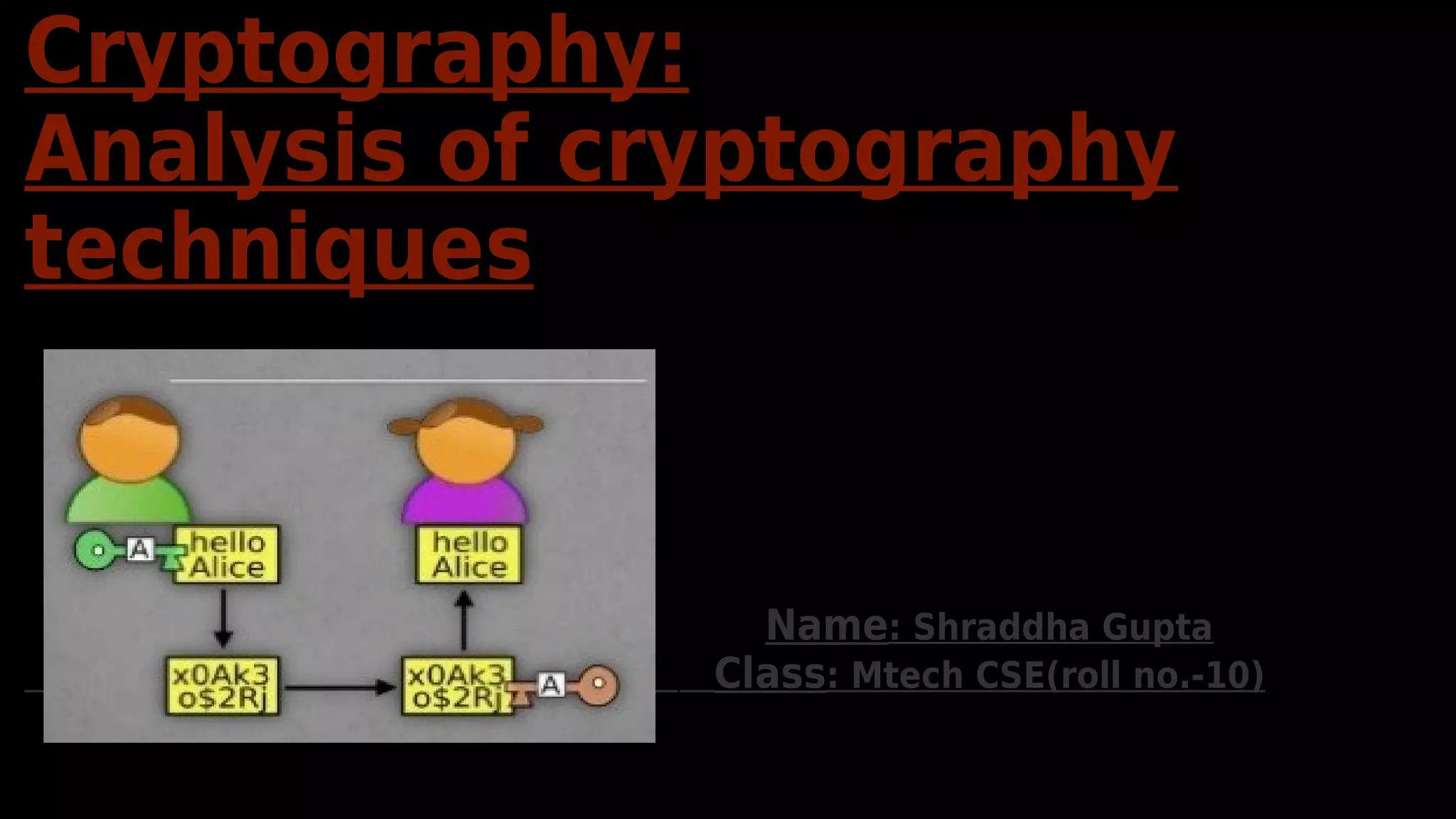
Cryptography:Cryptography:
Analysis of cryptographyAnalysis of cryptography
techniquestechniques
                                                      
NameName: Shraddha Gupta: Shraddha Gupta
                                                                                                                   ClassClass: Mtech CSE(roll no.-10): Mtech CSE(roll no.-10)
ContentsContents
 IntroductIon
 BasIc Idea of cryptography
 Key terms
 types of cryptography
 technIques of cryptography
 rsa
 des
 references
What does Secure mean??What does Secure mean??
         Security???
CryptographyCryptography
●
The word ‘Cryptology’ has a Greek etymology; it means ‘secret word’.
●
The art was transformed into a science by a 1948 paper [205] written by
Shannon. This was arguably the beginning of modern cryptology, in which
checking the integrity of the messages and authenticating the identities of
the communicating parties have become as essential as ensuring
message confidentiality.
●
Cryptography is the science and art of transforming messages to make
them secure and immune to attack.
General termsGeneral terms
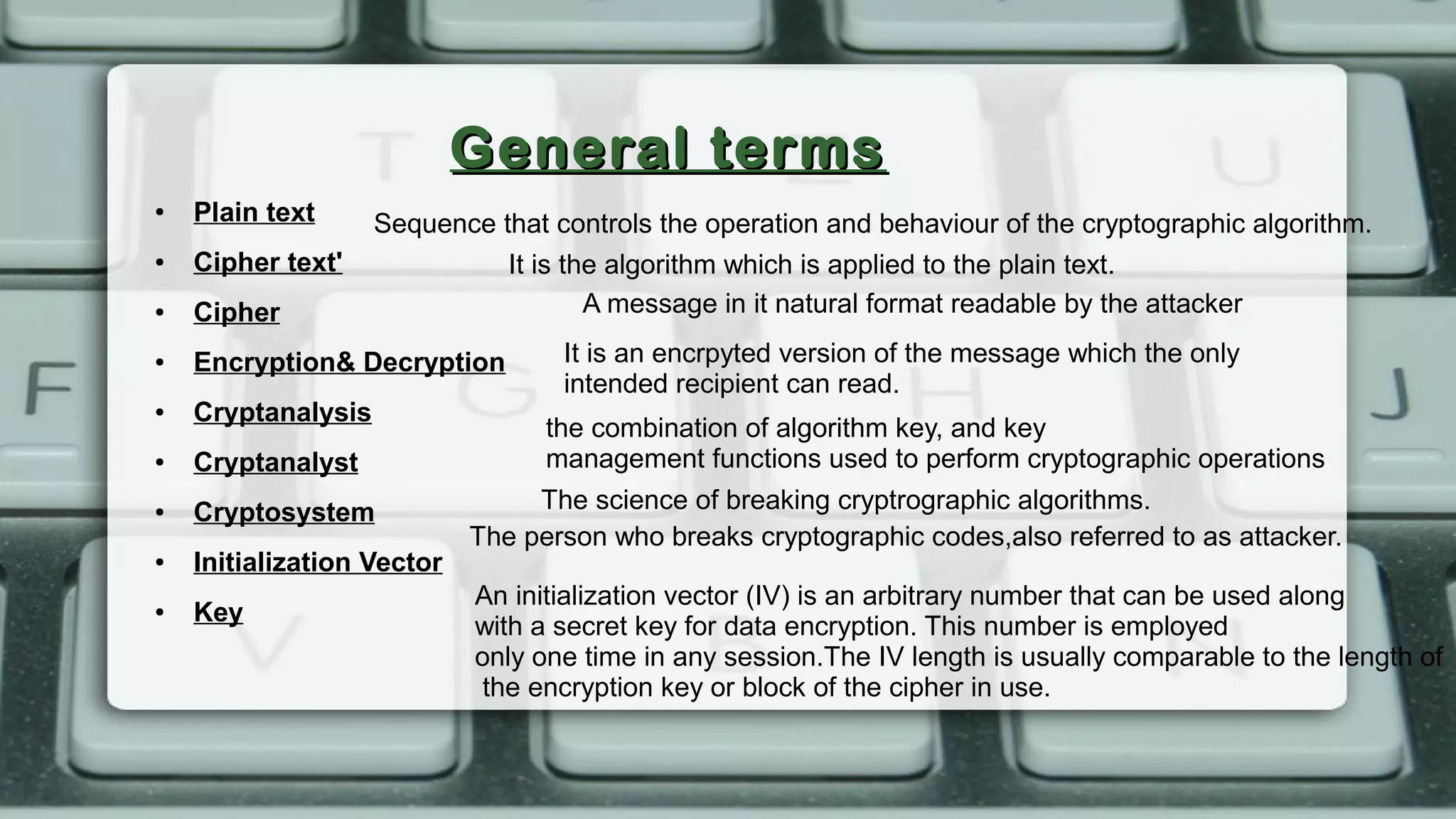
● Plain text
● Cipher text'
● Cipher
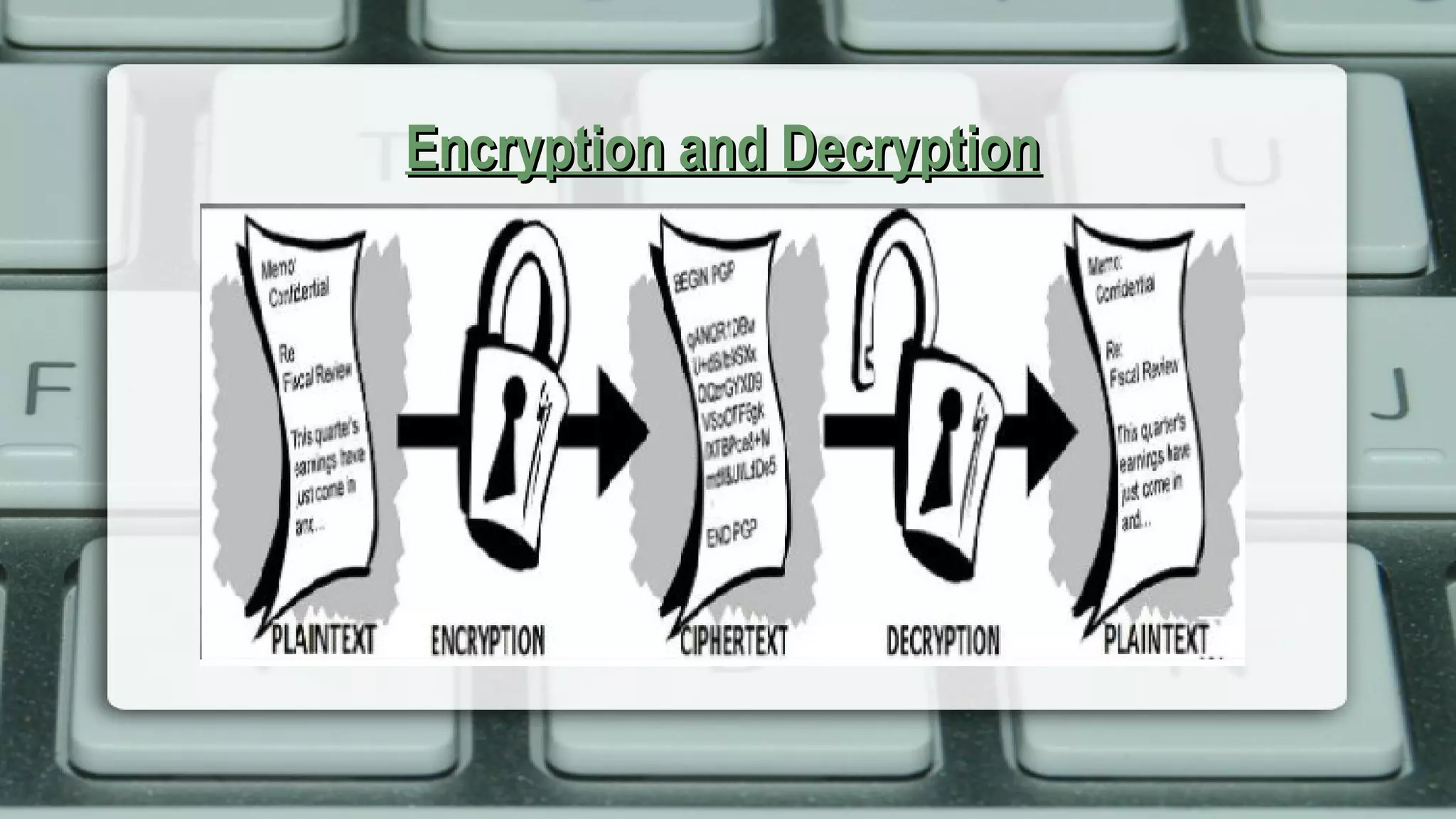
● Encryption& Decryption
● Cryptanalysis
● Cryptanalyst
● Cryptosystem
● Initialization Vector
● Key
A message in it natural format readable by the attacker
It is an encrpyted version of the message which the only
intended recipient can read.
It is the algorithm which is applied to the plain text.
The science of breaking cryptrographic algorithms.
The person who breaks cryptographic codes,also referred to as attacker.
An initialization vector (IV) is an arbitrary number that can be used along
with a secret key for data encryption. This number is employed
only one time in any session.The IV length is usually comparable to the length of
the encryption key or block of the cipher in use.
Sequence that controls the operation and behaviour of the cryptographic algorithm.
the combination of algorithm key, and key
management functions used to perform cryptographic operations
GOALSGOALS
● Integrity
● Non- Repudiation
● Authentication
● Confidentiality
● Types of attacks-Brute-froce,Dictionary attack,frequency
analysis,replay attack,etc.
Encryption and DecryptionEncryption and Decryption
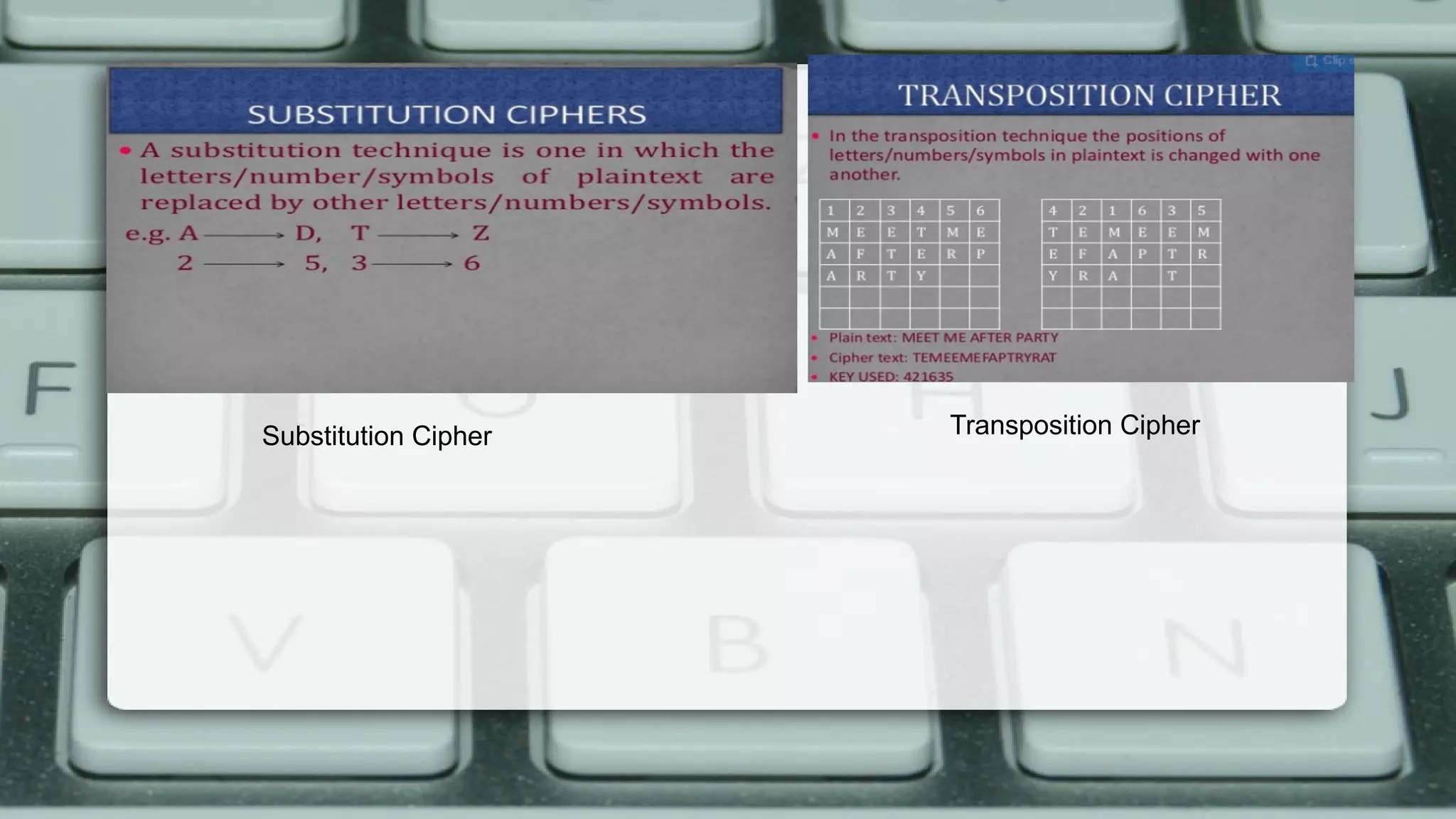
Substitution Cipher Transposition Cipher
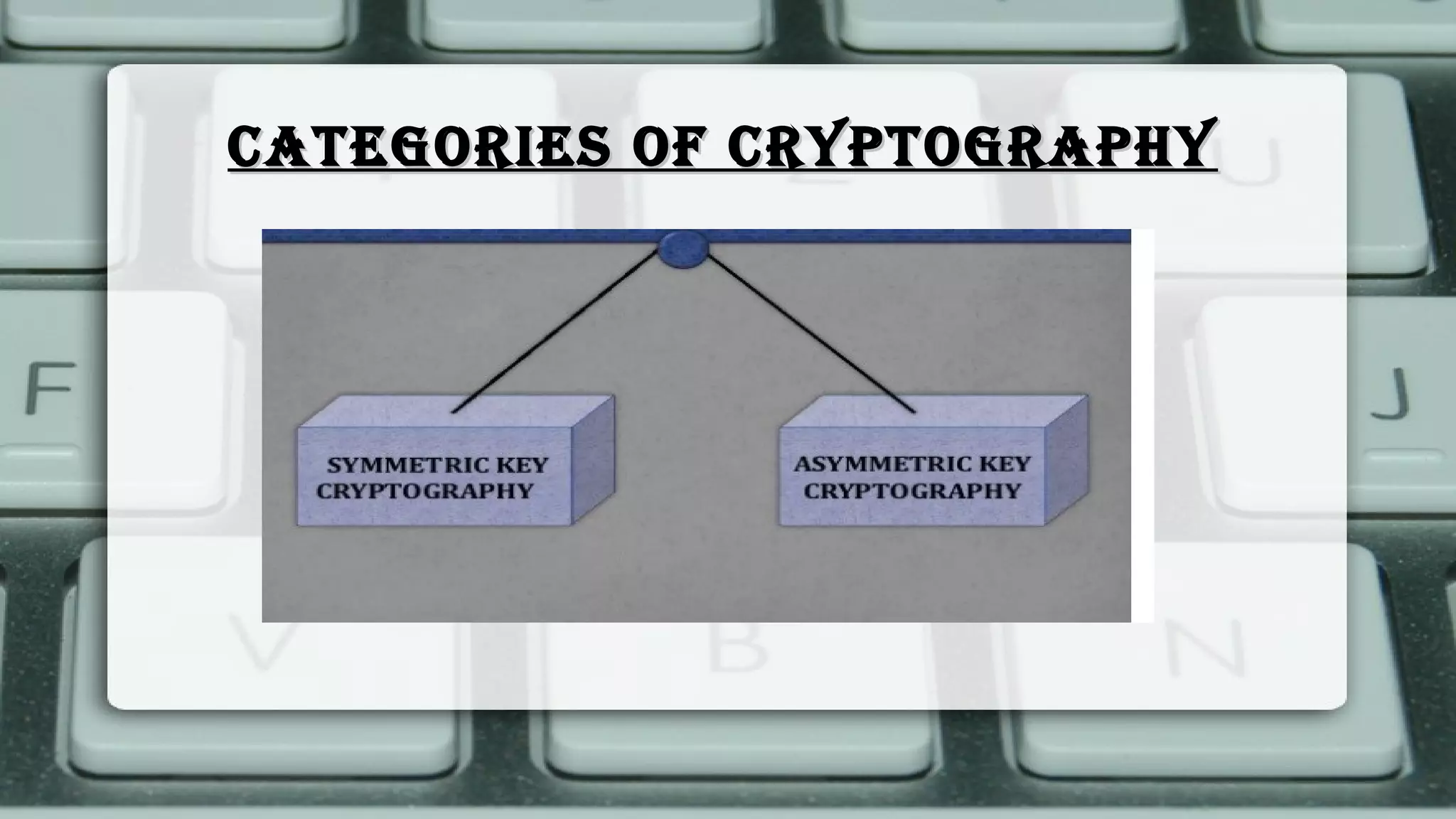
Categories of CryptographyCategories of Cryptography
Asymmetric Key CryptographyAsymmetric Key Cryptography
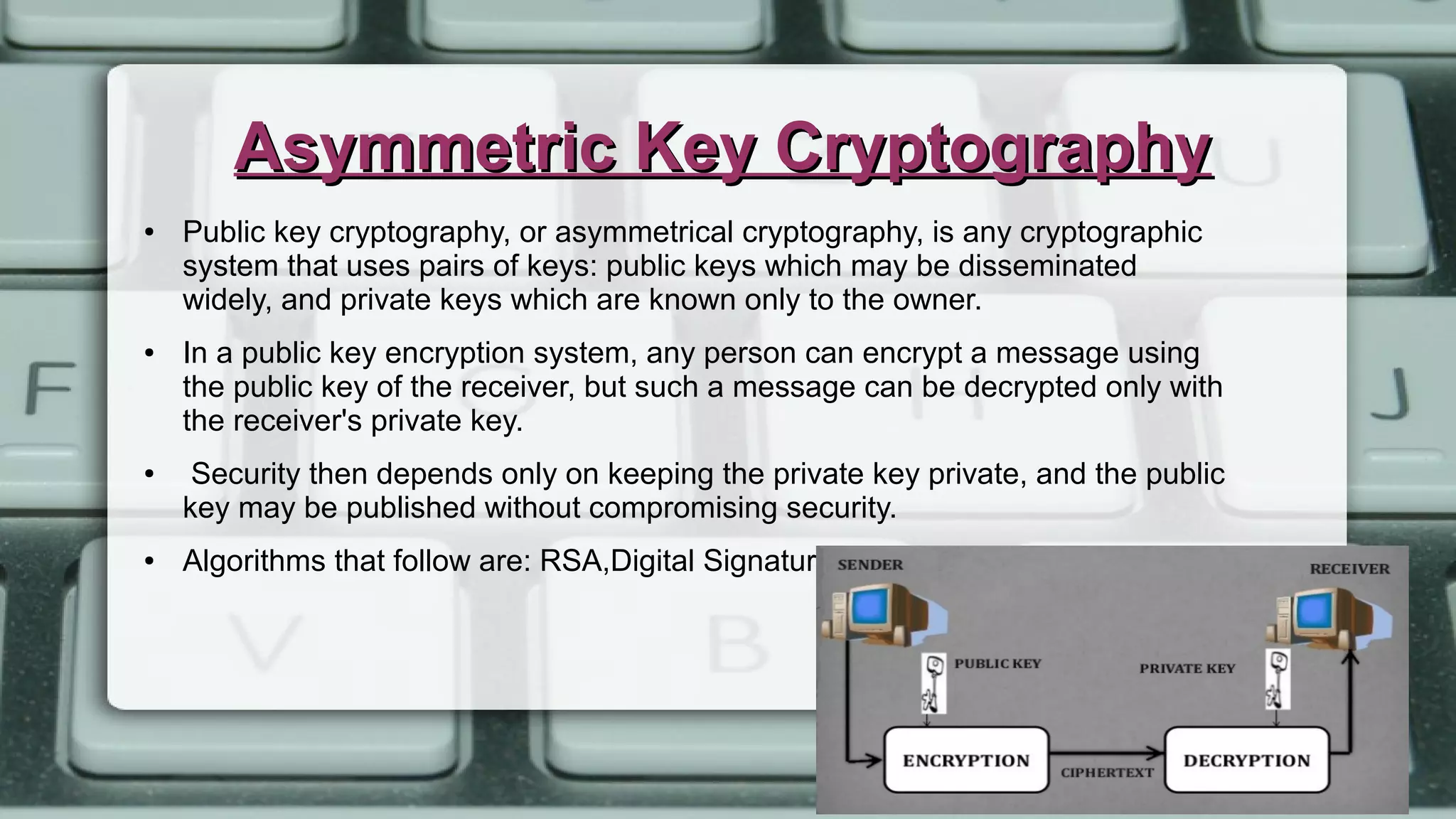
● Public key cryptography, or asymmetrical cryptography, is any cryptographic
system that uses pairs of keys: public keys which may be disseminated
widely, and private keys which are known only to the owner.
● In a public key encryption system, any person can encrypt a message using
the public key of the receiver, but such a message can be decrypted only with
the receiver's private key.
● Security then depends only on keeping the private key private, and the public
key may be published without compromising security.
● Algorithms that follow are: RSA,Digital Signatures, etc.
RSA AlgorithmRSA Algorithm
● 1)Choose two distinct prime numbers p and q.
For security purposes, the integers p and q should
be chosen at random, and should be similar in
magnitude but 'differ in length by a few digits to
make factoring harder. Prime integers can be
efficiently found using a primality test.
2)Compute n = pq.[n is used as the modulus for
both the public and private keys. Its length, usually
expressed in bits, is the key length.]
3)Compute z=(p-1)(q-1)
4)Choose an integer e such that 1 < e < z and
gcd(e, z) = 1; i.e., e and z are coprime.
5)Determine d as d ≡ e−1 (mod z); i.e., d is the
modular multiplicative inverse of e (modulo z).
This is more clearly stated as: solve for d given d e⋅
≡ 1 (mod z).
6)e is released as the public key exponent.
7)d is kept as the private key exponent.
Example:Example:
● Step1- Take two prime numbers p and q ->p=3 q=11
● Step2- find n=pxq → 3x11=33
● Step3- choose a variable z such that z=(p-1)(q-1) [z will be coprime to e] -----> 2x10=20
● Step4-choose a variable e such that coprime such that 0<e<z------->1<e<20,where e is a prime number
and is coprime to z, so we take e=7
● Step5-choose a variable d such that d=(dxe)modn -->(dxe)mod20=1
Let d=3,since where multiplied with 7 it will give 21mod20 that is =1
● Therefore Public key=(e,n) -----> (7,33)
● Therefore Private key=(d,n) -----> (3,33)
● For eg: If message is 2 suppose then
– Encrypt : C= m^emod n 2^7 mod 33=29
– Decrypt : M= c^dmod n 29^3mod 33=2
Symmetric Key AlgorithmSymmetric Key Algorithm
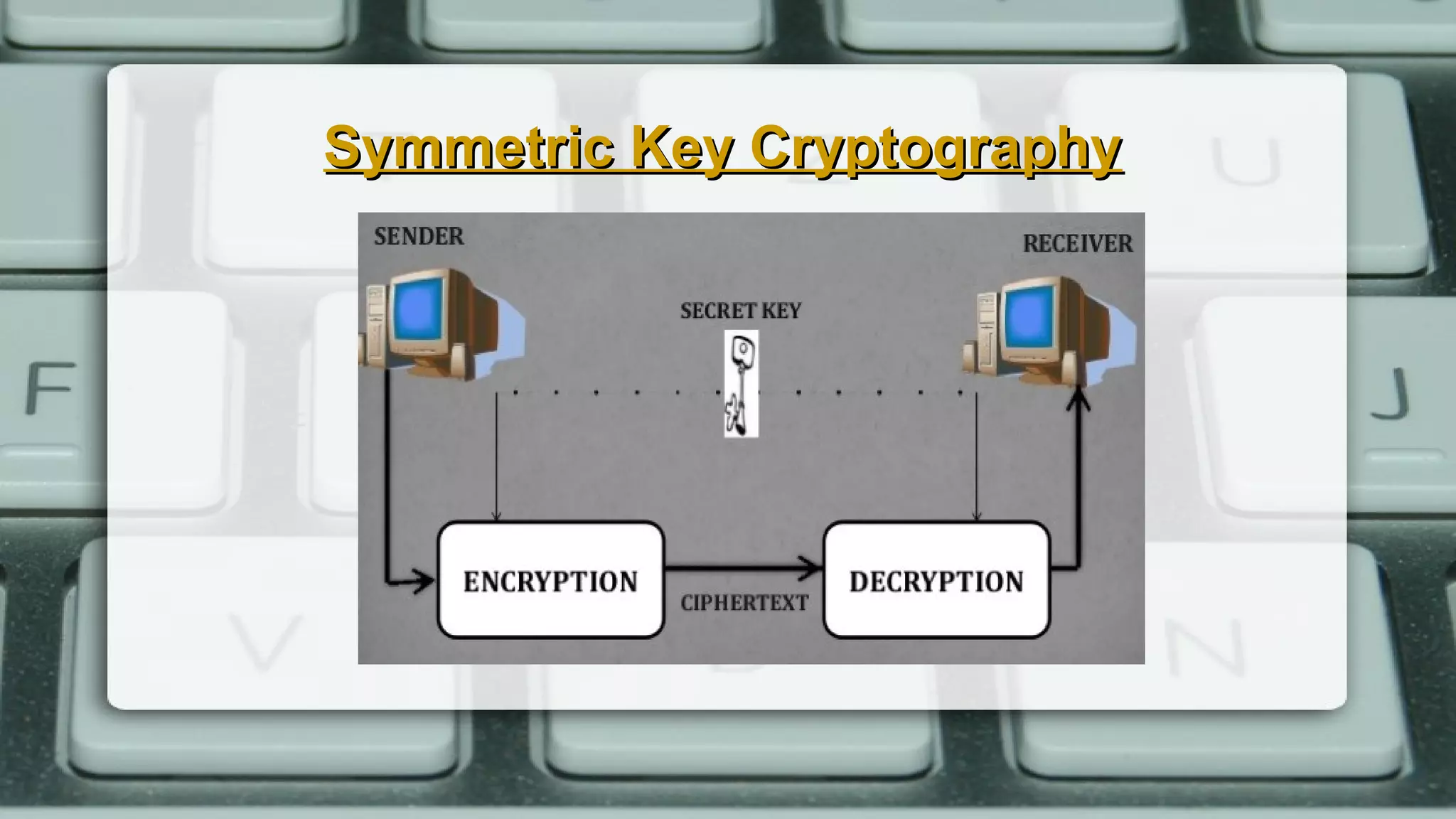
● Symmetric-key algorithms are algorithms that use the same
cryptographic keys for both encryption of plaintext and decryption of
ciphertext.
● This requirement that both parties have access to the secret key is
one of the main drawbacks of symmetric key encryption.
● Symmetric-key encryption can use either stream ciphers or block
ciphers.
● Algorithms:Common algorithm that follow are
AES,DES,Blowfish,Towfish,etc.
Symmetric Key CryptographySymmetric Key Cryptography
Data Encryption StandardData Encryption Standard
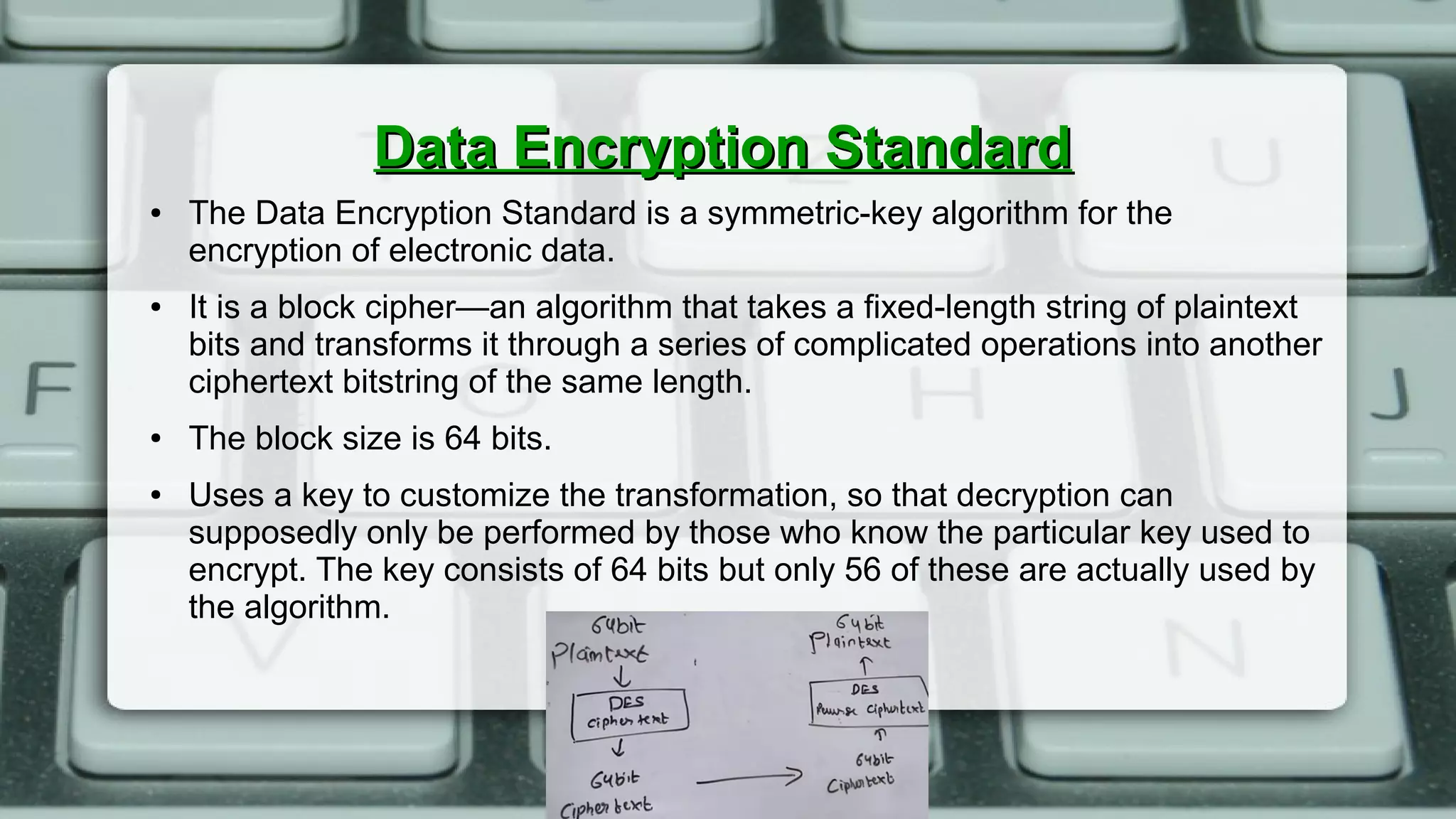
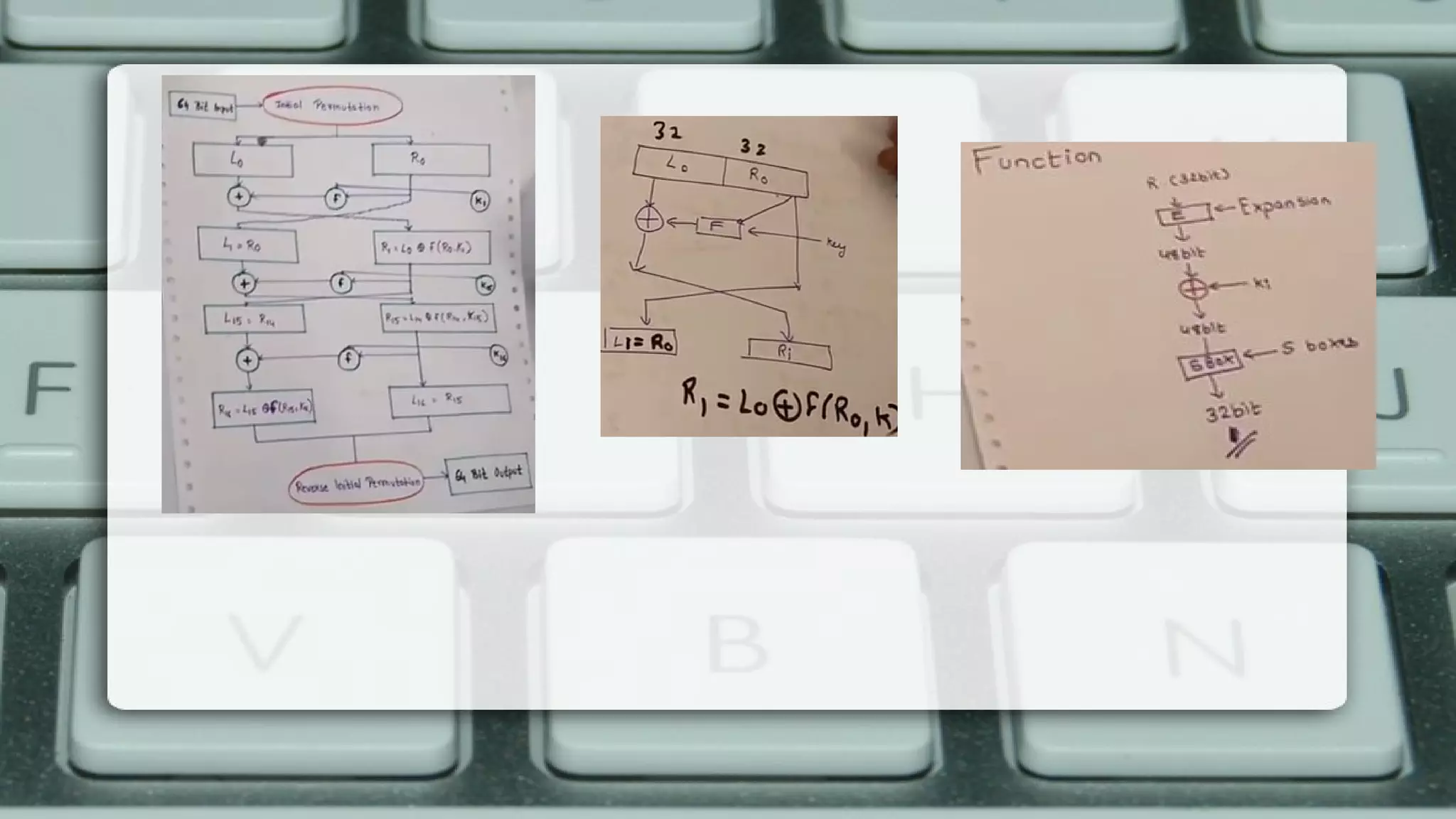
● The Data Encryption Standard is a symmetric-key algorithm for the
encryption of electronic data.
● It is a block cipher—an algorithm that takes a fixed-length string of plaintext
bits and transforms it through a series of complicated operations into another
ciphertext bitstring of the same length.
● The block size is 64 bits.
● Uses a key to customize the transformation, so that decryption can
supposedly only be performed by those who know the particular key used to
encrypt. The key consists of 64 bits but only 56 of these are actually used by
the algorithm.
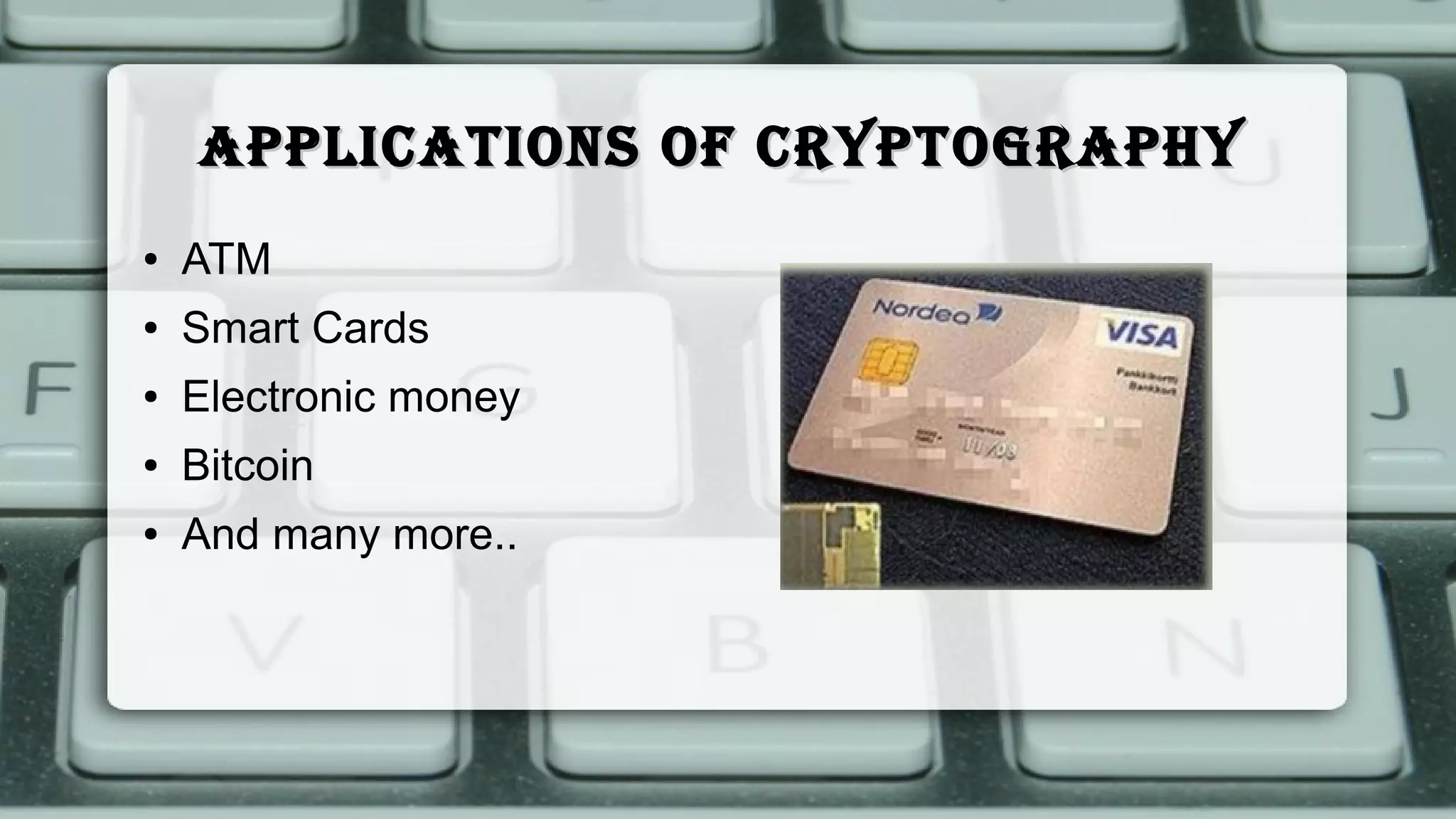
ApplicAtions of cryptogrAphyApplicAtions of cryptogrAphy
● ATM
● Smart Cards
● Electronic money
● Bitcoin
● And many more..
ReferencesReferences

https://www.esat.kuleuven.be/cosic/publications/thesis-188.pdf

https://en.wikipedia.org/wiki/Symmetric-key_algorithm#Encryption_algo

https://en.wikipedia.org/wiki/RSA_(cryptosystem)
thAnk youthAnk you

Basic techniques in cryptography

  • 1.
    Cryptography:Cryptography: Analysis of cryptographyAnalysisof cryptography techniquestechniques                                                        NameName: Shraddha Gupta: Shraddha Gupta                                                                                                                    ClassClass: Mtech CSE(roll no.-10): Mtech CSE(roll no.-10)
  • 2.
    ContentsContents  IntroductIon  BasIcIdea of cryptography  Key terms  types of cryptography  technIques of cryptography  rsa  des  references
  • 3.
    What does Securemean??What does Secure mean??          Security???
  • 4.
    CryptographyCryptography ● The word ‘Cryptology’has a Greek etymology; it means ‘secret word’. ● The art was transformed into a science by a 1948 paper [205] written by Shannon. This was arguably the beginning of modern cryptology, in which checking the integrity of the messages and authenticating the identities of the communicating parties have become as essential as ensuring message confidentiality. ● Cryptography is the science and art of transforming messages to make them secure and immune to attack.
  • 5.
    General termsGeneral terms ●Plain text ● Cipher text' ● Cipher ● Encryption& Decryption ● Cryptanalysis ● Cryptanalyst ● Cryptosystem ● Initialization Vector ● Key A message in it natural format readable by the attacker It is an encrpyted version of the message which the only intended recipient can read. It is the algorithm which is applied to the plain text. The science of breaking cryptrographic algorithms. The person who breaks cryptographic codes,also referred to as attacker. An initialization vector (IV) is an arbitrary number that can be used along with a secret key for data encryption. This number is employed only one time in any session.The IV length is usually comparable to the length of the encryption key or block of the cipher in use. Sequence that controls the operation and behaviour of the cryptographic algorithm. the combination of algorithm key, and key management functions used to perform cryptographic operations
  • 6.
    GOALSGOALS ● Integrity ● Non-Repudiation ● Authentication ● Confidentiality ● Types of attacks-Brute-froce,Dictionary attack,frequency analysis,replay attack,etc.
  • 7.
  • 8.
  • 9.
  • 10.
    Asymmetric Key CryptographyAsymmetricKey Cryptography ● Public key cryptography, or asymmetrical cryptography, is any cryptographic system that uses pairs of keys: public keys which may be disseminated widely, and private keys which are known only to the owner. ● In a public key encryption system, any person can encrypt a message using the public key of the receiver, but such a message can be decrypted only with the receiver's private key. ● Security then depends only on keeping the private key private, and the public key may be published without compromising security. ● Algorithms that follow are: RSA,Digital Signatures, etc.
  • 11.
    RSA AlgorithmRSA Algorithm ●1)Choose two distinct prime numbers p and q. For security purposes, the integers p and q should be chosen at random, and should be similar in magnitude but 'differ in length by a few digits to make factoring harder. Prime integers can be efficiently found using a primality test. 2)Compute n = pq.[n is used as the modulus for both the public and private keys. Its length, usually expressed in bits, is the key length.] 3)Compute z=(p-1)(q-1) 4)Choose an integer e such that 1 < e < z and gcd(e, z) = 1; i.e., e and z are coprime. 5)Determine d as d ≡ e−1 (mod z); i.e., d is the modular multiplicative inverse of e (modulo z). This is more clearly stated as: solve for d given d e⋅ ≡ 1 (mod z). 6)e is released as the public key exponent. 7)d is kept as the private key exponent.
  • 12.
    Example:Example: ● Step1- Taketwo prime numbers p and q ->p=3 q=11 ● Step2- find n=pxq → 3x11=33 ● Step3- choose a variable z such that z=(p-1)(q-1) [z will be coprime to e] -----> 2x10=20 ● Step4-choose a variable e such that coprime such that 0<e<z------->1<e<20,where e is a prime number and is coprime to z, so we take e=7 ● Step5-choose a variable d such that d=(dxe)modn -->(dxe)mod20=1 Let d=3,since where multiplied with 7 it will give 21mod20 that is =1 ● Therefore Public key=(e,n) -----> (7,33) ● Therefore Private key=(d,n) -----> (3,33) ● For eg: If message is 2 suppose then – Encrypt : C= m^emod n 2^7 mod 33=29 – Decrypt : M= c^dmod n 29^3mod 33=2
  • 13.
    Symmetric Key AlgorithmSymmetricKey Algorithm ● Symmetric-key algorithms are algorithms that use the same cryptographic keys for both encryption of plaintext and decryption of ciphertext. ● This requirement that both parties have access to the secret key is one of the main drawbacks of symmetric key encryption. ● Symmetric-key encryption can use either stream ciphers or block ciphers. ● Algorithms:Common algorithm that follow are AES,DES,Blowfish,Towfish,etc.
  • 14.
  • 15.
    Data Encryption StandardDataEncryption Standard ● The Data Encryption Standard is a symmetric-key algorithm for the encryption of electronic data. ● It is a block cipher—an algorithm that takes a fixed-length string of plaintext bits and transforms it through a series of complicated operations into another ciphertext bitstring of the same length. ● The block size is 64 bits. ● Uses a key to customize the transformation, so that decryption can supposedly only be performed by those who know the particular key used to encrypt. The key consists of 64 bits but only 56 of these are actually used by the algorithm.
  • 17.
    ApplicAtions of cryptogrAphyApplicAtionsof cryptogrAphy ● ATM ● Smart Cards ● Electronic money ● Bitcoin ● And many more..
  • 18.
  • 19.