Research
Methodology
& IPR-I
By: Dr. Kapil Gupta
Associate Prof.
MMEC, MMDU
What is Research?
• Research is the process of finding solutions to a
problem after a thorough study and analysis of the
situational factors.
• Research provides the needed information that guides
managers to make informed decisions to successfully
deal with problems
• The information provided could be the result of a
careful analysis of data gathered firsthand or of data
that are already available.
Objectives of Research
The purpose of research is to discover answers through the
application of scientific procedures.
The objectives are:
1. To gain familiarity with a phenomenon or to achieve new insights
into it – Exploratory or Formulative Research.
2. To portray accurately the characteristics of a particular
individual, situation or a group – Descriptive Research.
3. To determine the frequency with which something occurs or with
which it is associated with something else – Diagnostic Research.
4. To test a hypothesis of a causal relationship between variables –
Hypothesis-Testing Research.
Characteristics of Research
• Research is directed towards the solution of a problem.
• Research is based upon observable experience or empirical
evidence.
• Research demands accurate observation and description.
• Research involves gathering new data from primary sources or
using existing data for a new purpose.
• Research activities are characterized by carefully designed
procedures.
• Research requires expertise i.e., skill necessary to carryout
investigation, search the related literature and to understand and
analyze the data gathered.
Characteristics of Research
• Research is objective and logical – applying every possible test
to validate the data collected and conclusions reached.
• Research involves the quest for answers to unsolved problems.
• Research requires courage.
• Research is characterized by patient and unhurried activity.
• Research is carefully recorded and reported.
SCIENTIFIC METHOD
• ‘Science’ refers to the body of systematic and organized
knowledge which makes use of scientific method to acquire
knowledge in a particular field of enquiry.
• Scientific method is the systematic collection of data (facts) and
their theoretical treatment through proper observation,
experimentation and interpretation.
• Scientific method attempts to achieve a systematic interrelation
of facts by experimentation, observation, and logical arguments
from accepted postulates and a combination of these three in
varying proportions.
BASIC POSTULATES
IN SCIENTIFIC METHOD
• It relies on empirical evidence.
• It utilizes relevant concepts.
• It is committed to only objective considerations.
• It presupposes ethical neutrality.
• It results into probabilistic predictions.
• The methodology is made known.
• Aims at formulating scientific theories.
1. Purpose clearly defined.
2. Research process detailed.
3. Research design thoroughly planned.
4. High ethical standards applied.
5. Limitations frankly revealed.
6. Adequate analysis for decision maker’s needs.
7. Findings presented unambiguously.
8. Conclusions justified.
9. Researcher’s experience reflected.
CRITERIA OF A GOOD RESEARCH
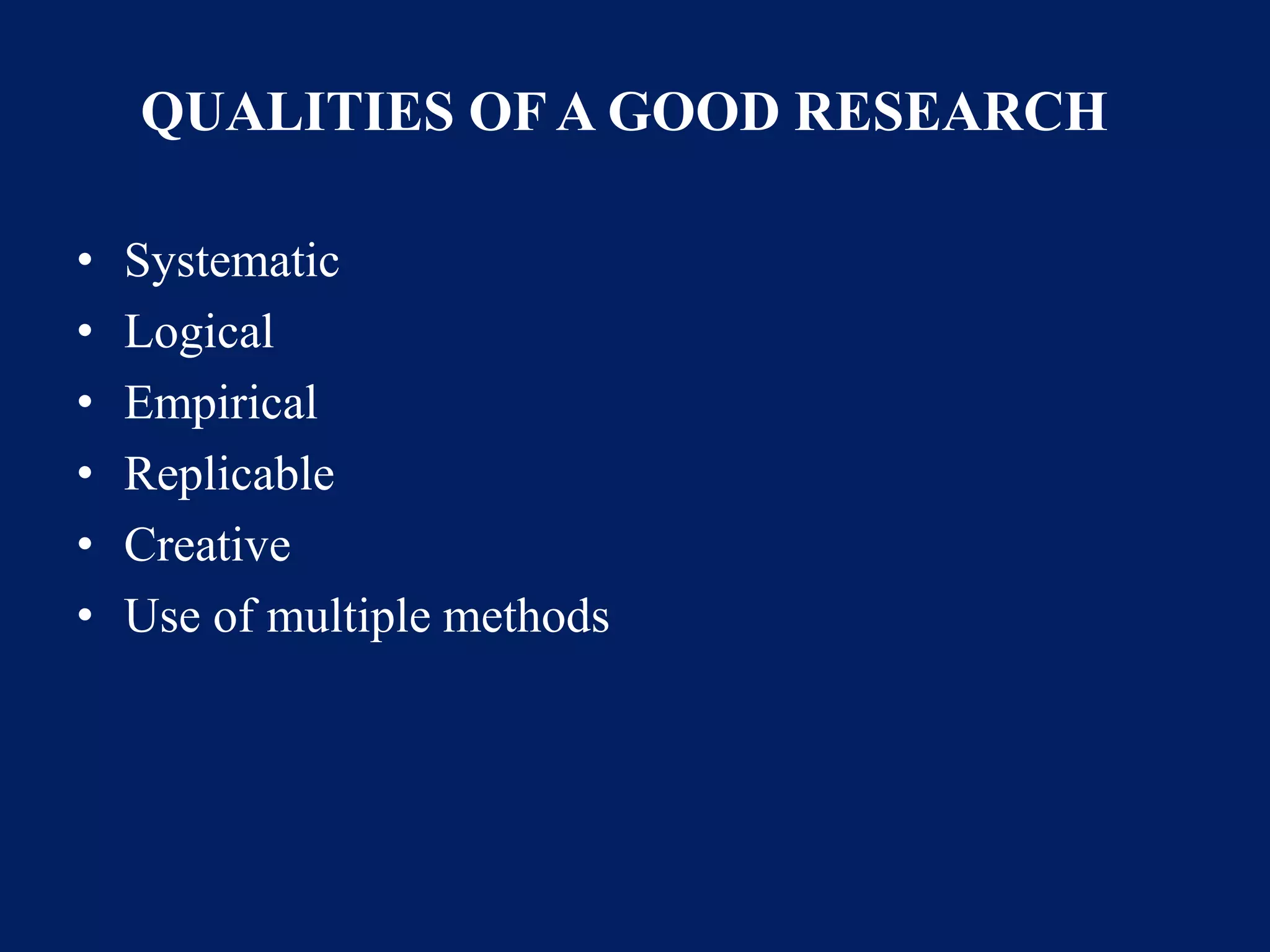
QUALITIES OF A GOOD RESEARCH
• Systematic
• Logical
• Empirical
• Replicable
• Creative
• Use of multiple methods
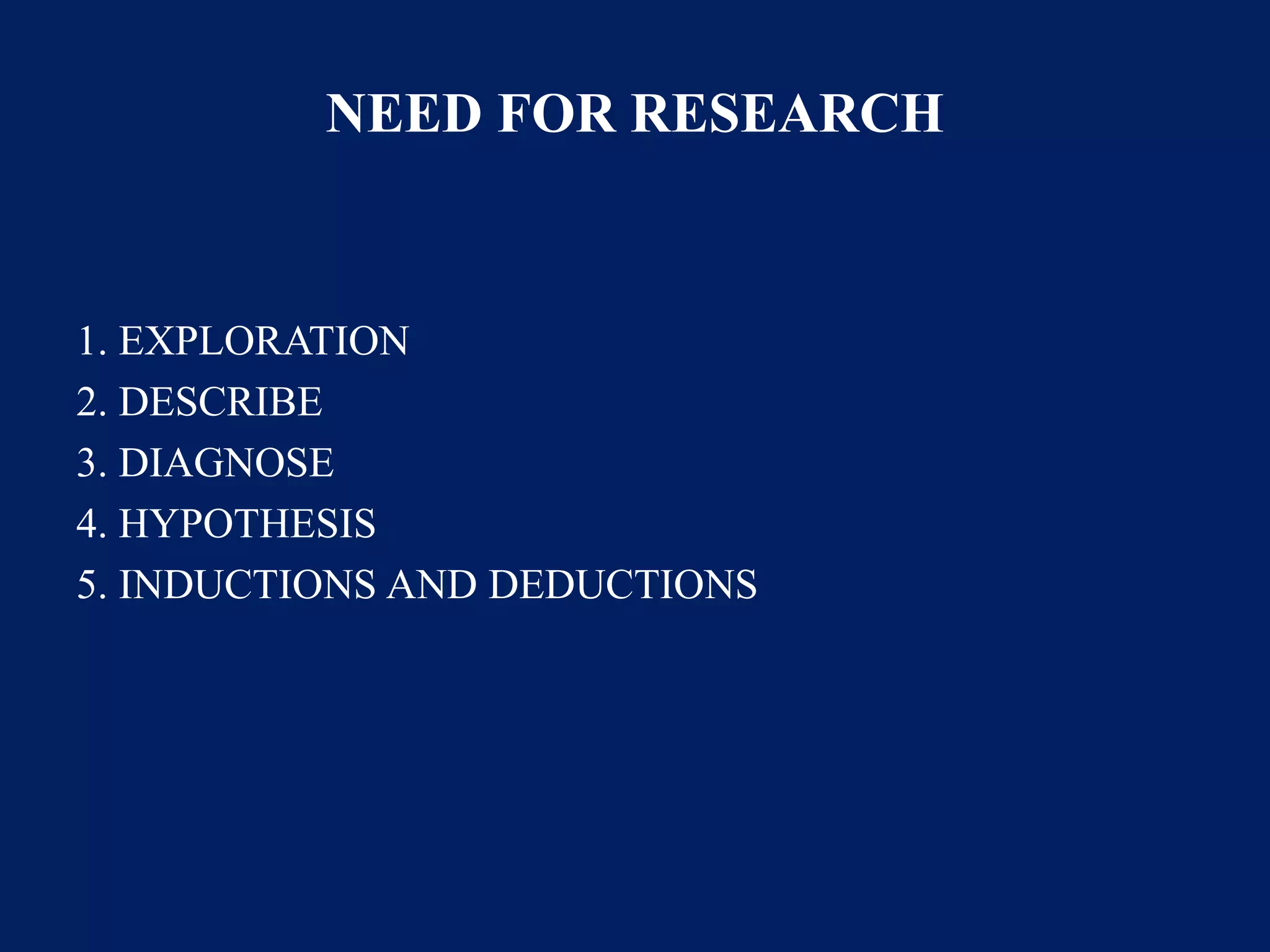
NEED FOR RESEARCH
1. EXPLORATION
2. DESCRIBE
3. DIAGNOSE
4. HYPOTHESIS
5. INDUCTIONS AND DEDUCTIONS
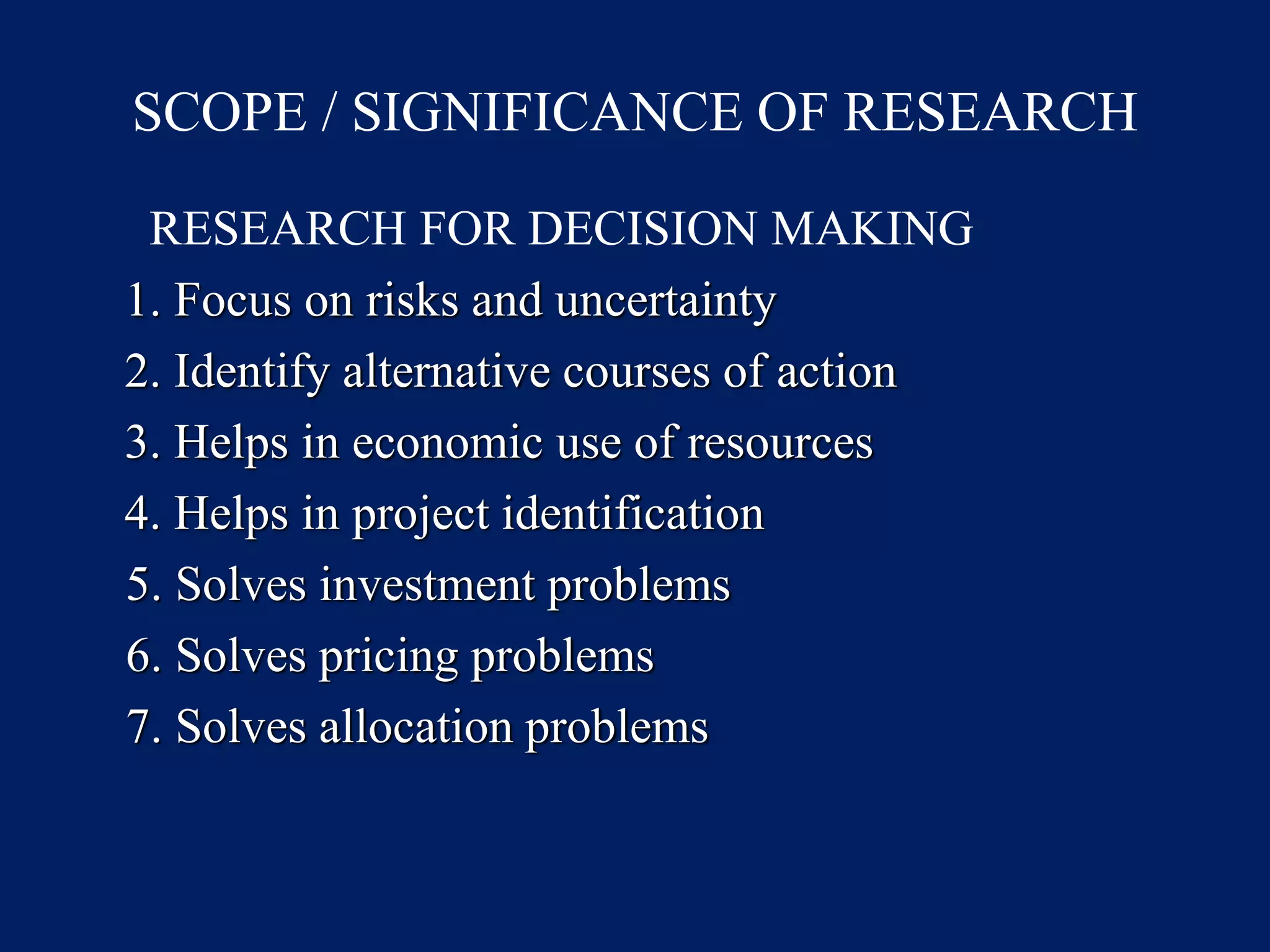
SCOPE / SIGNIFICANCE OF RESEARCH
RESEARCH FOR DECISION MAKING
1. Focus on risks and uncertainty
2. Identify alternative courses of action
3. Helps in economic use of resources
4. Helps in project identification
5. Solves investment problems
6. Solves pricing problems
7. Solves allocation problems
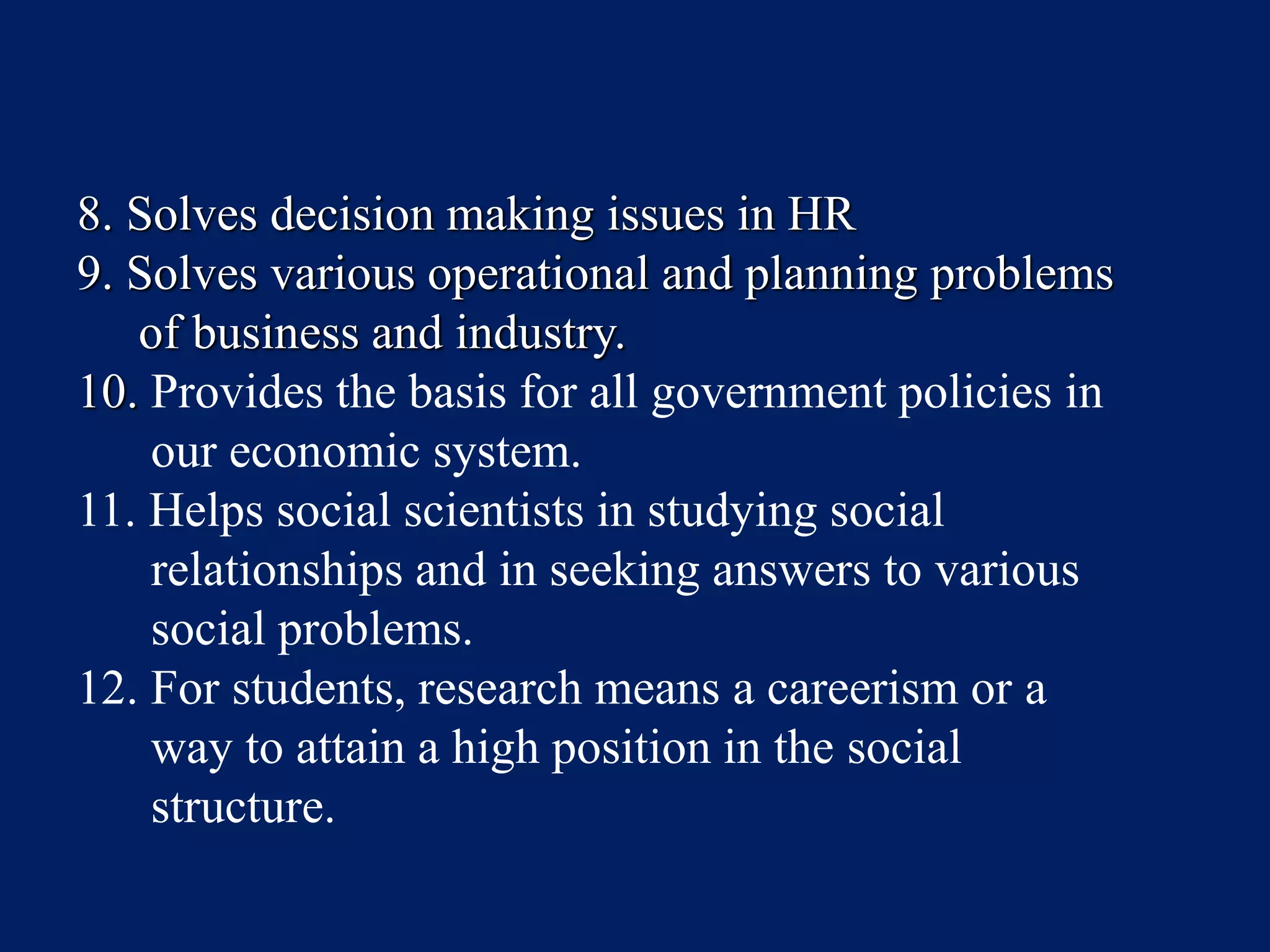
8. Solves decision making issues in HR
9. Solves various operational and planning problems
of business and industry.
10. Provides the basis for all government policies in
our economic system.
11. Helps social scientists in studying social
relationships and in seeking answers to various
social problems.
12. For students, research means a careerism or a
way to attain a high position in the social
structure.
13. For professionals in research, it may mean a source
of livelihood.
14. For philosophers and thinkers, research means the
outlet for new ideas and insights.
15. For literary men and women, research means
development of new styles and creative work.
16. For analysts and intellectuals, research means
generalizations of new theories.
PROBLEMS IN RESEARCH
1. Uncontrollable variables
2. Human tendencies
3. Time and money
4. Lack of computerization
5. Lack of scientific training in the methodology of
research.
6. Insufficient interaction between university research
departments and business establishments.
7. Lack of confidence on the part of business units to
give information.
8. Lack of code of conduct.
9. Difficulty of adequate and timely secretarial
assistance.
10. Poor library management and functioning.
11. Difficulty of timely availability of published data.
12. Ignorance
ROLE OF RESEARCH IN DECISION-MAKING
1. Decision-making is the process of selecting the best
alternative from the available set of alternatives.
2. Management is chiefly concerned with decision-making and
its implementation.
3. These decisions should be based on appropriate studies,
evaluations and observations.
4. Research provides us with knowledge and skills needed to
solve the problems and to meet the challenges of a fast
paced decision-making environment.
Decision-making involves three activities -Herbert
A Simon:
1. Intelligence Activity - scanning the environment for
identifying conditions necessary for the decision.
2. Designing Activity - identifying, developing and
analyzing the alternative courses of action.
3. Choice Activity - choosing the best course of action
from among the alternatives.
FACTORS AFFECT MANAGERIAL DECISIONS
1. INTERNAL FACTORS – factors present inside an organization
such as resources, technology, trade unions, cash flow,
manpower etc.
2. EXTERNAL FACTORS – factors present outside the
organization such as government policies, political factors,
socio-economic factors, legal framework, geographic and
cultural factors etc.
3. QUANTITATIVE FACTORS – factors that can be measured in
quantities such as time, resources, cost factors etc.
FACTORS AFFECT MANAGERIAL DECISIONS
4. QUALITATIVE FACTORS – factors that cannot be measured
in quantities such as organizational cohesiveness, sense of
belonging of employees, risk of technological change etc.
5. UNCERTAINITY FACTORS – factors which cannot be
predicted.
TYPES OF RESEARCH
Descriptive vs Analytical Research
Descriptive Research is a fact-finding investigation which is
aimed at describing the characteristics of individual, situation
or a group (or) describing the state of affairs as it exists at
present.
Analytical Research is primarily concerned with testing
hypothesis and specifying and interpreting relationships, by
analyzing the facts or information already available.
Applied vs Fundamental Research
Applied Research or Action Research is carried out to find
solution to a real-life problem requiring an action or policy
decision.
Fundamental Research which is also known as basic or pure
research is undertaken for the sake of knowledge without
any intention to apply it in practice. It is undertaken out of
intellectual curiosity and is not necessarily problem-oriented.
Quantitative vs Qualitative Research
Quantitative Research is employed for measuring the
quantity or amount of a particular phenomena by the
use of statistical analysis.
Qualitative Research is a non-quantitative type of
analysis which is aimed at finding out the quality of a
particular phenomenon.
Conceptual vs Empirical Research
Conceptual Research is generally used by philosophers and
thinkers to develop new concepts or to reinterpret existing
ones.
Empirical Research is a data-based research which depends
on experience or observation alone. It is aimed at coming up
with conclusions without due regard for system and theory.
Types of Research
• One-time Research – Research confined to a single time period.
• Longitudinal Research – Research carried on over several time
periods.
• Diagnostic Research – It is also called clinical research which
aims at identifying the causes of a problem, frequency with
which it occurs and the possible solutions for it.
• Exploratory Research – It is the preliminary study of an
unfamiliar problem, about which the researcher has little or no
knowledge. It is aimed to gain familiarity with the problem, to
generate new ideas or to make a precise formulation of the
problem. Hence it is also known as formulative research.
• Experimental Research – It is designed to assess the effect of
one particular variable on a phenomenon by keeping the other
variables constant or controlled.
• Historical Research – It is the study of past records and other
information sources, with a view to find the origin and
development of a phenomenon and to discover the trends in the
past, inorder to understand the present and to anticipate the
future.
REFERENCES
1. C. R. Kothari and Gaurav Garg, “Research
Methodology: Methods and Techniques”, NEW
AGE; 2nd Edition, 2014.
2. Stuart Melville and Wayne Goddard, “Research
methodology: an Introduction for science &
engineering students’”, Juta & Company, 1996.

Research Methodology & IPR-I

  • 1.
    Research Methodology & IPR-I By: Dr.Kapil Gupta Associate Prof. MMEC, MMDU
  • 2.
    What is Research? •Research is the process of finding solutions to a problem after a thorough study and analysis of the situational factors. • Research provides the needed information that guides managers to make informed decisions to successfully deal with problems • The information provided could be the result of a careful analysis of data gathered firsthand or of data that are already available.
  • 3.
    Objectives of Research Thepurpose of research is to discover answers through the application of scientific procedures. The objectives are: 1. To gain familiarity with a phenomenon or to achieve new insights into it – Exploratory or Formulative Research. 2. To portray accurately the characteristics of a particular individual, situation or a group – Descriptive Research. 3. To determine the frequency with which something occurs or with which it is associated with something else – Diagnostic Research. 4. To test a hypothesis of a causal relationship between variables – Hypothesis-Testing Research.
  • 4.
    Characteristics of Research •Research is directed towards the solution of a problem. • Research is based upon observable experience or empirical evidence. • Research demands accurate observation and description. • Research involves gathering new data from primary sources or using existing data for a new purpose. • Research activities are characterized by carefully designed procedures. • Research requires expertise i.e., skill necessary to carryout investigation, search the related literature and to understand and analyze the data gathered.
  • 5.
    Characteristics of Research •Research is objective and logical – applying every possible test to validate the data collected and conclusions reached. • Research involves the quest for answers to unsolved problems. • Research requires courage. • Research is characterized by patient and unhurried activity. • Research is carefully recorded and reported.
  • 6.
    SCIENTIFIC METHOD • ‘Science’refers to the body of systematic and organized knowledge which makes use of scientific method to acquire knowledge in a particular field of enquiry. • Scientific method is the systematic collection of data (facts) and their theoretical treatment through proper observation, experimentation and interpretation. • Scientific method attempts to achieve a systematic interrelation of facts by experimentation, observation, and logical arguments from accepted postulates and a combination of these three in varying proportions.
  • 7.
    BASIC POSTULATES IN SCIENTIFICMETHOD • It relies on empirical evidence. • It utilizes relevant concepts. • It is committed to only objective considerations. • It presupposes ethical neutrality. • It results into probabilistic predictions. • The methodology is made known. • Aims at formulating scientific theories.
  • 8.
    1. Purpose clearlydefined. 2. Research process detailed. 3. Research design thoroughly planned. 4. High ethical standards applied. 5. Limitations frankly revealed. 6. Adequate analysis for decision maker’s needs. 7. Findings presented unambiguously. 8. Conclusions justified. 9. Researcher’s experience reflected. CRITERIA OF A GOOD RESEARCH
  • 9.
    QUALITIES OF AGOOD RESEARCH • Systematic • Logical • Empirical • Replicable • Creative • Use of multiple methods
  • 10.
    NEED FOR RESEARCH 1.EXPLORATION 2. DESCRIBE 3. DIAGNOSE 4. HYPOTHESIS 5. INDUCTIONS AND DEDUCTIONS
  • 11.
    SCOPE / SIGNIFICANCEOF RESEARCH RESEARCH FOR DECISION MAKING 1. Focus on risks and uncertainty 2. Identify alternative courses of action 3. Helps in economic use of resources 4. Helps in project identification 5. Solves investment problems 6. Solves pricing problems 7. Solves allocation problems
  • 12.
    8. Solves decisionmaking issues in HR 9. Solves various operational and planning problems of business and industry. 10. Provides the basis for all government policies in our economic system. 11. Helps social scientists in studying social relationships and in seeking answers to various social problems. 12. For students, research means a careerism or a way to attain a high position in the social structure.
  • 13.
    13. For professionalsin research, it may mean a source of livelihood. 14. For philosophers and thinkers, research means the outlet for new ideas and insights. 15. For literary men and women, research means development of new styles and creative work. 16. For analysts and intellectuals, research means generalizations of new theories.
  • 14.
    PROBLEMS IN RESEARCH 1.Uncontrollable variables 2. Human tendencies 3. Time and money 4. Lack of computerization 5. Lack of scientific training in the methodology of research. 6. Insufficient interaction between university research departments and business establishments. 7. Lack of confidence on the part of business units to give information.
  • 15.
    8. Lack ofcode of conduct. 9. Difficulty of adequate and timely secretarial assistance. 10. Poor library management and functioning. 11. Difficulty of timely availability of published data. 12. Ignorance
  • 16.
    ROLE OF RESEARCHIN DECISION-MAKING 1. Decision-making is the process of selecting the best alternative from the available set of alternatives. 2. Management is chiefly concerned with decision-making and its implementation. 3. These decisions should be based on appropriate studies, evaluations and observations. 4. Research provides us with knowledge and skills needed to solve the problems and to meet the challenges of a fast paced decision-making environment.
  • 17.
    Decision-making involves threeactivities -Herbert A Simon: 1. Intelligence Activity - scanning the environment for identifying conditions necessary for the decision. 2. Designing Activity - identifying, developing and analyzing the alternative courses of action. 3. Choice Activity - choosing the best course of action from among the alternatives.
  • 18.
    FACTORS AFFECT MANAGERIALDECISIONS 1. INTERNAL FACTORS – factors present inside an organization such as resources, technology, trade unions, cash flow, manpower etc. 2. EXTERNAL FACTORS – factors present outside the organization such as government policies, political factors, socio-economic factors, legal framework, geographic and cultural factors etc. 3. QUANTITATIVE FACTORS – factors that can be measured in quantities such as time, resources, cost factors etc.
  • 19.
    FACTORS AFFECT MANAGERIALDECISIONS 4. QUALITATIVE FACTORS – factors that cannot be measured in quantities such as organizational cohesiveness, sense of belonging of employees, risk of technological change etc. 5. UNCERTAINITY FACTORS – factors which cannot be predicted.
  • 20.
    TYPES OF RESEARCH Descriptivevs Analytical Research Descriptive Research is a fact-finding investigation which is aimed at describing the characteristics of individual, situation or a group (or) describing the state of affairs as it exists at present. Analytical Research is primarily concerned with testing hypothesis and specifying and interpreting relationships, by analyzing the facts or information already available.
  • 21.
    Applied vs FundamentalResearch Applied Research or Action Research is carried out to find solution to a real-life problem requiring an action or policy decision. Fundamental Research which is also known as basic or pure research is undertaken for the sake of knowledge without any intention to apply it in practice. It is undertaken out of intellectual curiosity and is not necessarily problem-oriented.
  • 22.
    Quantitative vs QualitativeResearch Quantitative Research is employed for measuring the quantity or amount of a particular phenomena by the use of statistical analysis. Qualitative Research is a non-quantitative type of analysis which is aimed at finding out the quality of a particular phenomenon.
  • 23.
    Conceptual vs EmpiricalResearch Conceptual Research is generally used by philosophers and thinkers to develop new concepts or to reinterpret existing ones. Empirical Research is a data-based research which depends on experience or observation alone. It is aimed at coming up with conclusions without due regard for system and theory.
  • 24.
    Types of Research •One-time Research – Research confined to a single time period. • Longitudinal Research – Research carried on over several time periods. • Diagnostic Research – It is also called clinical research which aims at identifying the causes of a problem, frequency with which it occurs and the possible solutions for it. • Exploratory Research – It is the preliminary study of an unfamiliar problem, about which the researcher has little or no knowledge. It is aimed to gain familiarity with the problem, to generate new ideas or to make a precise formulation of the problem. Hence it is also known as formulative research.
  • 25.
    • Experimental Research– It is designed to assess the effect of one particular variable on a phenomenon by keeping the other variables constant or controlled. • Historical Research – It is the study of past records and other information sources, with a view to find the origin and development of a phenomenon and to discover the trends in the past, inorder to understand the present and to anticipate the future.
  • 26.
    REFERENCES 1. C. R.Kothari and Gaurav Garg, “Research Methodology: Methods and Techniques”, NEW AGE; 2nd Edition, 2014. 2. Stuart Melville and Wayne Goddard, “Research methodology: an Introduction for science & engineering students’”, Juta & Company, 1996.