Dynamic Routing Protocols
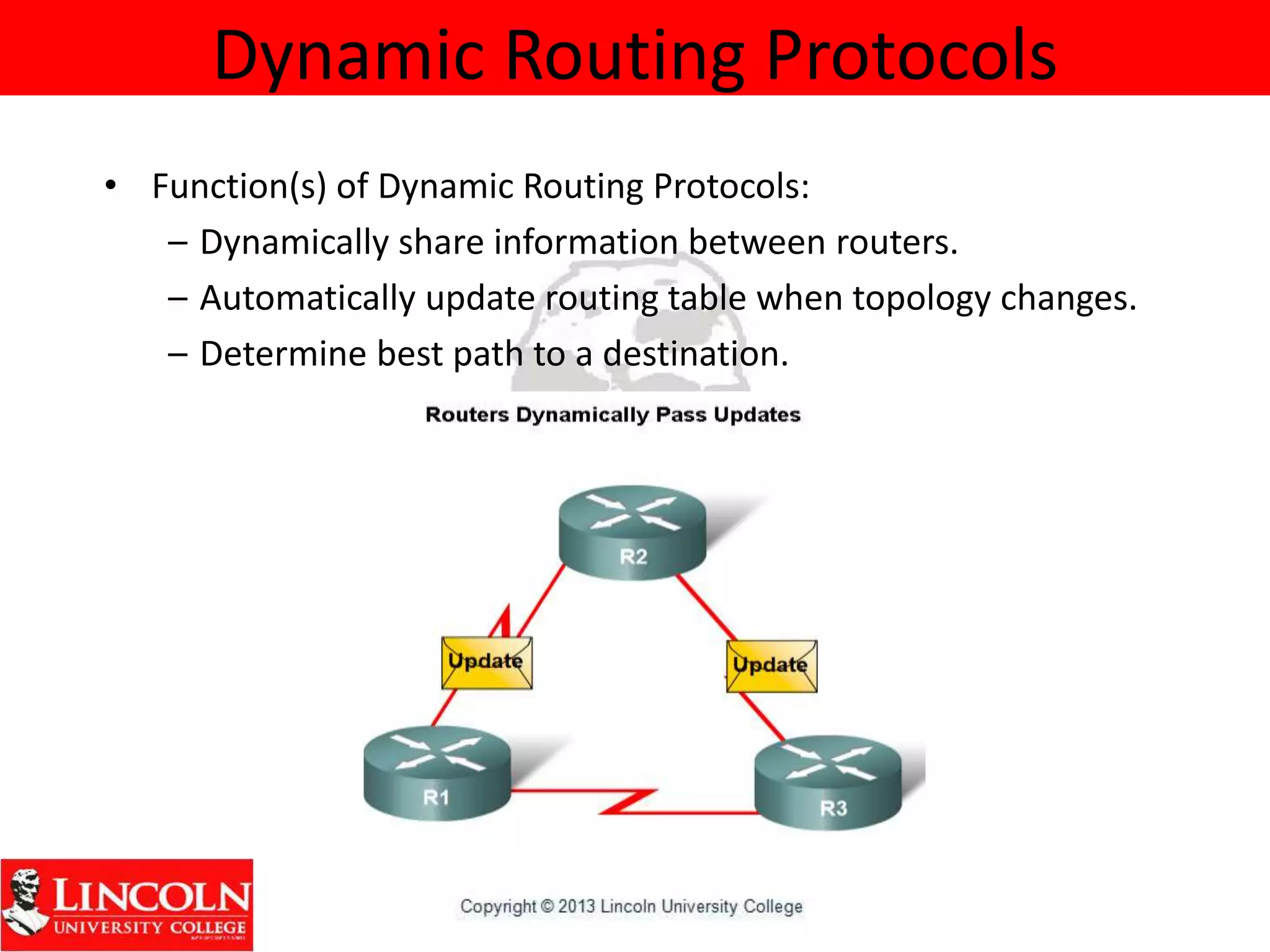
• Function(s) of Dynamic Routing Protocols:
– Dynamically share information between routers.
– Automatically update routing table when topology changes.
– Determine best path to a destination.
Dynamic Routing Protocols
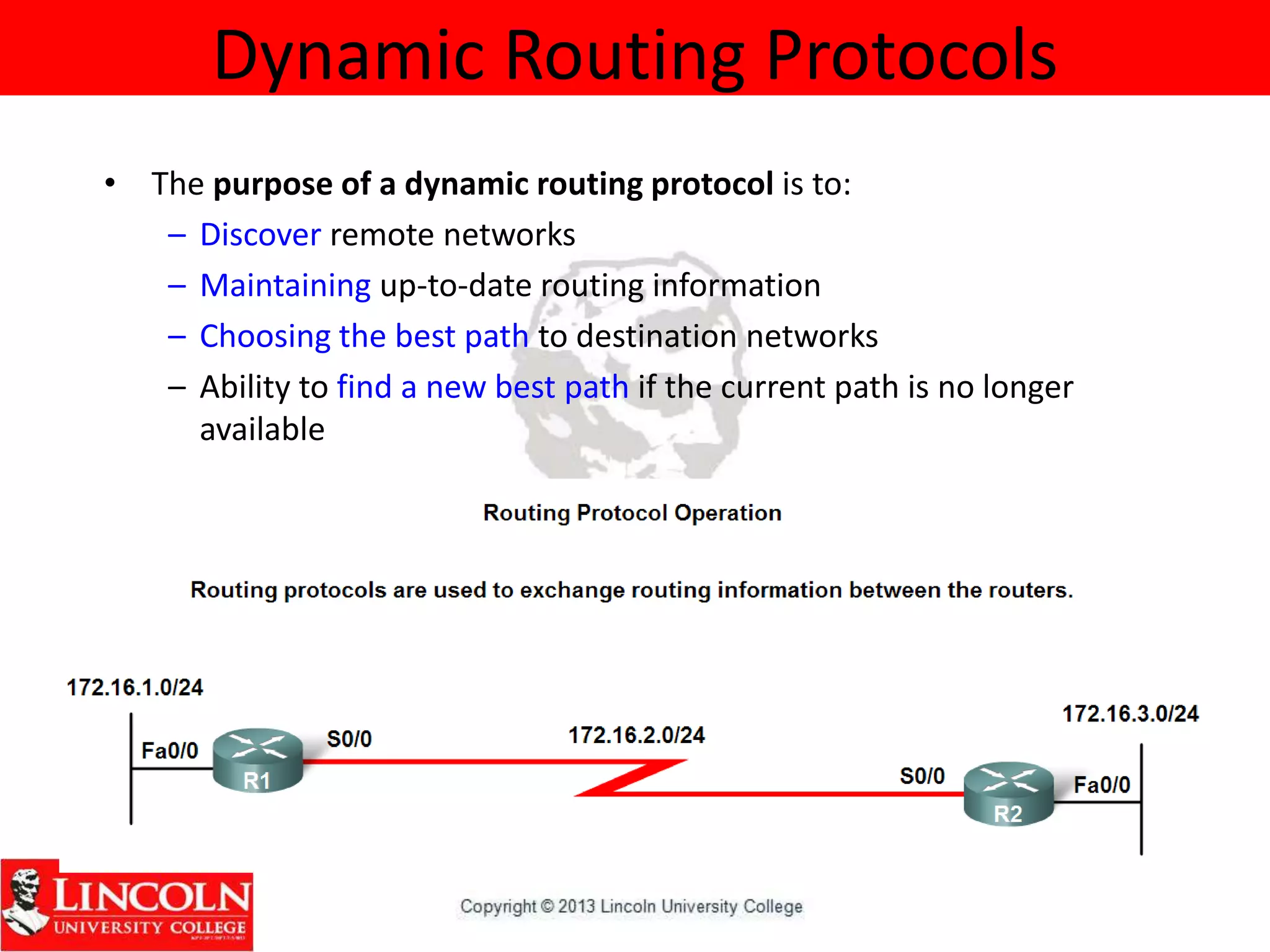
• The purpose of a dynamic routing protocol is to:
– Discover remote networks
– Maintaining up-to-date routing information
– Choosing the best path to destination networks
– Ability to find a new best path if the current path is no longer
available
Dynamic Routing Protocols
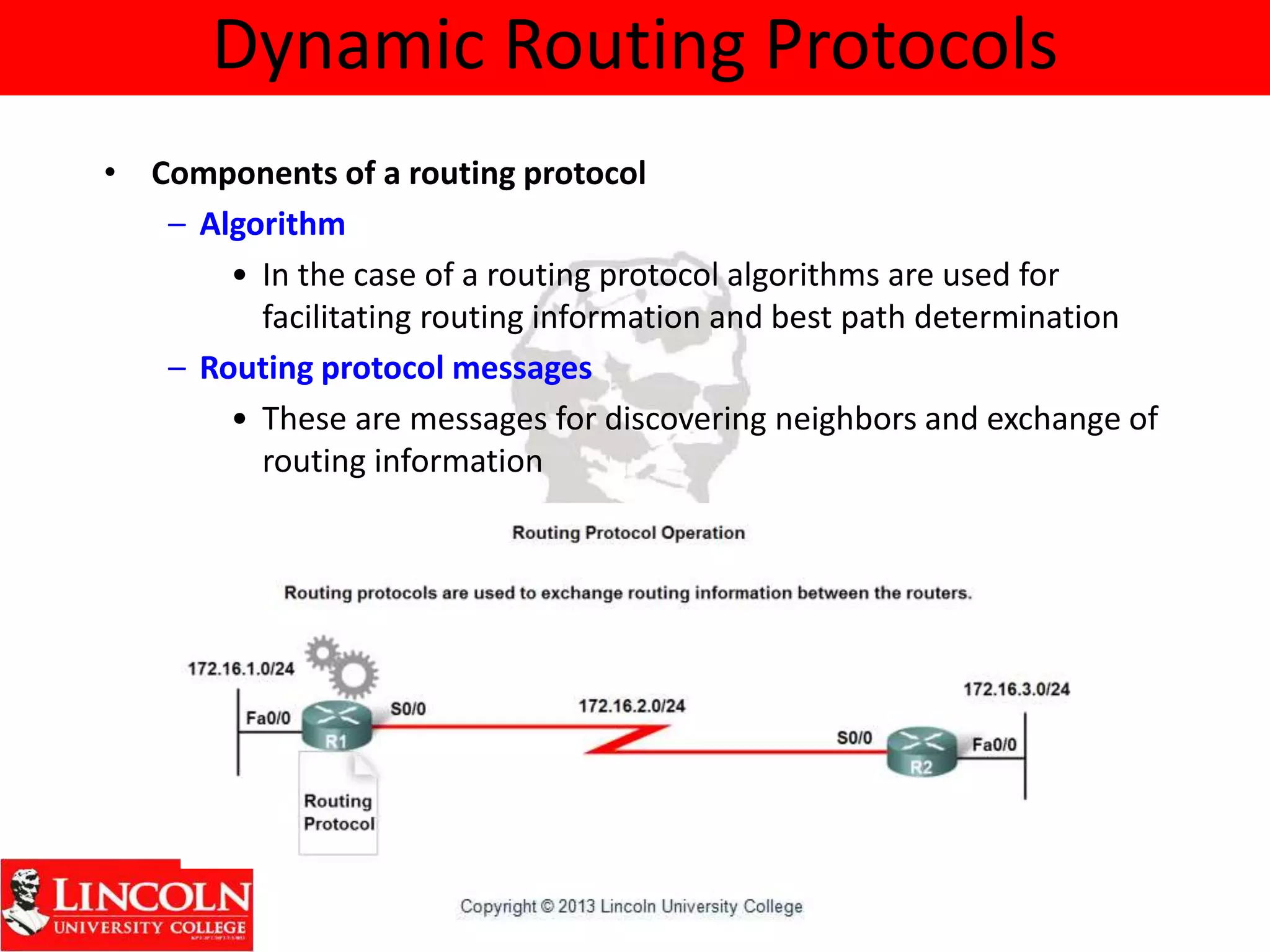
• Components of a routing protocol
– Algorithm
• In the case of a routing protocol algorithms are used for
facilitating routing information and best path determination
– Routing protocol messages
• These are messages for discovering neighbors and exchange of
routing information
Dynamic Routing Protocols
• Advantages of static routing
–It can backup multiple interfaces/networks on a
router
–Easy to configure
–No extra resources are needed
–More secure
• Disadvantages of static routing
–Network changes require manual
reconfiguration
–Does not scale well in large topologies
Classifying Routing Protocols
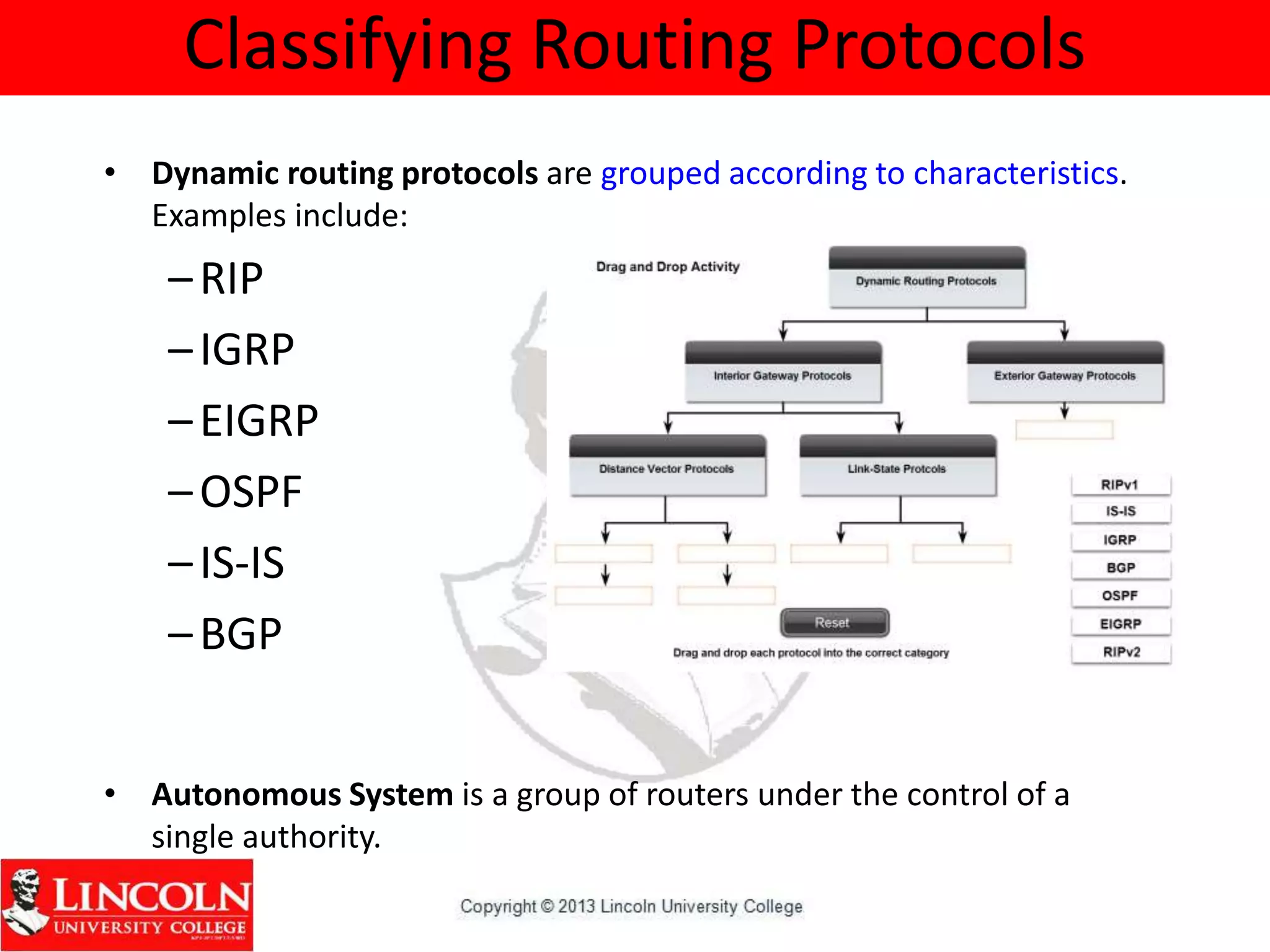
• Dynamic routing protocols are grouped according to characteristics.
Examples include:
–RIP
–IGRP
–EIGRP
–OSPF
–IS-IS
–BGP
• Autonomous System is a group of routers under the control of a
single authority.
Classifying Routing Protocols
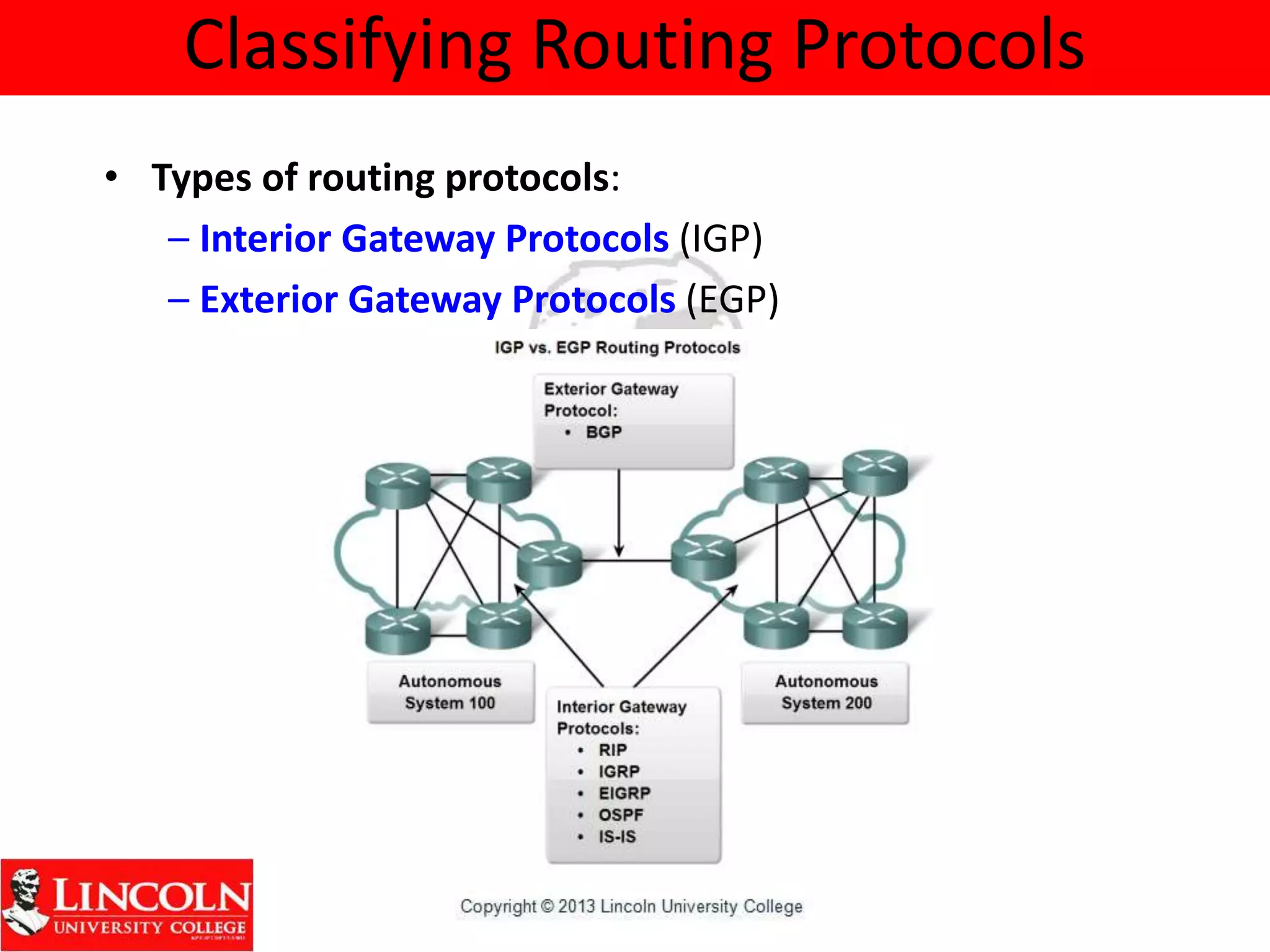
• Types of routing protocols:
– Interior Gateway Protocols (IGP)
– Exterior Gateway Protocols (EGP)
Classifying Routing Protocols
• Interior Gateway Routing Protocols (IGP)
–Used for routing inside an autonomous system &
used to route within the individual networks
themselves
–Examples: RIP, EIGRP, OSPF
• Exterior Routing Protocols (EGP)
–Used for routing between autonomous systems
–Example: BGPv4
Classifying Routing Protocols
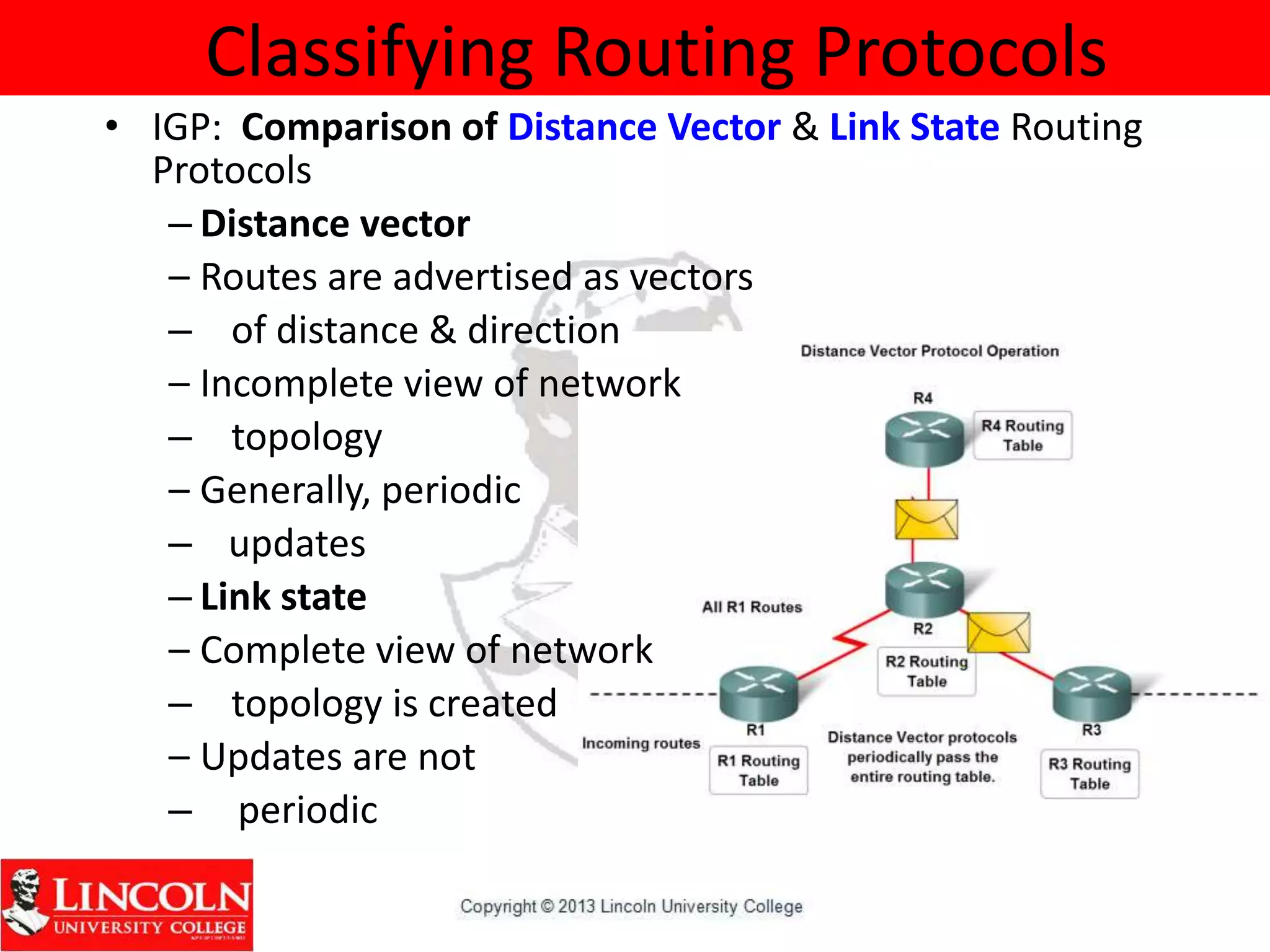
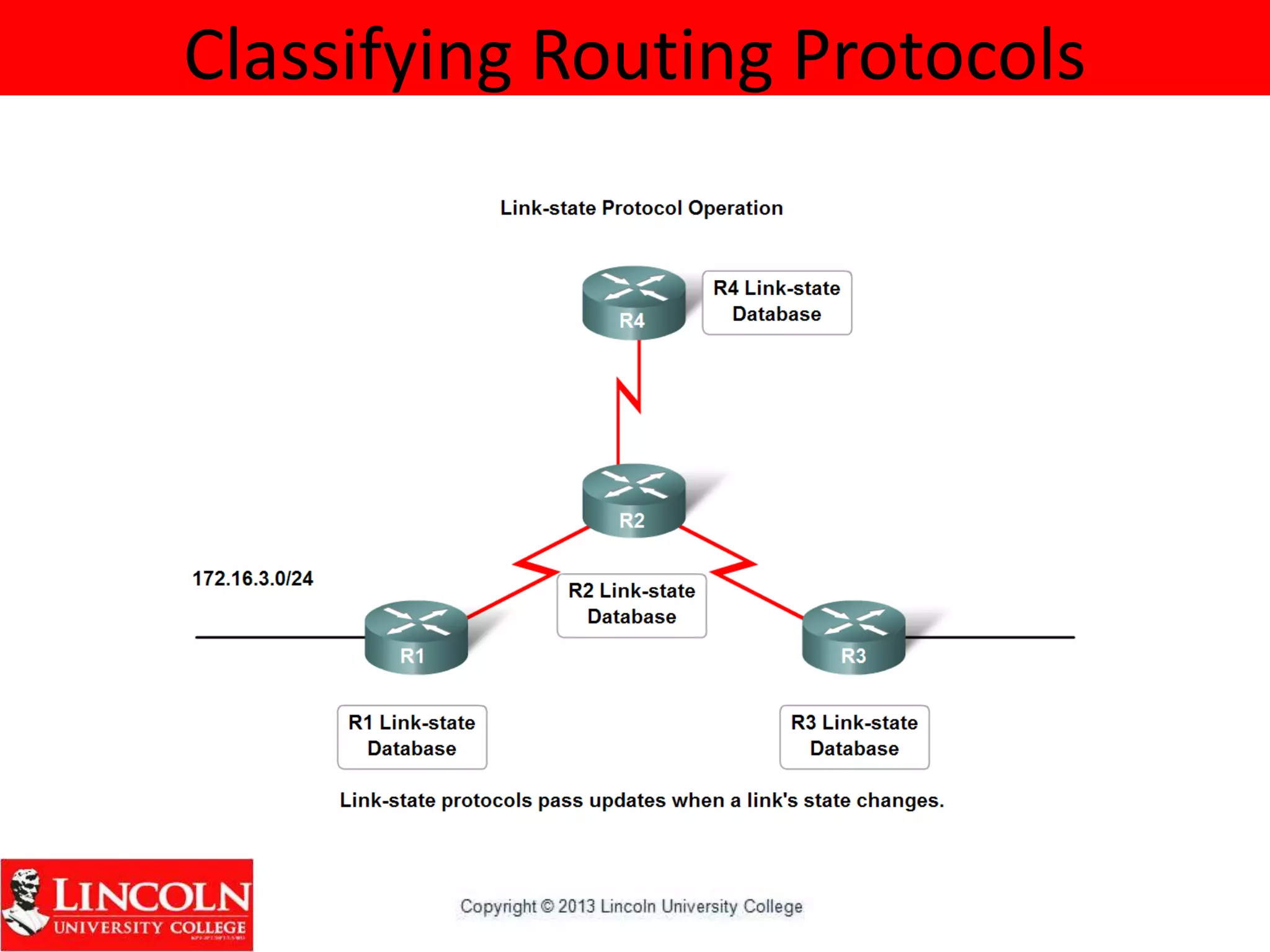
• IGP: Comparison of Distance Vector & Link State Routing
Protocols
– Distance vector
– Routes are advertised as vectors
– of distance & direction
– Incomplete view of network
– topology
– Generally, periodic
– updates
– Link state
– Complete view of network
– topology is created
– Updates are not
– periodic
Classifying Routing Protocols
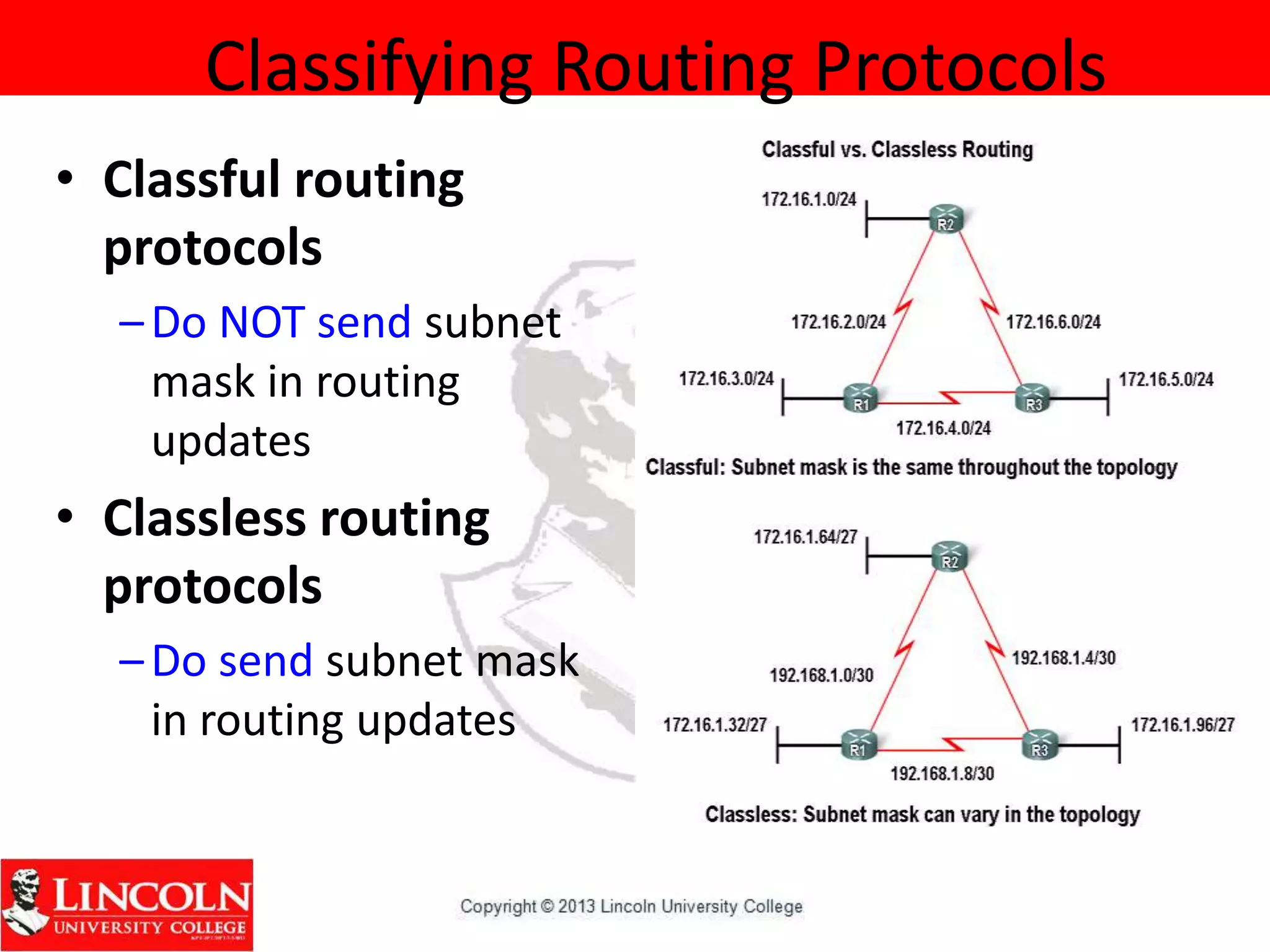
• Classful routing
protocols
–Do NOT send subnet
mask in routing
updates
• Classless routing
protocols
–Do send subnet mask
in routing updates
Classifying Routing Protocols
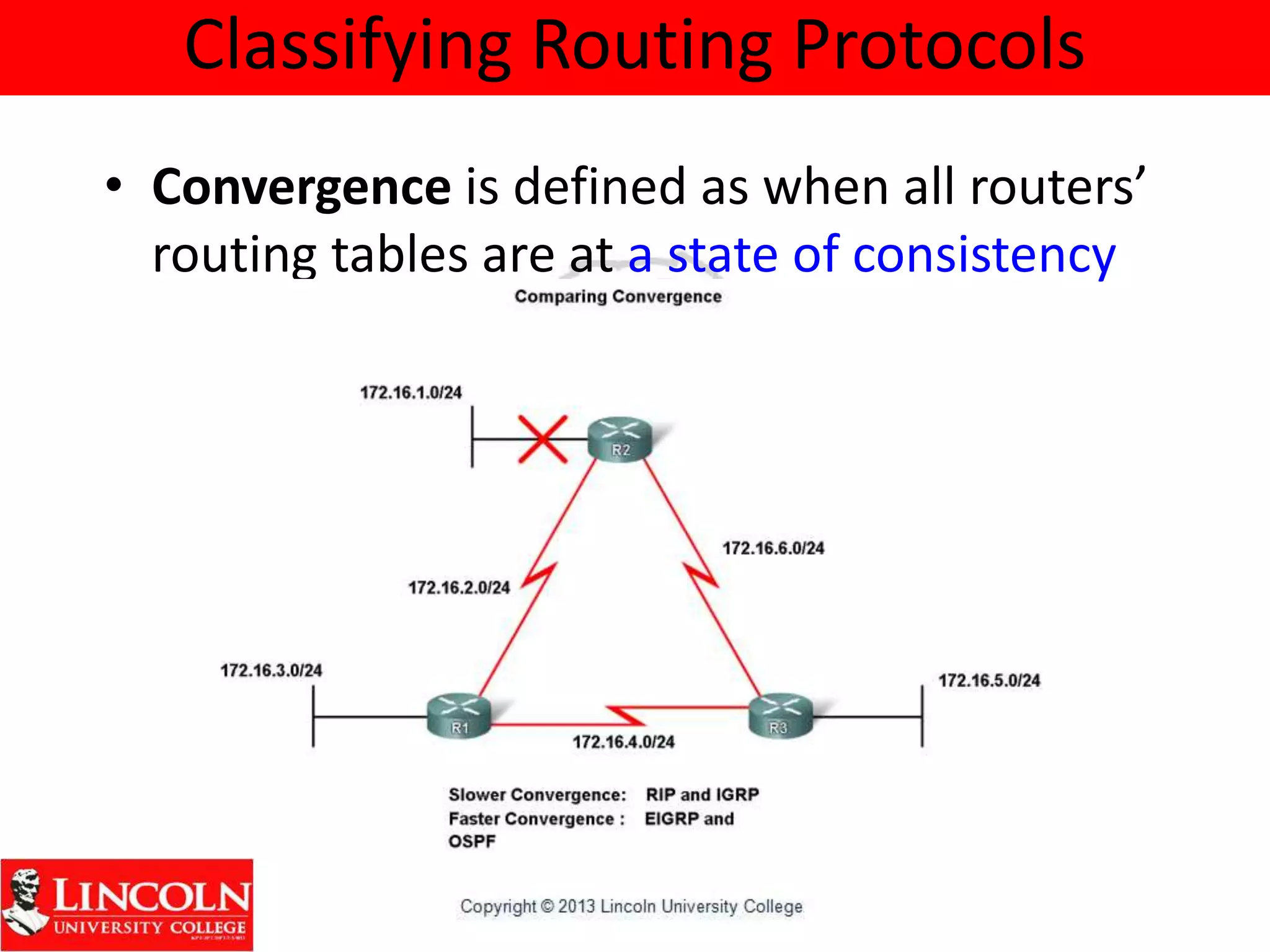
• Convergence is defined as when all routers’
routing tables are at a state of consistency

Sept 2017 dynamic routing

  • 1.
    Dynamic Routing Protocols •Function(s) of Dynamic Routing Protocols: – Dynamically share information between routers. – Automatically update routing table when topology changes. – Determine best path to a destination.
  • 2.
    Dynamic Routing Protocols •The purpose of a dynamic routing protocol is to: – Discover remote networks – Maintaining up-to-date routing information – Choosing the best path to destination networks – Ability to find a new best path if the current path is no longer available
  • 3.
    Dynamic Routing Protocols •Components of a routing protocol – Algorithm • In the case of a routing protocol algorithms are used for facilitating routing information and best path determination – Routing protocol messages • These are messages for discovering neighbors and exchange of routing information
  • 4.
    Dynamic Routing Protocols •Advantages of static routing –It can backup multiple interfaces/networks on a router –Easy to configure –No extra resources are needed –More secure • Disadvantages of static routing –Network changes require manual reconfiguration –Does not scale well in large topologies
  • 5.
    Classifying Routing Protocols •Dynamic routing protocols are grouped according to characteristics. Examples include: –RIP –IGRP –EIGRP –OSPF –IS-IS –BGP • Autonomous System is a group of routers under the control of a single authority.
  • 6.
    Classifying Routing Protocols •Types of routing protocols: – Interior Gateway Protocols (IGP) – Exterior Gateway Protocols (EGP)
  • 7.
    Classifying Routing Protocols •Interior Gateway Routing Protocols (IGP) –Used for routing inside an autonomous system & used to route within the individual networks themselves –Examples: RIP, EIGRP, OSPF • Exterior Routing Protocols (EGP) –Used for routing between autonomous systems –Example: BGPv4
  • 8.
    Classifying Routing Protocols •IGP: Comparison of Distance Vector & Link State Routing Protocols – Distance vector – Routes are advertised as vectors – of distance & direction – Incomplete view of network – topology – Generally, periodic – updates – Link state – Complete view of network – topology is created – Updates are not – periodic
  • 9.
  • 10.
    Classifying Routing Protocols •Classful routing protocols –Do NOT send subnet mask in routing updates • Classless routing protocols –Do send subnet mask in routing updates
  • 11.
    Classifying Routing Protocols •Convergence is defined as when all routers’ routing tables are at a state of consistency