Static and Dynamic Routing
 Static Routing is a simplistic approach.
 Shortcomings
 Cumbersome to configure.
 Cannot adapt to addition of new links or nodes.
 Cannot adapt to link or node failures.
 Cannot easily handle multiple paths to a
destination.
 Does not scale to large networks.
 Solution is to use Dynamic Routing.
Desirable Characteristics of
Dynamic Routing
 Automatically detect and adapt to topology
changes.
 Provide optimal routing.
 Scalability.
 Robustness.
 Simplicity.
 Rapid convergence.
 Some control of routing choices.
Convergence – why do I
care?
 Convergence is when all the routers have the
same routing information.
 When a network is not converged there is network
downtime.
 Packets don’t get to where they are supposed to
go.
○ Black holes (packets “disappear”)
○ Routing Loops (packets go back and fore between the
same devices)
 Occurs when there is a change in status of
router or the links.
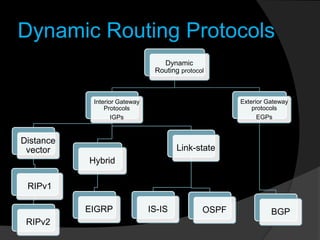
Dynamic Routing Protocols
Dynamic
Routing protocol
Interior Gateway
Protocols
IGPs
Distance
vector
RIPv1
RIPv2
Hybrid
EIGRP
Link-state
IS-IS OSPF
Exterior Gateway
protocols
EGPs
BGP
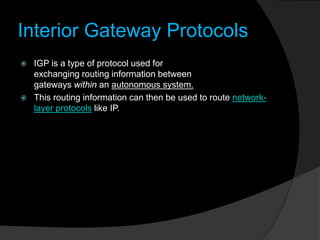
Interior Gateway Protocols
 IGP is a type of protocol used for
exchanging routing information between
gateways within an autonomous system.
 This routing information can then be used to route network-
layer protocols like IP.
RIP
RIP
 RIP was one of the first true Distance Vector routing
protocols.
 RIP uses the Bellman-Ford Distance Vector algorithm.
 Listen to neighbouring routes
 Install all routes in routing table
○ Lowest hop count wins
 Advertise all routes in table
○ Very simple, very stupid
 Only metric is hop count
 Network is max 16 hops (not large enough).
 periodic routing updates (every 30 seconds)
RIP (cont.)
 RIP supports IP and IPX routing.
 RIP utilizes UDP port 520
 Administrative distance of 120.
 RIP has a maximum hop count of 15
hops.
 RIPv1 is classful.
 RIPv1 does not support authentication
RIPv2
 RIPv2 is classless routing
 RIPv2 routing updates are sent as
multicast address of 224.0.0.9
 RIPv2 supports authentication
EIGRP
 Enhanced Interior Gateway Routing Protocol
 EIGRP is a Cisco-proprietary Hybrid routing
protocol
 EIGRP uses Diffusing Update Algorithm (DUAL)
 EIGRP will form neighbor relationships with
adjacent routers in the same Autonomous System
(AS).
 Support unicasts, multicasts (address 224.0.0.10)
 Reliable Transport Protocol (RTP)
 Updates are sent when a change occurs
 EIGRP Hellos are sent every 5 sec, 60 sec
 Hold timer is three times the Hello timer
EIGRP (cont.)
 EIGRP is a classless protocol, and thus supports
VLSMs
 EIGRP supports IP, IPX, and Appletalk routing
 Administrative Distance of 90, 170
 Maximum hop-count of 224, default hop-count is set
to 100.
 EIGRP Metric = 256*(10000000/Bandwidth + Delay)
 Eigrp supports three other parameters to calculate its
metric: Reliability, Load, and MTU.
 EIGRP, builds three separate tables
 Neighbor table
 Topology table
 Routing table
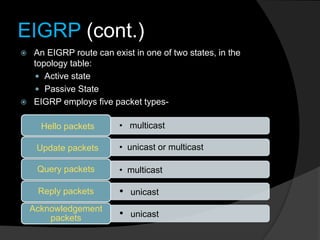
EIGRP (cont.)
 An EIGRP route can exist in one of two states, in the
topology table:
 Active state
 Passive State
 EIGRP employs five packet types-
• multicastHello packets
• unicast or multicastUpdate packets
• multicastQuery packets
• unicastReply packets
• unicast
Acknowledgement
packets
OSPF
 Open Shortest Path First
 “Open” means it is public domain
 Uses “Shortest Path First” algorithm – sometimes
called “the Dijkstra algorithm”
 IETF Working Group formed in 1988 to design an IGP
for IP
 OSPF v1 published in 1989 – RFC1131
 OSPF v2 published in 1991 – RFC1247
 Developments continued through the 90s and today
 OSPFv3 includes extensions to support IPv6
 Network is Divided into Areas
 Backbone area (area 0)
 Off backbone area (area 1-65,535)
 Special routers (autonomous system boundary routers)
or backbone routers responsible to dissipate
information about other AS into the current system.
OSPF (cont.)
 Carried in data field of IP packet
 Protocol value is 89
 No hop-counts limits
 AD value is 110
 Support classless network
 VLSM/CIDR
 Unique id for every router
 OSPF traffic is multicast either to address 224.0.0.5 or 224.0.0.6
 Metric = cost
 The OSPF process builds and maintains three separate tables
 Neighbor table
 Topology table
 Routing table
 Hello packets (10 seconds, 30 sec)
 Dead Interval (40 sec, 120 sec)
OSPF (cont.)
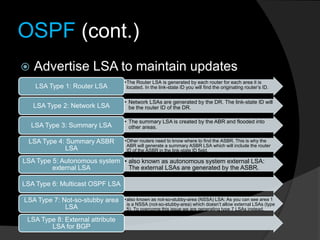
 Advertise LSA to maintain updates
•The Router LSA is generated by each router for each area it is
located. In the link-state ID you will find the originating router’s ID.LSA Type 1: Router LSA
• Network LSAs are generated by the DR. The link-state ID will
be the router ID of the DR.LSA Type 2: Network LSA
• The summary LSA is created by the ABR and flooded into
other areas.LSA Type 3: Summary LSA
•Other routers need to know where to find the ASBR. This is why the
ABR will generate a summary ASBR LSA which will include the router
ID of the ASBR in the link-state ID field.
LSA Type 4: Summary ASBR
LSA
• also known as autonomous system external LSA:
The external LSAs are generated by the ASBR.
LSA Type 5: Autonomous system
external LSA
LSA Type 6: Multicast OSPF LSA
•also known as not-so-stubby-area (NSSA) LSA: As you can see area 1
is a NSSA (not-so-stubby-area) which doesn’t allow external LSAs (type
5). To overcome this issue we are generating type 7 LSAs instead.
LSA Type 7: Not-so-stubby area
LSA
LSA Type 8: External attribute
LSA for BGP

Dynamic routing

  • 2.
    Static and DynamicRouting  Static Routing is a simplistic approach.  Shortcomings  Cumbersome to configure.  Cannot adapt to addition of new links or nodes.  Cannot adapt to link or node failures.  Cannot easily handle multiple paths to a destination.  Does not scale to large networks.  Solution is to use Dynamic Routing.
  • 3.
    Desirable Characteristics of DynamicRouting  Automatically detect and adapt to topology changes.  Provide optimal routing.  Scalability.  Robustness.  Simplicity.  Rapid convergence.  Some control of routing choices.
  • 4.
    Convergence – whydo I care?  Convergence is when all the routers have the same routing information.  When a network is not converged there is network downtime.  Packets don’t get to where they are supposed to go. ○ Black holes (packets “disappear”) ○ Routing Loops (packets go back and fore between the same devices)  Occurs when there is a change in status of router or the links.
  • 5.
    Dynamic Routing Protocols Dynamic Routingprotocol Interior Gateway Protocols IGPs Distance vector RIPv1 RIPv2 Hybrid EIGRP Link-state IS-IS OSPF Exterior Gateway protocols EGPs BGP
  • 6.
    Interior Gateway Protocols IGP is a type of protocol used for exchanging routing information between gateways within an autonomous system.  This routing information can then be used to route network- layer protocols like IP.
  • 7.
  • 8.
    RIP  RIP wasone of the first true Distance Vector routing protocols.  RIP uses the Bellman-Ford Distance Vector algorithm.  Listen to neighbouring routes  Install all routes in routing table ○ Lowest hop count wins  Advertise all routes in table ○ Very simple, very stupid  Only metric is hop count  Network is max 16 hops (not large enough).  periodic routing updates (every 30 seconds)
  • 9.
    RIP (cont.)  RIPsupports IP and IPX routing.  RIP utilizes UDP port 520  Administrative distance of 120.  RIP has a maximum hop count of 15 hops.  RIPv1 is classful.  RIPv1 does not support authentication
  • 10.
    RIPv2  RIPv2 isclassless routing  RIPv2 routing updates are sent as multicast address of 224.0.0.9  RIPv2 supports authentication
  • 11.
    EIGRP  Enhanced InteriorGateway Routing Protocol  EIGRP is a Cisco-proprietary Hybrid routing protocol  EIGRP uses Diffusing Update Algorithm (DUAL)  EIGRP will form neighbor relationships with adjacent routers in the same Autonomous System (AS).  Support unicasts, multicasts (address 224.0.0.10)  Reliable Transport Protocol (RTP)  Updates are sent when a change occurs  EIGRP Hellos are sent every 5 sec, 60 sec  Hold timer is three times the Hello timer
  • 12.
    EIGRP (cont.)  EIGRPis a classless protocol, and thus supports VLSMs  EIGRP supports IP, IPX, and Appletalk routing  Administrative Distance of 90, 170  Maximum hop-count of 224, default hop-count is set to 100.  EIGRP Metric = 256*(10000000/Bandwidth + Delay)  Eigrp supports three other parameters to calculate its metric: Reliability, Load, and MTU.  EIGRP, builds three separate tables  Neighbor table  Topology table  Routing table
  • 13.
    EIGRP (cont.)  AnEIGRP route can exist in one of two states, in the topology table:  Active state  Passive State  EIGRP employs five packet types- • multicastHello packets • unicast or multicastUpdate packets • multicastQuery packets • unicastReply packets • unicast Acknowledgement packets
  • 14.
    OSPF  Open ShortestPath First  “Open” means it is public domain  Uses “Shortest Path First” algorithm – sometimes called “the Dijkstra algorithm”  IETF Working Group formed in 1988 to design an IGP for IP  OSPF v1 published in 1989 – RFC1131  OSPF v2 published in 1991 – RFC1247  Developments continued through the 90s and today  OSPFv3 includes extensions to support IPv6  Network is Divided into Areas  Backbone area (area 0)  Off backbone area (area 1-65,535)  Special routers (autonomous system boundary routers) or backbone routers responsible to dissipate information about other AS into the current system.
  • 15.
    OSPF (cont.)  Carriedin data field of IP packet  Protocol value is 89  No hop-counts limits  AD value is 110  Support classless network  VLSM/CIDR  Unique id for every router  OSPF traffic is multicast either to address 224.0.0.5 or 224.0.0.6  Metric = cost  The OSPF process builds and maintains three separate tables  Neighbor table  Topology table  Routing table  Hello packets (10 seconds, 30 sec)  Dead Interval (40 sec, 120 sec)
  • 16.
    OSPF (cont.)  AdvertiseLSA to maintain updates •The Router LSA is generated by each router for each area it is located. In the link-state ID you will find the originating router’s ID.LSA Type 1: Router LSA • Network LSAs are generated by the DR. The link-state ID will be the router ID of the DR.LSA Type 2: Network LSA • The summary LSA is created by the ABR and flooded into other areas.LSA Type 3: Summary LSA •Other routers need to know where to find the ASBR. This is why the ABR will generate a summary ASBR LSA which will include the router ID of the ASBR in the link-state ID field. LSA Type 4: Summary ASBR LSA • also known as autonomous system external LSA: The external LSAs are generated by the ASBR. LSA Type 5: Autonomous system external LSA LSA Type 6: Multicast OSPF LSA •also known as not-so-stubby-area (NSSA) LSA: As you can see area 1 is a NSSA (not-so-stubby-area) which doesn’t allow external LSAs (type 5). To overcome this issue we are generating type 7 LSAs instead. LSA Type 7: Not-so-stubby area LSA LSA Type 8: External attribute LSA for BGP