Routing
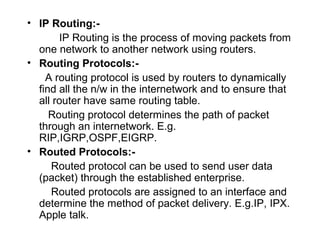
• IP Routing:- 
IP Routing is the process of moving packets from 
one network to another network using routers. 
• Routing Protocols:- 
A routing protocol is used by routers to dynamically 
find all the n/w in the internetwork and to ensure that 
all router have same routing table. 
Routing protocol determines the path of packet 
through an internetwork. E.g. 
RIP,IGRP,OSPF,EIGRP. 
• Routed Protocols:- 
Routed protocol can be used to send user data 
(packet) through the established enterprise. 
Routed protocols are assigned to an interface and 
determine the method of packet delivery. E.g.IP, IPX. 
Apple talk.
Types of Routing:- 
• Static Routing 
• Default Routing 
• Dynamic Routing
Static Routing 
• It is manually configured by administrator. 
• Mandatory need of destination network ip. 
• It is very secure and fast. 
• There is no bandwidth usage between routers. 
• Used for small organization with network of 10-15 
routers 
• Administrative distance for static route is 0 & 1. 
[Admin. Distance is ‘trustworthiness’ of routing 
information.lesser the AD higher the performance. 0- 
very good , 255-very bad] 
Disadvantages :- 
Used for small network. 
Everything to manually 
Network change effect complete n/W
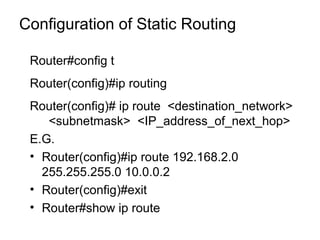
Configuration of Static Routing 
Router#config t 
Router(config)#ip routing 
Router(config)# ip route <destination_network> 
<subnetmask> <IP_address_of_next_hop> 
E.G. 
• Router(config)#ip route 192.168.2.0 
255.255.255.0 10.0.0.2 
• Router(config)#exit 
• Router#show ip route
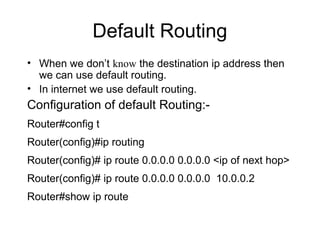
Default Routing 
• When we don’t know the destination ip address then 
we can use default routing. 
• In internet we use default routing. 
Configuration of default Routing:- 
Router#config t 
Router(config)#ip routing 
Router(config)# ip route 0.0.0.0 0.0.0.0 <ip of next hop> 
Router(config)# ip route 0.0.0.0 0.0.0.0 10.0.0.2 
Router#show ip route
Dynamic 
Routing
Advantage of Dynamic Routing:- 
• There is no need to know the destination network. 
• Need to advertise only directly connected networks. 
• Update the topology which change dynamically. 
• Administrative work is reduced. 
• Used for large organization. 
• Protocols:- 
1. Distance vector protocol 
2. Link state protocol 
3. Hybrid protocol
Distance vector protocol:- 
• Works with bellman ford algorithm. 
• Periodic updates. 
• It is classfull routing protocol. 
• Full routing table are exchanged. 
• Updates are through broadcast. 
• Also known by as “Routing by Rumor”. 
• E.g. RIP, IGRP.
Link state protocol:- 
• It works with Dijkstra algorithm. 
• It is a classless routing protocol. 
• Only missing route are exchanged. 
• Updates are through multicast. 
• Also known as “Routing by Intelligence”. 
• E.G. OSPF, IS-IS
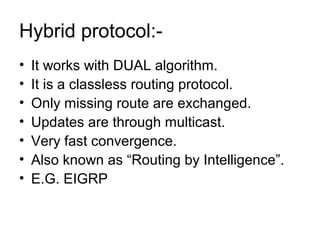
Hybrid protocol:- 
• It works with DUAL algorithm. 
• It is a classless routing protocol. 
• Only missing route are exchanged. 
• Updates are through multicast. 
• Very fast convergence. 
• Also known as “Routing by Intelligence”. 
• E.G. EIGRP
Timers:- 
• Update Timer:- 
Sets the interval between periodic routing 
updates . 
• Invalid Timer:- 
1.routers wait to hear update . 
2.after that period update will send out to all its 
neighbors that route is invalid or unreachable. 
• Holddown Timer:- 
Time for which the information about poorer 
route is ignored. 
• Flush timer:- 
After this timers expires route will remove from 
the routing table.
RIP (Routing information protocol) 
• Open standard protocol. 
• It is classfull routing protocol. 
• Updates are broadcasted via 255.255.255.255 
• Administrative distance is 120. 
• Metric is hop count 
• Maximum hop counts = 15 
• Maximum routers can connect=16. 
• Used for small organization. 
• Timers(in second) 
update timer=30 , invalid timer=180 
Holdown timer=180, flush timer=240
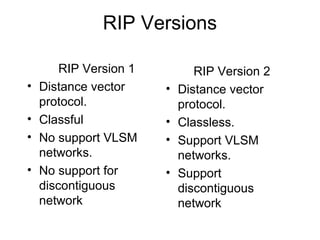
RIP Versions 
RIP Version 1 
• Distance vector 
protocol. 
• Classful 
• No support VLSM 
networks. 
• No support for 
discontiguous 
network 
RIP Version 2 
• Distance vector 
protocol. 
• Classless. 
• Support VLSM 
networks. 
• Support 
discontiguous 
network
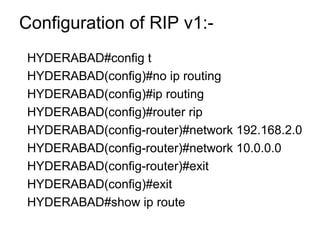
Configuration of RIP v1:- 
HYDERABAD#config t 
HYDERABAD(config)#no ip routing 
HYDERABAD(config)#ip routing 
HYDERABAD(config)#router rip 
HYDERABAD(config-router)#network 192.168.2.0 
HYDERABAD(config-router)#network 10.0.0.0 
HYDERABAD(config-router)#exit 
HYDERABAD(config)#exit 
HYDERABAD#show ip route
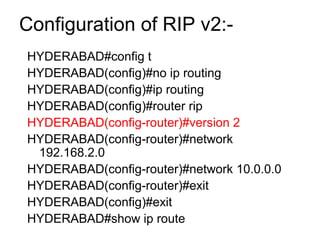
Configuration of RIP v2:- 
HYDERABAD#config t 
HYDERABAD(config)#no ip routing 
HYDERABAD(config)#ip routing 
HYDERABAD(config)#router rip 
HYDERABAD(config-router)#version 2 
HYDERABAD(config-router)#network 
192.168.2.0 
HYDERABAD(config-router)#network 10.0.0.0 
HYDERABAD(config-router)#exit 
HYDERABAD(config)#exit 
HYDERABAD#show ip route
Autonomous System(AS):- 
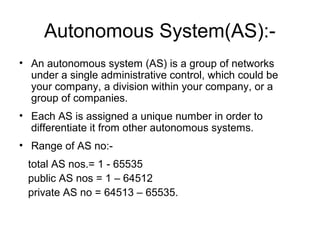
• An autonomous system (AS) is a group of networks 
under a single administrative control, which could be 
your company, a division within your company, or a 
group of companies. 
• Each AS is assigned a unique number in order to 
differentiate it from other autonomous systems. 
• Range of AS no:- 
total AS nos.= 1 - 65535 
public AS nos = 1 – 64512 
private AS no = 64513 – 65535.
Routing protocol classification:- 
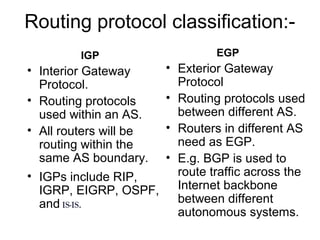
IGP 
• Interior Gateway 
Protocol. 
• Routing protocols 
used within an AS. 
• All routers will be 
routing within the 
same AS boundary. 
• IGPs include RIP, 
IGRP, EIGRP, OSPF, 
and IS-IS. 
EGP 
• Exterior Gateway 
Protocol 
• Routing protocols used 
between different AS. 
• Routers in different AS 
need as EGP. 
• E.g. BGP is used to 
route traffic across the 
Internet backbone 
between different 
autonomous systems.

CCNA part 5 routing

  • 1.
  • 2.
    • IP Routing:- IP Routing is the process of moving packets from one network to another network using routers. • Routing Protocols:- A routing protocol is used by routers to dynamically find all the n/w in the internetwork and to ensure that all router have same routing table. Routing protocol determines the path of packet through an internetwork. E.g. RIP,IGRP,OSPF,EIGRP. • Routed Protocols:- Routed protocol can be used to send user data (packet) through the established enterprise. Routed protocols are assigned to an interface and determine the method of packet delivery. E.g.IP, IPX. Apple talk.
  • 3.
    Types of Routing:- • Static Routing • Default Routing • Dynamic Routing
  • 4.
    Static Routing •It is manually configured by administrator. • Mandatory need of destination network ip. • It is very secure and fast. • There is no bandwidth usage between routers. • Used for small organization with network of 10-15 routers • Administrative distance for static route is 0 & 1. [Admin. Distance is ‘trustworthiness’ of routing information.lesser the AD higher the performance. 0- very good , 255-very bad] Disadvantages :- Used for small network. Everything to manually Network change effect complete n/W
  • 5.
    Configuration of StaticRouting Router#config t Router(config)#ip routing Router(config)# ip route <destination_network> <subnetmask> <IP_address_of_next_hop> E.G. • Router(config)#ip route 192.168.2.0 255.255.255.0 10.0.0.2 • Router(config)#exit • Router#show ip route
  • 6.
    Default Routing •When we don’t know the destination ip address then we can use default routing. • In internet we use default routing. Configuration of default Routing:- Router#config t Router(config)#ip routing Router(config)# ip route 0.0.0.0 0.0.0.0 <ip of next hop> Router(config)# ip route 0.0.0.0 0.0.0.0 10.0.0.2 Router#show ip route
  • 7.
  • 8.
    Advantage of DynamicRouting:- • There is no need to know the destination network. • Need to advertise only directly connected networks. • Update the topology which change dynamically. • Administrative work is reduced. • Used for large organization. • Protocols:- 1. Distance vector protocol 2. Link state protocol 3. Hybrid protocol
  • 9.
    Distance vector protocol:- • Works with bellman ford algorithm. • Periodic updates. • It is classfull routing protocol. • Full routing table are exchanged. • Updates are through broadcast. • Also known by as “Routing by Rumor”. • E.g. RIP, IGRP.
  • 10.
    Link state protocol:- • It works with Dijkstra algorithm. • It is a classless routing protocol. • Only missing route are exchanged. • Updates are through multicast. • Also known as “Routing by Intelligence”. • E.G. OSPF, IS-IS
  • 11.
    Hybrid protocol:- •It works with DUAL algorithm. • It is a classless routing protocol. • Only missing route are exchanged. • Updates are through multicast. • Very fast convergence. • Also known as “Routing by Intelligence”. • E.G. EIGRP
  • 12.
    Timers:- • UpdateTimer:- Sets the interval between periodic routing updates . • Invalid Timer:- 1.routers wait to hear update . 2.after that period update will send out to all its neighbors that route is invalid or unreachable. • Holddown Timer:- Time for which the information about poorer route is ignored. • Flush timer:- After this timers expires route will remove from the routing table.
  • 13.
    RIP (Routing informationprotocol) • Open standard protocol. • It is classfull routing protocol. • Updates are broadcasted via 255.255.255.255 • Administrative distance is 120. • Metric is hop count • Maximum hop counts = 15 • Maximum routers can connect=16. • Used for small organization. • Timers(in second) update timer=30 , invalid timer=180 Holdown timer=180, flush timer=240
  • 14.
    RIP Versions RIPVersion 1 • Distance vector protocol. • Classful • No support VLSM networks. • No support for discontiguous network RIP Version 2 • Distance vector protocol. • Classless. • Support VLSM networks. • Support discontiguous network
  • 15.
    Configuration of RIPv1:- HYDERABAD#config t HYDERABAD(config)#no ip routing HYDERABAD(config)#ip routing HYDERABAD(config)#router rip HYDERABAD(config-router)#network 192.168.2.0 HYDERABAD(config-router)#network 10.0.0.0 HYDERABAD(config-router)#exit HYDERABAD(config)#exit HYDERABAD#show ip route
  • 16.
    Configuration of RIPv2:- HYDERABAD#config t HYDERABAD(config)#no ip routing HYDERABAD(config)#ip routing HYDERABAD(config)#router rip HYDERABAD(config-router)#version 2 HYDERABAD(config-router)#network 192.168.2.0 HYDERABAD(config-router)#network 10.0.0.0 HYDERABAD(config-router)#exit HYDERABAD(config)#exit HYDERABAD#show ip route
  • 17.
    Autonomous System(AS):- •An autonomous system (AS) is a group of networks under a single administrative control, which could be your company, a division within your company, or a group of companies. • Each AS is assigned a unique number in order to differentiate it from other autonomous systems. • Range of AS no:- total AS nos.= 1 - 65535 public AS nos = 1 – 64512 private AS no = 64513 – 65535.
  • 18.
    Routing protocol classification:- IGP • Interior Gateway Protocol. • Routing protocols used within an AS. • All routers will be routing within the same AS boundary. • IGPs include RIP, IGRP, EIGRP, OSPF, and IS-IS. EGP • Exterior Gateway Protocol • Routing protocols used between different AS. • Routers in different AS need as EGP. • E.g. BGP is used to route traffic across the Internet backbone between different autonomous systems.