Presented
Dr. Ditipriya Sinha
• Introduction To Routing Protocols
• Goals Of Routing Protocols
• Classification Of Routing Protocols
• MANET (Mobile Ad-hoc Network)
• Address Resolution
ROUTING
Path finding from one node to the other node is known as Routing.
ROUTING PROTOCOLS
The routing protocol specifies how routers in a network share information with each other and report
changes.
Routing algorithms determine the specific choice of route.
 Optimal path selection
 Loop-free routing
 Minimize update traffic
 Easy to configure
 Adapts to changes easily and quickly
 Compatible with existing hosts and routers
 Does not create a lot of traffic
 Handle address limitations
Goals
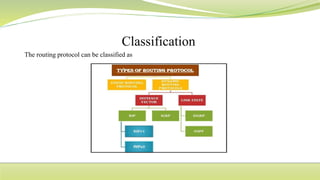
The routing protocol can be classified as
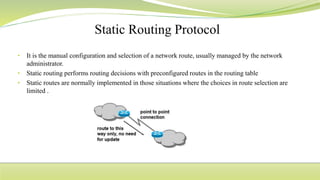
• It is the manual configuration and selection of a network route, usually managed by the network
administrator.
• Static routing performs routing decisions with preconfigured routes in the routing table
• Static routes are normally implemented in those situations where the choices in route selection are
limited .
Advantages :-
 No overhead on router CPU.
 No bandwidth usages between link.
 Security(Only administrator can add routes).
Disadvantages:-
 Administrator must understand internetwork and how each router is connected.
 Not practical on large networks as it is time insentive.
 Administrator must update all routers.
Cont…
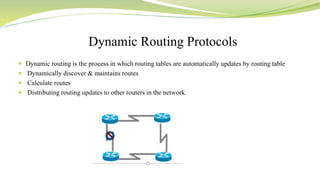
 Dynamic routing is the process in which routing tables are automatically updates by routing table
 Dynamically discover & maintains routes
 Calculate routes
 Distributing routing updates to other routers in the network.
Dynamic Routing Protocols
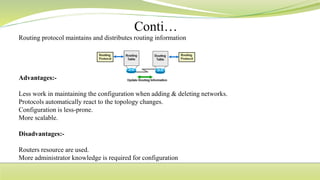
Routing protocol maintains and distributes routing information
Advantages:-
Less work in maintaining the configuration when adding & deleting networks.
Protocols automatically react to the topology changes.
Configuration is less-prone.
More scalable.
Disadvantages:-
Routers resource are used.
More administrator knowledge is required for configuration
• Describe the role of dynamic routing protocols and place these protocols in the context of modern
network design.
• Identify several ways to classify routing protocols.
• Describe how metrics are used by routing protocols and identify the metric types used by dynamic
routing protocols.
• Determine the administrative distance of a route and describe its importance in the routing process.
• Identify the different elements of the routing table.
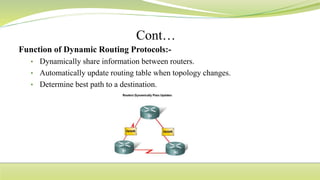
Function of Dynamic Routing Protocols:-
• Dynamically share information between routers.
• Automatically update routing table when topology changes.
• Determine best path to a destination.
• It Passes routing information between routers within “Autonomous System”.
• It is used to route within the individual networks themselves.
• Examples: RIP, EIGRP, OSPF
• Used for routing between autonomous systems.
• Example: BGPv4.
• May be more than one AS in internet.
• Routing algorithms and tables may differ between different AS.
• Finds a path, but can’t find an optimal path since it can’t compare routing metrics via
multiple AS.
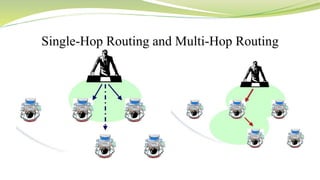
Single-Hop Routing and Multi-Hop Routing
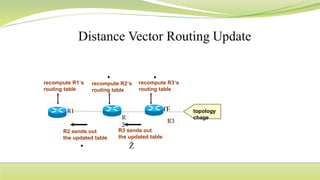
• It uses simple algorithms that calculate cumulative distance value between routers based on hop
count.
• It floods routing table only to its neighbors.
• It uses hop count as a metric.
• Each router periodically sends a copy of its routing table to neighbors.
• incomplete view of network topology.
topology
chage
Œ
R1
R
2
R3
recompute R3’s
routing table
•
R3 sends out
the updated table
Ž
recompute R2’s
routing table
•
R2 sends out
the updated table
•
recompute R1’s
routing table
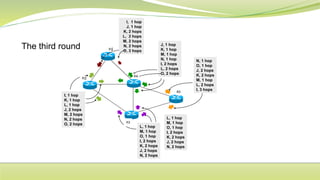
The first round I, 1 hop
J, 1 hop
I, 1 hop
K, 1 hop
L, 1 hop
J, 1 hop
K, 1 hop
M, 1 hop
N, 1 hop
L, 1 hop
M, 1 hop
O 1 hop
N, 1 hop
O, 1 hop
I
L
M
N
J
K
The third round J, 1 hop
K, 1 hop
M, 1 hop
N, 1 hop
I, 2 hops
L, 2 hops
O, 2 hops
N, 1 hop
O, 1 hop
J, 2 hops
K, 2 hops
M, 1 hop
L, 2 hops
I, 3 hops
I, 1 hop
K, 1 hop
L, 1 hop
J, 2 hops
M, 2 hops
N, 2 hops
O, 2 hops
L, 1 hop
M, 1 hop
O, 1 hop
I, 2 hops
K, 2 hops
J, 2 hops
N, 2 hops
L, 1 hop
M, 1 hop
O, 1 hop
I, 2 hops
K, 2 hops
J, 2 hops
N, 2 hops
Distance Vector: Crashed Recovery
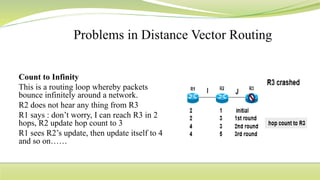
Count to Infinity
This is a routing loop whereby packets
bounce infinitely around a network.
R2 does not hear any thing from R3
R1 says : don’t worry, I can reach R3 in 2
hops, R2 update hop count to 3
R1 sees R2’s update, then update itself to 4
and so on……
The Split Horizon Rule is used to prevent routing loops
Solve by set distance “16” as infinity.
No destination can be more than 15 hops away from any other
Distance to X is not reported on the line that packet for X are sent
Actually, it reports with infinity.
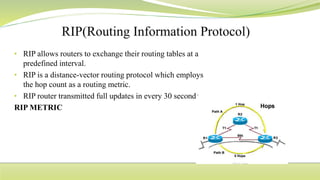
• RIP allows routers to exchange their routing tables at a
predefined interval.
• RIP is a distance-vector routing protocol which employs
the hop count as a routing metric.
• RIP router transmitted full updates in every 30 seconds.
RIP METRIC
RIP and RIP-V1 both are same routing protocol.
Characteristics:-
• Uses hop count metric.
• Support 15 hop-count limit.
• Support 6 equal cost paths.
• AD value is 120.
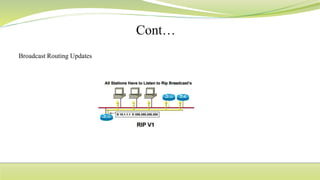
• It supports broadcasting.
• Support class full networks.
Broadcast Routing Updates
Characteristics:-
 It is a distance vector protocol.
 AD value is 120.
 Metric is hop count.
 It supports classless network.
 Maximum hop count is 15.
 Route updates after 30 sec.
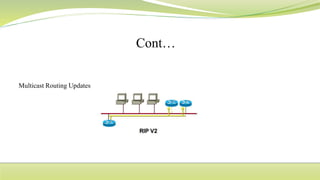
 It uses multicast ip for convergence.
RIP V2
Multicast Routing Updates
 Subnet mask support
 Reduce broadcast load
 Validated updates
 Multivendor environment
When to use RIPV2
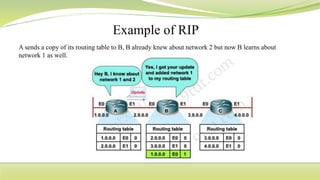
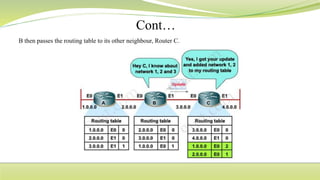
A sends a copy of its routing table to B, B already knew about network 2 but now B learns about
network 1 as well.
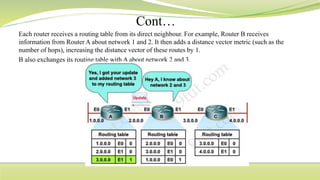
Each router receives a routing table from its direct neighbour. For example, Router B receives
information from Router A about network 1 and 2. It then adds a distance vector metric (such as the
number of hops), increasing the distance vector of these routes by 1.
B also exchanges its routing table with A about network 2 and 3.
B then passes the routing table to its other neighbour, Router C.
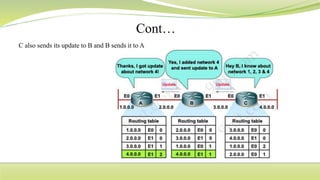
C also sends its update to B and B sends it to A
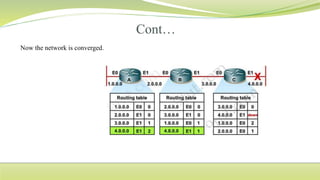
Now the network is converged.
Now let’s assume network 4 down suddenly.
In the following situation the count to infinity problem arises.
• IGRP is a distance vector protocol.
• To overcome RIP limitations IGRP introduced.
• Routing updates are broadcast every 90 seconds.
• It is used by router to exchange routing data within an autonomous system.
Characteristics:-
• Uses composite metrics.
• Uses multipath routing.
• Support unequal-cost load balancing.
• Supports split horizons.
• Administrative weight
• Delay
• Bandwidth
• Reliability
• Load
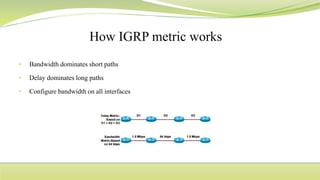
• Bandwidth dominates short paths
• Delay dominates long paths
• Configure bandwidth on all interfaces
• It supports the features both distance vector and link state protocol.
• The AD value of EIGRP is 90.
• By default ,bandwidth and delay are the activated metrics.
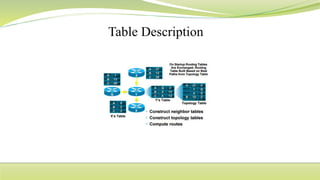
• EIGRP uses the tables like, Neighbour Table, Topology Table, and Route Table for route
discovery.
Characteristics:-
• Communication done via RTP.
• EIGRP is an ideal protocol in the large networks.
• Extremely fast convergence.
• Support classless network.
• Support discontinuous network.
• Support all 3 layer protocols(IPv4,Ipx, and IPv6).
 Topology table .
 Acted upon by DUAL.
 All routes advertised by neighbours.
 List of neighbours for each route.
 Routes passive or active.
 Neighbour table.
 Keeps adjacent neighbour's address.
 Keeps the hold time.
 Information for reliable transport.
When to use EIGRP
 Large update packets.
 Slow response to topological changes.
 Need for a Link State Protocol.
 A long list of functional requirements follows.
Problems with Distance Vector Routing Protocol
Each router must do the following:
• Discover its neighbors, learn their network address.
• Measure the delay or cost to each of its neighbors.
• Construct a packet telling all it has just learned.
• Send this packet to all other routers.
• Compute the shortest path to every other router.
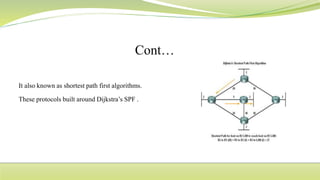
It also known as shortest path first algorithms.
These protocols built around Dijkstra’s SPF .
The shortest path to a destination is not necessarily the path with the least
number of hops.
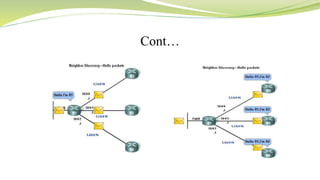
HELLO PACKET
• Hello packets are used to acquire and maintain neighbour adjacencies .
• Hello packets ensure that neighbours belong to the same logical subnet, same area, or contain the
correct authentication information .
• Dead intervals are used to detect when neighbours are no longer present.
Cont…
• Memory requirements
Typically link state routing protocols use more memory .
• Processing Requirements
More CPU processing is required of link state routing protocols.
• Bandwidth Requirements
Initial startup of link state routing protocols can consume lots of bandwidth.
• Uses metrics (costs) to calculate path
• Typically displays faster convergence than distance vector routing protocols
• Typically more scalable due to hierarchical nature
• Require more memory to store state information, i.e. databases.
• Increased complexity in designing networks.
 OSPF is a standardized Link-State routing protocol, designed to scale efficiently to support larger
networks.
Characteristics:-
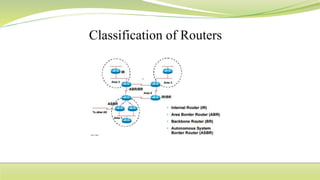
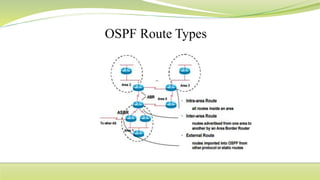
 It employs a hierarchical network design using Areas.
 It will form neighbour relationships with adjacent router in the same area.
 It is a classless protocol.
 It support only IP routing
 OSPF routes have an administrative distance is 110.
 OSPF uses cost as its metric
OSPF(Open Shortest Path First)
• Large hierarchical networks
• Complex networks, except… Topology restrictive Additional network design
• VLSM
• Fast convergence
• Multivendor
• Group of contiguous hosts and networks.
• Per area topological database Invisible outside the area Reduction in routing traffic.
• Backbone area contiguous All other areas must be connected to the backbone.
• Virtual Links.
• It can converge a network in the low seconds and guarantee loop-free paths.
• It can provide better load-sharing on external links.
• BGP is the de-facto Inter-AS routing protocol.
• Used for exchanging route information between ASs.
• Conveys information about AS path topology.
• Current version, BGP 4, defined in RFC 1771.
• Runs over TCP (port 179).
• Path Vector protocol.
• Exchange entire path information
• Prevents loops
 Learns multiple paths via internal and external BGP speakers.
 Picks the best path and installs in the IP forwarding table.
 Policies applied by influencing the best path selection.
General Operation
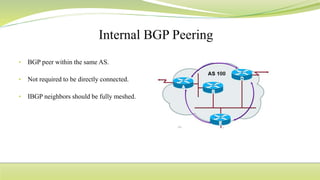
• BGP peer within the same AS.
• Not required to be directly connected.
• IBGP neighbors should be fully meshed.
• Between BGP speakers in different AS.
• Should be directly connected.
BGP is a path vector protocol with the following properties:
 Reliable updates: BGP runs on top of TCP (port 179)
 Incremental, triggered updates only
 Periodic keepalive messages to verify TCP connectivity
 Rich metrics (called path vectors or attributes)
 Designed to scale to huge internetworks (for example, the Internet)
It has enhancements over distance vector protocols.
Features of BGP
 BGP should be used if one of the following is true:
 An AS is a transit AS
 An AS is multi homed
 Inter-AS routing policy must be manipulated
 BGP should not be used if one of the following is true:
 Single-homed AS
 Insufficient memory and processor resources to handle
BGP routing
 Insufficient understanding of route filtering and BGP path selection process
When to Use BGP
Dynamic routing protocols fulfill the following functions
Dynamically share information between routers
Automatically update routing table when topology changes
Determine best path to a destination
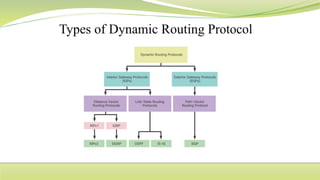
Routing protocols are grouped as either
Interior gateway protocols (IGP)Or
Exterior gateway protocols(EGP)
Types of IGPs include
Classless routing protocols - these protocols include subnet mask in routing updates
Glassful routing protocols - these protocols do not include subnet mask in routing update
MANET
(Mobile Ad-Hoc Network)
• Introduction
• Features of MANET
• Multi-hop routing
• Advantages of MANET
• Issues in MANET
• Routing in MANET
• Application of MANET
• Conclusion
 A mobile ad hoc network (MANET) is a self-configuring network in which several wireless nodes
temporary set up links between them.
 Ad hoc network has less infrastructure and each node can be act as a host or router.
 A mobile host with wireless communication devices is the ad hoc mobile network.
 MANET have the dynamic topology.
 It is useful in military and rescue areas.
 It support multi-hop communication .
Introduction
• Autonomous terminal
• Multi-hop routing
• Dynamic topology
• Fluctuating link capacity
• Light-weight terminal
• Less infrastructure
• This can be developed where there is less telecommunication
infrastructure.
• Cost estimation is very less.
• These networks can be set up at any place and time.
• MANET is multi-hop network with autonomous terminal and dynamic network topology.
• MANET can be used as temporary network.
• It requires less time.
• Limited wireless range
• Packet losses
• Dynamically changing Network Topology
• Device heterogeneity
• Hidden terminal problem
• Battery power constraints
MANET needs a routing protocol which can handle changing topology
Routing protocols have generally divided into three parts.
• Proactive protocols
• Reactive protocols
• Hybrid protocols
• In this type of routing protocol, each node should maintain at least one table to store the routing
information.
• In case of any change in the network topology, the nodes will propagate the route updates
throughout the network in order to maintain a stable network view.
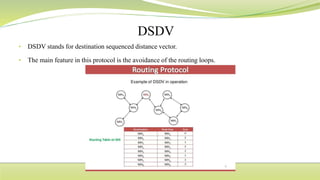
• DSDV stands for destination sequenced distance vector.
• The main feature in this protocol is the avoidance of the routing loops.
• Each node here maintains a routing table of all destinations and the number of hops to these
destinations.
• A sequence numbering system is used in order to be able to distinguish between the old and bad
routes from the new ones.
• Updates in the routing table are sent periodically to keep the routing table up-to-date and
consistent.
The broadcasts of the new route will contain:
Destination address.
Number of hops to the destination.
Sequence number of the information received regarding the destination.
New sequence number unique to the broadcast.
Each route is labeled with a sequence number and the route with the highest sequence number will be
used.
If there are two updates have the same sequence number, then the route with the smaller hop count
will be used.
Source-Initiated On-Demand Approaches:
The routing protocols create routes only when requested by the source node.
a route discovery process is initiated by the source node.
This process is considered done either after:
finding a route to the destination.
after examined all the possible route permutations.
Once the route is established, it will be maintained by some form of route maintenance procedure
either the destination becomes inaccessible or the route is no longer desired.
Route request packets (RREQ) the source node broadcasts an RREQ to all neighboring nodes.
Nodes record the source of the first RREQ received to establish a reverse path.
Route Request Packets (RREQ)
The source node broadcasts an RREQ to all neighboring nodes.
Nodes record the source of the first RREQ received to establish a reverse path.
Zone Routing Protocol (ZRP):
 ZRP defined a zone for each node which includes all nodes which are in certain distance in hops, called
Zone Radius.
 A proactive link state protocol is used to keep every node aware of the complete topology within its
zone .
 If a node needs to obtain a route to another node not in its zone its initiate the route discovery through
their border nodes.
Hybrid Routing Protocol
• Route query accumulates the traversed route on its way outwards from that node when the query
finally reaches a border which is in destination node.
• The border node send back a reply using the accumulated route from the query
depending upon the choice of zone radius it behave like proactive
• Personal area networking
cell phone, laptop, ear phone
• Military environments
soldiers, tanks, planes
• Civilian environments
taxi cab network
meeting rooms
sports stadiums
boats, small aircraft
• Emergency operations
search-and-rescue
policing and fire fighting
• MANET is an Ad-hoc infrastructure-less mobile network.
• In MANET, each node act as a host as well as router.
• These networks can be set up at any place and time.
• MANET is Multi-hop network with Autonomous Terminal and dynamic network topology.
• It operates without central coordinator.
• This can be developed at deployed area where there is no infrastructure.
• Required less cost and time.
• Introduction
• Protocols for Address Resolution
ARP
RARP
ICMP
• Address Resolution is the process of mapping a logical address to a corresponding physical
address and vice versa.
• It uses some protocols for mapping like,
ARP
RARP
ICMP
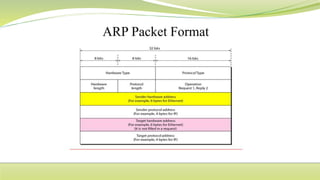
• ARP converts an IP address to its corresponding physical network address.
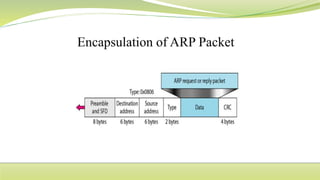
• ARP is necessary because the underlying ethernet hardware communicates using ethernet
addresses, not IP addresses.
• Besides Ethernet and Wi-Fi, ARP has also been implemented for ATM,TOKEN RING and other
physical network types.
Two types of operations.
• ARP Request.
• ARP Reply.
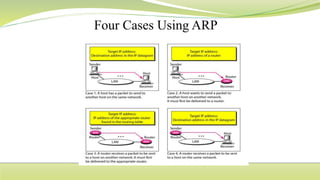
• A proxy ARP, running in a router, can respond to an ARP request for any of its proteges.
• The proxy ARP replies with its own MAC address.
• When the packet arrives, the router delivers it to the appropriate host.
• It allows a network to manage congestion that is independent to the device.
• It enables the Internet Protocol to work more efficiently.
• It works on Ethernet and Wi-Fi Networks.
• ARP can be useful if the ARP reply is kept in cache memory for a while.
• An ARP request is Broadcast and reply is Unicast.
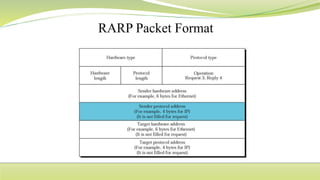
• It converts physical address to a corresponding logical address.
• A RARP messages is created and broadcast on the local network.
• The machine on the local network that knows the logical address will respond with a RARP reply.
• Broadcasting is done at data link layer.
• Broadcast requests does not pass the boundaries of a network.
Two types of operations.
• ARP Request
• ARP Reply
 It is the complement of ARP.
 RARP is not used on Ethernet or Wi-Fi networks .
 RARP requests are broadcast, RARP replies are unicast.
 Now DHCP have replaced RARP.
Characteristics of RARP
• It requires direct address to the network which makes it difficult for an application programmer to
build a server.
• It doesn't fully utilizes the capability of a network like Ethernet.
• It is enforced to send a minimum packet size since the reply from the server contains only one
small piece of information.
• There are some deficiencies in IP protocol.
1. The IP protocol has no error-reporting or error-correcting mechanism.
2. The IP protocol also lacks a mechanism for host and management queries.
• ICMP has been designed to compensate for the above two deficiencies.
• It is a companion to the IP protocol.
• ICMP always reports error messages to the original source.
• No ICMP error message will be generated in response to a datagram carrying an ICMP error
message.
• No ICMP error message will be generated for a fragmented datagram that is not the first fragment.
• No ICMP error message will be generated for a datagram having a multicast address.
• No ICMP error message will be generated for a datagram having a special address such as
127.0.0.0 or 0.0.0.0.
 So far we have discussed about Routing Protocols, Mobile Adhoc Network and Internet Protocols for
address resolution.
 Routing Protocols are used to route the data packet between the routers.
 In mobile adhoc network we use the several Proactive and Reactive protocols.
 ARP , RARP and ICMP are the different internet protocols using for the address mapping in the
network i.e from physical to logical and vice versa.
Conclusion
Referred Books :
 Forouzan, A. Behrouz. Data communications & networking. Tata
McGraw-Hill Education, 2006.
 Tanenbaum, Andrew S., and David J. Wetherall. Computer networks.
Pearson, 2011.

ROUTING PROTOCOLS new.pptx

  • 1.
  • 2.
    • Introduction ToRouting Protocols • Goals Of Routing Protocols • Classification Of Routing Protocols • MANET (Mobile Ad-hoc Network) • Address Resolution
  • 3.
    ROUTING Path finding fromone node to the other node is known as Routing. ROUTING PROTOCOLS The routing protocol specifies how routers in a network share information with each other and report changes. Routing algorithms determine the specific choice of route.
  • 4.
     Optimal pathselection  Loop-free routing  Minimize update traffic  Easy to configure  Adapts to changes easily and quickly  Compatible with existing hosts and routers  Does not create a lot of traffic  Handle address limitations Goals
  • 5.
    The routing protocolcan be classified as
  • 6.
    • It isthe manual configuration and selection of a network route, usually managed by the network administrator. • Static routing performs routing decisions with preconfigured routes in the routing table • Static routes are normally implemented in those situations where the choices in route selection are limited .
  • 7.
    Advantages :-  Nooverhead on router CPU.  No bandwidth usages between link.  Security(Only administrator can add routes). Disadvantages:-  Administrator must understand internetwork and how each router is connected.  Not practical on large networks as it is time insentive.  Administrator must update all routers. Cont…
  • 8.
     Dynamic routingis the process in which routing tables are automatically updates by routing table  Dynamically discover & maintains routes  Calculate routes  Distributing routing updates to other routers in the network. Dynamic Routing Protocols
  • 9.
    Routing protocol maintainsand distributes routing information Advantages:- Less work in maintaining the configuration when adding & deleting networks. Protocols automatically react to the topology changes. Configuration is less-prone. More scalable. Disadvantages:- Routers resource are used. More administrator knowledge is required for configuration
  • 10.
    • Describe therole of dynamic routing protocols and place these protocols in the context of modern network design. • Identify several ways to classify routing protocols. • Describe how metrics are used by routing protocols and identify the metric types used by dynamic routing protocols. • Determine the administrative distance of a route and describe its importance in the routing process. • Identify the different elements of the routing table.
  • 11.
    Function of DynamicRouting Protocols:- • Dynamically share information between routers. • Automatically update routing table when topology changes. • Determine best path to a destination.
  • 13.
    • It Passesrouting information between routers within “Autonomous System”. • It is used to route within the individual networks themselves. • Examples: RIP, EIGRP, OSPF
  • 14.
    • Used forrouting between autonomous systems. • Example: BGPv4. • May be more than one AS in internet. • Routing algorithms and tables may differ between different AS. • Finds a path, but can’t find an optimal path since it can’t compare routing metrics via multiple AS.
  • 16.
    Single-Hop Routing andMulti-Hop Routing
  • 17.
    • It usessimple algorithms that calculate cumulative distance value between routers based on hop count. • It floods routing table only to its neighbors. • It uses hop count as a metric. • Each router periodically sends a copy of its routing table to neighbors. • incomplete view of network topology.
  • 18.
    topology chage Œ R1 R 2 R3 recompute R3’s routing table • R3sends out the updated table Ž recompute R2’s routing table • R2 sends out the updated table • recompute R1’s routing table
  • 19.
    The first roundI, 1 hop J, 1 hop I, 1 hop K, 1 hop L, 1 hop J, 1 hop K, 1 hop M, 1 hop N, 1 hop L, 1 hop M, 1 hop O 1 hop N, 1 hop O, 1 hop I L M N J K
  • 21.
    The third roundJ, 1 hop K, 1 hop M, 1 hop N, 1 hop I, 2 hops L, 2 hops O, 2 hops N, 1 hop O, 1 hop J, 2 hops K, 2 hops M, 1 hop L, 2 hops I, 3 hops I, 1 hop K, 1 hop L, 1 hop J, 2 hops M, 2 hops N, 2 hops O, 2 hops L, 1 hop M, 1 hop O, 1 hop I, 2 hops K, 2 hops J, 2 hops N, 2 hops L, 1 hop M, 1 hop O, 1 hop I, 2 hops K, 2 hops J, 2 hops N, 2 hops
  • 22.
  • 23.
    Count to Infinity Thisis a routing loop whereby packets bounce infinitely around a network. R2 does not hear any thing from R3 R1 says : don’t worry, I can reach R3 in 2 hops, R2 update hop count to 3 R1 sees R2’s update, then update itself to 4 and so on……
  • 24.
    The Split HorizonRule is used to prevent routing loops Solve by set distance “16” as infinity. No destination can be more than 15 hops away from any other Distance to X is not reported on the line that packet for X are sent Actually, it reports with infinity.
  • 25.
    • RIP allowsrouters to exchange their routing tables at a predefined interval. • RIP is a distance-vector routing protocol which employs the hop count as a routing metric. • RIP router transmitted full updates in every 30 seconds. RIP METRIC
  • 26.
    RIP and RIP-V1both are same routing protocol. Characteristics:- • Uses hop count metric. • Support 15 hop-count limit. • Support 6 equal cost paths. • AD value is 120. • It supports broadcasting. • Support class full networks.
  • 27.
  • 28.
    Characteristics:-  It isa distance vector protocol.  AD value is 120.  Metric is hop count.  It supports classless network.  Maximum hop count is 15.  Route updates after 30 sec.  It uses multicast ip for convergence. RIP V2
  • 29.
  • 30.
     Subnet masksupport  Reduce broadcast load  Validated updates  Multivendor environment When to use RIPV2
  • 31.
    A sends acopy of its routing table to B, B already knew about network 2 but now B learns about network 1 as well.
  • 32.
    Each router receivesa routing table from its direct neighbour. For example, Router B receives information from Router A about network 1 and 2. It then adds a distance vector metric (such as the number of hops), increasing the distance vector of these routes by 1. B also exchanges its routing table with A about network 2 and 3.
  • 33.
    B then passesthe routing table to its other neighbour, Router C.
  • 34.
    C also sendsits update to B and B sends it to A
  • 35.
    Now the networkis converged.
  • 36.
    Now let’s assumenetwork 4 down suddenly.
  • 37.
    In the followingsituation the count to infinity problem arises.
  • 38.
    • IGRP isa distance vector protocol. • To overcome RIP limitations IGRP introduced. • Routing updates are broadcast every 90 seconds. • It is used by router to exchange routing data within an autonomous system. Characteristics:- • Uses composite metrics. • Uses multipath routing. • Support unequal-cost load balancing. • Supports split horizons.
  • 39.
    • Administrative weight •Delay • Bandwidth • Reliability • Load
  • 40.
    • Bandwidth dominatesshort paths • Delay dominates long paths • Configure bandwidth on all interfaces
  • 41.
    • It supportsthe features both distance vector and link state protocol. • The AD value of EIGRP is 90. • By default ,bandwidth and delay are the activated metrics. • EIGRP uses the tables like, Neighbour Table, Topology Table, and Route Table for route discovery. Characteristics:- • Communication done via RTP. • EIGRP is an ideal protocol in the large networks. • Extremely fast convergence. • Support classless network. • Support discontinuous network. • Support all 3 layer protocols(IPv4,Ipx, and IPv6).
  • 43.
     Topology table.  Acted upon by DUAL.  All routes advertised by neighbours.  List of neighbours for each route.  Routes passive or active.  Neighbour table.  Keeps adjacent neighbour's address.  Keeps the hold time.  Information for reliable transport. When to use EIGRP
  • 44.
     Large updatepackets.  Slow response to topological changes.  Need for a Link State Protocol.  A long list of functional requirements follows. Problems with Distance Vector Routing Protocol
  • 45.
    Each router mustdo the following: • Discover its neighbors, learn their network address. • Measure the delay or cost to each of its neighbors. • Construct a packet telling all it has just learned. • Send this packet to all other routers. • Compute the shortest path to every other router.
  • 46.
    It also knownas shortest path first algorithms. These protocols built around Dijkstra’s SPF .
  • 47.
    The shortest pathto a destination is not necessarily the path with the least number of hops.
  • 48.
    HELLO PACKET • Hellopackets are used to acquire and maintain neighbour adjacencies . • Hello packets ensure that neighbours belong to the same logical subnet, same area, or contain the correct authentication information . • Dead intervals are used to detect when neighbours are no longer present.
  • 49.
  • 50.
    • Memory requirements Typicallylink state routing protocols use more memory . • Processing Requirements More CPU processing is required of link state routing protocols. • Bandwidth Requirements Initial startup of link state routing protocols can consume lots of bandwidth.
  • 51.
    • Uses metrics(costs) to calculate path • Typically displays faster convergence than distance vector routing protocols • Typically more scalable due to hierarchical nature
  • 52.
    • Require morememory to store state information, i.e. databases. • Increased complexity in designing networks.
  • 53.
     OSPF isa standardized Link-State routing protocol, designed to scale efficiently to support larger networks. Characteristics:-  It employs a hierarchical network design using Areas.  It will form neighbour relationships with adjacent router in the same area.  It is a classless protocol.  It support only IP routing  OSPF routes have an administrative distance is 110.  OSPF uses cost as its metric OSPF(Open Shortest Path First)
  • 54.
    • Large hierarchicalnetworks • Complex networks, except… Topology restrictive Additional network design • VLSM • Fast convergence • Multivendor
  • 55.
    • Group ofcontiguous hosts and networks. • Per area topological database Invisible outside the area Reduction in routing traffic. • Backbone area contiguous All other areas must be connected to the backbone. • Virtual Links.
  • 58.
    • It canconverge a network in the low seconds and guarantee loop-free paths. • It can provide better load-sharing on external links.
  • 59.
    • BGP isthe de-facto Inter-AS routing protocol. • Used for exchanging route information between ASs. • Conveys information about AS path topology.
  • 61.
    • Current version,BGP 4, defined in RFC 1771. • Runs over TCP (port 179). • Path Vector protocol. • Exchange entire path information • Prevents loops
  • 62.
     Learns multiplepaths via internal and external BGP speakers.  Picks the best path and installs in the IP forwarding table.  Policies applied by influencing the best path selection. General Operation
  • 63.
    • BGP peerwithin the same AS. • Not required to be directly connected. • IBGP neighbors should be fully meshed.
  • 64.
    • Between BGPspeakers in different AS. • Should be directly connected.
  • 65.
    BGP is apath vector protocol with the following properties:  Reliable updates: BGP runs on top of TCP (port 179)  Incremental, triggered updates only  Periodic keepalive messages to verify TCP connectivity  Rich metrics (called path vectors or attributes)  Designed to scale to huge internetworks (for example, the Internet) It has enhancements over distance vector protocols. Features of BGP
  • 66.
     BGP shouldbe used if one of the following is true:  An AS is a transit AS  An AS is multi homed  Inter-AS routing policy must be manipulated  BGP should not be used if one of the following is true:  Single-homed AS  Insufficient memory and processor resources to handle BGP routing  Insufficient understanding of route filtering and BGP path selection process When to Use BGP
  • 67.
    Dynamic routing protocolsfulfill the following functions Dynamically share information between routers Automatically update routing table when topology changes Determine best path to a destination Routing protocols are grouped as either Interior gateway protocols (IGP)Or Exterior gateway protocols(EGP) Types of IGPs include Classless routing protocols - these protocols include subnet mask in routing updates Glassful routing protocols - these protocols do not include subnet mask in routing update
  • 68.
  • 69.
    • Introduction • Featuresof MANET • Multi-hop routing • Advantages of MANET • Issues in MANET • Routing in MANET • Application of MANET • Conclusion
  • 70.
     A mobilead hoc network (MANET) is a self-configuring network in which several wireless nodes temporary set up links between them.  Ad hoc network has less infrastructure and each node can be act as a host or router.  A mobile host with wireless communication devices is the ad hoc mobile network.  MANET have the dynamic topology.  It is useful in military and rescue areas.  It support multi-hop communication . Introduction
  • 71.
    • Autonomous terminal •Multi-hop routing • Dynamic topology • Fluctuating link capacity • Light-weight terminal • Less infrastructure
  • 72.
    • This canbe developed where there is less telecommunication infrastructure. • Cost estimation is very less. • These networks can be set up at any place and time. • MANET is multi-hop network with autonomous terminal and dynamic network topology. • MANET can be used as temporary network. • It requires less time.
  • 73.
    • Limited wirelessrange • Packet losses • Dynamically changing Network Topology • Device heterogeneity • Hidden terminal problem • Battery power constraints
  • 74.
    MANET needs arouting protocol which can handle changing topology Routing protocols have generally divided into three parts. • Proactive protocols • Reactive protocols • Hybrid protocols
  • 75.
    • In thistype of routing protocol, each node should maintain at least one table to store the routing information. • In case of any change in the network topology, the nodes will propagate the route updates throughout the network in order to maintain a stable network view.
  • 76.
    • DSDV standsfor destination sequenced distance vector. • The main feature in this protocol is the avoidance of the routing loops.
  • 77.
    • Each nodehere maintains a routing table of all destinations and the number of hops to these destinations. • A sequence numbering system is used in order to be able to distinguish between the old and bad routes from the new ones. • Updates in the routing table are sent periodically to keep the routing table up-to-date and consistent.
  • 78.
    The broadcasts ofthe new route will contain: Destination address. Number of hops to the destination. Sequence number of the information received regarding the destination. New sequence number unique to the broadcast. Each route is labeled with a sequence number and the route with the highest sequence number will be used. If there are two updates have the same sequence number, then the route with the smaller hop count will be used.
  • 79.
    Source-Initiated On-Demand Approaches: Therouting protocols create routes only when requested by the source node. a route discovery process is initiated by the source node. This process is considered done either after: finding a route to the destination. after examined all the possible route permutations. Once the route is established, it will be maintained by some form of route maintenance procedure either the destination becomes inaccessible or the route is no longer desired.
  • 80.
    Route request packets(RREQ) the source node broadcasts an RREQ to all neighboring nodes. Nodes record the source of the first RREQ received to establish a reverse path. Route Request Packets (RREQ) The source node broadcasts an RREQ to all neighboring nodes. Nodes record the source of the first RREQ received to establish a reverse path.
  • 81.
    Zone Routing Protocol(ZRP):  ZRP defined a zone for each node which includes all nodes which are in certain distance in hops, called Zone Radius.  A proactive link state protocol is used to keep every node aware of the complete topology within its zone .  If a node needs to obtain a route to another node not in its zone its initiate the route discovery through their border nodes. Hybrid Routing Protocol
  • 82.
    • Route queryaccumulates the traversed route on its way outwards from that node when the query finally reaches a border which is in destination node. • The border node send back a reply using the accumulated route from the query depending upon the choice of zone radius it behave like proactive
  • 83.
    • Personal areanetworking cell phone, laptop, ear phone • Military environments soldiers, tanks, planes • Civilian environments taxi cab network meeting rooms sports stadiums boats, small aircraft • Emergency operations search-and-rescue policing and fire fighting
  • 84.
    • MANET isan Ad-hoc infrastructure-less mobile network. • In MANET, each node act as a host as well as router. • These networks can be set up at any place and time. • MANET is Multi-hop network with Autonomous Terminal and dynamic network topology. • It operates without central coordinator. • This can be developed at deployed area where there is no infrastructure. • Required less cost and time.
  • 86.
    • Introduction • Protocolsfor Address Resolution ARP RARP ICMP
  • 87.
    • Address Resolutionis the process of mapping a logical address to a corresponding physical address and vice versa. • It uses some protocols for mapping like, ARP RARP ICMP
  • 88.
    • ARP convertsan IP address to its corresponding physical network address. • ARP is necessary because the underlying ethernet hardware communicates using ethernet addresses, not IP addresses. • Besides Ethernet and Wi-Fi, ARP has also been implemented for ATM,TOKEN RING and other physical network types.
  • 91.
    Two types ofoperations. • ARP Request. • ARP Reply.
  • 93.
    • A proxyARP, running in a router, can respond to an ARP request for any of its proteges. • The proxy ARP replies with its own MAC address. • When the packet arrives, the router delivers it to the appropriate host.
  • 94.
    • It allowsa network to manage congestion that is independent to the device. • It enables the Internet Protocol to work more efficiently. • It works on Ethernet and Wi-Fi Networks. • ARP can be useful if the ARP reply is kept in cache memory for a while. • An ARP request is Broadcast and reply is Unicast.
  • 95.
    • It convertsphysical address to a corresponding logical address. • A RARP messages is created and broadcast on the local network. • The machine on the local network that knows the logical address will respond with a RARP reply. • Broadcasting is done at data link layer. • Broadcast requests does not pass the boundaries of a network.
  • 98.
    Two types ofoperations. • ARP Request • ARP Reply
  • 99.
     It isthe complement of ARP.  RARP is not used on Ethernet or Wi-Fi networks .  RARP requests are broadcast, RARP replies are unicast.  Now DHCP have replaced RARP. Characteristics of RARP
  • 100.
    • It requiresdirect address to the network which makes it difficult for an application programmer to build a server. • It doesn't fully utilizes the capability of a network like Ethernet. • It is enforced to send a minimum packet size since the reply from the server contains only one small piece of information.
  • 101.
    • There aresome deficiencies in IP protocol. 1. The IP protocol has no error-reporting or error-correcting mechanism. 2. The IP protocol also lacks a mechanism for host and management queries. • ICMP has been designed to compensate for the above two deficiencies. • It is a companion to the IP protocol.
  • 104.
    • ICMP alwaysreports error messages to the original source. • No ICMP error message will be generated in response to a datagram carrying an ICMP error message. • No ICMP error message will be generated for a fragmented datagram that is not the first fragment. • No ICMP error message will be generated for a datagram having a multicast address. • No ICMP error message will be generated for a datagram having a special address such as 127.0.0.0 or 0.0.0.0.
  • 107.
     So farwe have discussed about Routing Protocols, Mobile Adhoc Network and Internet Protocols for address resolution.  Routing Protocols are used to route the data packet between the routers.  In mobile adhoc network we use the several Proactive and Reactive protocols.  ARP , RARP and ICMP are the different internet protocols using for the address mapping in the network i.e from physical to logical and vice versa. Conclusion
  • 108.
    Referred Books : Forouzan, A. Behrouz. Data communications & networking. Tata McGraw-Hill Education, 2006.  Tanenbaum, Andrew S., and David J. Wetherall. Computer networks. Pearson, 2011.