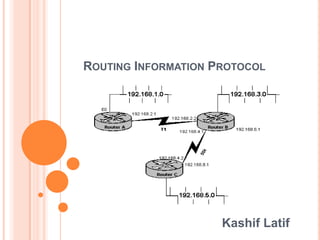
ROUTING INFORMATION PROTOCOL


                     Kashif Latif
WHAT IS RIP…?

RIP (Routing Information Protocol) is a standard for
exchange of routing information among gateways and
hosts.

Hop Count:
               Hop Count refers to the intermediate
devices (like routers) through which data must pass
between source and destination, rather than flowing
directly over a single wire.
COUNT…
 RIP prevents routing loops by implementing a limit
  on the number of hops allowed in a path from the
  source to a destination.
 The maximum number of hops allowed for RIP is
  15.
 This hop limit, however, also limits the size of
  networks that RIP can support.
 A hop count of 16 is considered an infinite distance
  and used to deprecate inaccessible, inoperable, or
  otherwise undesirable routes in the selection
  process.
COUNT…
 Originally each RIP router transmitted full updates
  every 30 seconds.
 In the early deployments, routing tables were small
  enough that the traffic was not significant.
 As networks grew in size, however, it became
  evident there could be a massive traffic burst every
  30 seconds, even if the routers had been initialized
  at random times.
 RIP uses the User Datagram Protocol (UDP) as its
  transport protocol, and is assigned the
  reserved port number 520.
VERSIONS OF RIP


There are three versions of the Routing Information
Protocol:

1.   RIP version 1
2.   RIP version 2
3.   RIPng (RIP next generation)
RIP VERSION 1
 Version 1 is the most-deployed version, since it is
  compatible with all RIP-capable devices.
 The periodic routing updates do not carry subnet
  information, lacking support for variable length
  subnet masks (VLSM).
 This limitation makes it impossible to have different-
  sized subnets inside of the same network class.
 In other words, all subnets in a network class must
  have the same size. There is also no support for
  router authentication, making RIP vulnerable to
  various attacks.
RIP VERSION 2
 Developed in 1993
 Last standardized in 1998

 Ability to carry subnet information

 To maintain backward compatibility, the hop count
  limit of 15 remained.
 RIPv2 multicasts the entire routing table to all
  adjacent routers at the address 224.0.0.9, as
  opposed to RIPv1 which uses broadcast.
 Route tags were also added in RIP version 2.
RIPNG
RIPng (RIP next generation), is an extension of RIPv2 for
support of IPv6, the next generation Internet Protocol. The
main differences between RIPv2 and RIPng are:

   Support of IPv6 networking.
   While RIPv2 supports RIPv1 updates
    authentication, RIPng does not
   RIPv2 allows attaching arbitrary tags to routes, RIPng
    does not;
   RIPv2 encodes the next-hop into each route
    entries, RIPng requires specific encoding of the next
    hop for a set of route entries.
   RIPng sends updates on UDP port 521 using the
    multicast group FF02::9.
LIMITATIONS
 Without using RMTI (Metric-based Topology
  Investigation), Hop count can not exceed 15, in the
  case that it exceeds this limitation, it will be
  considered invalid.
 Most RIP networks are flat. There is no concept of
  areas or boundaries in RIP networks.
 Variable Length Subnet Masks were not supported
  by RIP version 1.
 Without using RMTI, RIP has slow convergence
  and count to infinity problems.
IMPLEMENTATIONS
 Cisco IOS, software used in Cisco routers
  (supports version 1, version 2 and RIPng)
 Cisco NX-OS software used in Cisco Nexus data
  center switches (supports RIPv1 and RIPv2)
 Junos software used in Juniper
  routers, switches, and firewalls (supports RIPv1
  and RIPv2)
 Routing and Remote Access, a Windows
  Server feature, contains RIP support
 Quagga, a free open source routing software suite
  based on GNU Zebra
 BIRD, a free open source routing software suite
  OpenBSD, includes a RIP implementation
Kashif Latif

Routing Information Protocol

  • 1.
  • 2.
    WHAT IS RIP…? RIP(Routing Information Protocol) is a standard for exchange of routing information among gateways and hosts. Hop Count: Hop Count refers to the intermediate devices (like routers) through which data must pass between source and destination, rather than flowing directly over a single wire.
  • 3.
    COUNT…  RIP preventsrouting loops by implementing a limit on the number of hops allowed in a path from the source to a destination.  The maximum number of hops allowed for RIP is 15.  This hop limit, however, also limits the size of networks that RIP can support.  A hop count of 16 is considered an infinite distance and used to deprecate inaccessible, inoperable, or otherwise undesirable routes in the selection process.
  • 4.
    COUNT…  Originally eachRIP router transmitted full updates every 30 seconds.  In the early deployments, routing tables were small enough that the traffic was not significant.  As networks grew in size, however, it became evident there could be a massive traffic burst every 30 seconds, even if the routers had been initialized at random times.  RIP uses the User Datagram Protocol (UDP) as its transport protocol, and is assigned the reserved port number 520.
  • 5.
    VERSIONS OF RIP Thereare three versions of the Routing Information Protocol: 1. RIP version 1 2. RIP version 2 3. RIPng (RIP next generation)
  • 6.
    RIP VERSION 1 Version 1 is the most-deployed version, since it is compatible with all RIP-capable devices.  The periodic routing updates do not carry subnet information, lacking support for variable length subnet masks (VLSM).  This limitation makes it impossible to have different- sized subnets inside of the same network class.  In other words, all subnets in a network class must have the same size. There is also no support for router authentication, making RIP vulnerable to various attacks.
  • 7.
    RIP VERSION 2 Developed in 1993  Last standardized in 1998  Ability to carry subnet information  To maintain backward compatibility, the hop count limit of 15 remained.  RIPv2 multicasts the entire routing table to all adjacent routers at the address 224.0.0.9, as opposed to RIPv1 which uses broadcast.  Route tags were also added in RIP version 2.
  • 8.
    RIPNG RIPng (RIP nextgeneration), is an extension of RIPv2 for support of IPv6, the next generation Internet Protocol. The main differences between RIPv2 and RIPng are:  Support of IPv6 networking.  While RIPv2 supports RIPv1 updates authentication, RIPng does not  RIPv2 allows attaching arbitrary tags to routes, RIPng does not;  RIPv2 encodes the next-hop into each route entries, RIPng requires specific encoding of the next hop for a set of route entries.  RIPng sends updates on UDP port 521 using the multicast group FF02::9.
  • 9.
    LIMITATIONS  Without usingRMTI (Metric-based Topology Investigation), Hop count can not exceed 15, in the case that it exceeds this limitation, it will be considered invalid.  Most RIP networks are flat. There is no concept of areas or boundaries in RIP networks.  Variable Length Subnet Masks were not supported by RIP version 1.  Without using RMTI, RIP has slow convergence and count to infinity problems.
  • 10.
    IMPLEMENTATIONS  Cisco IOS,software used in Cisco routers (supports version 1, version 2 and RIPng)  Cisco NX-OS software used in Cisco Nexus data center switches (supports RIPv1 and RIPv2)  Junos software used in Juniper routers, switches, and firewalls (supports RIPv1 and RIPv2)  Routing and Remote Access, a Windows Server feature, contains RIP support  Quagga, a free open source routing software suite based on GNU Zebra  BIRD, a free open source routing software suite OpenBSD, includes a RIP implementation
  • 11.