PRESENTATION ON
ROUTING INFORMATION PROTOCOL
(RIP)
INTRODUCTION & DESCRIPTION
Subj.: Switching And Routing
05-04-2017
Guided By:
Prof. Wangiker M. D.Submitted By:
Ebrahim A.M. Al-Rahawe
MSc CN
rahawiye@gmail.com
CONTENTS
• INTRODUCTION
• OVERVIEW ON ROUTING PROTOCOLS
• WHAT IS THE RIP? AND WHY?
• RIP CHARACTERESTICS
• RIP VERSIONS
• RIP DESCRIPTION
• RIP LIMITATIONS
ROUTING PROTOCOLS
Any routing protocol has to be characterized depend on its type that
may be :
• Single / Multipath protocol.
• Flat / Hierarchical protocol.
• Interior / Exterior protocol.
• Link state / Distance vector protocol.
WHAT IS THE RIP?
• The Routing Information Protocol (RIP) is one of the oldest
routing protocols which employ the hop count as a routing metric.
• It is an interior, distance-vector protocol for small networks.
• One of the first IPs
• The maximum number of hops allowed for RIP is 15, which limits the
size of networks that RIP can support.
• A hop count of 16 is considered an infinite distance and the route is
considered unreachable.
WHY RIP?
• Early requirements to exchanges data between computers over
interconnected networks.
• Routing entities had to make a judgement on which path to route
traffic to destination.
• SO, RIP prevents routing loops by implementing limit on the number
of hops allowed in a path from source to destination.
• RIP (Routing Information Protocol) is a standard for exchange of
routing information among gateways and hosts.
RIP CHARECTERESTICS
RIP prevents routing loops by implementing a limit on the number of
hops allowed in a path from the source to a destination.
The maximum number of hops allowed for RIP is 15.
This hop limit, however, also limits the size of networks that RIP can
support.
A hop count of 16 is considered an infinite distance and used to
deprecate inaccessible, inoperable, or otherwise undesirable routes
in the selection process.
CONT….
Originally each RIP router transmitted full updates every 30 seconds.
In the early deployments, routing tables were small enough that the
traffic was not significant.
As networks grew in size, however, it became evident there could be
a massive traffic burst every 30 seconds, even if the routers had been
initialized at random times.
RIP uses the User Datagram Protocol (UDP) as its transport protocol,
and is assigned the reserved port number 520.
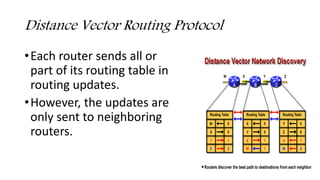
Distance Vector Routing Protocol
•Each router sends all or
part of its routing table in
routing updates.
•However, the updates are
only sent to neighboring
routers.
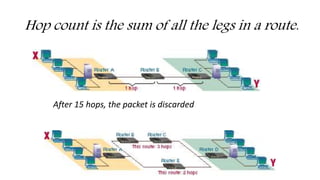
Hop count is the sum of all the legs in a route.
After 15 hops, the packet is discarded
Versions of RIP
There are two versions of the Routing Information Protocol:
1. RIP version 1
2. RIP version 2
RIP version 1
Version 1 is the most-deployed version, since it is compatible with all
RIP-capable devices.
The periodic routing updates do not carry subnet information,
lacking support for variable length subnet masks (VLSM).
This limitation makes it impossible to have different-
sized subnets inside of the same network class.
In other words, all subnets in a network class must have the same
size. There is also no support for router authentication, making RIP
vulnerable to various attacks.
RIP version 2
Developed in 1993
Last standardized in 1998
Ability to carry subnet information
To maintain backward compatibility, the hop count limit of 15
remained.
RIPv2 multicasts the entire routing table to all adjacent routers at the
address 224.0.0.9, as opposed to RIPv1 which uses broadcast.
Route tags were also added in RIP version 2.
RIP DESCRIPTION
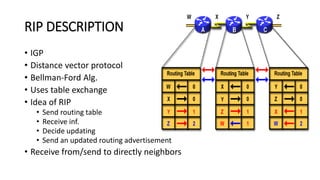
• IGP
• Distance vector protocol
• Bellman-Ford Alg.
• Uses table exchange
• Idea of RIP
• Send routing table
• Receive inf.
• Decide updating
• Send an updated routing advertisement
• Receive from/send to directly neighbors
RIP Limitations
Without using RMTI (Metric-based Topology Investigation), Hop
count can not exceed 15, in the case that it exceeds this limitation, it
will be considered invalid.
Most RIP networks are flat. There is no concept of areas or
boundaries in RIP networks.
Variable Length Subnet Masks were not supported by RIP version 1.
Without using RMTI, RIP has slow convergence and count to
infinity problems.
Rip presentation

Rip presentation

  • 1.
    PRESENTATION ON ROUTING INFORMATIONPROTOCOL (RIP) INTRODUCTION & DESCRIPTION Subj.: Switching And Routing 05-04-2017 Guided By: Prof. Wangiker M. D.Submitted By: Ebrahim A.M. Al-Rahawe MSc CN rahawiye@gmail.com
  • 2.
    CONTENTS • INTRODUCTION • OVERVIEWON ROUTING PROTOCOLS • WHAT IS THE RIP? AND WHY? • RIP CHARACTERESTICS • RIP VERSIONS • RIP DESCRIPTION • RIP LIMITATIONS
  • 3.
    ROUTING PROTOCOLS Any routingprotocol has to be characterized depend on its type that may be : • Single / Multipath protocol. • Flat / Hierarchical protocol. • Interior / Exterior protocol. • Link state / Distance vector protocol.
  • 4.
    WHAT IS THERIP? • The Routing Information Protocol (RIP) is one of the oldest routing protocols which employ the hop count as a routing metric. • It is an interior, distance-vector protocol for small networks. • One of the first IPs • The maximum number of hops allowed for RIP is 15, which limits the size of networks that RIP can support. • A hop count of 16 is considered an infinite distance and the route is considered unreachable.
  • 5.
    WHY RIP? • Earlyrequirements to exchanges data between computers over interconnected networks. • Routing entities had to make a judgement on which path to route traffic to destination. • SO, RIP prevents routing loops by implementing limit on the number of hops allowed in a path from source to destination. • RIP (Routing Information Protocol) is a standard for exchange of routing information among gateways and hosts.
  • 6.
    RIP CHARECTERESTICS RIP preventsrouting loops by implementing a limit on the number of hops allowed in a path from the source to a destination. The maximum number of hops allowed for RIP is 15. This hop limit, however, also limits the size of networks that RIP can support. A hop count of 16 is considered an infinite distance and used to deprecate inaccessible, inoperable, or otherwise undesirable routes in the selection process.
  • 7.
    CONT…. Originally each RIProuter transmitted full updates every 30 seconds. In the early deployments, routing tables were small enough that the traffic was not significant. As networks grew in size, however, it became evident there could be a massive traffic burst every 30 seconds, even if the routers had been initialized at random times. RIP uses the User Datagram Protocol (UDP) as its transport protocol, and is assigned the reserved port number 520.
  • 8.
    Distance Vector RoutingProtocol •Each router sends all or part of its routing table in routing updates. •However, the updates are only sent to neighboring routers.
  • 9.
    Hop count isthe sum of all the legs in a route. After 15 hops, the packet is discarded
  • 10.
    Versions of RIP Thereare two versions of the Routing Information Protocol: 1. RIP version 1 2. RIP version 2
  • 11.
    RIP version 1 Version1 is the most-deployed version, since it is compatible with all RIP-capable devices. The periodic routing updates do not carry subnet information, lacking support for variable length subnet masks (VLSM). This limitation makes it impossible to have different- sized subnets inside of the same network class. In other words, all subnets in a network class must have the same size. There is also no support for router authentication, making RIP vulnerable to various attacks.
  • 12.
    RIP version 2 Developedin 1993 Last standardized in 1998 Ability to carry subnet information To maintain backward compatibility, the hop count limit of 15 remained. RIPv2 multicasts the entire routing table to all adjacent routers at the address 224.0.0.9, as opposed to RIPv1 which uses broadcast. Route tags were also added in RIP version 2.
  • 13.
    RIP DESCRIPTION • IGP •Distance vector protocol • Bellman-Ford Alg. • Uses table exchange • Idea of RIP • Send routing table • Receive inf. • Decide updating • Send an updated routing advertisement • Receive from/send to directly neighbors
  • 14.
    RIP Limitations Without usingRMTI (Metric-based Topology Investigation), Hop count can not exceed 15, in the case that it exceeds this limitation, it will be considered invalid. Most RIP networks are flat. There is no concept of areas or boundaries in RIP networks. Variable Length Subnet Masks were not supported by RIP version 1. Without using RMTI, RIP has slow convergence and count to infinity problems.