FINAL PROJECT REPORT
DATA COMMUNICATION &
COMPUTER NETWORKING
SUBMITTED TO
TEACHER’S NAME
GROUP MEMBERS
Student’s ID Student’s Name Field
Routing Information Protocol (RIP)
DEFINITION:
Routing Information Protocol (RIP) is a dynamic routing protocol
which uses hop count as a routing metric to find the best path between
the source and the destination network.
DETAIL:
Routing Information Protocol (RIP) is the intradomain (interior)
routing protocol which is based on distance vector routing and it is
used inside an autonomous system. Routers and network links are
called node. The first column of routing table is destination address.
The cost of metric in this protocol is hop count which is number of
networks which need to be passed to reach destination. Here infinity
is defined by a fixed number which is 16 it means that using a Rip,
network cannot have more than 15 hops.
RIP’s VERSIONS:
There are two versions of routing information protocol.
 RIP Version1
 RIP Version2
RIP Version1:
RIP v1 is known as classful Routing Protocol because it doesn’t send
information of subnet mask in its routing update.
It is an open standard protocol means it works on the various vendors
routers. It works on most of the router, it is classful routing protocol.
Updates are broadcasted. Its administrative distance value is 120 , it
means it is not reliable. The lesser the administrative distance value
the reliability is much more. Its metric is hop count and max hop
count is 15. There will be total 16 routers in the network. When there
will be the same number of hop to reach destination, Rip starts to
perform load balancing. Load balancing means if there are three ways
to reach the destination and each way has same number of routers
then packets will be sent to each path to reach the destination. This
reduces traffic and also the load is balanced. It is used in small
companies; in this protocol routing tables are updated in each 30 sec.
whenever link breaks rip trace out another path to reach the
destination. It is one of the slowest protocol.
ADVANTAGES & DISADNATAGES OF RIP
VERSION 1
Advantages of RIP ver1:
1. Easy to configure, static router are complex.
2. Less overhead
3. No complexity.
Disadvantage of RIP ver1:
1. Bandwidth utilization is very high as broadcast for every 30
seconds.
2. It works only on hop count.
3. It is not scalable as hop count is only 15. If there will be
requirement of more routers in the network it would be a
problem.
4. Convergence is very slow, wastes a lot of time in finding alternate
path.
RIP Version-2:
RIP v2 is known as Classless Routing Protocol because it sends
information of subnet mask in its routing update.
Due to some deficiencies in the original RIP specification, RIP
version 2 was developed in 1993. It supports classless Inter-Domain
Routing (CIDR) and has ability to carry subnet information, its metric
is also hop count and max hop count 15 is same as rip version 1. It
support authentication and does sub netting and multicasting. Auto
summary can be done on every router. In RIPv2 Subnet masks are
included in the routing update. RIPv2 multicasts the entire routing
table to all adjacent routers at the address 224.0.0.9, as opposed to
RIPv1 which uses broadcast (255.255.255.255).
ADVANTAGES & DISADNATAGES OF RIP
VERSION 2
Advantages of RIP ver2
1. It’s a standardized protocol.
2. It’s VLSM compliant.
3. Provides fast convergence.
4. It sends triggered updates when the network changes.
5. Works with snapshot routing – making it ideal for dial networks.
Disadvantage of RIP ver2
There lie some disadvantages as well:
1. Max hop count of 15, due to the ‘count-to-infinity’ vulnerability.
2. No concept of neighbors.
3. Exchanges entire table with all neighbors every 30 seconds
(except in the case of a triggered update).
FEATURES OF RIP:
1. Updates of the network are exchanged periodically.
2. Updates (routing information) are always broadcast.
3. Full routing tables are sent in updates.
4. Routers always trust on routing information received from
neighbor routers. This is also known as routing on rumors.
RIP UPDATING ALGORITHM
Receive: a response RIP message
1. Add one hop to the hop count for each advertised destination.
2. Repeat the following steps for each advertised destination:
1. If (destination not in the routing table)
Add the advertised information to the table.
2. Else
1. If (next-hop field is the same)
Replace entry in the table with the advertised one.
2. Else
1. If (advertised hop count smaller than one in the table)
Replace entry in the routing table.
3. Return.
TOPOLOGY
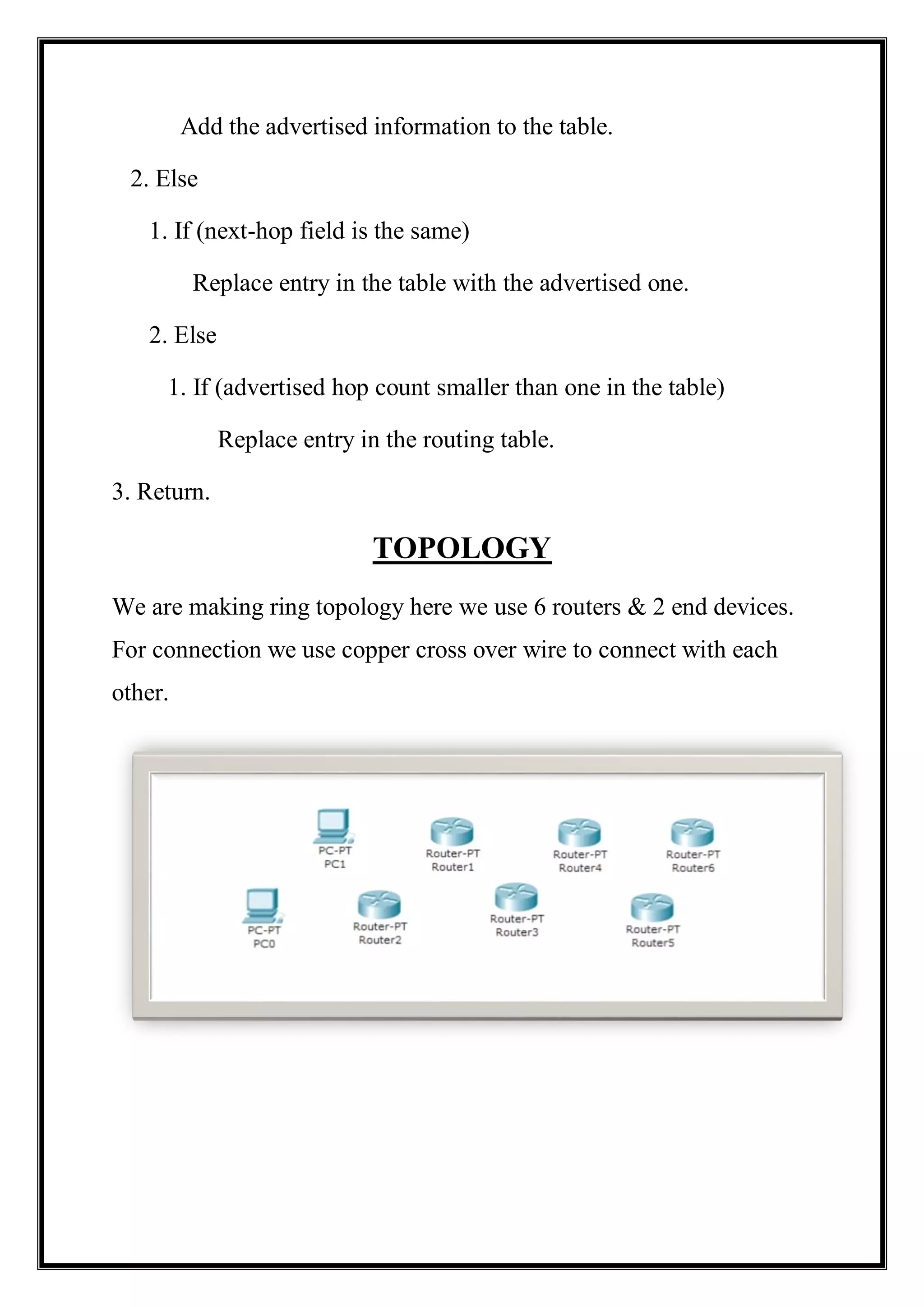
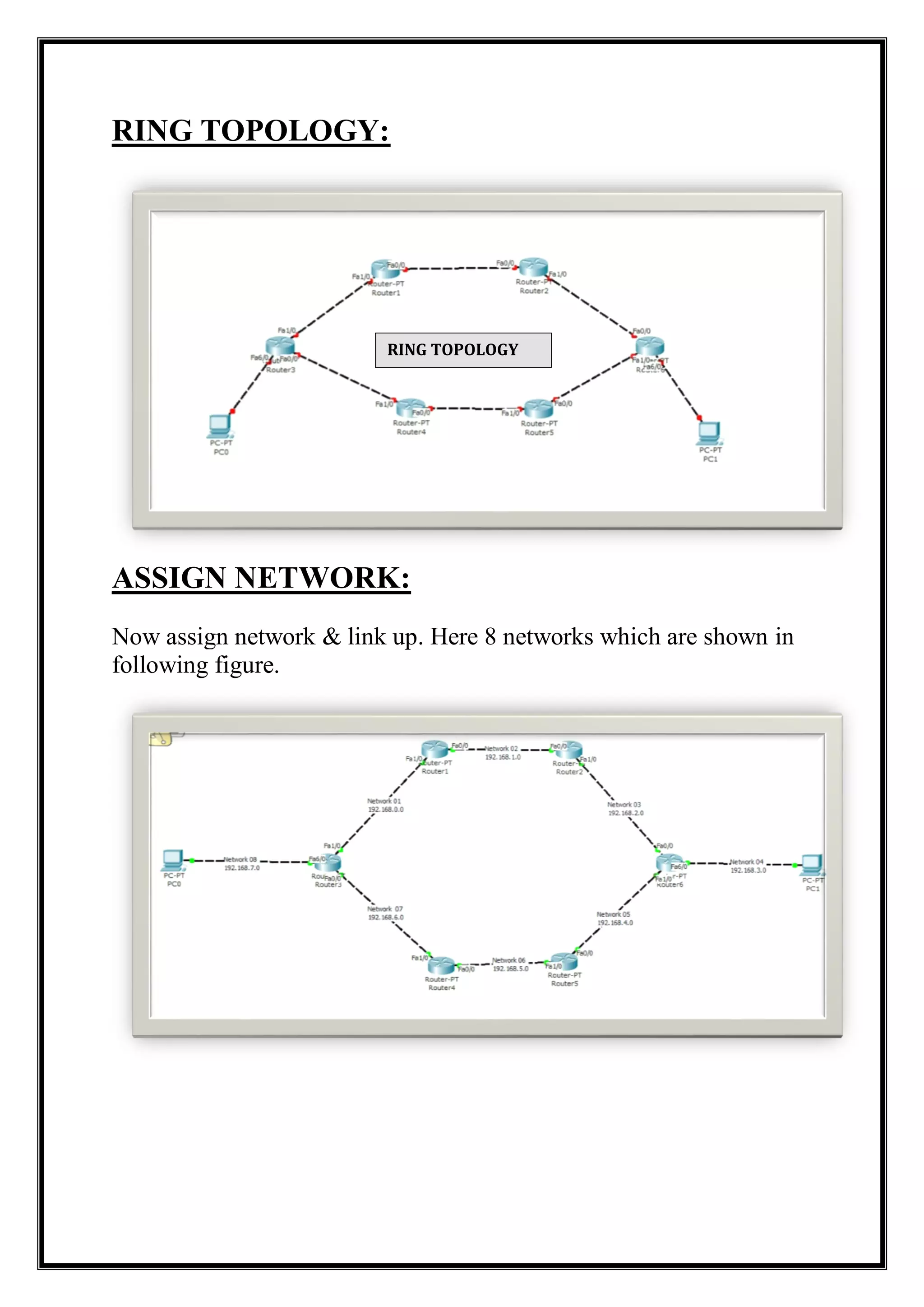
We are making ring topology here we use 6 routers & 2 end devices.
For connection we use copper cross over wire to connect with each
other.
RING TOPOLOGY:
ASSIGN NETWORK:
Now assign network & link up. Here 8 networks which are shown in
following figure.
RING TOPOLOGY
ASSIGN IP’S:
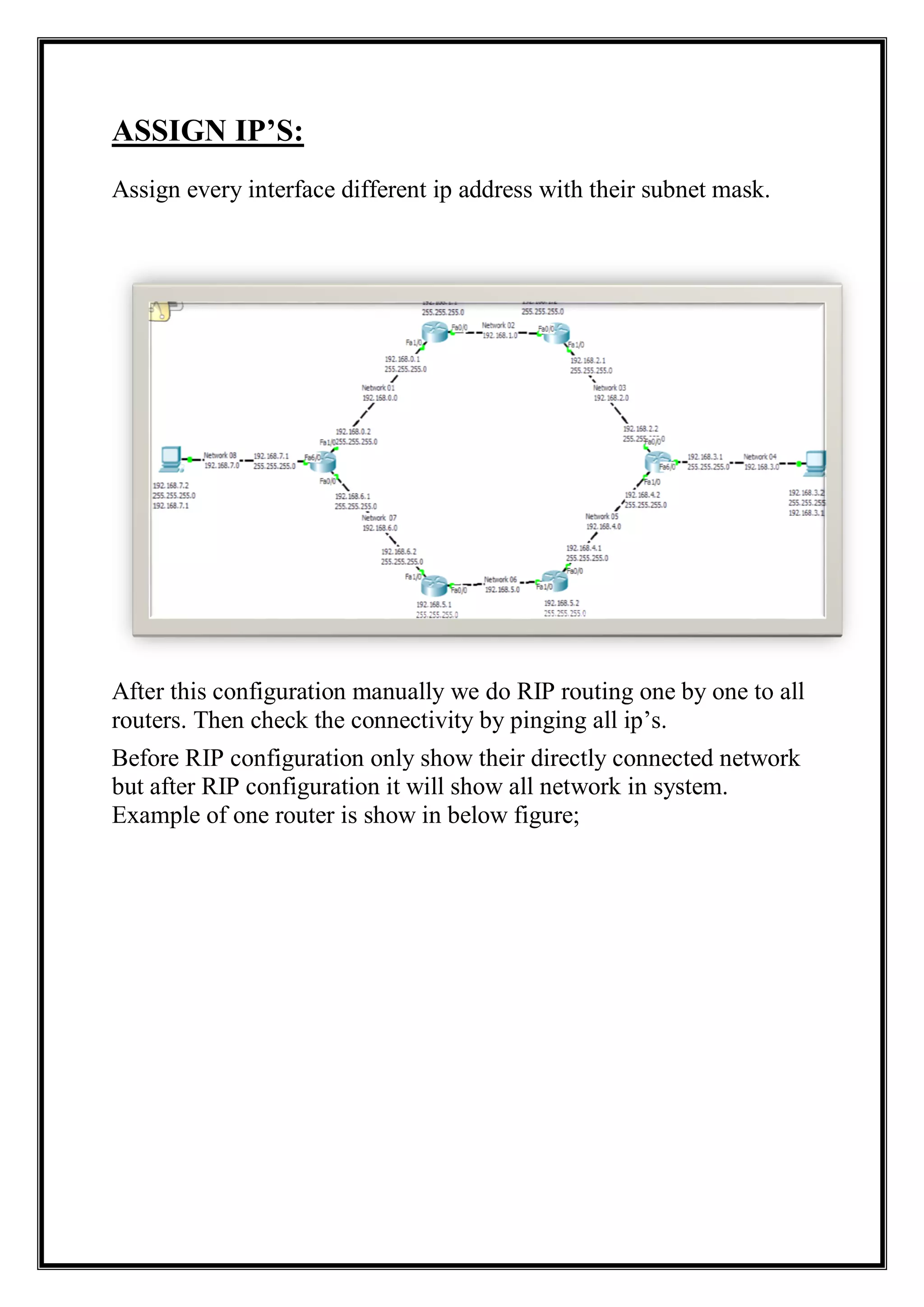
Assign every interface different ip address with their subnet mask.
After this configuration manually we do RIP routing one by one to all
routers. Then check the connectivity by pinging all ip’s.
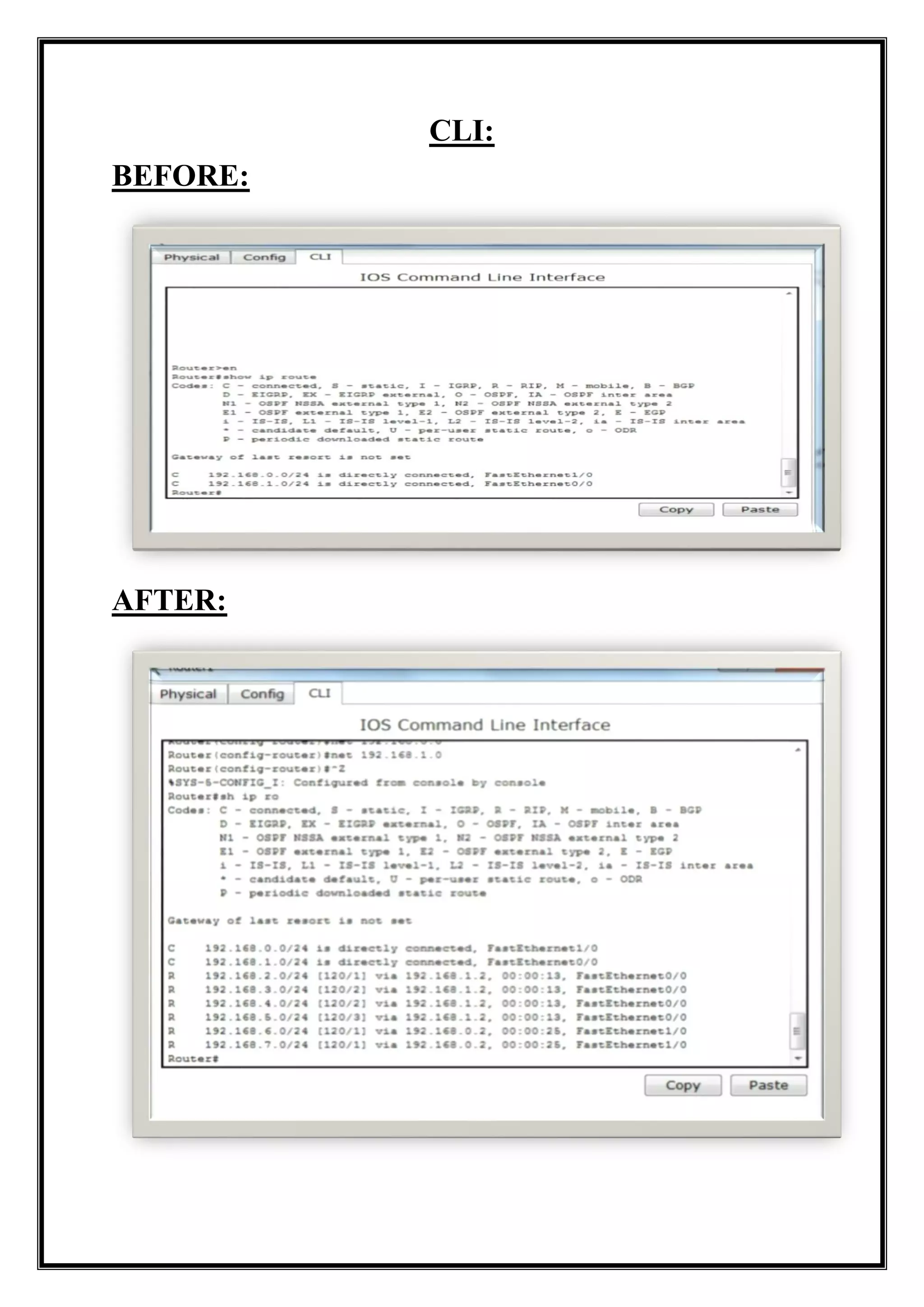
Before RIP configuration only show their directly connected network
but after RIP configuration it will show all network in system.
Example of one router is show in below figure;
CLI:
BEFORE:
AFTER:

Routing Information Protocol (RIP)

  • 1.
    FINAL PROJECT REPORT DATACOMMUNICATION & COMPUTER NETWORKING SUBMITTED TO TEACHER’S NAME GROUP MEMBERS Student’s ID Student’s Name Field
  • 3.
    Routing Information Protocol(RIP) DEFINITION: Routing Information Protocol (RIP) is a dynamic routing protocol which uses hop count as a routing metric to find the best path between the source and the destination network. DETAIL: Routing Information Protocol (RIP) is the intradomain (interior) routing protocol which is based on distance vector routing and it is used inside an autonomous system. Routers and network links are called node. The first column of routing table is destination address. The cost of metric in this protocol is hop count which is number of networks which need to be passed to reach destination. Here infinity is defined by a fixed number which is 16 it means that using a Rip, network cannot have more than 15 hops. RIP’s VERSIONS: There are two versions of routing information protocol.  RIP Version1  RIP Version2 RIP Version1: RIP v1 is known as classful Routing Protocol because it doesn’t send information of subnet mask in its routing update. It is an open standard protocol means it works on the various vendors routers. It works on most of the router, it is classful routing protocol. Updates are broadcasted. Its administrative distance value is 120 , it means it is not reliable. The lesser the administrative distance value the reliability is much more. Its metric is hop count and max hop
  • 4.
    count is 15.There will be total 16 routers in the network. When there will be the same number of hop to reach destination, Rip starts to perform load balancing. Load balancing means if there are three ways to reach the destination and each way has same number of routers then packets will be sent to each path to reach the destination. This reduces traffic and also the load is balanced. It is used in small companies; in this protocol routing tables are updated in each 30 sec. whenever link breaks rip trace out another path to reach the destination. It is one of the slowest protocol. ADVANTAGES & DISADNATAGES OF RIP VERSION 1 Advantages of RIP ver1: 1. Easy to configure, static router are complex. 2. Less overhead 3. No complexity. Disadvantage of RIP ver1: 1. Bandwidth utilization is very high as broadcast for every 30 seconds. 2. It works only on hop count. 3. It is not scalable as hop count is only 15. If there will be requirement of more routers in the network it would be a problem. 4. Convergence is very slow, wastes a lot of time in finding alternate path. RIP Version-2: RIP v2 is known as Classless Routing Protocol because it sends information of subnet mask in its routing update. Due to some deficiencies in the original RIP specification, RIP version 2 was developed in 1993. It supports classless Inter-Domain Routing (CIDR) and has ability to carry subnet information, its metric is also hop count and max hop count 15 is same as rip version 1. It support authentication and does sub netting and multicasting. Auto summary can be done on every router. In RIPv2 Subnet masks are
  • 5.
    included in therouting update. RIPv2 multicasts the entire routing table to all adjacent routers at the address 224.0.0.9, as opposed to RIPv1 which uses broadcast (255.255.255.255). ADVANTAGES & DISADNATAGES OF RIP VERSION 2 Advantages of RIP ver2 1. It’s a standardized protocol. 2. It’s VLSM compliant. 3. Provides fast convergence. 4. It sends triggered updates when the network changes. 5. Works with snapshot routing – making it ideal for dial networks. Disadvantage of RIP ver2 There lie some disadvantages as well: 1. Max hop count of 15, due to the ‘count-to-infinity’ vulnerability. 2. No concept of neighbors. 3. Exchanges entire table with all neighbors every 30 seconds (except in the case of a triggered update). FEATURES OF RIP: 1. Updates of the network are exchanged periodically. 2. Updates (routing information) are always broadcast. 3. Full routing tables are sent in updates. 4. Routers always trust on routing information received from neighbor routers. This is also known as routing on rumors. RIP UPDATING ALGORITHM Receive: a response RIP message 1. Add one hop to the hop count for each advertised destination. 2. Repeat the following steps for each advertised destination: 1. If (destination not in the routing table)
  • 6.
    Add the advertisedinformation to the table. 2. Else 1. If (next-hop field is the same) Replace entry in the table with the advertised one. 2. Else 1. If (advertised hop count smaller than one in the table) Replace entry in the routing table. 3. Return. TOPOLOGY We are making ring topology here we use 6 routers & 2 end devices. For connection we use copper cross over wire to connect with each other.
  • 7.
    RING TOPOLOGY: ASSIGN NETWORK: Nowassign network & link up. Here 8 networks which are shown in following figure. RING TOPOLOGY
  • 8.
    ASSIGN IP’S: Assign everyinterface different ip address with their subnet mask. After this configuration manually we do RIP routing one by one to all routers. Then check the connectivity by pinging all ip’s. Before RIP configuration only show their directly connected network but after RIP configuration it will show all network in system. Example of one router is show in below figure;
  • 9.