© 2007 Cisco Systems, Inc. All rights reserved. Cisco Public 1Version 4.0
EIGRP
Routing Protocols and Concepts
Ed Scrimaglia - CCIE
2© 2007 Cisco Systems, Inc. All rights reserved. Cisco Public
Objectives
 Describe the background and history of Enhanced
Interior Gateway Routing Protocol (EIGRP).
 Examine the basic EIGRP configuration commands
and identify their purposes.
 Calculate the composite metric used by EIGRP.
 Describe the concepts and operation of DUAL.
 Describe the uses of additional configuration
commands in EIGRP.
3© 2007 Cisco Systems, Inc. All rights reserved. Cisco Public
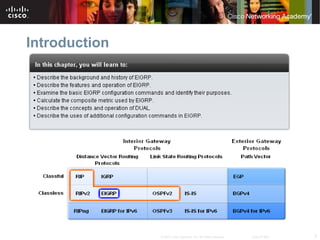
Introduction
4© 2007 Cisco Systems, Inc. All rights reserved. Cisco Public
EIGRP
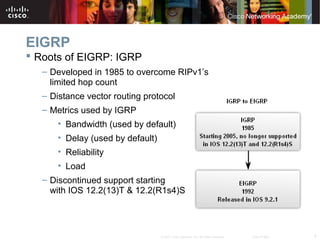
 Roots of EIGRP: IGRP
– Developed in 1985 to overcome RIPv1’s
limited hop count
– Distance vector routing protocol
– Metrics used by IGRP
• Bandwidth (used by default)
• Delay (used by default)
• Reliability
• Load
– Discontinued support starting
with IOS 12.2(13)T & 12.2(R1s4)S
5© 2007 Cisco Systems, Inc. All rights reserved. Cisco Public
EIGRP
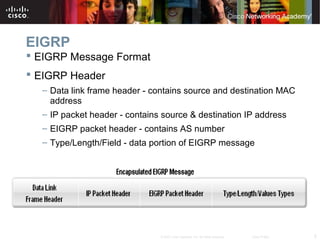
 EIGRP Message Format
 EIGRP Header
– Data link frame header - contains source and destination MAC
address
– IP packet header - contains source & destination IP address
– EIGRP packet header - contains AS number
– Type/Length/Field - data portion of EIGRP message
6© 2007 Cisco Systems, Inc. All rights reserved. Cisco Public
EIGRP
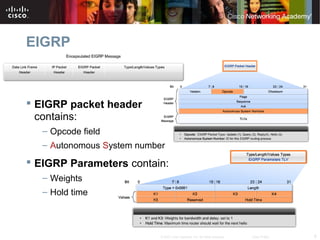
 EIGRP packet header
contains:
– Opcode field
– Autonomous System number
 EIGRP Parameters contain:
– Weights
– Hold time
7© 2007 Cisco Systems, Inc. All rights reserved. Cisco Public
EIGRP
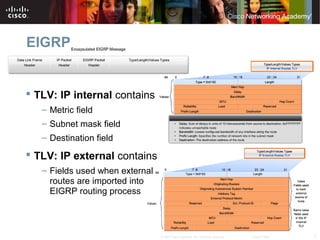
 TLV: IP internal contains
– Metric field
– Subnet mask field
– Destination field
 TLV: IP external contains
– Fields used when external
routes are imported into
EIGRP routing process
8© 2007 Cisco Systems, Inc. All rights reserved. Cisco Public
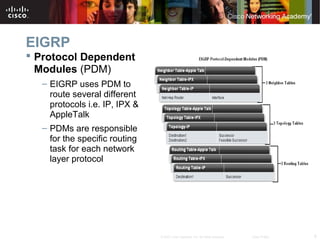
EIGRP
 Protocol Dependent
Modules (PDM)
– EIGRP uses PDM to
route several different
protocols i.e. IP, IPX &
AppleTalk
– PDMs are responsible
for the specific routing
task for each network
layer protocol
9© 2007 Cisco Systems, Inc. All rights reserved. Cisco Public
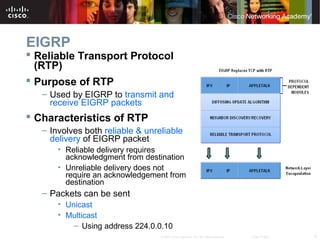
EIGRP
 Reliable Transport Protocol
(RTP)
 Purpose of RTP
– Used by EIGRP to transmit and
receive EIGRP packets
 Characteristics of RTP
– Involves both reliable & unreliable
delivery of EIGRP packet
• Reliable delivery requires
acknowledgment from destination
• Unreliable delivery does not
require an acknowledgement from
destination
– Packets can be sent
• Unicast
• Multicast
– Using address 224.0.0.10
10© 2007 Cisco Systems, Inc. All rights reserved. Cisco Public
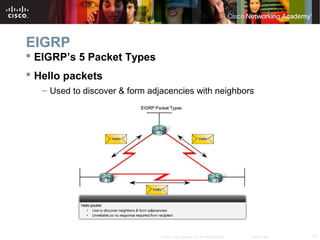
EIGRP
 EIGRP’s 5 Packet Types
 Hello packets
– Used to discover & form adjacencies with neighbors
11© 2007 Cisco Systems, Inc. All rights reserved. Cisco Public
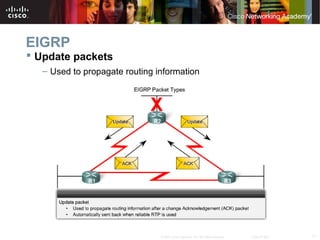
EIGRP
 Update packets
– Used to propagate routing information
12© 2007 Cisco Systems, Inc. All rights reserved. Cisco Public
EIGRP
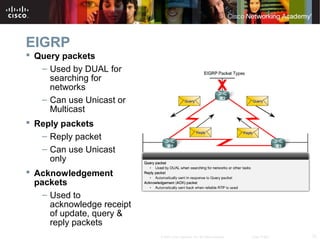
 Query packets
– Used by DUAL for
searching for
networks
– Can use Unicast or
Multicast
 Reply packets
– Reply packet
– Can use Unicast
only
 Acknowledgement
packets
– Used to
acknowledge receipt
of update, query &
reply packets
13© 2007 Cisco Systems, Inc. All rights reserved. Cisco Public
EIGRP
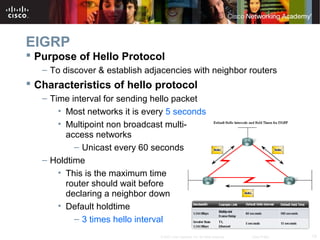
 Purpose of Hello Protocol
– To discover & establish adjacencies with neighbor routers
 Characteristics of hello protocol
– Time interval for sending hello packet
• Most networks it is every 5 seconds
• Multipoint non broadcast multi-
access networks
– Unicast every 60 seconds
– Holdtime
• This is the maximum time
router should wait before
declaring a neighbor down
• Default holdtime
– 3 times hello interval
14© 2007 Cisco Systems, Inc. All rights reserved. Cisco Public
EIGRP
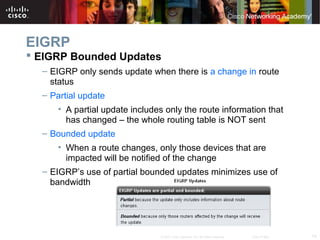
 EIGRP Bounded Updates
– EIGRP only sends update when there is a change in route
status
– Partial update
• A partial update includes only the route information that
has changed – the whole routing table is NOT sent
– Bounded update
• When a route changes, only those devices that are
impacted will be notified of the change
– EIGRP’s use of partial bounded updates minimizes use of
bandwidth
15© 2007 Cisco Systems, Inc. All rights reserved. Cisco Public
EIGRP
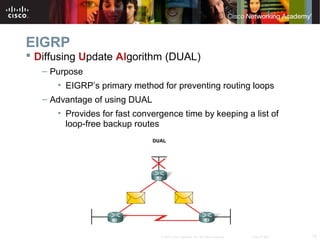
 Diffusing Update Algorithm (DUAL)
– Purpose
• EIGRP’s primary method for preventing routing loops
– Advantage of using DUAL
• Provides for fast convergence time by keeping a list of
loop-free backup routes
16© 2007 Cisco Systems, Inc. All rights reserved. Cisco Public
EIGRP
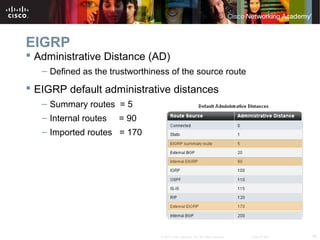
 Administrative Distance (AD)
– Defined as the trustworthiness of the source route
 EIGRP default administrative distances
– Summary routes = 5
– Internal routes = 90
– Imported routes = 170
17© 2007 Cisco Systems, Inc. All rights reserved. Cisco Public
EIGRP
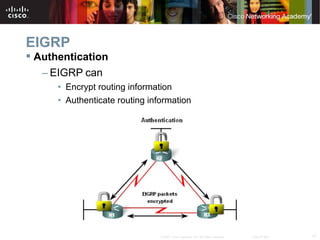
 Authentication
– EIGRP can
• Encrypt routing information
• Authenticate routing information
18© 2007 Cisco Systems, Inc. All rights reserved. Cisco Public
EIGRP
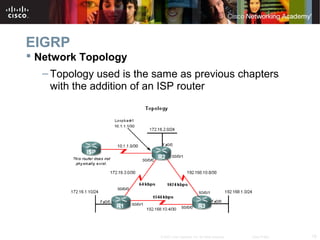
 Network Topology
– Topology used is the same as previous chapters
with the addition of an ISP router
19© 2007 Cisco Systems, Inc. All rights reserved. Cisco Public
EIGRP
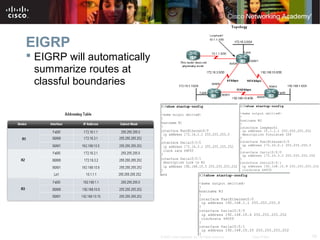
 EIGRP will automatically
summarize routes at
classful boundaries
20© 2007 Cisco Systems, Inc. All rights reserved. Cisco Public
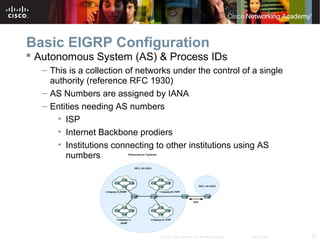
Basic EIGRP Configuration
 Autonomous System (AS) & Process IDs
– This is a collection of networks under the control of a single
authority (reference RFC 1930)
– AS Numbers are assigned by IANA
– Entities needing AS numbers
• ISP
• Internet Backbone prodiers
• Institutions connecting to other institutions using AS
numbers
21© 2007 Cisco Systems, Inc. All rights reserved. Cisco Public
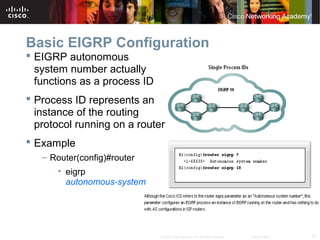
Basic EIGRP Configuration
 EIGRP autonomous
system number actually
functions as a process ID
 Process ID represents an
instance of the routing
protocol running on a router
 Example
– Router(config)#router
• eigrp
autonomous-system
22© 2007 Cisco Systems, Inc. All rights reserved. Cisco Public
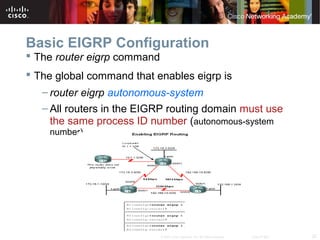
Basic EIGRP Configuration
 The router eigrp command
 The global command that enables eigrp is
– router eigrp autonomous-system
– All routers in the EIGRP routing domain must use
the same process ID number (autonomous-system
number)
23© 2007 Cisco Systems, Inc. All rights reserved. Cisco Public
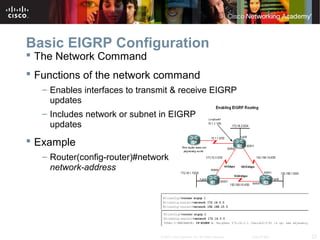
Basic EIGRP Configuration
 The Network Command
 Functions of the network command
– Enables interfaces to transmit & receive EIGRP
updates
– Includes network or subnet in EIGRP
updates
 Example
– Router(config-router)#network
network-address
24© 2007 Cisco Systems, Inc. All rights reserved. Cisco Public
Basic EIGRP Configuration
 The network Command with a Wildcard Mask
– This option is used when you want to configure
EIGRP to advertise specific subnets
– Example
• Router(config-router)#network network-address [wildcard-mask]
25© 2007 Cisco Systems, Inc. All rights reserved. Cisco Public
Basic EIGRP Configuration
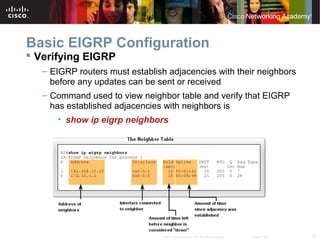
 Verifying EIGRP
– EIGRP routers must establish adjacencies with their neighbors
before any updates can be sent or received
– Command used to view neighbor table and verify that EIGRP
has established adjacencies with neighbors is
• show ip eigrp neighbors
26© 2007 Cisco Systems, Inc. All rights reserved. Cisco Public
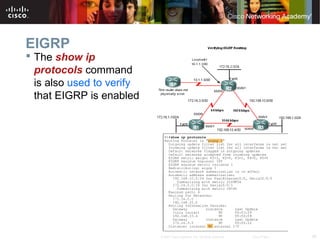
EIGRP
 The show ip
protocols command
is also used to verify
that EIGRP is enabled
27© 2007 Cisco Systems, Inc. All rights reserved. Cisco Public
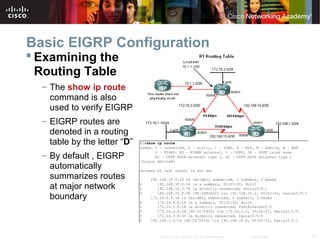
Basic EIGRP Configuration
 Examining the
Routing Table
– The show ip route
command is also
used to verify EIGRP
– EIGRP routes are
denoted in a routing
table by the letter “D”
– By default , EIGRP
automatically
summarizes routes
at major network
boundary
28© 2007 Cisco Systems, Inc. All rights reserved. Cisco Public
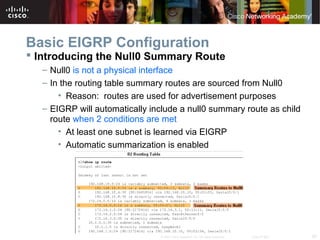
Basic EIGRP Configuration
 Introducing the Null0 Summary Route
– Null0 is not a physical interface
– In the routing table summary routes are sourced from Null0
• Reason: routes are used for advertisement purposes
– EIGRP will automatically include a null0 summary route as child
route when 2 conditions are met
• At least one subnet is learned via EIGRP
• Automatic summarization is enabled
29© 2007 Cisco Systems, Inc. All rights reserved. Cisco Public
Basic EIGRP Configuration
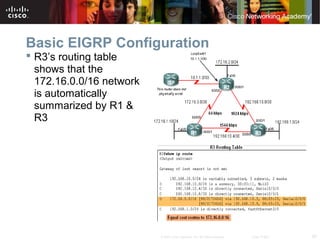
 R3’s routing table
shows that the
172.16.0.0/16 network
is automatically
summarized by R1 &
R3
30© 2007 Cisco Systems, Inc. All rights reserved. Cisco Public
EIGRP Metric Calculation
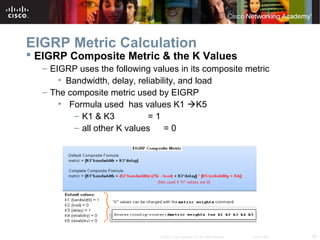
 EIGRP Composite Metric & the K Values
– EIGRP uses the following values in its composite metric
• Bandwidth, delay, reliability, and load
– The composite metric used by EIGRP
• Formula used has values K1 K5
– K1 & K3 = 1
– all other K values = 0
31© 2007 Cisco Systems, Inc. All rights reserved. Cisco Public
EIGRP Metric Calculation
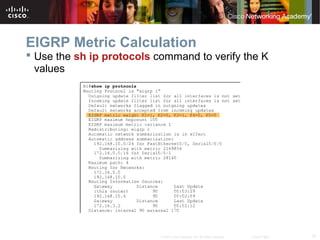
 Use the sh ip protocols command to verify the K
values
32© 2007 Cisco Systems, Inc. All rights reserved. Cisco Public
EIGRP Metric Calculation
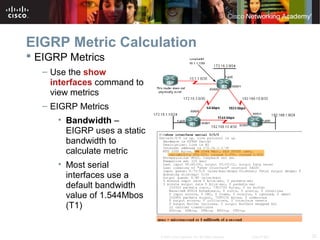
 EIGRP Metrics
– Use the show
interfaces command to
view metrics
– EIGRP Metrics
• Bandwidth –
EIGRP uses a static
bandwidth to
calculate metric
• Most serial
interfaces use a
default bandwidth
value of 1.544Mbos
(T1)
33© 2007 Cisco Systems, Inc. All rights reserved. Cisco Public
EIGRP Metric Calculation
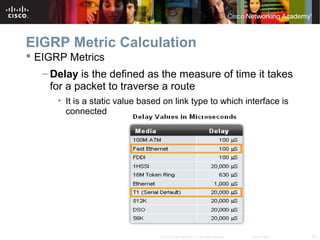
 EIGRP Metrics
– Delay is the defined as the measure of time it takes
for a packet to traverse a route
• It is a static value based on link type to which interface is
connected
34© 2007 Cisco Systems, Inc. All rights reserved. Cisco Public
EIGRP Metric Calculation
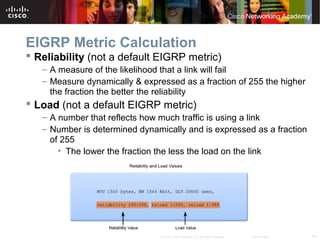
 Reliability (not a default EIGRP metric)
– A measure of the likelihood that a link will fail
– Measure dynamically & expressed as a fraction of 255 the higher
the fraction the better the reliability
 Load (not a default EIGRP metric)
– A number that reflects how much traffic is using a link
– Number is determined dynamically and is expressed as a fraction
of 255
• The lower the fraction the less the load on the link
35© 2007 Cisco Systems, Inc. All rights reserved. Cisco Public
EIGRP Metric Calculation
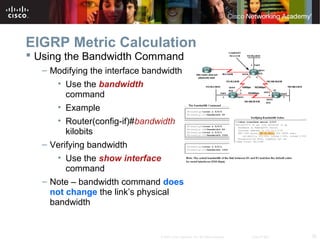
 Using the Bandwidth Command
– Modifying the interface bandwidth
• Use the bandwidth
command
• Example
• Router(config-if)#bandwidth
kilobits
– Verifying bandwidth
• Use the show interface
command
– Note – bandwidth command does
not change the link’s physical
bandwidth
36© 2007 Cisco Systems, Inc. All rights reserved. Cisco Public
EIGRP Metric Calculation
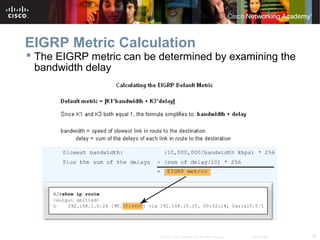
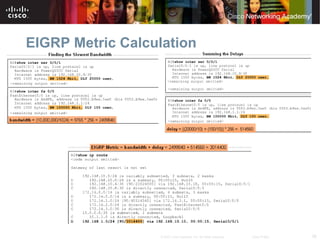
 The EIGRP metric can be determined by examining the
bandwidth delay
37© 2007 Cisco Systems, Inc. All rights reserved. Cisco Public
EIGRP Metric Calculation
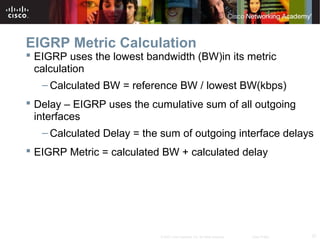
 EIGRP uses the lowest bandwidth (BW)in its metric
calculation
– Calculated BW = reference BW / lowest BW(kbps)
 Delay – EIGRP uses the cumulative sum of all outgoing
interfaces
– Calculated Delay = the sum of outgoing interface delays
 EIGRP Metric = calculated BW + calculated delay
38© 2007 Cisco Systems, Inc. All rights reserved. Cisco Public
EIGRP Metric Calculation
39© 2007 Cisco Systems, Inc. All rights reserved. Cisco Public
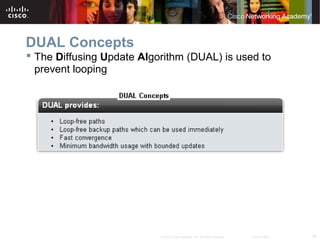
DUAL Concepts
 The Diffusing Update Algorithm (DUAL) is used to
prevent looping
40© 2007 Cisco Systems, Inc. All rights reserved. Cisco Public
DUAL Concepts
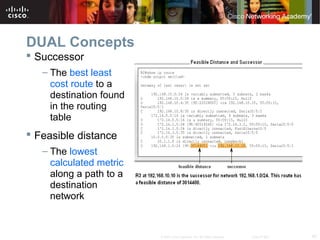
 Successor
– The best least
cost route to a
destination found
in the routing
table
 Feasible distance
– The lowest
calculated metric
along a path to a
destination
network
41© 2007 Cisco Systems, Inc. All rights reserved. Cisco Public
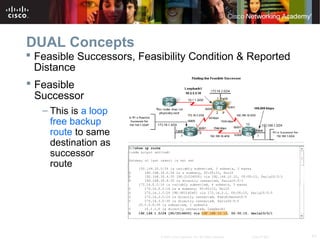
DUAL Concepts
 Feasible Successors, Feasibility Condition & Reported
Distance
 Feasible
Successor
– This is a loop
free backup
route to same
destination as
successor
route
42© 2007 Cisco Systems, Inc. All rights reserved. Cisco Public
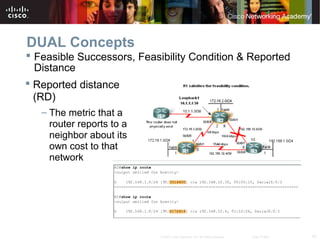
DUAL Concepts
 Reported distance
(RD)
– The metric that a
router reports to a
neighbor about its
own cost to that
network
 Feasible Successors, Feasibility Condition & Reported
Distance
43© 2007 Cisco Systems, Inc. All rights reserved. Cisco Public
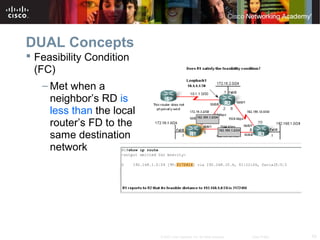
DUAL Concepts
 Feasibility Condition
(FC)
– Met when a
neighbor’s RD is
less than the local
router’s FD to the
same destination
network
44© 2007 Cisco Systems, Inc. All rights reserved. Cisco Public
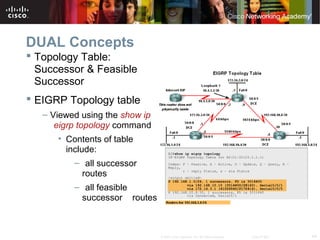
DUAL Concepts
 Topology Table:
Successor & Feasible
Successor
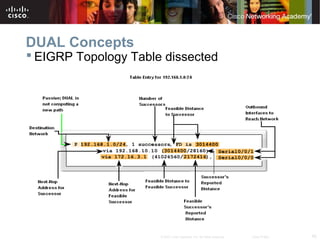
 EIGRP Topology table
– Viewed using the show ip
eigrp topology command
• Contents of table
include:
– all successor
routes
– all feasible
successor routes
45© 2007 Cisco Systems, Inc. All rights reserved. Cisco Public
DUAL Concepts
 EIGRP Topology Table dissected
46© 2007 Cisco Systems, Inc. All rights reserved. Cisco Public
DUAL Concepts
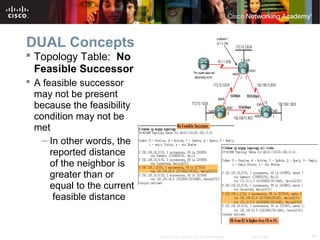
 Topology Table: No
Feasible Successor
 A feasible successor
may not be present
because the feasibility
condition may not be
met
– In other words, the
reported distance
of the neighbor is
greater than or
equal to the current
feasible distance
47© 2007 Cisco Systems, Inc. All rights reserved. Cisco Public
DUAL Concepts
 Finite Sate Machine (FSM)
– An abstract machine that defines a set of possible
states something can go through, what event
causes those states and what events result form
those states
– FSMs are used to describe how a device, computer
program, or routing algorithm will react to a set of
input events
48© 2007 Cisco Systems, Inc. All rights reserved. Cisco Public
DUAL Concepts
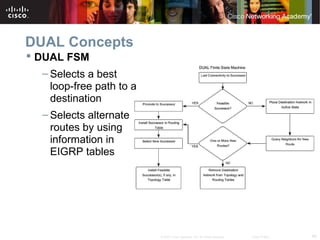
 DUAL FSM
– Selects a best
loop-free path to a
destination
– Selects alternate
routes by using
information in
EIGRP tables
49© 2007 Cisco Systems, Inc. All rights reserved. Cisco Public
DUAL Concepts
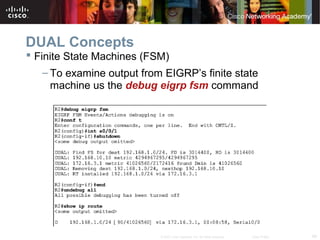
 Finite State Machines (FSM)
– To examine output from EIGRP’s finite state
machine us the debug eigrp fsm command
50© 2007 Cisco Systems, Inc. All rights reserved. Cisco Public
More EIGRP Configurations
 The Null0 Summary Route
– By default, EIGRP uses the Null0 interface to
discard any packets that match the parent route but
do not match any of the child routes
– EIGRP automatically includes a null0 summary
route as a child route whenever both of the following
conditions exist
• One or subnets exists that was learned via EIGRP
• Automatic summarization is enabled
51© 2007 Cisco Systems, Inc. All rights reserved. Cisco Public
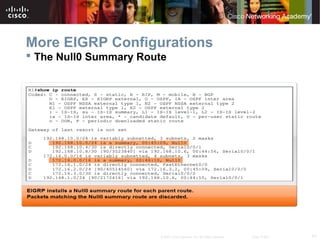
More EIGRP Configurations
 The Null0 Summary Route
52© 2007 Cisco Systems, Inc. All rights reserved. Cisco Public
More EIGRP Configurations
 Disabling Automatic Summarization
– The auto-summary command permits EIGRP to
automatically summarize at major network
boundaries
– The no auto-summary command is used to disable
automatic summarization
• This causes all EIGRP neighbors to send updates that will
not be automatically summarized
– This will cause changes to appear in both
» routing tables
» topology tables
53© 2007 Cisco Systems, Inc. All rights reserved. Cisco Public
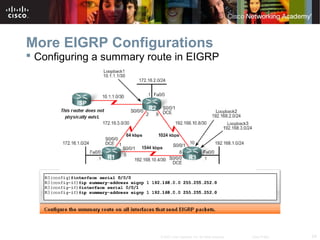
More EIGRP Configurations
 Manual Summarization
– Manual summarization can include supernets
• Reason: EIGRP is a classless routing protocol & include
subnet mask in update
– Command used to configure manual summarization
• Router(config-if)#ip summary-address eigrp as-number
network-address subnet-mask
54© 2007 Cisco Systems, Inc. All rights reserved. Cisco Public
More EIGRP Configurations
 Configuring a summary route in EIGRP
55© 2007 Cisco Systems, Inc. All rights reserved. Cisco Public
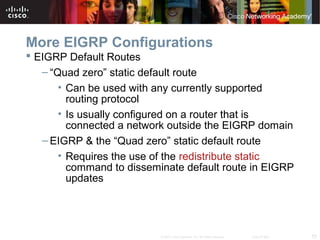
More EIGRP Configurations
 EIGRP Default Routes
– “Quad zero” static default route
• Can be used with any currently supported
routing protocol
• Is usually configured on a router that is
connected a network outside the EIGRP domain
– EIGRP & the “Quad zero” static default route
• Requires the use of the redistribute static
command to disseminate default route in EIGRP
updates
56© 2007 Cisco Systems, Inc. All rights reserved. Cisco Public
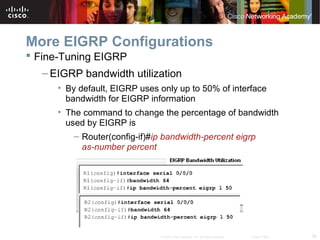
More EIGRP Configurations
 Fine-Tuning EIGRP
– EIGRP bandwidth utilization
• By default, EIGRP uses only up to 50% of interface
bandwidth for EIGRP information
• The command to change the percentage of bandwidth
used by EIGRP is
– Router(config-if)#ip bandwidth-percent eigrp
as-number percent
57© 2007 Cisco Systems, Inc. All rights reserved. Cisco Public
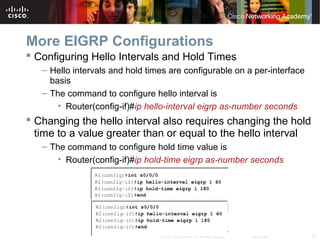
More EIGRP Configurations
 Configuring Hello Intervals and Hold Times
– Hello intervals and hold times are configurable on a per-interface
basis
– The command to configure hello interval is
• Router(config-if)#ip hello-interval eigrp as-number seconds
 Changing the hello interval also requires changing the hold
time to a value greater than or equal to the hello interval
– The command to configure hold time value is
• Router(config-if)#ip hold-time eigrp as-number seconds
58© 2007 Cisco Systems, Inc. All rights reserved. Cisco Public
Summary
 Background & History
– EIGRP is a derivative of IGRP
• EIGRP is a Cisco proprietary distance vector routing
protocol released in 1994
 EIGRP terms and characteristics
– EIGPR uses RTP to transmit & receive EIGRP packets
– EIGRP has 5 packet type:
• Hello packets
• Update packets
• Acknowledgement packets
• Query packets
• Reply packets
– Supports VLSM & CIDR
59© 2007 Cisco Systems, Inc. All rights reserved. Cisco Public
Summary
 EIGRP terms and characteristics
– EIGRP uses a hello protocol
• Purpose of hello protocol is to discover & establish
adjacencies
– EIGRP routing updates
• Aperiodic
• Partial and bounded
• Fast convergence
60© 2007 Cisco Systems, Inc. All rights reserved. Cisco Public
Summary
 EIGRP commands
– The following commands are used for EIGRP
configuration
• RtrA(config)#router eigrp [autonomous-system #]
• RtrA(config-router)#network network-number
– The following commands can be used to verify EIGRP
• Show ip protocols
• Show ip eigrp neighbors
• Show ip route
61© 2007 Cisco Systems, Inc. All rights reserved. Cisco Public
Summary
 EIGRP metrics include
– Bandwidth (default)
– Delay (default)
– Reliability
– Load
62© 2007 Cisco Systems, Inc. All rights reserved. Cisco Public
Summary
 DUAL
– Purpose of DUAL
• To prevent routing loops
– Successor
• Primary route to a destination
– Feasible successor
• Backup route to a destination
– Feasible distance
• Lowest calculated metric to a destination
– Reported distance
• The distance towards a destination as advertised by
an upstream neighbor
63© 2007 Cisco Systems, Inc. All rights reserved. Cisco Public
Summary
 Choosing the best route
– After router has received all updates from directly
connected neighbors, it can calculate its DUAL
• 1st
metric is calculated for each route
• 2nd
route with lowest metric is designated
successor & is placed in routing table
• 3rd
feasible successor is found
– Criteria for feasible successor: it must have
lower reported distance to the destination
than the installed route’s feasible distance
– Feasible routes are maintained in topology
table
64© 2007 Cisco Systems, Inc. All rights reserved. Cisco Public
Summary
 Automatic summarization
– On by default
– Summarizes routes on classful boundary
– Summarization can be disabled using the following
command
• RtrA(config-if)#no auto-summary
65© 2007 Cisco Systems, Inc. All rights reserved. Cisco Public

Eigrp.ppt

  • 1.
    © 2007 CiscoSystems, Inc. All rights reserved. Cisco Public 1Version 4.0 EIGRP Routing Protocols and Concepts Ed Scrimaglia - CCIE
  • 2.
    2© 2007 CiscoSystems, Inc. All rights reserved. Cisco Public Objectives  Describe the background and history of Enhanced Interior Gateway Routing Protocol (EIGRP).  Examine the basic EIGRP configuration commands and identify their purposes.  Calculate the composite metric used by EIGRP.  Describe the concepts and operation of DUAL.  Describe the uses of additional configuration commands in EIGRP.
  • 3.
    3© 2007 CiscoSystems, Inc. All rights reserved. Cisco Public Introduction
  • 4.
    4© 2007 CiscoSystems, Inc. All rights reserved. Cisco Public EIGRP  Roots of EIGRP: IGRP – Developed in 1985 to overcome RIPv1’s limited hop count – Distance vector routing protocol – Metrics used by IGRP • Bandwidth (used by default) • Delay (used by default) • Reliability • Load – Discontinued support starting with IOS 12.2(13)T & 12.2(R1s4)S
  • 5.
    5© 2007 CiscoSystems, Inc. All rights reserved. Cisco Public EIGRP  EIGRP Message Format  EIGRP Header – Data link frame header - contains source and destination MAC address – IP packet header - contains source & destination IP address – EIGRP packet header - contains AS number – Type/Length/Field - data portion of EIGRP message
  • 6.
    6© 2007 CiscoSystems, Inc. All rights reserved. Cisco Public EIGRP  EIGRP packet header contains: – Opcode field – Autonomous System number  EIGRP Parameters contain: – Weights – Hold time
  • 7.
    7© 2007 CiscoSystems, Inc. All rights reserved. Cisco Public EIGRP  TLV: IP internal contains – Metric field – Subnet mask field – Destination field  TLV: IP external contains – Fields used when external routes are imported into EIGRP routing process
  • 8.
    8© 2007 CiscoSystems, Inc. All rights reserved. Cisco Public EIGRP  Protocol Dependent Modules (PDM) – EIGRP uses PDM to route several different protocols i.e. IP, IPX & AppleTalk – PDMs are responsible for the specific routing task for each network layer protocol
  • 9.
    9© 2007 CiscoSystems, Inc. All rights reserved. Cisco Public EIGRP  Reliable Transport Protocol (RTP)  Purpose of RTP – Used by EIGRP to transmit and receive EIGRP packets  Characteristics of RTP – Involves both reliable & unreliable delivery of EIGRP packet • Reliable delivery requires acknowledgment from destination • Unreliable delivery does not require an acknowledgement from destination – Packets can be sent • Unicast • Multicast – Using address 224.0.0.10
  • 10.
    10© 2007 CiscoSystems, Inc. All rights reserved. Cisco Public EIGRP  EIGRP’s 5 Packet Types  Hello packets – Used to discover & form adjacencies with neighbors
  • 11.
    11© 2007 CiscoSystems, Inc. All rights reserved. Cisco Public EIGRP  Update packets – Used to propagate routing information
  • 12.
    12© 2007 CiscoSystems, Inc. All rights reserved. Cisco Public EIGRP  Query packets – Used by DUAL for searching for networks – Can use Unicast or Multicast  Reply packets – Reply packet – Can use Unicast only  Acknowledgement packets – Used to acknowledge receipt of update, query & reply packets
  • 13.
    13© 2007 CiscoSystems, Inc. All rights reserved. Cisco Public EIGRP  Purpose of Hello Protocol – To discover & establish adjacencies with neighbor routers  Characteristics of hello protocol – Time interval for sending hello packet • Most networks it is every 5 seconds • Multipoint non broadcast multi- access networks – Unicast every 60 seconds – Holdtime • This is the maximum time router should wait before declaring a neighbor down • Default holdtime – 3 times hello interval
  • 14.
    14© 2007 CiscoSystems, Inc. All rights reserved. Cisco Public EIGRP  EIGRP Bounded Updates – EIGRP only sends update when there is a change in route status – Partial update • A partial update includes only the route information that has changed – the whole routing table is NOT sent – Bounded update • When a route changes, only those devices that are impacted will be notified of the change – EIGRP’s use of partial bounded updates minimizes use of bandwidth
  • 15.
    15© 2007 CiscoSystems, Inc. All rights reserved. Cisco Public EIGRP  Diffusing Update Algorithm (DUAL) – Purpose • EIGRP’s primary method for preventing routing loops – Advantage of using DUAL • Provides for fast convergence time by keeping a list of loop-free backup routes
  • 16.
    16© 2007 CiscoSystems, Inc. All rights reserved. Cisco Public EIGRP  Administrative Distance (AD) – Defined as the trustworthiness of the source route  EIGRP default administrative distances – Summary routes = 5 – Internal routes = 90 – Imported routes = 170
  • 17.
    17© 2007 CiscoSystems, Inc. All rights reserved. Cisco Public EIGRP  Authentication – EIGRP can • Encrypt routing information • Authenticate routing information
  • 18.
    18© 2007 CiscoSystems, Inc. All rights reserved. Cisco Public EIGRP  Network Topology – Topology used is the same as previous chapters with the addition of an ISP router
  • 19.
    19© 2007 CiscoSystems, Inc. All rights reserved. Cisco Public EIGRP  EIGRP will automatically summarize routes at classful boundaries
  • 20.
    20© 2007 CiscoSystems, Inc. All rights reserved. Cisco Public Basic EIGRP Configuration  Autonomous System (AS) & Process IDs – This is a collection of networks under the control of a single authority (reference RFC 1930) – AS Numbers are assigned by IANA – Entities needing AS numbers • ISP • Internet Backbone prodiers • Institutions connecting to other institutions using AS numbers
  • 21.
    21© 2007 CiscoSystems, Inc. All rights reserved. Cisco Public Basic EIGRP Configuration  EIGRP autonomous system number actually functions as a process ID  Process ID represents an instance of the routing protocol running on a router  Example – Router(config)#router • eigrp autonomous-system
  • 22.
    22© 2007 CiscoSystems, Inc. All rights reserved. Cisco Public Basic EIGRP Configuration  The router eigrp command  The global command that enables eigrp is – router eigrp autonomous-system – All routers in the EIGRP routing domain must use the same process ID number (autonomous-system number)
  • 23.
    23© 2007 CiscoSystems, Inc. All rights reserved. Cisco Public Basic EIGRP Configuration  The Network Command  Functions of the network command – Enables interfaces to transmit & receive EIGRP updates – Includes network or subnet in EIGRP updates  Example – Router(config-router)#network network-address
  • 24.
    24© 2007 CiscoSystems, Inc. All rights reserved. Cisco Public Basic EIGRP Configuration  The network Command with a Wildcard Mask – This option is used when you want to configure EIGRP to advertise specific subnets – Example • Router(config-router)#network network-address [wildcard-mask]
  • 25.
    25© 2007 CiscoSystems, Inc. All rights reserved. Cisco Public Basic EIGRP Configuration  Verifying EIGRP – EIGRP routers must establish adjacencies with their neighbors before any updates can be sent or received – Command used to view neighbor table and verify that EIGRP has established adjacencies with neighbors is • show ip eigrp neighbors
  • 26.
    26© 2007 CiscoSystems, Inc. All rights reserved. Cisco Public EIGRP  The show ip protocols command is also used to verify that EIGRP is enabled
  • 27.
    27© 2007 CiscoSystems, Inc. All rights reserved. Cisco Public Basic EIGRP Configuration  Examining the Routing Table – The show ip route command is also used to verify EIGRP – EIGRP routes are denoted in a routing table by the letter “D” – By default , EIGRP automatically summarizes routes at major network boundary
  • 28.
    28© 2007 CiscoSystems, Inc. All rights reserved. Cisco Public Basic EIGRP Configuration  Introducing the Null0 Summary Route – Null0 is not a physical interface – In the routing table summary routes are sourced from Null0 • Reason: routes are used for advertisement purposes – EIGRP will automatically include a null0 summary route as child route when 2 conditions are met • At least one subnet is learned via EIGRP • Automatic summarization is enabled
  • 29.
    29© 2007 CiscoSystems, Inc. All rights reserved. Cisco Public Basic EIGRP Configuration  R3’s routing table shows that the 172.16.0.0/16 network is automatically summarized by R1 & R3
  • 30.
    30© 2007 CiscoSystems, Inc. All rights reserved. Cisco Public EIGRP Metric Calculation  EIGRP Composite Metric & the K Values – EIGRP uses the following values in its composite metric • Bandwidth, delay, reliability, and load – The composite metric used by EIGRP • Formula used has values K1 K5 – K1 & K3 = 1 – all other K values = 0
  • 31.
    31© 2007 CiscoSystems, Inc. All rights reserved. Cisco Public EIGRP Metric Calculation  Use the sh ip protocols command to verify the K values
  • 32.
    32© 2007 CiscoSystems, Inc. All rights reserved. Cisco Public EIGRP Metric Calculation  EIGRP Metrics – Use the show interfaces command to view metrics – EIGRP Metrics • Bandwidth – EIGRP uses a static bandwidth to calculate metric • Most serial interfaces use a default bandwidth value of 1.544Mbos (T1)
  • 33.
    33© 2007 CiscoSystems, Inc. All rights reserved. Cisco Public EIGRP Metric Calculation  EIGRP Metrics – Delay is the defined as the measure of time it takes for a packet to traverse a route • It is a static value based on link type to which interface is connected
  • 34.
    34© 2007 CiscoSystems, Inc. All rights reserved. Cisco Public EIGRP Metric Calculation  Reliability (not a default EIGRP metric) – A measure of the likelihood that a link will fail – Measure dynamically & expressed as a fraction of 255 the higher the fraction the better the reliability  Load (not a default EIGRP metric) – A number that reflects how much traffic is using a link – Number is determined dynamically and is expressed as a fraction of 255 • The lower the fraction the less the load on the link
  • 35.
    35© 2007 CiscoSystems, Inc. All rights reserved. Cisco Public EIGRP Metric Calculation  Using the Bandwidth Command – Modifying the interface bandwidth • Use the bandwidth command • Example • Router(config-if)#bandwidth kilobits – Verifying bandwidth • Use the show interface command – Note – bandwidth command does not change the link’s physical bandwidth
  • 36.
    36© 2007 CiscoSystems, Inc. All rights reserved. Cisco Public EIGRP Metric Calculation  The EIGRP metric can be determined by examining the bandwidth delay
  • 37.
    37© 2007 CiscoSystems, Inc. All rights reserved. Cisco Public EIGRP Metric Calculation  EIGRP uses the lowest bandwidth (BW)in its metric calculation – Calculated BW = reference BW / lowest BW(kbps)  Delay – EIGRP uses the cumulative sum of all outgoing interfaces – Calculated Delay = the sum of outgoing interface delays  EIGRP Metric = calculated BW + calculated delay
  • 38.
    38© 2007 CiscoSystems, Inc. All rights reserved. Cisco Public EIGRP Metric Calculation
  • 39.
    39© 2007 CiscoSystems, Inc. All rights reserved. Cisco Public DUAL Concepts  The Diffusing Update Algorithm (DUAL) is used to prevent looping
  • 40.
    40© 2007 CiscoSystems, Inc. All rights reserved. Cisco Public DUAL Concepts  Successor – The best least cost route to a destination found in the routing table  Feasible distance – The lowest calculated metric along a path to a destination network
  • 41.
    41© 2007 CiscoSystems, Inc. All rights reserved. Cisco Public DUAL Concepts  Feasible Successors, Feasibility Condition & Reported Distance  Feasible Successor – This is a loop free backup route to same destination as successor route
  • 42.
    42© 2007 CiscoSystems, Inc. All rights reserved. Cisco Public DUAL Concepts  Reported distance (RD) – The metric that a router reports to a neighbor about its own cost to that network  Feasible Successors, Feasibility Condition & Reported Distance
  • 43.
    43© 2007 CiscoSystems, Inc. All rights reserved. Cisco Public DUAL Concepts  Feasibility Condition (FC) – Met when a neighbor’s RD is less than the local router’s FD to the same destination network
  • 44.
    44© 2007 CiscoSystems, Inc. All rights reserved. Cisco Public DUAL Concepts  Topology Table: Successor & Feasible Successor  EIGRP Topology table – Viewed using the show ip eigrp topology command • Contents of table include: – all successor routes – all feasible successor routes
  • 45.
    45© 2007 CiscoSystems, Inc. All rights reserved. Cisco Public DUAL Concepts  EIGRP Topology Table dissected
  • 46.
    46© 2007 CiscoSystems, Inc. All rights reserved. Cisco Public DUAL Concepts  Topology Table: No Feasible Successor  A feasible successor may not be present because the feasibility condition may not be met – In other words, the reported distance of the neighbor is greater than or equal to the current feasible distance
  • 47.
    47© 2007 CiscoSystems, Inc. All rights reserved. Cisco Public DUAL Concepts  Finite Sate Machine (FSM) – An abstract machine that defines a set of possible states something can go through, what event causes those states and what events result form those states – FSMs are used to describe how a device, computer program, or routing algorithm will react to a set of input events
  • 48.
    48© 2007 CiscoSystems, Inc. All rights reserved. Cisco Public DUAL Concepts  DUAL FSM – Selects a best loop-free path to a destination – Selects alternate routes by using information in EIGRP tables
  • 49.
    49© 2007 CiscoSystems, Inc. All rights reserved. Cisco Public DUAL Concepts  Finite State Machines (FSM) – To examine output from EIGRP’s finite state machine us the debug eigrp fsm command
  • 50.
    50© 2007 CiscoSystems, Inc. All rights reserved. Cisco Public More EIGRP Configurations  The Null0 Summary Route – By default, EIGRP uses the Null0 interface to discard any packets that match the parent route but do not match any of the child routes – EIGRP automatically includes a null0 summary route as a child route whenever both of the following conditions exist • One or subnets exists that was learned via EIGRP • Automatic summarization is enabled
  • 51.
    51© 2007 CiscoSystems, Inc. All rights reserved. Cisco Public More EIGRP Configurations  The Null0 Summary Route
  • 52.
    52© 2007 CiscoSystems, Inc. All rights reserved. Cisco Public More EIGRP Configurations  Disabling Automatic Summarization – The auto-summary command permits EIGRP to automatically summarize at major network boundaries – The no auto-summary command is used to disable automatic summarization • This causes all EIGRP neighbors to send updates that will not be automatically summarized – This will cause changes to appear in both » routing tables » topology tables
  • 53.
    53© 2007 CiscoSystems, Inc. All rights reserved. Cisco Public More EIGRP Configurations  Manual Summarization – Manual summarization can include supernets • Reason: EIGRP is a classless routing protocol & include subnet mask in update – Command used to configure manual summarization • Router(config-if)#ip summary-address eigrp as-number network-address subnet-mask
  • 54.
    54© 2007 CiscoSystems, Inc. All rights reserved. Cisco Public More EIGRP Configurations  Configuring a summary route in EIGRP
  • 55.
    55© 2007 CiscoSystems, Inc. All rights reserved. Cisco Public More EIGRP Configurations  EIGRP Default Routes – “Quad zero” static default route • Can be used with any currently supported routing protocol • Is usually configured on a router that is connected a network outside the EIGRP domain – EIGRP & the “Quad zero” static default route • Requires the use of the redistribute static command to disseminate default route in EIGRP updates
  • 56.
    56© 2007 CiscoSystems, Inc. All rights reserved. Cisco Public More EIGRP Configurations  Fine-Tuning EIGRP – EIGRP bandwidth utilization • By default, EIGRP uses only up to 50% of interface bandwidth for EIGRP information • The command to change the percentage of bandwidth used by EIGRP is – Router(config-if)#ip bandwidth-percent eigrp as-number percent
  • 57.
    57© 2007 CiscoSystems, Inc. All rights reserved. Cisco Public More EIGRP Configurations  Configuring Hello Intervals and Hold Times – Hello intervals and hold times are configurable on a per-interface basis – The command to configure hello interval is • Router(config-if)#ip hello-interval eigrp as-number seconds  Changing the hello interval also requires changing the hold time to a value greater than or equal to the hello interval – The command to configure hold time value is • Router(config-if)#ip hold-time eigrp as-number seconds
  • 58.
    58© 2007 CiscoSystems, Inc. All rights reserved. Cisco Public Summary  Background & History – EIGRP is a derivative of IGRP • EIGRP is a Cisco proprietary distance vector routing protocol released in 1994  EIGRP terms and characteristics – EIGPR uses RTP to transmit & receive EIGRP packets – EIGRP has 5 packet type: • Hello packets • Update packets • Acknowledgement packets • Query packets • Reply packets – Supports VLSM & CIDR
  • 59.
    59© 2007 CiscoSystems, Inc. All rights reserved. Cisco Public Summary  EIGRP terms and characteristics – EIGRP uses a hello protocol • Purpose of hello protocol is to discover & establish adjacencies – EIGRP routing updates • Aperiodic • Partial and bounded • Fast convergence
  • 60.
    60© 2007 CiscoSystems, Inc. All rights reserved. Cisco Public Summary  EIGRP commands – The following commands are used for EIGRP configuration • RtrA(config)#router eigrp [autonomous-system #] • RtrA(config-router)#network network-number – The following commands can be used to verify EIGRP • Show ip protocols • Show ip eigrp neighbors • Show ip route
  • 61.
    61© 2007 CiscoSystems, Inc. All rights reserved. Cisco Public Summary  EIGRP metrics include – Bandwidth (default) – Delay (default) – Reliability – Load
  • 62.
    62© 2007 CiscoSystems, Inc. All rights reserved. Cisco Public Summary  DUAL – Purpose of DUAL • To prevent routing loops – Successor • Primary route to a destination – Feasible successor • Backup route to a destination – Feasible distance • Lowest calculated metric to a destination – Reported distance • The distance towards a destination as advertised by an upstream neighbor
  • 63.
    63© 2007 CiscoSystems, Inc. All rights reserved. Cisco Public Summary  Choosing the best route – After router has received all updates from directly connected neighbors, it can calculate its DUAL • 1st metric is calculated for each route • 2nd route with lowest metric is designated successor & is placed in routing table • 3rd feasible successor is found – Criteria for feasible successor: it must have lower reported distance to the destination than the installed route’s feasible distance – Feasible routes are maintained in topology table
  • 64.
    64© 2007 CiscoSystems, Inc. All rights reserved. Cisco Public Summary  Automatic summarization – On by default – Summarizes routes on classful boundary – Summarization can be disabled using the following command • RtrA(config-if)#no auto-summary
  • 65.
    65© 2007 CiscoSystems, Inc. All rights reserved. Cisco Public