TCP/IP Protocol Suite 1
Unicast Routing Protocols:Unicast Routing Protocols:
RIP, OSPF, and BGPRIP, OSPF, and BGP
• Distinguish between intra and interdomain routing
• Understand distance vector routing and RIP
• Understand link state routing and OSPF
• Understand path vector routing and BGP
TCP/IP Protocol Suite 2
14.1 INTRA- AND INTERDOMAIN
ROUTING
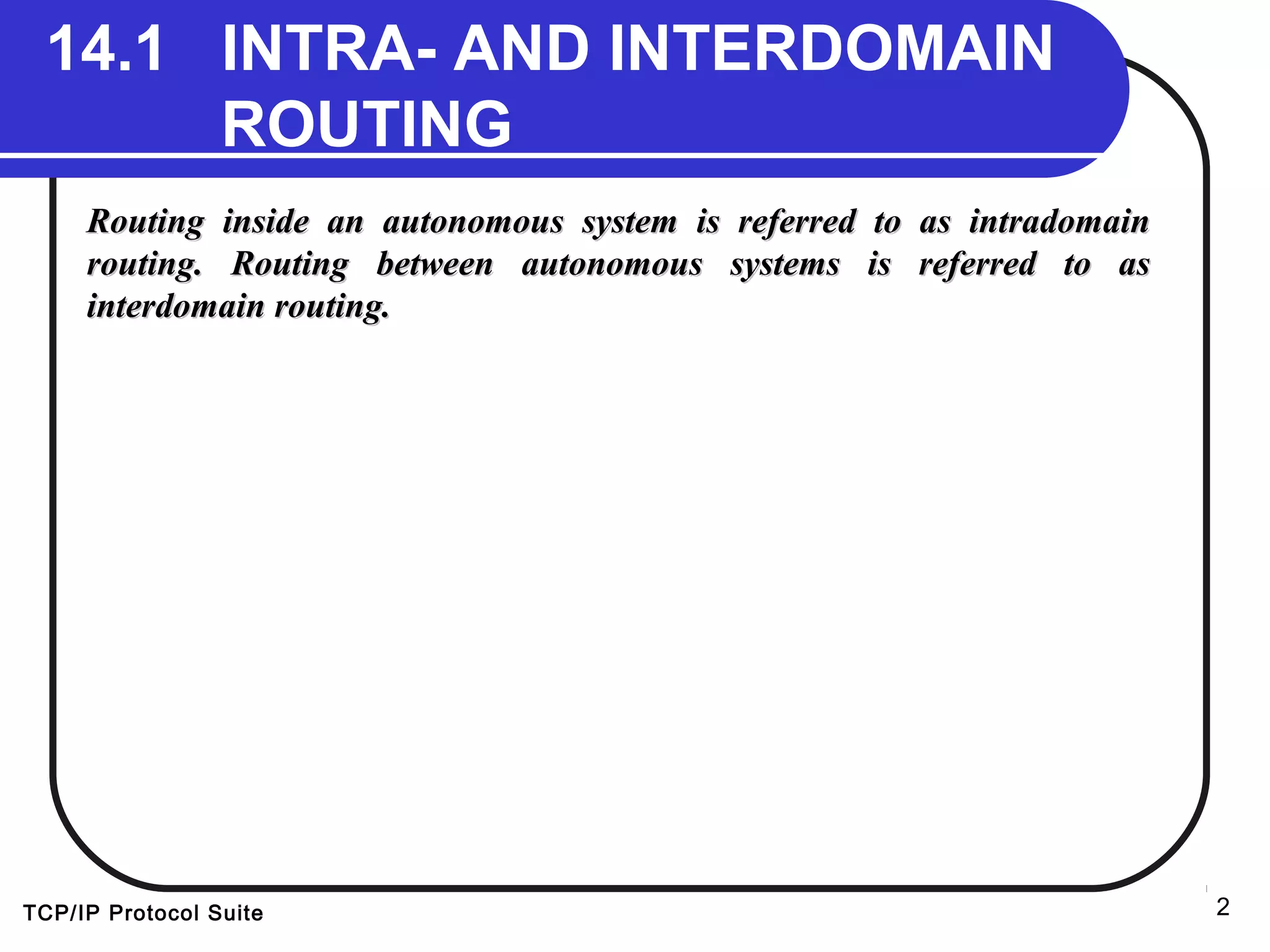
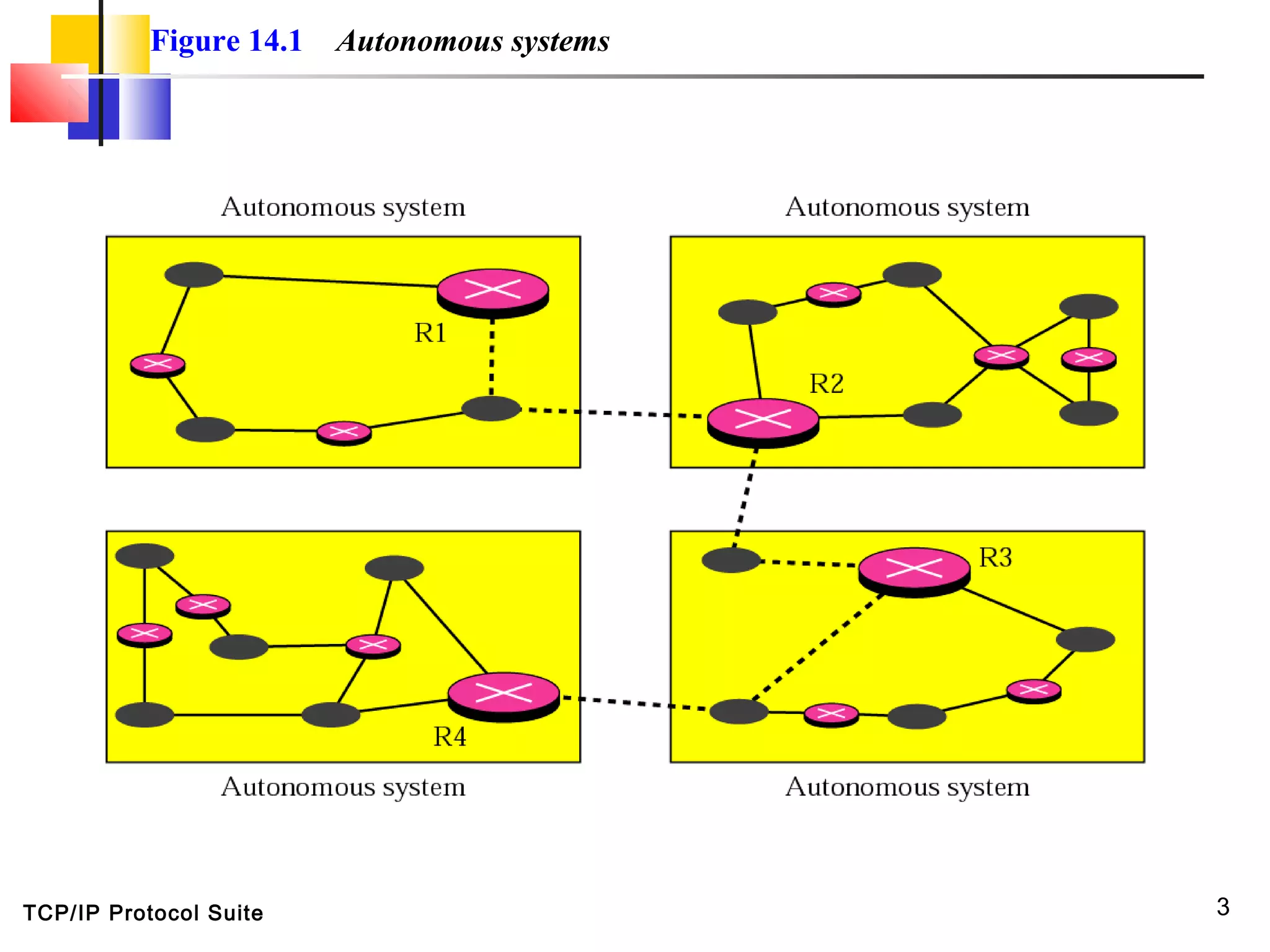
Routing inside an autonomous system is referred to as intradomainRouting inside an autonomous system is referred to as intradomain
routing. Routing between autonomous systems is referred to asrouting. Routing between autonomous systems is referred to as
interdomain routing.interdomain routing.
TCP/IP Protocol Suite 3
Figure 14.1 Autonomous systems
TCP/IP Protocol Suite 4
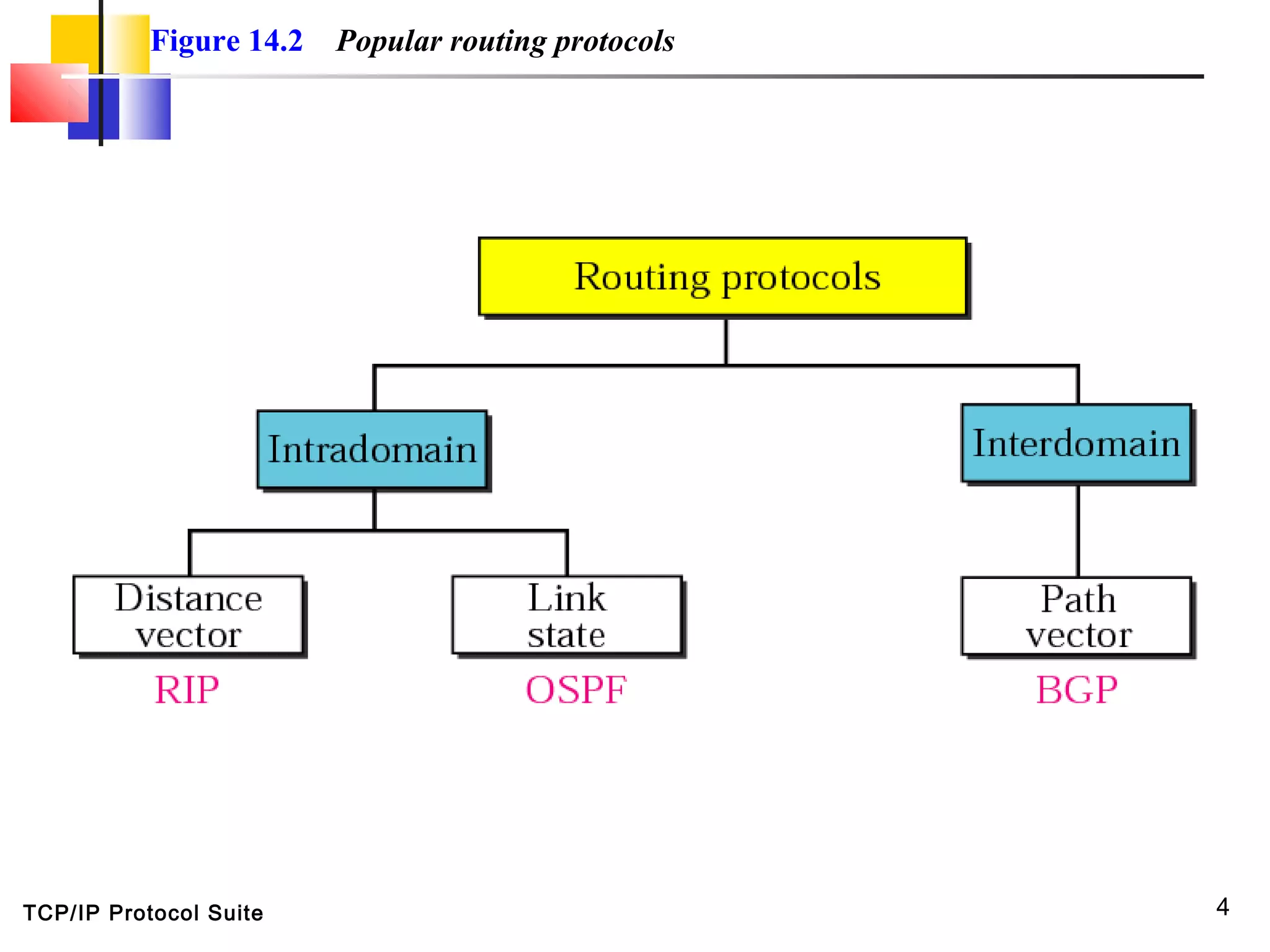
Figure 14.2 Popular routing protocols
TCP/IP Protocol Suite 5
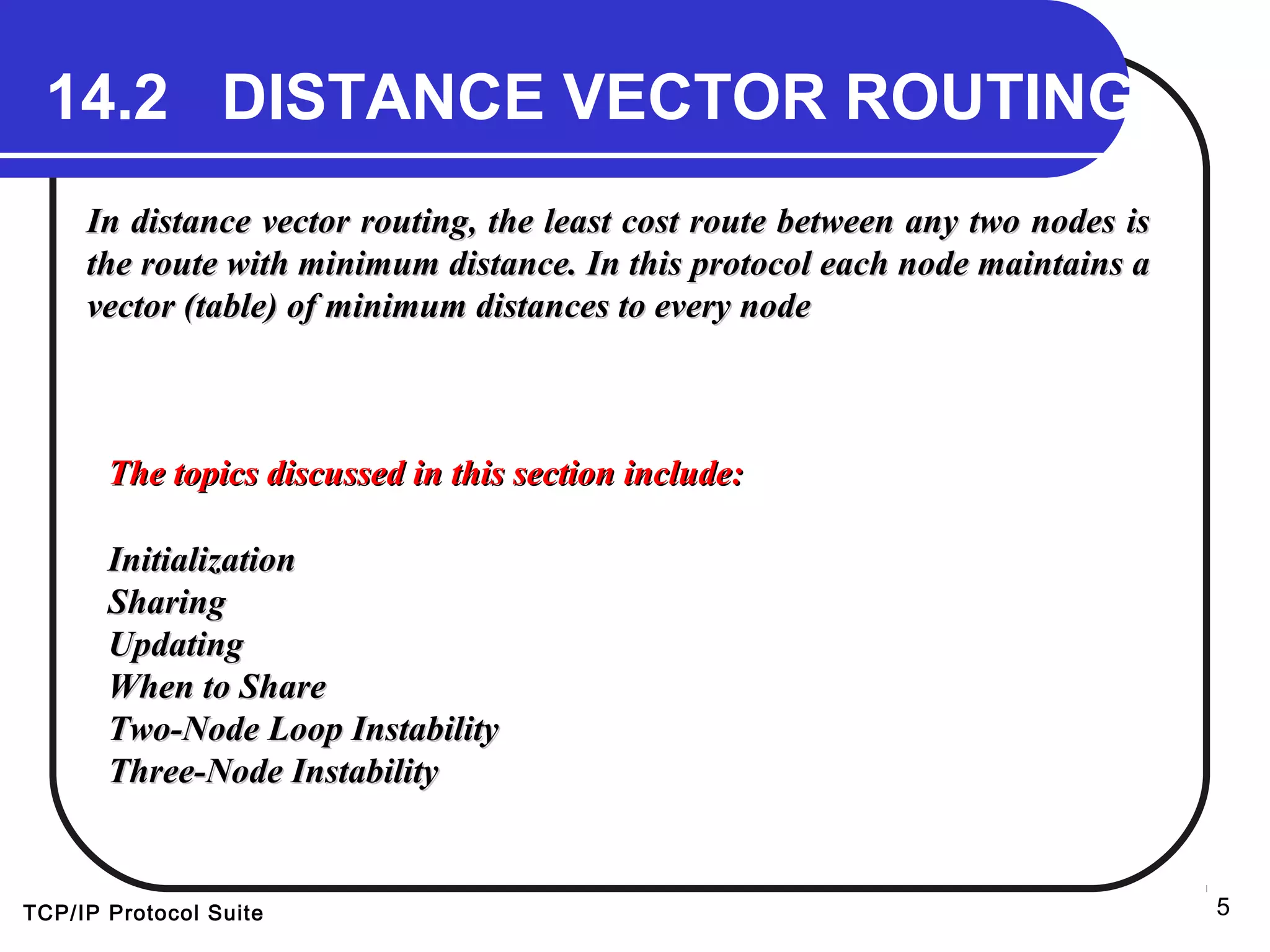
14.2 DISTANCE VECTOR ROUTING
In distance vector routing, the least cost route between any two nodes isIn distance vector routing, the least cost route between any two nodes is
the route with minimum distance. In this protocol each node maintains athe route with minimum distance. In this protocol each node maintains a
vector (table) of minimum distances to every nodevector (table) of minimum distances to every node
The topics discussed in this section include:The topics discussed in this section include:
InitializationInitialization
SharingSharing
UpdatingUpdating
When to ShareWhen to Share
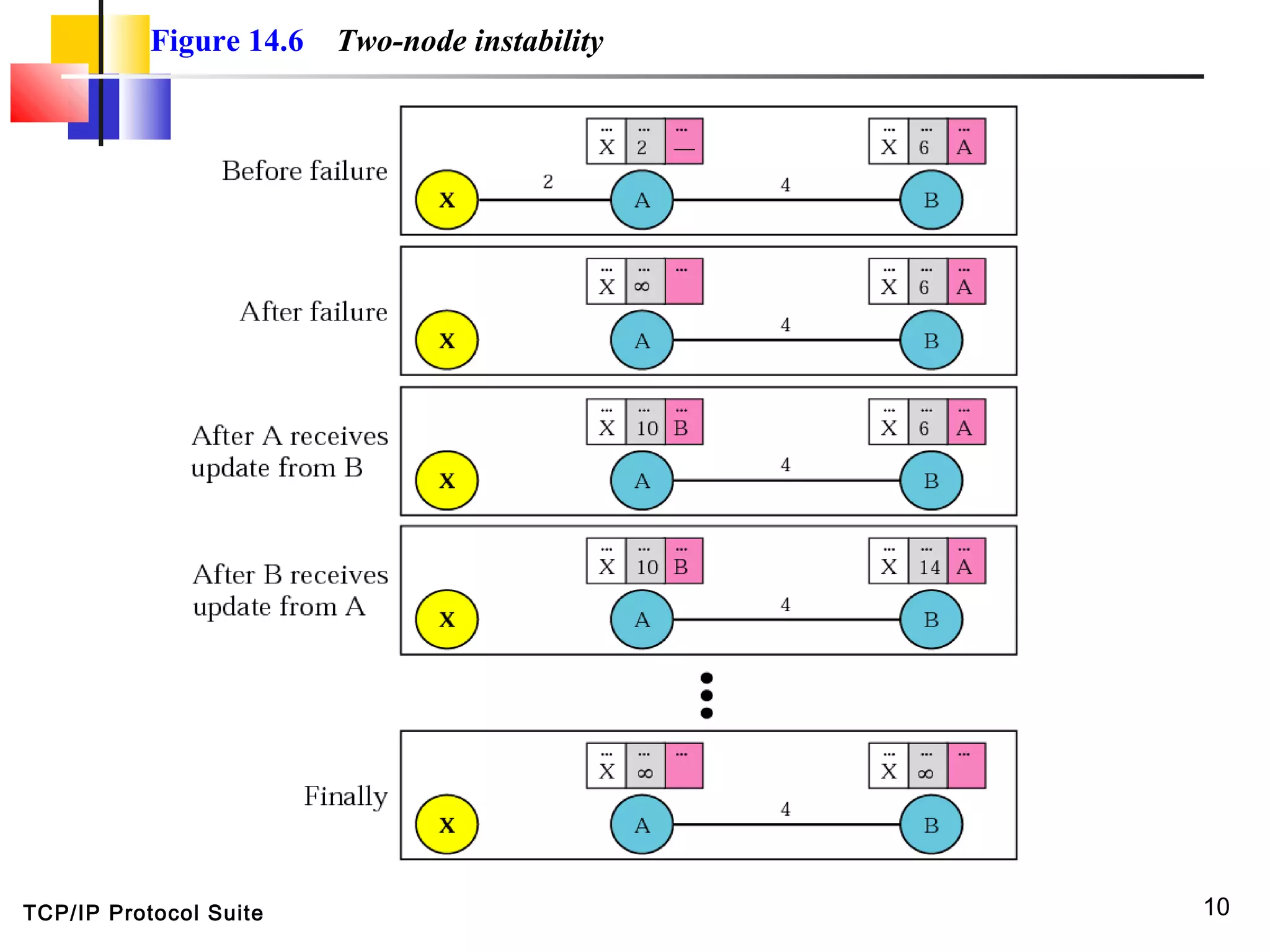
Two-Node Loop InstabilityTwo-Node Loop Instability
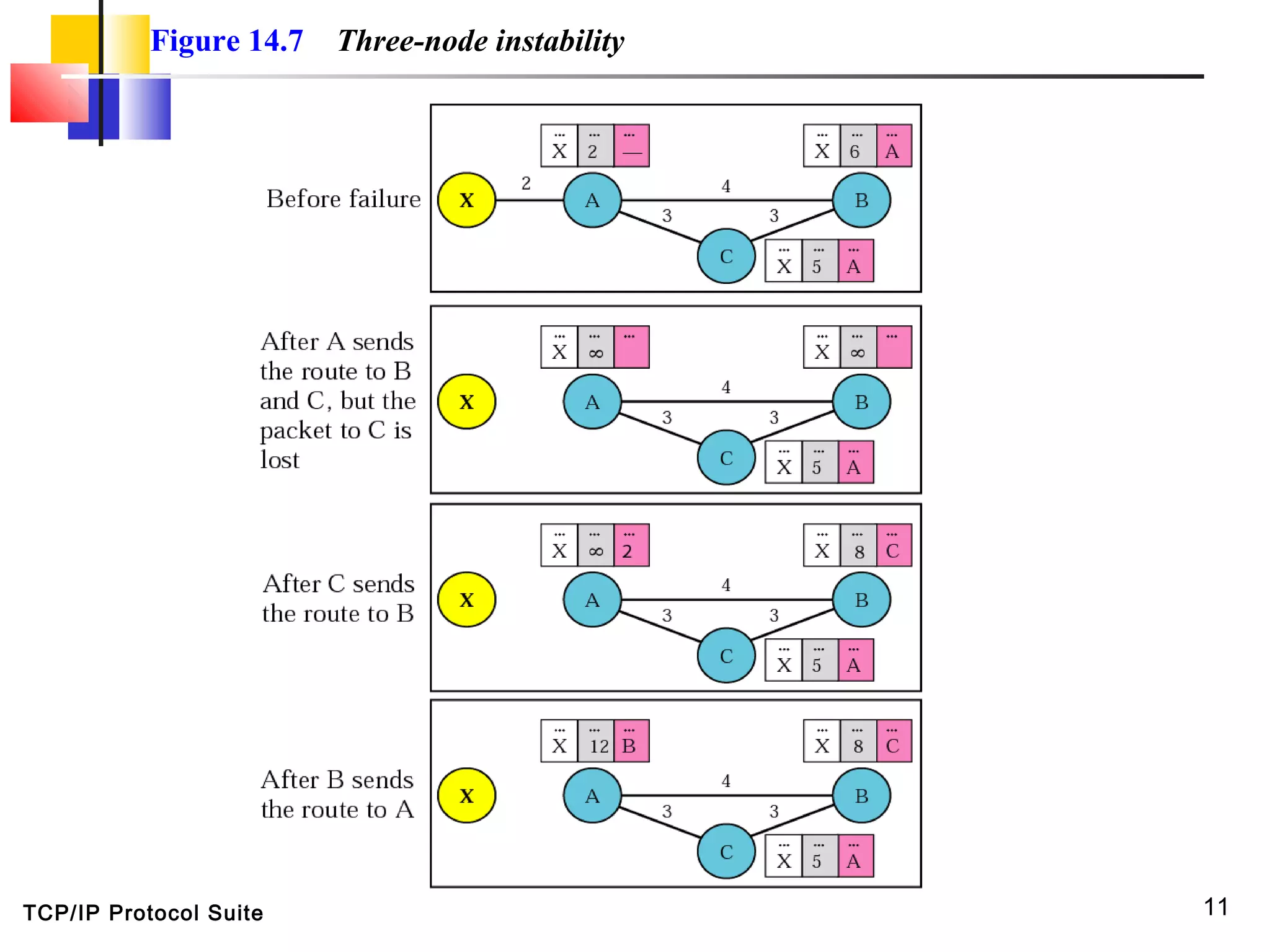
Three-Node InstabilityThree-Node Instability
TCP/IP Protocol Suite 6
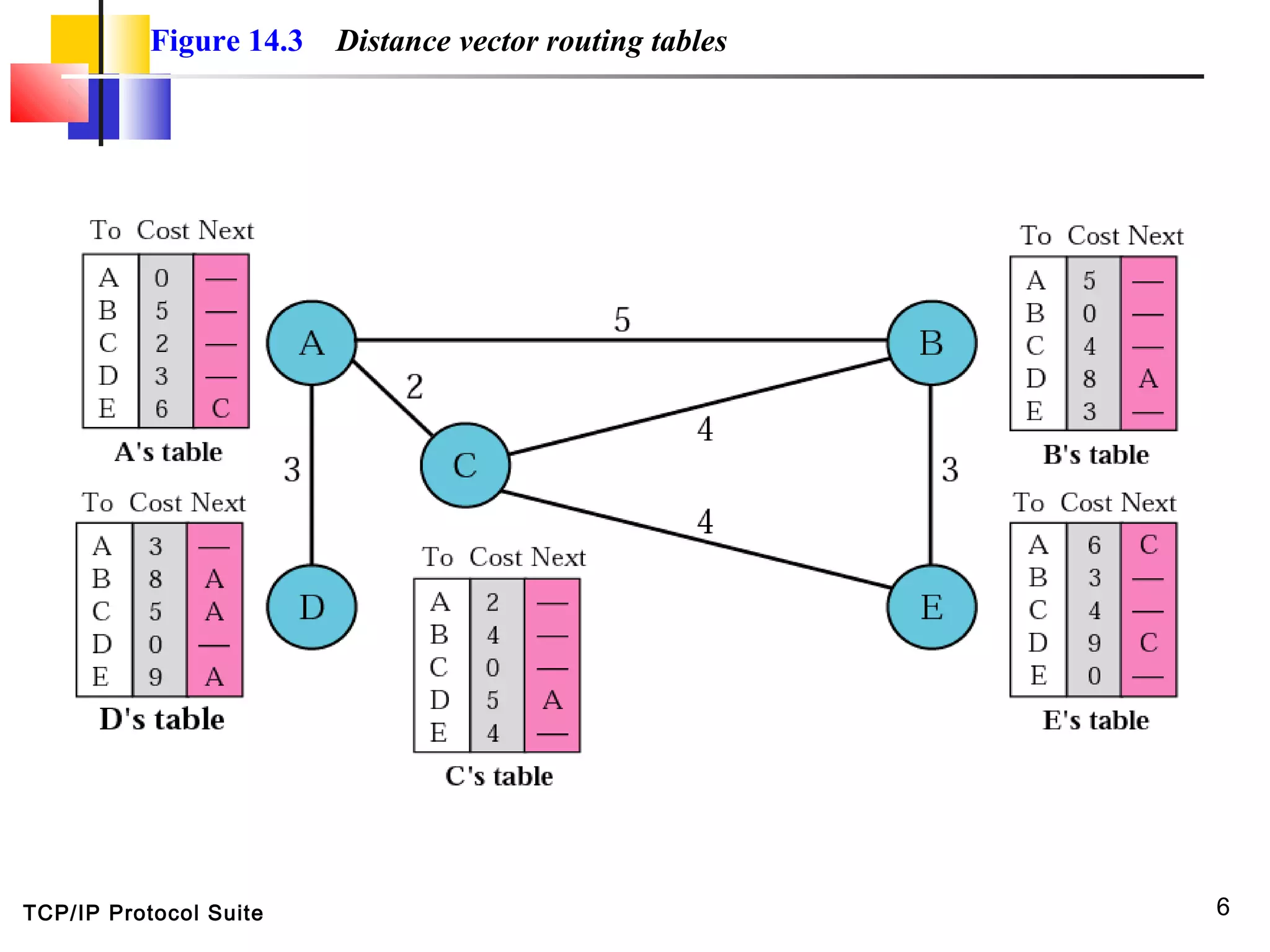
Figure 14.3 Distance vector routing tables
TCP/IP Protocol Suite 7
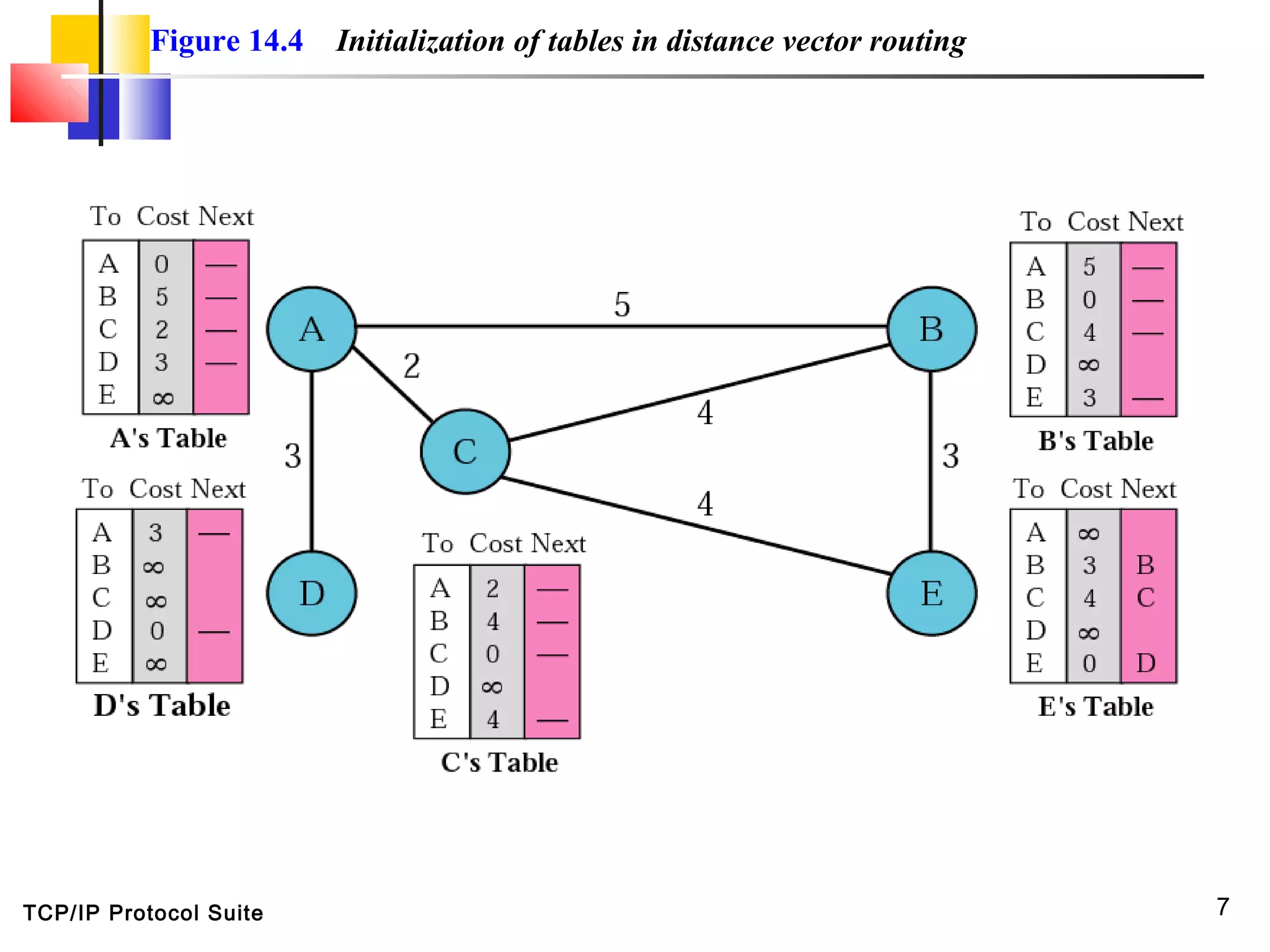
Figure 14.4 Initialization of tables in distance vector routing
TCP/IP Protocol Suite 8
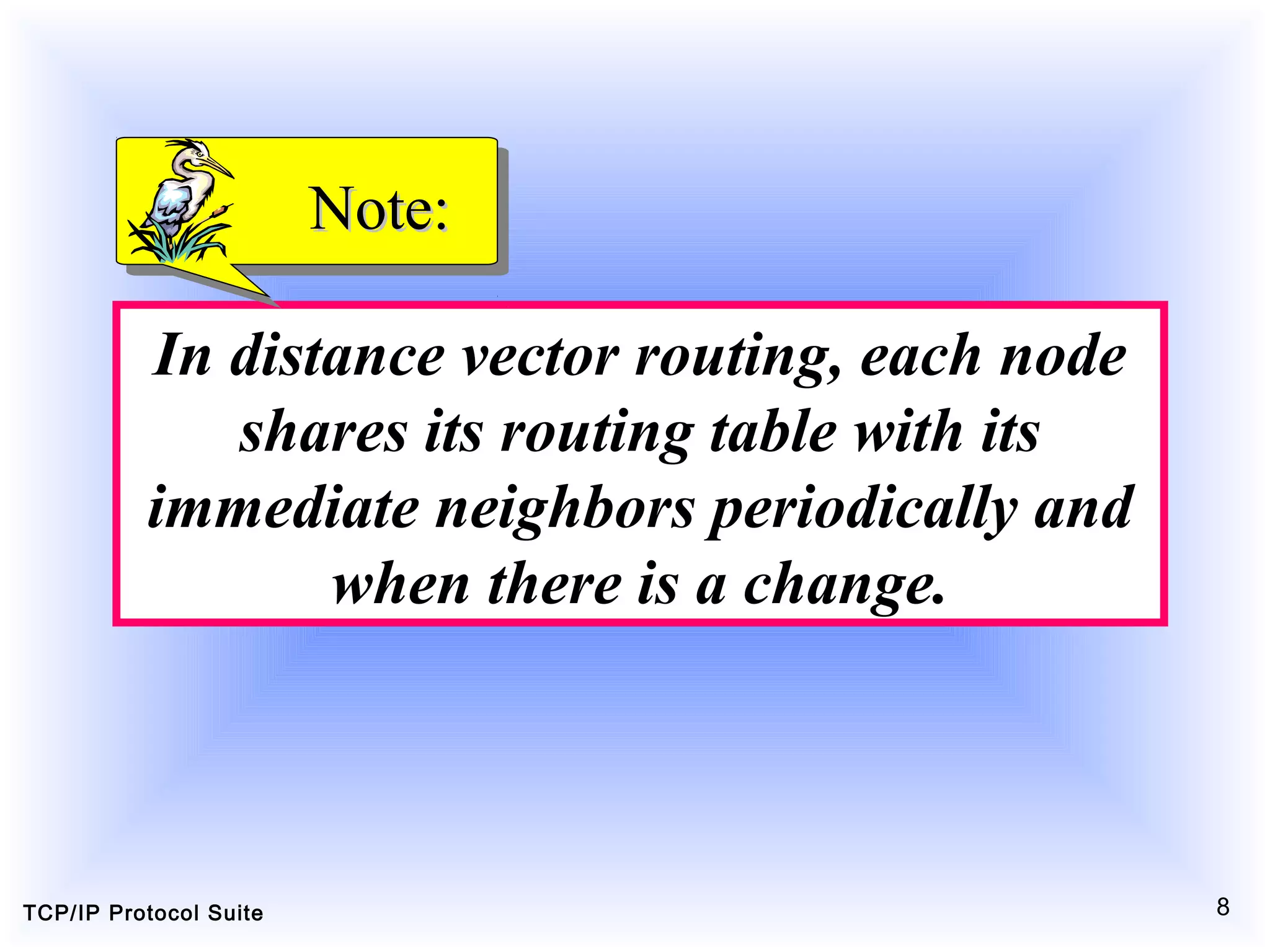
In distance vector routing, each node
shares its routing table with its
immediate neighbors periodically and
when there is a change.
Note:Note:
TCP/IP Protocol Suite 9
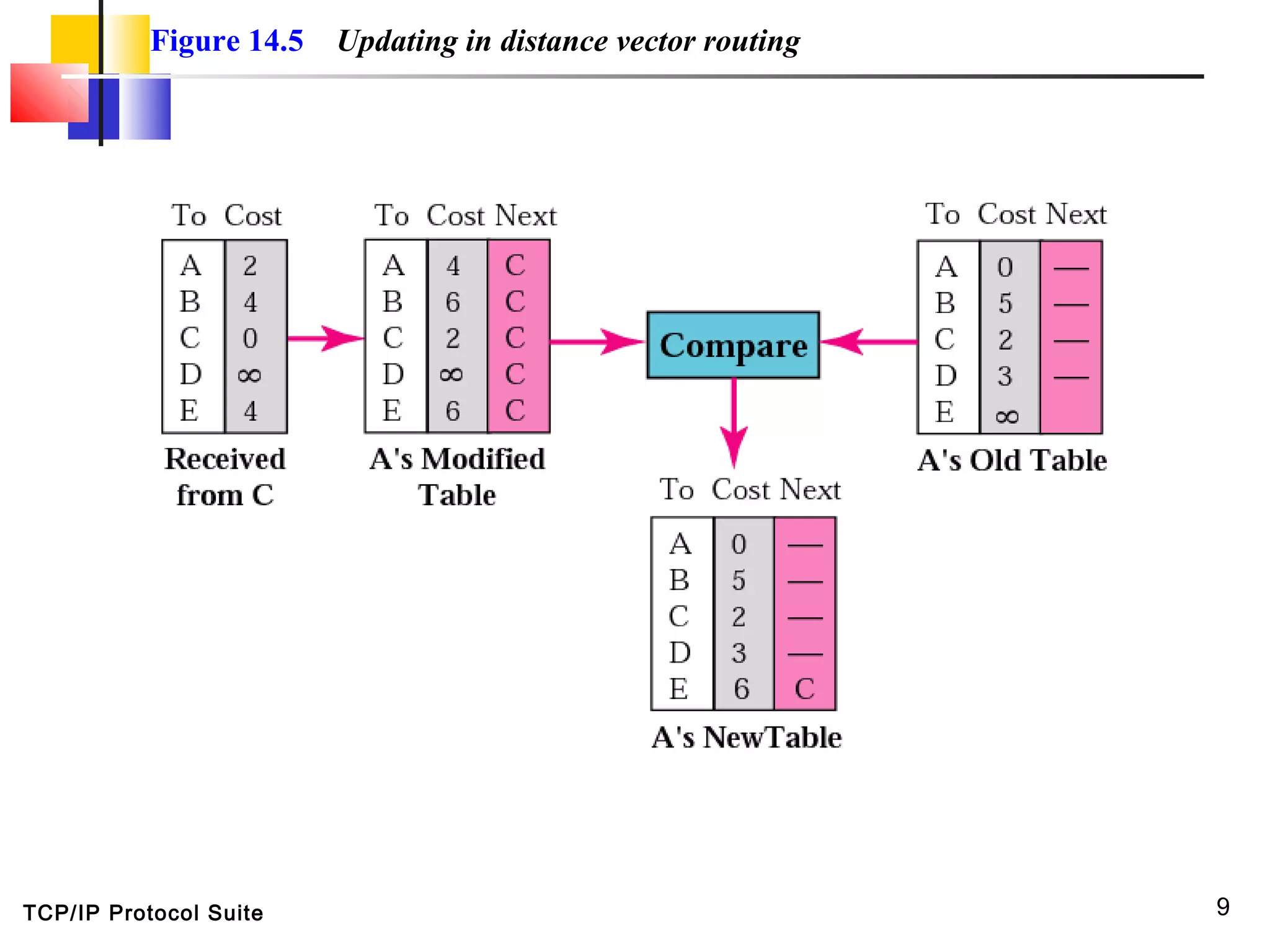
Figure 14.5 Updating in distance vector routing
TCP/IP Protocol Suite 10
Figure 14.6 Two-node instability
TCP/IP Protocol Suite 11
Figure 14.7 Three-node instability
TCP/IP Protocol Suite 12
14.3 RIP
The Routing Information Protocol (RIP) is an intradomain routingThe Routing Information Protocol (RIP) is an intradomain routing
protocol used inside an autonomous system. It is a very simple protocolprotocol used inside an autonomous system. It is a very simple protocol
based on distance vector routing.based on distance vector routing.
The topics discussed in this section include:The topics discussed in this section include:
RIP Message FormatRIP Message Format
Requests and ResponsesRequests and Responses
Timers in RIPTimers in RIP
RIP Version 2RIP Version 2
EncapsulationEncapsulation
TCP/IP Protocol Suite 13
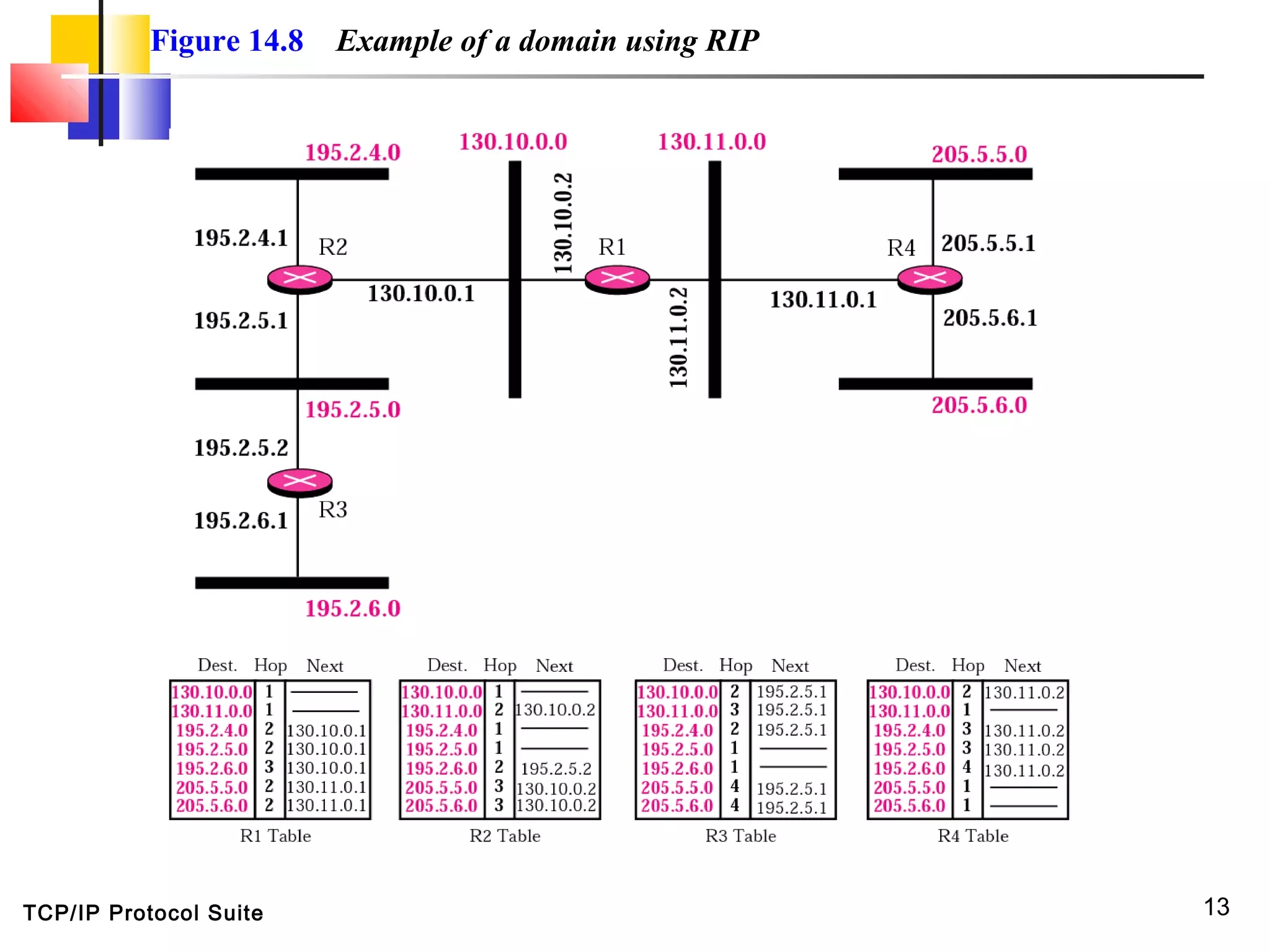
Figure 14.8 Example of a domain using RIP
TCP/IP Protocol Suite 14
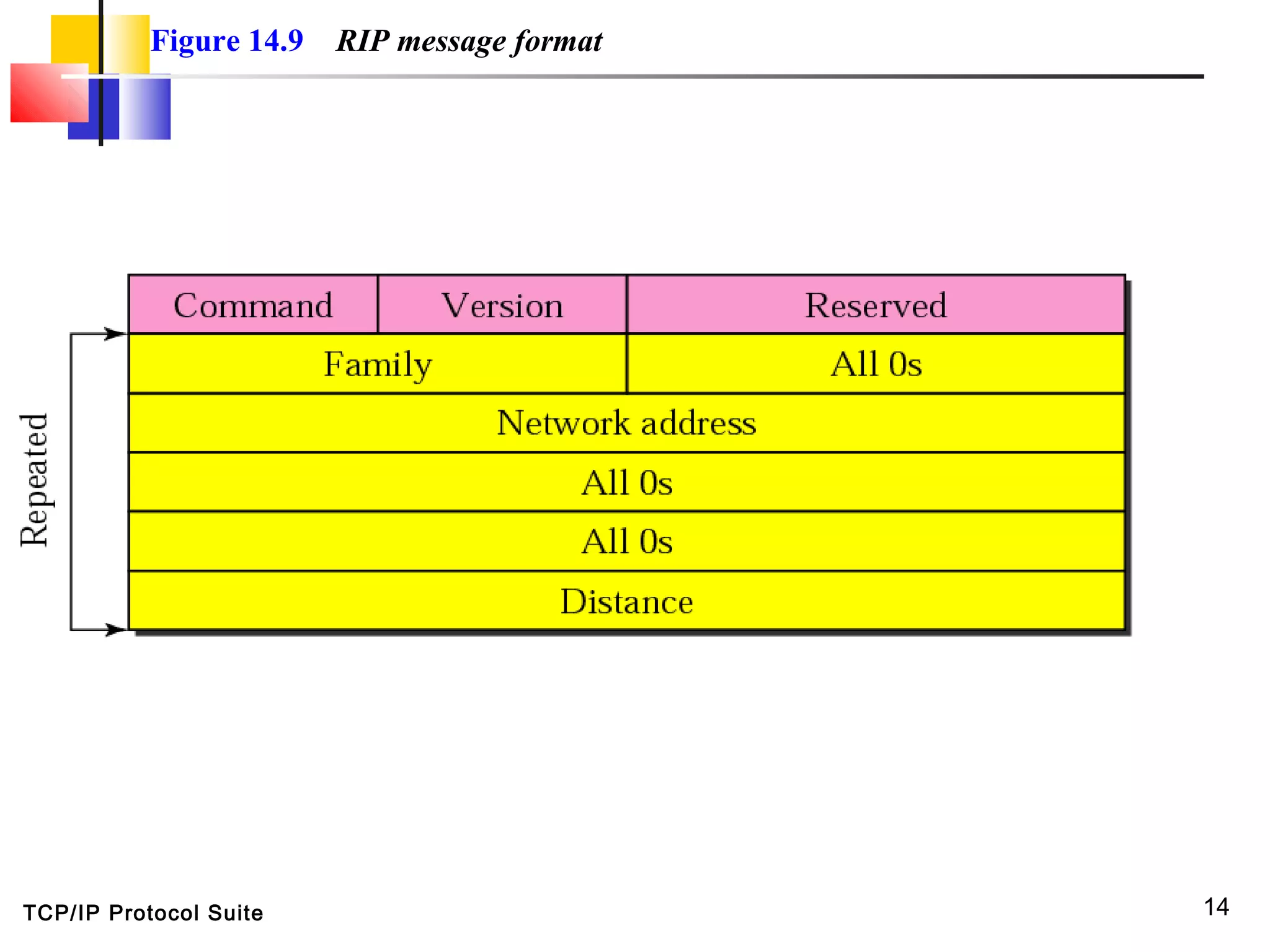
Figure 14.9 RIP message format
TCP/IP Protocol Suite 15
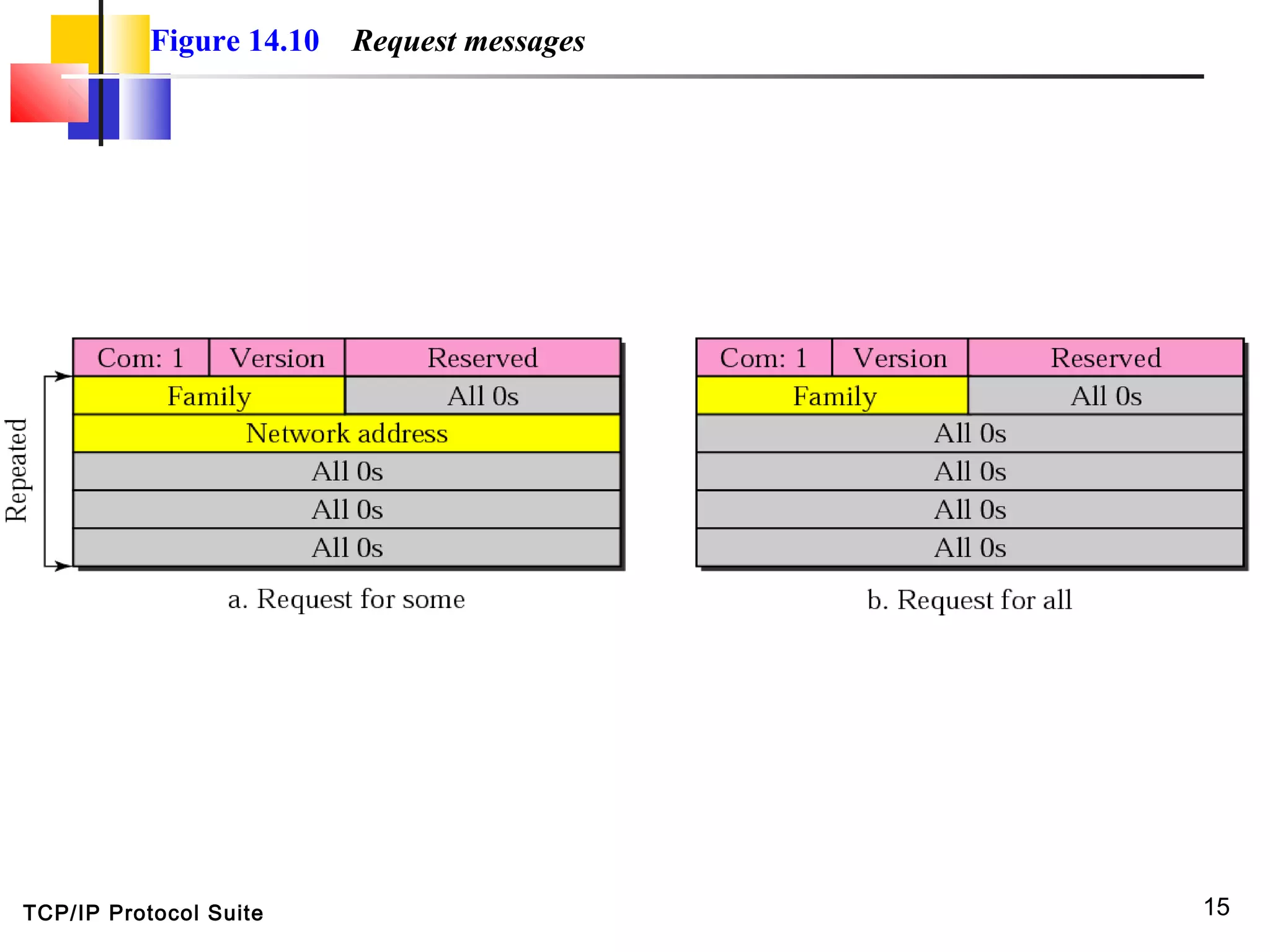
Figure 14.10 Request messages
TCP/IP Protocol Suite 16
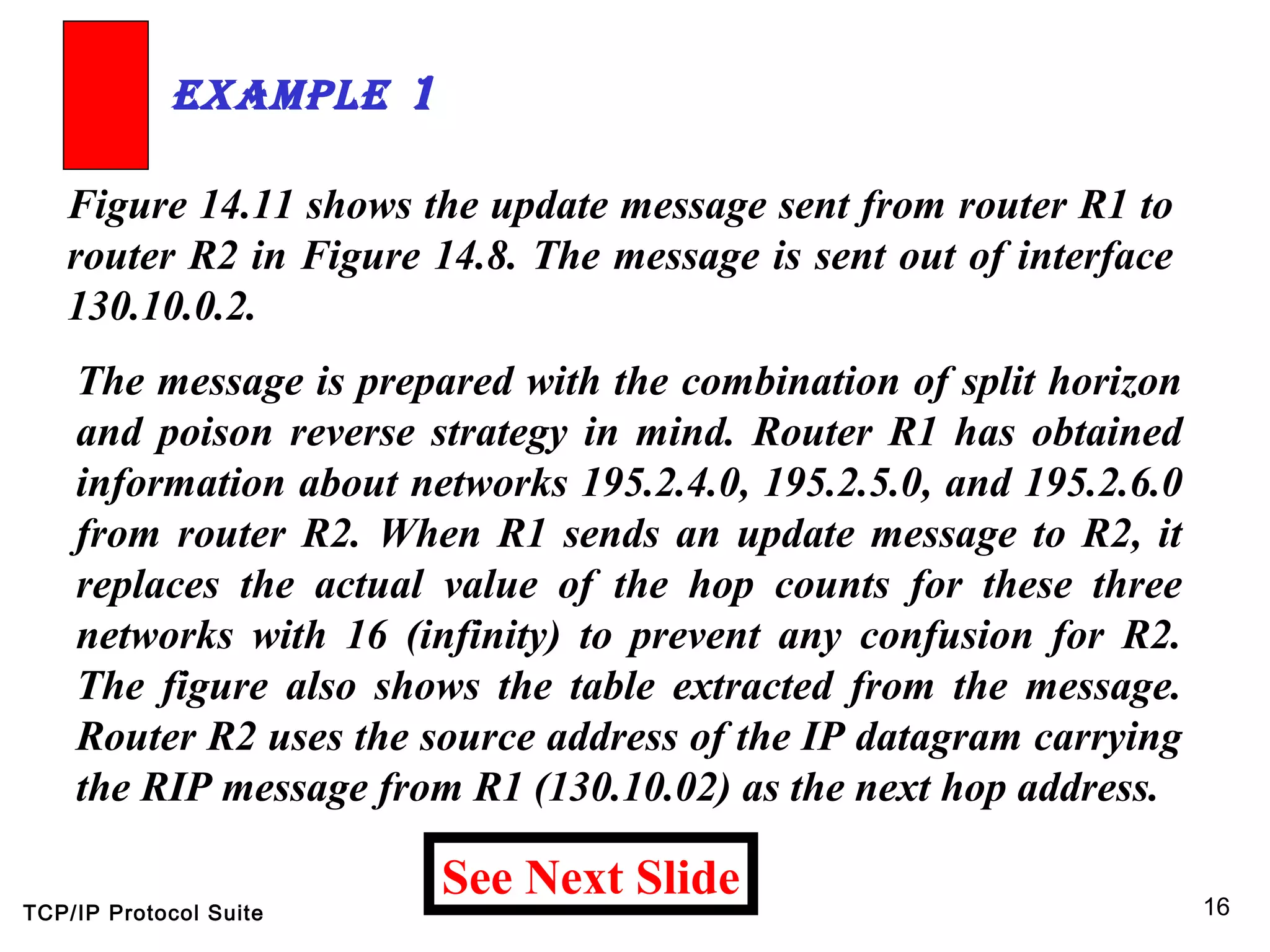
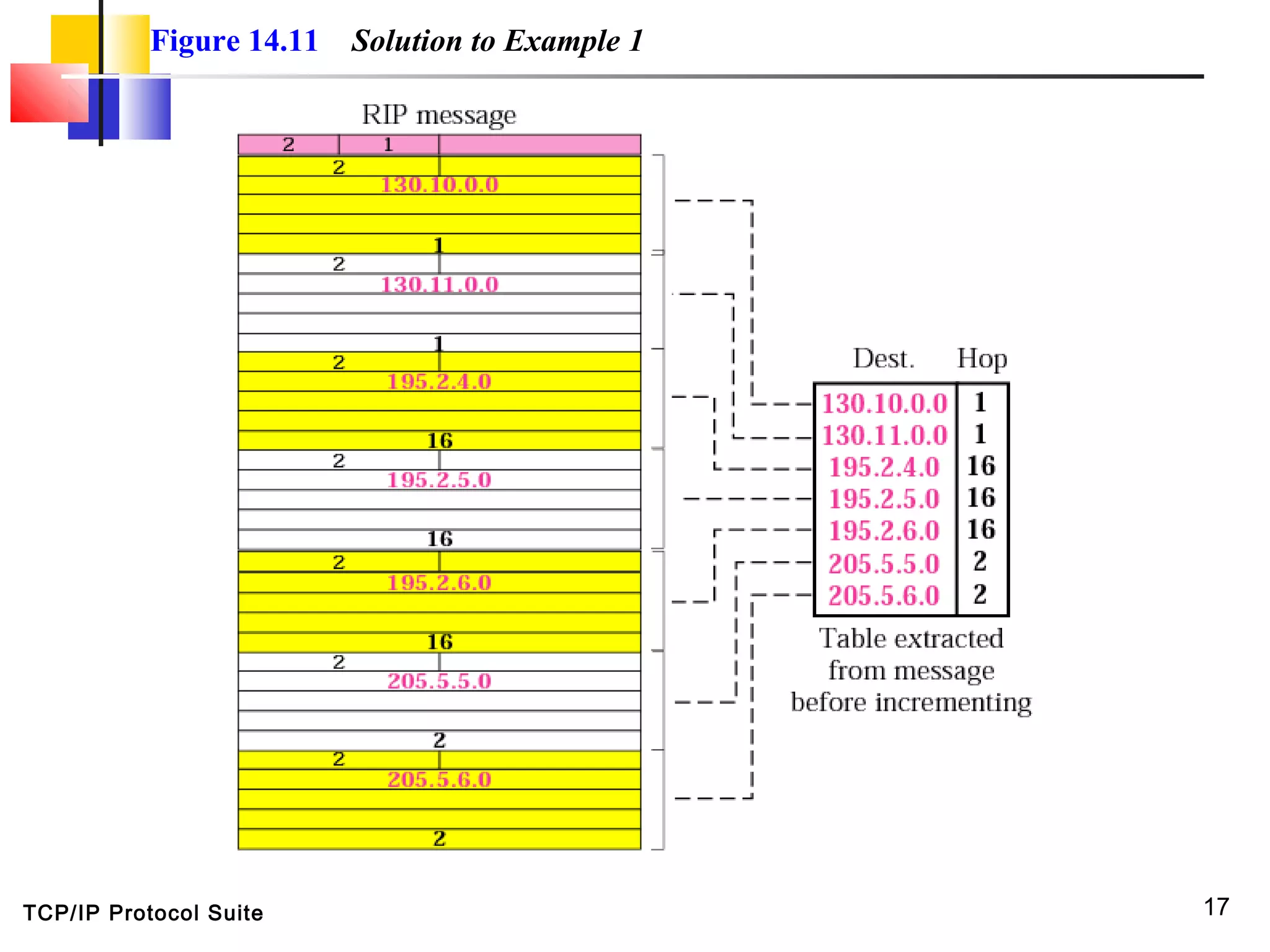
Figure 14.11 shows the update message sent from router R1 to
router R2 in Figure 14.8. The message is sent out of interface
130.10.0.2.
ExamplE 1
See Next Slide
The message is prepared with the combination of split horizon
and poison reverse strategy in mind. Router R1 has obtained
information about networks 195.2.4.0, 195.2.5.0, and 195.2.6.0
from router R2. When R1 sends an update message to R2, it
replaces the actual value of the hop counts for these three
networks with 16 (infinity) to prevent any confusion for R2.
The figure also shows the table extracted from the message.
Router R2 uses the source address of the IP datagram carrying
the RIP message from R1 (130.10.02) as the next hop address.
TCP/IP Protocol Suite 17
Figure 14.11 Solution to Example 1
TCP/IP Protocol Suite 18
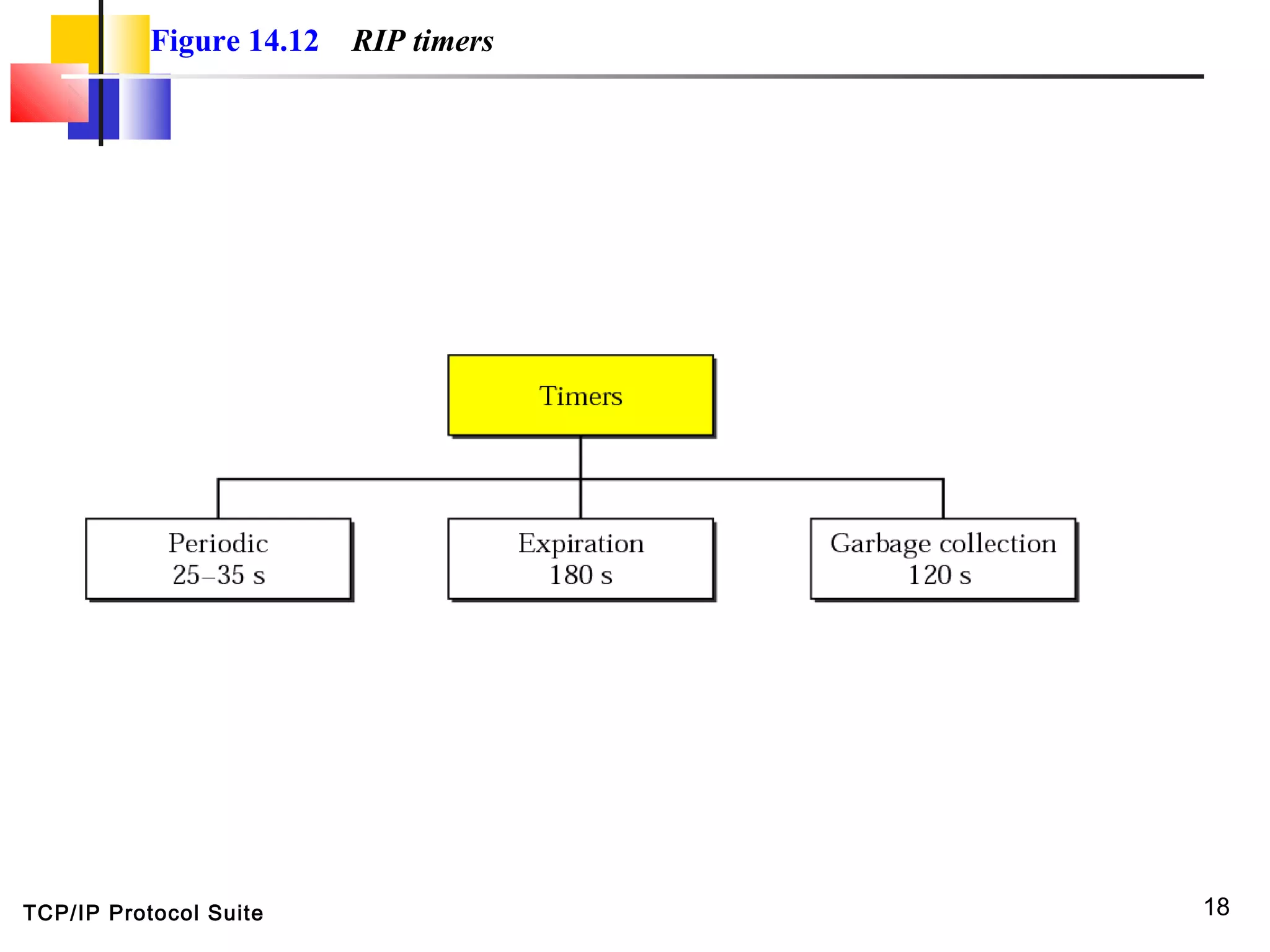
Figure 14.12 RIP timers
TCP/IP Protocol Suite 19
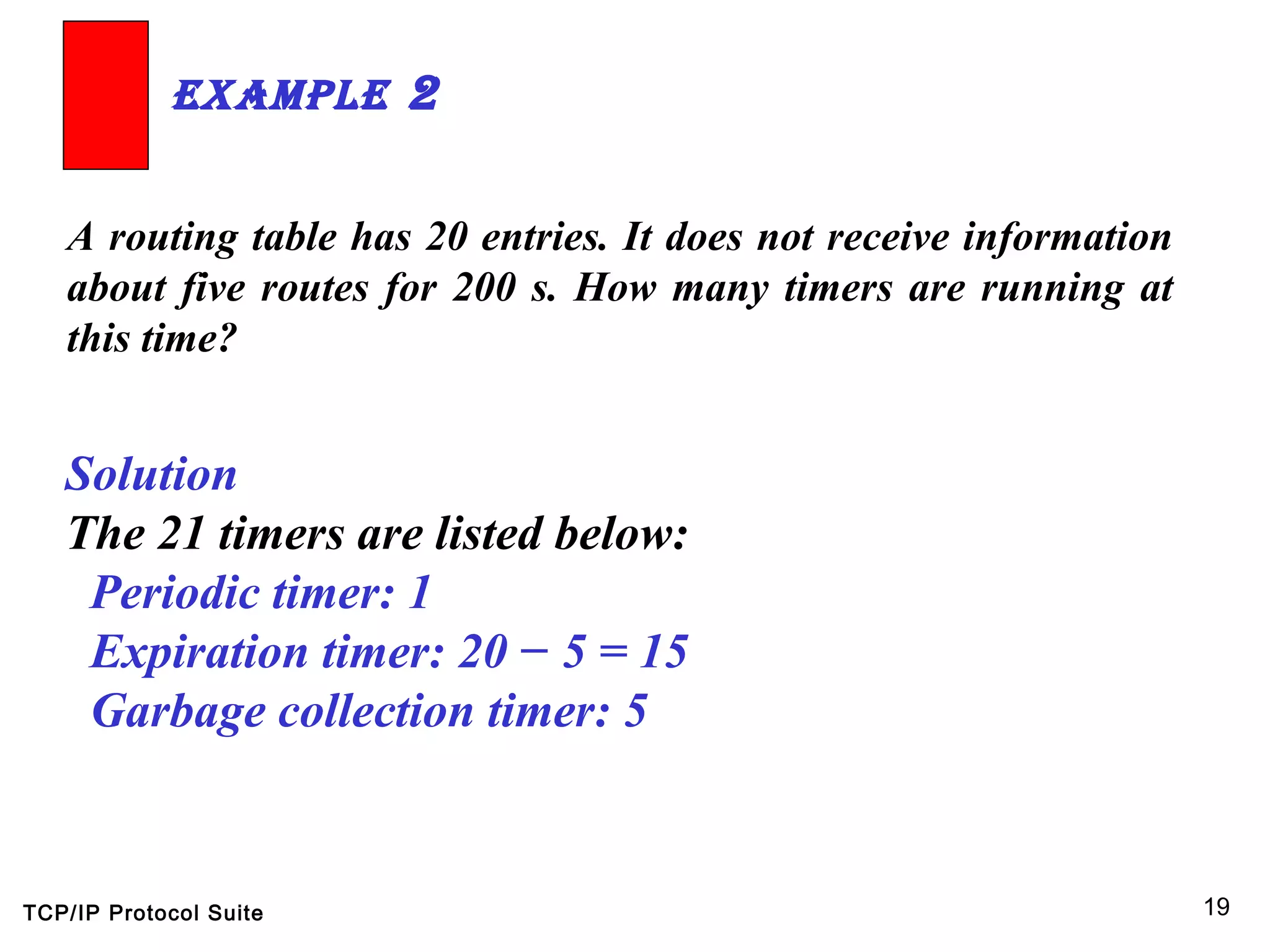
A routing table has 20 entries. It does not receive information
about five routes for 200 s. How many timers are running at
this time?
ExamplE 2
Solution
The 21 timers are listed below:
Periodic timer: 1
Expiration timer: 20 − 5 = 15
Garbage collection timer: 5
TCP/IP Protocol Suite 20
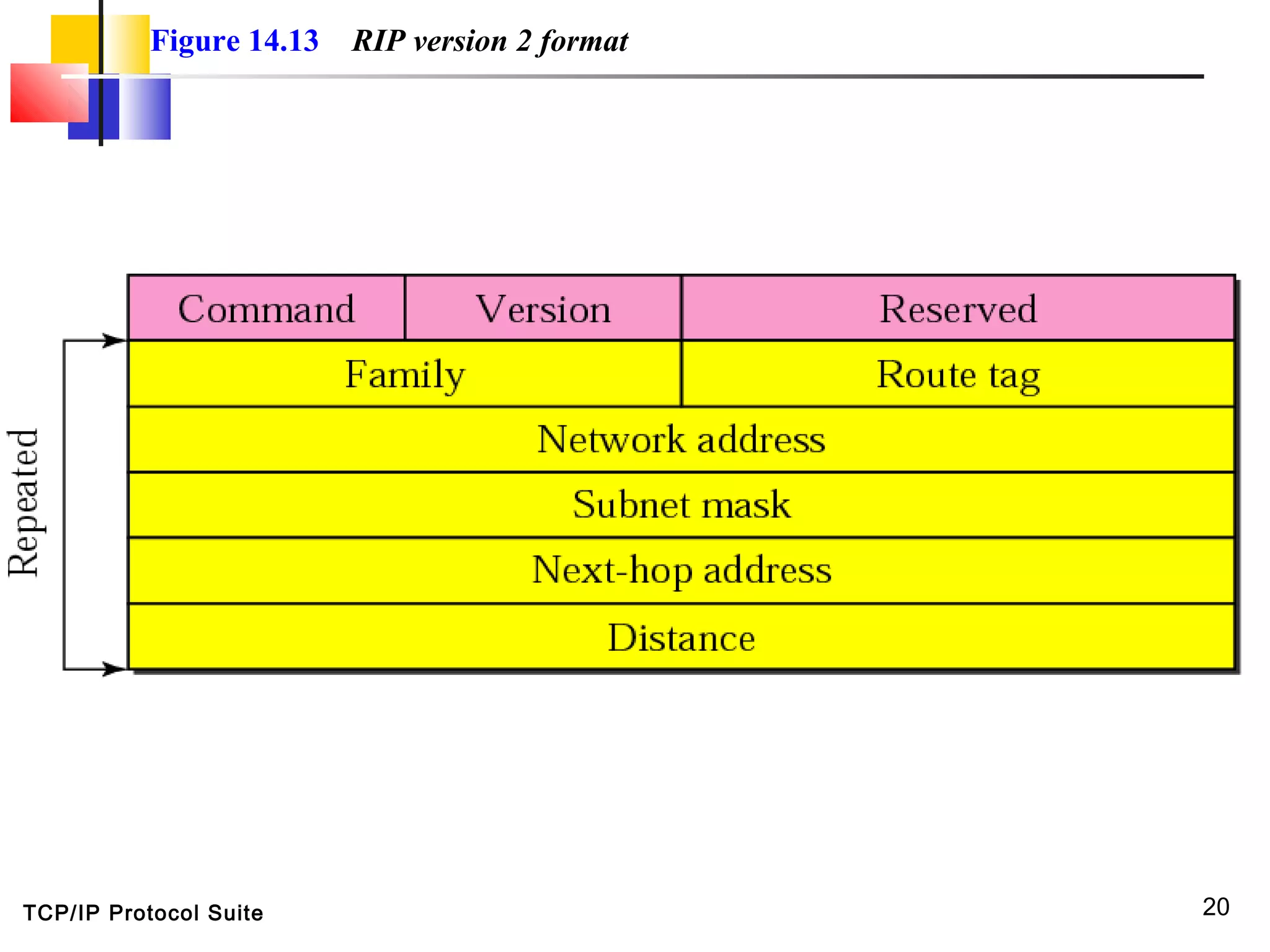
Figure 14.13 RIP version 2 format
TCP/IP Protocol Suite 21
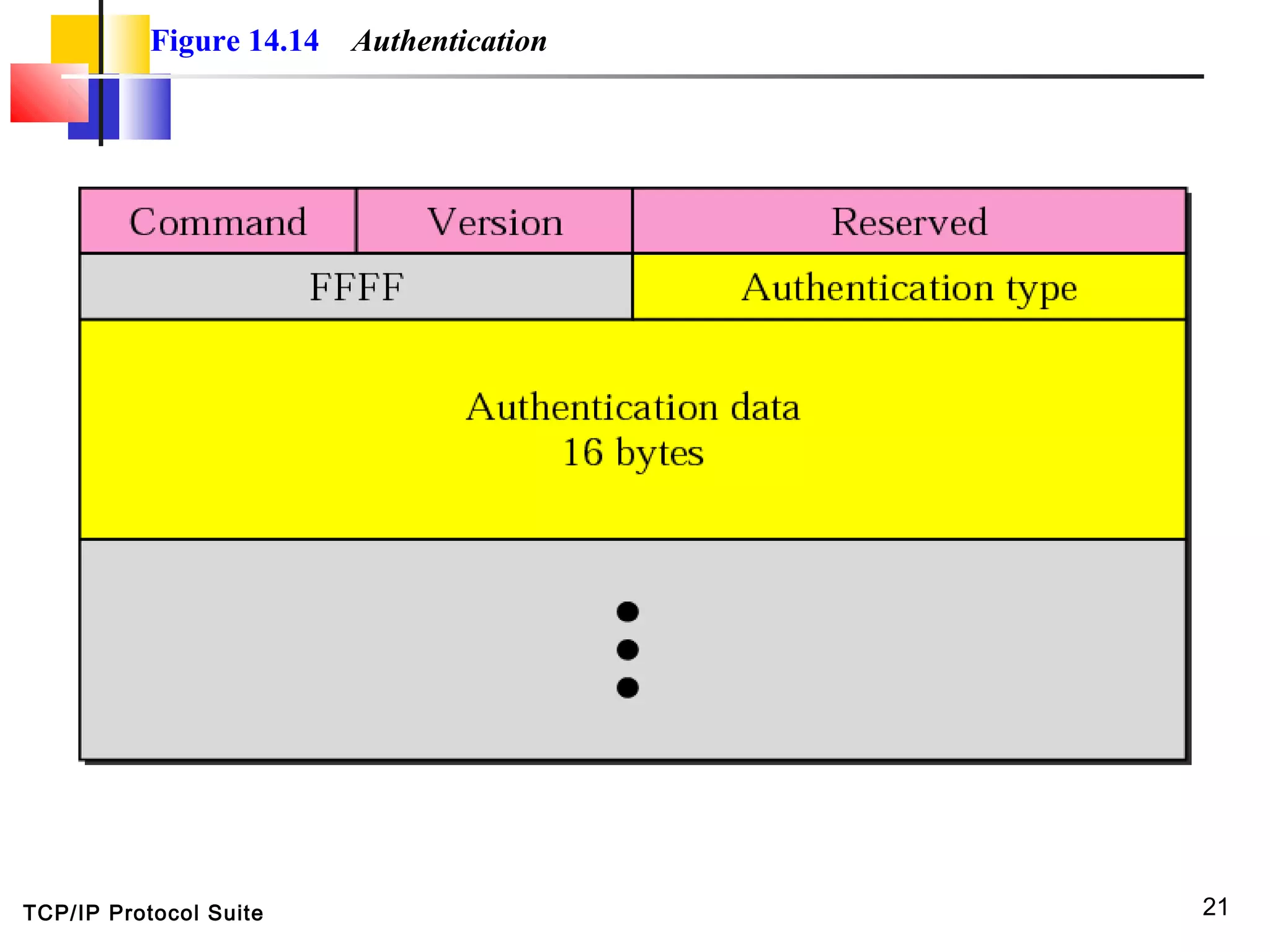
Figure 14.14 Authentication
TCP/IP Protocol Suite 22
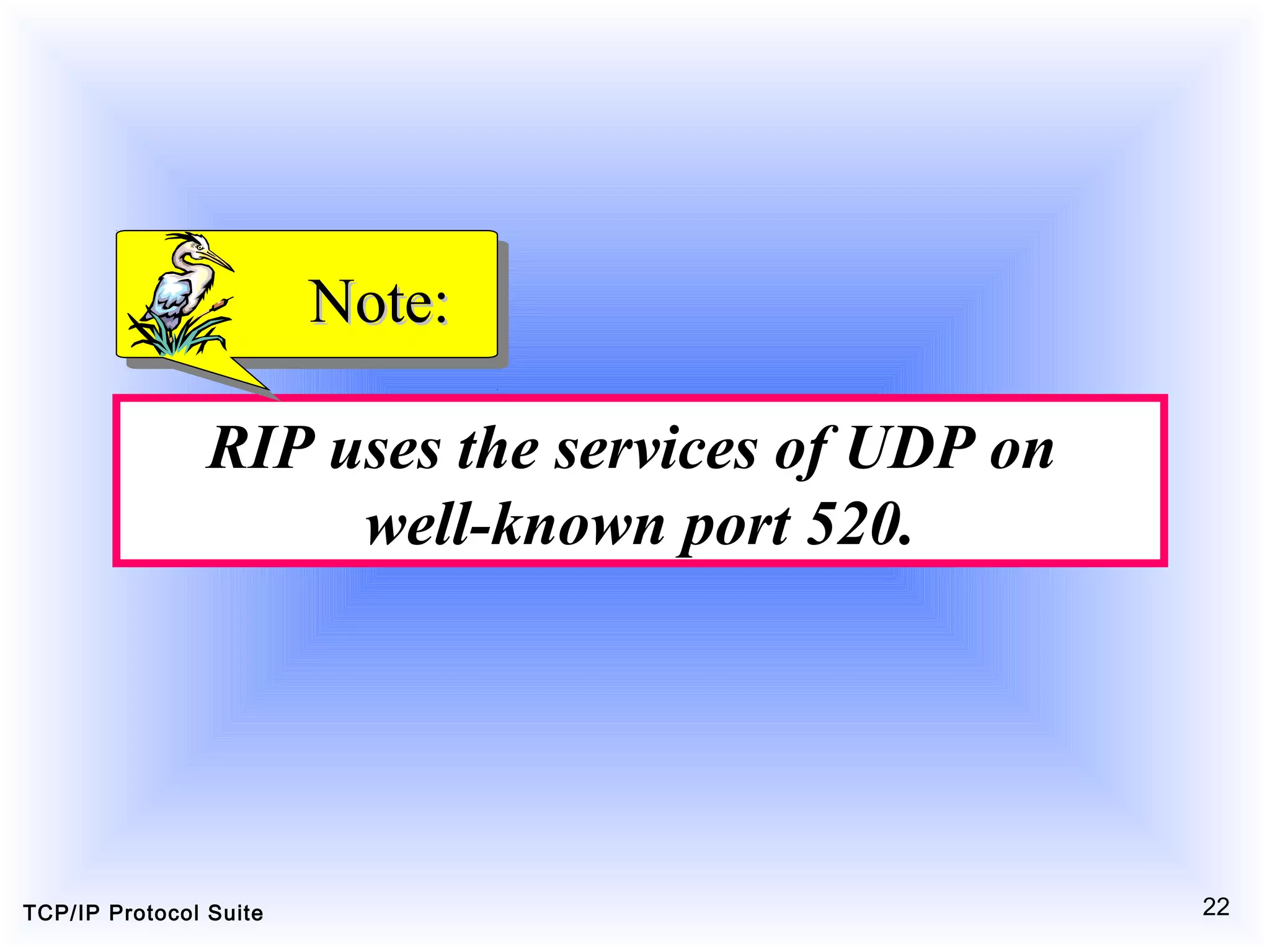
RIP uses the services of UDP on
well-known port 520.
Note:Note:
TCP/IP Protocol Suite 23
14.4 LINK STATE ROUTING
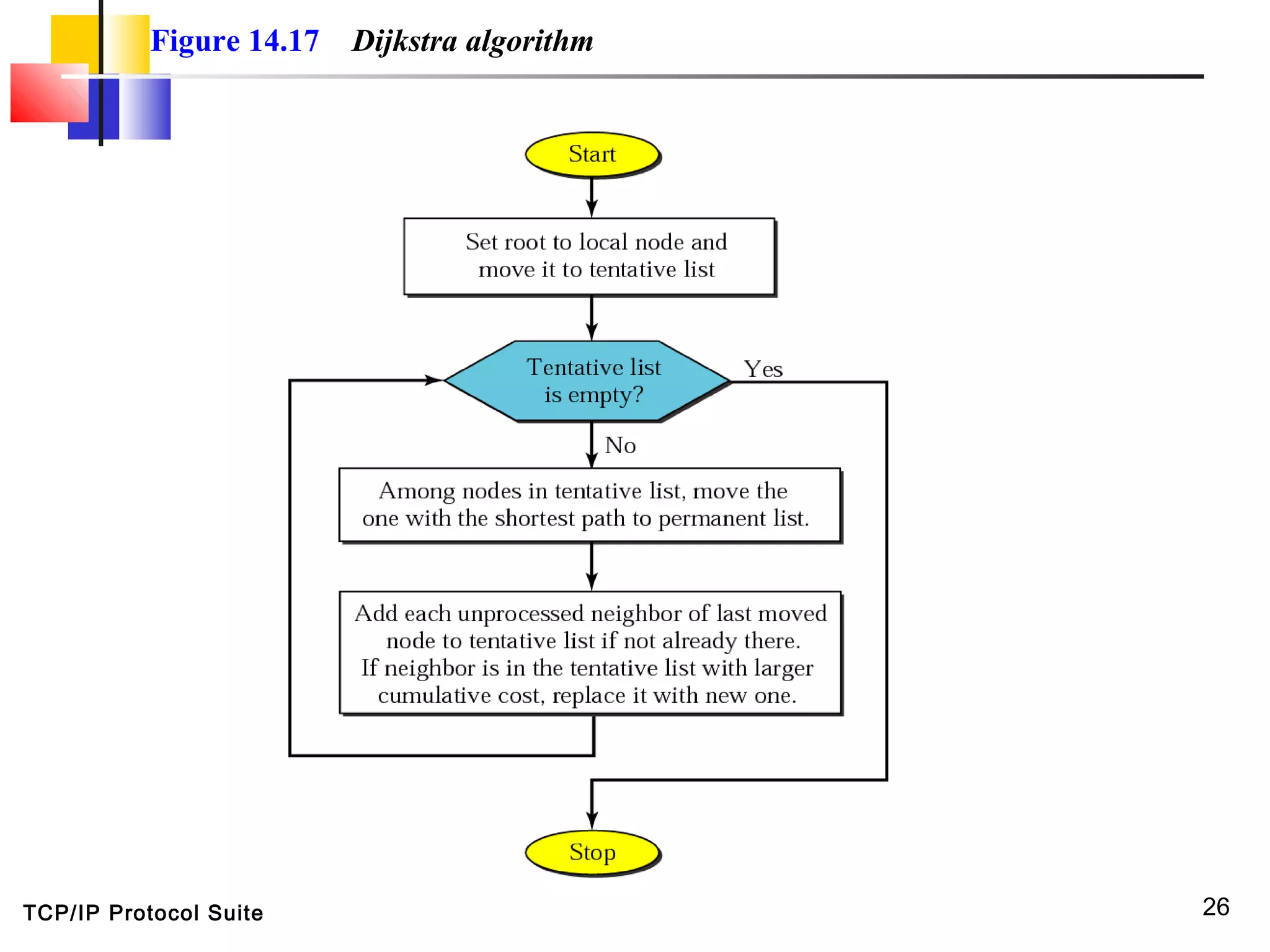
In link state routing, if each node in the domain has the entire topologyIn link state routing, if each node in the domain has the entire topology
of the domain, the node can use Dijkstra’s algorithm to build a routingof the domain, the node can use Dijkstra’s algorithm to build a routing
table.table.
The topics discussed in this section include:The topics discussed in this section include:
Building Routing TablesBuilding Routing Tables
TCP/IP Protocol Suite 24
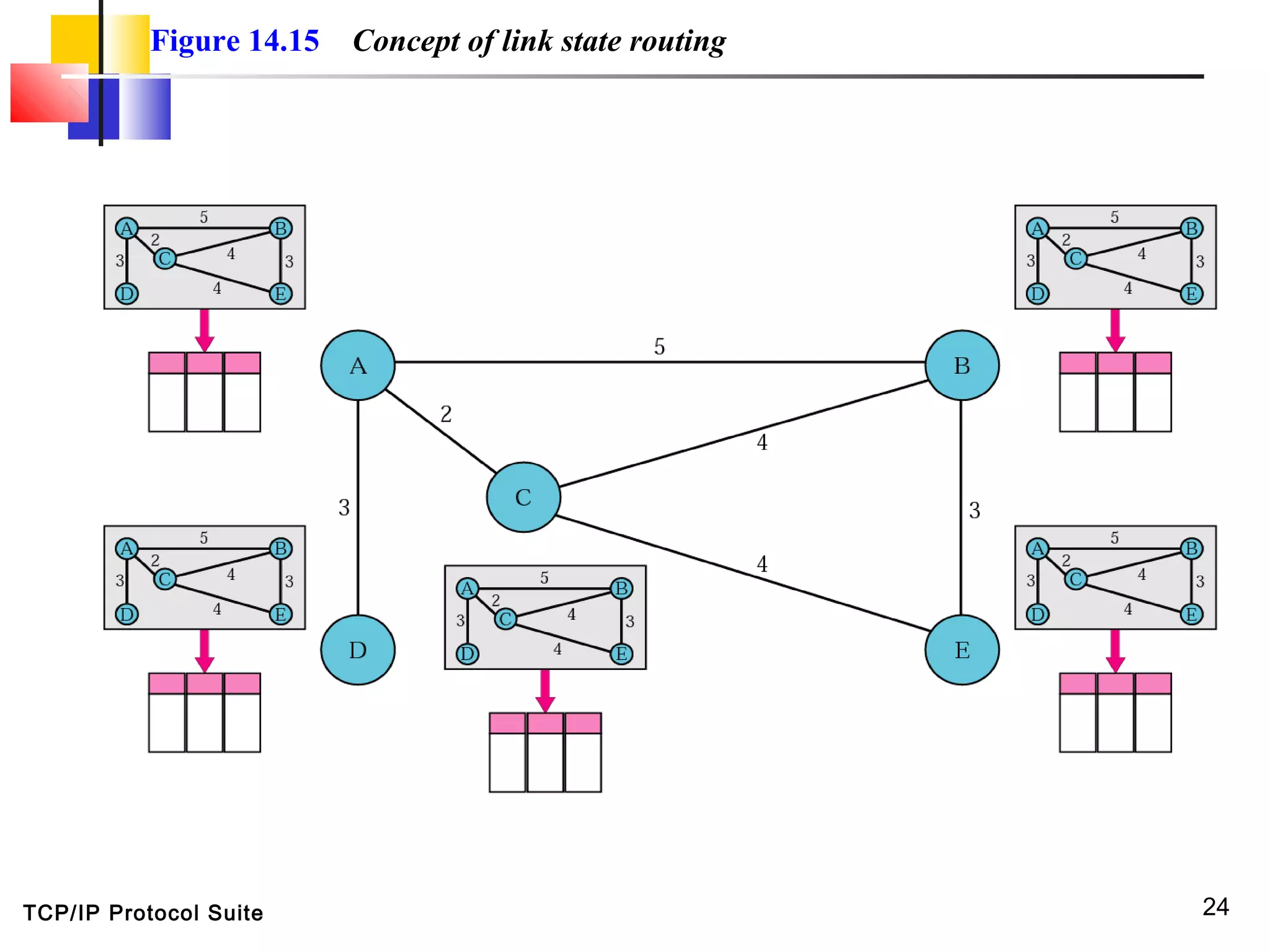
Figure 14.15 Concept of link state routing
TCP/IP Protocol Suite 25
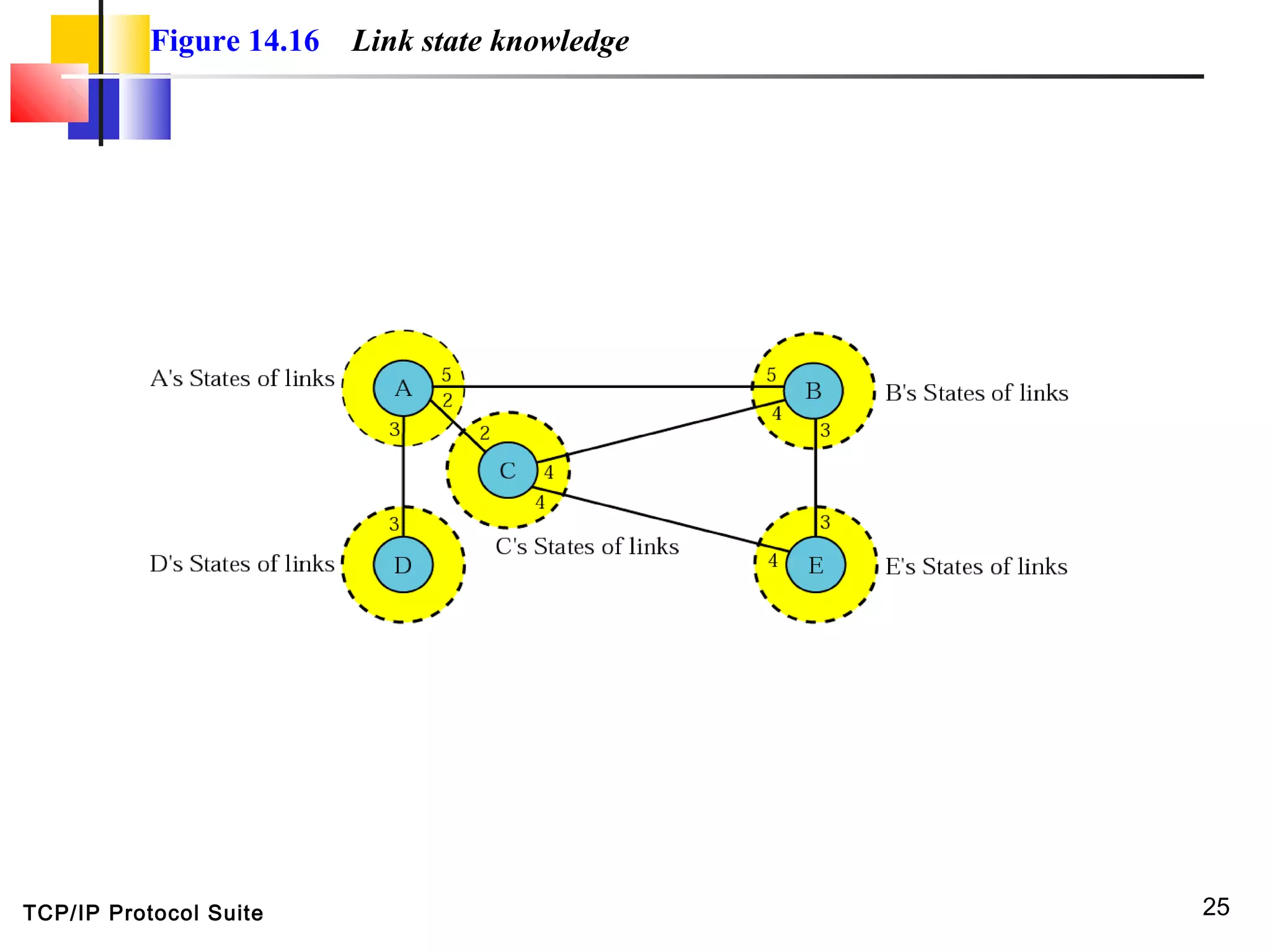
Figure 14.16 Link state knowledge
TCP/IP Protocol Suite 26
Figure 14.17 Dijkstra algorithm
TCP/IP Protocol Suite 27
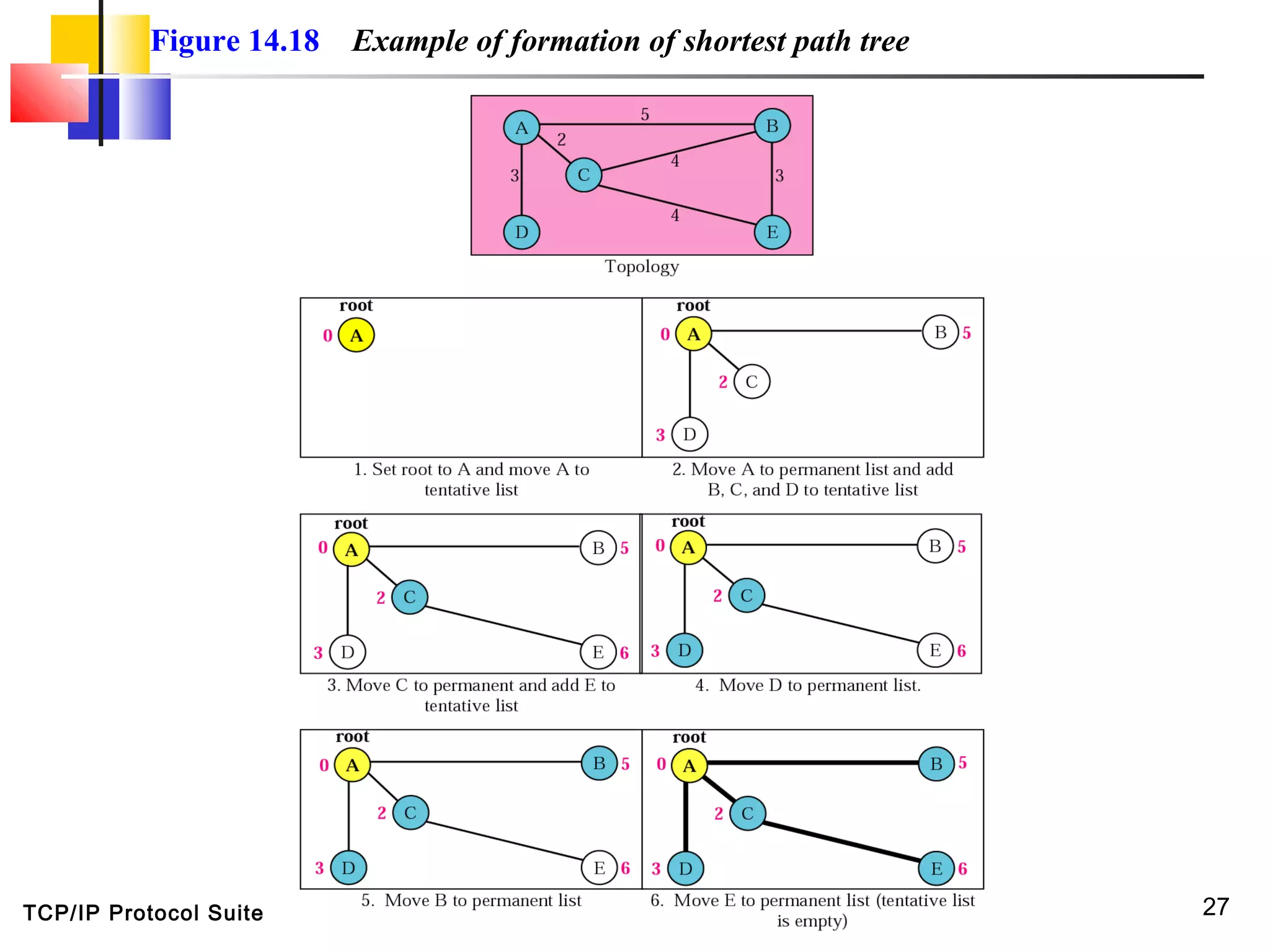
Figure 14.18 Example of formation of shortest path tree
TCP/IP Protocol Suite 28
Table 14.1Table 14.1 Routing table for node ARouting table for node A
TCP/IP Protocol Suite 29
14.5 OSPF
The Open Shortest Path First (OSPF) protocol is an intradomainThe Open Shortest Path First (OSPF) protocol is an intradomain
routing protocol based on link state routing. Its domain is also anrouting protocol based on link state routing. Its domain is also an
autonomous system.autonomous system.
The topics discussed in this section include:The topics discussed in this section include:
AreasAreas
MetricMetric
Types of LinksTypes of Links
Graphical RepresentationGraphical Representation
OSPF PacketsOSPF Packets
Link State Update PacketLink State Update Packet
Other PacketsOther Packets
EncapsulationEncapsulation
TCP/IP Protocol Suite 30
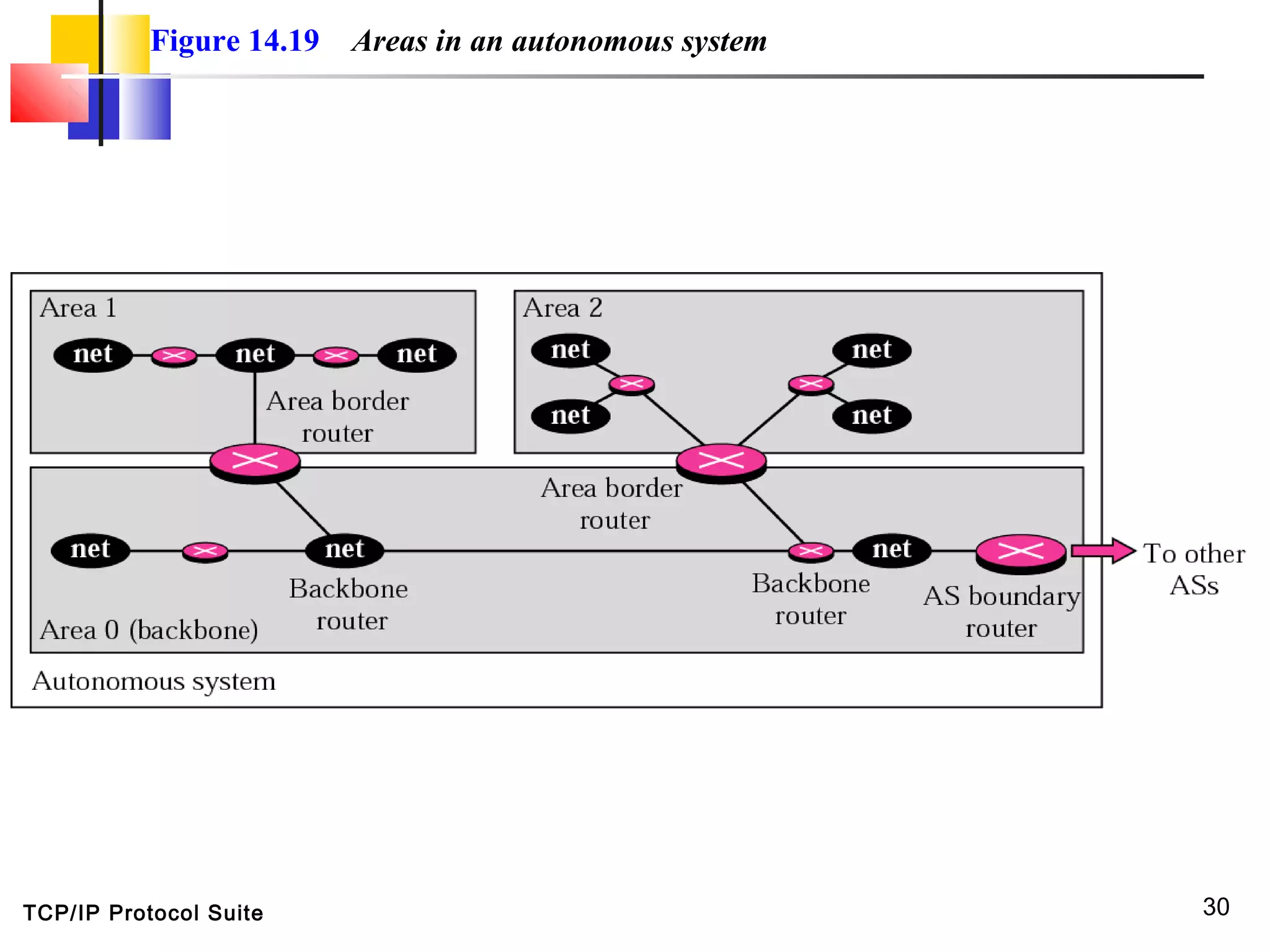
Figure 14.19 Areas in an autonomous system
TCP/IP Protocol Suite 31
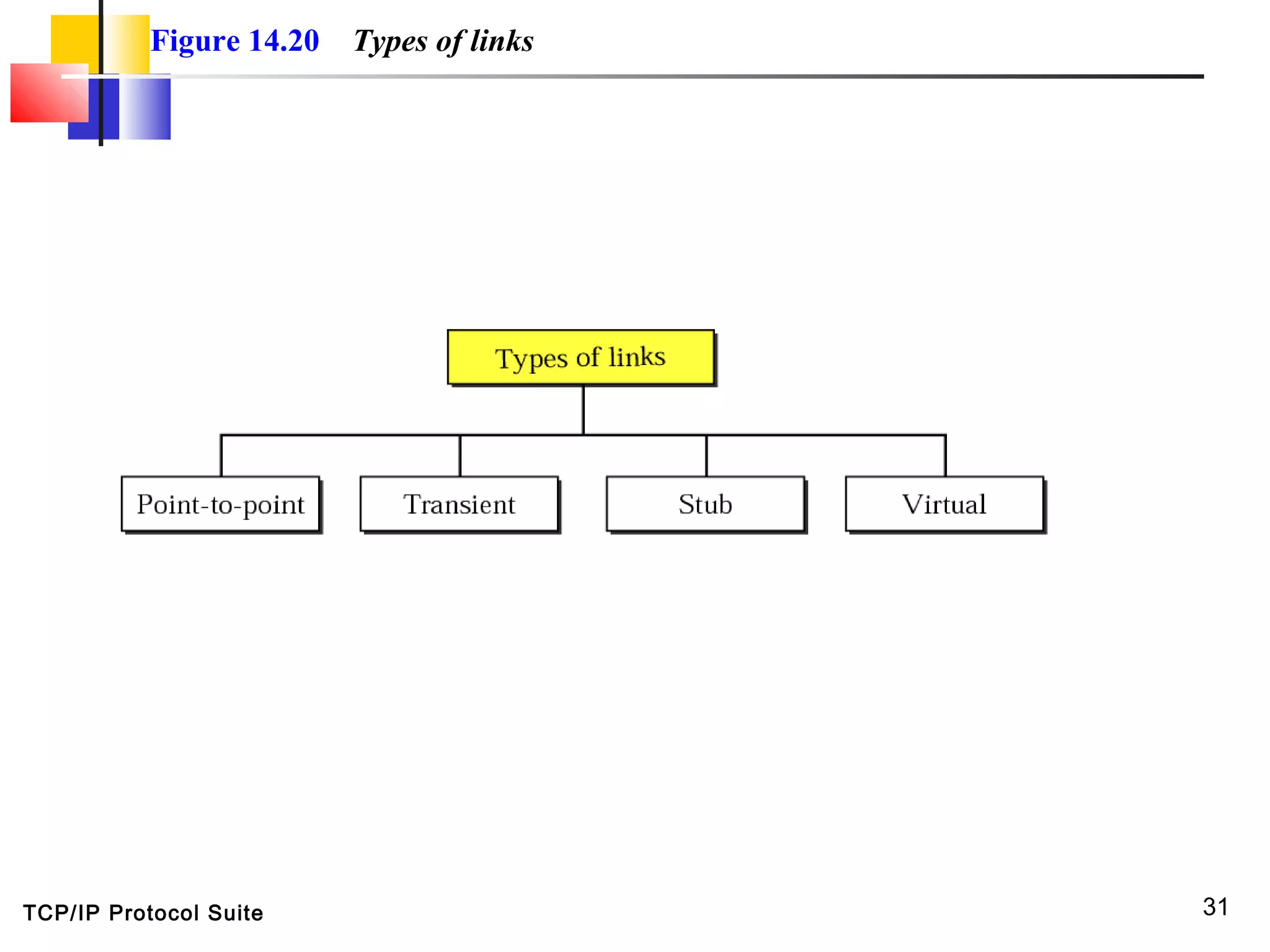
Figure 14.20 Types of links
TCP/IP Protocol Suite 32
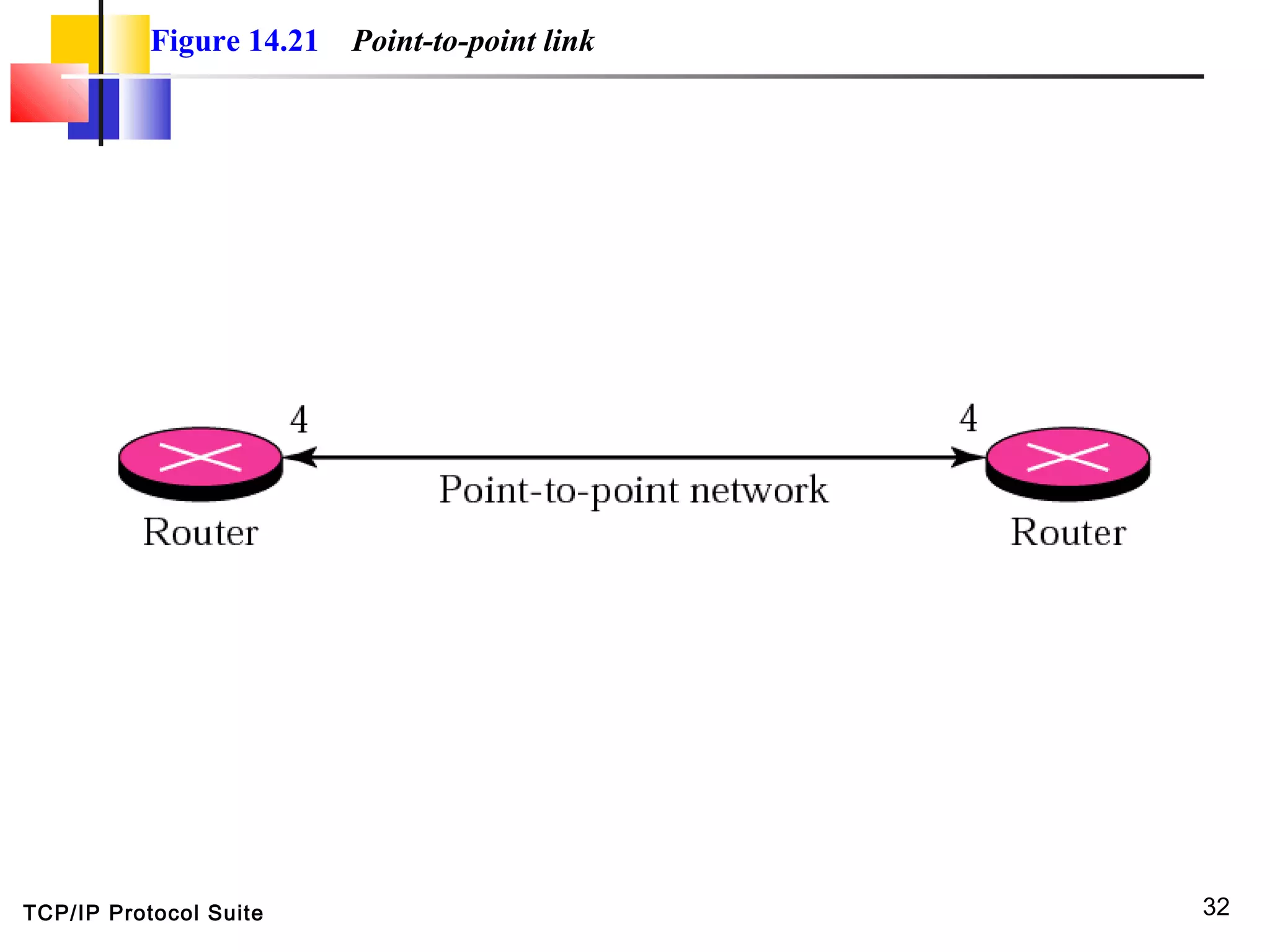
Figure 14.21 Point-to-point link
TCP/IP Protocol Suite 33
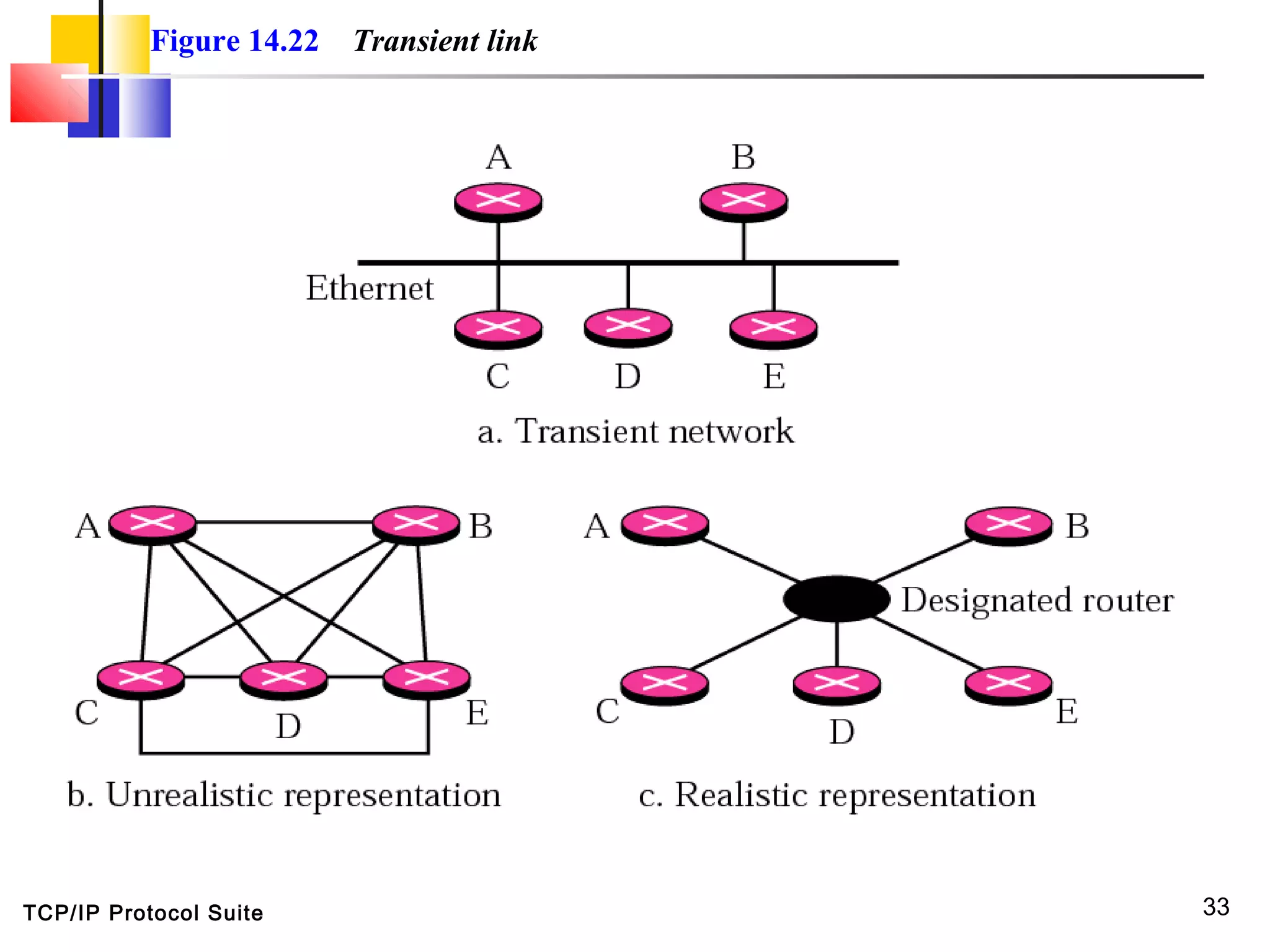
Figure 14.22 Transient link
TCP/IP Protocol Suite 34
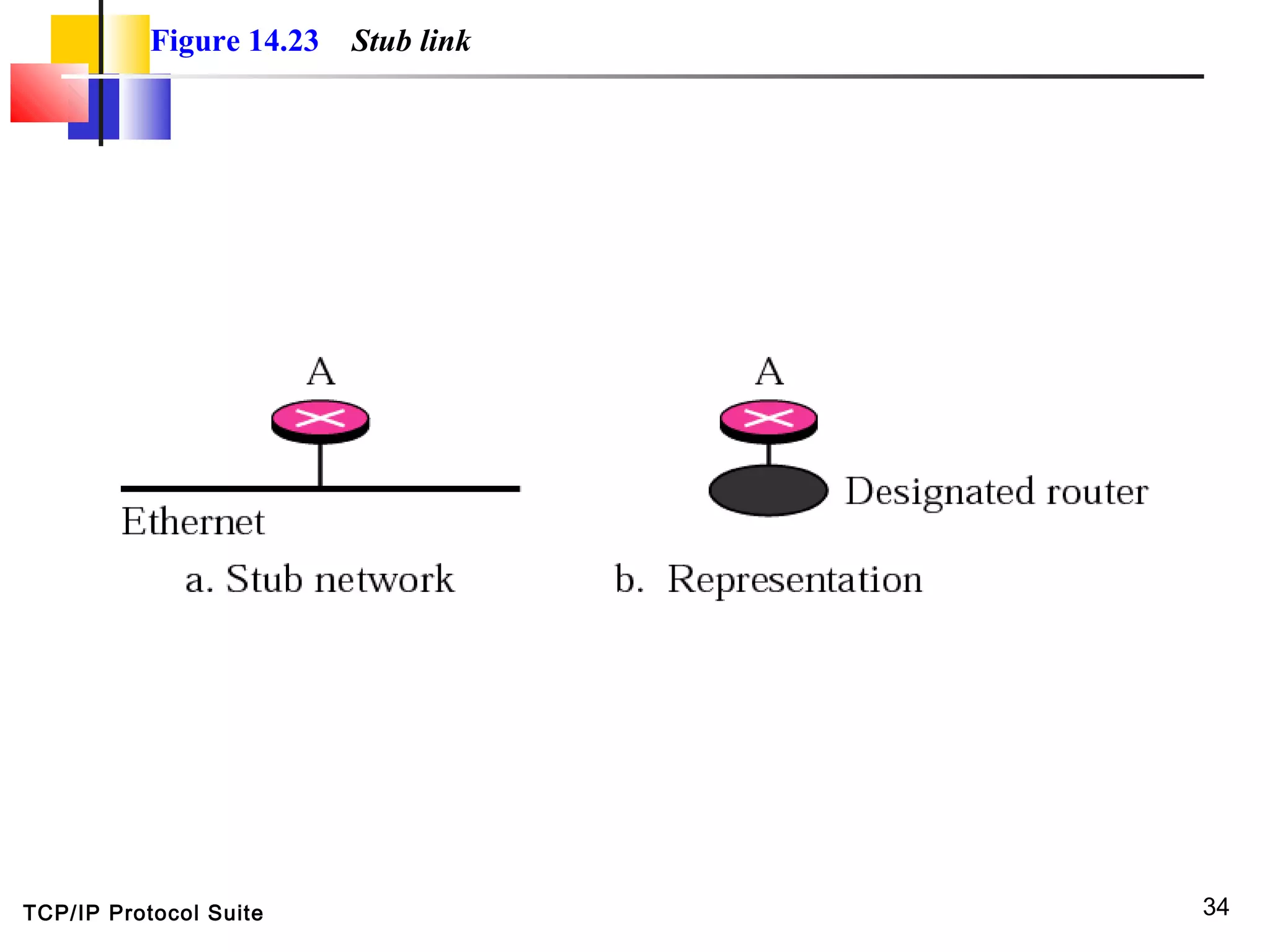
Figure 14.23 Stub link
TCP/IP Protocol Suite 35
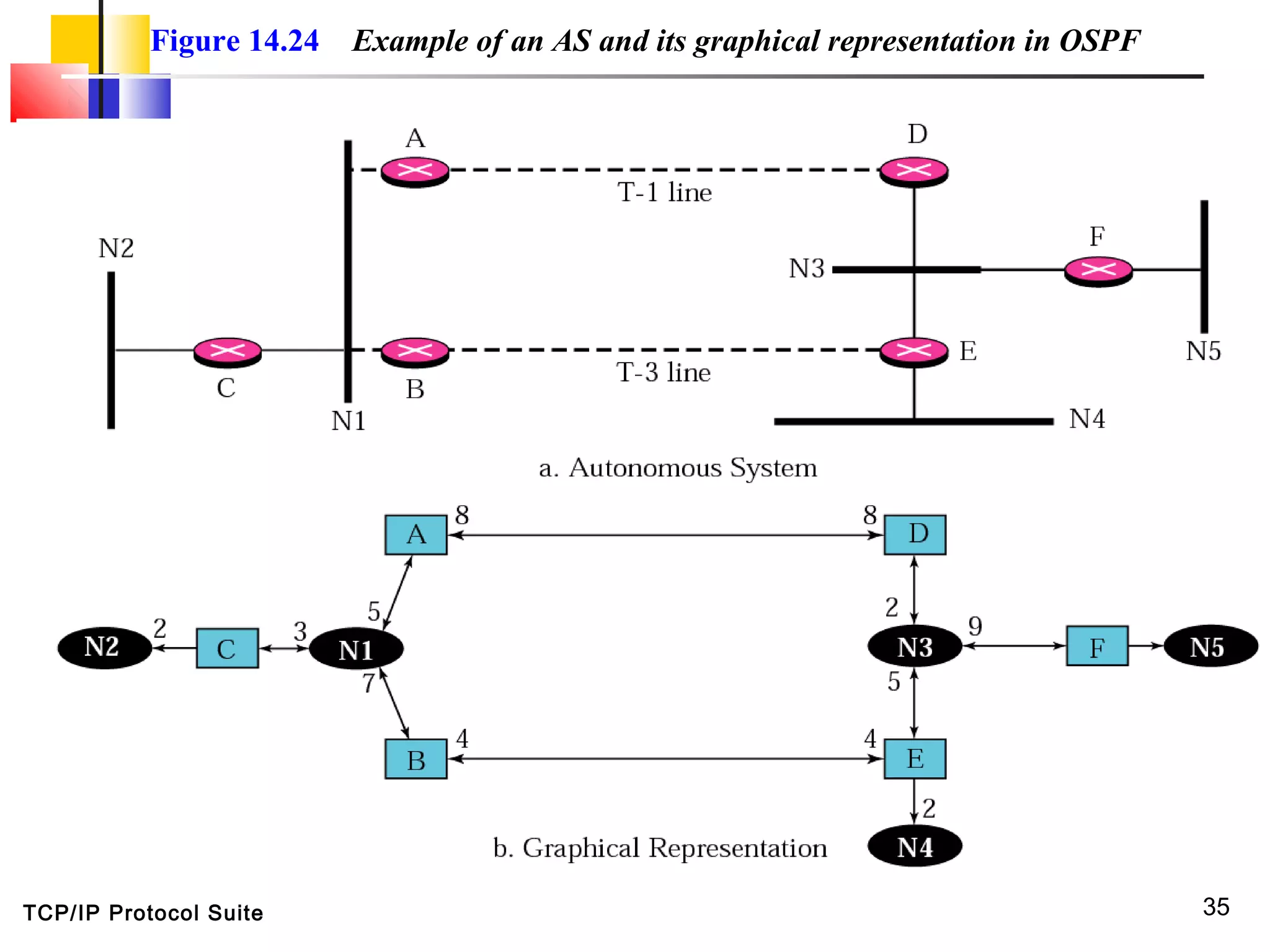
Figure 14.24 Example of an AS and its graphical representation in OSPF
TCP/IP Protocol Suite 36
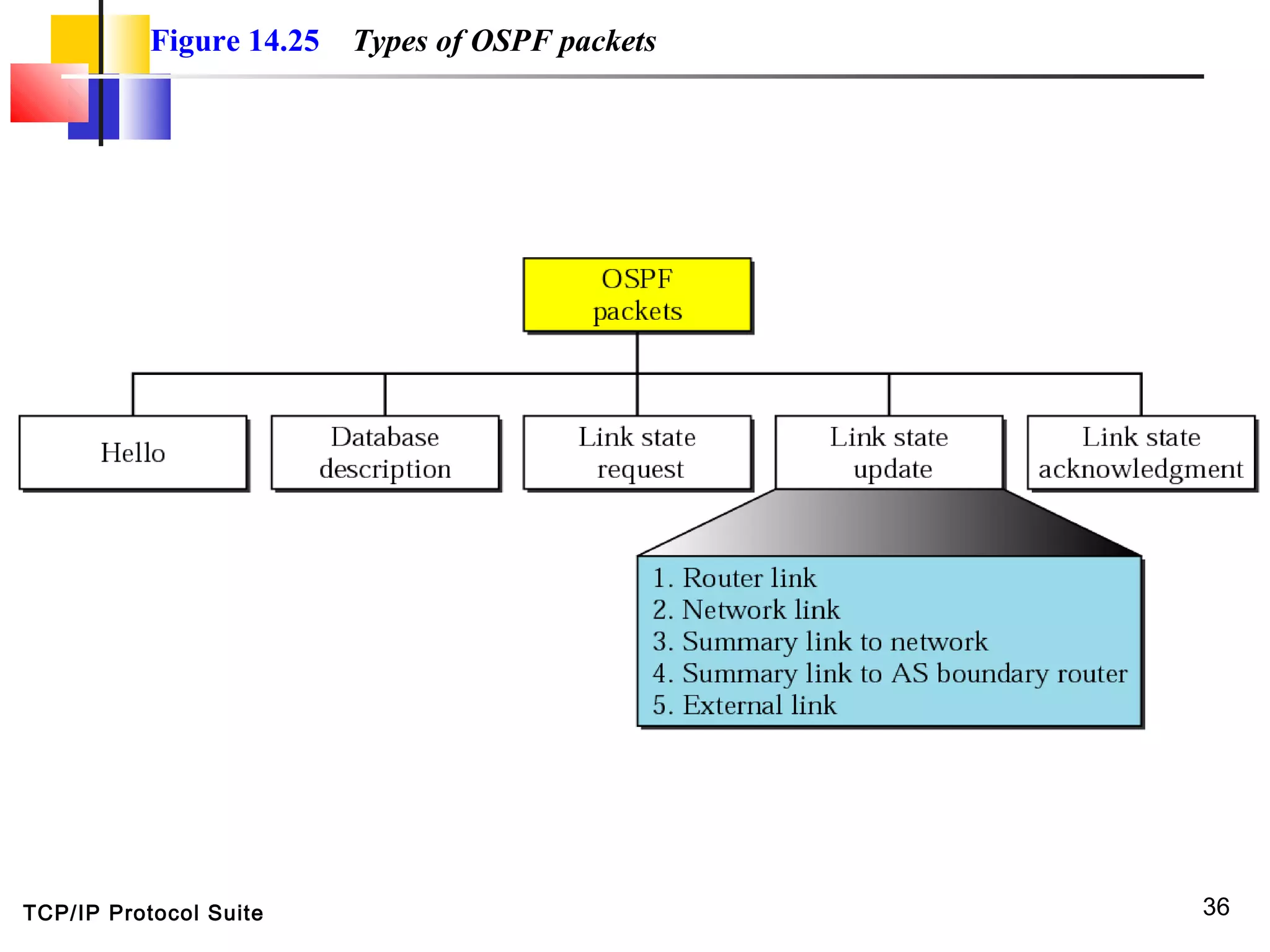
Figure 14.25 Types of OSPF packets
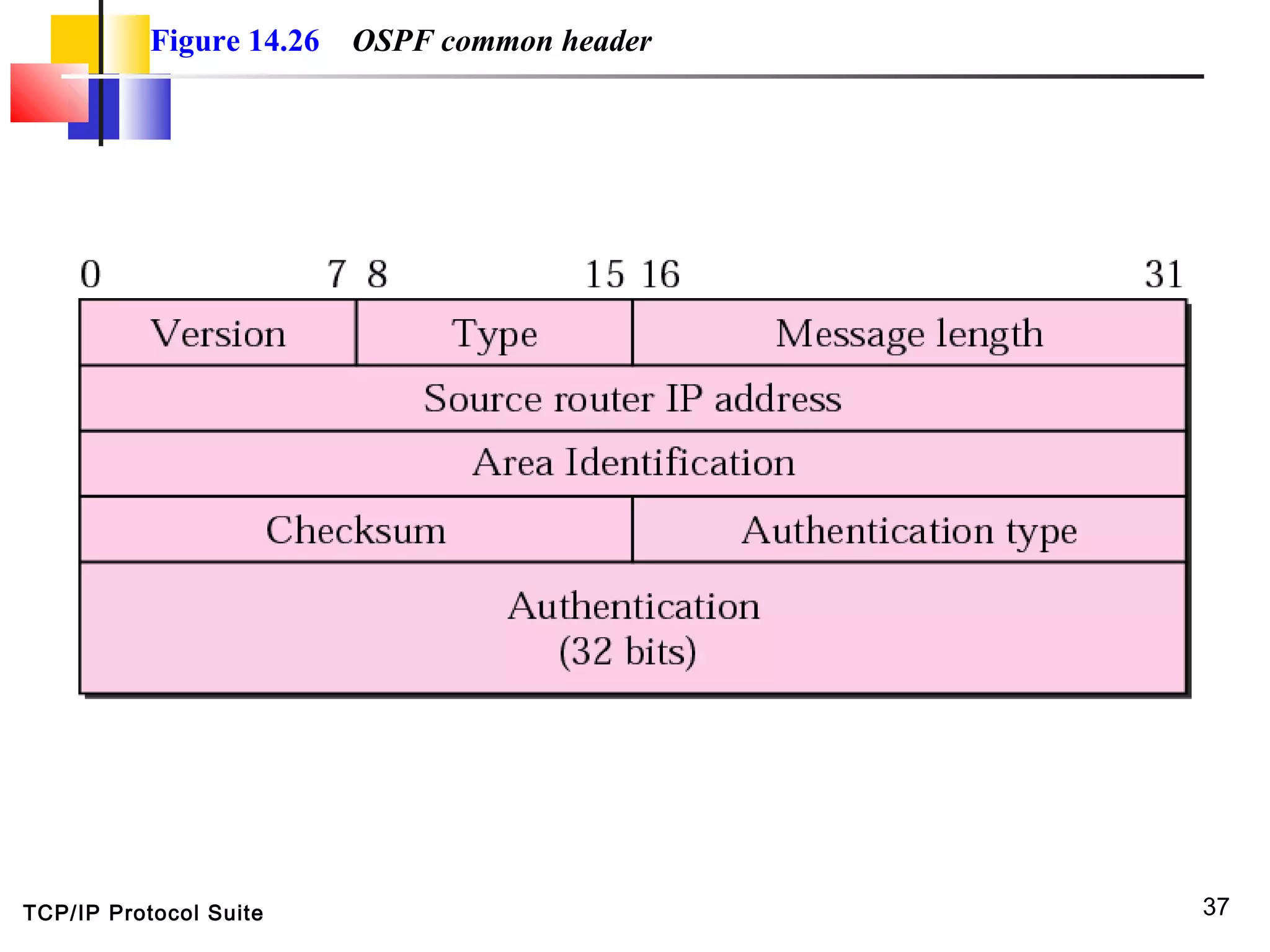
TCP/IP Protocol Suite 37
Figure 14.26 OSPF common header
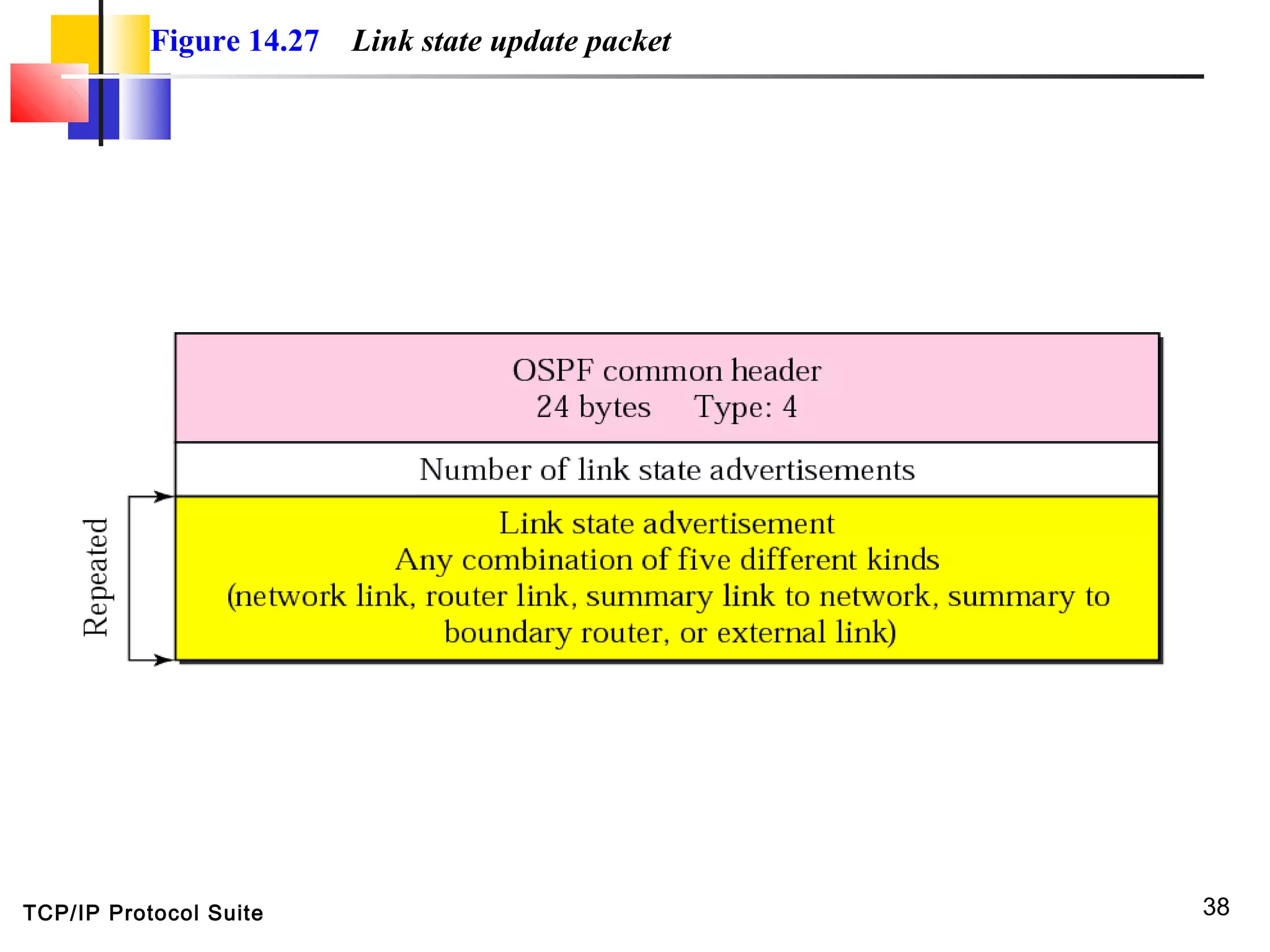
TCP/IP Protocol Suite 38
Figure 14.27 Link state update packet
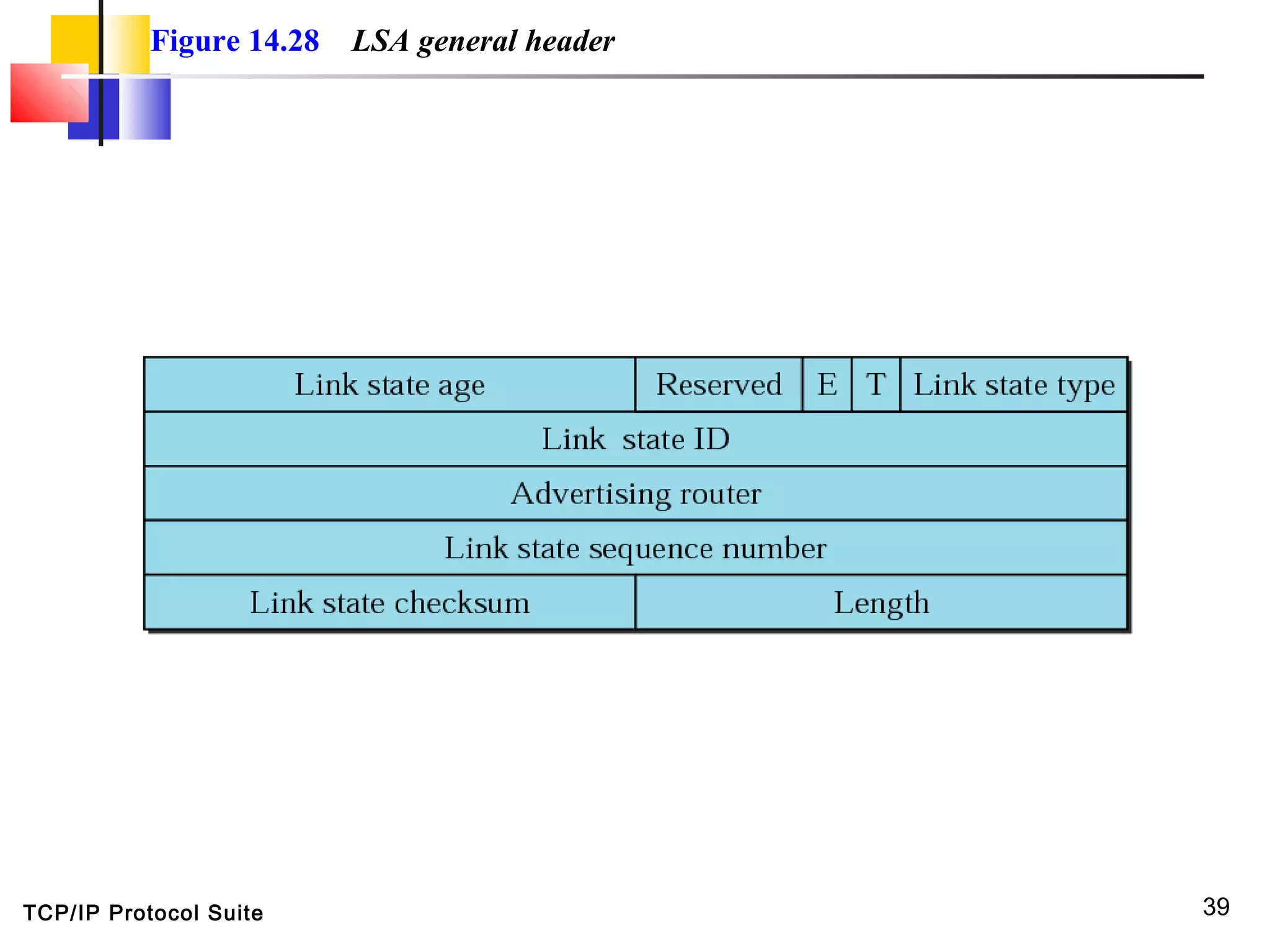
TCP/IP Protocol Suite 39
Figure 14.28 LSA general header
TCP/IP Protocol Suite 40
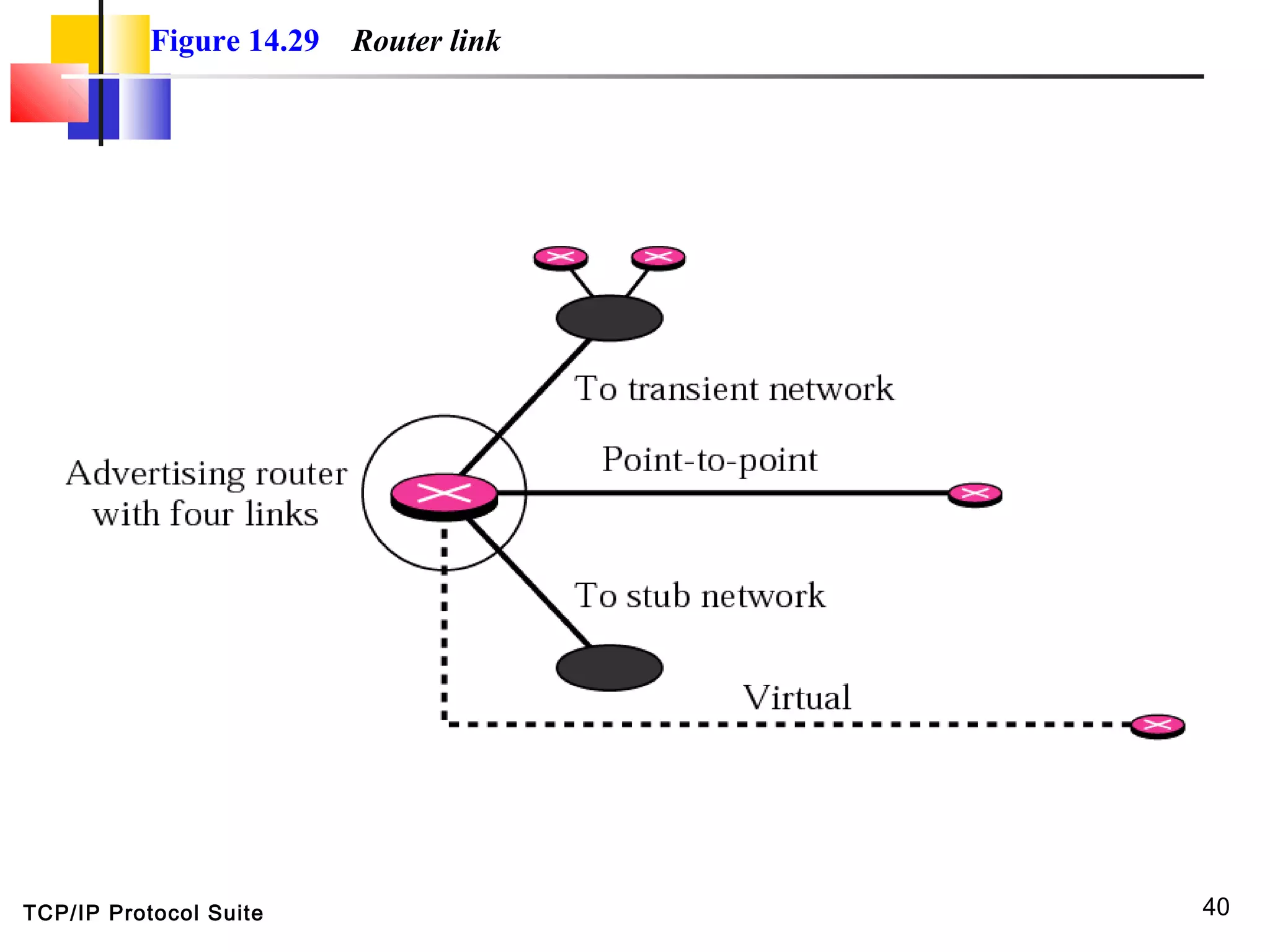
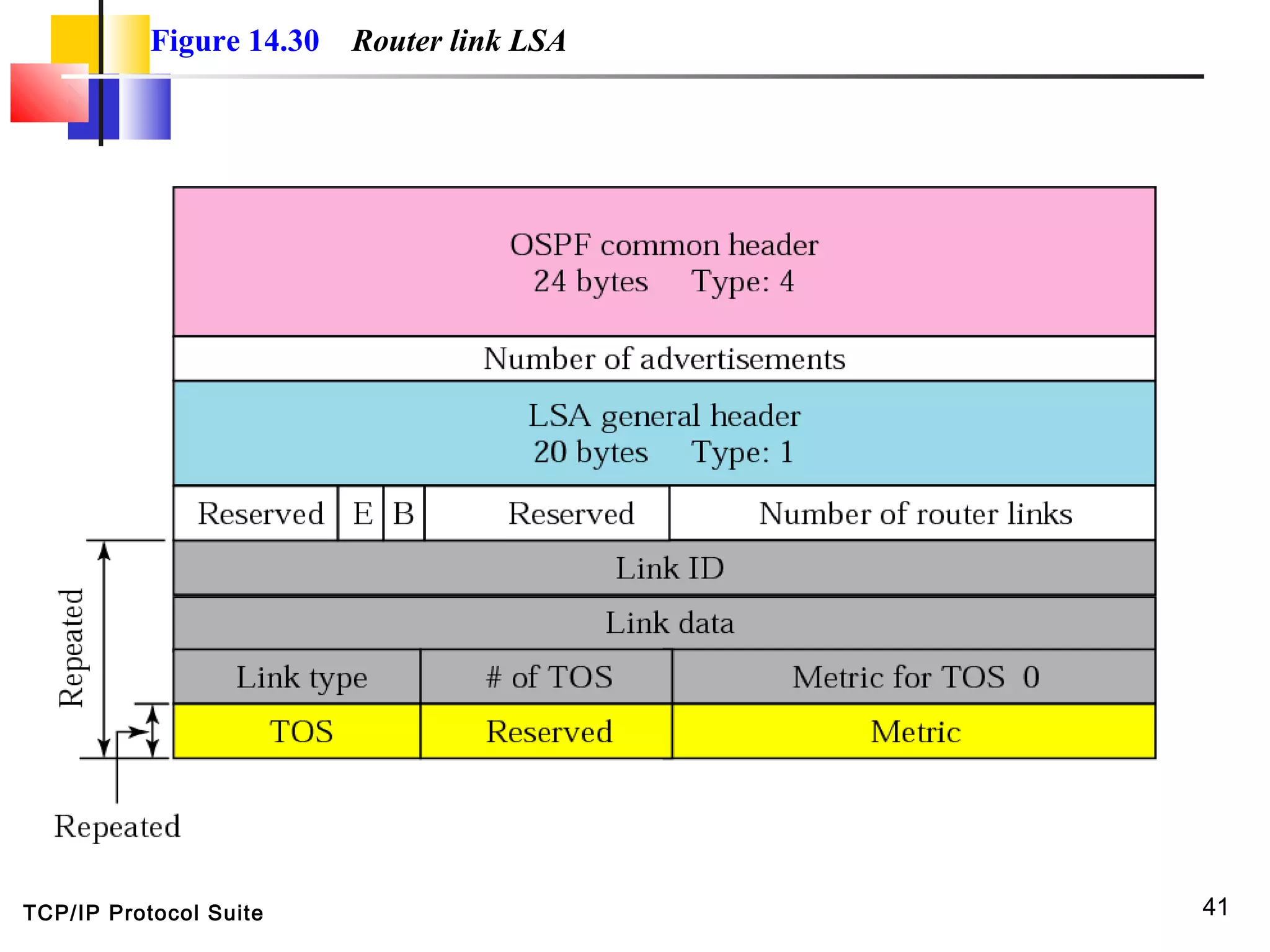
Figure 14.29 Router link
TCP/IP Protocol Suite 41
Figure 14.30 Router link LSA
TCP/IP Protocol Suite 42
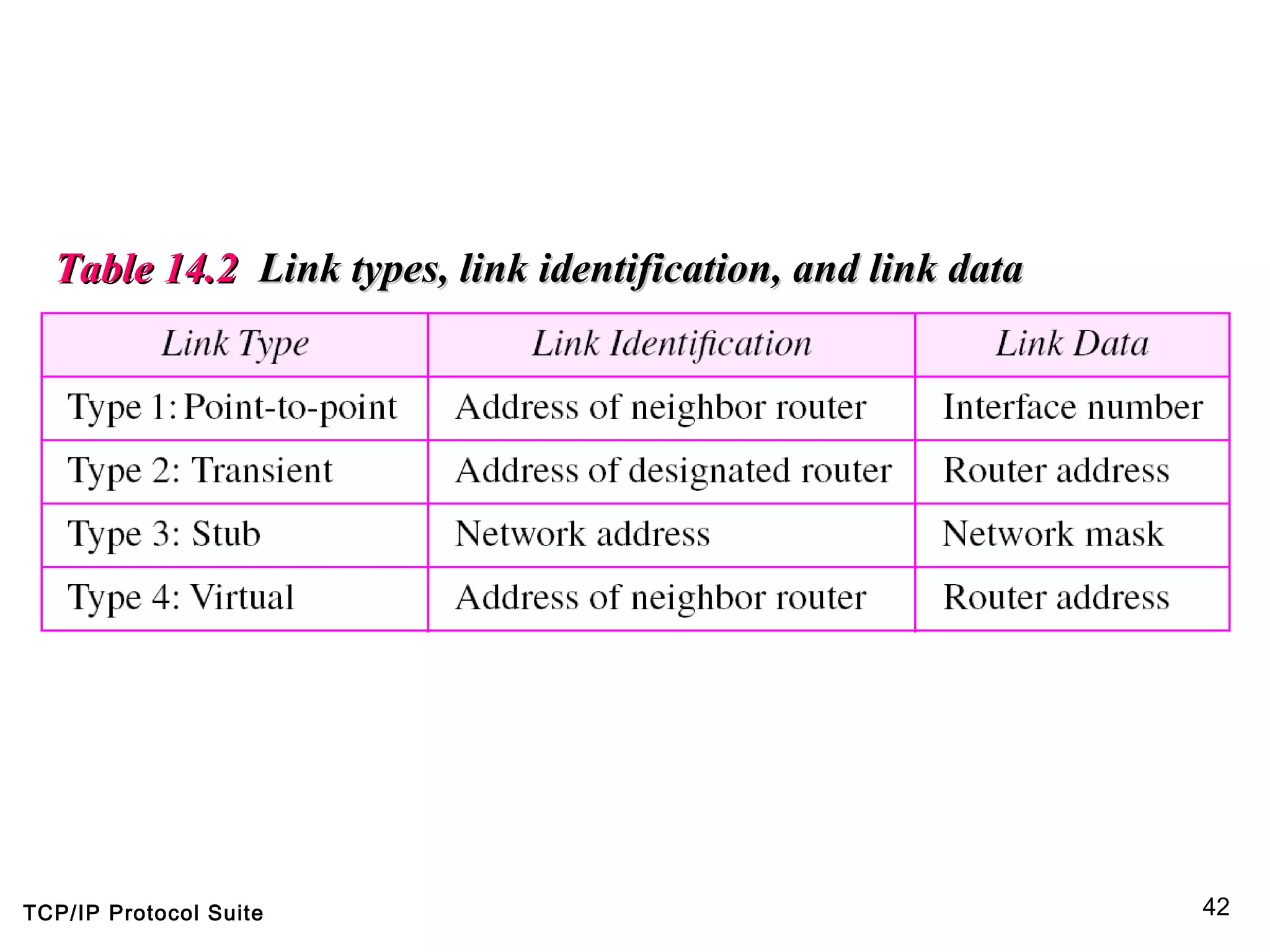
Table 14.2Table 14.2 Link types, link identification, and link dataLink types, link identification, and link data
TCP/IP Protocol Suite 43
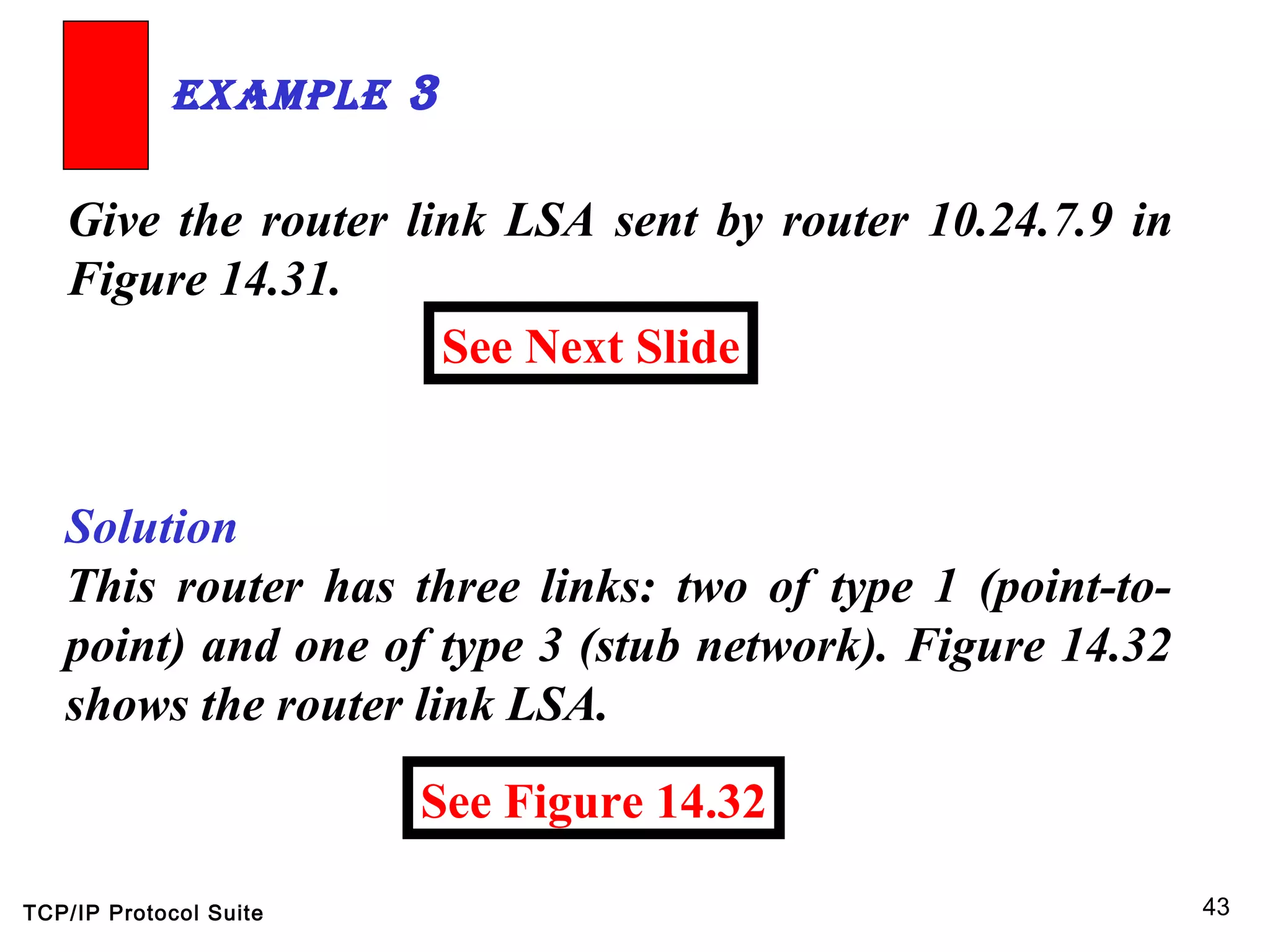
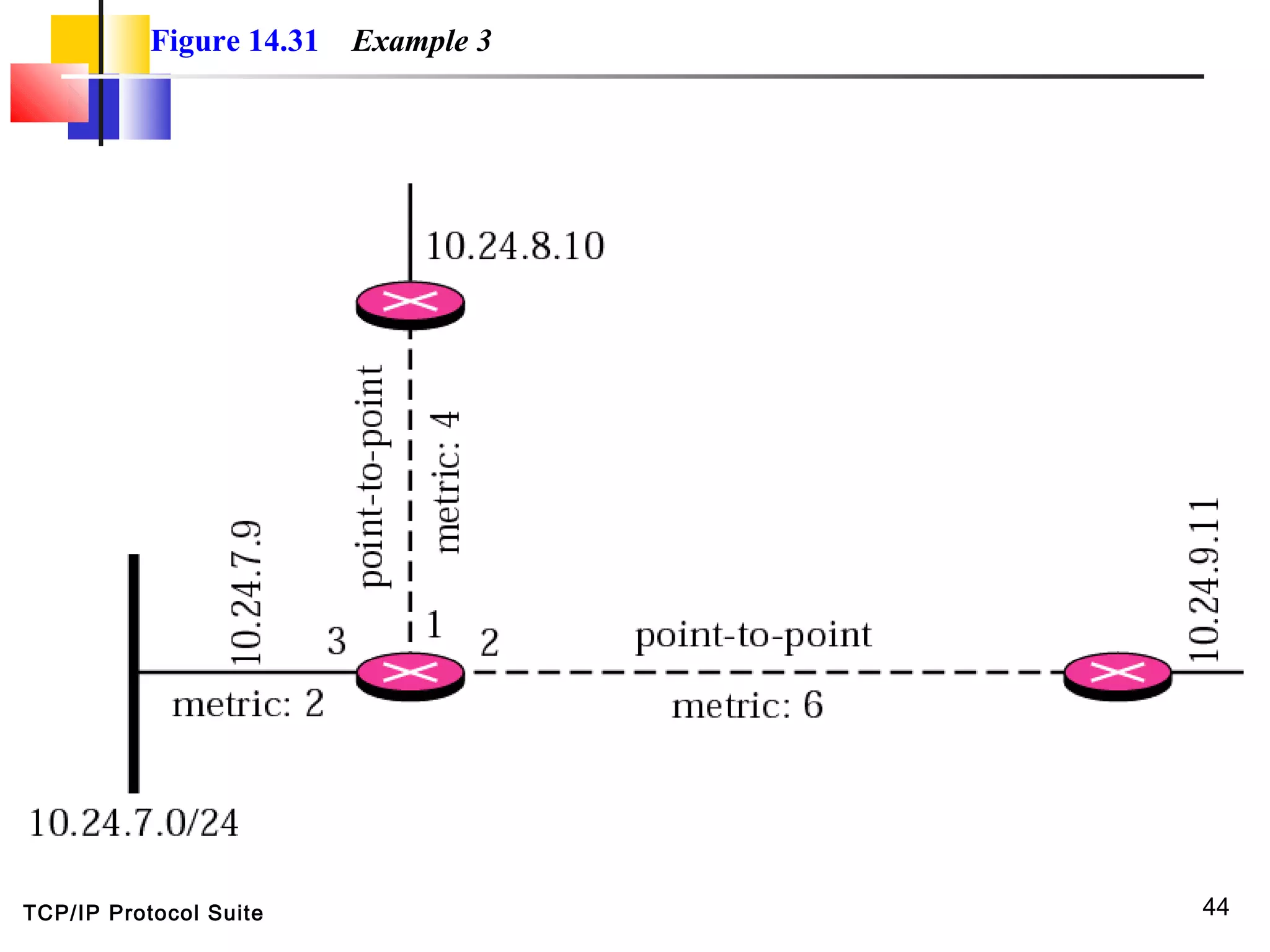
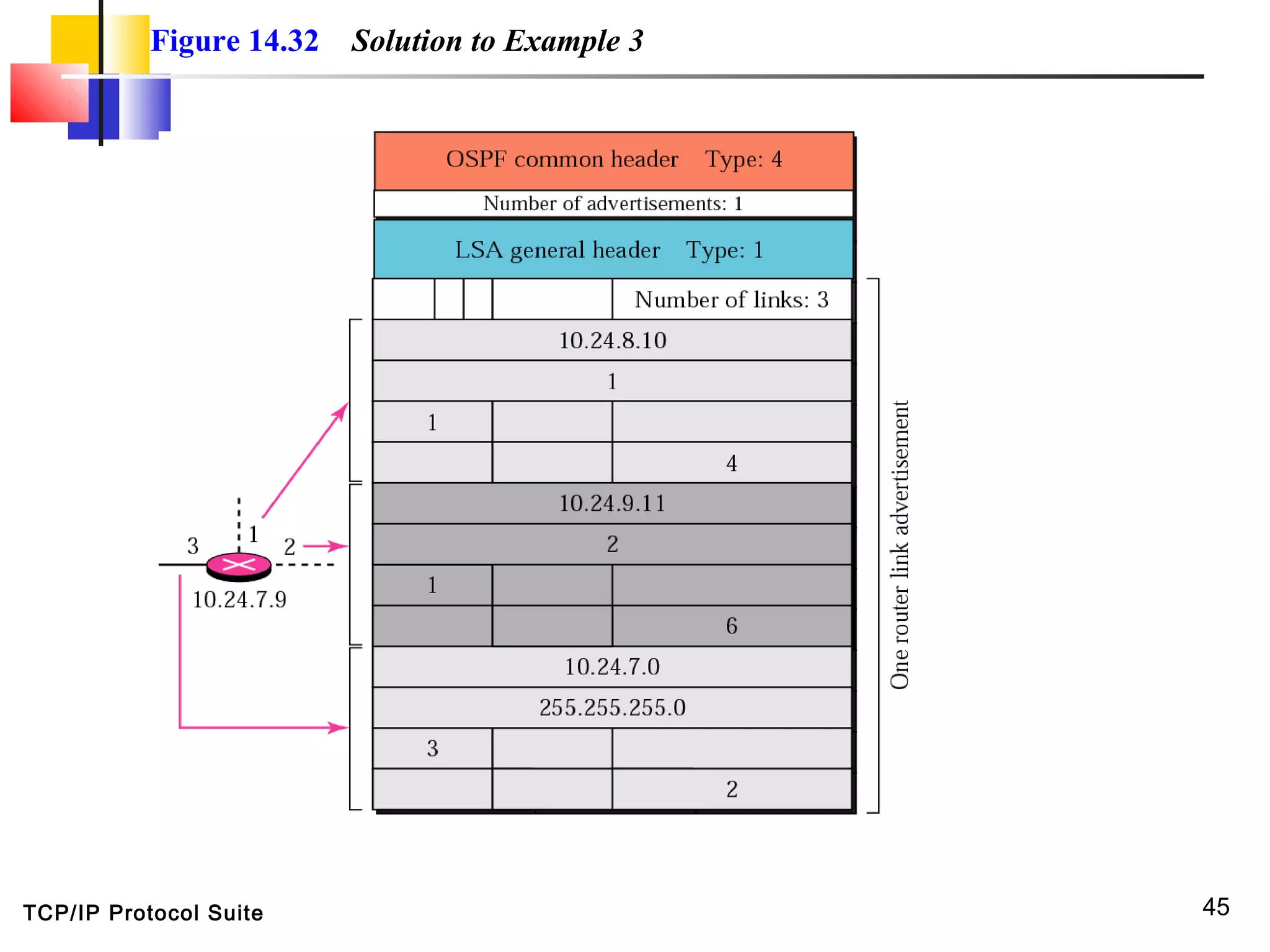
Give the router link LSA sent by router 10.24.7.9 in
Figure 14.31.
ExamplE 3
Solution
This router has three links: two of type 1 (point-to-
point) and one of type 3 (stub network). Figure 14.32
shows the router link LSA.
See Next Slide
See Figure 14.32
TCP/IP Protocol Suite 44
Figure 14.31 Example 3
TCP/IP Protocol Suite 45
Figure 14.32 Solution to Example 3
TCP/IP Protocol Suite 46
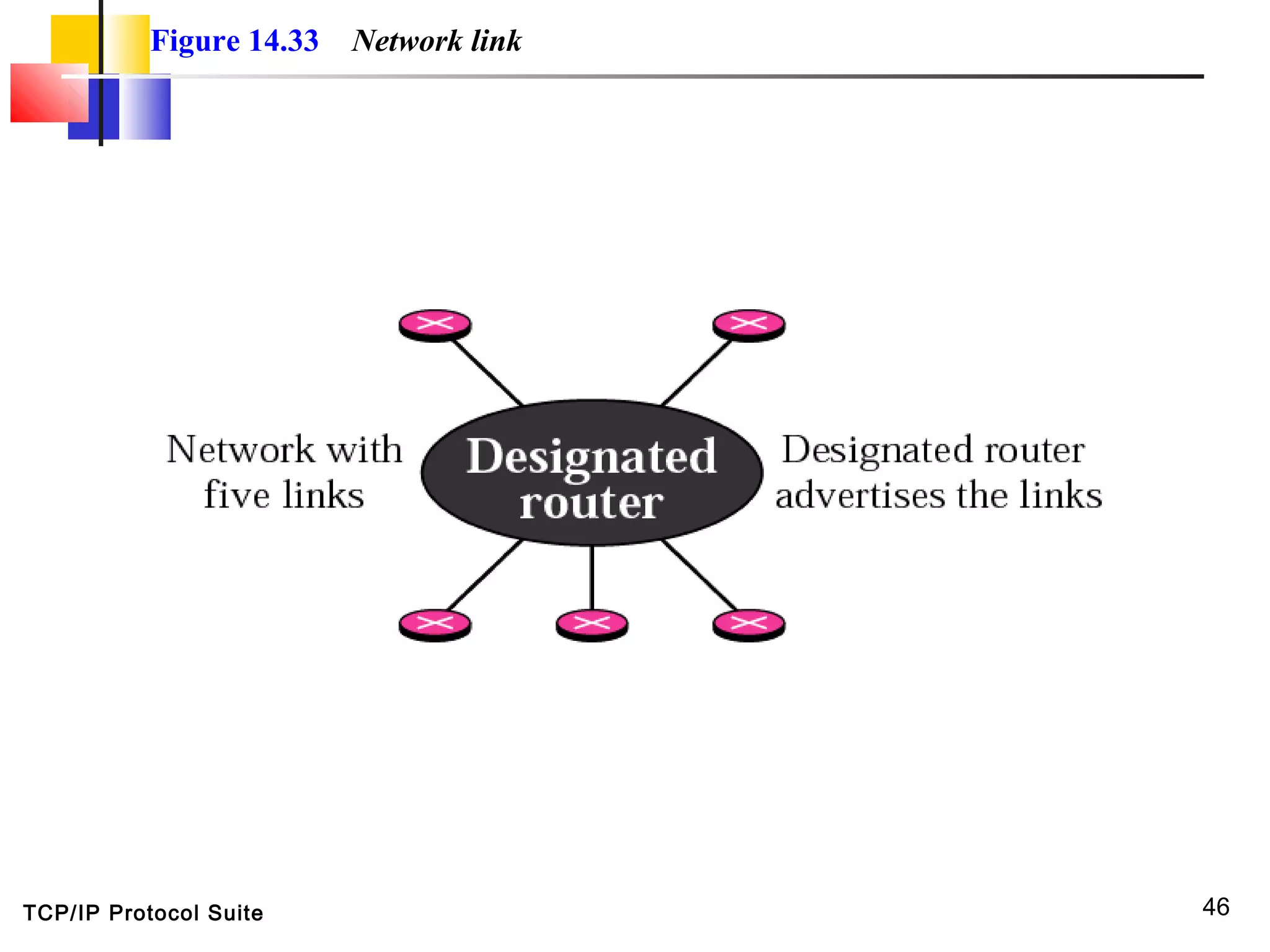
Figure 14.33 Network link
TCP/IP Protocol Suite 47
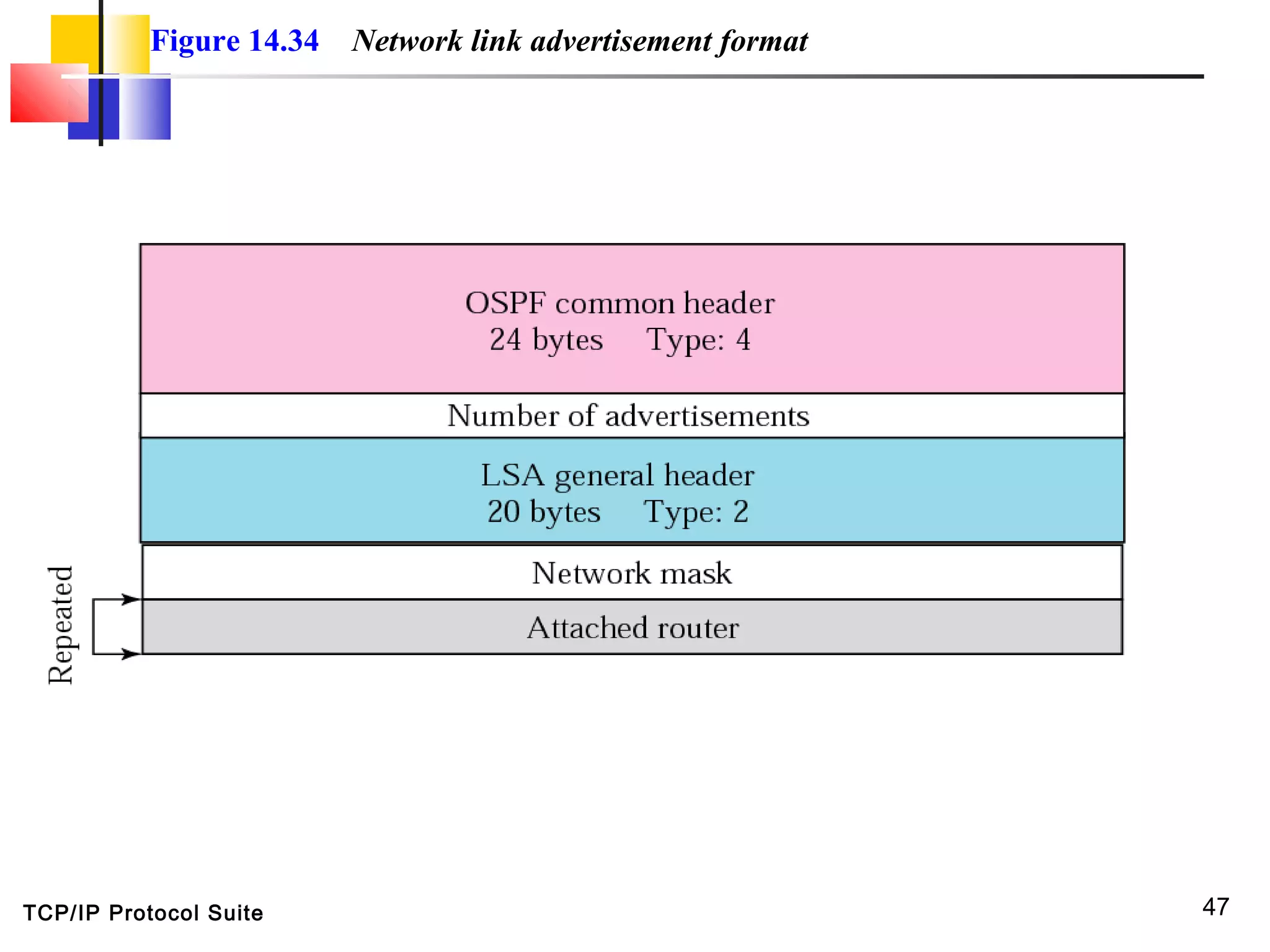
Figure 14.34 Network link advertisement format
TCP/IP Protocol Suite 48
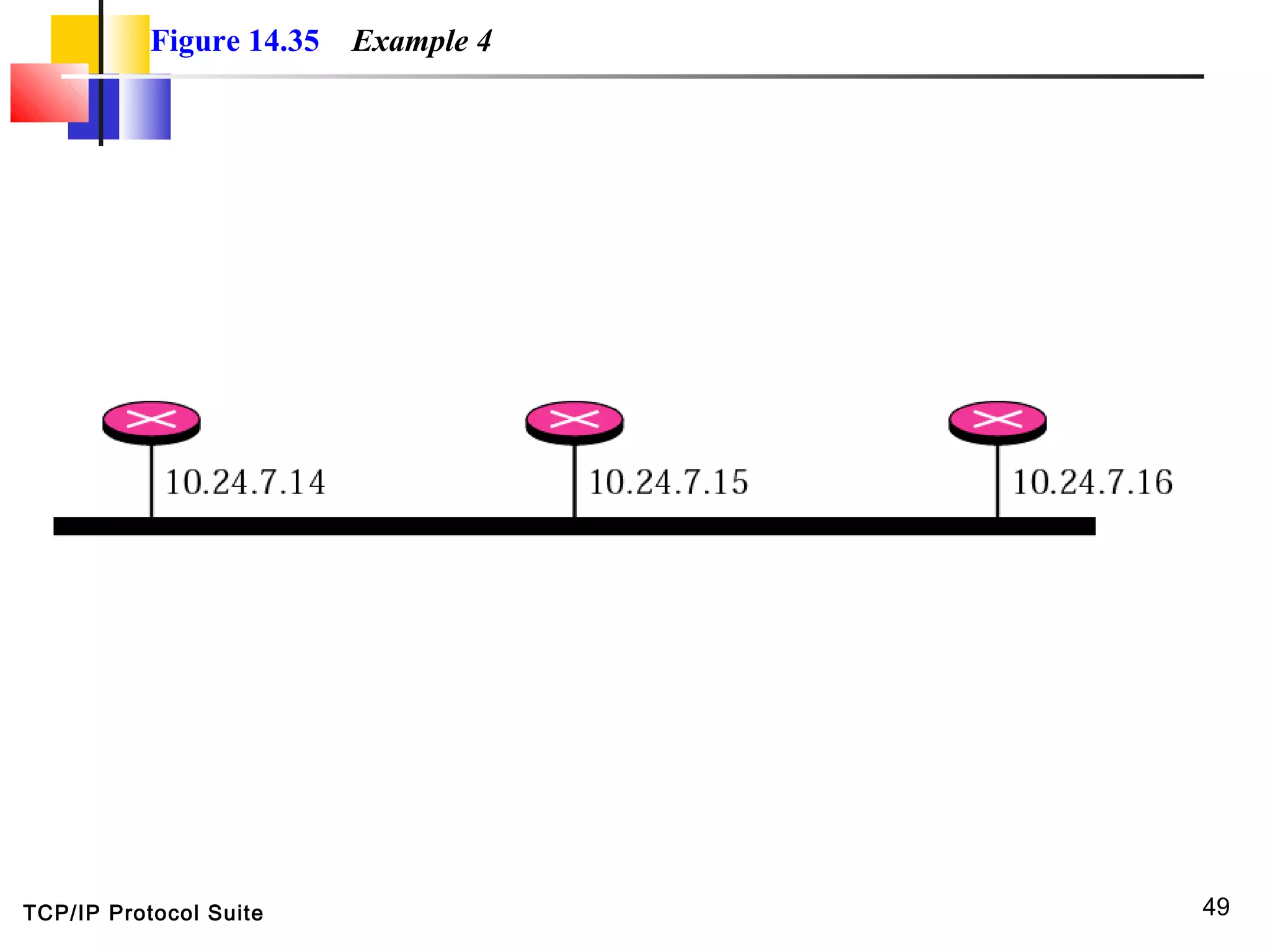
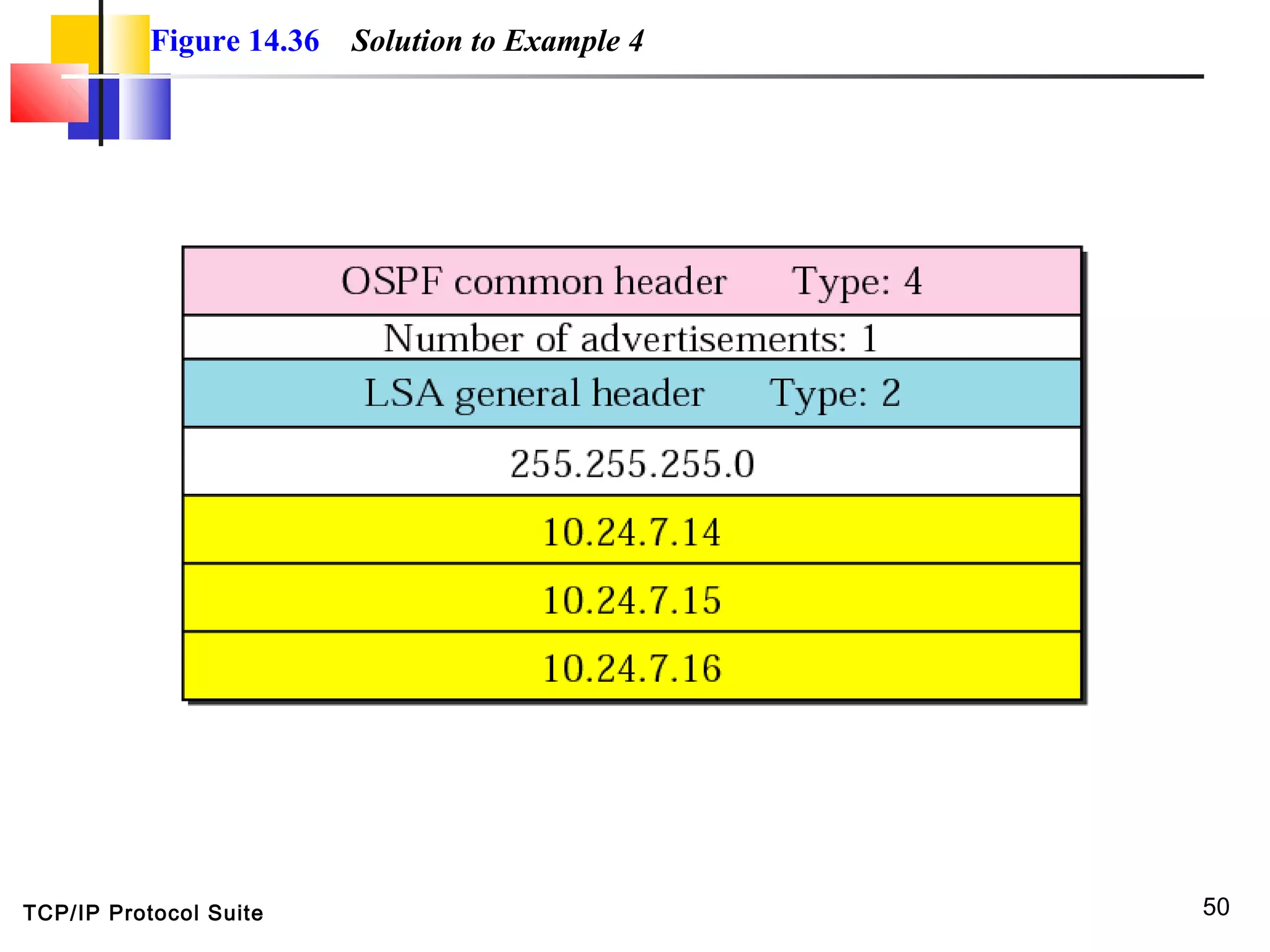
Give the network link LSA in Figure 14.35.
ExamplE 4
Solution.
See Next Slide
See Figure 14.36
TCP/IP Protocol Suite 49
Figure 14.35 Example 4
TCP/IP Protocol Suite 50
Figure 14.36 Solution to Example 4
TCP/IP Protocol Suite 51
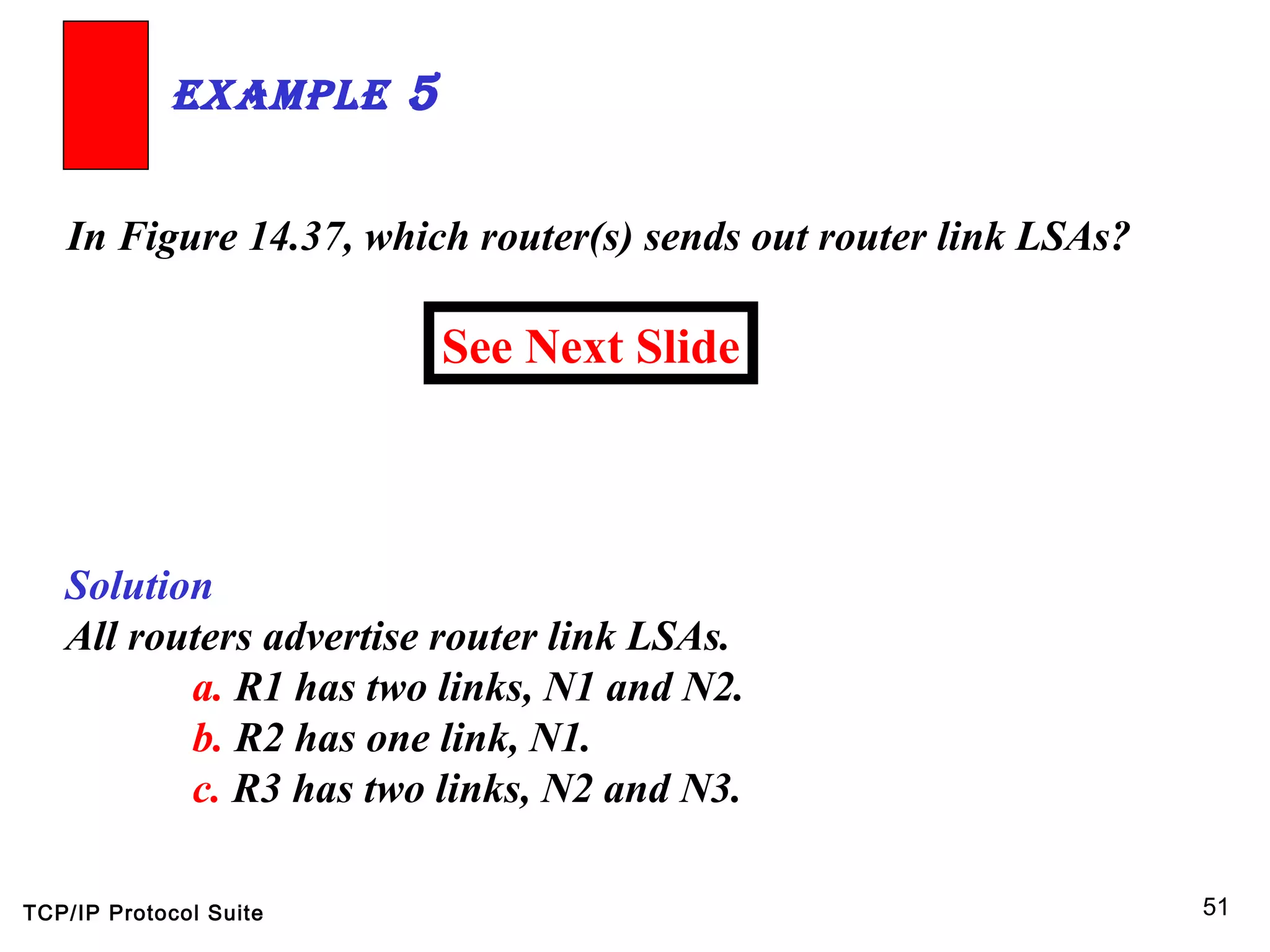
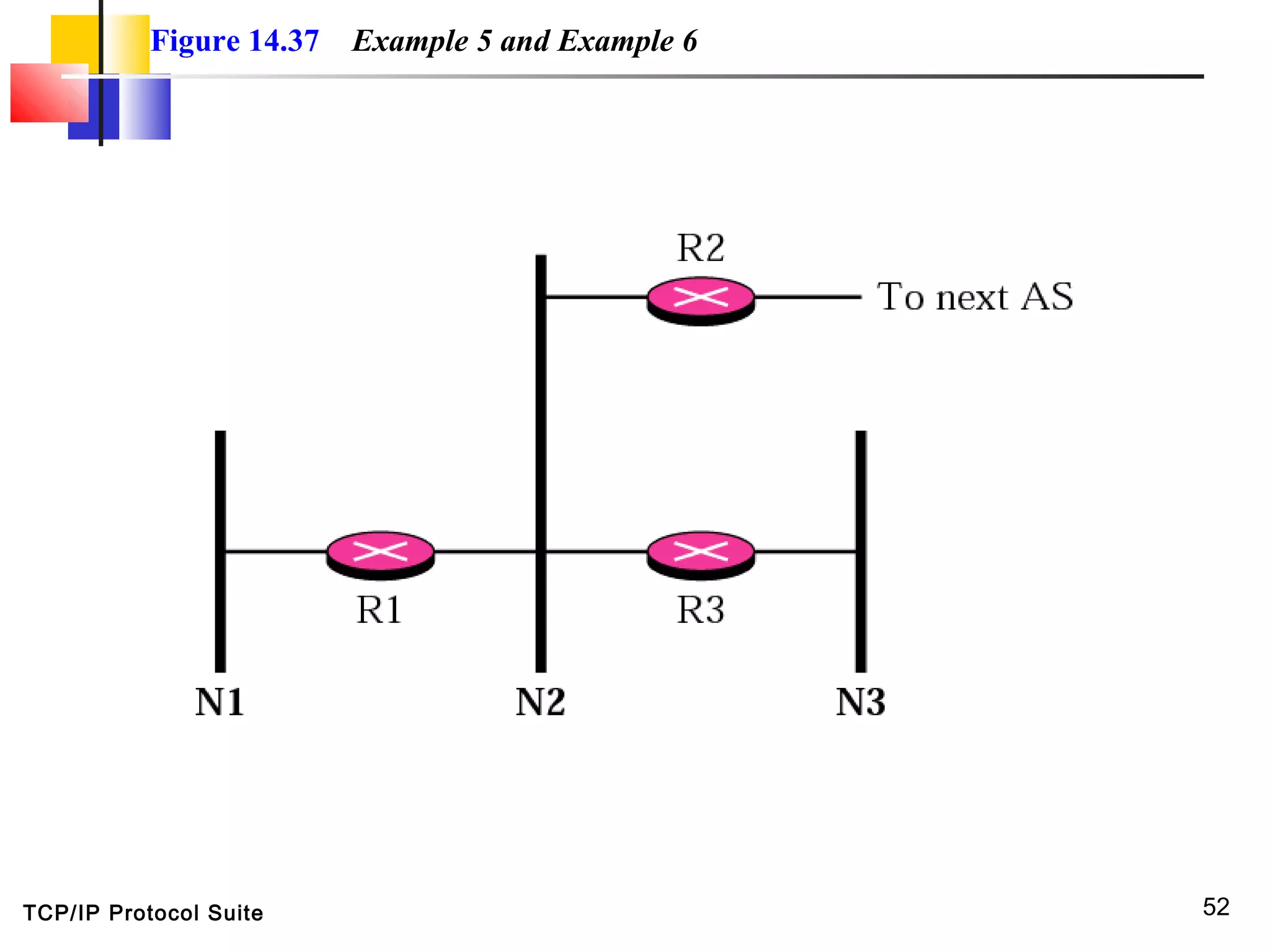
In Figure 14.37, which router(s) sends out router link LSAs?
ExamplE 5
Solution
All routers advertise router link LSAs.
a. R1 has two links, N1 and N2.
b. R2 has one link, N1.
c. R3 has two links, N2 and N3.
See Next Slide
TCP/IP Protocol Suite 52
Figure 14.37 Example 5 and Example 6
TCP/IP Protocol Suite 53
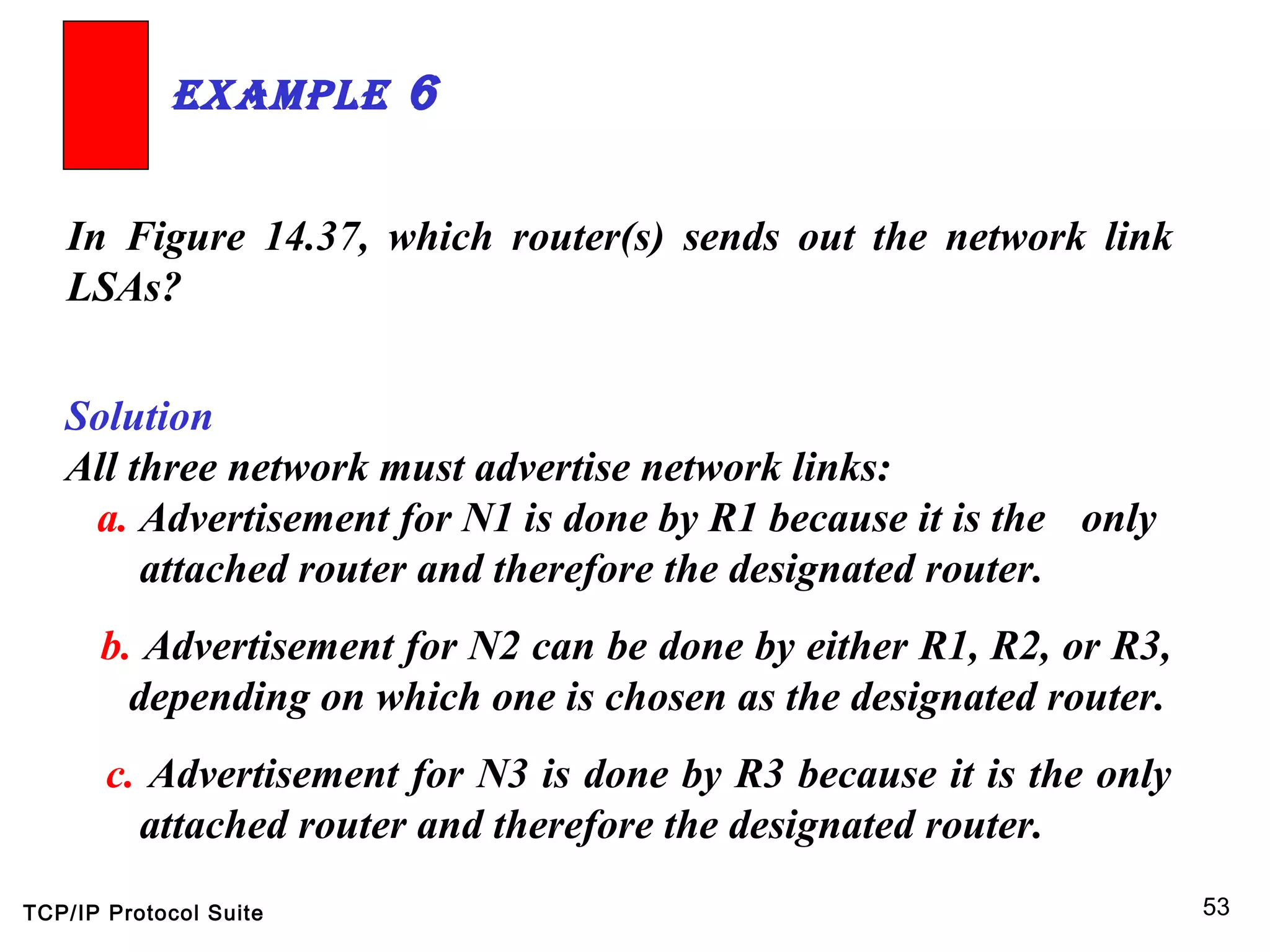
In Figure 14.37, which router(s) sends out the network link
LSAs?
ExamplE 6
Solution
All three network must advertise network links:
a. Advertisement for N1 is done by R1 because it is the only
attached router and therefore the designated router.
b. Advertisement for N2 can be done by either R1, R2, or R3,
depending on which one is chosen as the designated router.
c. Advertisement for N3 is done by R3 because it is the only
attached router and therefore the designated router.
TCP/IP Protocol Suite 54
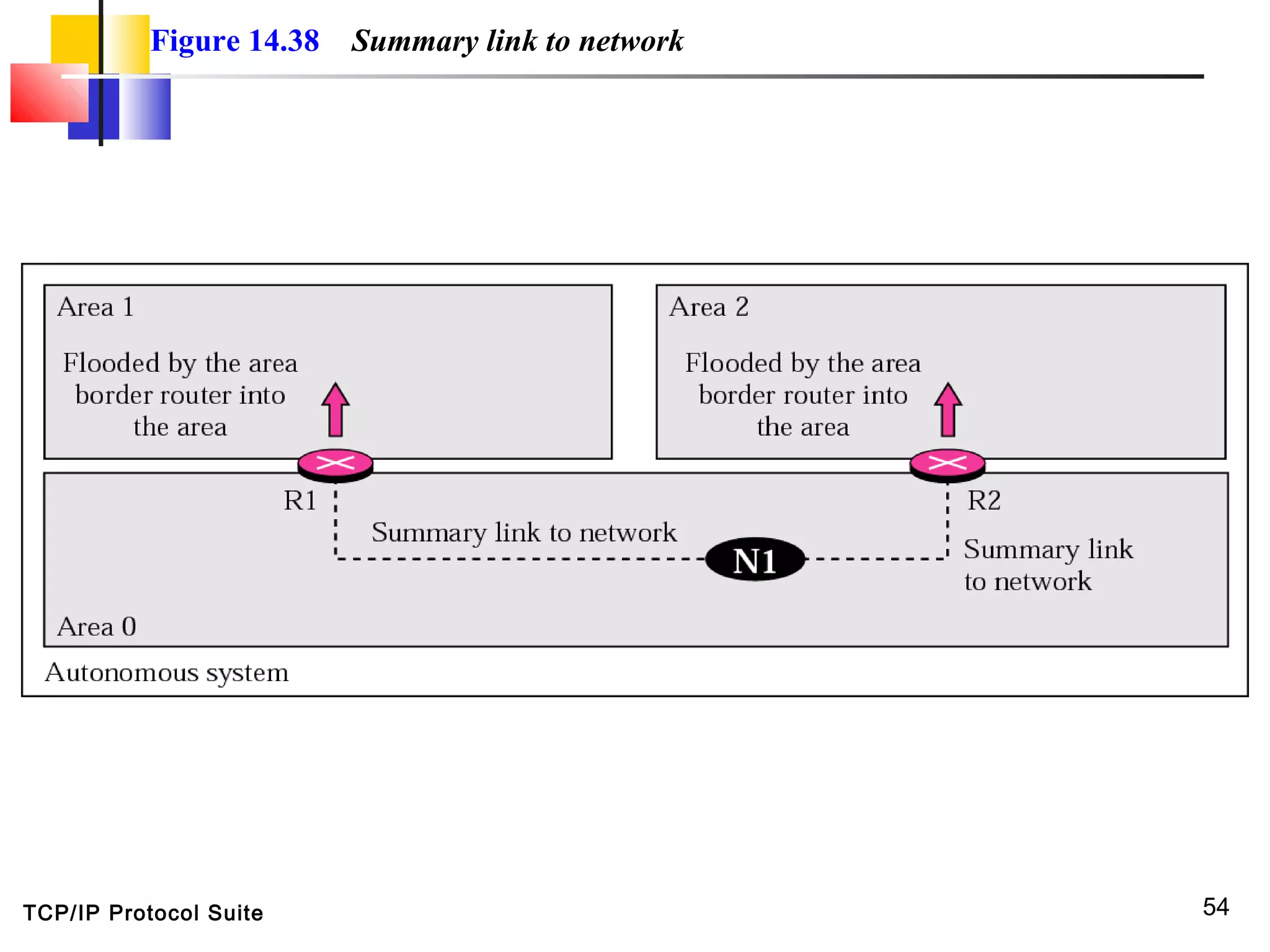
Figure 14.38 Summary link to network
TCP/IP Protocol Suite 55
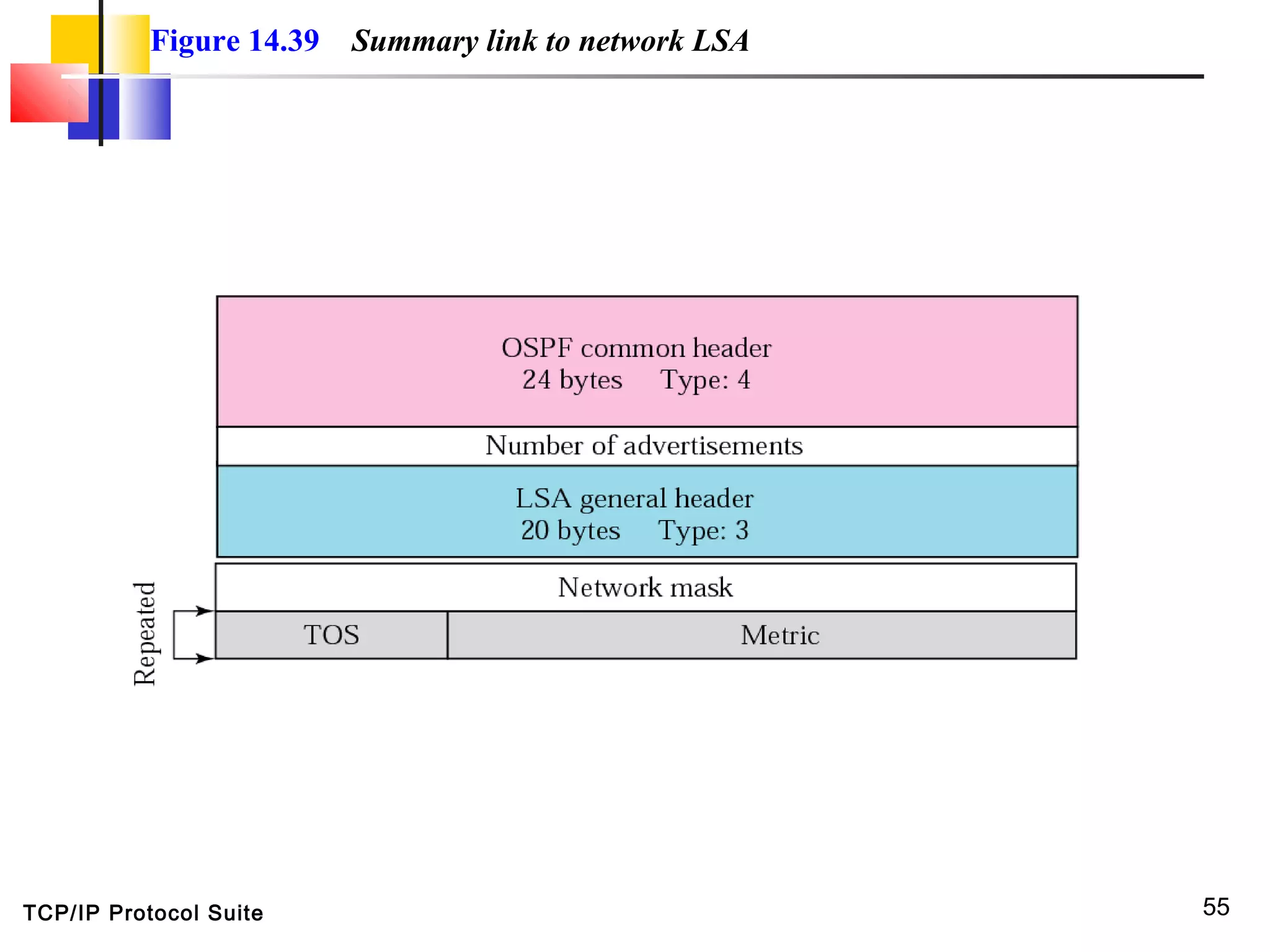
Figure 14.39 Summary link to network LSA
TCP/IP Protocol Suite 56
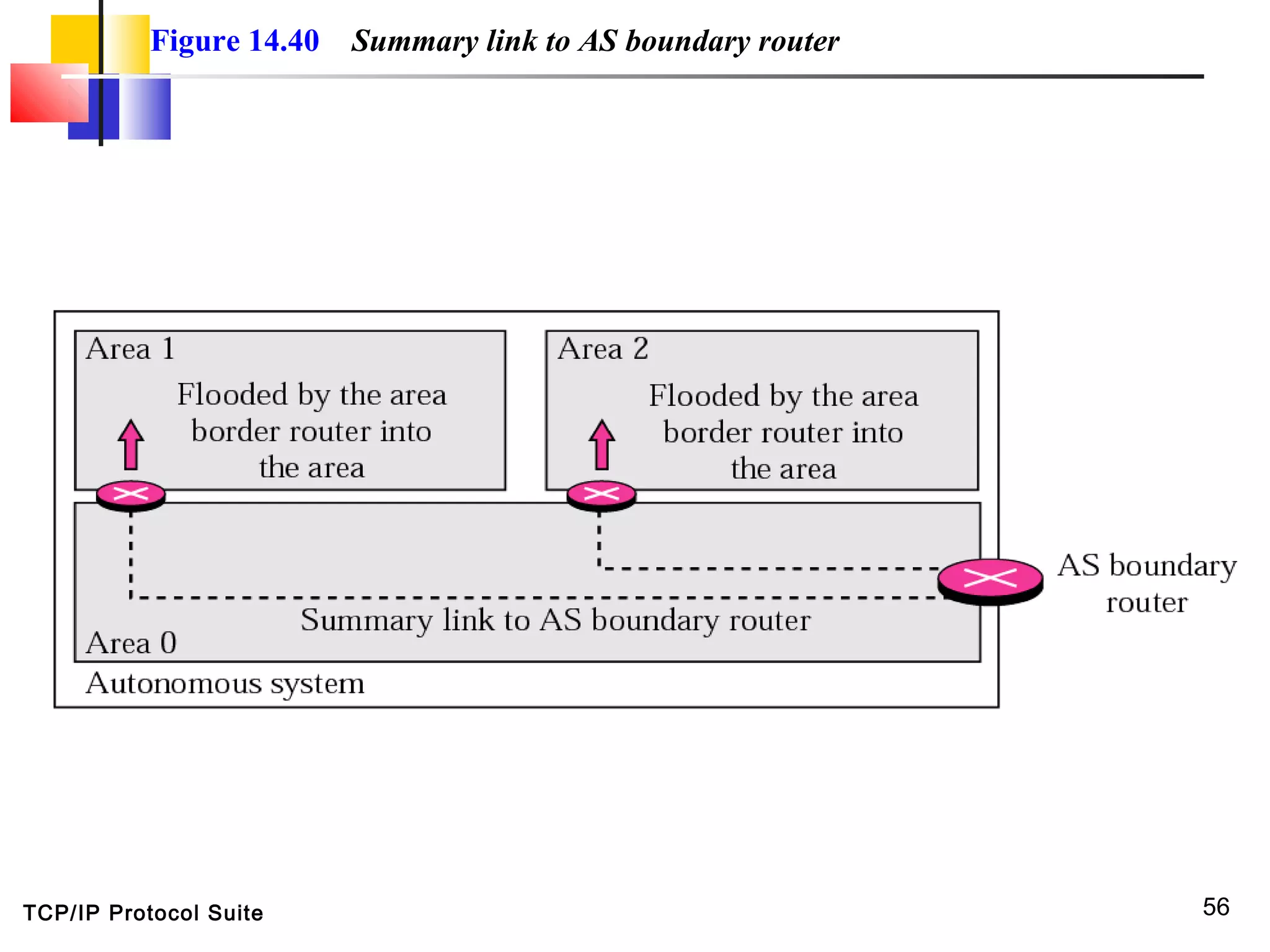
Figure 14.40 Summary link to AS boundary router
TCP/IP Protocol Suite 57
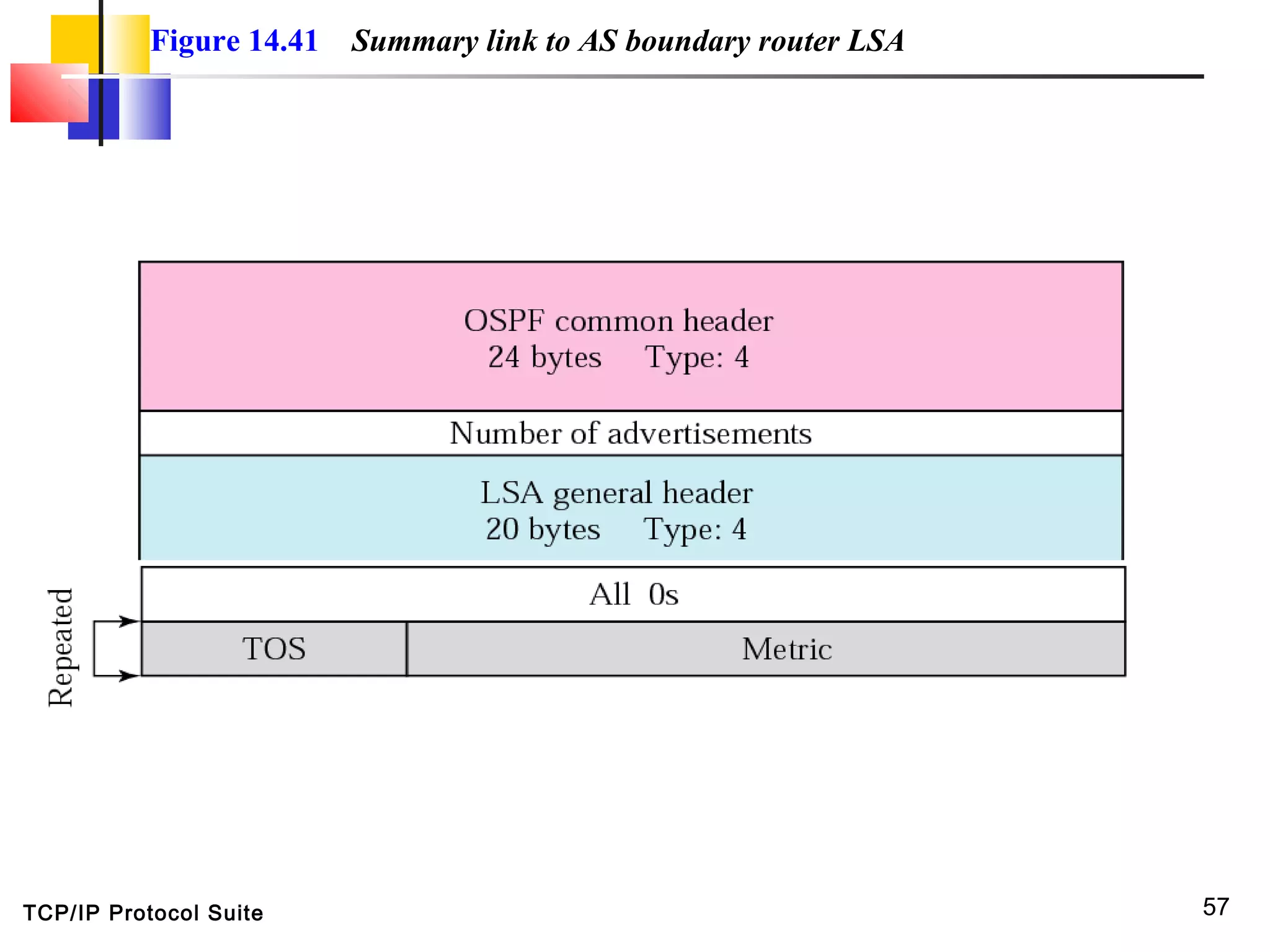
Figure 14.41 Summary link to AS boundary router LSA
TCP/IP Protocol Suite 58
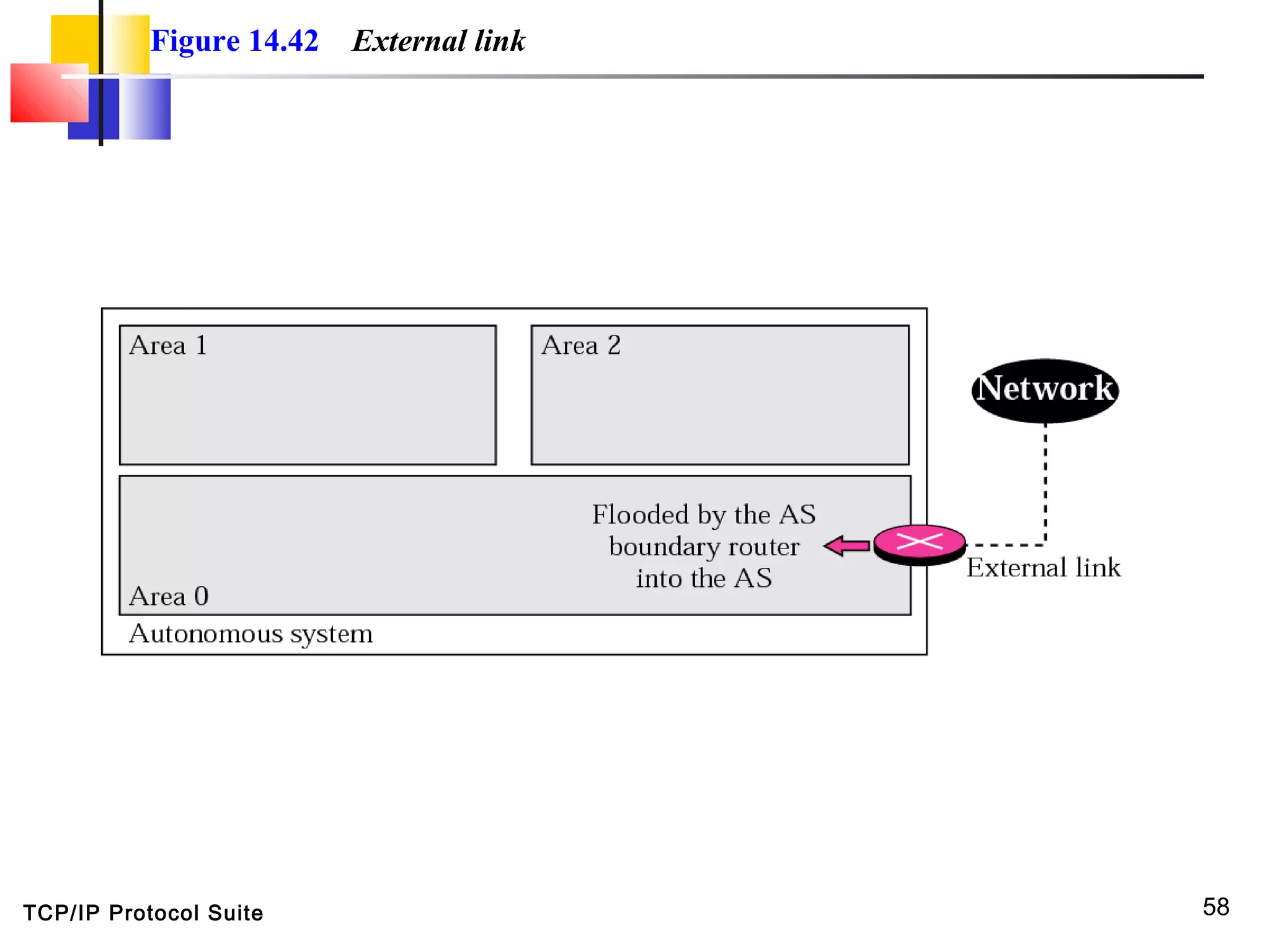
Figure 14.42 External link
TCP/IP Protocol Suite 59
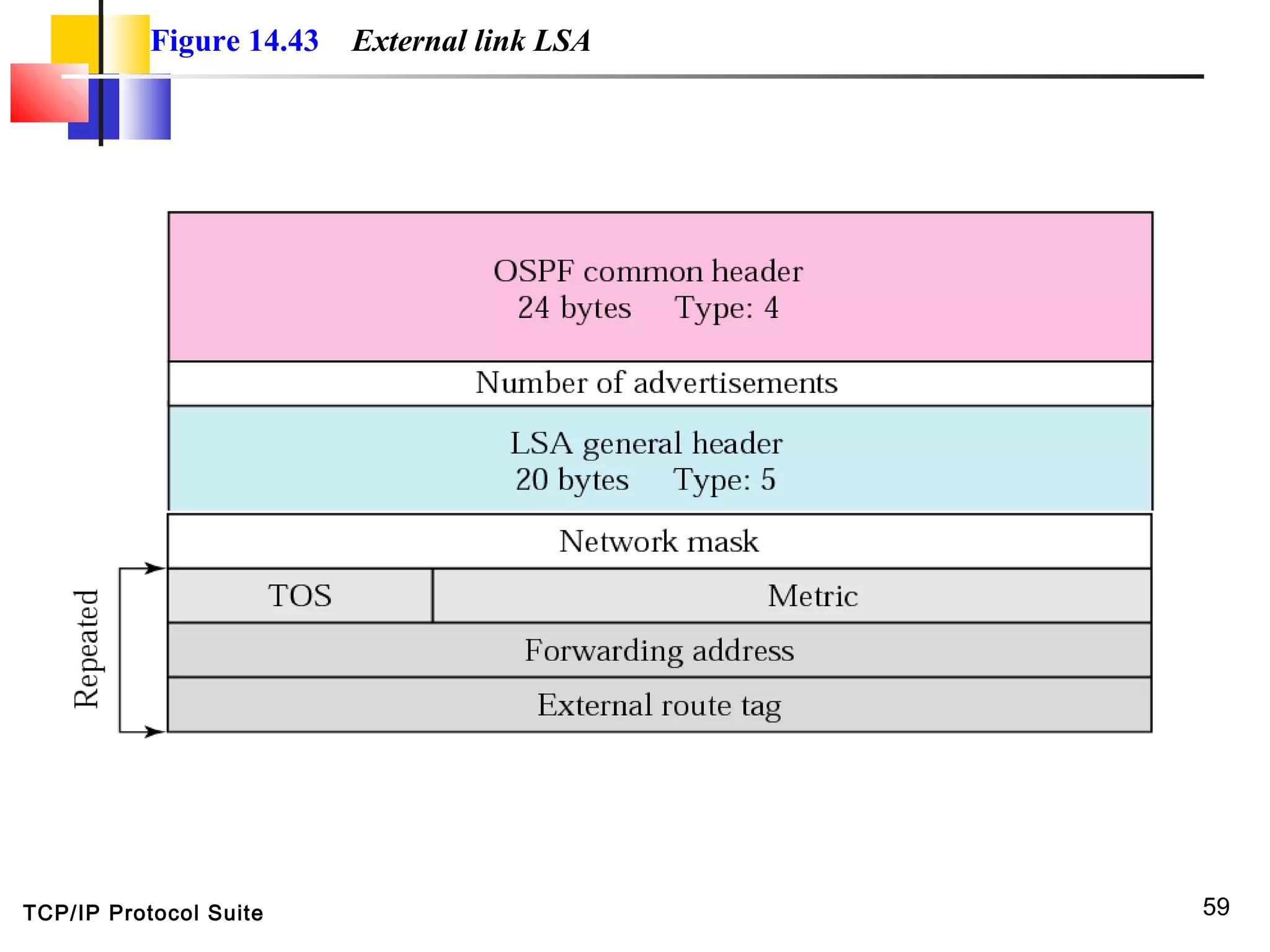
Figure 14.43 External link LSA
TCP/IP Protocol Suite 60
Figure 14.44 Hello packet
TCP/IP Protocol Suite 61
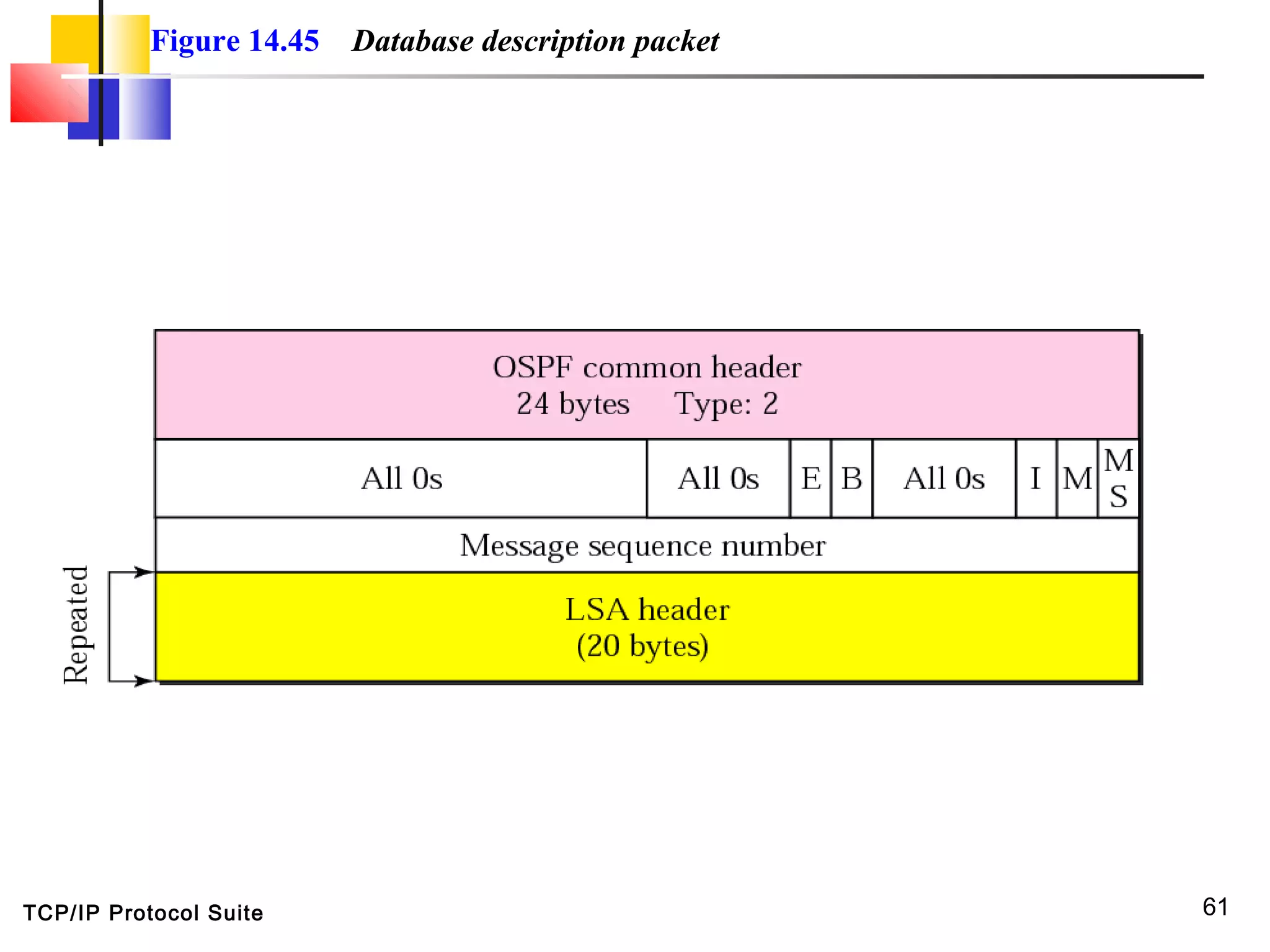
Figure 14.45 Database description packet
TCP/IP Protocol Suite 62
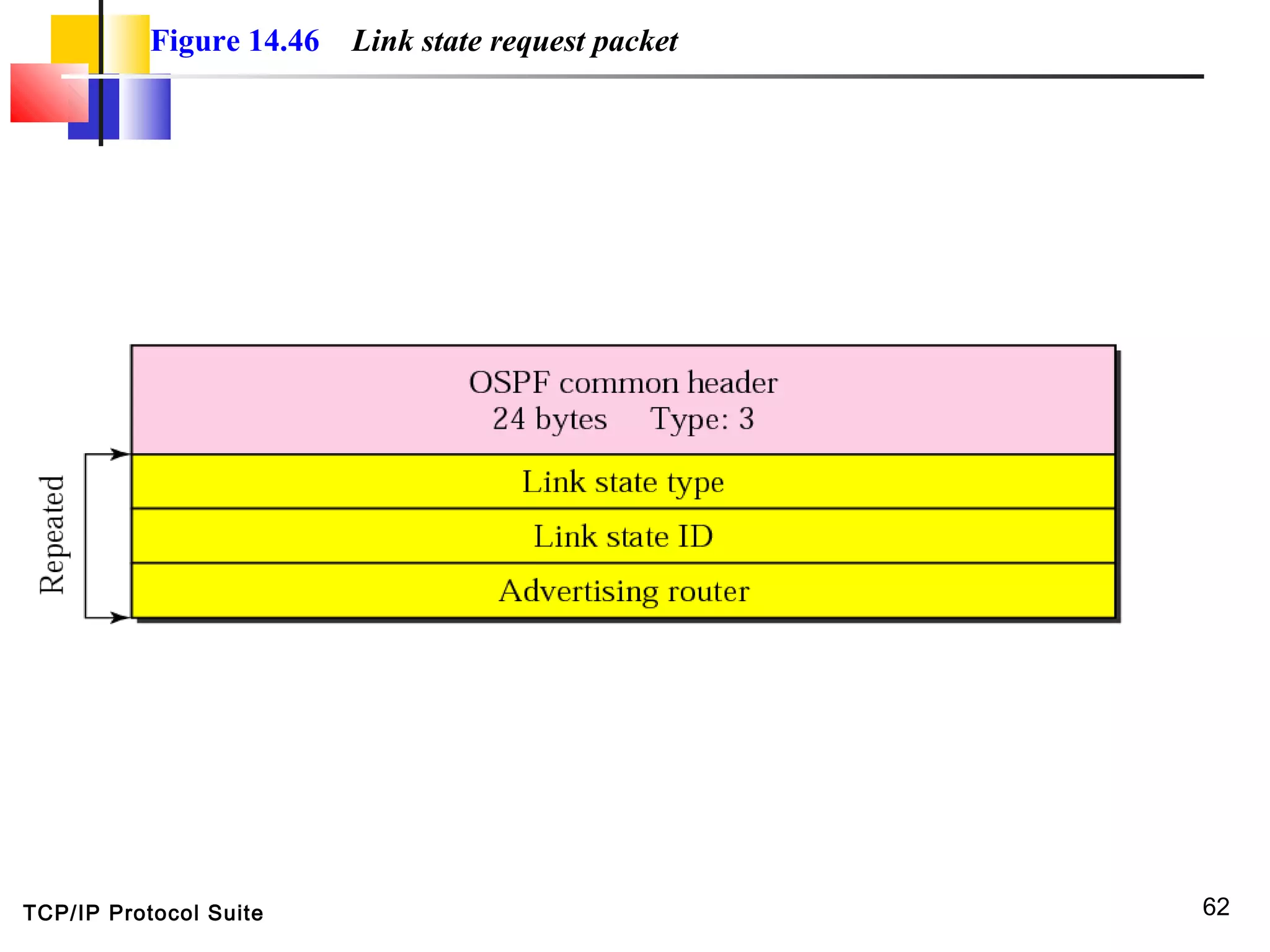
Figure 14.46 Link state request packet
TCP/IP Protocol Suite 63
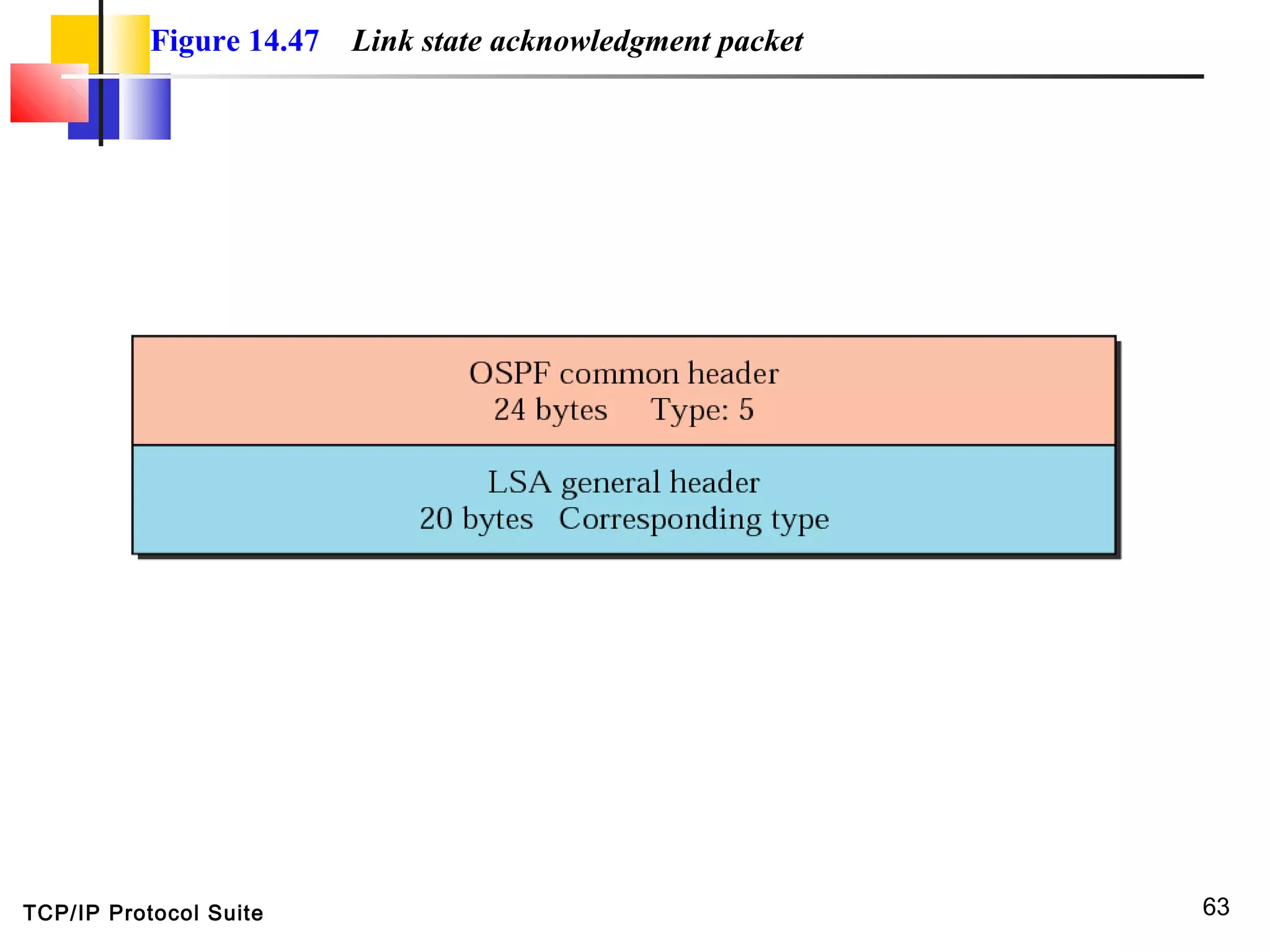
Figure 14.47 Link state acknowledgment packet
TCP/IP Protocol Suite 64
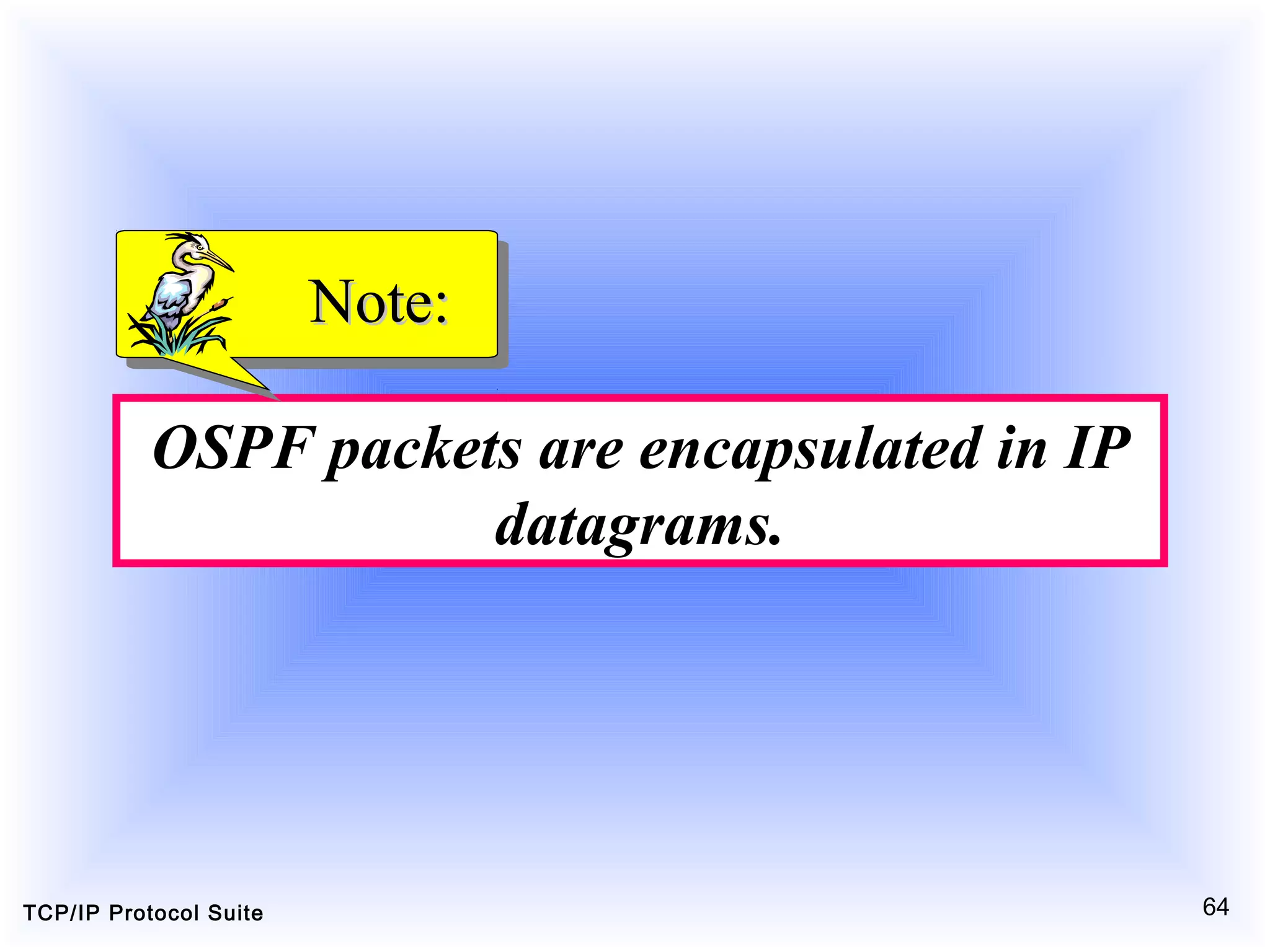
OSPF packets are encapsulated in IP
datagrams.
Note:Note:
TCP/IP Protocol Suite 65
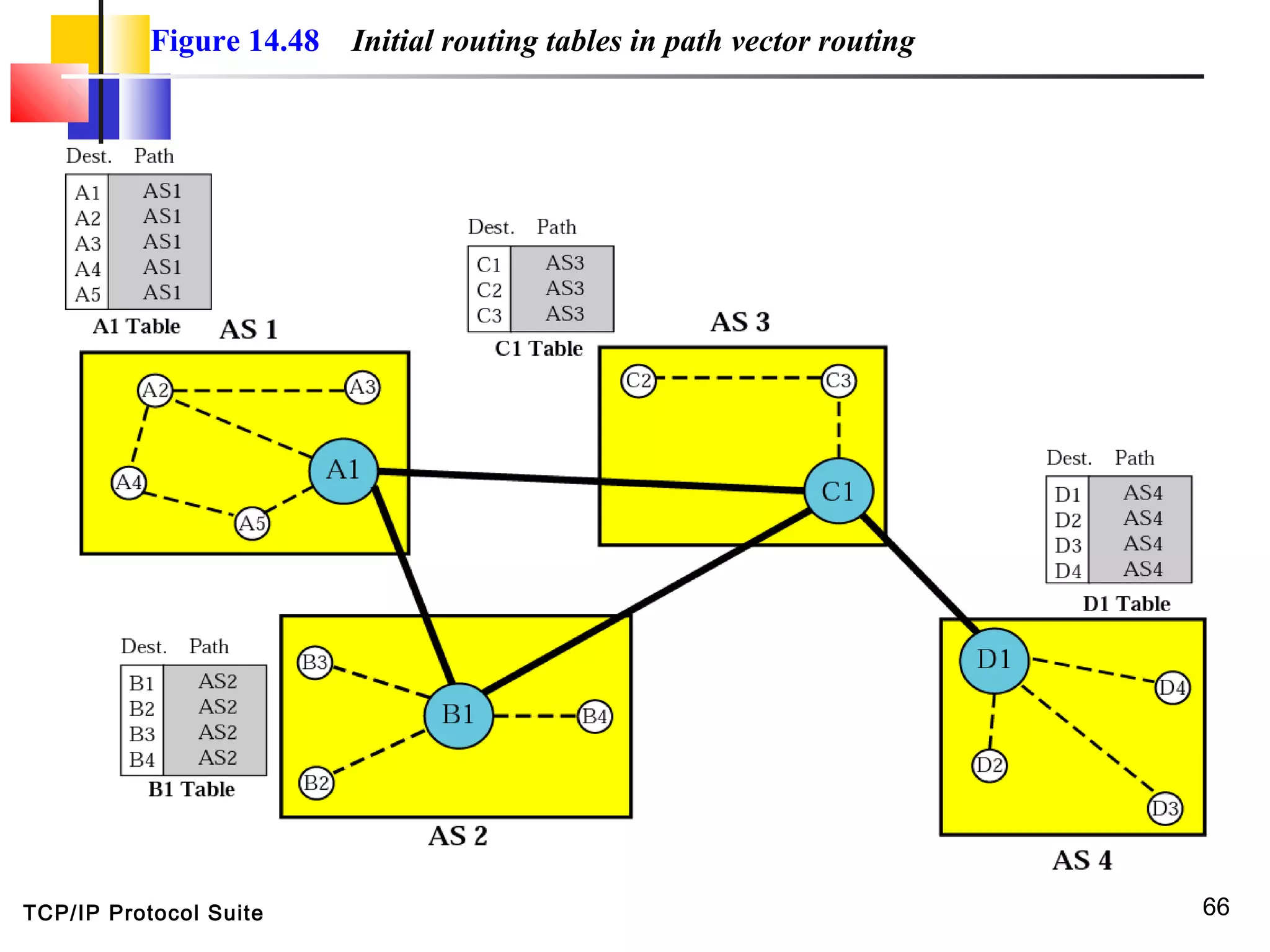
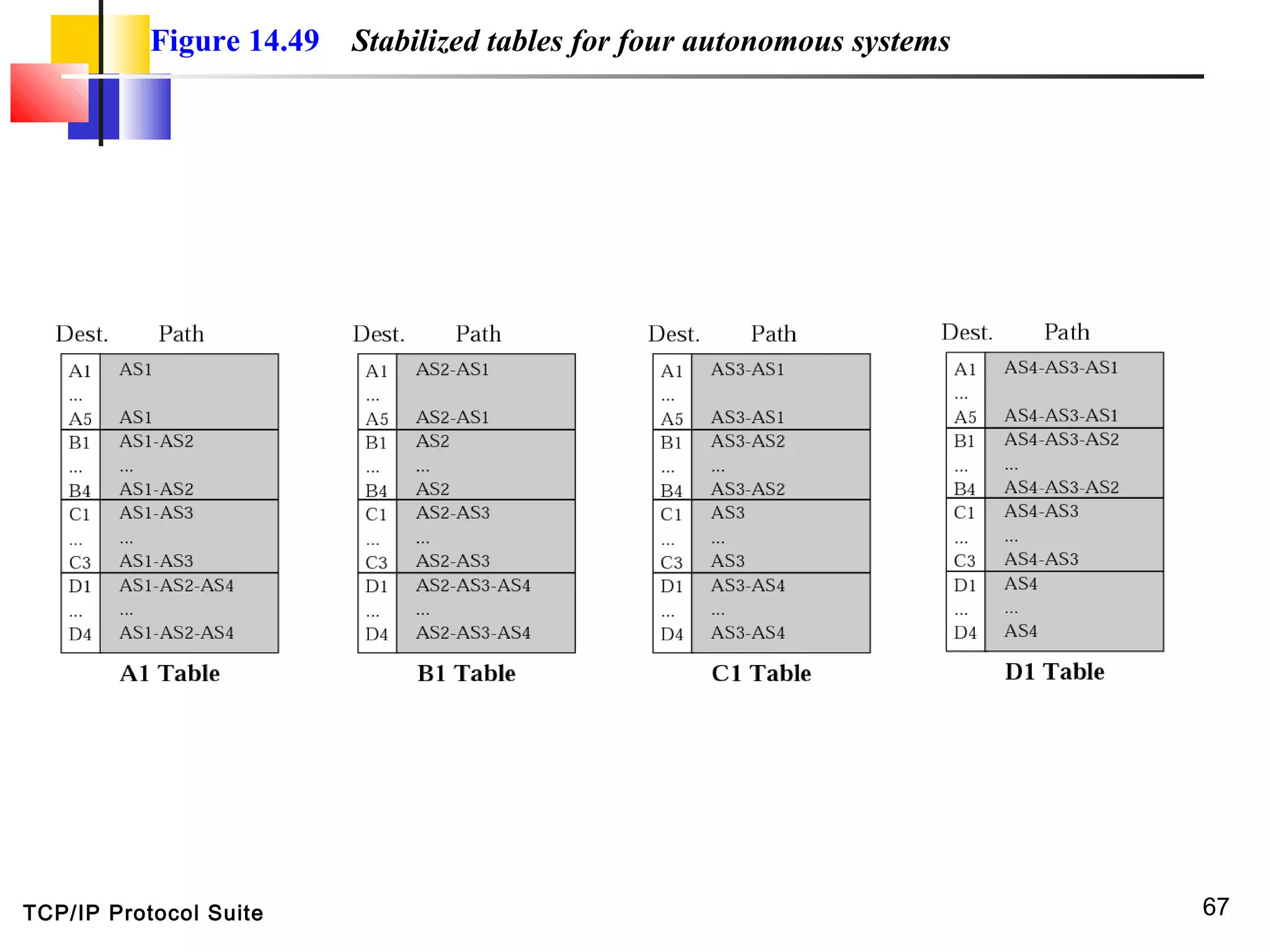
14.6 PATH VECTOR ROUTING
Path vector routing is similar to distance vector routing. There is at leastPath vector routing is similar to distance vector routing. There is at least
one node, called the speaker node, in each AS that creates a routingone node, called the speaker node, in each AS that creates a routing
table and advertises it to speaker nodes in the neighboring ASs..table and advertises it to speaker nodes in the neighboring ASs..
The topics discussed in this section include:The topics discussed in this section include:
InitializationInitialization
SharingSharing
UpdatingUpdating
TCP/IP Protocol Suite 66
Figure 14.48 Initial routing tables in path vector routing
TCP/IP Protocol Suite 67
Figure 14.49 Stabilized tables for four autonomous systems
TCP/IP Protocol Suite 68
14.7 BGP
Border Gateway Protocol (BGP) is an interdomain routing protocolBorder Gateway Protocol (BGP) is an interdomain routing protocol
using path vector routing. It first appeared in 1989 and has goneusing path vector routing. It first appeared in 1989 and has gone
through four versions.through four versions.
The topics discussed in this section include:The topics discussed in this section include:
Types of Autonomous SystemsTypes of Autonomous Systems
Path AttributesPath Attributes
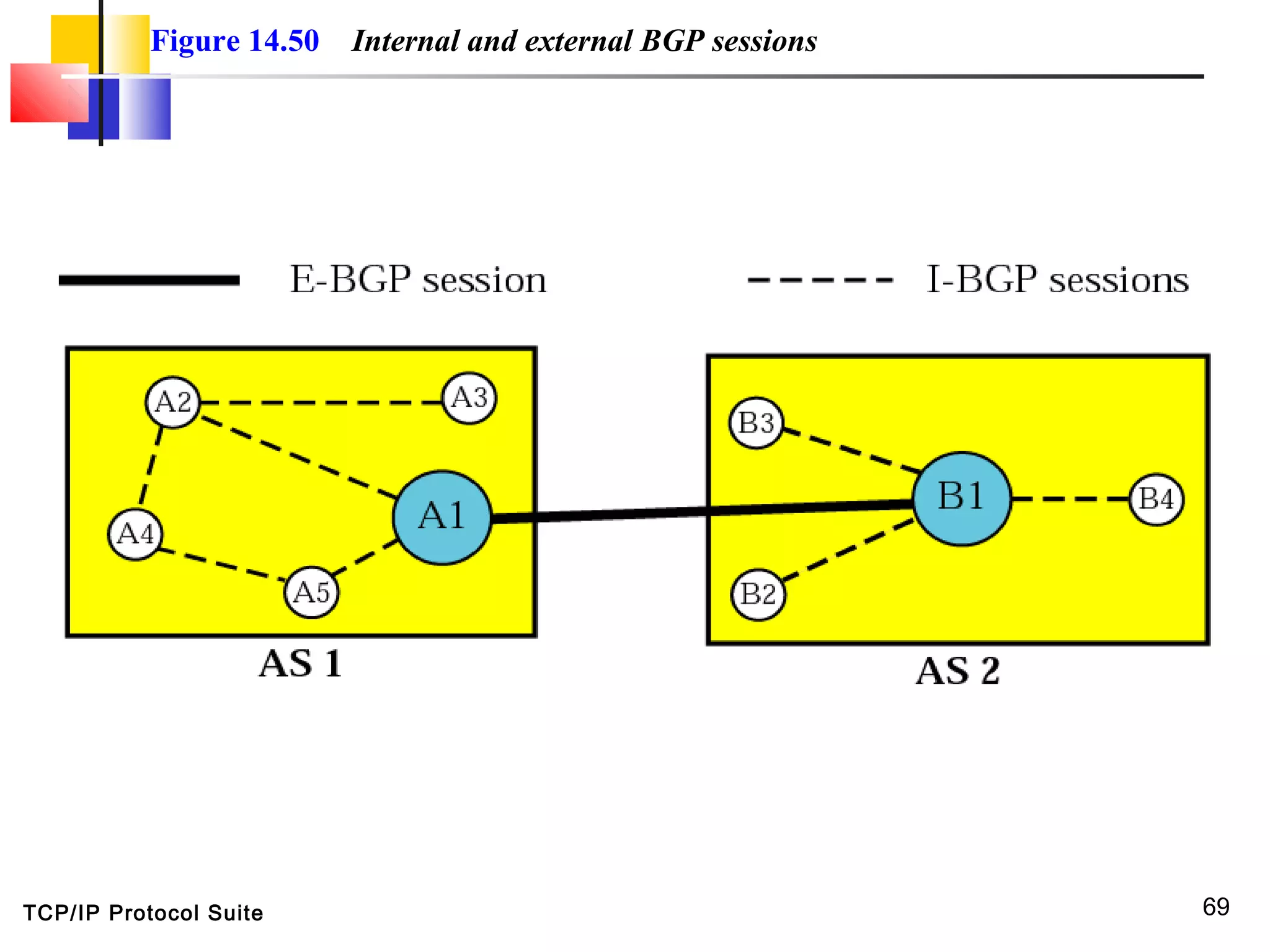
BGP SessionsBGP Sessions
External and Internal BGPExternal and Internal BGP
Types of PacketsTypes of Packets
Packet FormatPacket Format
EncapsulationEncapsulation
TCP/IP Protocol Suite 69
Figure 14.50 Internal and external BGP sessions
TCP/IP Protocol Suite 70
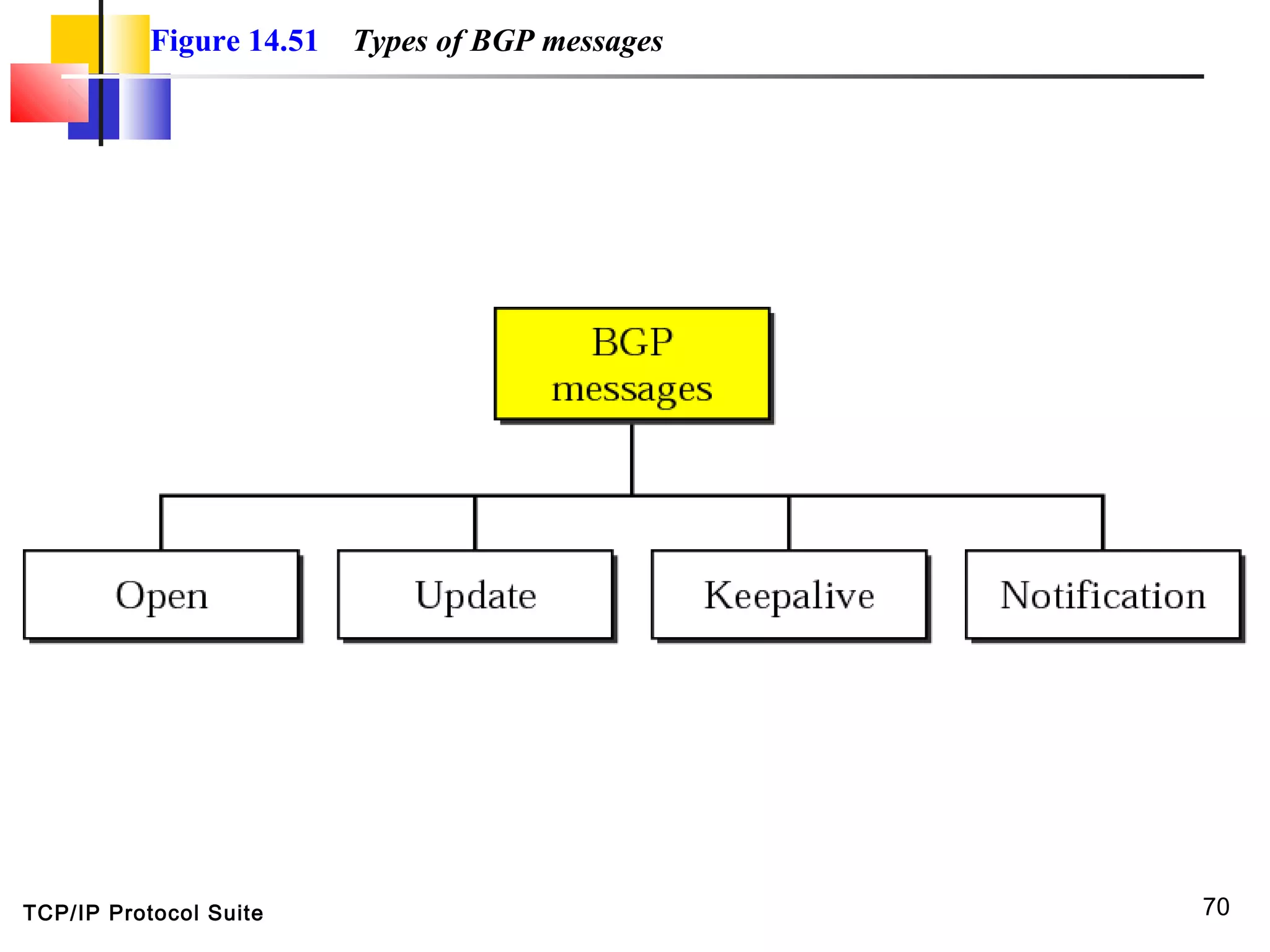
Figure 14.51 Types of BGP messages
TCP/IP Protocol Suite 71
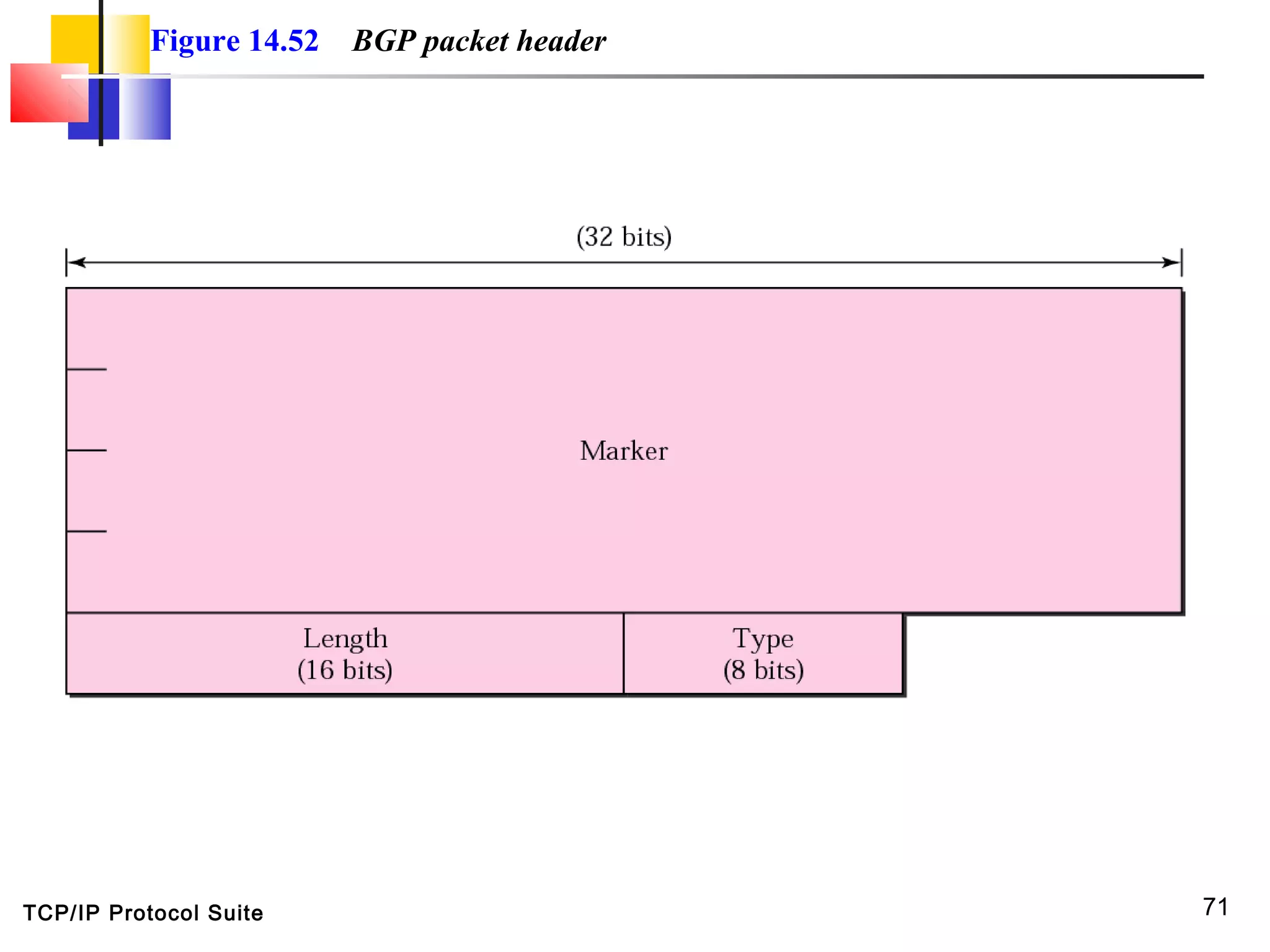
Figure 14.52 BGP packet header
TCP/IP Protocol Suite 72
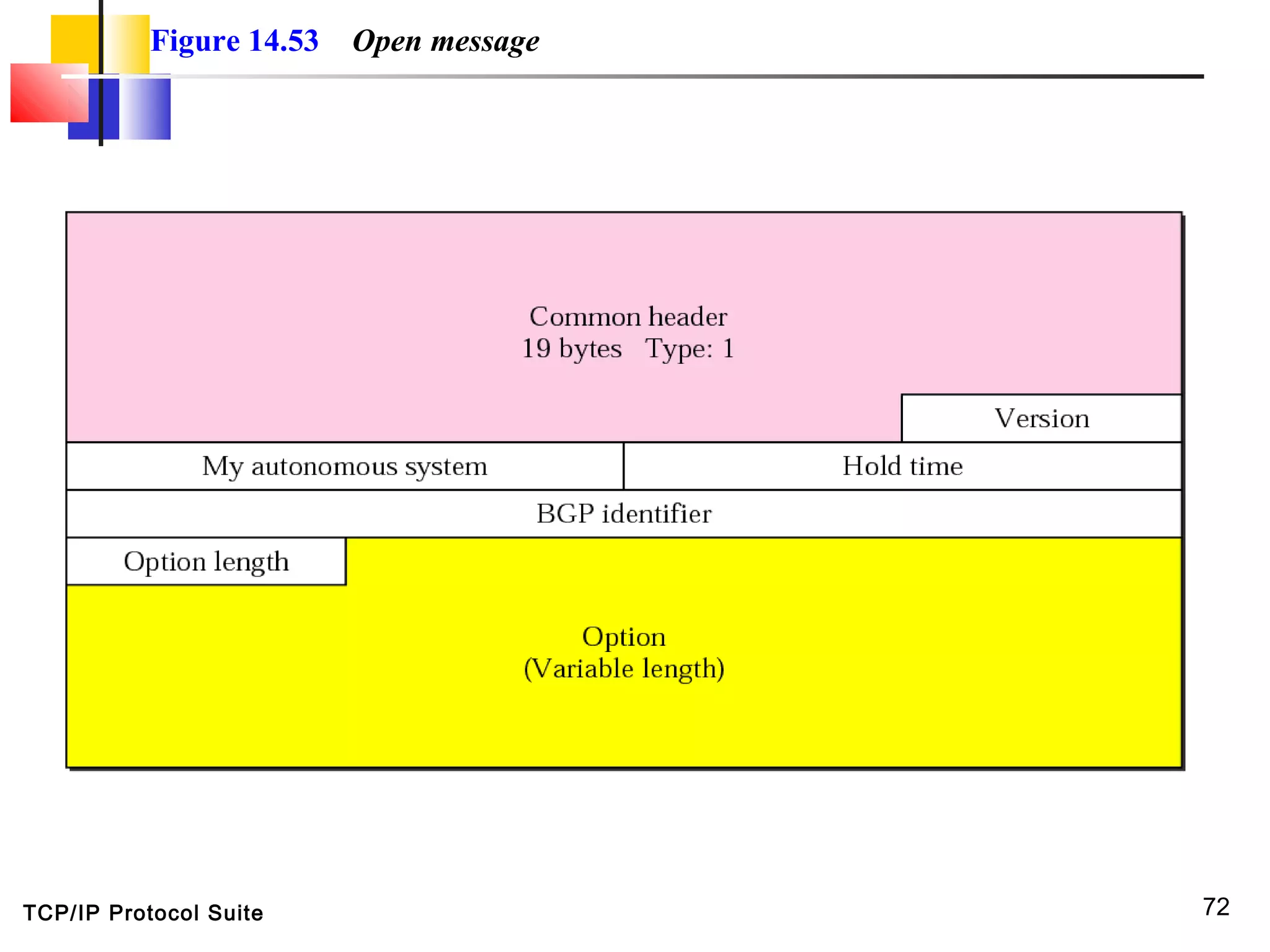
Figure 14.53 Open message
TCP/IP Protocol Suite 73
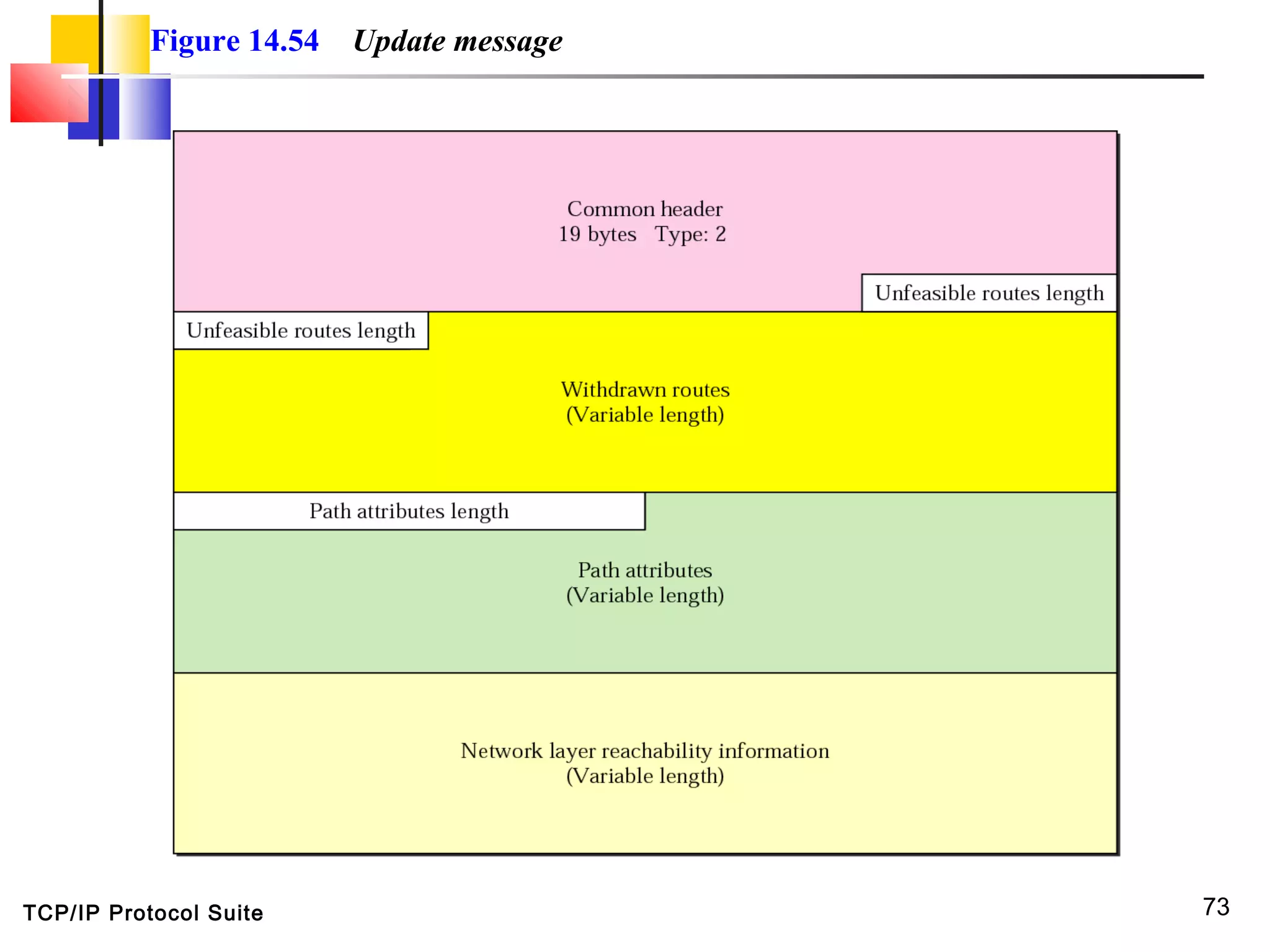
Figure 14.54 Update message
TCP/IP Protocol Suite 74
BGP supports classless addressing and
CIDR.
Note:Note:
TCP/IP Protocol Suite 75
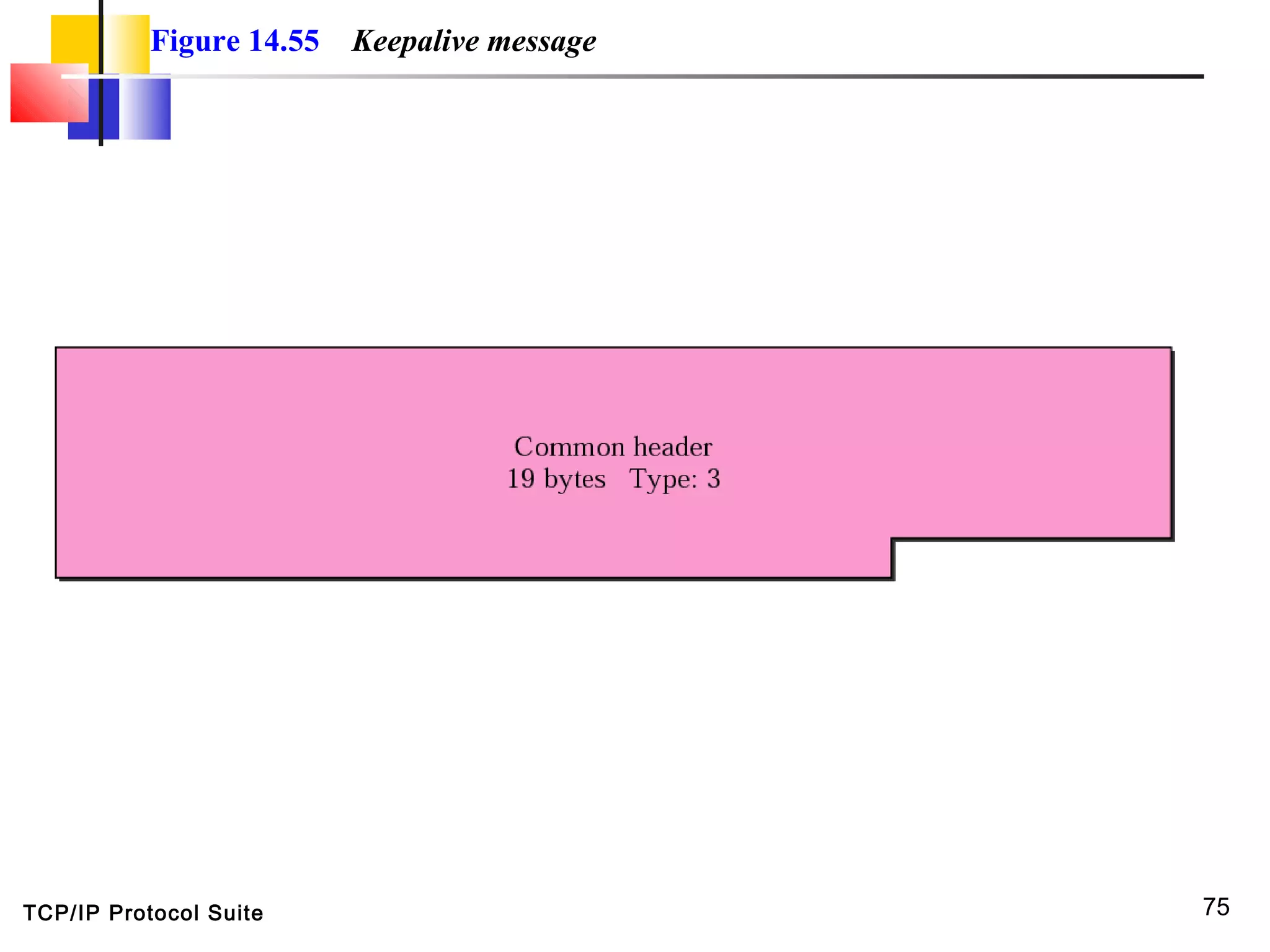
Figure 14.55 Keepalive message
TCP/IP Protocol Suite 76
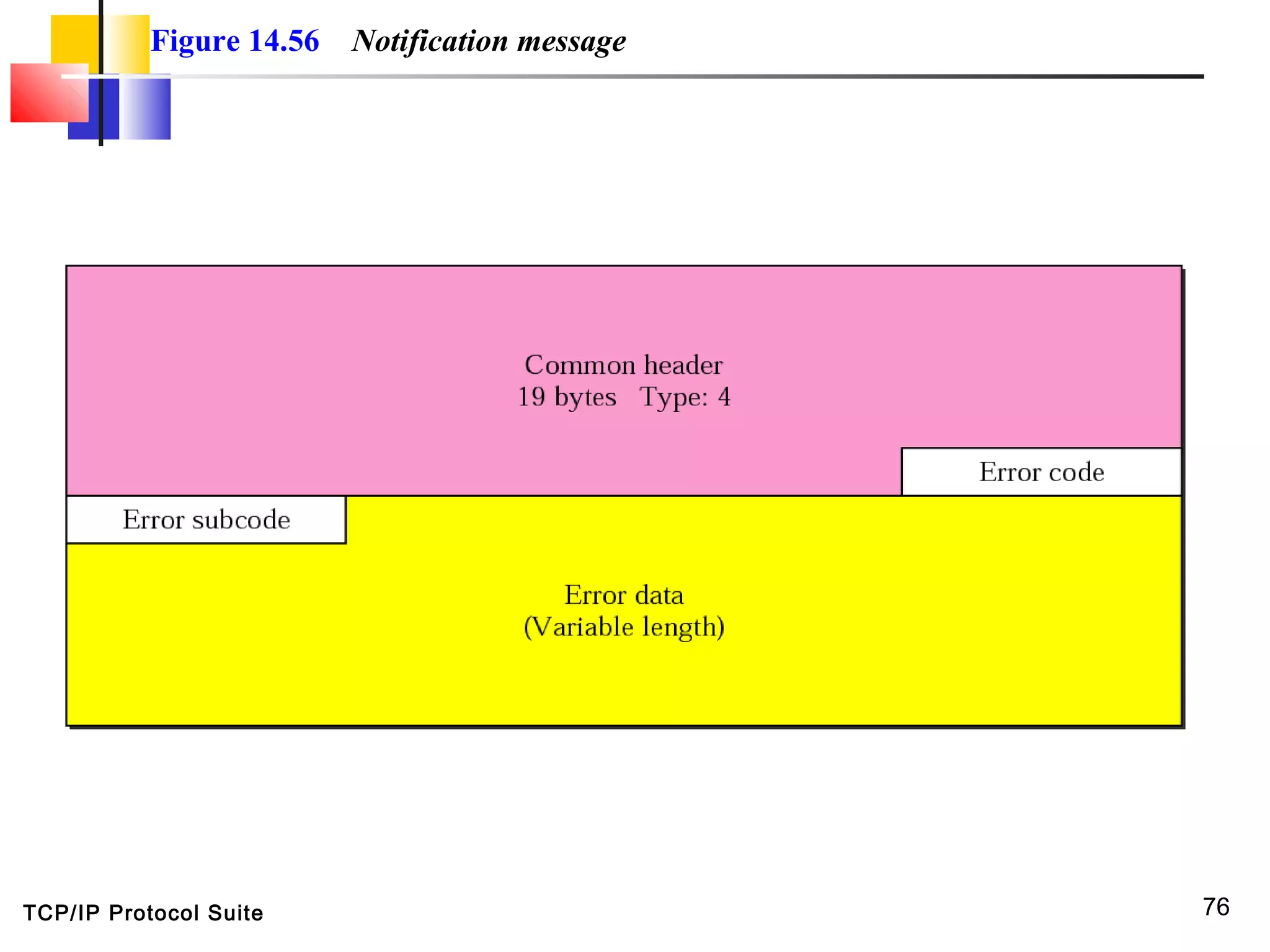
Figure 14.56 Notification message
TCP/IP Protocol Suite 77
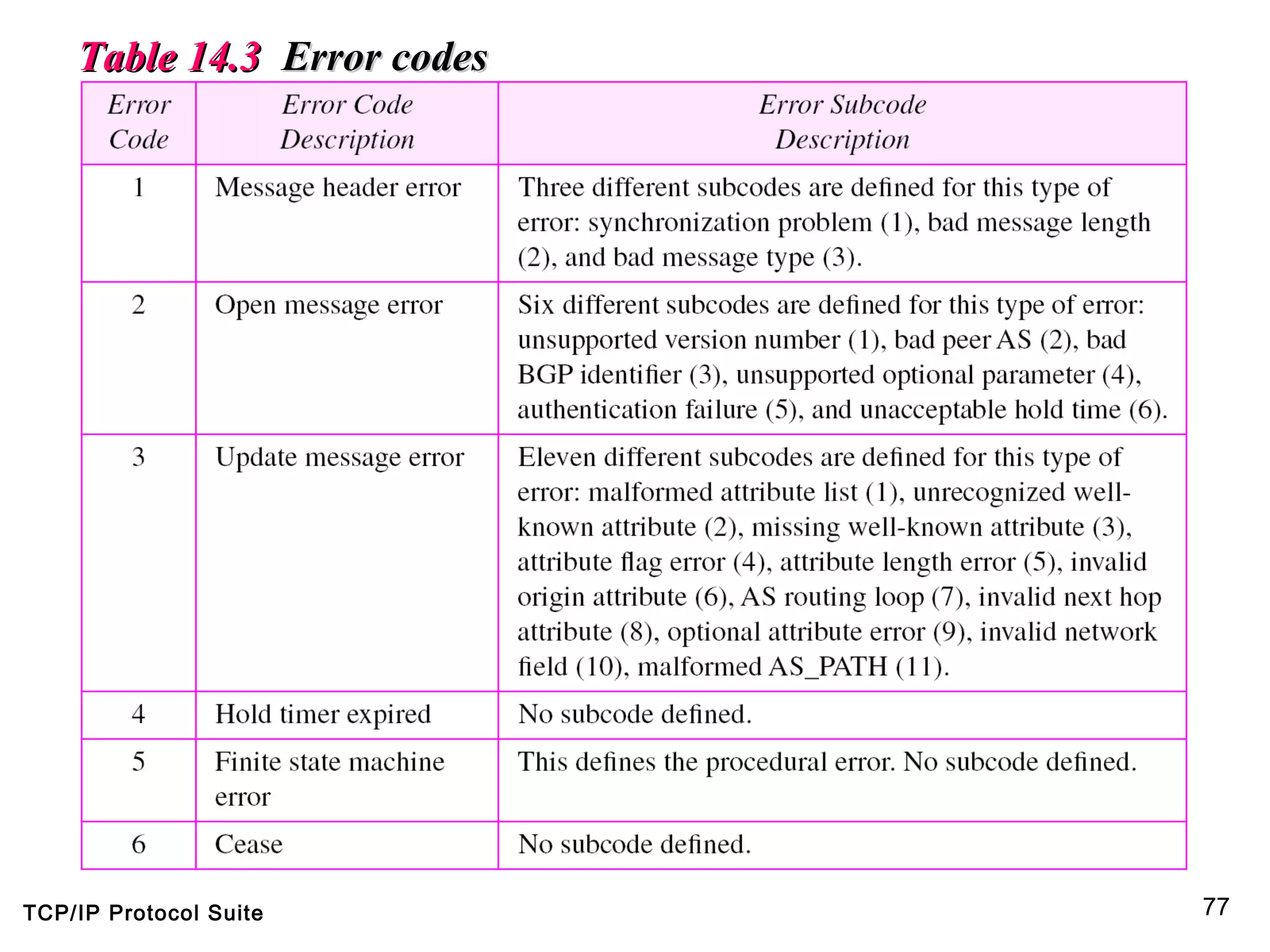
Table 14.3Table 14.3 Error codesError codes
TCP/IP Protocol Suite 78
BGP uses the services of TCP
on port 179.
Note:Note:

Rip ospf and bgp

  • 1.
    TCP/IP Protocol Suite1 Unicast Routing Protocols:Unicast Routing Protocols: RIP, OSPF, and BGPRIP, OSPF, and BGP • Distinguish between intra and interdomain routing • Understand distance vector routing and RIP • Understand link state routing and OSPF • Understand path vector routing and BGP
  • 2.
    TCP/IP Protocol Suite2 14.1 INTRA- AND INTERDOMAIN ROUTING Routing inside an autonomous system is referred to as intradomainRouting inside an autonomous system is referred to as intradomain routing. Routing between autonomous systems is referred to asrouting. Routing between autonomous systems is referred to as interdomain routing.interdomain routing.
  • 3.
    TCP/IP Protocol Suite3 Figure 14.1 Autonomous systems
  • 4.
    TCP/IP Protocol Suite4 Figure 14.2 Popular routing protocols
  • 5.
    TCP/IP Protocol Suite5 14.2 DISTANCE VECTOR ROUTING In distance vector routing, the least cost route between any two nodes isIn distance vector routing, the least cost route between any two nodes is the route with minimum distance. In this protocol each node maintains athe route with minimum distance. In this protocol each node maintains a vector (table) of minimum distances to every nodevector (table) of minimum distances to every node The topics discussed in this section include:The topics discussed in this section include: InitializationInitialization SharingSharing UpdatingUpdating When to ShareWhen to Share Two-Node Loop InstabilityTwo-Node Loop Instability Three-Node InstabilityThree-Node Instability
  • 6.
    TCP/IP Protocol Suite6 Figure 14.3 Distance vector routing tables
  • 7.
    TCP/IP Protocol Suite7 Figure 14.4 Initialization of tables in distance vector routing
  • 8.
    TCP/IP Protocol Suite8 In distance vector routing, each node shares its routing table with its immediate neighbors periodically and when there is a change. Note:Note:
  • 9.
    TCP/IP Protocol Suite9 Figure 14.5 Updating in distance vector routing
  • 10.
    TCP/IP Protocol Suite10 Figure 14.6 Two-node instability
  • 11.
    TCP/IP Protocol Suite11 Figure 14.7 Three-node instability
  • 12.
    TCP/IP Protocol Suite12 14.3 RIP The Routing Information Protocol (RIP) is an intradomain routingThe Routing Information Protocol (RIP) is an intradomain routing protocol used inside an autonomous system. It is a very simple protocolprotocol used inside an autonomous system. It is a very simple protocol based on distance vector routing.based on distance vector routing. The topics discussed in this section include:The topics discussed in this section include: RIP Message FormatRIP Message Format Requests and ResponsesRequests and Responses Timers in RIPTimers in RIP RIP Version 2RIP Version 2 EncapsulationEncapsulation
  • 13.
    TCP/IP Protocol Suite13 Figure 14.8 Example of a domain using RIP
  • 14.
    TCP/IP Protocol Suite14 Figure 14.9 RIP message format
  • 15.
    TCP/IP Protocol Suite15 Figure 14.10 Request messages
  • 16.
    TCP/IP Protocol Suite16 Figure 14.11 shows the update message sent from router R1 to router R2 in Figure 14.8. The message is sent out of interface 130.10.0.2. ExamplE 1 See Next Slide The message is prepared with the combination of split horizon and poison reverse strategy in mind. Router R1 has obtained information about networks 195.2.4.0, 195.2.5.0, and 195.2.6.0 from router R2. When R1 sends an update message to R2, it replaces the actual value of the hop counts for these three networks with 16 (infinity) to prevent any confusion for R2. The figure also shows the table extracted from the message. Router R2 uses the source address of the IP datagram carrying the RIP message from R1 (130.10.02) as the next hop address.
  • 17.
    TCP/IP Protocol Suite17 Figure 14.11 Solution to Example 1
  • 18.
    TCP/IP Protocol Suite18 Figure 14.12 RIP timers
  • 19.
    TCP/IP Protocol Suite19 A routing table has 20 entries. It does not receive information about five routes for 200 s. How many timers are running at this time? ExamplE 2 Solution The 21 timers are listed below: Periodic timer: 1 Expiration timer: 20 − 5 = 15 Garbage collection timer: 5
  • 20.
    TCP/IP Protocol Suite20 Figure 14.13 RIP version 2 format
  • 21.
    TCP/IP Protocol Suite21 Figure 14.14 Authentication
  • 22.
    TCP/IP Protocol Suite22 RIP uses the services of UDP on well-known port 520. Note:Note:
  • 23.
    TCP/IP Protocol Suite23 14.4 LINK STATE ROUTING In link state routing, if each node in the domain has the entire topologyIn link state routing, if each node in the domain has the entire topology of the domain, the node can use Dijkstra’s algorithm to build a routingof the domain, the node can use Dijkstra’s algorithm to build a routing table.table. The topics discussed in this section include:The topics discussed in this section include: Building Routing TablesBuilding Routing Tables
  • 24.
    TCP/IP Protocol Suite24 Figure 14.15 Concept of link state routing
  • 25.
    TCP/IP Protocol Suite25 Figure 14.16 Link state knowledge
  • 26.
    TCP/IP Protocol Suite26 Figure 14.17 Dijkstra algorithm
  • 27.
    TCP/IP Protocol Suite27 Figure 14.18 Example of formation of shortest path tree
  • 28.
    TCP/IP Protocol Suite28 Table 14.1Table 14.1 Routing table for node ARouting table for node A
  • 29.
    TCP/IP Protocol Suite29 14.5 OSPF The Open Shortest Path First (OSPF) protocol is an intradomainThe Open Shortest Path First (OSPF) protocol is an intradomain routing protocol based on link state routing. Its domain is also anrouting protocol based on link state routing. Its domain is also an autonomous system.autonomous system. The topics discussed in this section include:The topics discussed in this section include: AreasAreas MetricMetric Types of LinksTypes of Links Graphical RepresentationGraphical Representation OSPF PacketsOSPF Packets Link State Update PacketLink State Update Packet Other PacketsOther Packets EncapsulationEncapsulation
  • 30.
    TCP/IP Protocol Suite30 Figure 14.19 Areas in an autonomous system
  • 31.
    TCP/IP Protocol Suite31 Figure 14.20 Types of links
  • 32.
    TCP/IP Protocol Suite32 Figure 14.21 Point-to-point link
  • 33.
    TCP/IP Protocol Suite33 Figure 14.22 Transient link
  • 34.
    TCP/IP Protocol Suite34 Figure 14.23 Stub link
  • 35.
    TCP/IP Protocol Suite35 Figure 14.24 Example of an AS and its graphical representation in OSPF
  • 36.
    TCP/IP Protocol Suite36 Figure 14.25 Types of OSPF packets
  • 37.
    TCP/IP Protocol Suite37 Figure 14.26 OSPF common header
  • 38.
    TCP/IP Protocol Suite38 Figure 14.27 Link state update packet
  • 39.
    TCP/IP Protocol Suite39 Figure 14.28 LSA general header
  • 40.
    TCP/IP Protocol Suite40 Figure 14.29 Router link
  • 41.
    TCP/IP Protocol Suite41 Figure 14.30 Router link LSA
  • 42.
    TCP/IP Protocol Suite42 Table 14.2Table 14.2 Link types, link identification, and link dataLink types, link identification, and link data
  • 43.
    TCP/IP Protocol Suite43 Give the router link LSA sent by router 10.24.7.9 in Figure 14.31. ExamplE 3 Solution This router has three links: two of type 1 (point-to- point) and one of type 3 (stub network). Figure 14.32 shows the router link LSA. See Next Slide See Figure 14.32
  • 44.
    TCP/IP Protocol Suite44 Figure 14.31 Example 3
  • 45.
    TCP/IP Protocol Suite45 Figure 14.32 Solution to Example 3
  • 46.
    TCP/IP Protocol Suite46 Figure 14.33 Network link
  • 47.
    TCP/IP Protocol Suite47 Figure 14.34 Network link advertisement format
  • 48.
    TCP/IP Protocol Suite48 Give the network link LSA in Figure 14.35. ExamplE 4 Solution. See Next Slide See Figure 14.36
  • 49.
    TCP/IP Protocol Suite49 Figure 14.35 Example 4
  • 50.
    TCP/IP Protocol Suite50 Figure 14.36 Solution to Example 4
  • 51.
    TCP/IP Protocol Suite51 In Figure 14.37, which router(s) sends out router link LSAs? ExamplE 5 Solution All routers advertise router link LSAs. a. R1 has two links, N1 and N2. b. R2 has one link, N1. c. R3 has two links, N2 and N3. See Next Slide
  • 52.
    TCP/IP Protocol Suite52 Figure 14.37 Example 5 and Example 6
  • 53.
    TCP/IP Protocol Suite53 In Figure 14.37, which router(s) sends out the network link LSAs? ExamplE 6 Solution All three network must advertise network links: a. Advertisement for N1 is done by R1 because it is the only attached router and therefore the designated router. b. Advertisement for N2 can be done by either R1, R2, or R3, depending on which one is chosen as the designated router. c. Advertisement for N3 is done by R3 because it is the only attached router and therefore the designated router.
  • 54.
    TCP/IP Protocol Suite54 Figure 14.38 Summary link to network
  • 55.
    TCP/IP Protocol Suite55 Figure 14.39 Summary link to network LSA
  • 56.
    TCP/IP Protocol Suite56 Figure 14.40 Summary link to AS boundary router
  • 57.
    TCP/IP Protocol Suite57 Figure 14.41 Summary link to AS boundary router LSA
  • 58.
    TCP/IP Protocol Suite58 Figure 14.42 External link
  • 59.
    TCP/IP Protocol Suite59 Figure 14.43 External link LSA
  • 60.
    TCP/IP Protocol Suite60 Figure 14.44 Hello packet
  • 61.
    TCP/IP Protocol Suite61 Figure 14.45 Database description packet
  • 62.
    TCP/IP Protocol Suite62 Figure 14.46 Link state request packet
  • 63.
    TCP/IP Protocol Suite63 Figure 14.47 Link state acknowledgment packet
  • 64.
    TCP/IP Protocol Suite64 OSPF packets are encapsulated in IP datagrams. Note:Note:
  • 65.
    TCP/IP Protocol Suite65 14.6 PATH VECTOR ROUTING Path vector routing is similar to distance vector routing. There is at leastPath vector routing is similar to distance vector routing. There is at least one node, called the speaker node, in each AS that creates a routingone node, called the speaker node, in each AS that creates a routing table and advertises it to speaker nodes in the neighboring ASs..table and advertises it to speaker nodes in the neighboring ASs.. The topics discussed in this section include:The topics discussed in this section include: InitializationInitialization SharingSharing UpdatingUpdating
  • 66.
    TCP/IP Protocol Suite66 Figure 14.48 Initial routing tables in path vector routing
  • 67.
    TCP/IP Protocol Suite67 Figure 14.49 Stabilized tables for four autonomous systems
  • 68.
    TCP/IP Protocol Suite68 14.7 BGP Border Gateway Protocol (BGP) is an interdomain routing protocolBorder Gateway Protocol (BGP) is an interdomain routing protocol using path vector routing. It first appeared in 1989 and has goneusing path vector routing. It first appeared in 1989 and has gone through four versions.through four versions. The topics discussed in this section include:The topics discussed in this section include: Types of Autonomous SystemsTypes of Autonomous Systems Path AttributesPath Attributes BGP SessionsBGP Sessions External and Internal BGPExternal and Internal BGP Types of PacketsTypes of Packets Packet FormatPacket Format EncapsulationEncapsulation
  • 69.
    TCP/IP Protocol Suite69 Figure 14.50 Internal and external BGP sessions
  • 70.
    TCP/IP Protocol Suite70 Figure 14.51 Types of BGP messages
  • 71.
    TCP/IP Protocol Suite71 Figure 14.52 BGP packet header
  • 72.
    TCP/IP Protocol Suite72 Figure 14.53 Open message
  • 73.
    TCP/IP Protocol Suite73 Figure 14.54 Update message
  • 74.
    TCP/IP Protocol Suite74 BGP supports classless addressing and CIDR. Note:Note:
  • 75.
    TCP/IP Protocol Suite75 Figure 14.55 Keepalive message
  • 76.
    TCP/IP Protocol Suite76 Figure 14.56 Notification message
  • 77.
    TCP/IP Protocol Suite77 Table 14.3Table 14.3 Error codesError codes
  • 78.
    TCP/IP Protocol Suite78 BGP uses the services of TCP on port 179. Note:Note: