Kashif Latif
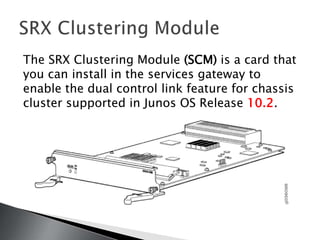
The SRX Clustering Module (SCM) is a card that
you can install in the services gateway to
enable the dual control link feature for chassis
cluster supported in Junos OS Release 10.2.
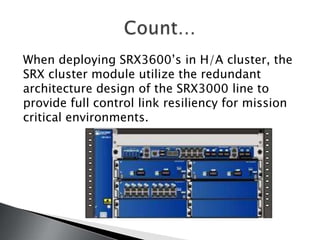
When deploying SRX3600’s in H/A cluster, the
SRX cluster module utilize the redundant
architecture design of the SRX3000 line to
provide full control link resiliency for mission
critical environments.
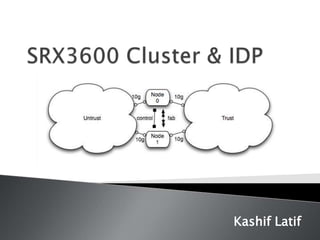
To form a chassis cluster, a pair of the same kind
of supported SRX-series devices or J-series
devices are combined to act as a single system
that enforces the same overall security.
 For SRX 5600 and SRX 5800 chassis
  clusters, the placement and type of Services
  Processing Cards (SPCs) must match in the two
  clusters.
 For SRX 3400 and SRX 3600 chassis
  clusters, the placement and type of
  SPCs, Input/output Cards (IOCs), and Network
  Processing Cards (NPCs) must match in the two
  devices.
For J-series chassis clusters, although the
devices must be the same kind, they can
contain different Physical Interface Modules
(PIMs).

When a device joins a cluster, it becomes a
node of that cluster. With the exception of
unique node settings and management IP
addresses, nodes in a cluster share the same
configuration.
You can deploy up to 15 chassis clusters in a
Layer 2 domain. Clusters and nodes are
identified in the following way:

1.   A cluster is identified by a cluster
     ID (cluster-id) specified as a number from 1
     through 15.
2.   A cluster node is identified by a node
     ID (node) specified as a number from 0 to 1.
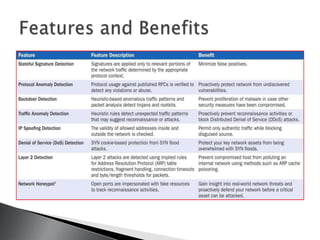
Juniper Networks Intrusion Detection and
Prevention (IDP) products provide comprehensive
and easy-to-use in-line protection that stops
network and application level attacks before they
inflict any damage to the network, minimizing the
time and costs associated with maintaining a
secure network.

 Usingindustry-recognized stateful detection and
 prevention techniques, Juniper Networks IDP
 provides zero day protection against
 worms, Trojans, spyware, key loggers and other
 malware from penetrating the network or
 spreading from already infected users.
Juniper Networks IDP not only helps protect
networks against attacks, it provides
information on rogue servers, as well as types
and versions of applications and operating
systems that may have unknowingly been
added to the network.

Application signatures, available on the Juniper
Networks IDP, goes a step further and enables
accurate detection of specific applications such
as peer-to-peer or instant messaging.
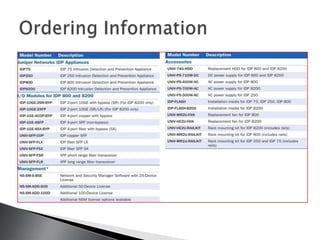
   Juniper Networks IDP 75 brings full Intrusion
    prevention System (IPS) capability to small and
    mid-size businesses as well as remote offices.

    Juniper Networks IDP 250 and IDP 800 offer
    market-leading IPS capabilities to mid-size and
    large enterprises as well as service providers.

    Juniper Networks IDP 8200 offers market
    leading performance with 10 Gbps of real world
    throughput and is also suited for large
    enterprises and service providers.
Kashif Latif

SRX3600 Cluster & IDP

  • 1.
  • 2.
    The SRX ClusteringModule (SCM) is a card that you can install in the services gateway to enable the dual control link feature for chassis cluster supported in Junos OS Release 10.2.
  • 3.
    When deploying SRX3600’sin H/A cluster, the SRX cluster module utilize the redundant architecture design of the SRX3000 line to provide full control link resiliency for mission critical environments.
  • 4.
    To form achassis cluster, a pair of the same kind of supported SRX-series devices or J-series devices are combined to act as a single system that enforces the same overall security.  For SRX 5600 and SRX 5800 chassis clusters, the placement and type of Services Processing Cards (SPCs) must match in the two clusters.  For SRX 3400 and SRX 3600 chassis clusters, the placement and type of SPCs, Input/output Cards (IOCs), and Network Processing Cards (NPCs) must match in the two devices.
  • 5.
    For J-series chassisclusters, although the devices must be the same kind, they can contain different Physical Interface Modules (PIMs). When a device joins a cluster, it becomes a node of that cluster. With the exception of unique node settings and management IP addresses, nodes in a cluster share the same configuration.
  • 6.
    You can deployup to 15 chassis clusters in a Layer 2 domain. Clusters and nodes are identified in the following way: 1. A cluster is identified by a cluster ID (cluster-id) specified as a number from 1 through 15. 2. A cluster node is identified by a node ID (node) specified as a number from 0 to 1.
  • 7.
    Juniper Networks IntrusionDetection and Prevention (IDP) products provide comprehensive and easy-to-use in-line protection that stops network and application level attacks before they inflict any damage to the network, minimizing the time and costs associated with maintaining a secure network.  Usingindustry-recognized stateful detection and prevention techniques, Juniper Networks IDP provides zero day protection against worms, Trojans, spyware, key loggers and other malware from penetrating the network or spreading from already infected users.
  • 8.
    Juniper Networks IDPnot only helps protect networks against attacks, it provides information on rogue servers, as well as types and versions of applications and operating systems that may have unknowingly been added to the network. Application signatures, available on the Juniper Networks IDP, goes a step further and enables accurate detection of specific applications such as peer-to-peer or instant messaging.
  • 11.
    Juniper Networks IDP 75 brings full Intrusion prevention System (IPS) capability to small and mid-size businesses as well as remote offices.  Juniper Networks IDP 250 and IDP 800 offer market-leading IPS capabilities to mid-size and large enterprises as well as service providers.  Juniper Networks IDP 8200 offers market leading performance with 10 Gbps of real world throughput and is also suited for large enterprises and service providers.
  • 12.