ROUTING INFORMATION PROTOCOL
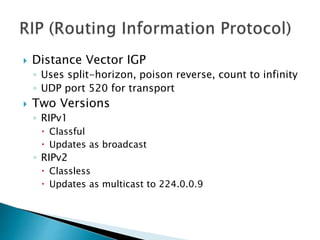
 Distance Vector IGP
◦ Uses split-horizon, poison reverse, count to infinity
◦ UDP port 520 for transport
 Two Versions
◦ RIPv1
 Classful
 Updates as broadcast
◦ RIPv2
 Classless
 Updates as multicast to 224.0.0.9
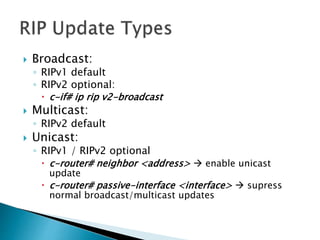
 Broadcast:
◦ RIPv1 default
◦ RIPv2 optional:
 c-if# ip rip v2-broadcast
 Multicast:
◦ RIPv2 default
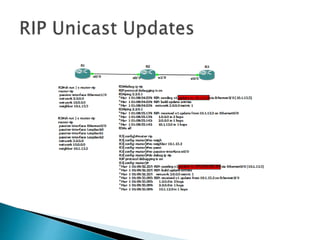
 Unicast:
◦ RIPv1 / RIPv2 optional
 c-router# neighbor <address>  enable unicast
update
 c-router# passive-interface <interface>  supress
normal broadcast/multicast updates
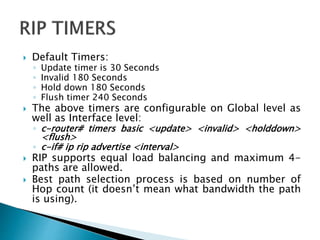
 Default Timers:
◦ Update timer is 30 Seconds
◦ Invalid 180 Seconds
◦ Hold down 180 Seconds
◦ Flush timer 240 Seconds
 The above timers are configurable on Global level as
well as Interface level:
◦ c-router# timers basic <update> <invalid> <holddown>
<flush>
◦ c-if# ip rip advertise <interval>
 RIP supports equal load balancing and maximum 4-
paths are allowed.
 Best path selection process is based on number of
Hop count (it doesn’t mean what bandwidth the path
is using).
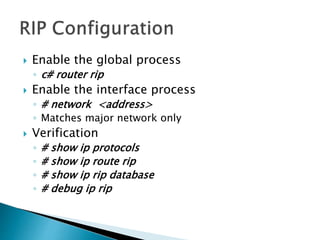
 Enable the global process
◦ c# router rip
 Enable the interface process
◦ # network <address>
◦ Matches major network only
 Verification
◦ # show ip protocols
◦ # show ip route rip
◦ # show ip rip database
◦ # debug ip rip
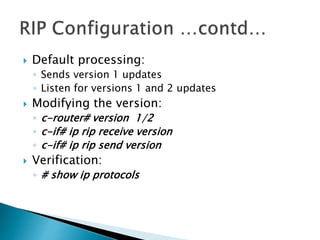
 Default processing:
◦ Sends version 1 updates
◦ Listen for versions 1 and 2 updates
 Modifying the version:
◦ c-router# version 1/2
◦ c-if# ip rip receive version
◦ c-if# ip rip send version
 Verification:
◦ # show ip protocols
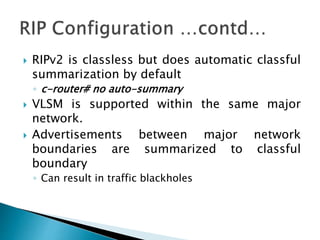
 RIPv2 is classless but does automatic classful
summarization by default
◦ c-router# no auto-summary
 VLSM is supported within the same major
network.
 Advertisements between major network
boundaries are summarized to classful
boundary
◦ Can result in traffic blackholes
 Updates received in an interface will not be
sent back out the same interface.
◦ Undesirable on partial mesh NBMA networks.
 Enabled by default on all interfaces except
main interface in Frame Relay
◦ c-if# no ip split-horizon
 Verification:
◦ # show ip interface
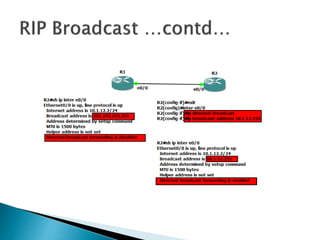
 The default feature of RIPv1 is broadcast with
the broadcast address 255.255.255.255.
 We have flexibility to configure Directed
Broadcast as per interface level which is by
default disabled.
 Directed RIP Broadcast is possible, but it is
not recommended to configure because the
user sitting in other subnet can also see the
ip addresses of your active users via just
pinging the Directed Broadcast Address which
is a kind of Security Breach.
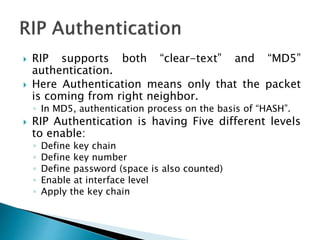
 RIP supports both “clear-text” and “MD5”
authentication.
 Here Authentication means only that the packet
is coming from right neighbor.
◦ In MD5, authentication process on the basis of “HASH”.
 RIP Authentication is having Five different levels
to enable:
◦ Define key chain
◦ Define key number
◦ Define password (space is also counted)
◦ Enable at interface level
◦ Apply the key chain
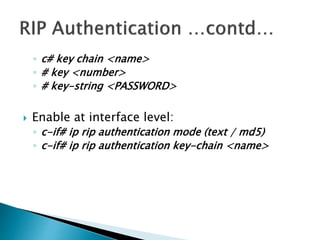
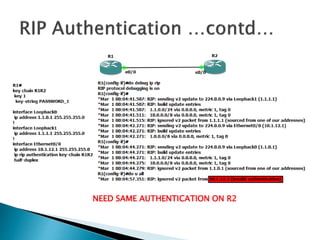
◦ c# key chain <name>
◦ # key <number>
◦ # key-string <PASSWORD>
 Enable at interface level:
◦ c-if# ip rip authentication mode (text / md5)
◦ c-if# ip rip authentication key-chain <name>
NEED SAME AUTHENTICATION ON R2
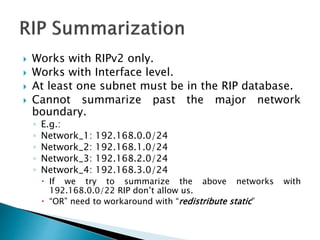
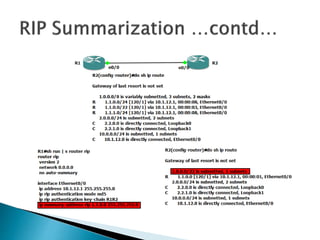
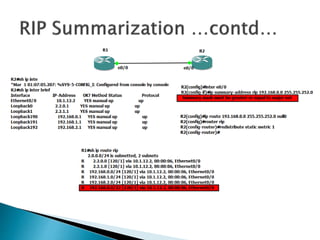
 Works with RIPv2 only.
 Works with Interface level.
 At least one subnet must be in the RIP database.
 Cannot summarize past the major network
boundary.
◦ E.g.:
◦ Network_1: 192.168.0.0/24
◦ Network_2: 192.168.1.0/24
◦ Network_3: 192.168.2.0/24
◦ Network_4: 192.168.3.0/24
 If we try to summarize the above networks with
192.168.0.0/22 RIP don’t allow us.
 “OR” need to workaround with “redistribute static”
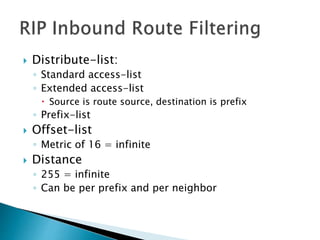
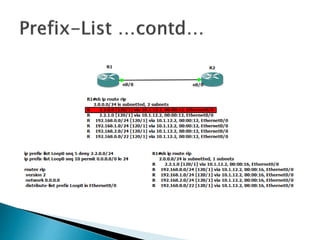
 Distribute-list:
◦ Standard access-list
◦ Extended access-list
 Source is route source, destination is prefix
◦ Prefix-list
 Offset-list
◦ Metric of 16 = infinite
 Distance
◦ 255 = infinite
◦ Can be per prefix and per neighbor
 Outbound and Inbound RIP updates can be
filtered at any interface or for the entire RIP
process.
 Prefix-list is used to match actual route:
◦ E.g.:
 ip prefix-list <name> permit 10.10.10.0/24
(means the above entry does not match either
10.10.10.0/25 or 10.10.0.0/23 in other words any
difference in address field or subnet mask field, this
prefix-list does not work)
 But if we want to match entire range of subnet, we need to
use key-words e.g. “le” (less than or equal to) or “ge”
(greater than or equal to).
◦ E.g.:
 ip prefix-list abc 0.0.0.0/0 le 10
Means any network with any subnet but mask value must be less than or
equal to 10-bits.
 ip prefix-list abc 0.0.0.0/0 (means default route)
 ip prefix-list abc 0.0.0.0/0 ge 32 (means all hosts having 32-bit mask)
 ip prefix-list abc 0.0.0.0/1 ge 8 le 8 (means exact match of 8-bit but
the first bit of network should be 0)
 ip prefix-list abc 128.0.0.0/2 ge 16 le 16 (means exact match of 16-bit
but the first bit of network should be 128)
 ip prefix-list abc 192.0.0.0/3 ge 24 le 24 (means exact match of 24-bit
but the first bit of network should be 192)
 ip prefix-list abc 128.0.0.0/2 le 32 (means anything less than 32-bit
but the first bit of network should be 128)
 RIP uses hop-count as Metric
◦ 1 hop per interface
◦ 16 is infinite
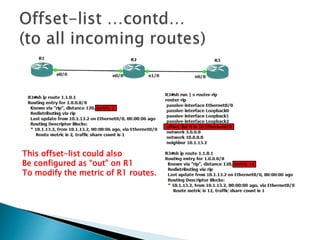
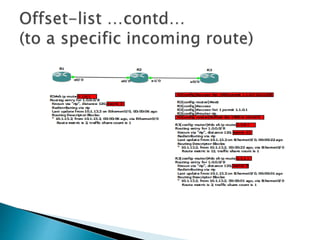
 Offset-list to modify metric (added the previous
metric) and could be configured
inbound/outbound to receive/ send the metric
value.
 Offset-list is used to Traffic Engineering (if we
have multiple paths to reach same destination)
and Route Filtering.
◦ access-list 0 means all routes
◦ Could also be configured on per prefix basis
This offset-list could also
Be configured as “out” on R1
To modify the metric of R1 routes.
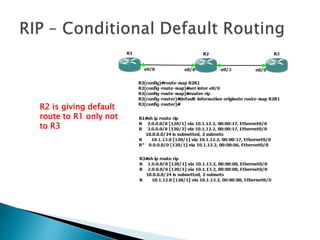
 Default Routing could be configured via two
different ways:
◦ Normal Default Routing
 Under the RIP process via default-information
originate command and default route would be
advertised all the interfaces running RIP protocol.
◦ Conditional Default Routing
 Use Route-map with prefix-list. This helps to control
where we want to send default route.
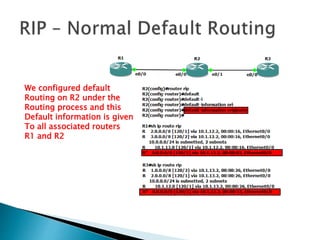
We configured default
Routing on R2 under the
Routing process and this
Default information is given
To all associated routers
R1 and R2
R2 is giving default
route to R1 only not
to R3
 RIP Triggered helps to prevent bandwidth
usage. RIP will send update only when there
is any change in the topology
 Supports suppression of periodic updates.
 RIP Triggered is configured on interface level.
◦ c-if# ip rip triggered
 Updates only accepted from routers on your
same subnet by default.
 Problems with devices running PPP and IPCP
address negotiation.
 Disabled with RIP processing level:
◦ c-router# no validate-update-source

Rip

  • 1.
  • 2.
     Distance VectorIGP ◦ Uses split-horizon, poison reverse, count to infinity ◦ UDP port 520 for transport  Two Versions ◦ RIPv1  Classful  Updates as broadcast ◦ RIPv2  Classless  Updates as multicast to 224.0.0.9
  • 3.
     Broadcast: ◦ RIPv1default ◦ RIPv2 optional:  c-if# ip rip v2-broadcast  Multicast: ◦ RIPv2 default  Unicast: ◦ RIPv1 / RIPv2 optional  c-router# neighbor <address>  enable unicast update  c-router# passive-interface <interface>  supress normal broadcast/multicast updates
  • 4.
     Default Timers: ◦Update timer is 30 Seconds ◦ Invalid 180 Seconds ◦ Hold down 180 Seconds ◦ Flush timer 240 Seconds  The above timers are configurable on Global level as well as Interface level: ◦ c-router# timers basic <update> <invalid> <holddown> <flush> ◦ c-if# ip rip advertise <interval>  RIP supports equal load balancing and maximum 4- paths are allowed.  Best path selection process is based on number of Hop count (it doesn’t mean what bandwidth the path is using).
  • 5.
     Enable theglobal process ◦ c# router rip  Enable the interface process ◦ # network <address> ◦ Matches major network only  Verification ◦ # show ip protocols ◦ # show ip route rip ◦ # show ip rip database ◦ # debug ip rip
  • 6.
     Default processing: ◦Sends version 1 updates ◦ Listen for versions 1 and 2 updates  Modifying the version: ◦ c-router# version 1/2 ◦ c-if# ip rip receive version ◦ c-if# ip rip send version  Verification: ◦ # show ip protocols
  • 7.
     RIPv2 isclassless but does automatic classful summarization by default ◦ c-router# no auto-summary  VLSM is supported within the same major network.  Advertisements between major network boundaries are summarized to classful boundary ◦ Can result in traffic blackholes
  • 8.
     Updates receivedin an interface will not be sent back out the same interface. ◦ Undesirable on partial mesh NBMA networks.  Enabled by default on all interfaces except main interface in Frame Relay ◦ c-if# no ip split-horizon  Verification: ◦ # show ip interface
  • 9.
     The defaultfeature of RIPv1 is broadcast with the broadcast address 255.255.255.255.  We have flexibility to configure Directed Broadcast as per interface level which is by default disabled.
  • 11.
     Directed RIPBroadcast is possible, but it is not recommended to configure because the user sitting in other subnet can also see the ip addresses of your active users via just pinging the Directed Broadcast Address which is a kind of Security Breach.
  • 13.
     RIP supportsboth “clear-text” and “MD5” authentication.  Here Authentication means only that the packet is coming from right neighbor. ◦ In MD5, authentication process on the basis of “HASH”.  RIP Authentication is having Five different levels to enable: ◦ Define key chain ◦ Define key number ◦ Define password (space is also counted) ◦ Enable at interface level ◦ Apply the key chain
  • 14.
    ◦ c# keychain <name> ◦ # key <number> ◦ # key-string <PASSWORD>  Enable at interface level: ◦ c-if# ip rip authentication mode (text / md5) ◦ c-if# ip rip authentication key-chain <name>
  • 15.
  • 16.
     Works withRIPv2 only.  Works with Interface level.  At least one subnet must be in the RIP database.  Cannot summarize past the major network boundary. ◦ E.g.: ◦ Network_1: 192.168.0.0/24 ◦ Network_2: 192.168.1.0/24 ◦ Network_3: 192.168.2.0/24 ◦ Network_4: 192.168.3.0/24  If we try to summarize the above networks with 192.168.0.0/22 RIP don’t allow us.  “OR” need to workaround with “redistribute static”
  • 19.
     Distribute-list: ◦ Standardaccess-list ◦ Extended access-list  Source is route source, destination is prefix ◦ Prefix-list  Offset-list ◦ Metric of 16 = infinite  Distance ◦ 255 = infinite ◦ Can be per prefix and per neighbor
  • 20.
     Outbound andInbound RIP updates can be filtered at any interface or for the entire RIP process.  Prefix-list is used to match actual route: ◦ E.g.:  ip prefix-list <name> permit 10.10.10.0/24 (means the above entry does not match either 10.10.10.0/25 or 10.10.0.0/23 in other words any difference in address field or subnet mask field, this prefix-list does not work)
  • 21.
     But ifwe want to match entire range of subnet, we need to use key-words e.g. “le” (less than or equal to) or “ge” (greater than or equal to). ◦ E.g.:  ip prefix-list abc 0.0.0.0/0 le 10 Means any network with any subnet but mask value must be less than or equal to 10-bits.  ip prefix-list abc 0.0.0.0/0 (means default route)  ip prefix-list abc 0.0.0.0/0 ge 32 (means all hosts having 32-bit mask)  ip prefix-list abc 0.0.0.0/1 ge 8 le 8 (means exact match of 8-bit but the first bit of network should be 0)  ip prefix-list abc 128.0.0.0/2 ge 16 le 16 (means exact match of 16-bit but the first bit of network should be 128)  ip prefix-list abc 192.0.0.0/3 ge 24 le 24 (means exact match of 24-bit but the first bit of network should be 192)  ip prefix-list abc 128.0.0.0/2 le 32 (means anything less than 32-bit but the first bit of network should be 128)
  • 23.
     RIP useshop-count as Metric ◦ 1 hop per interface ◦ 16 is infinite  Offset-list to modify metric (added the previous metric) and could be configured inbound/outbound to receive/ send the metric value.  Offset-list is used to Traffic Engineering (if we have multiple paths to reach same destination) and Route Filtering. ◦ access-list 0 means all routes ◦ Could also be configured on per prefix basis
  • 24.
    This offset-list couldalso Be configured as “out” on R1 To modify the metric of R1 routes.
  • 26.
     Default Routingcould be configured via two different ways: ◦ Normal Default Routing  Under the RIP process via default-information originate command and default route would be advertised all the interfaces running RIP protocol. ◦ Conditional Default Routing  Use Route-map with prefix-list. This helps to control where we want to send default route.
  • 27.
    We configured default Routingon R2 under the Routing process and this Default information is given To all associated routers R1 and R2
  • 28.
    R2 is givingdefault route to R1 only not to R3
  • 29.
     RIP Triggeredhelps to prevent bandwidth usage. RIP will send update only when there is any change in the topology  Supports suppression of periodic updates.  RIP Triggered is configured on interface level. ◦ c-if# ip rip triggered
  • 30.
     Updates onlyaccepted from routers on your same subnet by default.  Problems with devices running PPP and IPCP address negotiation.  Disabled with RIP processing level: ◦ c-router# no validate-update-source