UNIT 5 - RADICALS
ROOTS AND RADICAL EXPRESSIONS
IMPORTANT INFO
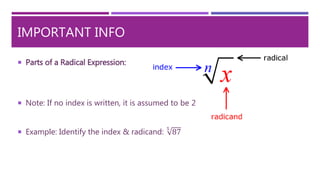
 Parts of a Radical Expression:
 Note: If no index is written, it is assumed to be 2
 Example: Identify the index & radicand:
5
87
IMPORTANT INFO
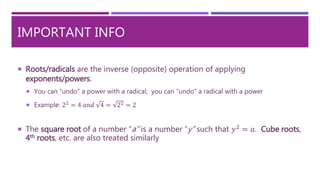
 Roots/radicals are the inverse (opposite) operation of applying
exponents/powers.
 You can “undo” a power with a radical; you can “undo” a radical with a power
 Example: 22
= 4 𝑎𝑛𝑑 4 = 22 = 2
 The square root of a number “a” is a number “y” such that 𝑦2 = 𝑎. Cube roots,
4th roots, etc. are also treated similarly
IF 𝑎 𝑛
= 𝑏, THEN 𝑎 IS THE NTH ROOT OF 𝑏
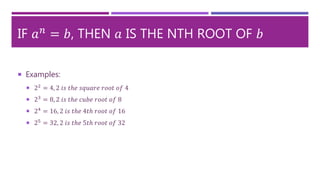
 Examples:
 22
= 4, 2 𝑖𝑠 𝑡ℎ𝑒 𝑠𝑞𝑢𝑎𝑟𝑒 𝑟𝑜𝑜𝑡 𝑜𝑓 4
 23 = 8, 2 𝑖𝑠 𝑡ℎ𝑒 𝑐𝑢𝑏𝑒 𝑟𝑜𝑜𝑡 𝑜𝑓 8
 24 = 16, 2 𝑖𝑠 𝑡ℎ𝑒 4𝑡ℎ 𝑟𝑜𝑜𝑡 𝑜𝑓 16
 25
= 32, 2 𝑖𝑠 𝑡ℎ𝑒 5𝑡ℎ 𝑟𝑜𝑜𝑡 𝑜𝑓 32
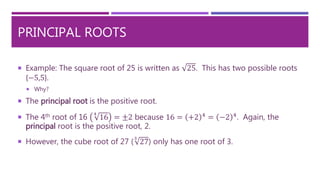
PRINCIPAL ROOTS
 Example: The square root of 25 is written as 25. This has two possible roots
{−5,5}.
 Why?
 The principal root is the positive root.
 The 4th root of 16
4
16 = ±2 because 16 = +2 4 = −2 4. Again, the
principal root is the positive root, 2.
 However, the cube root of 27 (
3
27) only has one root of 3.
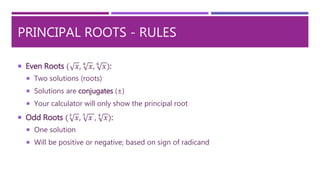
PRINCIPAL ROOTS - RULES
 Even Roots ( 𝑥, 4
𝑥, 6
𝑥):
 Two solutions (roots)
 Solutions are conjugates (±)
 Your calculator will only show the principal root
 Odd Roots (3
𝑥, 5
𝑥 , 4
𝑥):
 One solution
 Will be positive or negative; based on sign of radicand
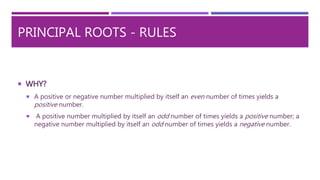
PRINCIPAL ROOTS - RULES
 WHY?
 A positive or negative number multiplied by itself an even number of times yields a
positive number.
 A positive number multiplied by itself an odd number of times yields a positive number; a
negative number multiplied by itself an odd number of times yields a negative number.
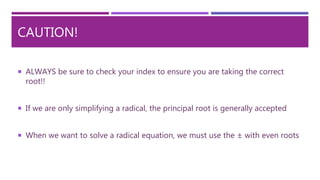
CAUTION!
 ALWAYS be sure to check your index to ensure you are taking the correct
root!!
 If we are only simplifying a radical, the principal root is generally accepted
 When we want to solve a radical equation, we must use the ± with even roots
EXPONENT TABLE
 Complete the exponent table on the last page of your packet using your TI-
84.
 We will refer to this table when simplifying radicals
 (You can/should remove this page to make it easier for future use)
PRACTICE
SIMPLIFY NTH ROOTS
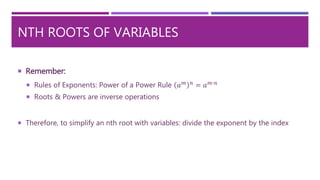
NTH ROOTS OF VARIABLES
 Remember:
 Rules of Exponents: Power of a Power Rule 𝑎 𝑚 𝑛
= 𝑎 𝑚∙𝑛
 Roots & Powers are inverse operations
 Therefore, to simplify an nth root with variables: divide the exponent by the index
PRACTICE
SIMPLIFY NTH ROOTS

Roots and Radical Expressions Notes

  • 1.
    UNIT 5 -RADICALS ROOTS AND RADICAL EXPRESSIONS
  • 2.
    IMPORTANT INFO  Partsof a Radical Expression:  Note: If no index is written, it is assumed to be 2  Example: Identify the index & radicand: 5 87
  • 3.
    IMPORTANT INFO  Roots/radicalsare the inverse (opposite) operation of applying exponents/powers.  You can “undo” a power with a radical; you can “undo” a radical with a power  Example: 22 = 4 𝑎𝑛𝑑 4 = 22 = 2  The square root of a number “a” is a number “y” such that 𝑦2 = 𝑎. Cube roots, 4th roots, etc. are also treated similarly
  • 4.
    IF 𝑎 𝑛 =𝑏, THEN 𝑎 IS THE NTH ROOT OF 𝑏  Examples:  22 = 4, 2 𝑖𝑠 𝑡ℎ𝑒 𝑠𝑞𝑢𝑎𝑟𝑒 𝑟𝑜𝑜𝑡 𝑜𝑓 4  23 = 8, 2 𝑖𝑠 𝑡ℎ𝑒 𝑐𝑢𝑏𝑒 𝑟𝑜𝑜𝑡 𝑜𝑓 8  24 = 16, 2 𝑖𝑠 𝑡ℎ𝑒 4𝑡ℎ 𝑟𝑜𝑜𝑡 𝑜𝑓 16  25 = 32, 2 𝑖𝑠 𝑡ℎ𝑒 5𝑡ℎ 𝑟𝑜𝑜𝑡 𝑜𝑓 32
  • 5.
    PRINCIPAL ROOTS  Example:The square root of 25 is written as 25. This has two possible roots {−5,5}.  Why?  The principal root is the positive root.  The 4th root of 16 4 16 = ±2 because 16 = +2 4 = −2 4. Again, the principal root is the positive root, 2.  However, the cube root of 27 ( 3 27) only has one root of 3.
  • 6.
    PRINCIPAL ROOTS -RULES  Even Roots ( 𝑥, 4 𝑥, 6 𝑥):  Two solutions (roots)  Solutions are conjugates (±)  Your calculator will only show the principal root  Odd Roots (3 𝑥, 5 𝑥 , 4 𝑥):  One solution  Will be positive or negative; based on sign of radicand
  • 7.
    PRINCIPAL ROOTS -RULES  WHY?  A positive or negative number multiplied by itself an even number of times yields a positive number.  A positive number multiplied by itself an odd number of times yields a positive number; a negative number multiplied by itself an odd number of times yields a negative number.
  • 8.
    CAUTION!  ALWAYS besure to check your index to ensure you are taking the correct root!!  If we are only simplifying a radical, the principal root is generally accepted  When we want to solve a radical equation, we must use the ± with even roots
  • 9.
    EXPONENT TABLE  Completethe exponent table on the last page of your packet using your TI- 84.  We will refer to this table when simplifying radicals  (You can/should remove this page to make it easier for future use)
  • 10.
  • 11.
    NTH ROOTS OFVARIABLES  Remember:  Rules of Exponents: Power of a Power Rule 𝑎 𝑚 𝑛 = 𝑎 𝑚∙𝑛  Roots & Powers are inverse operations  Therefore, to simplify an nth root with variables: divide the exponent by the index
  • 12.