Downloaded 11 times

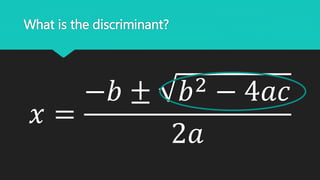

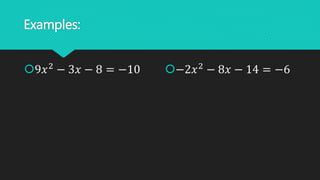
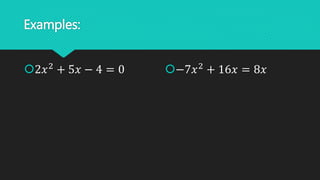
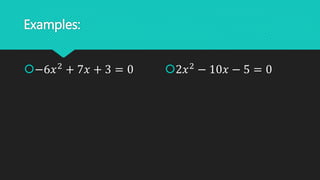
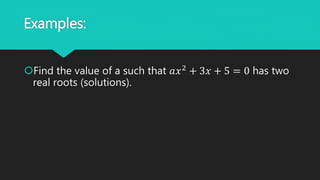
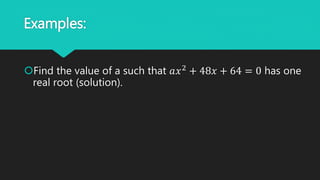

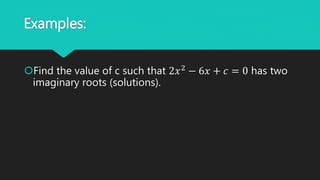
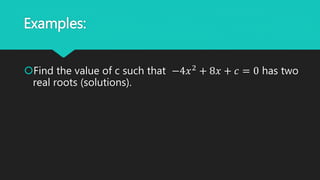
The document discusses the quadratic formula and the discriminant. The discriminant determines the nature of the roots of a quadratic equation. A positive discriminant that is a perfect square yields two real roots, a positive non-perfect square discriminant yields two real irrational roots, a zero discriminant yields one real rational root (a double root), and a negative discriminant yields two complex (imaginary) roots. Several examples of applying the discriminant to determine the root types are provided.


