BILINGUAL SECTION – MARÍA ESTHER DE LA ROSA
POWERS AND RADICALS
1. POWERS
This is explained in the theory of the past year
2. RADICALS
A radical is an expression denoted as , in which n and a
If the index is “2” it is a square root, if the index is “3” then it¨s a cube root, etc.
3. NUMBER OF ROOTS OF A RADICAL
We have three different cases:
a) Positive radicand and even exponent: Two different solutions
b) Negative radicand and even exponent: It has no solution.
c) Positive radicand and odd exponent: There is only one positive solution.
d) Negative radicand and odd exponent: There is only one negative solution
4. RELATIONSHIP BETWEEN RADICALS AND POWERS
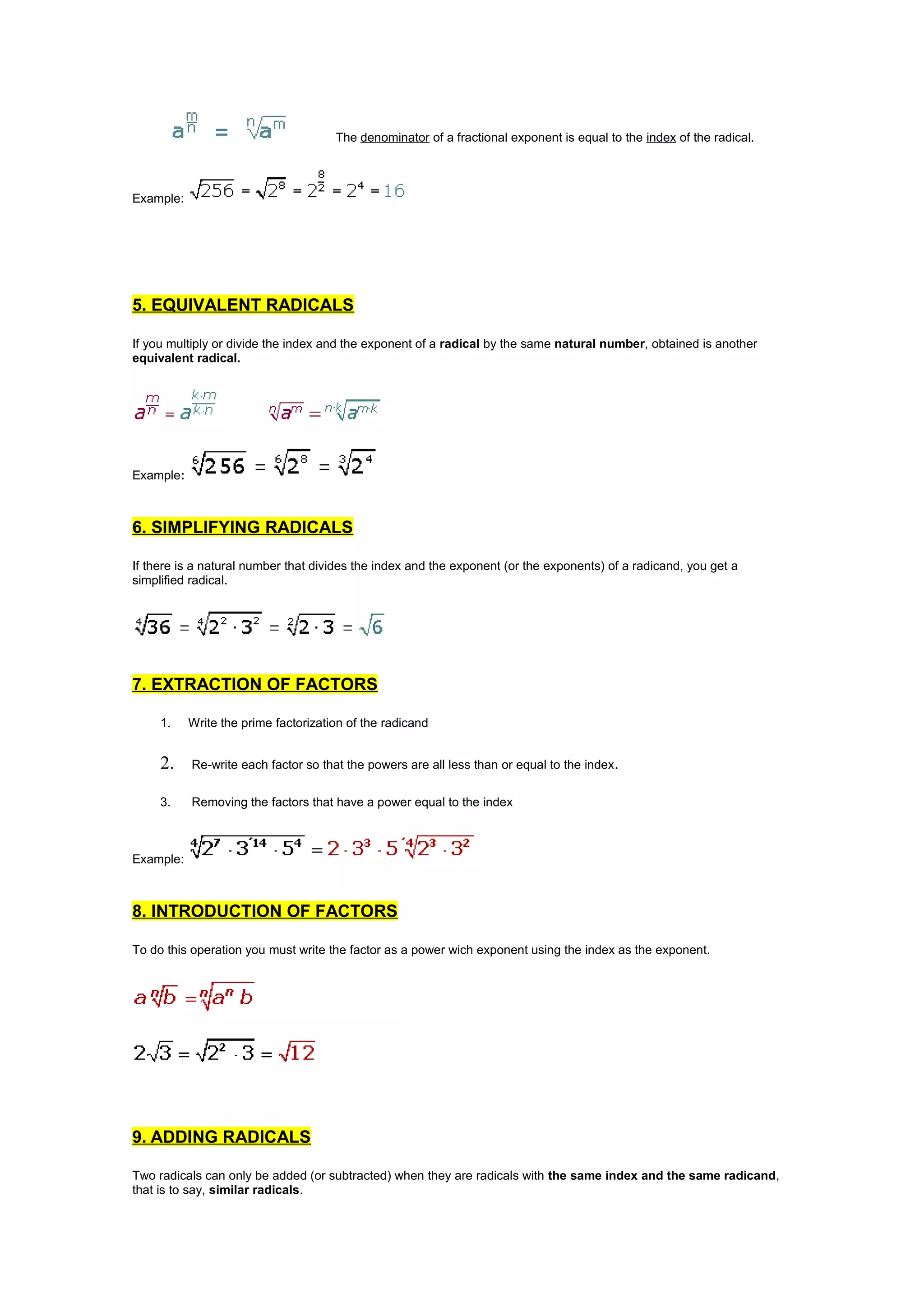
A radical can be expressed in the form of a power:
The denominator of a fractional exponent is equal to the index of the radical.
Example:
5. EQUIVALENT RADICALS
If you multiply or divide the index and the exponent of a radical by the same natural number, obtained is another
equivalent radical.
Example:
6. SIMPLIFYING RADICALS
If there is a natural number that divides the index and the exponent (or the exponents) of a radicand, you get a
simplified radical.
7. EXTRACTION OF FACTORS
1. Write the prime factorization of the radicand
2. Re-write each factor so that the powers are all less than or equal to the index.
3. Removing the factors that have a power equal to the index
Example:
8. INTRODUCTION OF FACTORS
To do this operation you must write the factor as a power wich exponent using the index as the exponent.
9. ADDING RADICALS
Two radicals can only be added (or subtracted) when they are radicals with the same index and the same radicand,
that is to say, similar radicals.
Example:
10. MULTIPLIYING AND DIVIDING RADICALS
1. First, reduce to a common index:
2. Divide the new index by the other index, then multiply this number by the exponent of the radicand.
Example 1:
Example 2:
11. POWER OF RADICALS
Example:
12. ROOT OF RADICALS
Examples:

Radicals

  • 1.
    BILINGUAL SECTION –MARÍA ESTHER DE LA ROSA POWERS AND RADICALS 1. POWERS This is explained in the theory of the past year 2. RADICALS A radical is an expression denoted as , in which n and a If the index is “2” it is a square root, if the index is “3” then it¨s a cube root, etc. 3. NUMBER OF ROOTS OF A RADICAL We have three different cases: a) Positive radicand and even exponent: Two different solutions b) Negative radicand and even exponent: It has no solution. c) Positive radicand and odd exponent: There is only one positive solution. d) Negative radicand and odd exponent: There is only one negative solution 4. RELATIONSHIP BETWEEN RADICALS AND POWERS A radical can be expressed in the form of a power:
  • 2.
    The denominator ofa fractional exponent is equal to the index of the radical. Example: 5. EQUIVALENT RADICALS If you multiply or divide the index and the exponent of a radical by the same natural number, obtained is another equivalent radical. Example: 6. SIMPLIFYING RADICALS If there is a natural number that divides the index and the exponent (or the exponents) of a radicand, you get a simplified radical. 7. EXTRACTION OF FACTORS 1. Write the prime factorization of the radicand 2. Re-write each factor so that the powers are all less than or equal to the index. 3. Removing the factors that have a power equal to the index Example: 8. INTRODUCTION OF FACTORS To do this operation you must write the factor as a power wich exponent using the index as the exponent. 9. ADDING RADICALS Two radicals can only be added (or subtracted) when they are radicals with the same index and the same radicand, that is to say, similar radicals.
  • 3.
    Example: 10. MULTIPLIYING ANDDIVIDING RADICALS 1. First, reduce to a common index: 2. Divide the new index by the other index, then multiply this number by the exponent of the radicand. Example 1: Example 2: 11. POWER OF RADICALS Example: 12. ROOT OF RADICALS Examples: