
Polynomials
Unit 6
What is a polynomial?
 An expression with two or more algebraic terms.
 Terms are separated by +/-
 Common Terms:
 Monomial
 An expression with exactly one algebraic term
 Binomial
 Trinomial
 Standard form: When a polynomial is written in
descending order of exponents
Naming Polynomials
 Polynomials are named based on their degree and
number of terms.
 Degree of a Monomial: The sum of the exponents
of the variables in that term
 Degree of a Polynomial (with one variable): The
highest degree of its terms (the highest exponent)
 Leading Coefficient: Coefficient of term with the
highest degree
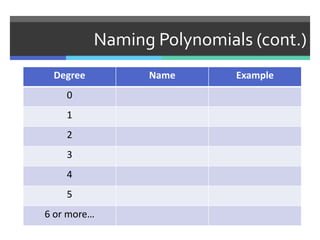
Naming Polynomials (cont.)
Degree Name Example
0
1
2
3
4
5
6 or more…
General Shape of Polynomial Graphs
Constant Linear
General Shape of Polynomial Graphs
Quadratic Cubic
General Shape of Polynomial Graphs
Quartic Quintic
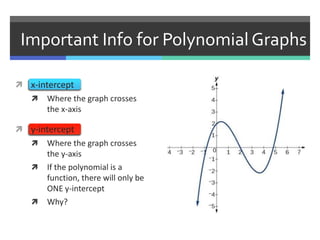
Important Info for Polynomial Graphs
 x-intercept
 Where the graph crosses
the x-axis
 y-intercept
 Where the graph crosses
the y-axis
 If the polynomial is a
function, there will only be
ONE y-intercept
 Why?
Important Info for Polynomial Graphs
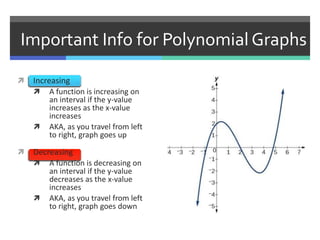
 Increasing
 A function is increasing on
an interval if the y-value
increases as the x-value
increases
 AKA, as you travel from left
to right, graph goes up
 Decreasing
 A function is decreasing on
an interval if the y-value
decreases as the x-value
increases
 AKA, as you travel from left
to right, graph goes down
Important Info for Polynomial Graphs
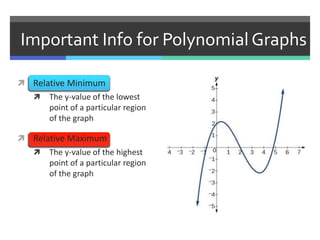
 Relative Minimum
 The y-value of the lowest
point of a particular region
of the graph
 Relative Maximum
 The y-value of the highest
point of a particular region
of the graph
Important Info for Polynomial Graphs
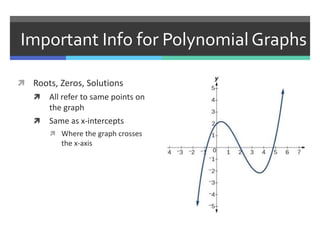
 Roots, Zeros, Solutions
 All refer to same points on
the graph
 Same as x-intercepts
 Where the graph crosses
the x-axis
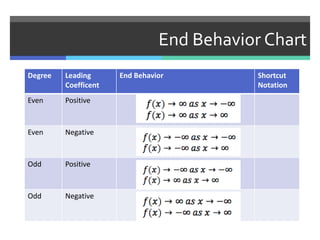
End Behavior of a Polynomial Graph
 The behavior of the graph of a function f(x) as x
approaches positive or negative infinity
 AKA, what directions will the arrows be pointing
 The degree and leading coefficient determine the
end behavior of the polynomial
 Even Degree – arrows point same direction
 Odd Degree – arrows point different directions
 Positive LC – right arrow will point up
 Negative LC – right arrow will point down
End Behavior Chart
Degree Leading
Coefficent
End Behavior Shortcut
Notation
Even Positive
Even Negative
Odd Positive
Odd Negative

Intro to Polynomials

  • 1.
  • 2.
    What is apolynomial?  An expression with two or more algebraic terms.  Terms are separated by +/-  Common Terms:  Monomial  An expression with exactly one algebraic term  Binomial  Trinomial  Standard form: When a polynomial is written in descending order of exponents
  • 3.
    Naming Polynomials  Polynomialsare named based on their degree and number of terms.  Degree of a Monomial: The sum of the exponents of the variables in that term  Degree of a Polynomial (with one variable): The highest degree of its terms (the highest exponent)  Leading Coefficient: Coefficient of term with the highest degree
  • 4.
    Naming Polynomials (cont.) DegreeName Example 0 1 2 3 4 5 6 or more…
  • 5.
    General Shape ofPolynomial Graphs Constant Linear
  • 6.
    General Shape ofPolynomial Graphs Quadratic Cubic
  • 7.
    General Shape ofPolynomial Graphs Quartic Quintic
  • 8.
    Important Info forPolynomial Graphs  x-intercept  Where the graph crosses the x-axis  y-intercept  Where the graph crosses the y-axis  If the polynomial is a function, there will only be ONE y-intercept  Why?
  • 9.
    Important Info forPolynomial Graphs  Increasing  A function is increasing on an interval if the y-value increases as the x-value increases  AKA, as you travel from left to right, graph goes up  Decreasing  A function is decreasing on an interval if the y-value decreases as the x-value increases  AKA, as you travel from left to right, graph goes down
  • 10.
    Important Info forPolynomial Graphs  Relative Minimum  The y-value of the lowest point of a particular region of the graph  Relative Maximum  The y-value of the highest point of a particular region of the graph
  • 11.
    Important Info forPolynomial Graphs  Roots, Zeros, Solutions  All refer to same points on the graph  Same as x-intercepts  Where the graph crosses the x-axis
  • 12.
    End Behavior ofa Polynomial Graph  The behavior of the graph of a function f(x) as x approaches positive or negative infinity  AKA, what directions will the arrows be pointing  The degree and leading coefficient determine the end behavior of the polynomial  Even Degree – arrows point same direction  Odd Degree – arrows point different directions  Positive LC – right arrow will point up  Negative LC – right arrow will point down
  • 13.
    End Behavior Chart DegreeLeading Coefficent End Behavior Shortcut Notation Even Positive Even Negative Odd Positive Odd Negative