Rules of Radicals
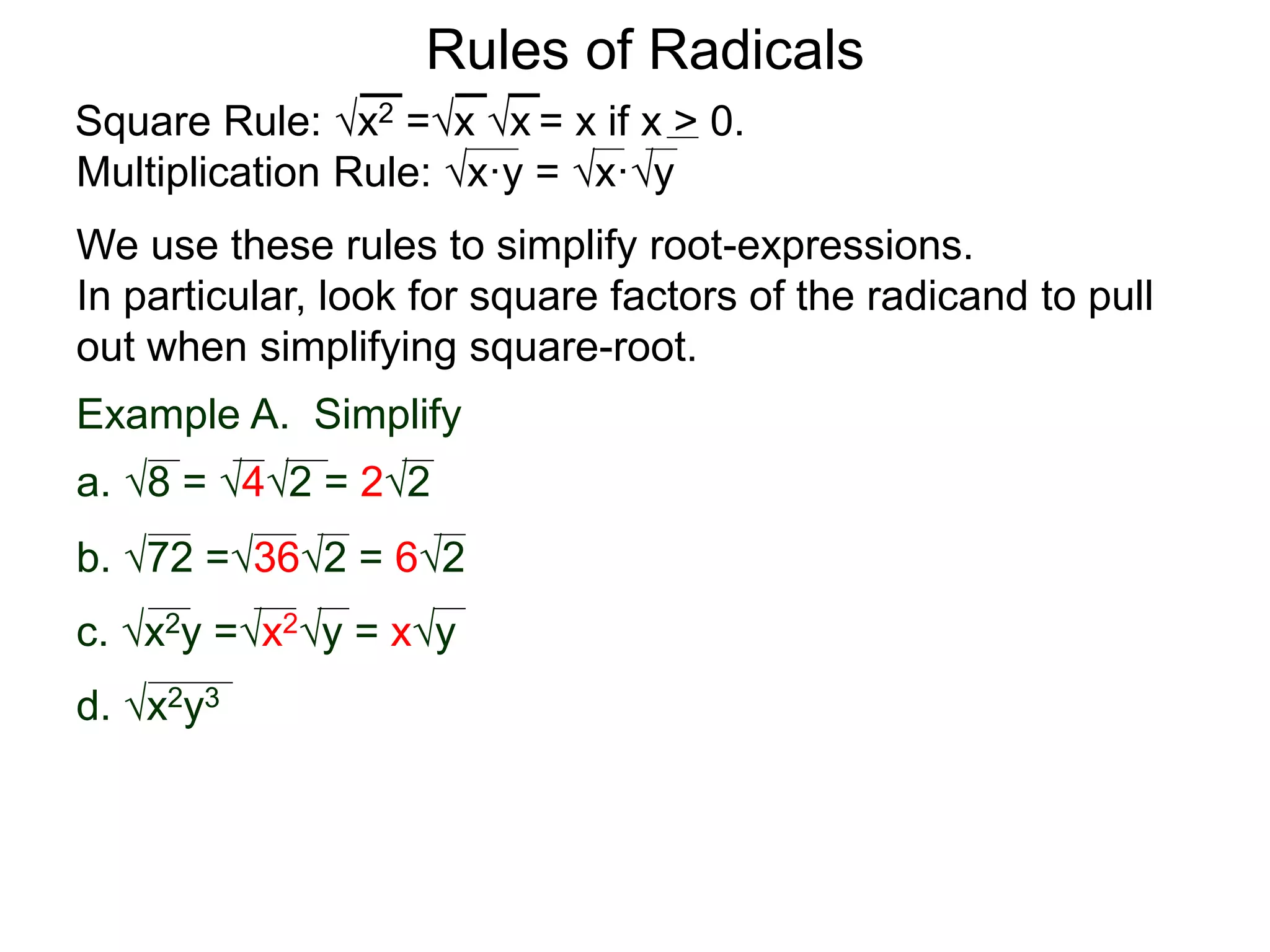
Square Rule: x2 =x x = x if x > 0.
Rules of Radicals
Square Rule: x2 =x x = x if x > 0.
Multiplication Rule: x·y = x·y
Rules of Radicals
Square Rule: x2 =x x = x if x > 0.
Multiplication Rule: x·y = x·y
We use these rules to simplify root-expressions.
Rules of Radicals
Square Rule: x2 =x x = x if x > 0.
Multiplication Rule: x·y = x·y
We use these rules to simplify root-expressions.
In particular, look for square factors of the radicand to pull
out when simplifying square-root.
Rules of Radicals
Example A. Simplify
a. 8
Square Rule: x2 =x x = x if x > 0.
Multiplication Rule: x·y = x·y
We use these rules to simplify root-expressions.
In particular, look for square factors of the radicand to pull
out when simplifying square-root.
Rules of Radicals
Example A. Simplify
a. 8 = 42
Square Rule: x2 =x x = x if x > 0.
Multiplication Rule: x·y = x·y
We use these rules to simplify root-expressions.
In particular, look for square factors of the radicand to pull
out when simplifying square-root.
Rules of Radicals
Example A. Simplify
a. 8 = 42 = 22
Square Rule: x2 =x x = x if x > 0.
Multiplication Rule: x·y = x·y
We use these rules to simplify root-expressions.
In particular, look for square factors of the radicand to pull
out when simplifying square-root.
Rules of Radicals
Example A. Simplify
a. 8 = 42 = 22
Square Rule: x2 =x x = x if x > 0.
Multiplication Rule: x·y = x·y
We use these rules to simplify root-expressions.
In particular, look for square factors of the radicand to pull
out when simplifying square-root.
Rules of Radicals
b. 72 =
Example A. Simplify
a. 8 = 42 = 22
Square Rule: x2 =x x = x if x > 0.
Multiplication Rule: x·y = x·y
We use these rules to simplify root-expressions.
In particular, look for square factors of the radicand to pull
out when simplifying square-root.
Rules of Radicals
b. 72 =362
Example A. Simplify
a. 8 = 42 = 22
Square Rule: x2 =x x = x if x > 0.
Multiplication Rule: x·y = x·y
We use these rules to simplify root-expressions.
In particular, look for square factors of the radicand to pull
out when simplifying square-root.
Rules of Radicals
b. 72 =362 = 62
Example A. Simplify
a. 8 = 42 = 22
Square Rule: x2 =x x = x if x > 0.
Multiplication Rule: x·y = x·y
We use these rules to simplify root-expressions.
In particular, look for square factors of the radicand to pull
out when simplifying square-root.
Rules of Radicals
b. 72 =362 = 62
c. x2y
Example A. Simplify
a. 8 = 42 = 22
Square Rule: x2 =x x = x if x > 0.
Multiplication Rule: x·y = x·y
We use these rules to simplify root-expressions.
In particular, look for square factors of the radicand to pull
out when simplifying square-root.
Rules of Radicals
b. 72 =362 = 62
c. x2y =x2y
Example A. Simplify
a. 8 = 42 = 22
Square Rule: x2 =x x = x if x > 0.
Multiplication Rule: x·y = x·y
We use these rules to simplify root-expressions.
In particular, look for square factors of the radicand to pull
out when simplifying square-root.
Rules of Radicals
b. 72 =362 = 62
c. x2y =x2y = xy
Example A. Simplify
a. 8 = 42 = 22
Square Rule: x2 =x x = x if x > 0.
Multiplication Rule: x·y = x·y
We use these rules to simplify root-expressions.
In particular, look for square factors of the radicand to pull
out when simplifying square-root.
Rules of Radicals
b. 72 =362 = 62
d. x2y3
c. x2y =x2y = xy
Example A. Simplify
a. 8 = 42 = 22
Square Rule: x2 =x x = x if x > 0.
Multiplication Rule: x·y = x·y
We use these rules to simplify root-expressions.
In particular, look for square factors of the radicand to pull
out when simplifying square-root.
Rules of Radicals
b. 72 =362 = 62
d. x2y3 =x2y2y
c. x2y =x2y = xy
Example A. Simplify
a. 8 = 42 = 22
Square Rule: x2 =x x = x if x > 0.
Multiplication Rule: x·y = x·y
We use these rules to simplify root-expressions.
In particular, look for square factors of the radicand to pull
out when simplifying square-root.
Rules of Radicals
b. 72 =362 = 62
d. x2y3 =x2y2y = xyy
c. x2y =x2y = xy
Example A. Simplify
a. 8 = 42 = 22
Square Rule: x2 =x x = x if x > 0.
Multiplication Rule: x·y = x·y
We use these rules to simplify root-expressions.
In particular, look for square factors of the radicand to pull
out when simplifying square-root.
Rules of Radicals
b. 72 =362 = 62
d. x2y3 =x2y2y = xyy
c. x2y =x2y = xy
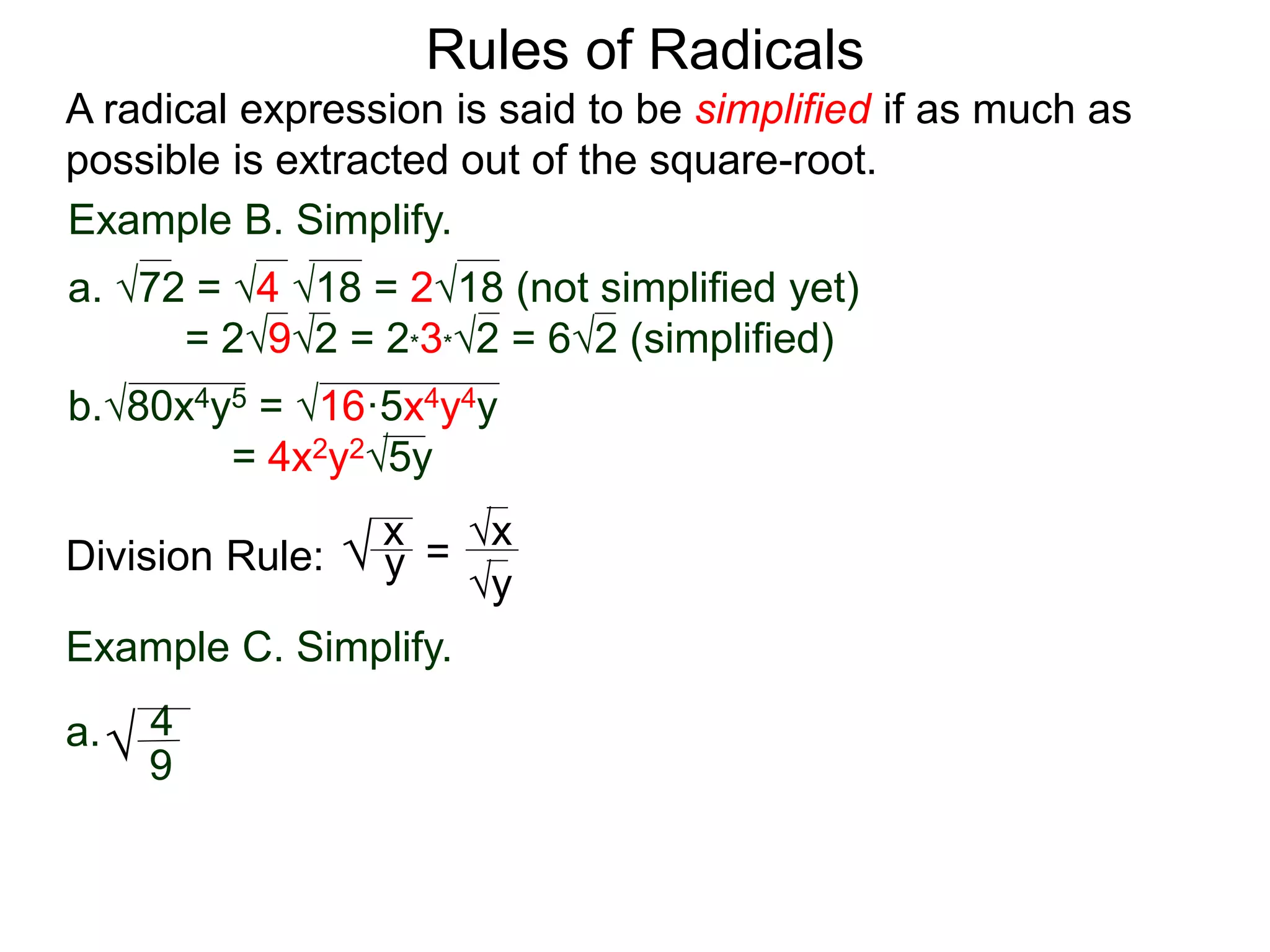
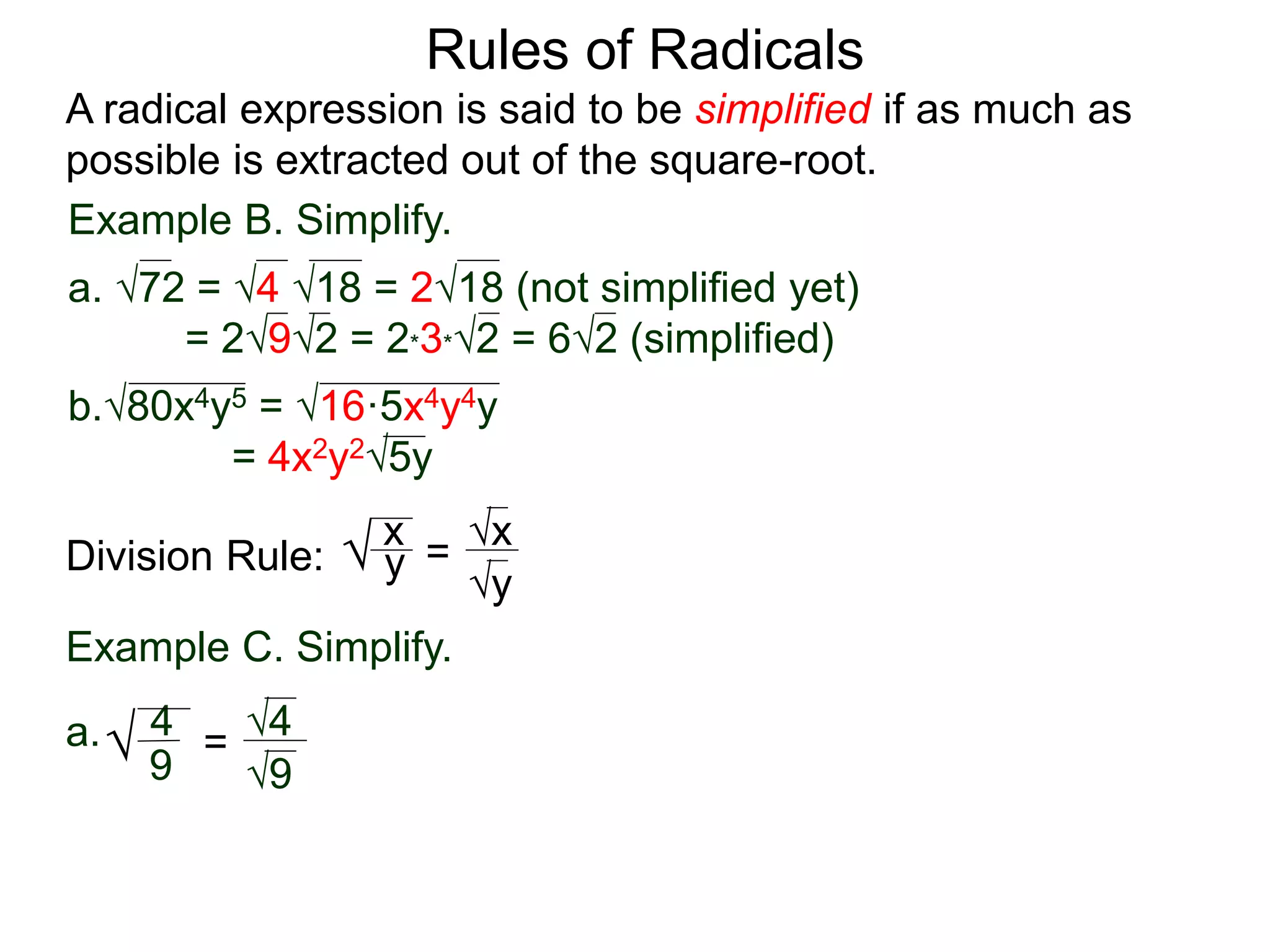
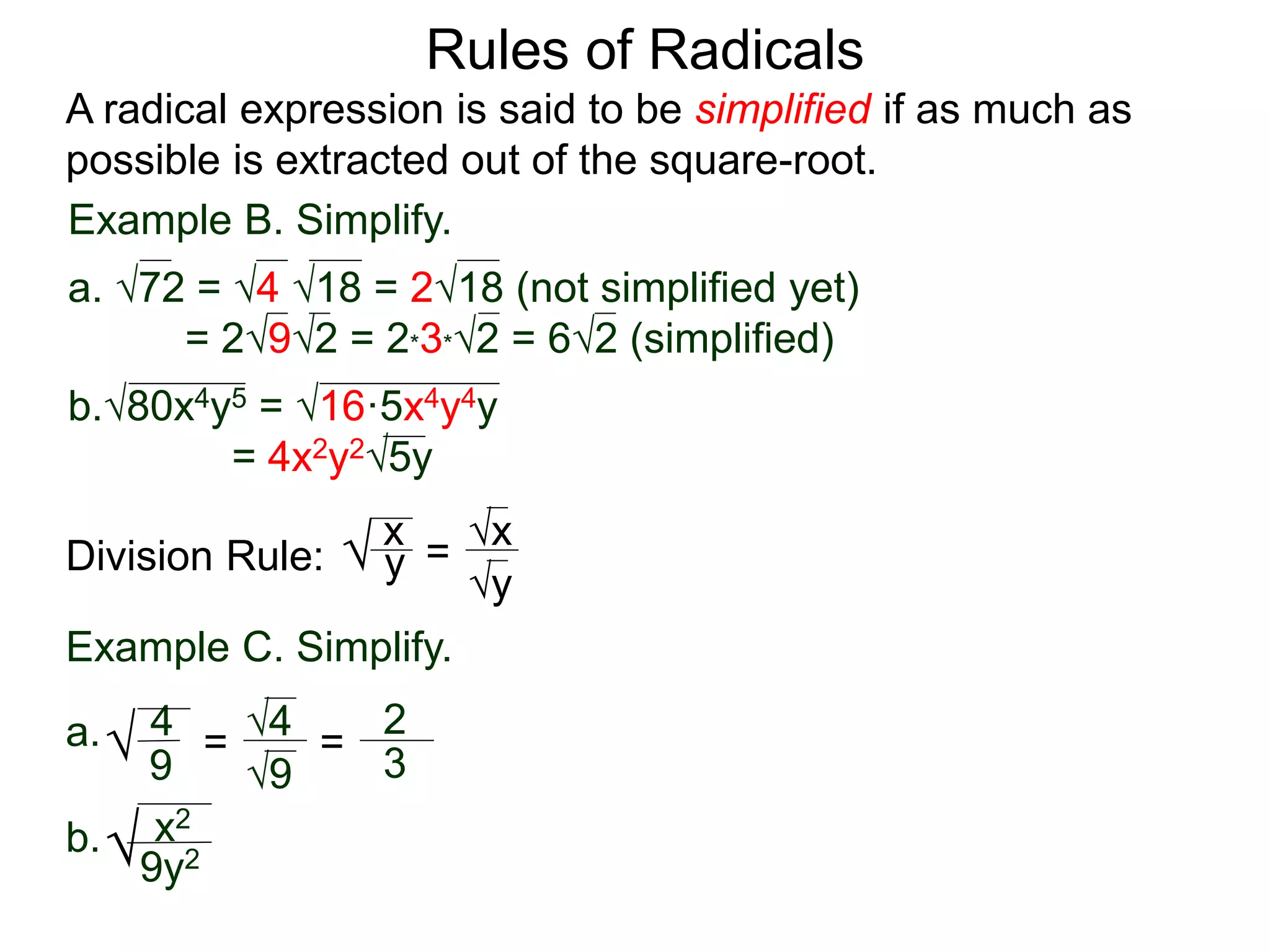
A radical expression is said to be simplified if as much as
possible is extracted out of the square-root.
A radical expression is said to be simplified if as much as
possible is extracted out of the square-root.
Rules of Radicals
A radical expression is said to be simplified if as much as
possible is extracted out of the square-root.
Example B. Simplify.
a. 72
Rules of Radicals
A radical expression is said to be simplified if as much as
possible is extracted out of the square-root.
Example B. Simplify.
a. 72 = 4 18
Rules of Radicals
A radical expression is said to be simplified if as much as
possible is extracted out of the square-root.
Example B. Simplify.
a. 72 = 4 18 = 218 (not simplified yet)
Rules of Radicals
A radical expression is said to be simplified if as much as
possible is extracted out of the square-root.
Example B. Simplify.
a. 72 = 4 18 = 218 (not simplified yet)
= 292
Rules of Radicals
A radical expression is said to be simplified if as much as
possible is extracted out of the square-root.
Example B. Simplify.
a. 72 = 4 18 = 218 (not simplified yet)
= 292 = 2*3*2
Rules of Radicals
A radical expression is said to be simplified if as much as
possible is extracted out of the square-root.
Example B. Simplify.
a. 72 = 4 18 = 218 (not simplified yet)
= 292 = 2*3*2 = 62 (simplified)
Rules of Radicals
A radical expression is said to be simplified if as much as
possible is extracted out of the square-root.
Example B. Simplify.
a. 72 = 4 18 = 218 (not simplified yet)
= 292 = 2*3*2 = 62 (simplified)
b.80x4y5
Rules of Radicals
A radical expression is said to be simplified if as much as
possible is extracted out of the square-root.
Example B. Simplify.
a. 72 = 4 18 = 218 (not simplified yet)
= 292 = 2*3*2 = 62 (simplified)
b.80x4y5 = 16·5x4y4y
Rules of Radicals
A radical expression is said to be simplified if as much as
possible is extracted out of the square-root.
Example B. Simplify.
a. 72 = 4 18 = 218 (not simplified yet)
= 292 = 2*3*2 = 62 (simplified)
b.80x4y5 = 16·5x4y4y
= 4x2y25y
Rules of Radicals
A radical expression is said to be simplified if as much as
possible is extracted out of the square-root.
Example B. Simplify.
a. 72 = 4 18 = 218 (not simplified yet)
= 292 = 2*3*2 = 62 (simplified)
b.80x4y5 = 16·5x4y4y
= 4x2y25y
Rules of Radicals
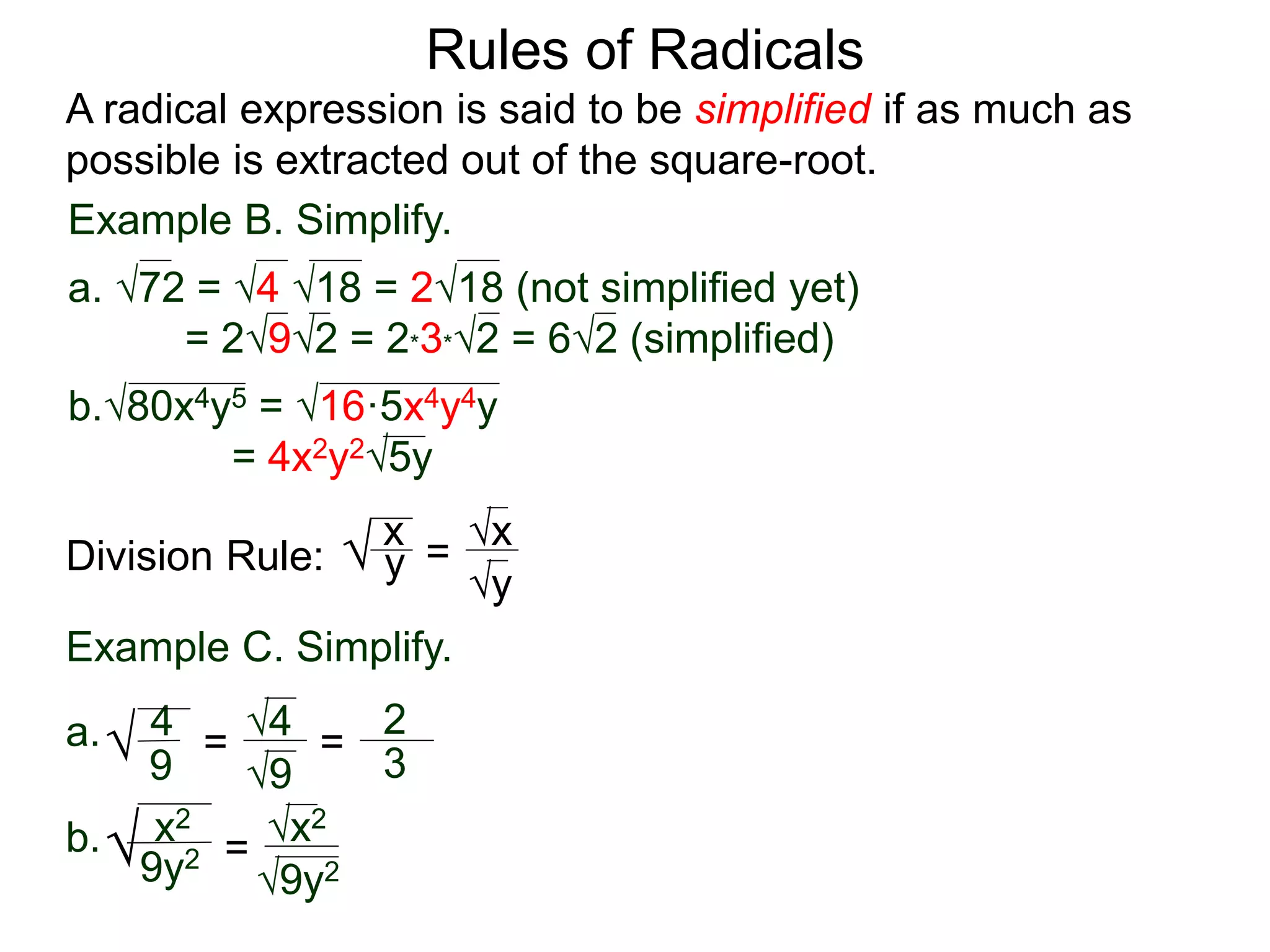
Division Rule: y
x
y
x
 =
A radical expression is said to be simplified if as much as
possible is extracted out of the square-root.
Example B. Simplify.
a. 72 = 4 18 = 218 (not simplified yet)
= 292 = 2*3*2 = 62 (simplified)
b.80x4y5 = 16·5x4y4y
= 4x2y25y
Rules of Radicals
Division Rule: y
x
y
x
 =
Example C. Simplify.
A radical expression is said to be simplified if as much as
possible is extracted out of the square-root.
Example B. Simplify.
a. 72 = 4 18 = 218 (not simplified yet)
= 292 = 2*3*2 = 62 (simplified)
b.80x4y5 = 16·5x4y4y
= 4x2y25y
Rules of Radicals
Division Rule: y
x
y
x
 =
Example C. Simplify.
9
4
a.
A radical expression is said to be simplified if as much as
possible is extracted out of the square-root.
Example B. Simplify.
a. 72 = 4 18 = 218 (not simplified yet)
= 292 = 2*3*2 = 62 (simplified)
b.80x4y5 = 16·5x4y4y
= 4x2y25y
Rules of Radicals
Division Rule: y
x
y
x
 =
Example C. Simplify.
9
4
9
4
a. =
A radical expression is said to be simplified if as much as
possible is extracted out of the square-root.
Example B. Simplify.
a. 72 = 4 18 = 218 (not simplified yet)
= 292 = 2*3*2 = 62 (simplified)
b.80x4y5 = 16·5x4y4y
= 4x2y25y
Rules of Radicals
Division Rule: y
x
y
x
 =
Example C. Simplify.
9
4
9
4
3
2
a. = =
A radical expression is said to be simplified if as much as
possible is extracted out of the square-root.
Example B. Simplify.
a. 72 = 4 18 = 218 (not simplified yet)
= 292 = 2*3*2 = 62 (simplified)
b.80x4y5 = 16·5x4y4y
= 4x2y25y
Rules of Radicals
Division Rule: y
x
y
x
 =
Example C. Simplify.
9
4
9
4
3
2
9y2
x2
a. = =
b.
A radical expression is said to be simplified if as much as
possible is extracted out of the square-root.
Example B. Simplify.
a. 72 = 4 18 = 218 (not simplified yet)
= 292 = 2*3*2 = 62 (simplified)
b.80x4y5 = 16·5x4y4y
= 4x2y25y
Rules of Radicals
Division Rule: y
x
y
x
 =
Example C. Simplify.
9
4
9
4
3
2
9y2
x2
9y2
x2
a. = =
b. =
A radical expression is said to be simplified if as much as
possible is extracted out of the square-root.
Example B. Simplify.
a. 72 = 4 18 = 218 (not simplified yet)
= 292 = 2*3*2 = 62 (simplified)
b.80x4y5 = 16·5x4y4y
= 4x2y25y
Rules of Radicals
Division Rule: y
x
y
x
 =
Example C. Simplify.
9
4
9
4
3
2
9y2
x2
9y2
x2
3y
x
a. = =
b. = =
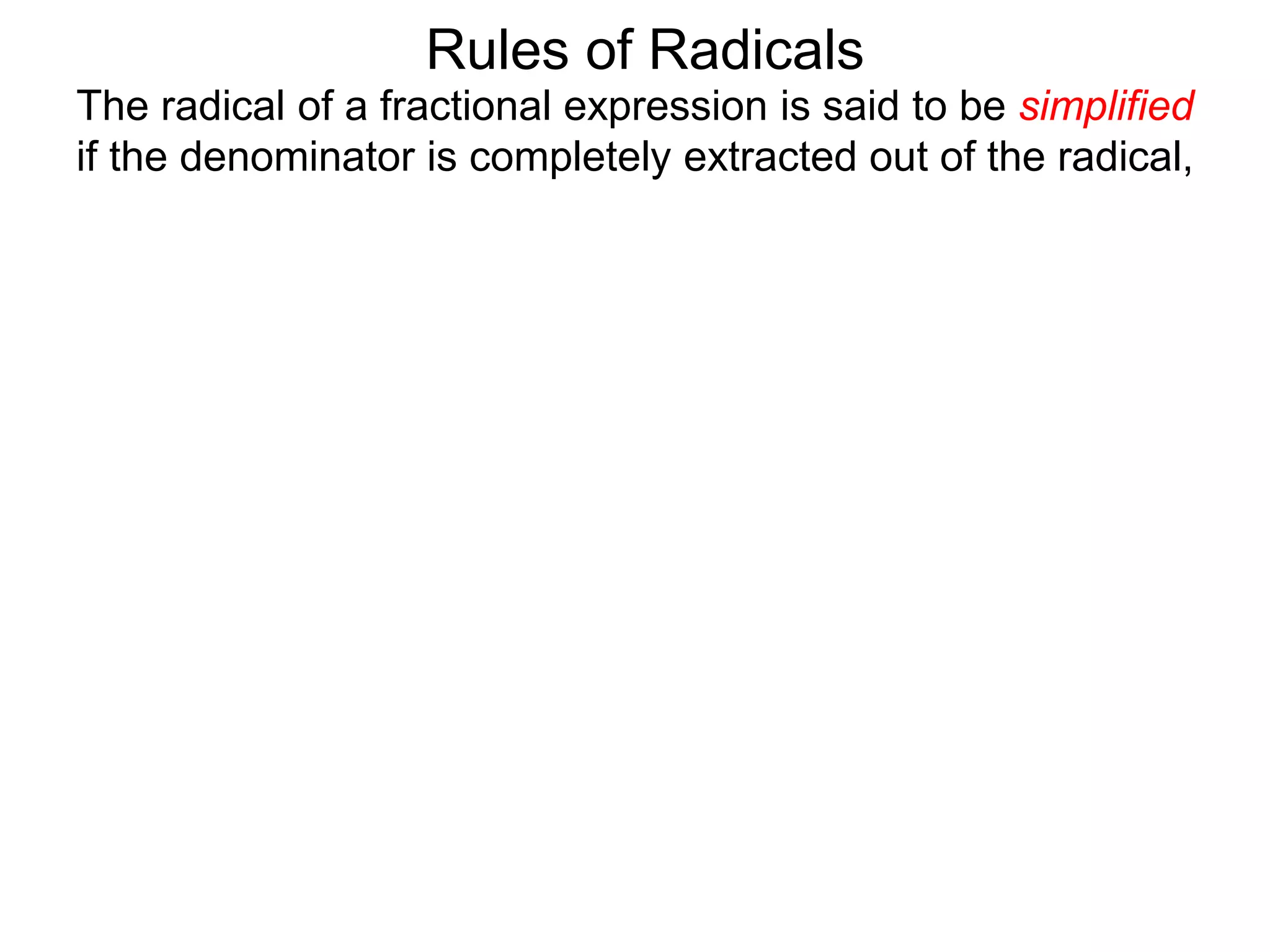
The radical of a fractional expression is said to be simplified
if the denominator is completely extracted out of the radical,
Rules of Radicals
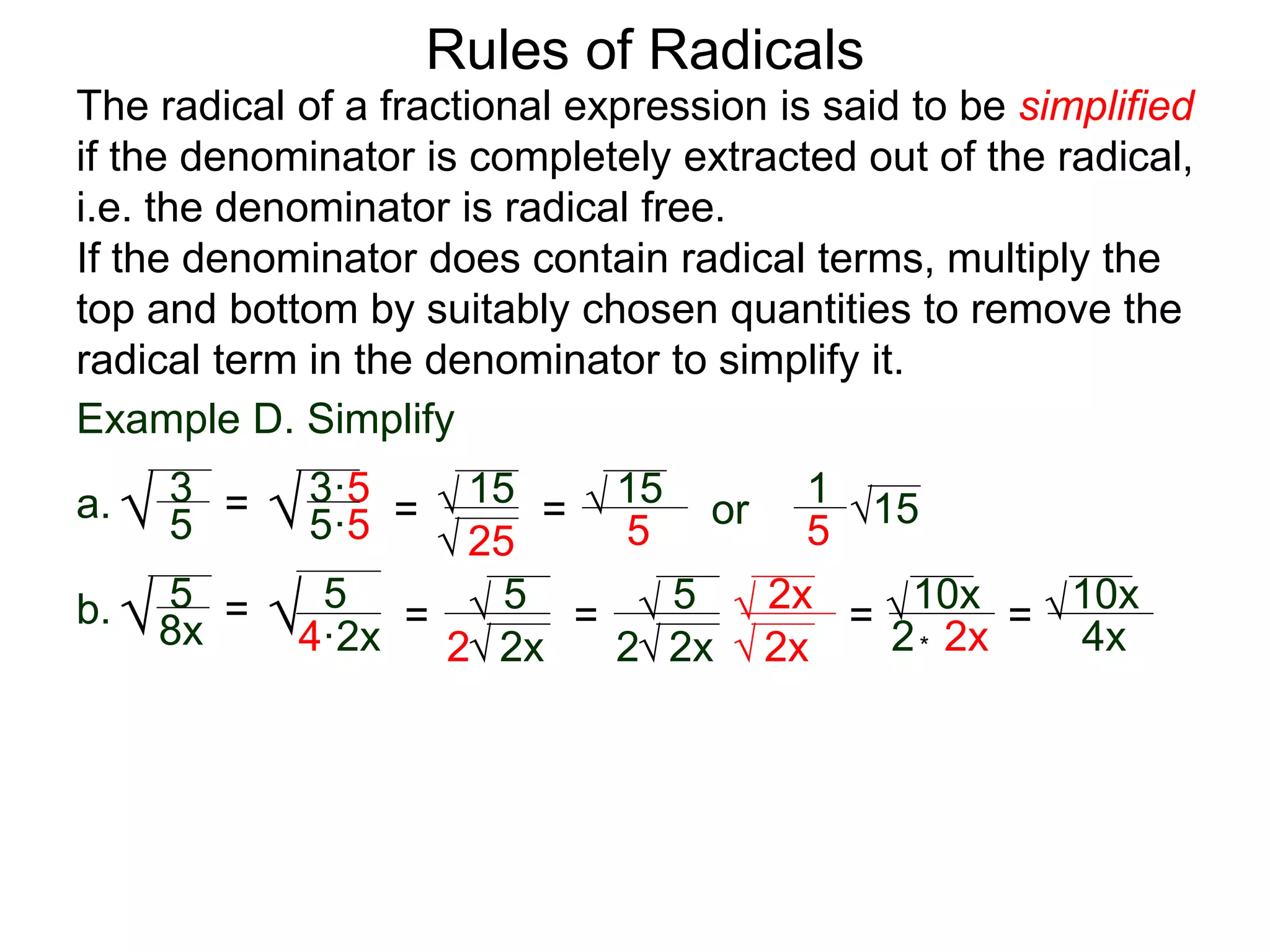
The radical of a fractional expression is said to be simplified
if the denominator is completely extracted out of the radical,
i.e. the denominator is radical free.
Rules of Radicals
The radical of a fractional expression is said to be simplified
if the denominator is completely extracted out of the radical,
i.e. the denominator is radical free.
If the denominator does contain radical terms, multiply the
top and bottom by suitably chosen quantities to remove the
radical term in the denominator to simplify it.
Rules of Radicals
Example D. Simplify
5
3
The radical of a fractional expression is said to be simplified
if the denominator is completely extracted out of the radical,
i.e. the denominator is radical free.
If the denominator does contain radical terms, multiply the
top and bottom by suitably chosen quantities to remove the
radical term in the denominator to simplify it.
Rules of Radicals
a. 
Example D. Simplify
5
3
5·5
3·5
The radical of a fractional expression is said to be simplified
if the denominator is completely extracted out of the radical,
i.e. the denominator is radical free.
If the denominator does contain radical terms, multiply the
top and bottom by suitably chosen quantities to remove the
radical term in the denominator to simplify it.
Rules of Radicals
a. = 
Example D. Simplify
5
3
5·5
3·5
The radical of a fractional expression is said to be simplified
if the denominator is completely extracted out of the radical,
i.e. the denominator is radical free.
If the denominator does contain radical terms, multiply the
top and bottom by suitably chosen quantities to remove the
radical term in the denominator to simplify it.
Rules of Radicals
a. =  =
25
15

Example D. Simplify
5
3
5·5
3·5
The radical of a fractional expression is said to be simplified
if the denominator is completely extracted out of the radical,
i.e. the denominator is radical free.
If the denominator does contain radical terms, multiply the
top and bottom by suitably chosen quantities to remove the
radical term in the denominator to simplify it.
Rules of Radicals
a. =  =
25
15

=
5
15
Example D. Simplify
5
3
5·5
3·5
The radical of a fractional expression is said to be simplified
if the denominator is completely extracted out of the radical,
i.e. the denominator is radical free.
If the denominator does contain radical terms, multiply the
top and bottom by suitably chosen quantities to remove the
radical term in the denominator to simplify it.
Rules of Radicals
a. =  =
25
15

=
5
15
8x
5b. 
5
1 15or
Example D. Simplify
5
3
5·5
3·5
The radical of a fractional expression is said to be simplified
if the denominator is completely extracted out of the radical,
i.e. the denominator is radical free.
If the denominator does contain radical terms, multiply the
top and bottom by suitably chosen quantities to remove the
radical term in the denominator to simplify it.
Rules of Radicals
a. =  =
25
15

=
5
15
8x
5
4·2x
5b. = 
5
1 15or
Example D. Simplify
5
3
5·5
3·5
The radical of a fractional expression is said to be simplified
if the denominator is completely extracted out of the radical,
i.e. the denominator is radical free.
If the denominator does contain radical terms, multiply the
top and bottom by suitably chosen quantities to remove the
radical term in the denominator to simplify it.
Rules of Radicals
2
a. =  =
25
15

=
5
15
8x
5
4·2x
5b. =  =
2x
5

5
1 15or
Example D. Simplify
5
3
5·5
3·5
The radical of a fractional expression is said to be simplified
if the denominator is completely extracted out of the radical,
i.e. the denominator is radical free.
If the denominator does contain radical terms, multiply the
top and bottom by suitably chosen quantities to remove the
radical term in the denominator to simplify it.
Rules of Radicals
2
a. =  =
25
15

=
5
15
8x
5
4·2x
5b. =  =
2x
5

=
2 2x
5
 2x
2x

5
1 15or
Example D. Simplify
5
3
5·5
3·5
The radical of a fractional expression is said to be simplified
if the denominator is completely extracted out of the radical,
i.e. the denominator is radical free.
If the denominator does contain radical terms, multiply the
top and bottom by suitably chosen quantities to remove the
radical term in the denominator to simplify it.
Rules of Radicals
2
a. =  =
25
15

=
5
15
8x
5
4·2x
5b. =  =
2x
5

=
2 2x
5
 2x
2x

=
2 2x
10x
*
5
1 15or
Example D. Simplify
5
3
5·5
3·5
The radical of a fractional expression is said to be simplified
if the denominator is completely extracted out of the radical,
i.e. the denominator is radical free.
If the denominator does contain radical terms, multiply the
top and bottom by suitably chosen quantities to remove the
radical term in the denominator to simplify it.
Rules of Radicals
2
a. =  =
25
15

=
5
15
8x
5
4·2x
5b. =  =
2x
5

=
2 2x
5
 2x
2x

=
2 2x
10x
*
=
4x
10x
5
1 15or
Example D. Simplify
5
3
5·5
3·5
The radical of a fractional expression is said to be simplified
if the denominator is completely extracted out of the radical,
i.e. the denominator is radical free.
If the denominator does contain radical terms, multiply the
top and bottom by suitably chosen quantities to remove the
radical term in the denominator to simplify it.
Rules of Radicals
2
a. =  =
25
15

=
5
15
8x
5
4·2x
5b. =  =
2x
5

=
2 2x
5
 2x
2x

=
2 2x
10x
*
=
4x
10x
5
1 15or
4x
1 10xor
Example D. Simplify
5
3
5·5
3·5
The radical of a fractional expression is said to be simplified
if the denominator is completely extracted out of the radical,
i.e. the denominator is radical free.
If the denominator does contain radical terms, multiply the
top and bottom by suitably chosen quantities to remove the
radical term in the denominator to simplify it.
Rules of Radicals
2
a. =  =
25
15

=
5
15
8x
5
4·2x
5b. =  =
2x
5

=
2 2x
5
 2x
2x

=
2 2x
10x
*
=
4x
10x
WARNING!!!!
a ± b = a ±b
5
1 15or
4x
1 10xor
Example D. Simplify
5
3
5·5
3·5
The radical of a fractional expression is said to be simplified
if the denominator is completely extracted out of the radical,
i.e. the denominator is radical free.
If the denominator does contain radical terms, multiply the
top and bottom by suitably chosen quantities to remove the
radical term in the denominator to simplify it.
Rules of Radicals
2
a. =  =
25
15

=
5
15
8x
5
4·2x
5b. =  =
2x
5

=
2 2x
5
 2x
2x

=
2 2x
10x
*
=
4x
10x
WARNING!!!!
a ± b = a ±b
For example: 4 + 913 =
5
1 15or
4x
1 10xor
Example D. Simplify
5
3
5·5
3·5
The radical of a fractional expression is said to be simplified
if the denominator is completely extracted out of the radical,
i.e. the denominator is radical free.
If the denominator does contain radical terms, multiply the
top and bottom by suitably chosen quantities to remove the
radical term in the denominator to simplify it.
Rules of Radicals
2
a. =  =
25
15

=
5
15
8x
5
4·2x
5b. =  =
2x
5

=
2 2x
5
 2x
2x

=
2 2x
10x
*
=
4x
10x
WARNING!!!!
a ± b = a ±b
For example: 4 + 913 =
5
1 15or
4x
1 10xor
Example D. Simplify
5
3
5·5
3·5
The radical of a fractional expression is said to be simplified
if the denominator is completely extracted out of the radical,
i.e. the denominator is radical free.
If the denominator does contain radical terms, multiply the
top and bottom by suitably chosen quantities to remove the
radical term in the denominator to simplify it.
Rules of Radicals
2
a. =  =
25
15

=
5
15
8x
5
4·2x
5b. =  =
2x
5

=
2 2x
5
 2x
2x

=
2 2x
10x
*
=
4x
10x
WARNING!!!!
a ± b = a ±b
For example: 4 + 9 = 4 +913 =
5
1 15or
4x
1 10xor
Example D. Simplify
5
3
5·5
3·5
The radical of a fractional expression is said to be simplified
if the denominator is completely extracted out of the radical,
i.e. the denominator is radical free.
If the denominator does contain radical terms, multiply the
top and bottom by suitably chosen quantities to remove the
radical term in the denominator to simplify it.
Rules of Radicals
2
a. =  =
25
15

=
5
15
8x
5
4·2x
5b. =  =
2x
5

=
2 2x
5
 2x
2x

=
2 2x
10x
*
=
4x
10x
WARNING!!!!
a ± b = a ±b
For example: 4 + 9 = 4 +9 = 2 + 3 = 513 =
5
1 15or
4x
1 10xor
Rules of Radicals
Exercise A. Simplify the following radicals.
1. 12 2. 18 3. 20 4. 28
5. 32 6. 36 7. 40 8. 45
9. 54 10. 60 11. 72 12. 84
13. 90 14. 96x2 15. 108x3 16. 120x2y2
17. 150y4 18. 189x3y2 19. 240x5y8 18. 242x19y34
19. 12 12 20. 1818 21. 2 16
23. 183
22. 123
24. 1227 25. 1850 26. 1040
27. 20x15x 28.12xy15y
29. 32xy324x5 30. x8y13x15y9
Exercise B. Simplify the following radicals. Remember that
you have a choice to simplify each of the radicals first then
multiply, or multiply the radicals first then simplify.
Rules of Radicals
Exercise C. Simplify the following radicals. Remember that
you have a choice to simplify each of the radicals first then
multiply, or multiply the radicals first then simplify. Make sure
the denominators are radical–free.
8x
531. x
10
 14
5x32. 7
20
 5
1233. 15
8x
534. 3
2
 3
32x35. 7
5
 5
236. 29
x

x
(x + 1)39. x
(x + 1)
 x
(x + 1)40. x(x + 1)
1

1
(x + 1)
37.
x
(x2 – 1)41. x(x + 1)
(x – 1)

x
(x + 1)38.
x21 – 1
Exercise D. Take the denominators of out of the radical.
42.
9x21 – 143.

4 2 rules of radicals

  • 1.
  • 2.
    Square Rule: x2=x x = x if x > 0. Rules of Radicals
  • 3.
    Square Rule: x2=x x = x if x > 0. Multiplication Rule: x·y = x·y Rules of Radicals
  • 4.
    Square Rule: x2=x x = x if x > 0. Multiplication Rule: x·y = x·y We use these rules to simplify root-expressions. Rules of Radicals
  • 5.
    Square Rule: x2=x x = x if x > 0. Multiplication Rule: x·y = x·y We use these rules to simplify root-expressions. In particular, look for square factors of the radicand to pull out when simplifying square-root. Rules of Radicals
  • 6.
    Example A. Simplify a.8 Square Rule: x2 =x x = x if x > 0. Multiplication Rule: x·y = x·y We use these rules to simplify root-expressions. In particular, look for square factors of the radicand to pull out when simplifying square-root. Rules of Radicals
  • 7.
    Example A. Simplify a.8 = 42 Square Rule: x2 =x x = x if x > 0. Multiplication Rule: x·y = x·y We use these rules to simplify root-expressions. In particular, look for square factors of the radicand to pull out when simplifying square-root. Rules of Radicals
  • 8.
    Example A. Simplify a.8 = 42 = 22 Square Rule: x2 =x x = x if x > 0. Multiplication Rule: x·y = x·y We use these rules to simplify root-expressions. In particular, look for square factors of the radicand to pull out when simplifying square-root. Rules of Radicals
  • 9.
    Example A. Simplify a.8 = 42 = 22 Square Rule: x2 =x x = x if x > 0. Multiplication Rule: x·y = x·y We use these rules to simplify root-expressions. In particular, look for square factors of the radicand to pull out when simplifying square-root. Rules of Radicals b. 72 =
  • 10.
    Example A. Simplify a.8 = 42 = 22 Square Rule: x2 =x x = x if x > 0. Multiplication Rule: x·y = x·y We use these rules to simplify root-expressions. In particular, look for square factors of the radicand to pull out when simplifying square-root. Rules of Radicals b. 72 =362
  • 11.
    Example A. Simplify a.8 = 42 = 22 Square Rule: x2 =x x = x if x > 0. Multiplication Rule: x·y = x·y We use these rules to simplify root-expressions. In particular, look for square factors of the radicand to pull out when simplifying square-root. Rules of Radicals b. 72 =362 = 62
  • 12.
    Example A. Simplify a.8 = 42 = 22 Square Rule: x2 =x x = x if x > 0. Multiplication Rule: x·y = x·y We use these rules to simplify root-expressions. In particular, look for square factors of the radicand to pull out when simplifying square-root. Rules of Radicals b. 72 =362 = 62 c. x2y
  • 13.
    Example A. Simplify a.8 = 42 = 22 Square Rule: x2 =x x = x if x > 0. Multiplication Rule: x·y = x·y We use these rules to simplify root-expressions. In particular, look for square factors of the radicand to pull out when simplifying square-root. Rules of Radicals b. 72 =362 = 62 c. x2y =x2y
  • 14.
    Example A. Simplify a.8 = 42 = 22 Square Rule: x2 =x x = x if x > 0. Multiplication Rule: x·y = x·y We use these rules to simplify root-expressions. In particular, look for square factors of the radicand to pull out when simplifying square-root. Rules of Radicals b. 72 =362 = 62 c. x2y =x2y = xy
  • 15.
    Example A. Simplify a.8 = 42 = 22 Square Rule: x2 =x x = x if x > 0. Multiplication Rule: x·y = x·y We use these rules to simplify root-expressions. In particular, look for square factors of the radicand to pull out when simplifying square-root. Rules of Radicals b. 72 =362 = 62 d. x2y3 c. x2y =x2y = xy
  • 16.
    Example A. Simplify a.8 = 42 = 22 Square Rule: x2 =x x = x if x > 0. Multiplication Rule: x·y = x·y We use these rules to simplify root-expressions. In particular, look for square factors of the radicand to pull out when simplifying square-root. Rules of Radicals b. 72 =362 = 62 d. x2y3 =x2y2y c. x2y =x2y = xy
  • 17.
    Example A. Simplify a.8 = 42 = 22 Square Rule: x2 =x x = x if x > 0. Multiplication Rule: x·y = x·y We use these rules to simplify root-expressions. In particular, look for square factors of the radicand to pull out when simplifying square-root. Rules of Radicals b. 72 =362 = 62 d. x2y3 =x2y2y = xyy c. x2y =x2y = xy
  • 18.
    Example A. Simplify a.8 = 42 = 22 Square Rule: x2 =x x = x if x > 0. Multiplication Rule: x·y = x·y We use these rules to simplify root-expressions. In particular, look for square factors of the radicand to pull out when simplifying square-root. Rules of Radicals b. 72 =362 = 62 d. x2y3 =x2y2y = xyy c. x2y =x2y = xy A radical expression is said to be simplified if as much as possible is extracted out of the square-root.
  • 19.
    A radical expressionis said to be simplified if as much as possible is extracted out of the square-root. Rules of Radicals
  • 20.
    A radical expressionis said to be simplified if as much as possible is extracted out of the square-root. Example B. Simplify. a. 72 Rules of Radicals
  • 21.
    A radical expressionis said to be simplified if as much as possible is extracted out of the square-root. Example B. Simplify. a. 72 = 4 18 Rules of Radicals
  • 22.
    A radical expressionis said to be simplified if as much as possible is extracted out of the square-root. Example B. Simplify. a. 72 = 4 18 = 218 (not simplified yet) Rules of Radicals
  • 23.
    A radical expressionis said to be simplified if as much as possible is extracted out of the square-root. Example B. Simplify. a. 72 = 4 18 = 218 (not simplified yet) = 292 Rules of Radicals
  • 24.
    A radical expressionis said to be simplified if as much as possible is extracted out of the square-root. Example B. Simplify. a. 72 = 4 18 = 218 (not simplified yet) = 292 = 2*3*2 Rules of Radicals
  • 25.
    A radical expressionis said to be simplified if as much as possible is extracted out of the square-root. Example B. Simplify. a. 72 = 4 18 = 218 (not simplified yet) = 292 = 2*3*2 = 62 (simplified) Rules of Radicals
  • 26.
    A radical expressionis said to be simplified if as much as possible is extracted out of the square-root. Example B. Simplify. a. 72 = 4 18 = 218 (not simplified yet) = 292 = 2*3*2 = 62 (simplified) b.80x4y5 Rules of Radicals
  • 27.
    A radical expressionis said to be simplified if as much as possible is extracted out of the square-root. Example B. Simplify. a. 72 = 4 18 = 218 (not simplified yet) = 292 = 2*3*2 = 62 (simplified) b.80x4y5 = 16·5x4y4y Rules of Radicals
  • 28.
    A radical expressionis said to be simplified if as much as possible is extracted out of the square-root. Example B. Simplify. a. 72 = 4 18 = 218 (not simplified yet) = 292 = 2*3*2 = 62 (simplified) b.80x4y5 = 16·5x4y4y = 4x2y25y Rules of Radicals
  • 29.
    A radical expressionis said to be simplified if as much as possible is extracted out of the square-root. Example B. Simplify. a. 72 = 4 18 = 218 (not simplified yet) = 292 = 2*3*2 = 62 (simplified) b.80x4y5 = 16·5x4y4y = 4x2y25y Rules of Radicals Division Rule: y x y x  =
  • 30.
    A radical expressionis said to be simplified if as much as possible is extracted out of the square-root. Example B. Simplify. a. 72 = 4 18 = 218 (not simplified yet) = 292 = 2*3*2 = 62 (simplified) b.80x4y5 = 16·5x4y4y = 4x2y25y Rules of Radicals Division Rule: y x y x  = Example C. Simplify.
  • 31.
    A radical expressionis said to be simplified if as much as possible is extracted out of the square-root. Example B. Simplify. a. 72 = 4 18 = 218 (not simplified yet) = 292 = 2*3*2 = 62 (simplified) b.80x4y5 = 16·5x4y4y = 4x2y25y Rules of Radicals Division Rule: y x y x  = Example C. Simplify. 9 4 a.
  • 32.
    A radical expressionis said to be simplified if as much as possible is extracted out of the square-root. Example B. Simplify. a. 72 = 4 18 = 218 (not simplified yet) = 292 = 2*3*2 = 62 (simplified) b.80x4y5 = 16·5x4y4y = 4x2y25y Rules of Radicals Division Rule: y x y x  = Example C. Simplify. 9 4 9 4 a. =
  • 33.
    A radical expressionis said to be simplified if as much as possible is extracted out of the square-root. Example B. Simplify. a. 72 = 4 18 = 218 (not simplified yet) = 292 = 2*3*2 = 62 (simplified) b.80x4y5 = 16·5x4y4y = 4x2y25y Rules of Radicals Division Rule: y x y x  = Example C. Simplify. 9 4 9 4 3 2 a. = =
  • 34.
    A radical expressionis said to be simplified if as much as possible is extracted out of the square-root. Example B. Simplify. a. 72 = 4 18 = 218 (not simplified yet) = 292 = 2*3*2 = 62 (simplified) b.80x4y5 = 16·5x4y4y = 4x2y25y Rules of Radicals Division Rule: y x y x  = Example C. Simplify. 9 4 9 4 3 2 9y2 x2 a. = = b.
  • 35.
    A radical expressionis said to be simplified if as much as possible is extracted out of the square-root. Example B. Simplify. a. 72 = 4 18 = 218 (not simplified yet) = 292 = 2*3*2 = 62 (simplified) b.80x4y5 = 16·5x4y4y = 4x2y25y Rules of Radicals Division Rule: y x y x  = Example C. Simplify. 9 4 9 4 3 2 9y2 x2 9y2 x2 a. = = b. =
  • 36.
    A radical expressionis said to be simplified if as much as possible is extracted out of the square-root. Example B. Simplify. a. 72 = 4 18 = 218 (not simplified yet) = 292 = 2*3*2 = 62 (simplified) b.80x4y5 = 16·5x4y4y = 4x2y25y Rules of Radicals Division Rule: y x y x  = Example C. Simplify. 9 4 9 4 3 2 9y2 x2 9y2 x2 3y x a. = = b. = =
  • 37.
    The radical ofa fractional expression is said to be simplified if the denominator is completely extracted out of the radical, Rules of Radicals
  • 38.
    The radical ofa fractional expression is said to be simplified if the denominator is completely extracted out of the radical, i.e. the denominator is radical free. Rules of Radicals
  • 39.
    The radical ofa fractional expression is said to be simplified if the denominator is completely extracted out of the radical, i.e. the denominator is radical free. If the denominator does contain radical terms, multiply the top and bottom by suitably chosen quantities to remove the radical term in the denominator to simplify it. Rules of Radicals
  • 40.
    Example D. Simplify 5 3 Theradical of a fractional expression is said to be simplified if the denominator is completely extracted out of the radical, i.e. the denominator is radical free. If the denominator does contain radical terms, multiply the top and bottom by suitably chosen quantities to remove the radical term in the denominator to simplify it. Rules of Radicals a. 
  • 41.
    Example D. Simplify 5 3 5·5 3·5 Theradical of a fractional expression is said to be simplified if the denominator is completely extracted out of the radical, i.e. the denominator is radical free. If the denominator does contain radical terms, multiply the top and bottom by suitably chosen quantities to remove the radical term in the denominator to simplify it. Rules of Radicals a. = 
  • 42.
    Example D. Simplify 5 3 5·5 3·5 Theradical of a fractional expression is said to be simplified if the denominator is completely extracted out of the radical, i.e. the denominator is radical free. If the denominator does contain radical terms, multiply the top and bottom by suitably chosen quantities to remove the radical term in the denominator to simplify it. Rules of Radicals a. =  = 25 15 
  • 43.
    Example D. Simplify 5 3 5·5 3·5 Theradical of a fractional expression is said to be simplified if the denominator is completely extracted out of the radical, i.e. the denominator is radical free. If the denominator does contain radical terms, multiply the top and bottom by suitably chosen quantities to remove the radical term in the denominator to simplify it. Rules of Radicals a. =  = 25 15  = 5 15
  • 44.
    Example D. Simplify 5 3 5·5 3·5 Theradical of a fractional expression is said to be simplified if the denominator is completely extracted out of the radical, i.e. the denominator is radical free. If the denominator does contain radical terms, multiply the top and bottom by suitably chosen quantities to remove the radical term in the denominator to simplify it. Rules of Radicals a. =  = 25 15  = 5 15 8x 5b.  5 1 15or
  • 45.
    Example D. Simplify 5 3 5·5 3·5 Theradical of a fractional expression is said to be simplified if the denominator is completely extracted out of the radical, i.e. the denominator is radical free. If the denominator does contain radical terms, multiply the top and bottom by suitably chosen quantities to remove the radical term in the denominator to simplify it. Rules of Radicals a. =  = 25 15  = 5 15 8x 5 4·2x 5b. =  5 1 15or
  • 46.
    Example D. Simplify 5 3 5·5 3·5 Theradical of a fractional expression is said to be simplified if the denominator is completely extracted out of the radical, i.e. the denominator is radical free. If the denominator does contain radical terms, multiply the top and bottom by suitably chosen quantities to remove the radical term in the denominator to simplify it. Rules of Radicals 2 a. =  = 25 15  = 5 15 8x 5 4·2x 5b. =  = 2x 5  5 1 15or
  • 47.
    Example D. Simplify 5 3 5·5 3·5 Theradical of a fractional expression is said to be simplified if the denominator is completely extracted out of the radical, i.e. the denominator is radical free. If the denominator does contain radical terms, multiply the top and bottom by suitably chosen quantities to remove the radical term in the denominator to simplify it. Rules of Radicals 2 a. =  = 25 15  = 5 15 8x 5 4·2x 5b. =  = 2x 5  = 2 2x 5  2x 2x  5 1 15or
  • 48.
    Example D. Simplify 5 3 5·5 3·5 Theradical of a fractional expression is said to be simplified if the denominator is completely extracted out of the radical, i.e. the denominator is radical free. If the denominator does contain radical terms, multiply the top and bottom by suitably chosen quantities to remove the radical term in the denominator to simplify it. Rules of Radicals 2 a. =  = 25 15  = 5 15 8x 5 4·2x 5b. =  = 2x 5  = 2 2x 5  2x 2x  = 2 2x 10x * 5 1 15or
  • 49.
    Example D. Simplify 5 3 5·5 3·5 Theradical of a fractional expression is said to be simplified if the denominator is completely extracted out of the radical, i.e. the denominator is radical free. If the denominator does contain radical terms, multiply the top and bottom by suitably chosen quantities to remove the radical term in the denominator to simplify it. Rules of Radicals 2 a. =  = 25 15  = 5 15 8x 5 4·2x 5b. =  = 2x 5  = 2 2x 5  2x 2x  = 2 2x 10x * = 4x 10x 5 1 15or
  • 50.
    Example D. Simplify 5 3 5·5 3·5 Theradical of a fractional expression is said to be simplified if the denominator is completely extracted out of the radical, i.e. the denominator is radical free. If the denominator does contain radical terms, multiply the top and bottom by suitably chosen quantities to remove the radical term in the denominator to simplify it. Rules of Radicals 2 a. =  = 25 15  = 5 15 8x 5 4·2x 5b. =  = 2x 5  = 2 2x 5  2x 2x  = 2 2x 10x * = 4x 10x 5 1 15or 4x 1 10xor
  • 51.
    Example D. Simplify 5 3 5·5 3·5 Theradical of a fractional expression is said to be simplified if the denominator is completely extracted out of the radical, i.e. the denominator is radical free. If the denominator does contain radical terms, multiply the top and bottom by suitably chosen quantities to remove the radical term in the denominator to simplify it. Rules of Radicals 2 a. =  = 25 15  = 5 15 8x 5 4·2x 5b. =  = 2x 5  = 2 2x 5  2x 2x  = 2 2x 10x * = 4x 10x WARNING!!!! a ± b = a ±b 5 1 15or 4x 1 10xor
  • 52.
    Example D. Simplify 5 3 5·5 3·5 Theradical of a fractional expression is said to be simplified if the denominator is completely extracted out of the radical, i.e. the denominator is radical free. If the denominator does contain radical terms, multiply the top and bottom by suitably chosen quantities to remove the radical term in the denominator to simplify it. Rules of Radicals 2 a. =  = 25 15  = 5 15 8x 5 4·2x 5b. =  = 2x 5  = 2 2x 5  2x 2x  = 2 2x 10x * = 4x 10x WARNING!!!! a ± b = a ±b For example: 4 + 913 = 5 1 15or 4x 1 10xor
  • 53.
    Example D. Simplify 5 3 5·5 3·5 Theradical of a fractional expression is said to be simplified if the denominator is completely extracted out of the radical, i.e. the denominator is radical free. If the denominator does contain radical terms, multiply the top and bottom by suitably chosen quantities to remove the radical term in the denominator to simplify it. Rules of Radicals 2 a. =  = 25 15  = 5 15 8x 5 4·2x 5b. =  = 2x 5  = 2 2x 5  2x 2x  = 2 2x 10x * = 4x 10x WARNING!!!! a ± b = a ±b For example: 4 + 913 = 5 1 15or 4x 1 10xor
  • 54.
    Example D. Simplify 5 3 5·5 3·5 Theradical of a fractional expression is said to be simplified if the denominator is completely extracted out of the radical, i.e. the denominator is radical free. If the denominator does contain radical terms, multiply the top and bottom by suitably chosen quantities to remove the radical term in the denominator to simplify it. Rules of Radicals 2 a. =  = 25 15  = 5 15 8x 5 4·2x 5b. =  = 2x 5  = 2 2x 5  2x 2x  = 2 2x 10x * = 4x 10x WARNING!!!! a ± b = a ±b For example: 4 + 9 = 4 +913 = 5 1 15or 4x 1 10xor
  • 55.
    Example D. Simplify 5 3 5·5 3·5 Theradical of a fractional expression is said to be simplified if the denominator is completely extracted out of the radical, i.e. the denominator is radical free. If the denominator does contain radical terms, multiply the top and bottom by suitably chosen quantities to remove the radical term in the denominator to simplify it. Rules of Radicals 2 a. =  = 25 15  = 5 15 8x 5 4·2x 5b. =  = 2x 5  = 2 2x 5  2x 2x  = 2 2x 10x * = 4x 10x WARNING!!!! a ± b = a ±b For example: 4 + 9 = 4 +9 = 2 + 3 = 513 = 5 1 15or 4x 1 10xor
  • 56.
    Rules of Radicals ExerciseA. Simplify the following radicals. 1. 12 2. 18 3. 20 4. 28 5. 32 6. 36 7. 40 8. 45 9. 54 10. 60 11. 72 12. 84 13. 90 14. 96x2 15. 108x3 16. 120x2y2 17. 150y4 18. 189x3y2 19. 240x5y8 18. 242x19y34 19. 12 12 20. 1818 21. 2 16 23. 183 22. 123 24. 1227 25. 1850 26. 1040 27. 20x15x 28.12xy15y 29. 32xy324x5 30. x8y13x15y9 Exercise B. Simplify the following radicals. Remember that you have a choice to simplify each of the radicals first then multiply, or multiply the radicals first then simplify.
  • 57.
    Rules of Radicals ExerciseC. Simplify the following radicals. Remember that you have a choice to simplify each of the radicals first then multiply, or multiply the radicals first then simplify. Make sure the denominators are radical–free. 8x 531. x 10  14 5x32. 7 20  5 1233. 15 8x 534. 3 2  3 32x35. 7 5  5 236. 29 x  x (x + 1)39. x (x + 1)  x (x + 1)40. x(x + 1) 1  1 (x + 1) 37. x (x2 – 1)41. x(x + 1) (x – 1)  x (x + 1)38. x21 – 1 Exercise D. Take the denominators of out of the radical. 42. 9x21 – 143.