
root locus - 11.1


11. ROOT LOCUS ANALYSIS


   Topics:
        • Root-locus plots

   Objectives:
        • To be able to predict and control system stability.


11.1 INTRODUCTION

            The system can also be checked for general stability when controller parameters
    are varied using root-locus plots.


11.2 ROOT-LOCUS ANALYSIS

            In a engineered system we may typically have one or more design parameters,
    adjustments, or user settings. It is important to determine if any of these will make the sys-
    tem unstable. This is generally undesirable and possibly unsafe. For example, think of a
    washing machine that vibrates so much that it ‘walks’ across a floor, or a high speed air-
    craft that fails due to resonant vibrations. Root-locus plots are used to plot the system roots
    over the range of a variable to determine if the system will become unstable, or oscillate.

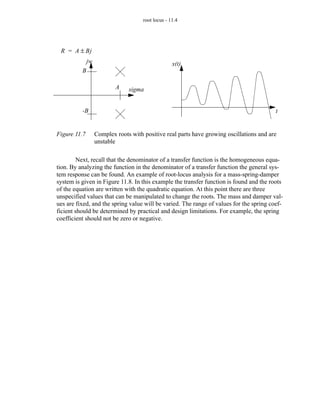
             Recall the general solution to a homogeneous differential equation. Complex roots
    will result in a sinusoidal oscillation. If the roots are real the result will be e-to-the-t terms.
    If the real roots are negative then the terms will tend to decay to zero and be stable, while
    positive roots will result in terms that grow exponentially and become unstable. Consider
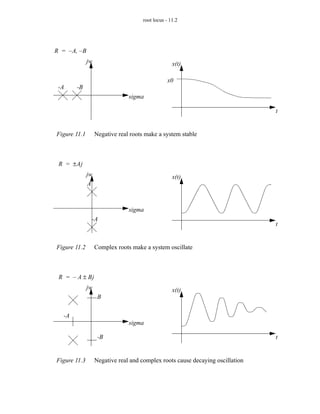
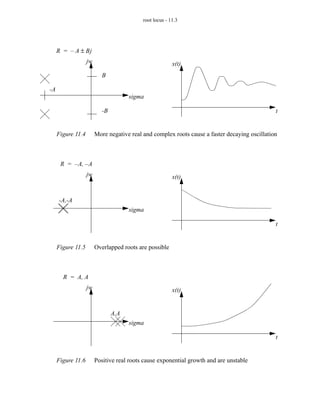
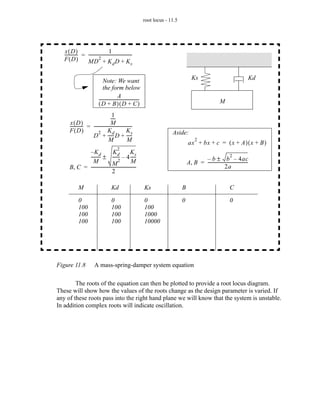
    the roots of a second-order homogeneous differential equation, as shown in Figure 11.1 to
    Figure 11.7. These roots are shown on the complex planes on the left, and a time response
    is shown to the right. Notice that in these figures (negative real) roots on the left hand side
    of the complex plane cause the response to decrease while roots on the right hand side
    cause it to increase. The rule is that any roots on the right hand side of the plane make a
    system unstable. Also note that the complex roots cause some amount of oscillation.
root locus - 11.2


R = – A, – B
              jw                                    x(t)

                                                  x0
 -A     -B
                                sigma

                                                                                t


Figure 11.1        Negative real roots make a system stable


 R = ± Aj
              jw                                    x(t)
              A


                                sigma
               -A
                                                                                t


Figure 11.2        Complex roots make a system oscillate


 R = – A ± Bj
              jw                                    x(t)
                    B


   -A
                                sigma

                    -B                                                          t


Figure 11.3        Negative real and complex roots cause decaying oscillation
root locus - 11.3


     R = – A ± Bj
                   jw                                    x(t)
                           B

-A
                                      sigma

                           -B                                                                  t


     Figure 11.4        More negative real and complex roots cause a faster decaying oscillation


      R = – A, – A
                   jw                                    x(t)


     -A,-A
                                      sigma

                                                                                               t


     Figure 11.5        Overlapped roots are possible


       R = A, A
                   jw                                    x(t)


                                A,A
                                      sigma

                                                                                               t


     Figure 11.6        Positive real roots cause exponential growth and are unstable
root locus - 11.4


 R = A ± Bj
              jw                                    x(t)
          B

                           A    sigma


          -B                                                                              t


Figure 11.7        Complex roots with positive real parts have growing oscillations and are
                   unstable

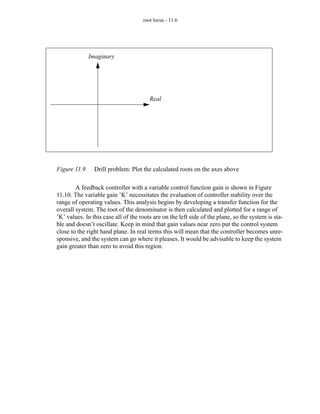
         Next, recall that the denominator of a transfer function is the homogeneous equa-
tion. By analyzing the function in the denominator of a transfer function the general sys-
tem response can be found. An example of root-locus analysis for a mass-spring-damper
system is given in Figure 11.8. In this example the transfer function is found and the roots
of the equation are written with the quadratic equation. At this point there are three
unspecified values that can be manipulated to change the roots. The mass and damper val-
ues are fixed, and the spring value will be varied. The range of values for the spring coef-
ficient should be determined by practical and design limitations. For example, the spring
coefficient should not be zero or negative.
root locus - 11.5


    x( D)                             1
   ------------ = -----------------------------------------
              -                                           -
   F(D)                     2
                  MD + K d D + K s


                                   Note: We want                                                   Ks                                       Kd
                                   the form below
                                                 A
                               --------------------------------------
                                                                    -                                                   M
                               (D + B)(D + C)
                                       1-
                                      ----
       x(D)                           M
       ------------ = ------------------------------------
                  -                                      -
       F(D)                2 Kd                      Ks                               Aside:
                      D + ----- D + -----
                                        -
                                    M                 M                                              2
                                                                                                ax + bx + c = ( x + A ) ( x + B )
                                               2
              –Kd                  Kd               Ks
              -------- ± ------ – 4 -----
                      -                 -                                                              – b ± b – 4ac
                                                                                                                               2
                M                  M
                                        2           M                                           A, B = --------------------------------------
       B, C = ------------------------------------------
                                                       -                                                               2a
                                  2

              M                           Kd                            Ks                  B                                  C

              0                           0                             0                   0                                  0
              100                         100                           100
              100                         100                           1000
              100                         100                           10000


Figure 11.8                A mass-spring-damper system equation

        The roots of the equation can then be plotted to provide a root locus diagram.
These will show how the values of the roots change as the design parameter is varied. If
any of these roots pass into the right hand plane we will know that the system is unstable.
In addition complex roots will indicate oscillation.
root locus - 11.6


              Imaginary


                                        Real


Figure 11.9     Drill problem: Plot the calculated roots on the axes above

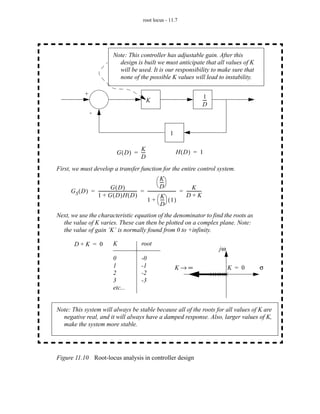
        A feedback controller with a variable control function gain is shown in Figure
11.10. The variable gain ’K’ necessitates the evaluation of controller stability over the
range of operating values. This analysis begins by developing a transfer function for the
overall system. The root of the denominator is then calculated and plotted for a range of
’K’ values. In this case all of the roots are on the left side of the plane, so the system is sta-
ble and doesn’t oscillate. Keep in mind that gain values near zero put the control system
close to the right hand plane. In real terms this will mean that the controller becomes unre-
sponsive, and the system can go where it pleases. It would be advisable to keep the system
gain greater than zero to avoid this region.
root locus - 11.7


                                   Note: This controller has adjustable gain. After this
                                     design is built we must anticipate that all values of K
                                     will be used. It is our responsibility to make sure that
                                     none of the possible K values will lead to instability.

              +                                                                                       1
                                                          K                                          ---
                                                                                                       -
                                                                                                     D
                  -


                                                                           1

                                               K                               H(D ) = 1
                                     G ( D ) = ---
                                                 -
                                               D
First, we must develop a transfer function for the entire control system.
                                                                  --- 
                                                                    K -
                             G( D)                                D                     K -
     G S ( D ) = ------------------------------------ = -------------------------- = -------------
                                                    -                            -
                 1 + G ( D )H ( D )                                                  D+K
                                                        1 +  ---  ( 1 )
                                                                    K  -
                                                                  D
Next, we use the characteristic equation of the denominator to find the roots as
  the value of K varies. These can then be plotted on a complex plane. Note:
  the value of gain ’K’ is normally found from 0 to +infinity.

       D+K = 0                     K                   root
                                                                                                           jω
                                   0                   -0
                                   1                   -1                      K→∞                              K = 0   σ
                                   2                   -2
                                   3                   -3
                                   etc...


Note: This system will always be stable because all of the roots for all values of K are
  negative real, and it will always have a damped response. Also, larger values of K,
  make the system more stable.


Figure 11.10 Root-locus analysis in controller design
root locus - 11.8


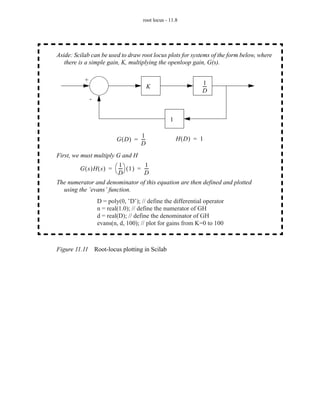
Aside: Scilab can be used to draw root locus plots for systems of the form below, where
   there is a simple gain, K, multiplying the openloop gain, G(s).

           +                                                        1
                                            K                      ---
                                                                     -
                                                                   D
               -


                                                       1

                                       1                   H(D ) = 1
                            G ( D ) = ---
                                        -
                                      D
First, we must multiply G and H

         G ( s )H ( s ) =  ---  ( 1 ) = ---
                             1             1
                              -             -
                           D            D
The numerator and denominator of this equation are then defined and plotted
  using the ’evans’ function.
                   D = poly(0, ’D’); // define the differential operator
                   n = real(1.0); // define the numerator of GH
                   d = real(D); // define the denominator of GH
                   evans(n, d, 100); // plot for gains from K=0 to 100


Figure 11.11 Root-locus plotting in Scilab
root locus - 11.9


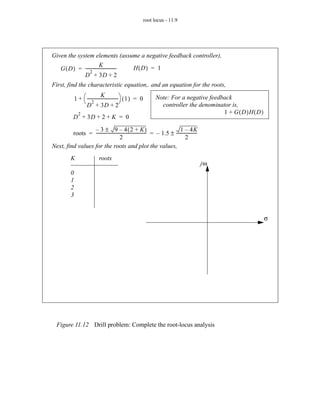
Given the system elements (assume a negative feedback controller),
                          K                H(D) = 1
   G ( D ) = -----------------------------
                  2
                                         -
             D + 3D + 2
First, find the characteristic equation,. and an equation for the roots,

                1 +  -----------------------------  ( 1 ) = 0
                                   K              -                     Note: For a negative feedback
                     2                                                  controller the denominator is,
                      D + 3D + 2
                  2                                                                               1 + G ( D )H ( D )
             D + 3D + 2 + K = 0

                  – 3 ± 9 – 4(2 + K-                           )               1 – 4K
         roots = ----------------------------------------------- = – 1.5 ± -------------------
                                                                                             -
                                        2                                           2
Next, find values for the roots and plot the values,
            K                    roots
                                                                                                 jω
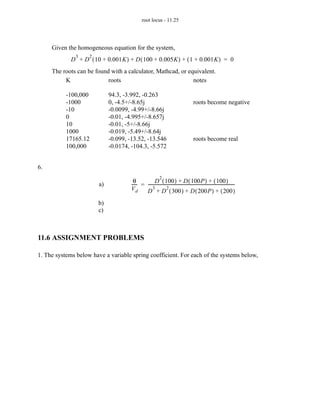
            0
            1
            2
            3


                                                                                                                       σ


   Figure 11.12 Drill problem: Complete the root-locus analysis
root locus - 11.10


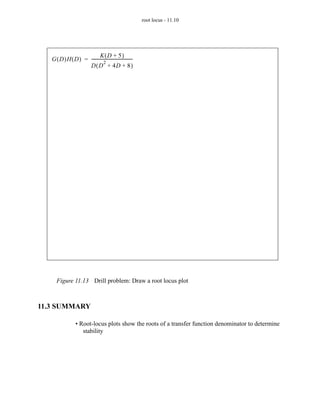
                            K(D + 5 )
   G ( D )H ( D ) = ---------------------------------------
                                2
                    D ( D + 4D + 8 )


      Figure 11.13 Drill problem: Draw a root locus plot


11.3 SUMMARY

                   • Root-locus plots show the roots of a transfer function denominator to determine
                      stability
root locus - 11.11


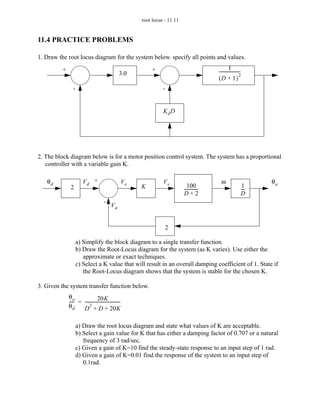
11.4 PRACTICE PROBLEMS

1. Draw the root locus diagram for the system below. specify all points and values.
         +                                                       +                                        1
                                                   3.0                                           --------------------
                                                                                                                    -
                                                                                                                    2
                                                                                                 (D + 1)
                -                                                      -


                                                                       KdD


2. The block diagram below is for a motor position control system. The system has a proportional
   controller with a variable gain K.

   θd                  Vd +                             Ve             Vs                          ω                      θa
              2                                              K                      100 -                            1
                                                                                  ------------                      ---
                                                                                                                      -
                                                                                  D+2                               D
                                       -
                                             Va


                                                                        2

                  a) Simplify the block diagram to a single transfer function.
                  b) Draw the Root-Locus diagram for the system (as K varies). Use either the
                     approximate or exact techniques.
                  c) Select a K value that will result in an overall damping coefficient of 1. State if
                     the Root-Locus diagram shows that the system is stable for the chosen K.

3. Given the system transfer function below.
             θo                 20K
             ---- = ---------------------------------
                -                                   -
             θd          2
                    D + D + 20K

                  a) Draw the root locus diagram and state what values of K are acceptable.
                  b) Select a gain value for K that has either a damping factor of 0.707 or a natural
                     frequency of 3 rad/sec.
                  c) Given a gain of K=10 find the steady-state response to an input step of 1 rad.
                  d) Given a gain of K=0.01 find the response of the system to an input step of
                     0.1rad.
root locus - 11.12


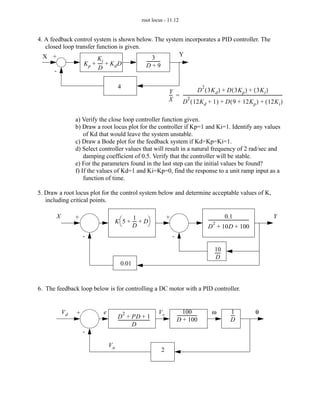
4. A feedback control system is shown below. The system incorporates a PID controller. The
   closed loop transfer function is given.
  X +                                                   Y
                        Ki                      3 -
                  K p + ---- + K d D
                           -               ------------
                         D                 D+9
       -

                                     4                                                                  2
                                                                           Y                  D ( 3K d ) + D ( 3K p ) + ( 3K i )
                                                                           -- = ----------------------------------------------------------------------------------------------
                                                                            -                                                                                                -
                                                                           X         2
                                                                                D ( 12K d + 1 ) + D ( 9 + 12K p ) + ( 12K i )

                a) Verify the close loop controller function given.
                b) Draw a root locus plot for the controller if Kp=1 and Ki=1. Identify any values
                    of Kd that would leave the system unstable.
                c) Draw a Bode plot for the feedback system if Kd=Kp=Ki=1.
                d) Select controller values that will result in a natural frequency of 2 rad/sec and
                    damping coefficient of 0.5. Verify that the controller will be stable.
                e) For the parameters found in the last step can the initial values be found?
                f) If the values of Kd=1 and Ki=Kp=0, find the response to a unit ramp input as a
                    function of time.

5. Draw a root locus plot for the control system below and determine acceptable values of K,
   including critical points.

       X                                                                                                                     0.1                                     Y
                                    K  5 + --- + D
                                      
                +                            1                             +                                 --------------------------------------
                                                                                                                                                  -
                                              -
                                            D                                                                    2
                                                                                                             D + 10D + 100
                    -                                                          -

                                                                                                                   10
                                                                                                                   -----
                                                                                                                       -
                                                                                                                    D
                                       0.01


6. The feedback loop below is for controlling a DC motor with a PID controller.


           Vd   +          e             2                            Vs                100 -
                                                                                   ------------------           ω                 1
                                                                                                                                 ---
                                                                                                                                   -                  θ
                                     D + PD + 1                                    D + 100                                       D
                                     ------------------------------
                                                  D
                    -

                               Va
                                                                      2
root locus - 11.13


a) Find the transfer function for the system.
b) Draw a root locus diagram for the variable parameter ‘P’.
c) Find the response of the system in to a unit step input using explicit integration.
root locus - 11.14


11.5 PRACTICE PROBLEM SOLUTIONS

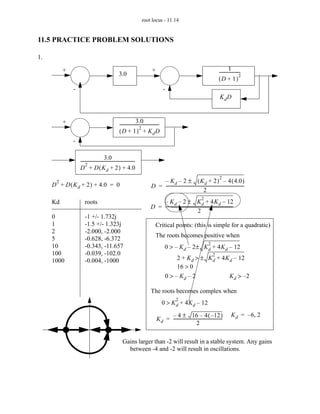
1.

          +                                                                         +                                                               1 -
                                                     3.0                                                                                   --------------------
                                                                                                                                                              2
                                                                                                                                           (D + 1)
              -                                                                               -
                                                                                                                                            KdD


          +                                                           3.0
                                                      -------------------------------------
                                                                                          -
                                                                         2
                                                      ( D + 1 ) + Kd D
              -

                                         3.0
                  ---------------------------------------------------
                                                                    -
                       2
                  D + D ( K d + 2 ) + 4.0
                                                                                                                                            2
      2                                                                                – K d – 2 ± ( K d + 2 ) – 4 ( 4.0 )
     D + D ( K d + 2 ) + 4.0 = 0                                                   D = --------------------------------------------------------------------------
                                                                                                                                                                -
                                                                                                                           2
                                                                                                                             2
     Kd               roots                                                           – K d – 2 ± K d + 4K d – 12
                                                                                  D = ----------------------------------------------------------------
                                                                                                                                                     -
                                                                                                                     2
     0                -1 +/- 1.732j
     1                -1.5 +/- 1.323j                                                  Critical points: (this is simple for a quadratic)
     2                -2.000, -2.000
                                                                                       The roots becomes positive when
     5                -0.628, -6.372
                                                                                                                                  2
     10               -0.343, -11.657                                                          0 > – K d – 2 ± K d + 4K d – 12
     100              -0.039, -102.0                                                                                                  2
     1000             -0.004, -1000                                                                 2 + K d > ± K d + 4K d – 12
                                                                                                    16 > 0
                                                                                               0 > – Kd – 2             Kd > –2

                                                                                  The roots becomes complex when
                                                                                                       2
                                                                                              0 > K d + 4K d – 12

                                                                                              – 4 ± 16 – 4 ( – 12 -                        )          K d = – 6, 2
                                                                                        K d = ----------------------------------------------
                                                                                                                    2

                                                         Gains larger than -2 will result in a stable system. Any gains
                                                           between -4 and -2 will result in oscillations.
root locus - 11.15


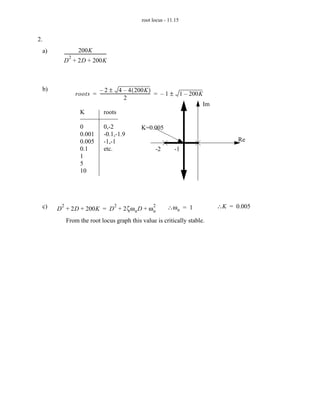
2.
  a)                   200K
         ---------------------------------------
                                               -
              2
         D + 2D + 200K


 b)                        – 2 ± 4 – 4 ( 200K )
                   roots = ----------------------------------------------- = – 1 ± 1 – 200K
                                                                         -
                                                  2
                                                                                           Im
                     K         roots

                       0                     0,-2        K=0.005
                       0.001                 -0.1,-1.9
                       0.005                 -1,-1                                                    Re
                       0.1                   etc.              -2        -1
                       1
                       5
                       10


  c)    2
       D + 2D + 200K = D + 2ζω n D + ω n
                                                   2          2      ∴ω n = 1                   ∴K = 0.005

            From the root locus graph this value is critically stable.
root locus - 11.16


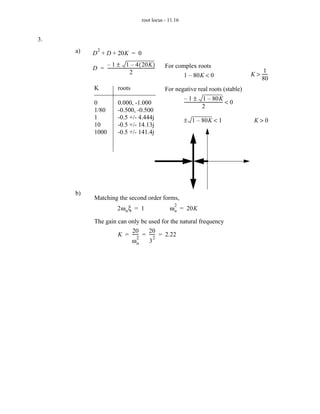
3.
     a)      2
          D + D + 20K = 0
              – 1 ± 1 – 4 ( 20K )                            For complex roots
          D = --------------------------------------------
                                                         -                                                           1-
                                   2                                1 – 80K < 0                                K > -----
                                                                                                                   80
           K                 roots                           For negative real roots (stable)
                                                                    – 1 ± 1 – 80K
           0                 0.000, -1.000                          ------------------------------------ < 0
                                                                                                       -
                                                                                     2
           1/80              -0.500, -0.500
           1                 -0.5 +/- 4.444j                        ± 1 – 80K < 1                               K>0
           10                -0.5 +/- 14.13j
           1000              -0.5 +/- 141.4j


     b)
           Matching the second order forms,
                                                                2
                             2ω n ξ = 1                        ω n = 20K

           The gain can only be used for the natural frequency
                         20     20
                    K = ----- = ----- = 2.22
                            -
                            2      2
                                    -
                         ωn     3
root locus - 11.17


     θo                 20 ( 10 )
c)   ---- = ----------------------------------------
         -                                         -
     θd          2
              D + D + 20 ( 10 )
        ··    ·
       θ o + θd + θ d 200 = 200θd

     Homogeneous:
                    2
                 A + A + 200 = 0

                     – 1 ± 1 – 4 ( 200 )                                      A = – 0.5 ± 14.1j
                 A = -------------------------------------------
                                                               -
                                          2
                                          – 0.5t
                 θo ( t ) = C1 e                   sin ( 14.1t + C 2 )

     Particular:
                 θ = A
                 0 + 0 + A200 = 200 ( 1rad )                                          A = 1rad
                 θ o ( t ) = 1rad

     Initial Conditions (assume at rest):
                                          – 0.5t
                 θo ( t ) = C1 e                   sin ( 14.1t + C 2 ) + 1rad

                 θ o ( 0 ) = C 1 ( 1 ) sin ( 14.1 ( 0 ) + C 2 ) + 1rad = 0
                                                                   C 1 sin ( C 2 ) = – 1rad                  (1)
                                                    – 0.5t                                     – 0.5t
                 θ' o ( t ) = – 0.5C 1 e                     sin ( 14.1t + C 2 ) – 14.1C 1 e            cos ( 14.1t + C 2 )
                          0 = – 0.5C 1 sin ( C 2 ) – 14.1C 1 cos ( C 2 )
                          14.1 cos ( C 2 ) = – 0.5 sin ( C 2 )
                          14.1
                          --------- = tan ( C 2 )
                                   -                                                           C 2 = – 1.54
                          – 0.5
                         – 1rad-                 – 1rad -
                 C 1 = ------------------ = ------------------------- = 1.000rad
                       sin ( C 2 )          sin ( – 1.54 )

                        – 0.5t
     θo ( t ) = ( e              sin ( 14.1t – 1.54 ) + 1 ) ( rad )
root locus - 11.18


     θo                 20 ( 0.01 )
d)   ---- = --------------------------------------------
        -                                              -
     θd          2
              D + D + 20 ( 0.01 )
          ··    ·
         θ o + θd + θ d 0.2 = 0.2θd

      Homogeneous:
                        2
                     A + A + 0.2 = 0

                         – 1 ± 1 – 4 ( 0.2 )                                     A = – 0.7236068, – 0.2763932
                     A = -----------------------------------------
                                                                 -
                                             2
                                               – 0.724t               – 0.276t
                      θo ( t ) = C1 e                      + C2 e

      Particular:
                    θ = A
                     0 + 0 + A0.2 = 0.2 ( 1rad )                                                A = 1rad
                    θ o ( t ) = 1rad

      Initial Conditions (assume at rest):
                                             – 0.724t                – 0.276t
                    θo ( t ) = C1 e                        + C2e                + 1rad
                                              – 0.724t               – 0.276t
                    θo ( 0 ) = C1 e                        + C2 e                + 1rad = 0
                                                                           C 1 + C 2 = – 1rad                (1)
                                                               – 0.724t                       – 0.276t
                    θ' o ( t ) = – 0.724 ( C 1 e                          ) – 0.276 ( C 2 e              )

                    C 1 = – 0.381C 2

                    – 0.381C 2 + C 2 = – 1rad                                            C 2 = – 1.616rad

                       C 1 = – 0.381 ( – 1.616rad ) = 0.616rad
                                        – 0.724t                           – 0.276t
      θ o ( t ) = ( 0.616 )e                         + ( – 1.616 )e                   + 1rad
root locus - 11.19


4.
     (ans.   X +                  Kp D + K i + Kd D
                                                                          2                                                  Y
                                                                                                         3 -
                                  ------------------------------------------
                                                                           -                        ------------
                                                     D                                              D+9
                 -

                                                                 4

             X +                                                                              2                              Y
                                            3K p D + 3K i + 3K d D
                                            ----------------------------------------------------
                                                                                               -
                 -                                         D(D + 9)


                                                                 4

             X                                                                            2                                  Y
                                        3K p D + 3K i + 3K d D
                     -------------------------------------------------------------------------------------------
                                                                                                               2
                     D ( D + 9 ) + 12K p D + 12K i + 12K d D


             X                                                                                     2                             Y
                                                 3K p D + 3K i + 3K d D
                            ----------------------------------------------------------------------------------------------
                                                                                                                         -
                                 2
                            D ( 12K d + 1 ) + D ( 9 + 12K p ) + ( 12K i )
root locus - 11.20


b)       2
     D ( 12K d + 1 ) + D ( 9 + 12K p ) + ( 12K i ) = 0
                                                                             2
         – 9 – 12K p ± ( 9 + 12K p ) – 4 ( 12K d + 1 )12K
     D = ------------------------------------------------------------------------------------------------------------------i
                                                                                                                          -
                                                   2 ( 12K d + 1 )

     Kd                           roots

     -100                         -0.092, 0.109
     -10                          -0.241, 0.418
     -1                           -0.46, 2.369
     -0.1                         -0.57, 105.6
     0                            -0.588, -20.41
     1                            -0.808 +/- 0.52j
     10                           -0.087 +/- 0.303j
     100                          -0.0087 +/- 0.1j

     Stable for,                                                                         2
                             – 9 – 12K p ± ( 9 + 12K p ) – 4 ( 12K d + 1 )12K i < 0

                                                              2
                             ± ( 9 + 12K p ) – 4 ( 12K d + 1 )12K i < 9 + 12K p
                                                       2                                                                       2
                             ( 9 + 12K p ) – 4 ( 12K d + 1 )12K i < ( 9 + 12K p )

                             – 4 ( 12K d + 1 )12K i < 0
                                   –1
                             K d > -----
                                       -
                                   12

     Becomes complex at,
                                                                        2
                                      0 > ( 9 + 12K p ) – 4 ( 12K d + 1 )12K i
                                                                                         2
                                      576K d K i > ( 9 + 12K p ) – 48K i
                                                                            2
                                            ( 9 + 12K p ) – 48K i
                                      K d > ----------------------------------------------
                                                                                         -                           K d > 0.682
                                                         576K d K i
root locus - 11.21


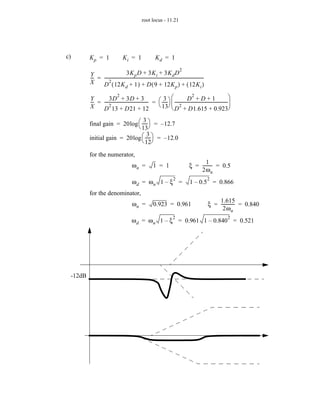
c)       Kp = 1                      Ki = 1                      Kd = 1
                                                                                      2
         Y                         3K p D + 3K i + 3K d D
         -- = ----------------------------------------------------------------------------------------------
          -                                                                                                -
         X         2
              D ( 12K d + 1 ) + D ( 9 + 12K p ) + ( 12K i )

                                                              3-                                                      
                          2                                                           2
         -- = ----------------------------------------- =  -----  --------------------------------------------------
         Y         3D + 3D + 3 -                                                 D +D+1
          -                                                                                                           -
                                                           13  2
                                                                     D + D1.615 + 0.923
         X         2
              D 13 + D21 + 12

         final gain = 20 log  ----- = – 12.7
                                3-
                              13
         initial gain = 20 log  ----- = – 12.0
                                   3-
                                12

         for the numerator,
                                                                                                      1
                                             ωn =              1 = 1                           ξ = --------- = 0.5
                                                                                                   2ω n
                                                                                 2                             2
                                             ωd = ωn 1 – ξ =                                   1 – 0.5 = 0.866
         for the denominator,
                                                                                                                   1.615
                                             ωn =              0.923 = 0.961                                   ξ = ------------ = 0.840
                                                                                                                              -
                                                                                                                     2ω n
                                                                                2                                       2
                                             ω d = ω n 1 – ξ = 0.961 1 – 0.840 = 0.521


 -12dB
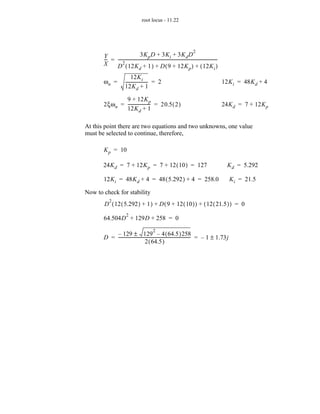
root locus - 11.22


                                                                                    2
       Y                         3K p D + 3K i + 3K d D
       -- = ----------------------------------------------------------------------------------------------
        -                                                                                                -
       X         2
            D ( 12K d + 1 ) + D ( 9 + 12K p ) + ( 12K i )
                              12K i
       ωn =              --------------------- = 2
                                             -                                                               12K i = 48K d + 4
                         12K d + 1

               9 + 12K p
       2ξω n = --------------------- = 20.5 ( 2 )
                                   -                                                                         24K d = 7 + 12K p
               12K d + 1

At this point there are two equations and two unknowns, one value
must be selected to continue, therefore,

       K p = 10

       24K d = 7 + 12K p = 7 + 12 ( 10 ) = 127                                                                 K d = 5.292

       12K i = 48K d + 4 = 48 ( 5.292 ) + 4 = 258.0                                                            K i = 21.5

Now to check for stability
           2
       D ( 12 ( 5.292 ) + 1 ) + D ( 9 + 12 ( 10 ) ) + ( 12 ( 21.5 ) ) = 0
                          2
       64.504D + 129D + 258 = 0
                                                 2
           – 129 ± 129 – 4 ( 64.5 )258
       D = -------------------------------------------------------------------- = – 1 ± 1.73j
                                                                              -
                                    2 ( 64.5 )
root locus - 11.23


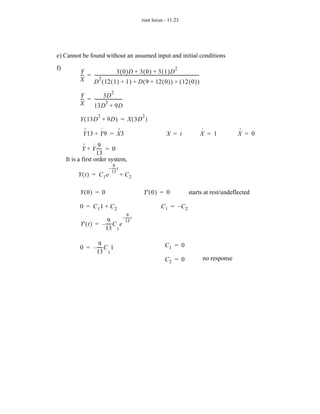
e) Cannot be found without an assumed input and initial conditions
f)                                                                                           2
           Y                         3 ( 0 )D + 3 ( 0 ) + 3 ( 1 )D
           -- = ---------------------------------------------------------------------------------------------------
            -                                                                                                     -
           X         2
                D ( 12 ( 1 ) + 1 ) + D ( 9 + 12 ( 0 ) ) + ( 12 ( 0 ) )
                                      2
           Y             3D
           -- = --------------------------
            -                            -
           X               2
                13D + 9D
                          2                                      2
           Y ( 13D + 9D ) = X ( 3D )
             ··     ·     ··                                                                                          ·             ··
             Y 13 + Y 9 = X 3                                                         X = t                           X = 1         X = 0
              ·· · 9
             Y + Y ----- = 0
                       -
                    13
     It is a first order system,
                                       9-
                                    – ----- t
                                      13
          Y ( t ) = C1 e                        + C2

           Y( 0) = 0                                              Y' ( 0 ) = 0                           starts at rest/undeflected

           0 = C11 + C2                                                          C1 = –C2
                                                    9
                                 – t              -----
                                                      -
                          9-
           Y' ( t ) = – ----- C e 13
                        13 1

                   9-                                                               C1 = 0
           0 = – ----- C 1
                 13 1
                                                                                    C2 = 0                            no response
root locus - 11.24


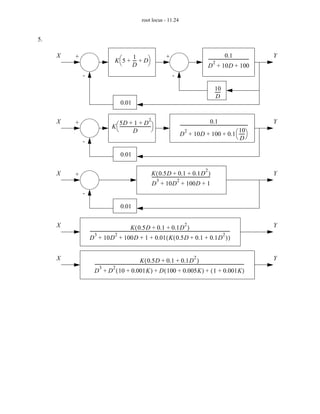
5.

     X                                                                                                                                            0.1                      Y
                                        K  5 + --- + D
         +                                       1                                       +                                        --------------------------------------
                                                                                                                                                                       -
                                                  -
                                               D                                                                                     2
                                                                                                                                  D + 10D + 100
             -                                                                                 -

                                                                                                                                        10
                                                                                                                                        -----
                                                                                                                                            -
                                                                                                                                         D
                                              0.01


     X                                                                  2                                                          0.1                                     Y
                                      K  ----------------------------- 
         +                                5D + 1 + D -                                                ----------------------------------------------------------------
                                                                                                                                                                     -
                                                                       
                                                                                                      D + 10D + 100 + 0.1  -----
                                                       D                                                   2                                                  10 -
                                                                                                                                                             D
             -

                                              0.01

                                                                                                                              2
     X   +                                                                  K ( 0.5D + 0.1 + 0.1D )
                                                                            -------------------------------------------------------
                                                                                                                                  -
                                                                                                                                                                           Y
                                                                                 3                  2
                                                                            D + 10D + 100D + 1
             -

                                              0.01


     X                                                  K ( 0.5D + 0.1 + 0.1D )
                                                                                                          2                                                                Y
                 -------------------------------------------------------------------------------------------------------------------------------------
                                                                                                                                                     -
                      3                  2                                                                                                      2
                 D + 10D + 100D + 1 + 0.01 ( K ( 0.5D + 0.1 + 0.1D ) )


     X                                                          K ( 0.5D + 0.1 + 0.1D )
                                                                                                                   2                                                       Y
                     ----------------------------------------------------------------------------------------------------------------------------------------------
                                                                                                                                                                  -
                          3            2
                     D + D ( 10 + 0.001K ) + D ( 100 + 0.005K ) + ( 1 + 0.001K )
root locus - 11.25


     Given the homogeneous equation for the system,
               3    2
             D + D ( 10 + 0.001K ) + D ( 100 + 0.005K ) + ( 1 + 0.001K ) = 0
     The roots can be found with a calculator, Mathcad, or equivalent.
          K                roots                             notes

           -100,000          94.3, -3.992, -0.263
           -1000             0, -4.5+/-8.65j                                               roots become negative
           -10               -0.0099, -4.99+/-8.66j
           0                 -0.01, -4.995+/-8.657j
           10                -0.01, -5+/-8.66j
           1000              -0.019, -5.49+/-8.64j
           17165.12          -0.099, -13.52, -13.546                                       roots become real
           100,000           -0.0174, -104.3, -5.572


6.
                                                              2
                                       θ             D ( 100 ) + D ( 100P ) + ( 100 ) -
                        a)            ----- = ----------------------------------------------------------------------------------
                                          -
                                      Vd           3            2
                                              D + D ( 300 ) + D ( 200P ) + ( 200 )
                        b)
                        c)


11.6 ASSIGNMENT PROBLEMS

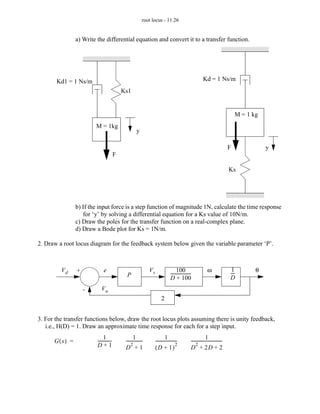
1. The systems below have a variable spring coefficient. For each of the systems below,
root locus - 11.26


               a) Write the differential equation and convert it to a transfer function.


       Kd1 = 1 Ns/m                                                                                         Kd = 1 Ns/m
                                           Ks1


                                                                                                                                     M = 1 kg
                       M = 1kg
                                                     y

                                                                                                                                 F              y
                                       F

                                                                                                                                 Ks


               b) If the input force is a step function of magnitude 1N, calculate the time response
                  for ‘y’ by solving a differential equation for a Ks value of 10N/m.
               c) Draw the poles for the transfer function on a real-complex plane.
               d) Draw a Bode plot for Ks = 1N/m.

2. Draw a root locus diagram for the feedback system below given the variable parameter ‘P’.


         Vd    +             e                                Vs                     100 -                      ω                 1
                                                                                                                                 ---
                                                                                                                                   -        θ
                                             P                                  ------------------
                                                                                D + 100                                          D
                   -       Va
                                                                        2


3. For the transfer functions below, draw the root locus plots assuming there is unity feedback,
   i.e., H(D) = 1. Draw an approximate time response for each for a step input.
                             1 -                   1 -                      1 -                                1
      G(s) =            ------------        ---------------
                                                 2
                                                                   --------------------
                                                                                      2
                                                                                                 -----------------------------
                                                                                                      2
                                                                                                                             -
                        D+1                 D +1                   (D + 1)                       D + 2D + 2
root locus - 11.27


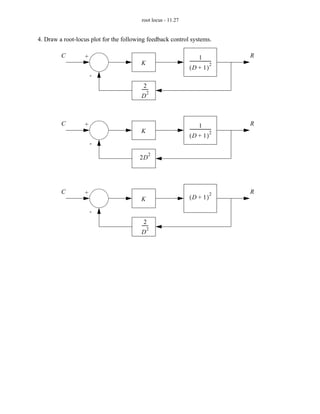
4. Draw a root-locus plot for the following feedback control systems.

         C        +                                                    1             R
                                         K                    --------------------
                                                                                 -
                                                                                 2
                                                              (D + 1)
                      -
                                           2
                                         ------
                                              2
                                         D


         C        +                                                    1 -           R
                                         K                    --------------------
                                                                                 2
                                                              (D + 1)
                      -
                                              2
                                        2D


         C        +                                                            2     R
                                         K                    (D + 1)

                      -
                                           2
                                         ------
                                              2
                                         D

Root locus analysis

  • 1.
    root locus -11.1 11. ROOT LOCUS ANALYSIS Topics: • Root-locus plots Objectives: • To be able to predict and control system stability. 11.1 INTRODUCTION The system can also be checked for general stability when controller parameters are varied using root-locus plots. 11.2 ROOT-LOCUS ANALYSIS In a engineered system we may typically have one or more design parameters, adjustments, or user settings. It is important to determine if any of these will make the sys- tem unstable. This is generally undesirable and possibly unsafe. For example, think of a washing machine that vibrates so much that it ‘walks’ across a floor, or a high speed air- craft that fails due to resonant vibrations. Root-locus plots are used to plot the system roots over the range of a variable to determine if the system will become unstable, or oscillate. Recall the general solution to a homogeneous differential equation. Complex roots will result in a sinusoidal oscillation. If the roots are real the result will be e-to-the-t terms. If the real roots are negative then the terms will tend to decay to zero and be stable, while positive roots will result in terms that grow exponentially and become unstable. Consider the roots of a second-order homogeneous differential equation, as shown in Figure 11.1 to Figure 11.7. These roots are shown on the complex planes on the left, and a time response is shown to the right. Notice that in these figures (negative real) roots on the left hand side of the complex plane cause the response to decrease while roots on the right hand side cause it to increase. The rule is that any roots on the right hand side of the plane make a system unstable. Also note that the complex roots cause some amount of oscillation.
  • 2.
    root locus -11.2 R = – A, – B jw x(t) x0 -A -B sigma t Figure 11.1 Negative real roots make a system stable R = ± Aj jw x(t) A sigma -A t Figure 11.2 Complex roots make a system oscillate R = – A ± Bj jw x(t) B -A sigma -B t Figure 11.3 Negative real and complex roots cause decaying oscillation
  • 3.
    root locus -11.3 R = – A ± Bj jw x(t) B -A sigma -B t Figure 11.4 More negative real and complex roots cause a faster decaying oscillation R = – A, – A jw x(t) -A,-A sigma t Figure 11.5 Overlapped roots are possible R = A, A jw x(t) A,A sigma t Figure 11.6 Positive real roots cause exponential growth and are unstable
  • 4.
    root locus -11.4 R = A ± Bj jw x(t) B A sigma -B t Figure 11.7 Complex roots with positive real parts have growing oscillations and are unstable Next, recall that the denominator of a transfer function is the homogeneous equa- tion. By analyzing the function in the denominator of a transfer function the general sys- tem response can be found. An example of root-locus analysis for a mass-spring-damper system is given in Figure 11.8. In this example the transfer function is found and the roots of the equation are written with the quadratic equation. At this point there are three unspecified values that can be manipulated to change the roots. The mass and damper val- ues are fixed, and the spring value will be varied. The range of values for the spring coef- ficient should be determined by practical and design limitations. For example, the spring coefficient should not be zero or negative.
  • 5.
    root locus -11.5 x( D) 1 ------------ = ----------------------------------------- - - F(D) 2 MD + K d D + K s Note: We want Ks Kd the form below A -------------------------------------- - M (D + B)(D + C) 1- ---- x(D) M ------------ = ------------------------------------ - - F(D) 2 Kd Ks Aside: D + ----- D + ----- - M M 2 ax + bx + c = ( x + A ) ( x + B ) 2 –Kd Kd Ks -------- ± ------ – 4 ----- - - – b ± b – 4ac 2 M M 2 M A, B = -------------------------------------- B, C = ------------------------------------------ - 2a 2 M Kd Ks B C 0 0 0 0 0 100 100 100 100 100 1000 100 100 10000 Figure 11.8 A mass-spring-damper system equation The roots of the equation can then be plotted to provide a root locus diagram. These will show how the values of the roots change as the design parameter is varied. If any of these roots pass into the right hand plane we will know that the system is unstable. In addition complex roots will indicate oscillation.
  • 6.
    root locus -11.6 Imaginary Real Figure 11.9 Drill problem: Plot the calculated roots on the axes above A feedback controller with a variable control function gain is shown in Figure 11.10. The variable gain ’K’ necessitates the evaluation of controller stability over the range of operating values. This analysis begins by developing a transfer function for the overall system. The root of the denominator is then calculated and plotted for a range of ’K’ values. In this case all of the roots are on the left side of the plane, so the system is sta- ble and doesn’t oscillate. Keep in mind that gain values near zero put the control system close to the right hand plane. In real terms this will mean that the controller becomes unre- sponsive, and the system can go where it pleases. It would be advisable to keep the system gain greater than zero to avoid this region.
  • 7.
    root locus -11.7 Note: This controller has adjustable gain. After this design is built we must anticipate that all values of K will be used. It is our responsibility to make sure that none of the possible K values will lead to instability. + 1 K --- - D - 1 K H(D ) = 1 G ( D ) = --- - D First, we must develop a transfer function for the entire control system.  ---  K - G( D)  D K - G S ( D ) = ------------------------------------ = -------------------------- = ------------- - - 1 + G ( D )H ( D ) D+K 1 +  ---  ( 1 ) K -  D Next, we use the characteristic equation of the denominator to find the roots as the value of K varies. These can then be plotted on a complex plane. Note: the value of gain ’K’ is normally found from 0 to +infinity. D+K = 0 K root jω 0 -0 1 -1 K→∞ K = 0 σ 2 -2 3 -3 etc... Note: This system will always be stable because all of the roots for all values of K are negative real, and it will always have a damped response. Also, larger values of K, make the system more stable. Figure 11.10 Root-locus analysis in controller design
  • 8.
    root locus -11.8 Aside: Scilab can be used to draw root locus plots for systems of the form below, where there is a simple gain, K, multiplying the openloop gain, G(s). + 1 K --- - D - 1 1 H(D ) = 1 G ( D ) = --- - D First, we must multiply G and H G ( s )H ( s ) =  ---  ( 1 ) = --- 1 1 - -  D D The numerator and denominator of this equation are then defined and plotted using the ’evans’ function. D = poly(0, ’D’); // define the differential operator n = real(1.0); // define the numerator of GH d = real(D); // define the denominator of GH evans(n, d, 100); // plot for gains from K=0 to 100 Figure 11.11 Root-locus plotting in Scilab
  • 9.
    root locus -11.9 Given the system elements (assume a negative feedback controller), K H(D) = 1 G ( D ) = ----------------------------- 2 - D + 3D + 2 First, find the characteristic equation,. and an equation for the roots, 1 +  -----------------------------  ( 1 ) = 0 K - Note: For a negative feedback  2  controller the denominator is, D + 3D + 2 2 1 + G ( D )H ( D ) D + 3D + 2 + K = 0 – 3 ± 9 – 4(2 + K- ) 1 – 4K roots = ----------------------------------------------- = – 1.5 ± ------------------- - 2 2 Next, find values for the roots and plot the values, K roots jω 0 1 2 3 σ Figure 11.12 Drill problem: Complete the root-locus analysis
  • 10.
    root locus -11.10 K(D + 5 ) G ( D )H ( D ) = --------------------------------------- 2 D ( D + 4D + 8 ) Figure 11.13 Drill problem: Draw a root locus plot 11.3 SUMMARY • Root-locus plots show the roots of a transfer function denominator to determine stability
  • 11.
    root locus -11.11 11.4 PRACTICE PROBLEMS 1. Draw the root locus diagram for the system below. specify all points and values. + + 1 3.0 -------------------- - 2 (D + 1) - - KdD 2. The block diagram below is for a motor position control system. The system has a proportional controller with a variable gain K. θd Vd + Ve Vs ω θa 2 K 100 - 1 ------------ --- - D+2 D - Va 2 a) Simplify the block diagram to a single transfer function. b) Draw the Root-Locus diagram for the system (as K varies). Use either the approximate or exact techniques. c) Select a K value that will result in an overall damping coefficient of 1. State if the Root-Locus diagram shows that the system is stable for the chosen K. 3. Given the system transfer function below. θo 20K ---- = --------------------------------- - - θd 2 D + D + 20K a) Draw the root locus diagram and state what values of K are acceptable. b) Select a gain value for K that has either a damping factor of 0.707 or a natural frequency of 3 rad/sec. c) Given a gain of K=10 find the steady-state response to an input step of 1 rad. d) Given a gain of K=0.01 find the response of the system to an input step of 0.1rad.
  • 12.
    root locus -11.12 4. A feedback control system is shown below. The system incorporates a PID controller. The closed loop transfer function is given. X + Y Ki 3 - K p + ---- + K d D - ------------ D D+9 - 4 2 Y D ( 3K d ) + D ( 3K p ) + ( 3K i ) -- = ---------------------------------------------------------------------------------------------- - - X 2 D ( 12K d + 1 ) + D ( 9 + 12K p ) + ( 12K i ) a) Verify the close loop controller function given. b) Draw a root locus plot for the controller if Kp=1 and Ki=1. Identify any values of Kd that would leave the system unstable. c) Draw a Bode plot for the feedback system if Kd=Kp=Ki=1. d) Select controller values that will result in a natural frequency of 2 rad/sec and damping coefficient of 0.5. Verify that the controller will be stable. e) For the parameters found in the last step can the initial values be found? f) If the values of Kd=1 and Ki=Kp=0, find the response to a unit ramp input as a function of time. 5. Draw a root locus plot for the control system below and determine acceptable values of K, including critical points. X 0.1 Y K  5 + --- + D  + 1 + -------------------------------------- - - D  2 D + 10D + 100 - - 10 ----- - D 0.01 6. The feedback loop below is for controlling a DC motor with a PID controller. Vd + e 2 Vs 100 - ------------------ ω 1 --- - θ D + PD + 1 D + 100 D ------------------------------ D - Va 2
  • 13.
    root locus -11.13 a) Find the transfer function for the system. b) Draw a root locus diagram for the variable parameter ‘P’. c) Find the response of the system in to a unit step input using explicit integration.
  • 14.
    root locus -11.14 11.5 PRACTICE PROBLEM SOLUTIONS 1. + + 1 - 3.0 -------------------- 2 (D + 1) - - KdD + 3.0 ------------------------------------- - 2 ( D + 1 ) + Kd D - 3.0 --------------------------------------------------- - 2 D + D ( K d + 2 ) + 4.0 2 2 – K d – 2 ± ( K d + 2 ) – 4 ( 4.0 ) D + D ( K d + 2 ) + 4.0 = 0 D = -------------------------------------------------------------------------- - 2 2 Kd roots – K d – 2 ± K d + 4K d – 12 D = ---------------------------------------------------------------- - 2 0 -1 +/- 1.732j 1 -1.5 +/- 1.323j Critical points: (this is simple for a quadratic) 2 -2.000, -2.000 The roots becomes positive when 5 -0.628, -6.372 2 10 -0.343, -11.657 0 > – K d – 2 ± K d + 4K d – 12 100 -0.039, -102.0 2 1000 -0.004, -1000 2 + K d > ± K d + 4K d – 12 16 > 0 0 > – Kd – 2 Kd > –2 The roots becomes complex when 2 0 > K d + 4K d – 12 – 4 ± 16 – 4 ( – 12 - ) K d = – 6, 2 K d = ---------------------------------------------- 2 Gains larger than -2 will result in a stable system. Any gains between -4 and -2 will result in oscillations.
  • 15.
    root locus -11.15 2. a) 200K --------------------------------------- - 2 D + 2D + 200K b) – 2 ± 4 – 4 ( 200K ) roots = ----------------------------------------------- = – 1 ± 1 – 200K - 2 Im K roots 0 0,-2 K=0.005 0.001 -0.1,-1.9 0.005 -1,-1 Re 0.1 etc. -2 -1 1 5 10 c) 2 D + 2D + 200K = D + 2ζω n D + ω n 2 2 ∴ω n = 1 ∴K = 0.005 From the root locus graph this value is critically stable.
  • 16.
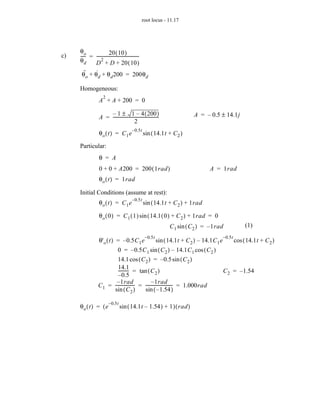
    root locus -11.16 3. a) 2 D + D + 20K = 0 – 1 ± 1 – 4 ( 20K ) For complex roots D = -------------------------------------------- - 1- 2 1 – 80K < 0 K > ----- 80 K roots For negative real roots (stable) – 1 ± 1 – 80K 0 0.000, -1.000 ------------------------------------ < 0 - 2 1/80 -0.500, -0.500 1 -0.5 +/- 4.444j ± 1 – 80K < 1 K>0 10 -0.5 +/- 14.13j 1000 -0.5 +/- 141.4j b) Matching the second order forms, 2 2ω n ξ = 1 ω n = 20K The gain can only be used for the natural frequency 20 20 K = ----- = ----- = 2.22 - 2 2 - ωn 3
  • 17.
    root locus -11.17 θo 20 ( 10 ) c) ---- = ---------------------------------------- - - θd 2 D + D + 20 ( 10 ) ·· · θ o + θd + θ d 200 = 200θd Homogeneous: 2 A + A + 200 = 0 – 1 ± 1 – 4 ( 200 ) A = – 0.5 ± 14.1j A = ------------------------------------------- - 2 – 0.5t θo ( t ) = C1 e sin ( 14.1t + C 2 ) Particular: θ = A 0 + 0 + A200 = 200 ( 1rad ) A = 1rad θ o ( t ) = 1rad Initial Conditions (assume at rest): – 0.5t θo ( t ) = C1 e sin ( 14.1t + C 2 ) + 1rad θ o ( 0 ) = C 1 ( 1 ) sin ( 14.1 ( 0 ) + C 2 ) + 1rad = 0 C 1 sin ( C 2 ) = – 1rad (1) – 0.5t – 0.5t θ' o ( t ) = – 0.5C 1 e sin ( 14.1t + C 2 ) – 14.1C 1 e cos ( 14.1t + C 2 ) 0 = – 0.5C 1 sin ( C 2 ) – 14.1C 1 cos ( C 2 ) 14.1 cos ( C 2 ) = – 0.5 sin ( C 2 ) 14.1 --------- = tan ( C 2 ) - C 2 = – 1.54 – 0.5 – 1rad- – 1rad - C 1 = ------------------ = ------------------------- = 1.000rad sin ( C 2 ) sin ( – 1.54 ) – 0.5t θo ( t ) = ( e sin ( 14.1t – 1.54 ) + 1 ) ( rad )
  • 18.
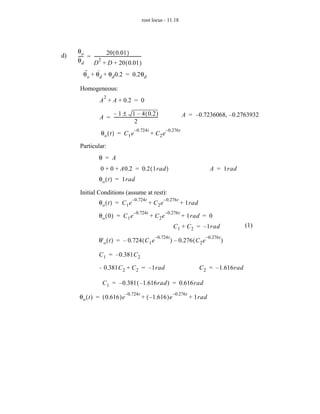
    root locus -11.18 θo 20 ( 0.01 ) d) ---- = -------------------------------------------- - - θd 2 D + D + 20 ( 0.01 ) ·· · θ o + θd + θ d 0.2 = 0.2θd Homogeneous: 2 A + A + 0.2 = 0 – 1 ± 1 – 4 ( 0.2 ) A = – 0.7236068, – 0.2763932 A = ----------------------------------------- - 2 – 0.724t – 0.276t θo ( t ) = C1 e + C2 e Particular: θ = A 0 + 0 + A0.2 = 0.2 ( 1rad ) A = 1rad θ o ( t ) = 1rad Initial Conditions (assume at rest): – 0.724t – 0.276t θo ( t ) = C1 e + C2e + 1rad – 0.724t – 0.276t θo ( 0 ) = C1 e + C2 e + 1rad = 0 C 1 + C 2 = – 1rad (1) – 0.724t – 0.276t θ' o ( t ) = – 0.724 ( C 1 e ) – 0.276 ( C 2 e ) C 1 = – 0.381C 2 – 0.381C 2 + C 2 = – 1rad C 2 = – 1.616rad C 1 = – 0.381 ( – 1.616rad ) = 0.616rad – 0.724t – 0.276t θ o ( t ) = ( 0.616 )e + ( – 1.616 )e + 1rad
  • 19.
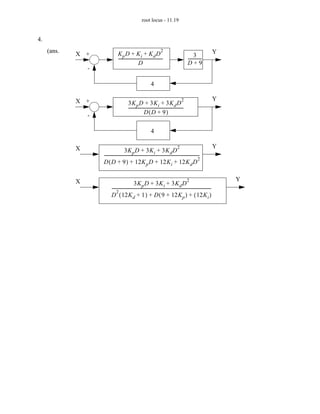
    root locus -11.19 4. (ans. X + Kp D + K i + Kd D 2 Y 3 - ------------------------------------------ - ------------ D D+9 - 4 X + 2 Y 3K p D + 3K i + 3K d D ---------------------------------------------------- - - D(D + 9) 4 X 2 Y 3K p D + 3K i + 3K d D ------------------------------------------------------------------------------------------- 2 D ( D + 9 ) + 12K p D + 12K i + 12K d D X 2 Y 3K p D + 3K i + 3K d D ---------------------------------------------------------------------------------------------- - 2 D ( 12K d + 1 ) + D ( 9 + 12K p ) + ( 12K i )
  • 20.
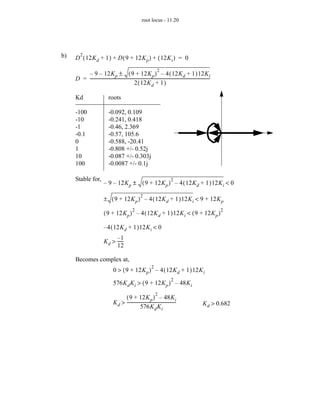
    root locus -11.20 b) 2 D ( 12K d + 1 ) + D ( 9 + 12K p ) + ( 12K i ) = 0 2 – 9 – 12K p ± ( 9 + 12K p ) – 4 ( 12K d + 1 )12K D = ------------------------------------------------------------------------------------------------------------------i - 2 ( 12K d + 1 ) Kd roots -100 -0.092, 0.109 -10 -0.241, 0.418 -1 -0.46, 2.369 -0.1 -0.57, 105.6 0 -0.588, -20.41 1 -0.808 +/- 0.52j 10 -0.087 +/- 0.303j 100 -0.0087 +/- 0.1j Stable for, 2 – 9 – 12K p ± ( 9 + 12K p ) – 4 ( 12K d + 1 )12K i < 0 2 ± ( 9 + 12K p ) – 4 ( 12K d + 1 )12K i < 9 + 12K p 2 2 ( 9 + 12K p ) – 4 ( 12K d + 1 )12K i < ( 9 + 12K p ) – 4 ( 12K d + 1 )12K i < 0 –1 K d > ----- - 12 Becomes complex at, 2 0 > ( 9 + 12K p ) – 4 ( 12K d + 1 )12K i 2 576K d K i > ( 9 + 12K p ) – 48K i 2 ( 9 + 12K p ) – 48K i K d > ---------------------------------------------- - K d > 0.682 576K d K i
  • 21.
    root locus -11.21 c) Kp = 1 Ki = 1 Kd = 1 2 Y 3K p D + 3K i + 3K d D -- = ---------------------------------------------------------------------------------------------- - - X 2 D ( 12K d + 1 ) + D ( 9 + 12K p ) + ( 12K i ) 3-   2 2 -- = ----------------------------------------- =  -----  -------------------------------------------------- Y 3D + 3D + 3 - D +D+1 - -  13  2 D + D1.615 + 0.923 X 2 D 13 + D21 + 12 final gain = 20 log  ----- = – 12.7 3-  13 initial gain = 20 log  ----- = – 12.0 3-  12 for the numerator, 1 ωn = 1 = 1 ξ = --------- = 0.5 2ω n 2 2 ωd = ωn 1 – ξ = 1 – 0.5 = 0.866 for the denominator, 1.615 ωn = 0.923 = 0.961 ξ = ------------ = 0.840 - 2ω n 2 2 ω d = ω n 1 – ξ = 0.961 1 – 0.840 = 0.521 -12dB
  • 22.
    root locus -11.22 2 Y 3K p D + 3K i + 3K d D -- = ---------------------------------------------------------------------------------------------- - - X 2 D ( 12K d + 1 ) + D ( 9 + 12K p ) + ( 12K i ) 12K i ωn = --------------------- = 2 - 12K i = 48K d + 4 12K d + 1 9 + 12K p 2ξω n = --------------------- = 20.5 ( 2 ) - 24K d = 7 + 12K p 12K d + 1 At this point there are two equations and two unknowns, one value must be selected to continue, therefore, K p = 10 24K d = 7 + 12K p = 7 + 12 ( 10 ) = 127 K d = 5.292 12K i = 48K d + 4 = 48 ( 5.292 ) + 4 = 258.0 K i = 21.5 Now to check for stability 2 D ( 12 ( 5.292 ) + 1 ) + D ( 9 + 12 ( 10 ) ) + ( 12 ( 21.5 ) ) = 0 2 64.504D + 129D + 258 = 0 2 – 129 ± 129 – 4 ( 64.5 )258 D = -------------------------------------------------------------------- = – 1 ± 1.73j - 2 ( 64.5 )
  • 23.
    root locus -11.23 e) Cannot be found without an assumed input and initial conditions f) 2 Y 3 ( 0 )D + 3 ( 0 ) + 3 ( 1 )D -- = --------------------------------------------------------------------------------------------------- - - X 2 D ( 12 ( 1 ) + 1 ) + D ( 9 + 12 ( 0 ) ) + ( 12 ( 0 ) ) 2 Y 3D -- = -------------------------- - - X 2 13D + 9D 2 2 Y ( 13D + 9D ) = X ( 3D ) ·· · ·· · ·· Y 13 + Y 9 = X 3 X = t X = 1 X = 0 ·· · 9 Y + Y ----- = 0 - 13 It is a first order system, 9- – ----- t 13 Y ( t ) = C1 e + C2 Y( 0) = 0 Y' ( 0 ) = 0 starts at rest/undeflected 0 = C11 + C2 C1 = –C2 9 – t ----- - 9- Y' ( t ) = – ----- C e 13 13 1 9- C1 = 0 0 = – ----- C 1 13 1 C2 = 0 no response
  • 24.
    root locus -11.24 5. X 0.1 Y K  5 + --- + D + 1 + -------------------------------------- - -  D  2 D + 10D + 100 - - 10 ----- - D 0.01 X 2 0.1 Y K  -----------------------------  + 5D + 1 + D - ---------------------------------------------------------------- -   D + 10D + 100 + 0.1  ----- D 2 10 -  D - 0.01 2 X + K ( 0.5D + 0.1 + 0.1D ) ------------------------------------------------------- - Y 3 2 D + 10D + 100D + 1 - 0.01 X K ( 0.5D + 0.1 + 0.1D ) 2 Y ------------------------------------------------------------------------------------------------------------------------------------- - 3 2 2 D + 10D + 100D + 1 + 0.01 ( K ( 0.5D + 0.1 + 0.1D ) ) X K ( 0.5D + 0.1 + 0.1D ) 2 Y ---------------------------------------------------------------------------------------------------------------------------------------------- - 3 2 D + D ( 10 + 0.001K ) + D ( 100 + 0.005K ) + ( 1 + 0.001K )
  • 25.
    root locus -11.25 Given the homogeneous equation for the system, 3 2 D + D ( 10 + 0.001K ) + D ( 100 + 0.005K ) + ( 1 + 0.001K ) = 0 The roots can be found with a calculator, Mathcad, or equivalent. K roots notes -100,000 94.3, -3.992, -0.263 -1000 0, -4.5+/-8.65j roots become negative -10 -0.0099, -4.99+/-8.66j 0 -0.01, -4.995+/-8.657j 10 -0.01, -5+/-8.66j 1000 -0.019, -5.49+/-8.64j 17165.12 -0.099, -13.52, -13.546 roots become real 100,000 -0.0174, -104.3, -5.572 6. 2 θ D ( 100 ) + D ( 100P ) + ( 100 ) - a) ----- = ---------------------------------------------------------------------------------- - Vd 3 2 D + D ( 300 ) + D ( 200P ) + ( 200 ) b) c) 11.6 ASSIGNMENT PROBLEMS 1. The systems below have a variable spring coefficient. For each of the systems below,
  • 26.
    root locus -11.26 a) Write the differential equation and convert it to a transfer function. Kd1 = 1 Ns/m Kd = 1 Ns/m Ks1 M = 1 kg M = 1kg y F y F Ks b) If the input force is a step function of magnitude 1N, calculate the time response for ‘y’ by solving a differential equation for a Ks value of 10N/m. c) Draw the poles for the transfer function on a real-complex plane. d) Draw a Bode plot for Ks = 1N/m. 2. Draw a root locus diagram for the feedback system below given the variable parameter ‘P’. Vd + e Vs 100 - ω 1 --- - θ P ------------------ D + 100 D - Va 2 3. For the transfer functions below, draw the root locus plots assuming there is unity feedback, i.e., H(D) = 1. Draw an approximate time response for each for a step input. 1 - 1 - 1 - 1 G(s) = ------------ --------------- 2 -------------------- 2 ----------------------------- 2 - D+1 D +1 (D + 1) D + 2D + 2
  • 27.
    root locus -11.27 4. Draw a root-locus plot for the following feedback control systems. C + 1 R K -------------------- - 2 (D + 1) - 2 ------ 2 D C + 1 - R K -------------------- 2 (D + 1) - 2 2D C + 2 R K (D + 1) - 2 ------ 2 D