Midterm Exam Emat 213
                               November 2005
                                Marked out of 36

   [10 points] Problem 1.
Write the general solution of the following linear ODEs

                       (a) y (5) − y (4) − y − y + 4y − 2y = 0
                                       1      1
                       (b) x4 y + x2 y + xy − 2y = 0
                                       2      2
You may find this useful:
                            1          1                           1
    m(m − 1)(m − 2)(m − 3) + m(m − 1) + m − 2 = (m − 2)2 m2 − 2m −
                            2          2                           2
    m5 − m4 − m3 − m2 + 4m − 2 = (m − 1)3 (m + 1 − i)(m + 1 + i)

Solution
For (a) the second hint gives the factorization of the auxiliary equation. The
roots are m = 1 with multiplicity 3 and −1 ± i. Therefore the complementary
solution is

            yc = c1 ex + c2 xex + c3 x2 ex + c4 e−x cos(x) + c5 e−x sin(x)

For (b) the first hint gives almost the factorization of the auxiliary equation:
the quadratic polynomial has roots

                          1                                     1      √
            m2 − 2m −       =0        m1,2 = 1 ±         1+       = 1 ± 6/2
                          2                                     2
Therefore                                           √                √
                yc = c1 x2 + c2 x2 ln(x) + c3 x1+       6/2
                                                              + c4 x1−   6/2


   [10 points] Problem 2.
Consider the linear ODE

                             y − 4y + 4y = 25 cos(x)

(i) Find the complementary solution yc (i.e. the general solution of the as-
sociated homogeneous equation).
(ii) Find a particular solution yp (hint: Undetermined coefficients or Varia-
tion of Parameters (whichever)).
(iii) Use the above information to find the solution for the IVP

                             y − 4y + 4y = 25 cos(x)

                             y(0) = 0, y (0) = 0

                                          1
Solution
Complementary: the aux. eq.

                           m2 − 4m + 4 = (m − 2)2

Hence
                                yc = c1 e2x + c2 xe2x
Particular: we use the Ansatz

                               yp = A cos(x) + B sin(x)
                               yp = −A sin(x) + B cos(x)
                               yp = −A cos(x) − B sin(x) .

Plugging into the equation we get

    −A cos(x) − B sin(x) − 4(−A sin(x) + B cos(x)) + 4(A cos(x) + B sin(x)) =
    (3A − 4B) cos(x) + (4A + 3B) sin(x) = 25 cos(x)

        3A − 4B = 25            3A − 4B = 25              − 9 B − 4B = 25
                     →                 3     →              4
         4A + 3B = 0              A = −4B                     A = −3B
                                                                    4


          − 25 B = 25           B = −4
    →        4        →
          A = −3B 4              A=3

                               yp = 3 cos(x) − 4 sin(x)
The general solution is thus

               y = 3 cos(x) − 4 sin(x) + c1 e2x + c2 xe2x
               y = −3 sin(x) − 4 cos(x) + 2c1 e2x + 2c2 xe2x + c2 e2x

We have thus

                    y(0) = 3 + c1 = 0 ⇒ c1 = −3
                    y (0) = −4 − 6 + c2 = 0 ⇒ c2 = 10
                    yIV P = 3 cos(x) − 4 sin(x) − 3e2x + 10xe2x


   [10 points] Problem 3.
Consider the Cauchy-Euler linear ODE

                                x2 y − xy + y = x2

(i) Find the complementary solution yc (i.e. the general solution of the
associated homogeneous equation).
(ii) Find a particular solution yp (hint: Variation of Parameters. Warning:

                                          2
must put in standard form first!). Solution Complementary: the auxiliary
equation is
                m(m − 1) − m + 1 = m2 − 2m + 1 = (m − 1)2
hence
                                    yc = c1 x + c2 x ln x
Particular: using variation of parameters. Note that the standard form is
                                          1     1
                                    y −     y + 2y = 1
                                          x    x
so f (x) in the formula of variation of parameters is f (x) = 1.

        yp = u 1 y 1 + u 2 y 2
                   x x ln x
        W := det               =x
                   1 ln x + 1
             −y2 f    x ln x
        u1 =       =−        = − ln(x) ⇒ u1 = −                   ln(x)dx = −x ln x + x
              W         x
             y1 f   x
        u2 =      = = 1 ⇒ u2 = x
             W      x
So we have

                          yp = (x − x ln x)x + x2 ln x = x2
                                   y = x2 + c1 x + c2 x ln x


   [10 points] Problem 4.
A mass of 2Kg is attached to a spring of constant k = 1 N/m. The medium
offers a damping coefficient of 2 N s/m. The system is subject to an external
force equal to
                             Fext = 13 cos(2t).
Find the motion of the mass if we know that it is released from equilibrium and
at rest.
Solution
The equation of motion is

                                 M x + βx + kx = Fext
                                 2x + 2x + x = 13 cos(2t).

We have the auxiliary equation
                                                        √
                     2                           −1 ±       1−2       −1 ± i
                 2m + 2m + 1 = 0 m1,2 =                           =
                                                        2               2
                                  t
                                 −2
                           xc = e     (c1 cos(t/2) + c2 sin(t/2))

                                             3
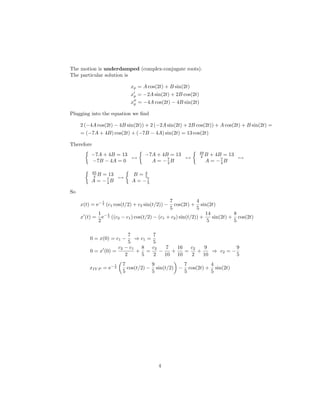
The motion is underdamped (complex-conjugate roots).
The particular solution is

                                xp = A cos(2t) + B sin(2t)
                                xp = −2A sin(2t) + 2B cos(2t)
                                xp = −4A cos(2t) − 4B sin(2t)

Plugging into the equation we find

     2 (−4A cos(2t) − 4B sin(2t)) + 2 (−2A sin(2t) + 2B cos(2t)) + A cos(2t) + B sin(2t) =
     = (−7A + 4B) cos(2t) + (−7B − 4A) sin(2t) = 13 cos(2t)

Therefore
                                                                49
          −7A + 4B = 13               −7A + 4B = 13              4 B
                                                                   + 4B = 13
                        →                           →                        →
          −7B − 4A = 0                  A = −7B
                                              4                   A = −7B
                                                                       4

            65
             4 B
              = 13              B=4
                   →                 5
          A = −7B
               4                A = −57


So
                   t                               7             4
     x(t) = e− 2 (c1 cos(t/2) + c2 sin(t/2)) −       cos(2t) + sin(2t)
                                                   5             5
               1 −t                                                  14          8
     x (t) =     e 2   ((c2 − c1 ) cos(t/2) − (c1 + c2 ) sin(t/2)) +    sin(2t) + cos(2t)
               2                                                      5          5

                          7         7
         0 = x(0) = c1 −     ⇒ c1 =
                          5         5
                     c2 − c1   8    c2   7   16   c2    9          9
         0 = x (0) =         + =       −   +    =    +    ⇒ c2 = −
                        2      5    2    10 10    2    10          5
                        t   7           9          7         4
         xIV P = e− 2         cos(t/2) − sin(t/2) − cos(2t) + sin(2t)
                            5           5          5         5


                                            4

Emat 213 midterm 2 fall 2005

  • 1.
    Midterm Exam Emat213 November 2005 Marked out of 36 [10 points] Problem 1. Write the general solution of the following linear ODEs (a) y (5) − y (4) − y − y + 4y − 2y = 0 1 1 (b) x4 y + x2 y + xy − 2y = 0 2 2 You may find this useful: 1 1 1 m(m − 1)(m − 2)(m − 3) + m(m − 1) + m − 2 = (m − 2)2 m2 − 2m − 2 2 2 m5 − m4 − m3 − m2 + 4m − 2 = (m − 1)3 (m + 1 − i)(m + 1 + i) Solution For (a) the second hint gives the factorization of the auxiliary equation. The roots are m = 1 with multiplicity 3 and −1 ± i. Therefore the complementary solution is yc = c1 ex + c2 xex + c3 x2 ex + c4 e−x cos(x) + c5 e−x sin(x) For (b) the first hint gives almost the factorization of the auxiliary equation: the quadratic polynomial has roots 1 1 √ m2 − 2m − =0 m1,2 = 1 ± 1+ = 1 ± 6/2 2 2 Therefore √ √ yc = c1 x2 + c2 x2 ln(x) + c3 x1+ 6/2 + c4 x1− 6/2 [10 points] Problem 2. Consider the linear ODE y − 4y + 4y = 25 cos(x) (i) Find the complementary solution yc (i.e. the general solution of the as- sociated homogeneous equation). (ii) Find a particular solution yp (hint: Undetermined coefficients or Varia- tion of Parameters (whichever)). (iii) Use the above information to find the solution for the IVP y − 4y + 4y = 25 cos(x) y(0) = 0, y (0) = 0 1
  • 2.
    Solution Complementary: the aux.eq. m2 − 4m + 4 = (m − 2)2 Hence yc = c1 e2x + c2 xe2x Particular: we use the Ansatz yp = A cos(x) + B sin(x) yp = −A sin(x) + B cos(x) yp = −A cos(x) − B sin(x) . Plugging into the equation we get −A cos(x) − B sin(x) − 4(−A sin(x) + B cos(x)) + 4(A cos(x) + B sin(x)) = (3A − 4B) cos(x) + (4A + 3B) sin(x) = 25 cos(x) 3A − 4B = 25 3A − 4B = 25 − 9 B − 4B = 25 → 3 → 4 4A + 3B = 0 A = −4B A = −3B 4 − 25 B = 25 B = −4 → 4 → A = −3B 4 A=3 yp = 3 cos(x) − 4 sin(x) The general solution is thus y = 3 cos(x) − 4 sin(x) + c1 e2x + c2 xe2x y = −3 sin(x) − 4 cos(x) + 2c1 e2x + 2c2 xe2x + c2 e2x We have thus y(0) = 3 + c1 = 0 ⇒ c1 = −3 y (0) = −4 − 6 + c2 = 0 ⇒ c2 = 10 yIV P = 3 cos(x) − 4 sin(x) − 3e2x + 10xe2x [10 points] Problem 3. Consider the Cauchy-Euler linear ODE x2 y − xy + y = x2 (i) Find the complementary solution yc (i.e. the general solution of the associated homogeneous equation). (ii) Find a particular solution yp (hint: Variation of Parameters. Warning: 2
  • 3.
    must put instandard form first!). Solution Complementary: the auxiliary equation is m(m − 1) − m + 1 = m2 − 2m + 1 = (m − 1)2 hence yc = c1 x + c2 x ln x Particular: using variation of parameters. Note that the standard form is 1 1 y − y + 2y = 1 x x so f (x) in the formula of variation of parameters is f (x) = 1. yp = u 1 y 1 + u 2 y 2 x x ln x W := det =x 1 ln x + 1 −y2 f x ln x u1 = =− = − ln(x) ⇒ u1 = − ln(x)dx = −x ln x + x W x y1 f x u2 = = = 1 ⇒ u2 = x W x So we have yp = (x − x ln x)x + x2 ln x = x2 y = x2 + c1 x + c2 x ln x [10 points] Problem 4. A mass of 2Kg is attached to a spring of constant k = 1 N/m. The medium offers a damping coefficient of 2 N s/m. The system is subject to an external force equal to Fext = 13 cos(2t). Find the motion of the mass if we know that it is released from equilibrium and at rest. Solution The equation of motion is M x + βx + kx = Fext 2x + 2x + x = 13 cos(2t). We have the auxiliary equation √ 2 −1 ± 1−2 −1 ± i 2m + 2m + 1 = 0 m1,2 = = 2 2 t −2 xc = e (c1 cos(t/2) + c2 sin(t/2)) 3
  • 4.
    The motion isunderdamped (complex-conjugate roots). The particular solution is xp = A cos(2t) + B sin(2t) xp = −2A sin(2t) + 2B cos(2t) xp = −4A cos(2t) − 4B sin(2t) Plugging into the equation we find 2 (−4A cos(2t) − 4B sin(2t)) + 2 (−2A sin(2t) + 2B cos(2t)) + A cos(2t) + B sin(2t) = = (−7A + 4B) cos(2t) + (−7B − 4A) sin(2t) = 13 cos(2t) Therefore 49 −7A + 4B = 13 −7A + 4B = 13 4 B + 4B = 13 → → → −7B − 4A = 0 A = −7B 4 A = −7B 4 65 4 B = 13 B=4 → 5 A = −7B 4 A = −57 So t 7 4 x(t) = e− 2 (c1 cos(t/2) + c2 sin(t/2)) − cos(2t) + sin(2t) 5 5 1 −t 14 8 x (t) = e 2 ((c2 − c1 ) cos(t/2) − (c1 + c2 ) sin(t/2)) + sin(2t) + cos(2t) 2 5 5 7 7 0 = x(0) = c1 − ⇒ c1 = 5 5 c2 − c1 8 c2 7 16 c2 9 9 0 = x (0) = + = − + = + ⇒ c2 = − 2 5 2 10 10 2 10 5 t 7 9 7 4 xIV P = e− 2 cos(t/2) − sin(t/2) − cos(2t) + sin(2t) 5 5 5 5 4