Download as ODP, PPTX


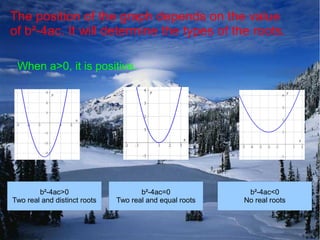
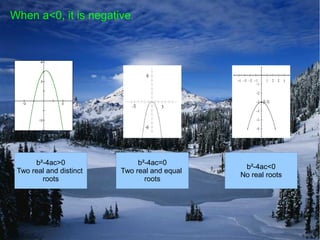

![Example:
Find the range of values of m if the graph of quadratic functions
h(x)= x² – 2(4m+1)x + 16m²-3 cuts the x axis at two distinct
points.
So, a= 1
First you should divide the values of
b= -2(4m+1)
a, b and c from this equation
c= 16m²-3
Since, it cuts the x axis at two distinct points,
so b²-4ac >0 will be applied.
[-2(4m+1)]²-4(1)(16m²-3) > 0
4(16m²+8m+1) – 64m²+12 > 0
64m² + 32m + 4- 64m²+12 > 0
32m + 16 > 0
32m > -16
m > -16
32
m > -1
2](https://image.slidesharecdn.com/quadraticfunctions-130130015557-phpapp01/85/Quadratic-functions-6-320.jpg)
![Example:
Express the following quadratic equation in the form of a(x+p)² + q. State the
maximum / minimum value of the the function and corresponding value of x.
f(x)= 2x² + 7x + 10
2x² + 7x + 10
2(x² + 7x + 10)
2( x² + 7 x + 5)
Normal completing
2
square method
2[x² + 7/2 x + (7/4)²- (7/4)² + 5]
2(x + 7/4)² + 31/16
2(x+7/4)² + 31/8](https://image.slidesharecdn.com/quadraticfunctions-130130015557-phpapp01/85/Quadratic-functions-8-320.jpg)
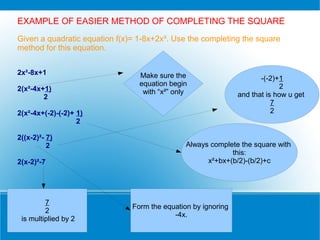


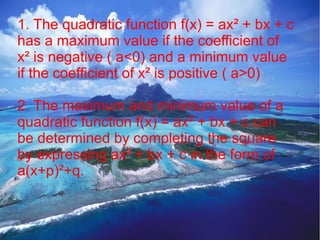
1. The quadratic function f(x) = ax^2 + bx + c has a maximum value if a < 0 and a minimum value if a > 0. 2. The maximum and minimum values can be determined by completing the square, writing the function as a(x + p)^2 + q. 3. Quadratic inequalities can be solved by graphing, with the negative region shaded if the inequality sign is < 0. Factorization using a calculator can also solve inequalities.


