Standards And
Codes
Presented By:
Muhammad Nasir Ali
UET LAHORE
mnasirali64@gmail.com
Contents
 What are standards?
 Types of standards
 Specifications of standards with examples
 What are Codes?
 Types of codes
 Code’s specification with examples
What is Standard?
 “A document that provides
requirements, specifications, guidelines
or characteristics used consistently to
ensure an organizational purposes about
their products”.
 Standards are everywhere in everything.
Types of Standards
 International Organization for Standardization (ISO)
 Japanese Industrial Standard (JIS)
 The American Society of Mechanical Engineers (ASME)
 National Aerospace Standards (NASM )
 United States Military Standard
 Society of Automotive Engineers (SAE)
 British Standards Institution (BSI)
 ASTM International American Society for Testing and
Materials .
Specifications
with Examples
ISO Standards
Welding Fabrication
Standards
 ISO 9001
 EN 729
 EN ISO 3834
Use and field of application
of EN ISO 3834
 This International Standard is structured in five parts:
 − EN ISO 3834-1: Guidelines for selection and use;
 − EN ISO 3834-2: Comprehensive quality requirements;
 − EN ISO 3834-3: Standard quality requirements;
 − EN ISO 3834-4: Elementary quality requirements;
 − EN ISO 3834-5: Normative references to fulfil the
requirements of EN ISO 3834-2, EN ISO 3834-3 and EN
ISO 3834-4.
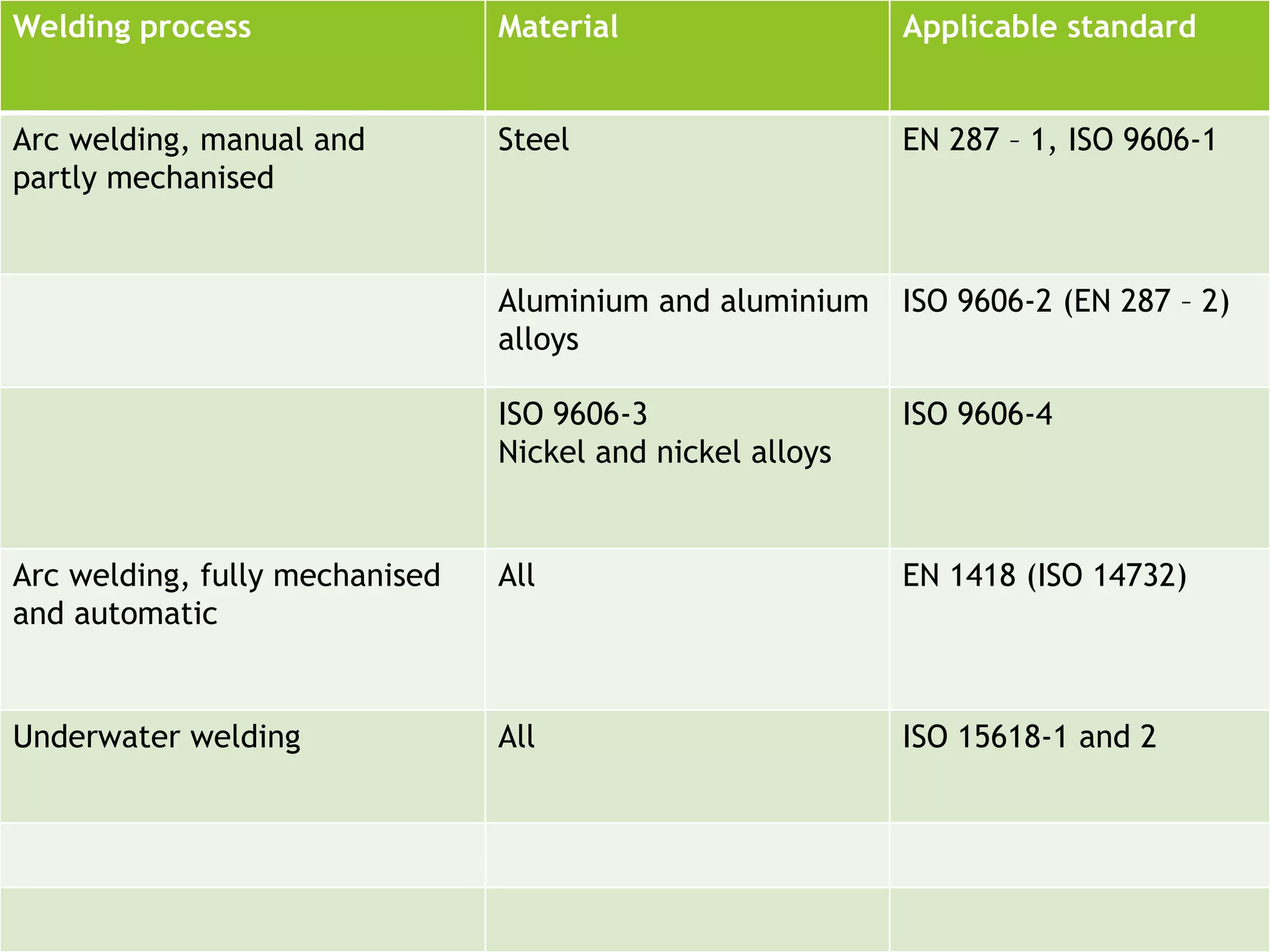
Welding process Material Applicable standard
Arc welding, manual and
partly mechanised
Steel EN 287 – 1, ISO 9606-1
Aluminium and aluminium
alloys
ISO 9606-2 (EN 287 – 2)
ISO 9606-3
Nickel and nickel alloys
ISO 9606-4
Arc welding, fully mechanised
and automatic
All EN 1418 (ISO 14732)
Underwater welding All ISO 15618-1 and 2
Fastener
Specifications
Standards for Fasteners from American
Society for Testing and Materials (ASTM)
ASTM Fastener Standards
 ASTM A194
 ASTM A307
 ASTM A325
 ASTM A394
 ASTM A563
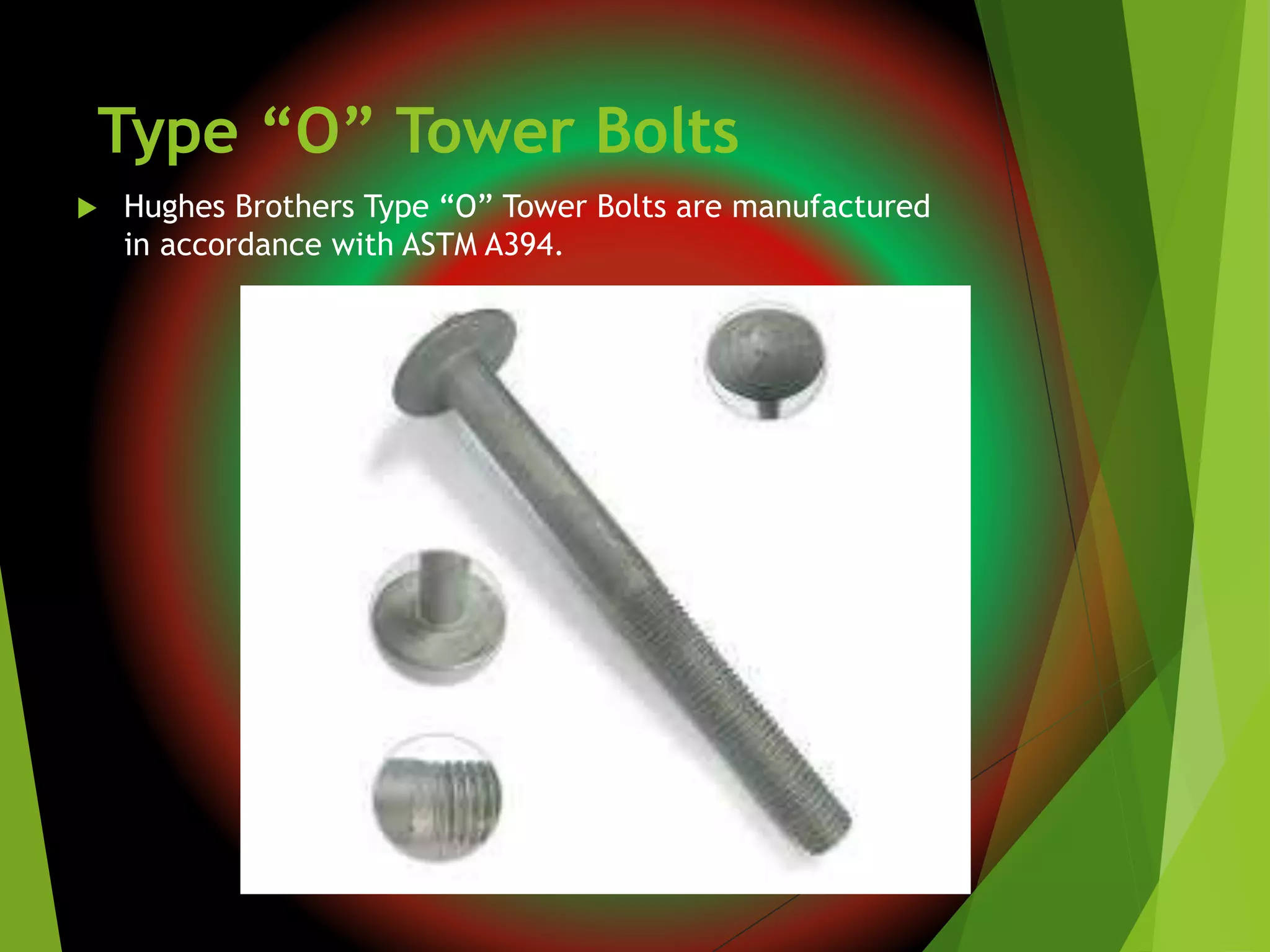
Type “O” Tower Bolts
 Hughes Brothers Type “O” Tower Bolts are manufactured
in accordance with ASTM A394.
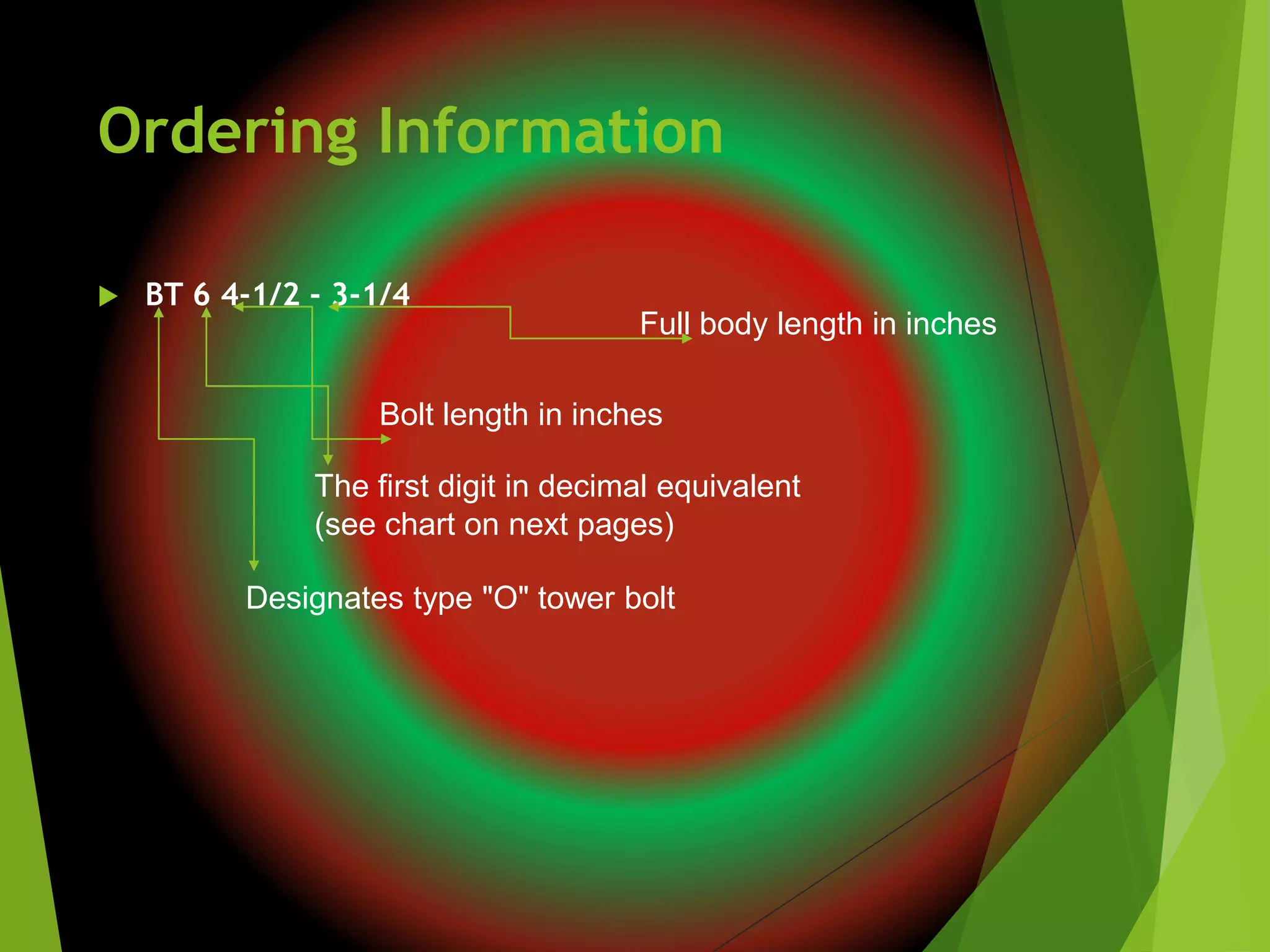
Ordering Information
 BT 6 4-1/2 - 3-1/4
Designates type "O" tower bolt
The first digit in decimal equivalent
(see chart on next pages)
Bolt length in inches
Full body length in inches
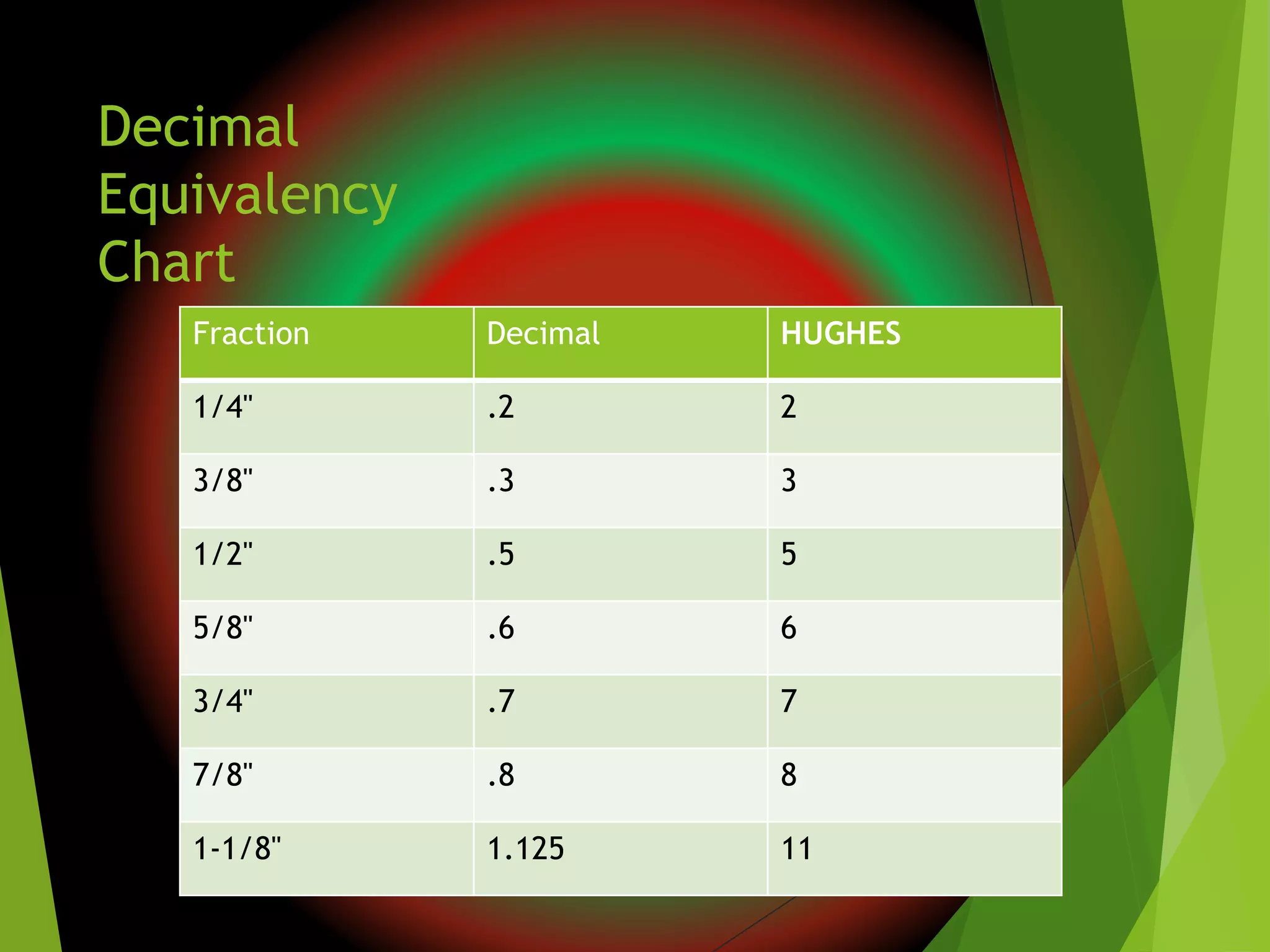
Decimal
Equivalency
Chart
Fraction Decimal HUGHES
1/4" .2 2
3/8" .3 3
1/2" .5 5
5/8" .6 6
3/4" .7 7
7/8" .8 8
1-1/8" 1.125 11
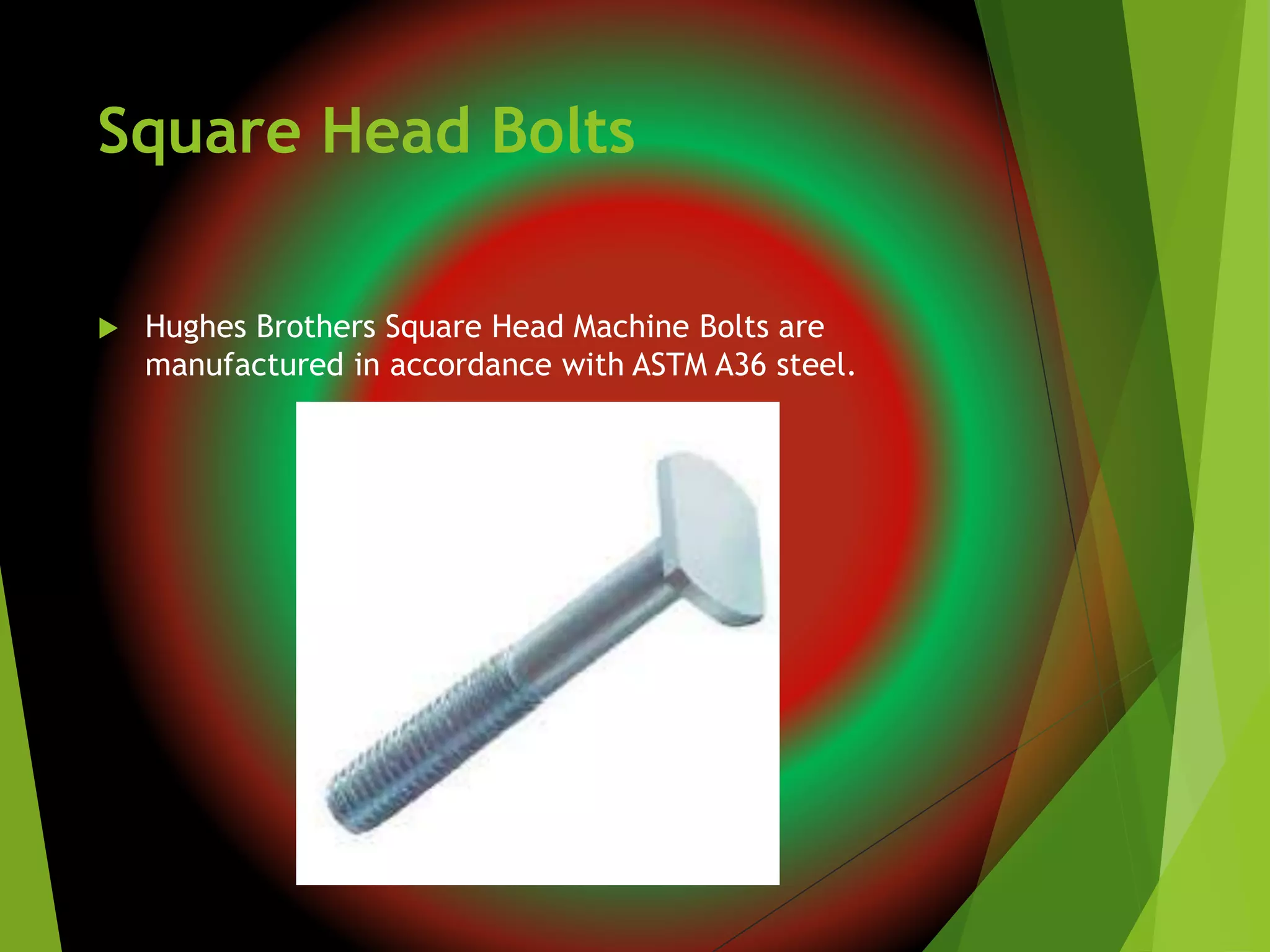
Square Head Bolts
 Hughes Brothers Square Head Machine Bolts are
manufactured in accordance with ASTM A36 steel.
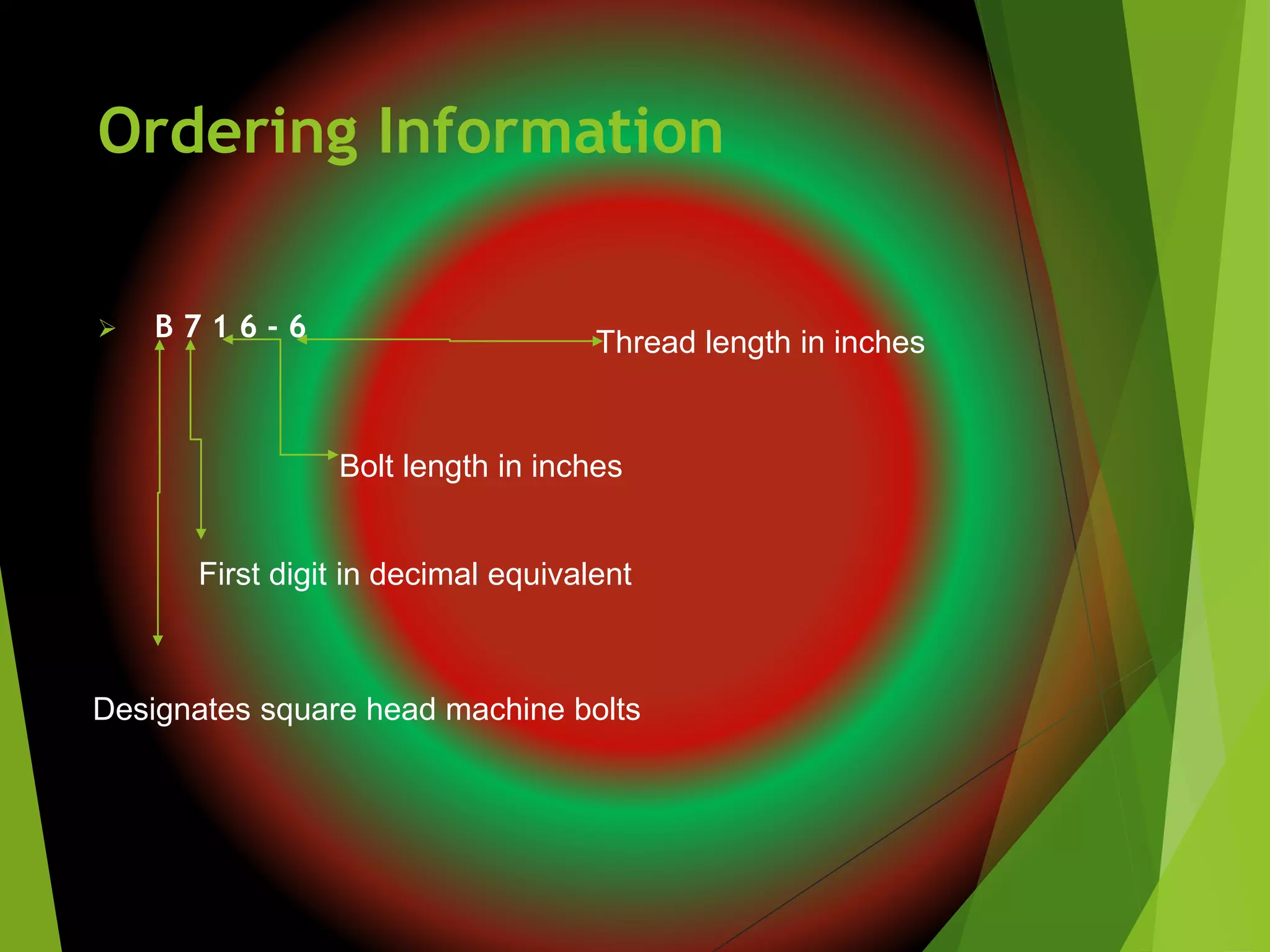
Ordering Information
 B 7 1 6 - 6
Designates square head machine bolts
First digit in decimal equivalent
Bolt length in inches
Thread length in inches
ASTM Steel
Standard
A514 steel
A514 steel
 The tensile yield strength of A514 alloys is specified as
at least 100 ksi (689 MPa) for thicknesses up to 2.5
inches (63.5 mm) thick plate.
 ultimate tensile strength at least 110 ksi (758 Mpa).
 Plates from 2.5 to 6.0 inches thick have specified
strength of 621 MPa (yield) and(689–896 MPa)
(ultimate).
 A514 steels are used where a weldable, machinable,
very high strength steel is required to save weight or
meet ultimate strength requirements.
International
Organization for
Standardization
(ISO)
Specifications
ISO/TR 29381:2008
 Metallic materials -- Measurement of
mechanical properties by an instrumented
indentation test -- Indentation tensile
properties.
 ISO/TR 29381:2008 describes methods for
evaluating tensile properties of metallic
materials using an instrumented
indentation test.
ISO 13314:2011
 Mechanical testing of metals -- Ductility testing --
Compression test for porous and cellular metals.
 ISO 13314:2011 specifies a test method for
compressive properties of porous and cellular
metals with a porosity of 50 % or more.
 Compressive tests can be carried out at ambient
temperature under quasi-static strain rate
conditions.
Overview of
ISO 9001 and
ISO 14001
ISO 9001 and ISO 14001 in
brief
 ISO 9001 and ISO 14001 are among ISO's most well
known standards ever.
 They are implemented by more than a million
organizations in some 175 countries.
 ISO 9001 helps organizations to implement quality
management.
 ISO 14001 helps organizations to implement
environmental management.
 ISO 9001 is for quality management
 Quality management means what the organization
does to :
 ensure that its products or services satisfy the
customer's quality requirements and
 comply with any regulations applicable to those
products or services.
 enhance customer satisfaction, and
 achieve continual improvement of its performance
 ISO 14001 is for environmental management. This
means what the organization does to:
 minimize harmful effects on the environment caused
by its activities,
 to conform to applicable regulatory requirements, and
to
 achieve continual improvement of its environmental
performance.
Processes, not products
 Both ISO 9001 and ISO 14001 concern the way an
organization goes about its work.
 They are not product standards.
 They are not service standards.
 They are process standards.
 They can be used by product manufacturers and
service providers.
Processes, not products
(cont.)
 Processes affect final products or services.
 ISO 9001 gives the requirements for what the
organization must do to manage processes affecting
quality of its products and services.
 ISO 14001 gives the requirements for what the
organization must do to manage processes affecting
the impact of its activities on the environment.
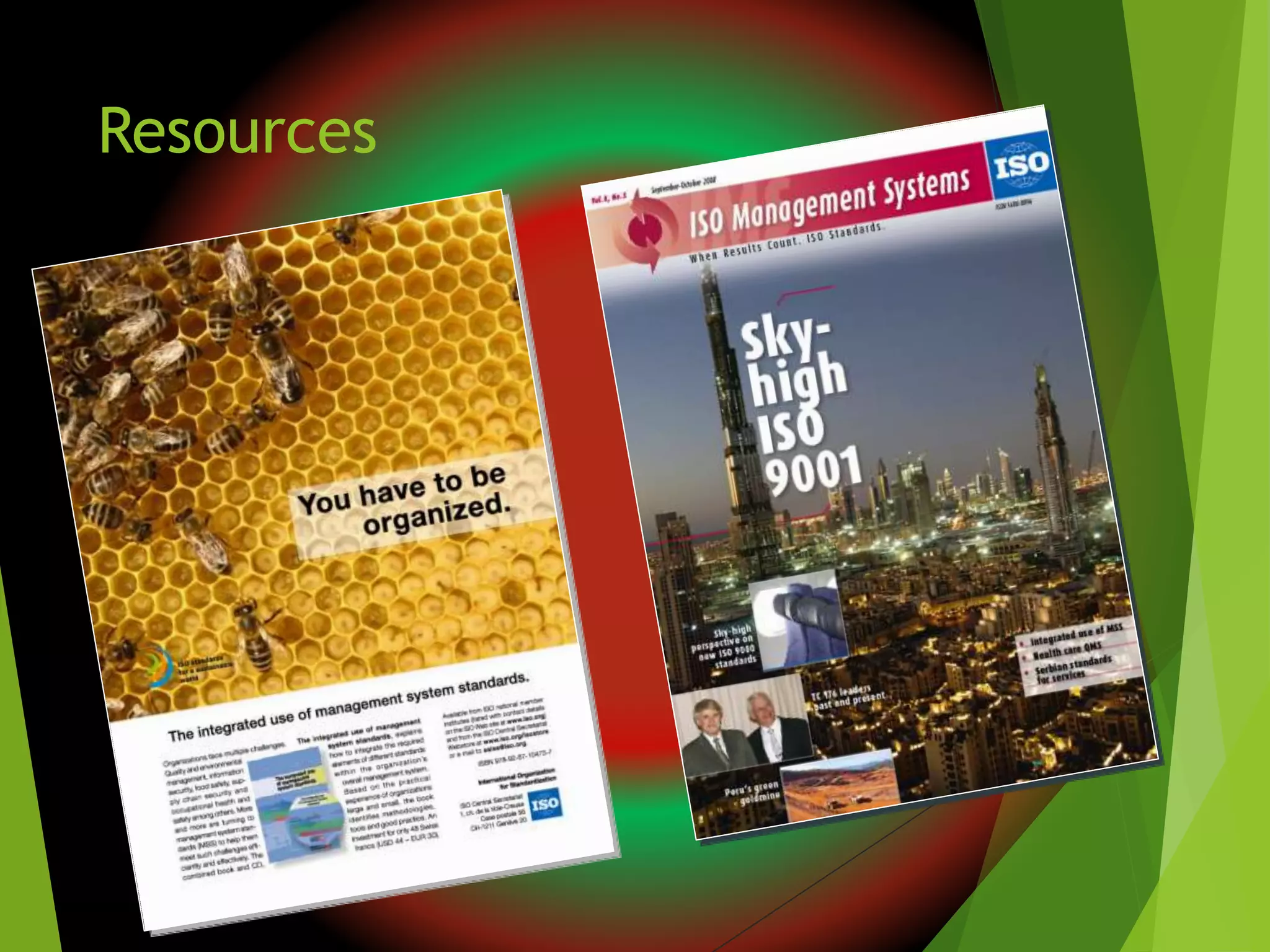
Resources
What Are Codes?
Codes
“A standard is a code when it has been adopted by
one or more governmental bodies and is enforceable
by law, or when it has been incorporated into a
business contract”
Material classification MC-codes
 ISO P Steel
 ISO M Stainless steel
 ISO K Cast iron
 ISO N Non-ferrous materials
 ISO S HRSA and Titanium
 ISO H Hardened steel
MC code structure
 “The structure is set up so that the MC
code can represent a variety of workpiece
material properties and characteristics
using a combination of letters and
numbers.”
Code’s
Specification
With examples
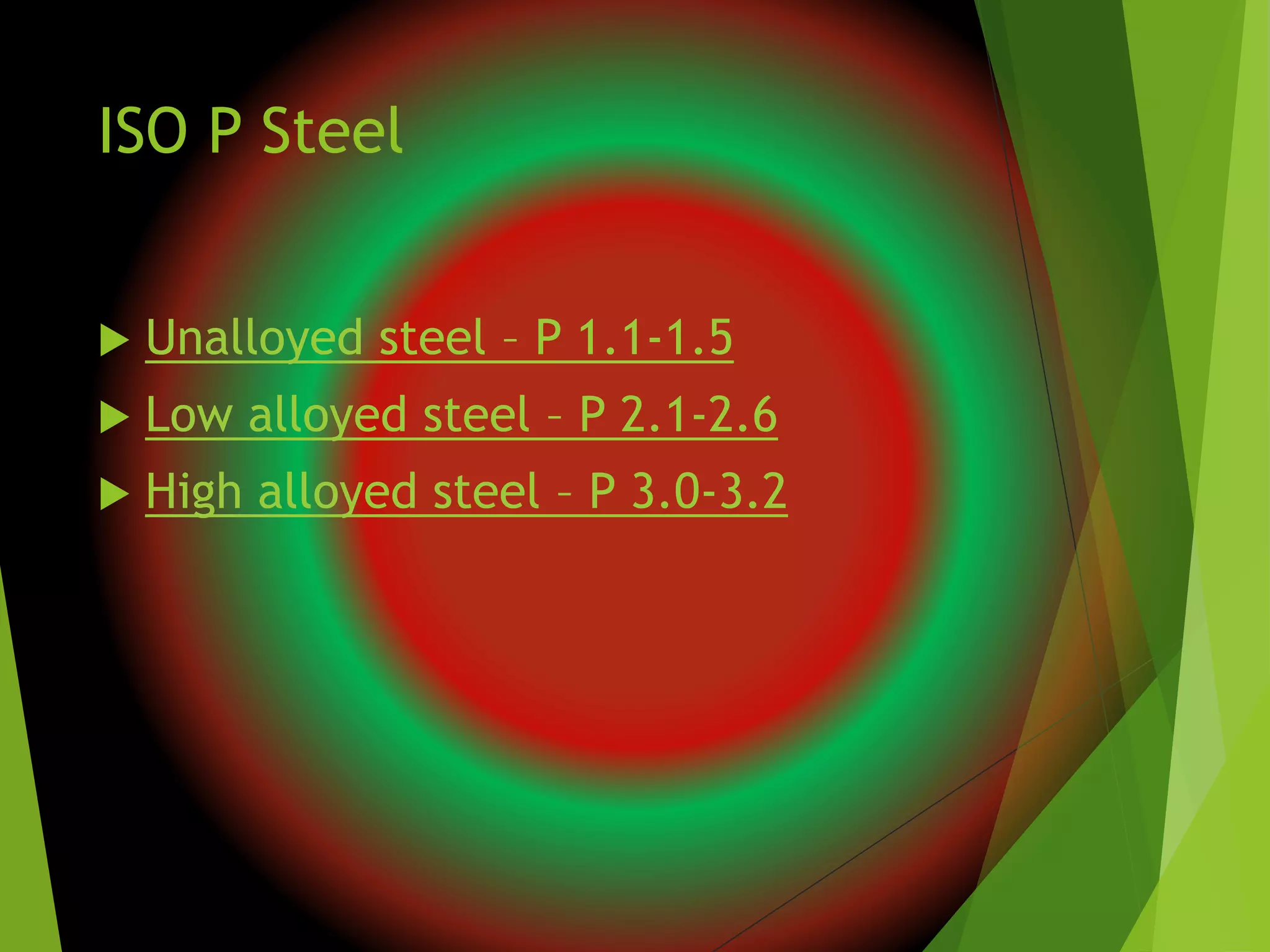
ISO P Steel
 Unalloyed steel – P 1.1-1.5
 Low alloyed steel – P 2.1-2.6
 High alloyed steel – P 3.0-3.2
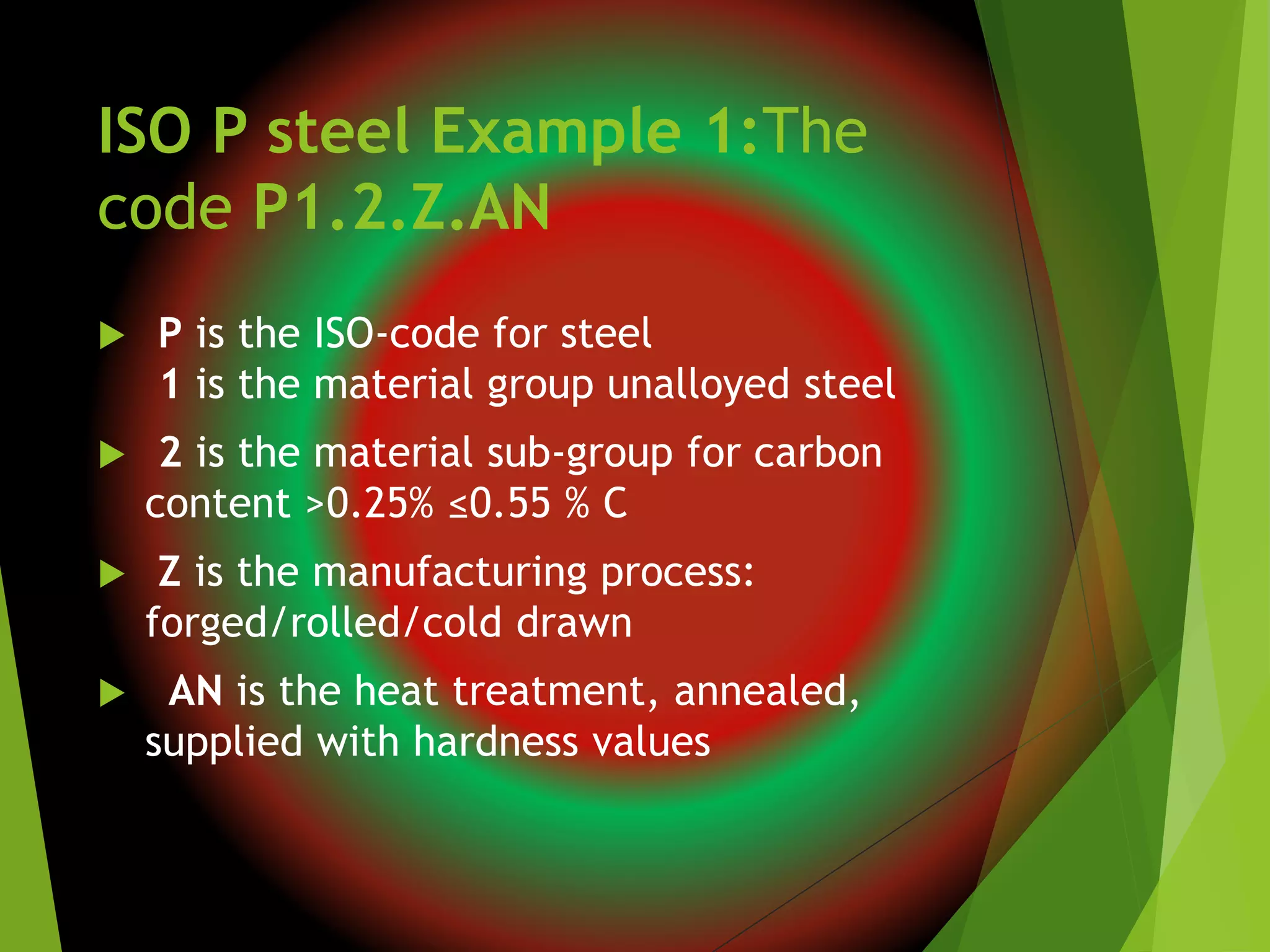
ISO P steel Example 1:The
code P1.2.Z.AN
 P is the ISO-code for steel
1 is the material group unalloyed steel
 2 is the material sub-group for carbon
content >0.25% ≤0.55 % C
 Z is the manufacturing process:
forged/rolled/cold drawn
 AN is the heat treatment, annealed,
supplied with hardness values
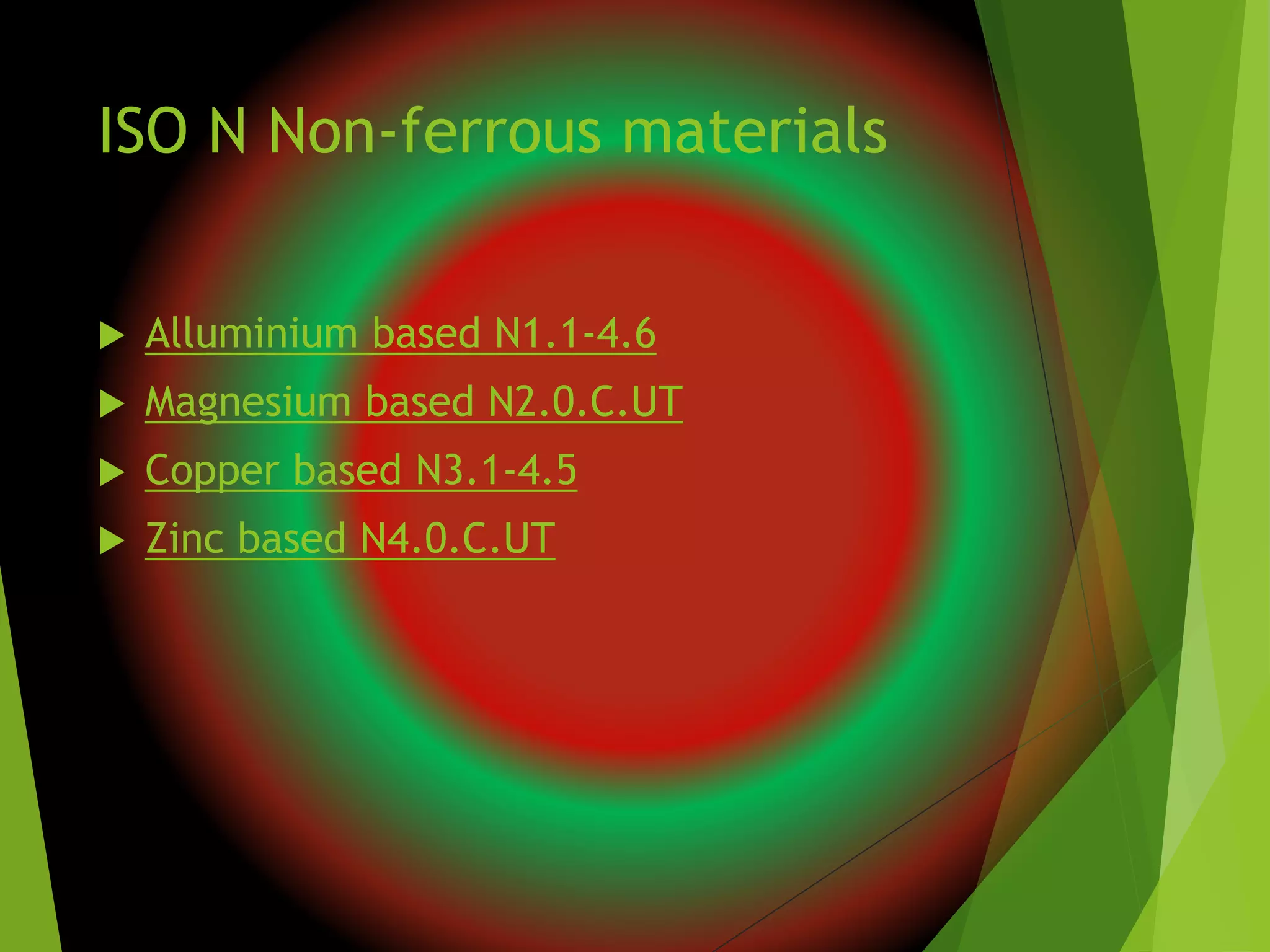
ISO N Non-ferrous materials
 Alluminium based N1.1-4.6
 Magnesium based N2.0.C.UT
 Copper based N3.1-4.5
 Zinc based N4.0.C.UT
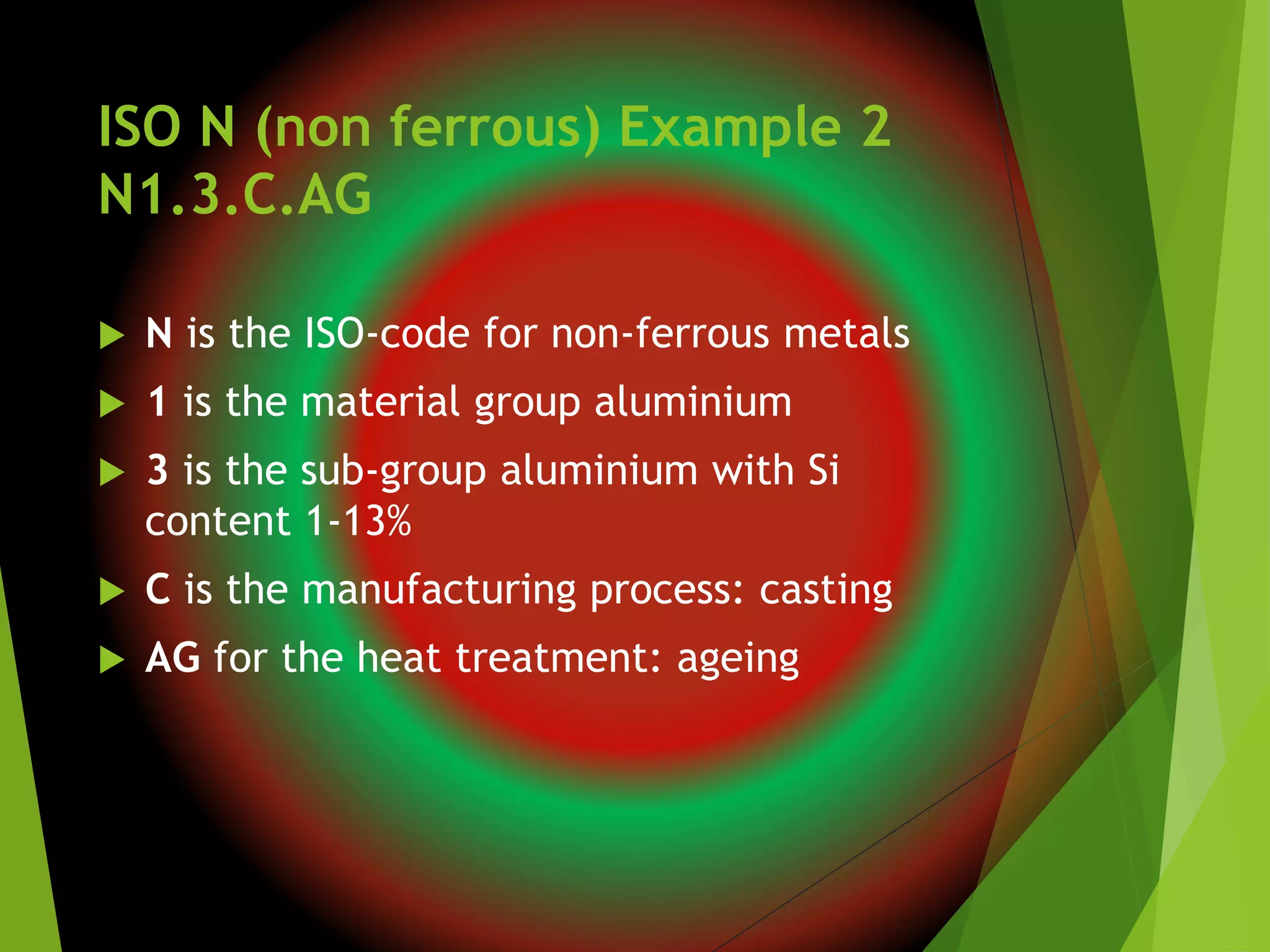
ISO N (non ferrous) Example 2
N1.3.C.AG
 N is the ISO-code for non-ferrous metals
 1 is the material group aluminium
 3 is the sub-group aluminium with Si
content 1-13%
 C is the manufacturing process: casting
 AG for the heat treatment: ageing
ISO M Stainless steel
 Ferritic and martensitic stainless steel –
P5.0-5.1
 Austenitic and super-austenitic stainless
steel – M1.0-2.0
 Duplex stainless steel – M 3.41-3.42
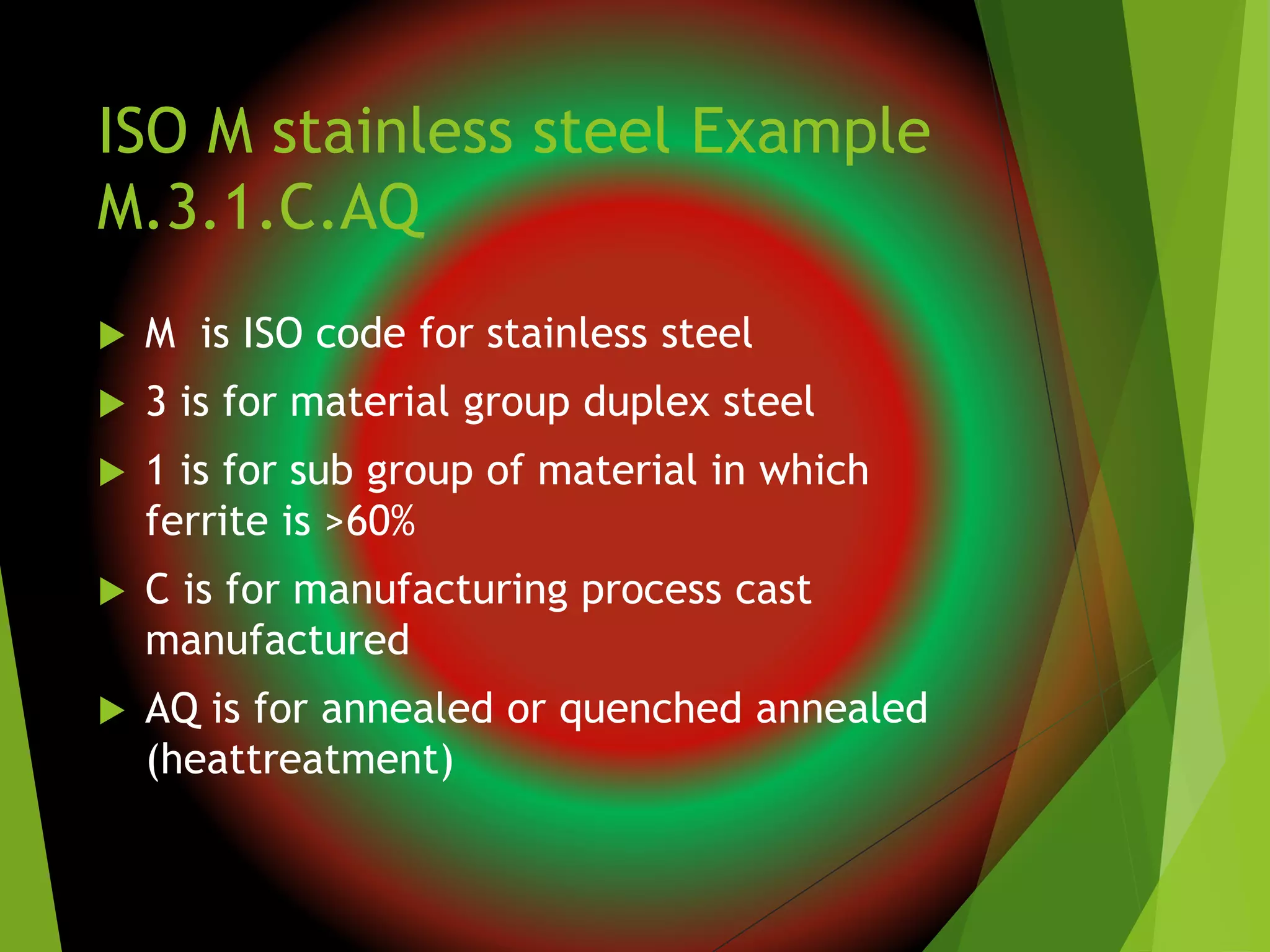
ISO M stainless steel Example
M.3.1.C.AQ
 M is ISO code for stainless steel
 3 is for material group duplex steel
 1 is for sub group of material in which
ferrite is >60%
 C is for manufacturing process cast
manufactured
 AQ is for annealed or quenched annealed
(heattreatment)
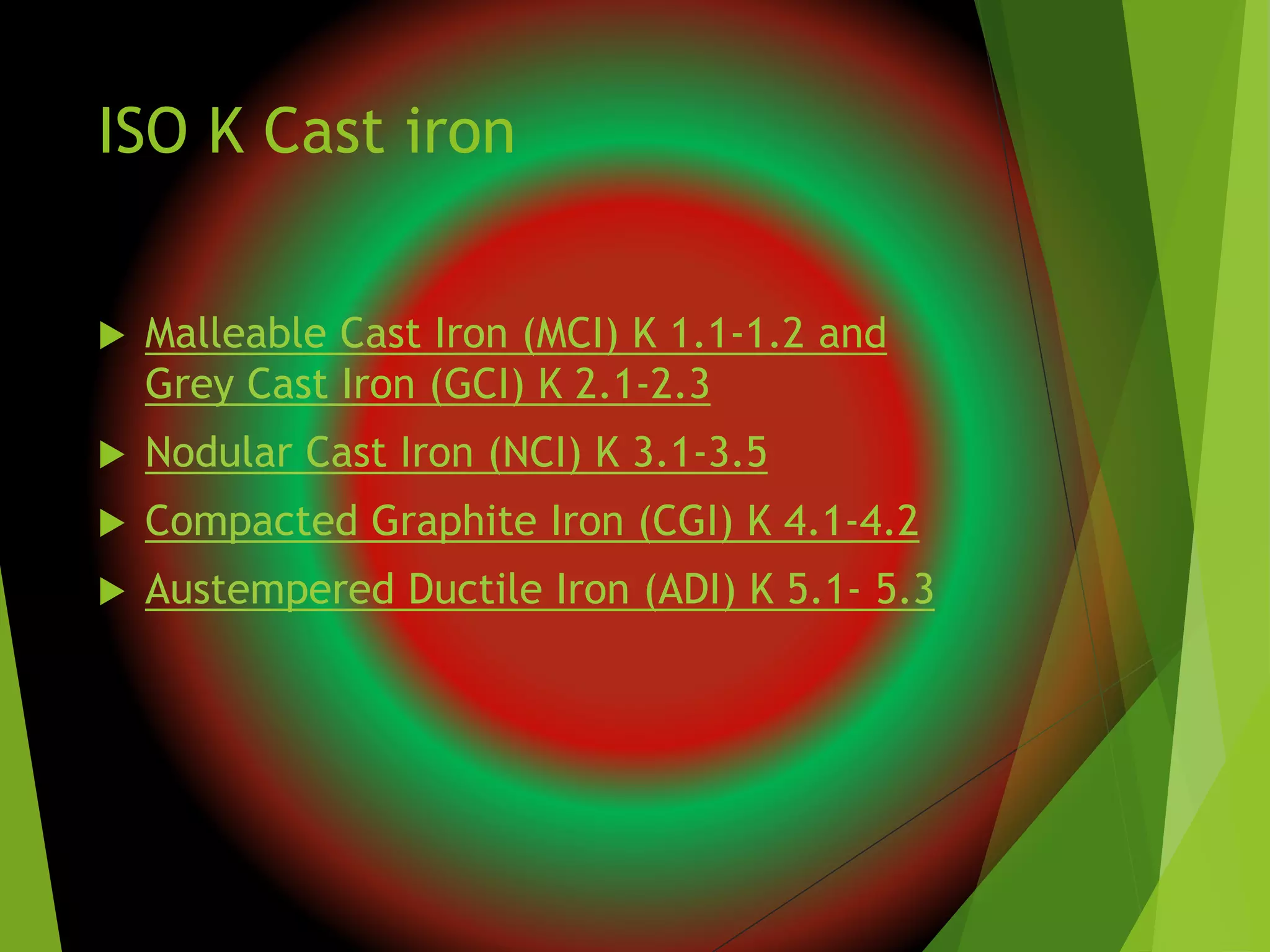
ISO K Cast iron
 Malleable Cast Iron (MCI) K 1.1-1.2 and
Grey Cast Iron (GCI) K 2.1-2.3
 Nodular Cast Iron (NCI) K 3.1-3.5
 Compacted Graphite Iron (CGI) K 4.1-4.2
 Austempered Ductile Iron (ADI) K 5.1- 5.3
ISO K cast iron Example
K3.3.C.UT
 K is ISO code for cast iron
 3 is for material group nodular
 3 is for material sub group perlitic
 C is for manufacturing process cast
manufactured
 UT is for untreated (heatreatment
process)
ISO S HRSA and Titanium
 HRSA (heat resistant super alloys)
materials – S 1.0-3.0
 Titanium– S 4.1-4.4
ISO S HRSA & Titanium
example S4.4.Z.AG
 S is for ISO S group
 4 is for material group titanium based
 4 is for material sub group beta alloys
 Z is for manufacturing process
forged/rolled/cold drawn
 AG is for aged (heat treated)
ISO H Hardened steel
 Steel(extra hard) H1.1-4.3
 Chilled cast iron H2.0.4
 Stellities H3.0.5
 Ferro TIC H4.0.6
ISO H
Example H1.3.Z.HA
 H is for ISO H hardened steel
 1 is for material group steel(extra hard)
 3 is for material sub group in which
hardness level is 60
 Z is for manufacturing process
forged/rolled/cold drawn
 HA is for hardened+tempered(heat
treatment)
Ethical Behaviour
 Submitted by:
2013-ME-390
2013-ME-389
2013-ME-365
2013-ME-379
Submitted to:
Mam Samina
context
 Ethics
 Ethical Behavior
 Alternative Views
 Code of ethics
 How ethical dilemma complicate workplace
 How can ethical standards be maintained
 Management ethics types
 Sources of ethical views
 Overlap model of law moral and ethics
 How companies manage ethics
What is Ethics
Ethics involves
 Having guidelines for human behavior
 Studying moral choices and values
 Choosing between right and wrong
What is ethical behaviour
 Ethics
 Code of moral principles.
 Set standards of “good” and “bad” as opposed
to “right” and “wrong”
 Ethical behavior
 What is accepted as good and right in the
context of the governing moral code
 Law, values, and ethical behavior:
 Legal behavior is not necessarily ethical
behavior
 Personal values help determine individual
ethical behavior
Terminal values
Instrumental values
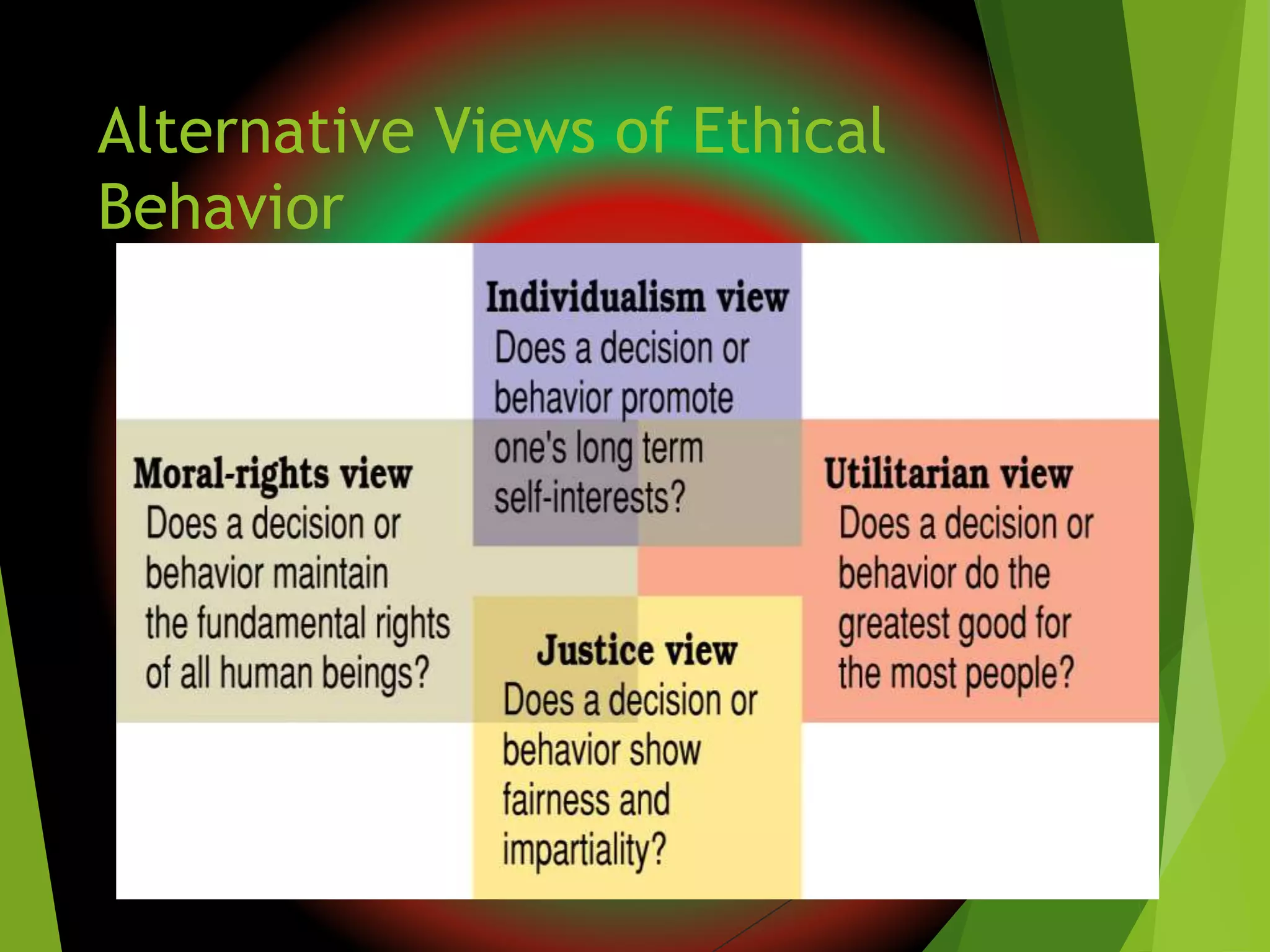
Alternative Views of Ethical
Behavior
What is code of ethics
A code of ethics is
 A systematic set of rules and procedure used to guide
the behavior of an individual, a business or a culture
 The code of ethics is in writing and available to
everyone who is expected to abide them
How do ethical dilemmas
complicate the workplace?
 An ethical dilemma occurs when choices, although
having potential for personal and/or organizational
benefit, may be considered unethical.
 Ethical dilemmas include:
 Discrimination
 Sexual harassment
 Conflicts of interest
 Customer confidence
 Organizational resources
 Ethical behavior can be rationalized by convincing
yourself that:
 Behavior is not really illegal.
 Behavior is really in everyone’s best interests.
 Nobody will ever find out.
 The organization will “protect” you
 Factors influencing ethical behavior include:
 The person
 Family influences, religious values, personal
standards, and personal needs.
 The organization
 Supervisory behavior, peer group norms and
behavior, and policy statements and written
rules.
 The environment
 Government laws and regulations, societal
norms and values, and competitive climate in
an industry.
How can high ethical
standards be maintained?
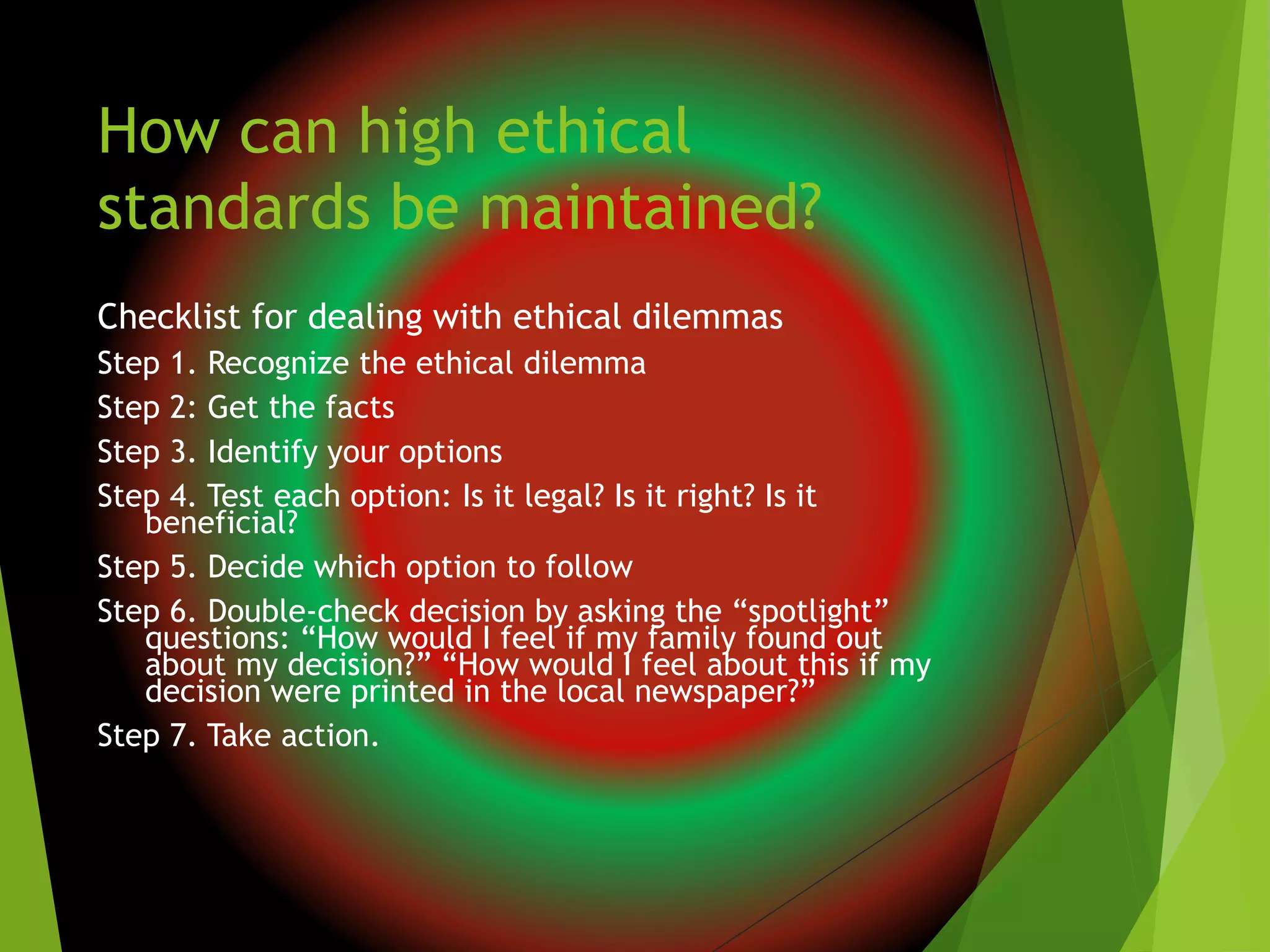
Checklist for dealing with ethical dilemmas
Step 1. Recognize the ethical dilemma
Step 2: Get the facts
Step 3. Identify your options
Step 4. Test each option: Is it legal? Is it right? Is it
beneficial?
Step 5. Decide which option to follow
Step 6. Double-check decision by asking the “spotlight”
questions: “How would I feel if my family found out
about my decision?” “How would I feel about this if my
decision were printed in the local newspaper?”
Step 7. Take action.
Types of Management Ethics
 Immoral
 Recognize the ethical issues involved and choose to do the
wrong thing.
 Moral
 Recognize the ethical issues involved and choose to do the
right thing.
 Amoral
 Do not consider the ethical implications of an action or
believe that ethics are irrelevant.
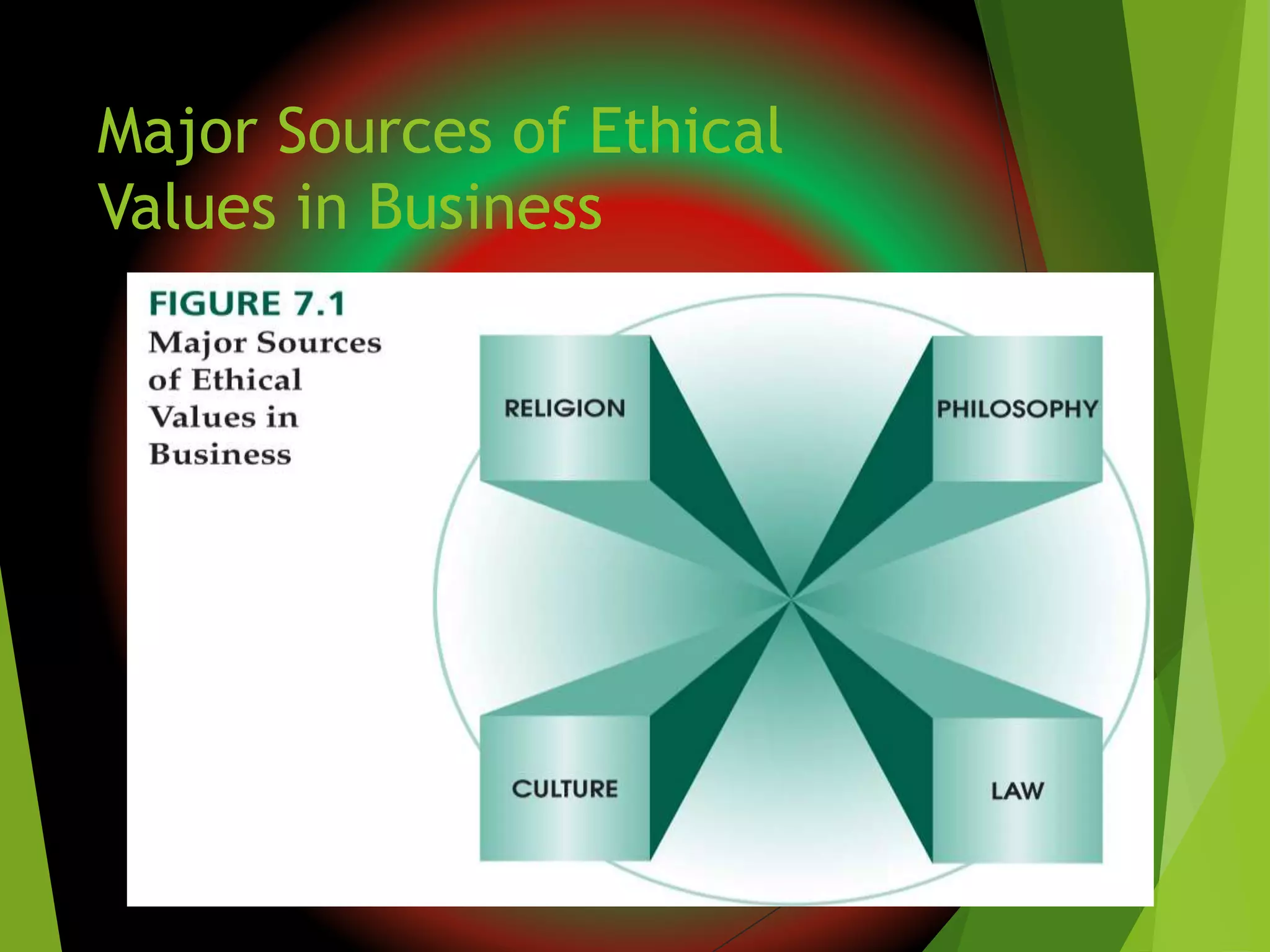
Major Sources of Ethical
Values in Business
The Overlap Model of Law,
Ethics and Morals
 While all three approaches of law, ethics, and morals
attempt to give us guidance as to the propriety of our
conduct, they do not always give us the same answers.
Definitions
 Ethics: Rules of conduct based on consensually-
accepted standards of behavior. (Conventional
Approach)
 Morals: Absolute Precepts of personal behavior based
on religion or philosophy. (Principles Approach)
 Law: Formal standards that permit or forbid certain
behaviors.
How Companies Manage Ethics
Seven Steps:
 Establish compliance standards and procedures
 Code of Conduct
 Ethical oversight occurs at high levels of management
 Do not delegate authority to persons who are prone to
engage in criminal behavior
 Use background checks
 Communicate standards to all employees
 Ethics Training Programs
 Establish Monitoring and ethical auditing systems
 Consistently enforce standards
 Immediately after an offence take steps to prevent
future offences
Standards & Codes An Overview to Materials and Machine design

Standards & Codes An Overview to Materials and Machine design

  • 1.
    Standards And Codes Presented By: MuhammadNasir Ali UET LAHORE mnasirali64@gmail.com
  • 2.
    Contents  What arestandards?  Types of standards  Specifications of standards with examples  What are Codes?  Types of codes  Code’s specification with examples
  • 3.
    What is Standard? “A document that provides requirements, specifications, guidelines or characteristics used consistently to ensure an organizational purposes about their products”.  Standards are everywhere in everything.
  • 4.
    Types of Standards International Organization for Standardization (ISO)  Japanese Industrial Standard (JIS)  The American Society of Mechanical Engineers (ASME)  National Aerospace Standards (NASM )  United States Military Standard  Society of Automotive Engineers (SAE)  British Standards Institution (BSI)  ASTM International American Society for Testing and Materials .
  • 5.
  • 6.
    Welding Fabrication Standards  ISO9001  EN 729  EN ISO 3834
  • 7.
    Use and fieldof application of EN ISO 3834  This International Standard is structured in five parts:  − EN ISO 3834-1: Guidelines for selection and use;  − EN ISO 3834-2: Comprehensive quality requirements;  − EN ISO 3834-3: Standard quality requirements;  − EN ISO 3834-4: Elementary quality requirements;  − EN ISO 3834-5: Normative references to fulfil the requirements of EN ISO 3834-2, EN ISO 3834-3 and EN ISO 3834-4.
  • 8.
    Welding process MaterialApplicable standard Arc welding, manual and partly mechanised Steel EN 287 – 1, ISO 9606-1 Aluminium and aluminium alloys ISO 9606-2 (EN 287 – 2) ISO 9606-3 Nickel and nickel alloys ISO 9606-4 Arc welding, fully mechanised and automatic All EN 1418 (ISO 14732) Underwater welding All ISO 15618-1 and 2
  • 9.
    Fastener Specifications Standards for Fastenersfrom American Society for Testing and Materials (ASTM)
  • 10.
    ASTM Fastener Standards ASTM A194  ASTM A307  ASTM A325  ASTM A394  ASTM A563
  • 11.
    Type “O” TowerBolts  Hughes Brothers Type “O” Tower Bolts are manufactured in accordance with ASTM A394.
  • 12.
    Ordering Information  BT6 4-1/2 - 3-1/4 Designates type "O" tower bolt The first digit in decimal equivalent (see chart on next pages) Bolt length in inches Full body length in inches
  • 13.
    Decimal Equivalency Chart Fraction Decimal HUGHES 1/4".2 2 3/8" .3 3 1/2" .5 5 5/8" .6 6 3/4" .7 7 7/8" .8 8 1-1/8" 1.125 11
  • 14.
    Square Head Bolts Hughes Brothers Square Head Machine Bolts are manufactured in accordance with ASTM A36 steel.
  • 15.
    Ordering Information  B7 1 6 - 6 Designates square head machine bolts First digit in decimal equivalent Bolt length in inches Thread length in inches
  • 16.
  • 17.
    A514 steel  Thetensile yield strength of A514 alloys is specified as at least 100 ksi (689 MPa) for thicknesses up to 2.5 inches (63.5 mm) thick plate.  ultimate tensile strength at least 110 ksi (758 Mpa).  Plates from 2.5 to 6.0 inches thick have specified strength of 621 MPa (yield) and(689–896 MPa) (ultimate).  A514 steels are used where a weldable, machinable, very high strength steel is required to save weight or meet ultimate strength requirements.
  • 18.
  • 19.
    ISO/TR 29381:2008  Metallicmaterials -- Measurement of mechanical properties by an instrumented indentation test -- Indentation tensile properties.  ISO/TR 29381:2008 describes methods for evaluating tensile properties of metallic materials using an instrumented indentation test.
  • 20.
    ISO 13314:2011  Mechanicaltesting of metals -- Ductility testing -- Compression test for porous and cellular metals.  ISO 13314:2011 specifies a test method for compressive properties of porous and cellular metals with a porosity of 50 % or more.  Compressive tests can be carried out at ambient temperature under quasi-static strain rate conditions.
  • 21.
    Overview of ISO 9001and ISO 14001
  • 22.
    ISO 9001 andISO 14001 in brief  ISO 9001 and ISO 14001 are among ISO's most well known standards ever.  They are implemented by more than a million organizations in some 175 countries.  ISO 9001 helps organizations to implement quality management.  ISO 14001 helps organizations to implement environmental management.
  • 23.
     ISO 9001is for quality management  Quality management means what the organization does to :  ensure that its products or services satisfy the customer's quality requirements and  comply with any regulations applicable to those products or services.  enhance customer satisfaction, and  achieve continual improvement of its performance
  • 24.
     ISO 14001is for environmental management. This means what the organization does to:  minimize harmful effects on the environment caused by its activities,  to conform to applicable regulatory requirements, and to  achieve continual improvement of its environmental performance.
  • 25.
    Processes, not products Both ISO 9001 and ISO 14001 concern the way an organization goes about its work.  They are not product standards.  They are not service standards.  They are process standards.  They can be used by product manufacturers and service providers.
  • 26.
    Processes, not products (cont.) Processes affect final products or services.  ISO 9001 gives the requirements for what the organization must do to manage processes affecting quality of its products and services.  ISO 14001 gives the requirements for what the organization must do to manage processes affecting the impact of its activities on the environment.
  • 27.
  • 28.
  • 29.
    Codes “A standard isa code when it has been adopted by one or more governmental bodies and is enforceable by law, or when it has been incorporated into a business contract”
  • 30.
    Material classification MC-codes ISO P Steel  ISO M Stainless steel  ISO K Cast iron  ISO N Non-ferrous materials  ISO S HRSA and Titanium  ISO H Hardened steel
  • 31.
    MC code structure “The structure is set up so that the MC code can represent a variety of workpiece material properties and characteristics using a combination of letters and numbers.”
  • 32.
  • 33.
    ISO P Steel Unalloyed steel – P 1.1-1.5  Low alloyed steel – P 2.1-2.6  High alloyed steel – P 3.0-3.2
  • 34.
    ISO P steelExample 1:The code P1.2.Z.AN  P is the ISO-code for steel 1 is the material group unalloyed steel  2 is the material sub-group for carbon content >0.25% ≤0.55 % C  Z is the manufacturing process: forged/rolled/cold drawn  AN is the heat treatment, annealed, supplied with hardness values
  • 35.
    ISO N Non-ferrousmaterials  Alluminium based N1.1-4.6  Magnesium based N2.0.C.UT  Copper based N3.1-4.5  Zinc based N4.0.C.UT
  • 36.
    ISO N (nonferrous) Example 2 N1.3.C.AG  N is the ISO-code for non-ferrous metals  1 is the material group aluminium  3 is the sub-group aluminium with Si content 1-13%  C is the manufacturing process: casting  AG for the heat treatment: ageing
  • 37.
    ISO M Stainlesssteel  Ferritic and martensitic stainless steel – P5.0-5.1  Austenitic and super-austenitic stainless steel – M1.0-2.0  Duplex stainless steel – M 3.41-3.42
  • 38.
    ISO M stainlesssteel Example M.3.1.C.AQ  M is ISO code for stainless steel  3 is for material group duplex steel  1 is for sub group of material in which ferrite is >60%  C is for manufacturing process cast manufactured  AQ is for annealed or quenched annealed (heattreatment)
  • 39.
    ISO K Castiron  Malleable Cast Iron (MCI) K 1.1-1.2 and Grey Cast Iron (GCI) K 2.1-2.3  Nodular Cast Iron (NCI) K 3.1-3.5  Compacted Graphite Iron (CGI) K 4.1-4.2  Austempered Ductile Iron (ADI) K 5.1- 5.3
  • 40.
    ISO K castiron Example K3.3.C.UT  K is ISO code for cast iron  3 is for material group nodular  3 is for material sub group perlitic  C is for manufacturing process cast manufactured  UT is for untreated (heatreatment process)
  • 41.
    ISO S HRSAand Titanium  HRSA (heat resistant super alloys) materials – S 1.0-3.0  Titanium– S 4.1-4.4
  • 42.
    ISO S HRSA& Titanium example S4.4.Z.AG  S is for ISO S group  4 is for material group titanium based  4 is for material sub group beta alloys  Z is for manufacturing process forged/rolled/cold drawn  AG is for aged (heat treated)
  • 43.
    ISO H Hardenedsteel  Steel(extra hard) H1.1-4.3  Chilled cast iron H2.0.4  Stellities H3.0.5  Ferro TIC H4.0.6
  • 44.
    ISO H Example H1.3.Z.HA H is for ISO H hardened steel  1 is for material group steel(extra hard)  3 is for material sub group in which hardness level is 60  Z is for manufacturing process forged/rolled/cold drawn  HA is for hardened+tempered(heat treatment)
  • 46.
  • 47.
  • 48.
    context  Ethics  EthicalBehavior  Alternative Views  Code of ethics  How ethical dilemma complicate workplace  How can ethical standards be maintained  Management ethics types  Sources of ethical views  Overlap model of law moral and ethics  How companies manage ethics
  • 49.
    What is Ethics Ethicsinvolves  Having guidelines for human behavior  Studying moral choices and values  Choosing between right and wrong
  • 50.
    What is ethicalbehaviour  Ethics  Code of moral principles.  Set standards of “good” and “bad” as opposed to “right” and “wrong”  Ethical behavior  What is accepted as good and right in the context of the governing moral code
  • 51.
     Law, values,and ethical behavior:  Legal behavior is not necessarily ethical behavior  Personal values help determine individual ethical behavior Terminal values Instrumental values
  • 52.
    Alternative Views ofEthical Behavior
  • 53.
    What is codeof ethics A code of ethics is  A systematic set of rules and procedure used to guide the behavior of an individual, a business or a culture  The code of ethics is in writing and available to everyone who is expected to abide them
  • 54.
    How do ethicaldilemmas complicate the workplace?  An ethical dilemma occurs when choices, although having potential for personal and/or organizational benefit, may be considered unethical.  Ethical dilemmas include:  Discrimination  Sexual harassment  Conflicts of interest  Customer confidence  Organizational resources
  • 55.
     Ethical behaviorcan be rationalized by convincing yourself that:  Behavior is not really illegal.  Behavior is really in everyone’s best interests.  Nobody will ever find out.  The organization will “protect” you
  • 56.
     Factors influencingethical behavior include:  The person  Family influences, religious values, personal standards, and personal needs.  The organization  Supervisory behavior, peer group norms and behavior, and policy statements and written rules.  The environment  Government laws and regulations, societal norms and values, and competitive climate in an industry.
  • 57.
    How can highethical standards be maintained? Checklist for dealing with ethical dilemmas Step 1. Recognize the ethical dilemma Step 2: Get the facts Step 3. Identify your options Step 4. Test each option: Is it legal? Is it right? Is it beneficial? Step 5. Decide which option to follow Step 6. Double-check decision by asking the “spotlight” questions: “How would I feel if my family found out about my decision?” “How would I feel about this if my decision were printed in the local newspaper?” Step 7. Take action.
  • 58.
    Types of ManagementEthics  Immoral  Recognize the ethical issues involved and choose to do the wrong thing.  Moral  Recognize the ethical issues involved and choose to do the right thing.  Amoral  Do not consider the ethical implications of an action or believe that ethics are irrelevant.
  • 59.
    Major Sources ofEthical Values in Business
  • 60.
    The Overlap Modelof Law, Ethics and Morals  While all three approaches of law, ethics, and morals attempt to give us guidance as to the propriety of our conduct, they do not always give us the same answers.
  • 61.
    Definitions  Ethics: Rulesof conduct based on consensually- accepted standards of behavior. (Conventional Approach)  Morals: Absolute Precepts of personal behavior based on religion or philosophy. (Principles Approach)  Law: Formal standards that permit or forbid certain behaviors.
  • 62.
    How Companies ManageEthics Seven Steps:  Establish compliance standards and procedures  Code of Conduct  Ethical oversight occurs at high levels of management  Do not delegate authority to persons who are prone to engage in criminal behavior  Use background checks
  • 63.
     Communicate standardsto all employees  Ethics Training Programs  Establish Monitoring and ethical auditing systems  Consistently enforce standards  Immediately after an offence take steps to prevent future offences