PRESENTED BY
 TAMOOR KHALIL
UW-14-MET-BSC-011
 M ZUBAIR
UW-14-MET-BSC-032
 MATTI ULLAH
UW-14-MET-BSC-018
FRANCIS TURBINE
SUBMITTED TO Mr. Umer Sohail
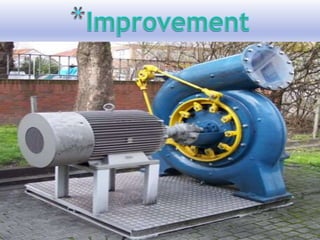
Francis Turbine is an Inward Flow Reaction Turbine
having Radial Discharge at Outlet. (i.e. = 0).
Modern Francis Turbine is a mixed flow type turbine
(i.e. Water enters the runner of the turbine in the
radial direction and leaves the runner in the axial
direction).
In the Francis turbines the water must be enter into
inlet nozzle and the velocity must be decreases.
Then the water moves in the forward direction in the
turbine but continuous decrease in the spiral casing
area must be happened. With the constant speed the
water strikes the turbine blades.
On the runner the blades are mounted. The blades
are designed like a thin air foil.
So due to the design the water flow occurs at low
pressure at one point and other side it creates a low
pressure.
So the motion takes place from the high pressure to
the low pressure.
Inside the blade it looks like a bucket it using the
impulsive force for rotation of water.
If the flow rate of water changes then by using the
governing mechanism we can set the angle of attack
of the water on the blade. At that case the turbine
works properly.
Initially the water passes from the blades and next
later enters into the draft tube, where we can notice
the continuous increment in the area and velocity of
the water must be decreases.
Medium head(45m to 250m)
Reaction(K.E.+P.E)
mixed flow(radial + axial)
medium specific speed(50 to 250)
disposition of shaft of runner is vertical
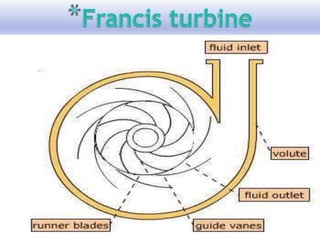
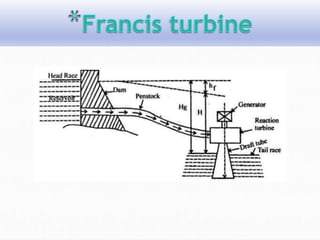
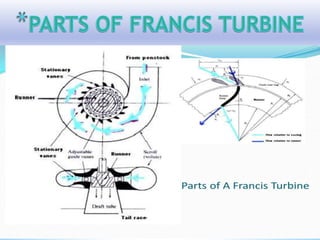
Penstock-it is a large size conduit which conveys
water from upstream to the dam/reservoir to the
turbine runner
 spiral casing- it constitutes a closed passage whose
cross section area gradually decrease along flow
direction area is maximum at inlet and nearly zero at
exit
guide vanes-these vanes direct the water on the
runner at an angle appropriate to the design,
controlled by hand wheel or governor
Governing mechanism-it changes the position of
guide vanes to affect a variation in water flow rate,
when the load condition on the turbine changes
Runner and runner blades-the driving force on the
runner is both due to impulse and reaction
effect(usually runner blades 16-24).
Draft tube-it is generally an expending tube which
discharges the water, passing through the runner to
the tail race.
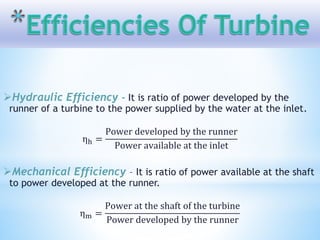
Hydraulic Efficiency - It is ratio of power developed by the
runner of a turbine to the power supplied by the water at the inlet.
ηh =
Power developed by the runner
Power available at the inlet
Mechanical Efficiency – It is ratio of power available at the shaft
to power developed at the runner.
ηm =
Power at the shaft of the turbine
Power developed by the runner
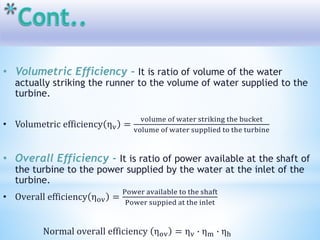
• Volumetric Efficiency - It is ratio of volume of the water
actually striking the runner to the volume of water supplied to the
turbine.
• Volumetric efficiency ηv =
volume of water striking the bucket
volume of water supplied to the turbine
• Overall Efficiency - It is ratio of power available at the shaft of
the turbine to the power supplied by the water at the inlet of the
turbine.
• Overall efficiency ηov =
Power available to the shaft
Power suppied at the inlet
Normal overall efficiency ηov = ηv ∙ ηm ∙ ηh
Water wheels of different types have been used historically for
over 1000 years to power mills of all types, but they were
relatively inefficient.
Nineteenth-century efficiency improvements of water turbines
allowed them to replace nearly all water wheel applications and
compete with steam engines wherever water power was
available.
After electric generators were developed in the late 1800s
turbines were a natural source of generator power where
potential hydro-power sources existed.
Pawtucket Gatehouse in Lowell, Massachusetts; site of the first Francis turbine
In 1826 Benoit Fourneyron developed a high efficiency (80%) outward-
flow water turbine. Water was directed tangentially through the turbine
runner, causing it to spin. Jean-Victor Poncelet designed an inward-flow
turbine in about 1820 that used the same principles.
In 1848 James B. Francis, while working as head engineer of the Locks
and Canals company in the water wheel-powered textile factory city
of Lowell, Massachusetts, improved on these designs to create more
efficient turbines.
 He applied scientific principles and testing methods to produce a very
efficient turbine design. More importantly, his mathematical and
graphical calculation methods improved turbine design and engineering.
 His analytical methods allowed confident design of high efficiency
turbines to precisely match a site's water flow and pressure (water
head).
It is most widely used turbine in world (70-
80%).
Effective use of water pressure as well as
velocity.
It is American standard turbine.
Very good efficiency (80-94%).
Cost is high.
Due to it’s complex design and large no of
moving parts, maintenance and repair is
difficult and costly.
It is applicable to flow of medium head only.
Cavitation is also a big problem.
Francis Turbine

Francis Turbine

  • 1.
    PRESENTED BY  TAMOORKHALIL UW-14-MET-BSC-011  M ZUBAIR UW-14-MET-BSC-032  MATTI ULLAH UW-14-MET-BSC-018 FRANCIS TURBINE SUBMITTED TO Mr. Umer Sohail
  • 2.
    Francis Turbine isan Inward Flow Reaction Turbine having Radial Discharge at Outlet. (i.e. = 0). Modern Francis Turbine is a mixed flow type turbine (i.e. Water enters the runner of the turbine in the radial direction and leaves the runner in the axial direction).
  • 4.
    In the Francisturbines the water must be enter into inlet nozzle and the velocity must be decreases. Then the water moves in the forward direction in the turbine but continuous decrease in the spiral casing area must be happened. With the constant speed the water strikes the turbine blades. On the runner the blades are mounted. The blades are designed like a thin air foil. So due to the design the water flow occurs at low pressure at one point and other side it creates a low pressure.
  • 5.
    So the motiontakes place from the high pressure to the low pressure. Inside the blade it looks like a bucket it using the impulsive force for rotation of water. If the flow rate of water changes then by using the governing mechanism we can set the angle of attack of the water on the blade. At that case the turbine works properly. Initially the water passes from the blades and next later enters into the draft tube, where we can notice the continuous increment in the area and velocity of the water must be decreases.
  • 6.
    Medium head(45m to250m) Reaction(K.E.+P.E) mixed flow(radial + axial) medium specific speed(50 to 250) disposition of shaft of runner is vertical
  • 8.
    Penstock-it is alarge size conduit which conveys water from upstream to the dam/reservoir to the turbine runner  spiral casing- it constitutes a closed passage whose cross section area gradually decrease along flow direction area is maximum at inlet and nearly zero at exit guide vanes-these vanes direct the water on the runner at an angle appropriate to the design, controlled by hand wheel or governor
  • 9.
    Governing mechanism-it changesthe position of guide vanes to affect a variation in water flow rate, when the load condition on the turbine changes Runner and runner blades-the driving force on the runner is both due to impulse and reaction effect(usually runner blades 16-24). Draft tube-it is generally an expending tube which discharges the water, passing through the runner to the tail race.
  • 11.
    Hydraulic Efficiency -It is ratio of power developed by the runner of a turbine to the power supplied by the water at the inlet. ηh = Power developed by the runner Power available at the inlet Mechanical Efficiency – It is ratio of power available at the shaft to power developed at the runner. ηm = Power at the shaft of the turbine Power developed by the runner
  • 12.
    • Volumetric Efficiency- It is ratio of volume of the water actually striking the runner to the volume of water supplied to the turbine. • Volumetric efficiency ηv = volume of water striking the bucket volume of water supplied to the turbine • Overall Efficiency - It is ratio of power available at the shaft of the turbine to the power supplied by the water at the inlet of the turbine. • Overall efficiency ηov = Power available to the shaft Power suppied at the inlet Normal overall efficiency ηov = ηv ∙ ηm ∙ ηh
  • 13.
    Water wheels ofdifferent types have been used historically for over 1000 years to power mills of all types, but they were relatively inefficient. Nineteenth-century efficiency improvements of water turbines allowed them to replace nearly all water wheel applications and compete with steam engines wherever water power was available. After electric generators were developed in the late 1800s turbines were a natural source of generator power where potential hydro-power sources existed.
  • 14.
    Pawtucket Gatehouse inLowell, Massachusetts; site of the first Francis turbine
  • 16.
    In 1826 BenoitFourneyron developed a high efficiency (80%) outward- flow water turbine. Water was directed tangentially through the turbine runner, causing it to spin. Jean-Victor Poncelet designed an inward-flow turbine in about 1820 that used the same principles. In 1848 James B. Francis, while working as head engineer of the Locks and Canals company in the water wheel-powered textile factory city of Lowell, Massachusetts, improved on these designs to create more efficient turbines.  He applied scientific principles and testing methods to produce a very efficient turbine design. More importantly, his mathematical and graphical calculation methods improved turbine design and engineering.  His analytical methods allowed confident design of high efficiency turbines to precisely match a site's water flow and pressure (water head).
  • 17.
    It is mostwidely used turbine in world (70- 80%). Effective use of water pressure as well as velocity. It is American standard turbine. Very good efficiency (80-94%).
  • 18.
    Cost is high. Dueto it’s complex design and large no of moving parts, maintenance and repair is difficult and costly. It is applicable to flow of medium head only. Cavitation is also a big problem.