NOTES AND FORMULAE ADDITIONAL MATHEMATICS FORM 4
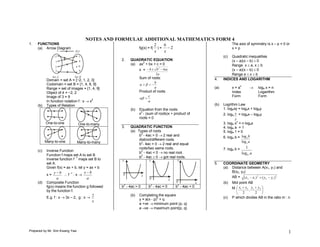
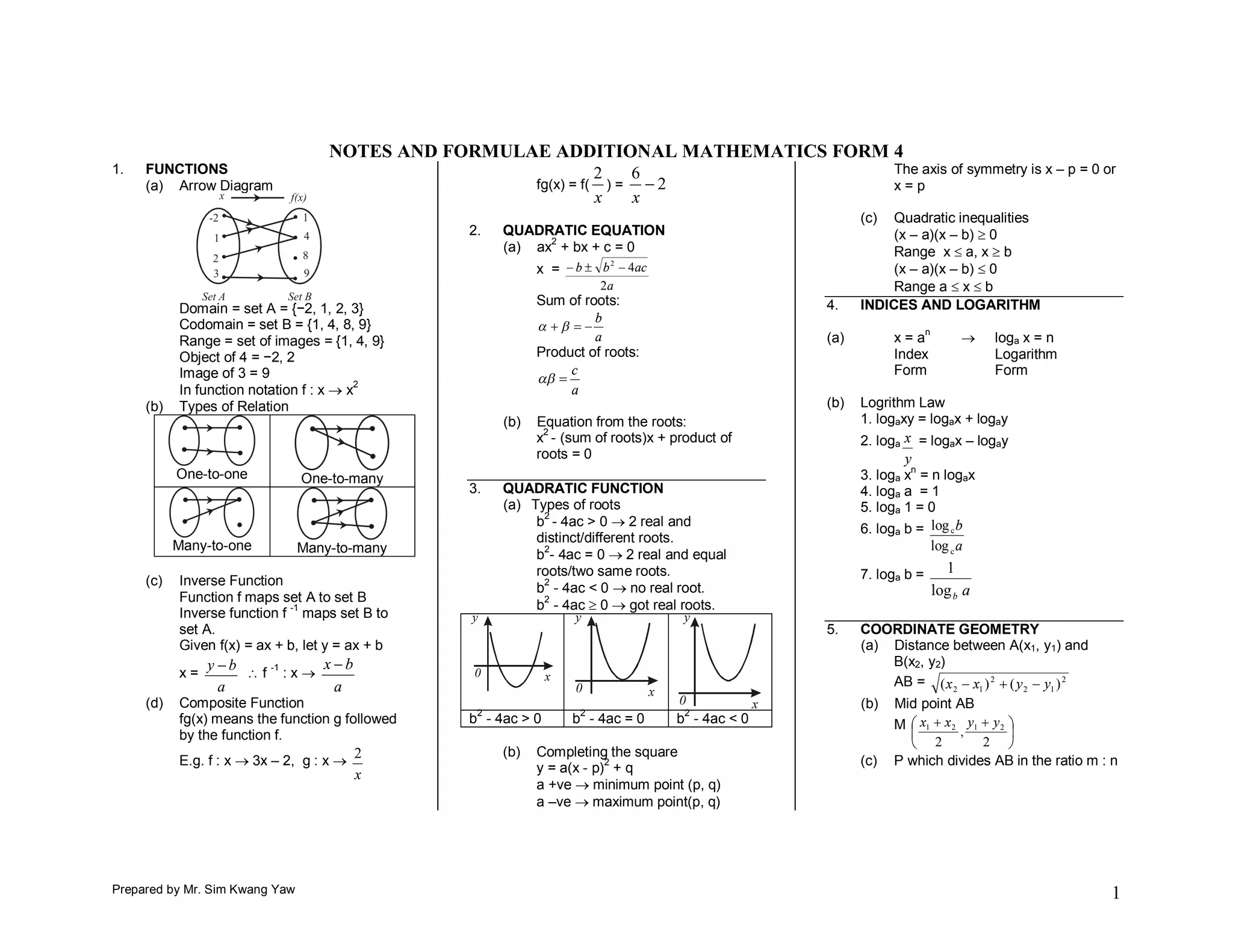
1.   FUNCTIONS                                                           2    6                                    The axis of symmetry is x – p = 0 or
     (a) Arrow Diagram                                      fg(x) = f(     )=   2                                 x=p
                                                                         x    x
                                                                                                             (c)  Quadratic inequalities
                                                 2.   QUADRATIC EQUATION                                          (x – a)(x – b)  0
                                                            2
                                                      (a) ax + bx + c = 0                                         Range x  a, x  b
                                                                       2
                                                            x =  b  b  4ac                                     (x – a)(x – b)  0
                                                                         2a                                       Range a  x  b
                                                            Sum of roots:                              4.    INDICES AND LOGARITHM
           Domain = set A = {−2, 1, 2, 3}
                                                                     b
           Codomain = set B = {1, 4, 8, 9}                                                                            n
           Range = set of images = {1, 4, 9}                         a                                 (a)         x=a                  loga x = n
           Object of 4 = −2, 2                              Product of roots:                                      Index                 Logarithm
           Image of 3 = 9                                        c                                                 Form                  Form
                                         2                   
           In function notation f : x  x                        a
     (b)   Types of Relation                                                                           (b)   Logrithm Law
                                                      (b)   Equation from the roots:                         1. logaxy = logax + logay
                                                             2
                                                            x - (sum of roots)x + product of                 2. loga x = logax – logay
                                                            roots = 0                                                y
                                                                                                                      n
           One-to-one           One-to-many                                                                  3. loga x = n logax
                                                 3.   QUADRATIC FUNCTION                                     4. loga a = 1
                                                      (a) Types of roots                                     5. loga 1 = 0
                                                            2
                                                           b - 4ac > 0  2 real and
                                                                                                             6. loga b = log c b
                                                           distinct/different roots.
           Many-to-one          Many-to-many                2                                                            log c a
                                                           b - 4ac = 0  2 real and equal
                                                           roots/two same roots.                             7. loga b =         1
     (c)   Inverse Function                                 2
                                                           b - 4ac < 0  no real root.                                         log b a
           Function f maps set A to set B                   2
                             -1                            b - 4ac  0  got real roots.
           Inverse function f maps set B to      y                 y                  y
           set A.                                                                                      5.    COORDINATE GEOMETRY
           Given f(x) = ax + b, let y = ax + b                                                               (a) Distance between A(x1, y1) and
                y b   -1   xb                                                                                  B(x2, y2)
           x=        f :x                      0             x
                  a          a                                     0                                             AB = ( x 2  x1 ) 2  ( y 2  y1 ) 2
                                                                                 x
     (d)   Composite Function                                                        0             x         (b)   Mid point AB
                                                  2                 2                 2
           fg(x) means the function g followed   b - 4ac > 0       b - 4ac = 0       b - 4ac < 0                   M  x1  x 2 , y1  y 2 
           by the function f.                                                                                                             
                                                                                                                      2             2 
                                          2           (b)   Completing the square
           E.g. f : x  3x – 2, g : x                                  2                                    (c)   P which divides AB in the ratio m : n
                                          x                 y = a(x - p) + q
                                                            a +ve  minimum point (p, q)
                                                            a –ve  maximum point(p, q)


Prepared by Mr. Sim Kwang Yaw                                                                                                                           1
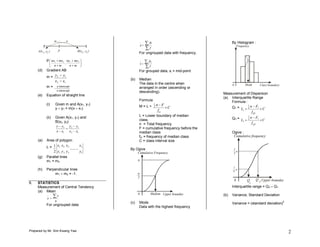
m :          n                                                                          By Histogram :
                                                                   x
                                                                         fx                                        Frequency
                        P                  B(x2 , y2 )
                                                                        f
     A(x 1 , y1 )
                                                                For ungrouped data with frequency.

             P  nx1  mx 2 ny1  my 2                                  fx
                            ,                                    x
                                                                               i

                   nm              nm                               f
     (d)     Gradient AB                                        For grouped data, xi = mid-point
             m = y 2  y1
                 x 2  x1                                (b)    Median
                                                                The data in the centre when                 0             Mode     Class boundary
             m =  y-intercept                                  arranged in order (ascending or
                      x-intercept                               descending).
     (e)     Equation of straight line                                                                Measurement of Dispersion
                                                                                                      (a) Interquartile Range
                                                                Formula                                   Formula :
             (i)     Given m and A(x1, y1)                                         1
                                                                                       nF                          1
                                                                M=L+               2
                                                                                           C             Q1 = L  4 n  F1  C
                     y – y1 = m(x – x1)
                                                                                        fm                       1
                                                                                                                       f Q1
             (ii)    Given A(x1, y1) and                        L = Lower boundary of median                         3
                                                                class.                                      Q3 = L  4 n  F3  C
                     B(x2, y2)                                                                                    3
                                                                                                                        f Q3
                                                                n = Total frequency
                     y  y1 y 2  y1
                                                               F = cumulative frequency before the
                      x  x1 x 2  x1                           median class                                Ogive :
                                                                fm = frequency of median class               Cumulative frequency
     (a)     Area of polygon                                    C = class interval size
             L = 1 x1 x2 x3 ......... x1
                                                         By Ogive                                            3
                                                                                                            __
                    2 y1 y 2 y 3            y1                 Cumulative Frequency                          4
                                                                                                               n
     (g)     Parallel lines
             m1 = m2                                           n

                                                                                                             1
                                                                                                            __ n
     (h)     Perpendicular lines                                                                            4
                  m1  m2 = -1.                                n
                                                               __
                                                               2
                                                                                                                0          Q     Q 3 Upper boundary
6.   STATISTICS                                                                                                             1
     Measurement of Central Tendency                                                                        Interquartile range = Q3 – Q1
     (a) Mean
                                                               0           Median Upper boundary      (b)   Variance, Standard Deviation
              x
                    x
                    n                                                                                                                               2
                                                         (c)    Mode                                        Variance = (standard deviation)
             For ungrouped data
                                                                Data with the highest frequency


Prepared by Mr. Sim Kwang Yaw                                                                                                                           2
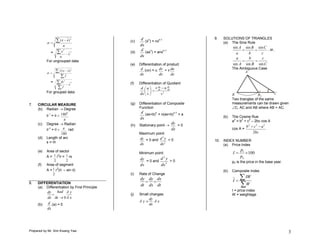
2                  d (xn) = nxn-1                 9.   SOLUTIONS OF TRIANGLES
            
                  ( x  x)                   (c)                                       (a) The Sine Rule
                        n                           dx
                                                                                              sin A sin B sin C
                                                    d (axn) = anxn-1                                          , or,
             =     x2      x
                                 2            (d)                                               a     b     c
                    n                               dx
                                                                                                a     b     c
           For ungrouped data                                                                           
                                              (e)   Differentiation of product                sin A sin B sin C
                                 2                   d (uv) = u dv + v du                     The Ambiguous Case
            
                  f ( x  x)
                                                    dx            dx     dx
                    f
                        2
             =    fx  x        2
                                              (f)   Differentiation of Quotient
                  f                                d  u  v du  u dv
           For grouped data                               dx 2 dx
                                                    dx  v     v
                                                                                              Two triangles of the same
7.   CIRCULAR MEASURE                         (g)   Differentiation of Composite              measurements can be drawn given
     (b) Radian  Degree                            Function                                  C, AC and AB where AB < AC.
                     0                               d (ax+b)n = n(ax+b)n-1 × a
          =   180
          r
                                                    dx                                  (b)   The Cosine Rue
                                                                                              2   2   2
                                                                                              a = b + c – 2bc cos A
     (c)   Degree  Radian                    (h)   Stationary point 
                                                                       dy = 0
                                                                                                        b 2  c2  a 2
            =    rad                                                                      cos A =
             o
                                                                       dx
                   180                              Maximum point:                                           2bc
     (d)   Length of arc                            dy = 0 and d 2 y < 0
           s = r                                                                  10. INDEX NUMBER
                                                    dx         dx 2                    (a) Price Index
     (e)   Area of sector                                                                          p1
                   2
                                                    Minimum point:                            I       100
           A = 1 r  = 1 rs                                     2                                  po
                2       2                           dy = 0 and d y > 0
                                                                                              p0 is the price in the base year.
     (f)   Area of segment                          dx         dx 2
                  2
           A = 1 r ( – sin )                                                          (b)   Composite Index
               2                              (i)   Rate of Change
                                                    dy dy dx
                                                                                            I
                                                                                                    IW
8.   DIFFERENTIATION
     (a) Differentiation by First Principle
                                                    dt dx dt                                       W
           dy    had  y                                                                      I = price index
                                             (j)   Small changes:                            W = weightage
           dx x  0  x                                  dy
           d (a) = 0                                 y  . x
     (b)                                                  dx
           dx


Prepared by Mr. Sim Kwang Yaw                                                                                                     3

Form 4 formulae and note

  • 1.
    NOTES AND FORMULAEADDITIONAL MATHEMATICS FORM 4 1. FUNCTIONS 2 6 The axis of symmetry is x – p = 0 or (a) Arrow Diagram fg(x) = f( )= 2 x=p x x (c) Quadratic inequalities 2. QUADRATIC EQUATION (x – a)(x – b)  0 2 (a) ax + bx + c = 0 Range x  a, x  b 2 x =  b  b  4ac (x – a)(x – b)  0 2a Range a  x  b Sum of roots: 4. INDICES AND LOGARITHM Domain = set A = {−2, 1, 2, 3} b Codomain = set B = {1, 4, 8, 9}    n Range = set of images = {1, 4, 9} a (a) x=a  loga x = n Object of 4 = −2, 2 Product of roots: Index Logarithm Image of 3 = 9 c Form Form 2   In function notation f : x  x a (b) Types of Relation (b) Logrithm Law (b) Equation from the roots: 1. logaxy = logax + logay 2 x - (sum of roots)x + product of 2. loga x = logax – logay roots = 0 y n One-to-one One-to-many 3. loga x = n logax 3. QUADRATIC FUNCTION 4. loga a = 1 (a) Types of roots 5. loga 1 = 0 2 b - 4ac > 0  2 real and 6. loga b = log c b distinct/different roots. Many-to-one Many-to-many 2 log c a b - 4ac = 0  2 real and equal roots/two same roots. 7. loga b = 1 (c) Inverse Function 2 b - 4ac < 0  no real root. log b a Function f maps set A to set B 2 -1 b - 4ac  0  got real roots. Inverse function f maps set B to y y y set A. 5. COORDINATE GEOMETRY Given f(x) = ax + b, let y = ax + b (a) Distance between A(x1, y1) and y b -1 xb B(x2, y2) x= f :x 0 x a a 0 AB = ( x 2  x1 ) 2  ( y 2  y1 ) 2 x (d) Composite Function 0 x (b) Mid point AB 2 2 2 fg(x) means the function g followed b - 4ac > 0 b - 4ac = 0 b - 4ac < 0 M  x1  x 2 , y1  y 2  by the function f.    2 2  2 (b) Completing the square E.g. f : x  3x – 2, g : x  2 (c) P which divides AB in the ratio m : n x y = a(x - p) + q a +ve  minimum point (p, q) a –ve  maximum point(p, q) Prepared by Mr. Sim Kwang Yaw 1
  • 2.
    m : n By Histogram : x  fx Frequency P B(x2 , y2 ) f A(x 1 , y1 ) For ungrouped data with frequency. P  nx1  mx 2 ny1  my 2   fx  ,  x i  nm nm  f (d) Gradient AB For grouped data, xi = mid-point m = y 2  y1 x 2  x1 (b) Median The data in the centre when 0 Mode Class boundary m =  y-intercept arranged in order (ascending or x-intercept descending). (e) Equation of straight line Measurement of Dispersion (a) Interquartile Range Formula Formula : (i) Given m and A(x1, y1) 1 nF 1 M=L+ 2 C Q1 = L  4 n  F1  C y – y1 = m(x – x1) fm 1 f Q1 (ii) Given A(x1, y1) and L = Lower boundary of median 3 class. Q3 = L  4 n  F3  C B(x2, y2) 3 f Q3 n = Total frequency y  y1 y 2  y1  F = cumulative frequency before the x  x1 x 2  x1 median class Ogive : fm = frequency of median class Cumulative frequency (a) Area of polygon C = class interval size L = 1 x1 x2 x3 ......... x1 By Ogive 3 __ 2 y1 y 2 y 3 y1 Cumulative Frequency 4 n (g) Parallel lines m1 = m2 n 1 __ n (h) Perpendicular lines 4 m1  m2 = -1. n __ 2 0 Q Q 3 Upper boundary 6. STATISTICS 1 Measurement of Central Tendency Interquartile range = Q3 – Q1 (a) Mean 0 Median Upper boundary (b) Variance, Standard Deviation x x n 2 (c) Mode Variance = (standard deviation) For ungrouped data Data with the highest frequency Prepared by Mr. Sim Kwang Yaw 2
  • 3.
    2 d (xn) = nxn-1 9. SOLUTIONS OF TRIANGLES    ( x  x) (c) (a) The Sine Rule n dx sin A sin B sin C d (axn) = anxn-1   , or, =  x2 x 2 (d) a b c n dx a b c For ungrouped data   (e) Differentiation of product sin A sin B sin C 2 d (uv) = u dv + v du The Ambiguous Case    f ( x  x) dx dx dx f 2 =  fx  x 2 (f) Differentiation of Quotient f d  u  v du  u dv For grouped data    dx 2 dx dx  v  v Two triangles of the same 7. CIRCULAR MEASURE (g) Differentiation of Composite measurements can be drawn given (b) Radian  Degree Function C, AC and AB where AB < AC. 0 d (ax+b)n = n(ax+b)n-1 × a  =   180 r dx (b) The Cosine Rue  2 2 2 a = b + c – 2bc cos A (c) Degree  Radian (h) Stationary point  dy = 0 b 2  c2  a 2  =    rad cos A = o dx 180 Maximum point: 2bc (d) Length of arc dy = 0 and d 2 y < 0 s = r 10. INDEX NUMBER dx dx 2 (a) Price Index (e) Area of sector p1 2 Minimum point: I  100 A = 1 r  = 1 rs 2 po 2 2 dy = 0 and d y > 0 p0 is the price in the base year. (f) Area of segment dx dx 2 2 A = 1 r ( – sin ) (b) Composite Index 2 (i) Rate of Change dy dy dx   I  IW 8. DIFFERENTIATION (a) Differentiation by First Principle dt dx dt W dy had  y I = price index  (j) Small changes: W = weightage dx x  0  x dy d (a) = 0  y  . x (b) dx dx Prepared by Mr. Sim Kwang Yaw 3