COMPLEX NUMBERS

    1.00         The complex number system


   There is no real number x which satisfies the polynomial equation x2 1 0 . To permit solutions of this
   and similar equations, the set of complex numbers is introduced.

   We can consider a complex number as having the form a + bi where a and b are real number and i, which
   is called the imaginary unit, has the property that i 2       –1 . It is denoted by z i.e. z = a + ib. ‘a’ is called as
   real part of z which is denoted by (Re z) and ‘b’ is called as imaginary part of z which is denoted by (Im
   z).

   Any complex number is:

     (i)    Purely real, if b = 0              (b) Purely imaginary, if a = 0                 (c) Imaginary, if b    0

   Note :

     (a) The set R of real numbers is a proper subset of the Complex Numbers. Hence the complete
            number system is N      W      I     Q    R    C.

     (b) Zero is purely real as well as purely imaginary but not imaginary.

     (c)    i     –1 is called the imaginary unit. Also i 2      –1; i3   –i; i 4    1 etc.

     (d)        a b    ab only if atleast one of a or b is non–negative.

     (e) is z = a + ib, then a – ib is called complex conjugate of z and written as z a – ib .


    1.01 Algebraic Operations
    111
   Fundamental operations with complex numbers
    1
   In performing operations with complex numbers we can proceed as in the algebra of real numbers,
   replacing i 2 by –1 when it occurs.

     (1)    Addition (a bi) (c di)         a bi c di           (a c) (b d )i

     (2)    Subtraction (a bi) – (c di)        a bi – c – di     (a – c) (b – d )i

     (3)    Multiplication (a bi) (c di)        ac adi bci bdi 2          (ac – bd ) (ad bc)i

Progression / APEX INSTITUTE FOR IIT-JEE / AIEEE / PMT, 0120-4901457, +919990495952, +919910817866                   Page 1
a bi a bi c – bi                 ac – adi bci – bdi 2 ac bd (bc – ad )i ac bd bc – ad
     (4)   Division       =                                                =                 = 2   +        i.
                      c di c di c – di                       c2 – d 2i 2        c2 – d 2      c d 2 c2 d 2

   Inequalities in complex numbers are not defined. There is no validity if we say that complex number is
   positive or negative. e.g. z > 0, 4 + 2i < 2 + 4i are meaningless.

   In real numbers if a 2 b2             0 then a 0 b however in complex numbers, z12             2
                                                                                                 z2   0 does not imply z1   z2    0.


   Illustration 1 :    Find multiplicative inverse of 3 + 2i, then

   Solution:            Let z be the multiplicative inverse of 3 2i, then
                                z.(3 2i) 1
                                          1           3 – 2i
                                z
                                         3 2i       3 2i 3 – 2i
                                          3 2
                                z          – i
                                         13 13
                                     3 2
                                      – i            Ans.
                                    13 13


    1.02 Equality In Complex Number
    111
   Two complex numbers z1 a1 ib1 & z2 a2
    1                                                              ib2 are equal if and only if their real and imaginary parts are

   equal respectively. i.e. z1            z2            Re( z2 ) and I m ( z1 )   I m ( z2 ) .


   Illustration 2 :    Find the value of x and y for which (2 3i) x2 – (3 – 2i) y 2 x – 3 y 5i where x, y R.

   Solution:           ( z 3i ) x 2 – (3 – 2i ) y       2 x – 3 y 5i
                                2x – 3y
                                     2
                                                   2x – 3y
                                x2 – x         0
                             x       0, 1 and 3x 2       2y    5
                                                   5
                            if x         0, y        and if x 1, y 1
                                                   2
                                                5
                            x       0, y          and x 1, y 1
                                                2


Progression / APEX INSTITUTE FOR IIT-JEE / AIEEE / PMT, 0120-4901457, +919990495952, +919910817866                               Page 2
Illustration 3 :   Find the value of expression x4 – 4x3 3x2 – 2x 1 when x 1 i is a factor of expression.

   Solution:          x 1 i
                              x –1 i                           ( x –1) 2         –1
                              x – 2x 2
                                  2
                                                         0 Now x – 4 x3 3 x 2 – 2 x 1
                                                                      4


                           ( x 2 – 2 x 2)( x 2 – 3 x – 3) – 4 x 7
                          when x 1 i i.e. x 2 – 2 x 2                                     0
                          x 4 – 4 x3 3 x 2 – 2 x 1 0 – 4(1 i) 7
                                      – 4 7 – 4i
                                      3 – 4i                 Ans


   Illustration 4 :   Solve for z if z 2 | z | 0 .

   Solution:          Let z           x iy

                              ( x iy ) 2                x2     y2     0


                              x2 – y 2                  x2     y2    0 and 2 xy               0
                              x       0 or y            0
                      when x           0– y       2
                                                         | y| 0
                              y        0, 1, –1                            z      0, i, –1
                      when y            0           x2 | x | 0                   x    0
                              z        0            Ans.                  z       0, z        i, z   –1


   Illustration 5 :   Find square root of 7 + 40i.

   Solution:          Let (x iy ) 2               9 40i
                              x –y2        2
                                                    9                          ........(i)
                      and xy           20                                  ..........(ii )
                      squing (i ) and adding with 4times the square of (ii )
                      we get x 4               y 4 – 2x2 y 2        4x2 y 2          81 1600
                              ( x2         y 2 )2       168
                                  2        2
                              x        y          4                            ........(iii)
                      from (i) (iii) we can see that x & y are of same sign
                           x iy                  (5 4i) or           (5 4i)
                           Sq. roots of a 40i                             (5 4i)
                                  (5 4i)                     Ans.


Progression / APEX INSTITUTE FOR IIT-JEE / AIEEE / PMT, 0120-4901457, +919990495952, +919910817866        Page 3
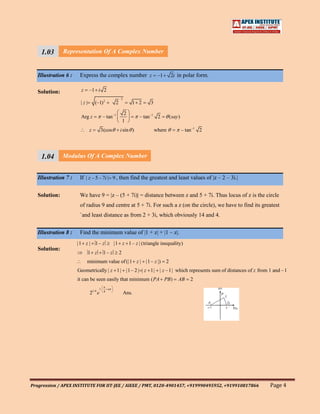
1.03 Representation Of A Complex Number
     111
     1
   Illustration 6 : Express the complex number z –1                              2i in polar form.


   Solution:           z     –1 i 2
                                                     2
                       |z|       (–1) 2          2            1 2    3

                                                          2
                       Arg z           – tan –1                 – tan –1 2       ( say )
                                                         1
                             z         3(cos         i sin )             where             – tan –1 2


     1.04 Modulus Of A Complex Number
     111
     1
   Illustration 7 : If | z – 5 – 7i | 9 , then find the greatest and least values of |z – 2 – 3i.|


   Solution:           We have 9 = |z – (5 + 7i)| = distance between z and 5 + 7i. Thus locus of z is the circle
                       of radius 9 and centre at 5 + 7i. For such a z (on the circle), we have to find its greatest
                       `and least distance as from 2 + 3i, which obviously 14 and 4.


   Illustration 8 :    Find the minimum value of |1 + z| + |1 – z|.
                      |1 z | 1 – z              |1 z 1 – z | (triangle inequality)
   Solution:
                             1 z        1– z         2
                           minimum value of (|1 z | |1 – z |)                2
                      Geometrically | z 1| |1 – 2 | | z 1| | z –1| which represents sum of distances of z from 1 and –1
                      it can be seen easily that minimum ( PA PB )                    AB       2
                                   1        n
                             21/ 4 e    8
                                                         Ans.


Progression / APEX INSTITUTE FOR IIT-JEE / AIEEE / PMT, 0120-4901457, +919990495952, +919910817866             Page 4
2
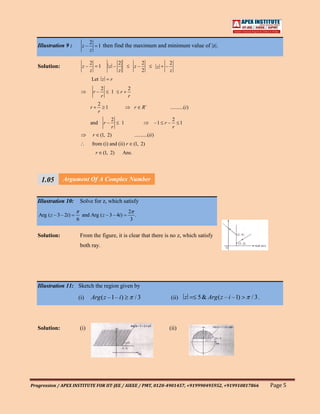
   Illustration 9 :         z–               1 then find the maximum and minimum value of |z|.
                                 z

                                 2                         2                2                    2
   Solution:                z–               1      z –                z–                z   –
                                 z                         z                2                    z
                                 Let z                 r
                                              2                    2
                                     r–                1   r
                                              r                    r
                                             2
                                 r             1                       r    R                    ..........(i )
                                             r
                                                       2                                          2
                                 and              r–           1                         –1 r –     1
                                                       r                                          r
                                     r       (1, 2)                    ..........(ii )
                                 from (i) and (ii) r                   (1, 2)
                                         r       (1, 2)        Ans.


     1.05 Argument Of A Complex Number
     111
     1
   Illustration 10: Solve for z, which satisfy
                                                                   2
   Arg ( z – 3 – 2i)        and Arg ( z – 3 – 4i)                     .
                       6                                            3


   Solution:               From the figure, it is clear that there is no z, which satisfy
                           both ray.


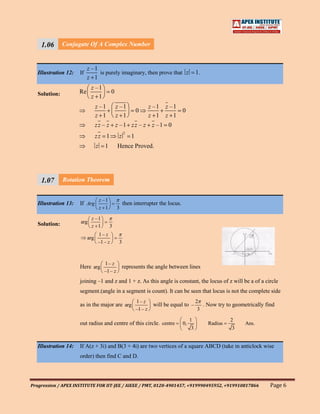
   Illustration 11: Sketch the region given by

                       (i)       Arg ( z –1– i)                        /3                         (ii)      z     5 & Arg ( z – i –1)   /3.


   Solution:               (i)                                                                   (ii)


Progression / APEX INSTITUTE FOR IIT-JEE / AIEEE / PMT, 0120-4901457, +919990495952, +919910817866                                            Page 5
1.06       Conjugate Of A Complex Number
    111
    1
                           z –1
   Illustration 12:   If        is purely imaginary, then prove that z                     1.
                           z 1
                            z –1
   Solution:          Re                   0
                            z 1
                                 z –1          z –1                 z –1   z –1
                                                            0                   0
                                 z 1           z 1                  z 1    z 1
                                 z z – z z –1 z z – z z –1 0
                                                    2
                                 zz 1           z       1
                                 z     1       Hence Proved.


     1.07 Rotation Theorem
     111
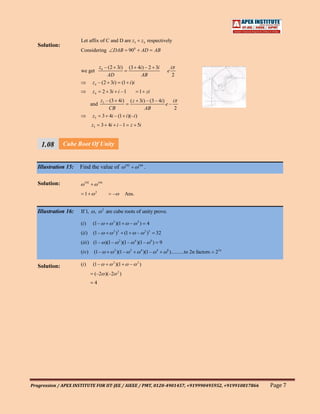
     1                     z –1
   Illustration 13: If Arg                          then interrupter the locus.
                                     z 1       3

                            z –1
   Solution:          arg
                            z 1            3
                                  1– z
                           arg
                                  –1 – z        3


                                      1– z
                      Here arg                      represents the angle between lines
                                      –1– z
                      joining –1 and z and 1 + z. As this angle is constant, the locus of z will be a of a circle
                      segment.(angle in a segment is count). It can be seen that locus is not the complete side
                                                            1– z                           2
                      as in the major are arg                        will be equal to –       . Now try to geometrically find
                                                            –1– z                           3

                                                                                       1                  2
                      out radius and centre of this circle. centre                0,            Radius          Ans.
                                                                                       3                  3


   Illustration 14:   If A(z + 3i) and B(3 + 4i) are two vertices of a square ABCD (take in anticlock wise
                      order) then find C and D.


Progression / APEX INSTITUTE FOR IIT-JEE / AIEEE / PMT, 0120-4901457, +919990495952, +919910817866                         Page 6
Let affix of C and D are z3                                      z4 respectively
   Solution:                                                               0
                      Considering                DAB                  90               AD           AB


                                 z4 – (2 3i) (3 4i) – 2 3i                                                          i
                      we get                                                                                    e
                                     AD            AB                                                                2
                              z4 – (2 3i ) (1 i )i
                              z4             2 3i i –1                             1 zi
                                        z3 – (3 4i ) ( z 3i ) – (3 – 4i)    i
                              and                                        e–
                                            CB               AB              2
                              z3         3 4i – (1 i )(–i )
                              z3         3 4i i –1 z 5i


     1.08 Cube Root Of Unity
     111
     1
   Illustration 15: Find the value of                            192           194
                                                                                        .

   Solution:            192            194


                        1          2
                                                 –               Ans.

                                         2
   Illustration 16:   If 1,     ,             are cube roots of unity prove.

                      (i )     (1 –              2
                                                     )(1               –       2
                                                                                   )        4
                      (ii )    (1 –              2 5
                                                     )           (1            –        2 5
                                                                                            )           32
                      (iii ) (1 – )(1 –                  2
                                                             )(1 –         4
                                                                               )(1 –            8
                                                                                                    )       9
                      (iv)     (1 –               2
                                                      )(1 –            2           4
                                                                                       )(1 –            4       8
                                                                                                                    )..........to 2n factors   22 n

   Solution:          (i )     (1 –              2
                                                     )(1               –       2
                                                                                   )
                               (–2 )(–2                  2
                                                             )
                               4


Progression / APEX INSTITUTE FOR IIT-JEE / AIEEE / PMT, 0120-4901457, +919990495952, +919910817866                                                    Page 7
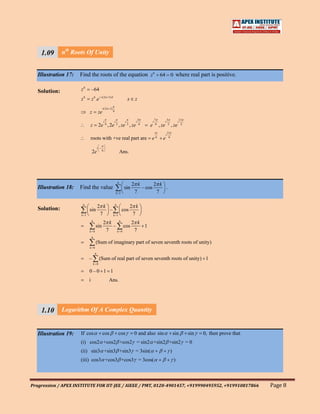
th
     1.09 n Roots Of Unity
     111
     1
   Illustration 17: Find the roots of the equation                                        z6           64 0 where real part is positive.


   Solution:          z6          –64
                          6
                      z           z 6 .e         i (2 n 1)
                                                                            x    z
                                                  i (2 n 1)
                                                              6
                              z            ze
                                                                                     5            7               3                11
                                                  i           i         i        i            i               i                i
                              z             2e 6 , 2e 2 , ze 2 , ze                   6
                                                                                          e        6
                                                                                                       , ze        2
                                                                                                                       , ze         2

                                                                                                  i               11
                                                                                                              i
                              roots with +ve real part are                                e6             e         6


                                           i –
                                                 6
                                  2e                                  Ans.


                                                                  6
                                                                                2 k       2 k
   Illustration 18:   Find the value                                    sin         – cos     .
                                                                  k 1            7         7

                       6                          6
   Solution:                               2 k           2 k
                              sin              –     cos
                      k 1                   7    k 1      7
                                  6
                                                  2 k 6    2 k
                                       sin           – cos     1
                              k 0                  7  k 0   7
                                  6
                                       (Sum of imaginary part of seven seventh roots of unity)
                              k 0
                                       6
                              –             (Sum of real part of seven seventh roots of unity) 1
                                      k 0

                              0–0 1 1
                              i                         Ans.


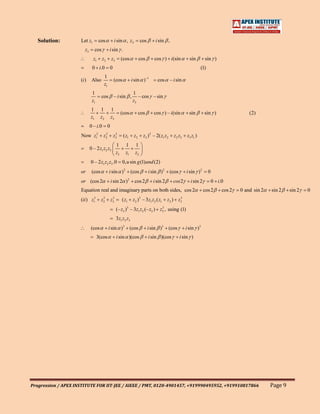
    1.10       Logarithm Of A Complex Quantity


   Illustration 19:   If cos                     cos               cos           0 and also sin                            sin          sin   0, then prove that
                      (i) cos2 +cos2 +cos2 = sin2 +sin2 +sin2 = 0
                      (ii) sin3 +sin3 +sin3 = 3sin(                                                                    )
                      (iii) cos3 +cos3 +cos3 = 3cos(                                                                       )


Progression / APEX INSTITUTE FOR IIT-JEE / AIEEE / PMT, 0120-4901457, +919990495952, +919910817866                                                                 Page 8
Solution:         Let z1            cos           i sin , z2            cos       i sin ,
                        z3        cos            i sin .
                               z1       z2        z3        (cos           cos      cos ) i(sin               sin       sin )
                              0 i.0              0                                                                    (1)
                                            1
                     (i )     Also                   (cos           i sin ) –1        cos        – i sin
                                            z1
                              1                                      1
                                        cos          – i sin ,          – cos – sin
                              z1                                     z3
                             1         1          1
                                                            (cos           cos      cos ) – i(sin             sin       sin )                   (2)
                             z1        z2         z3
                             0 – i.0         0
                     Now z         2
                                   1     z   2
                                             2
                                                      2
                                                     z3      ( z1     z2     z3 ) 2 – 2( z1 z2     z 2 z3   z3 z1 )
                                                       1      1       1
                             0 – 2 z1 z2 z3
                                                       z3     z1      z2
                             0 – 2 z1 z2 z3 .0              0, u sin g (1)and (2)
                     or       (cos               i sin ) 2          (cos         i sin ) 2       (cos       i sin ) 2       0
                     or (cos 2                    i sin 2 ) 2         cos 2        i sin 2         cos 2      i sin 2           0 i.0
                     Equation real and imaginary parts on both sides, cos 2                                             cos 2       cos 2   0 and sin 2   sin 2    sin 2   0
                     (ii ) z13           3
                                        z2         3
                                                  z3        ( z1     z2 )3 – 3 z1 z2 ( z1    z 2 ) z3
                                                                                                    3


                                                       (– z3 )3 – 3z1 z2 (– z3 ) z3 , using (1)
                                                                                  3


                                                       3z1 z2 z3
                             (cos                i sin )3           (cos         i sin )3 (cos              i sin )3
                                   3(cos               i sin )(cos               i sin )(cos            i sin )


Progression / APEX INSTITUTE FOR IIT-JEE / AIEEE / PMT, 0120-4901457, +919990495952, +919910817866                                                        Page 9
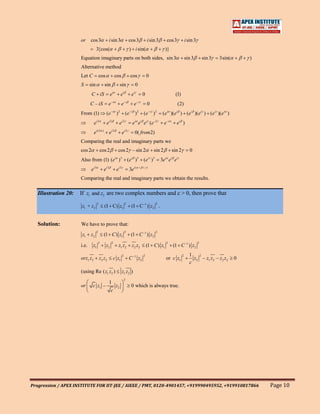
or cos 3                          i sin 3                     cos 3                 i sin 3             cos 3           i sin 3
                                   3{cos(                                           ) i sin(                                 )}
                      Equation imaginary parts on both sides, sin 3                                                                           sin 3         sin 3   3sin(       )
                      Alternative method
                      Let C              cos                    cos                  cos                  0
                      S      sin                 sin                    sin                   0
                                                            i               i             i
                              C iS                      e               e             e               0                            (1)
                             C – iS                 e–i                 e–i               e–i             0                             (2)
                                                         –i         2                –i           2           –i       2
                      From (1)                     (e           )               (e            )       (e           )        (e )(e ) (ei )(ei ) (ei )(ei )
                                                                                                                              i     i


                                ei 2               ei 2             ei 2                  ei ei ei (e –2                    e–i     ei )
                                ei (2        )
                                                        ei 2            ei 2                  0( from 2)
                      Comparing the real and imaginary parts we
                      cos 2              cos 2                      cos 2 – sin 2                                  sin 2          sin 2          0
                      Also from (1) (ei )3 (ei )3 (ei )3                                                                   3ei ei ei
                              ei 3               ei 3           ei 3                3ei (                 )


                      Comparing the real and imaginary parts we obtain the results.

   Illustration 20:   If z1 and z2 are two complex numbers and c > 0, then prove that
                                     2                                          2                                      2
                      z1 + z2                    (I C) z1                             (I C –1 ) z2 .


   Solution:          We have to prove that:
                                     2                                          2                                      2
                      z1     z2                  (1 C ) z1                            (1 C –1 ) z2
                                         3               2                                                                    2                         3
                      i.e.     z1                 z2                z1 z2             z2 z2               (1 C ) z1               (1 C –1 ) z2
                                                                         2                            2                                   2     1 2
                      orz1 z2            z2 z2               c z1                   C –1 z2                                  or c z1              z2 – z1 z2 – z2 z2        0
                                                                                                                                                c
                      (using Re ( z1 z2 )                               z1 z2 )
                                                                             2
                                                        1
                      or       c z1 –                           z2                    0 which is always true.
                                                         c


Progression / APEX INSTITUTE FOR IIT-JEE / AIEEE / PMT, 0120-4901457, +919990495952, +919910817866                                                                                  Page 10
Illustration 21:   If ,        [ / 6,           / 3], i 1, 2, 3, 4, 5 and z 4 cos                1    z 3 cos   2   z 3 cos   3   z cos     4   cos   5


                                                                    3
                          2 3, then show that | z |                   .
                                                                    4

   Solution:          Given that
                      cos 1 .z 4      cos 2 .z 3 cos 3 .z 2                 cos 4 .z cos        5       2 3
                      or cos 1 .z 4        cos 2 .z 3 cos 3 .z 2                cos 4 .z cos         5    2 3

                      2 3         cos 1 .z 4        cos 2 .z 3            cos 3 .z 2     cos 4 .z        cos   5

                                i [ / 6, / 3]
                             1                       3
                                    cos    i
                             2                      2
                                    3                 3                3                3            3
                       2 3            | z |4            | z |3           | z |2           |z|
                                   2                 2                2                2            2
                           3 | z |4       | z |3     | z |2      |z|
                           3 | z | | z |2            | z |3      | z |4     | z |5 ..........
                                    |z|
                             3              3–e| z | | z |
                                   1– | z |
                                                                    3
                                 4| z| 3                  |z|
                                                                    4

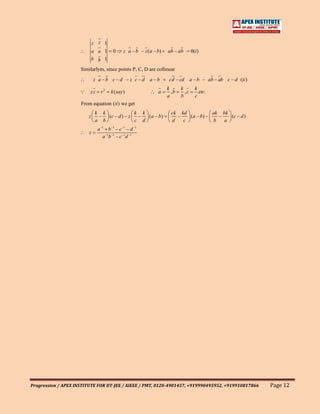
   Illustration 21:   Two different non parallel lines cut the circle |z| = r in point a, b, c, d respectively.
                                                                                                                   a –1 b –1 – c –1 – d –1
                      Prove that these lines meet in the point z given by z =                                                              .
                                                                                                                      a –1b –1 – c –1d –1

   Solution:          Since point P, A, B are collinear


Progression / APEX INSTITUTE FOR IIT-JEE / AIEEE / PMT, 0120-4901457, +919990495952, +919910817866                                                           Page 11
z z 1
                             a a 1      0     z a – b – z (a – b)   ab – ab       0(i )
                             b b 1
                     Similarlym, since points P, C, D are collinear
                             z a –b c –d – z c –d a –b               cd – cd a – b – ab – ab c – d (ii )
                                                                    k      k        k
                        zz      r2   k ( say )                a      ,b     ,c       etc.
                                                                    a      b        c
                     From equation (ii ) we get
                              k k             k k                     ck kd            ak bk
                         z     – (c – d ) – z  –  ( a – b)              –   ( a – b) –   –   (c – d )
                              a b             c d                     d   c            b   a
                               a –1 b –1 – c –1 – d –1
                         z
                                  a –1b –1 – c –1d –1


Progression / APEX INSTITUTE FOR IIT-JEE / AIEEE / PMT, 0120-4901457, +919990495952, +919910817866         Page 12

STUDY MATERIAL FOR IIT-JEE on Complex number

  • 1.
    COMPLEX NUMBERS 1.00 The complex number system There is no real number x which satisfies the polynomial equation x2 1 0 . To permit solutions of this and similar equations, the set of complex numbers is introduced. We can consider a complex number as having the form a + bi where a and b are real number and i, which is called the imaginary unit, has the property that i 2 –1 . It is denoted by z i.e. z = a + ib. ‘a’ is called as real part of z which is denoted by (Re z) and ‘b’ is called as imaginary part of z which is denoted by (Im z). Any complex number is: (i) Purely real, if b = 0 (b) Purely imaginary, if a = 0 (c) Imaginary, if b 0 Note : (a) The set R of real numbers is a proper subset of the Complex Numbers. Hence the complete number system is N W I Q R C. (b) Zero is purely real as well as purely imaginary but not imaginary. (c) i –1 is called the imaginary unit. Also i 2 –1; i3 –i; i 4 1 etc. (d) a b ab only if atleast one of a or b is non–negative. (e) is z = a + ib, then a – ib is called complex conjugate of z and written as z a – ib . 1.01 Algebraic Operations 111 Fundamental operations with complex numbers 1 In performing operations with complex numbers we can proceed as in the algebra of real numbers, replacing i 2 by –1 when it occurs. (1) Addition (a bi) (c di) a bi c di (a c) (b d )i (2) Subtraction (a bi) – (c di) a bi – c – di (a – c) (b – d )i (3) Multiplication (a bi) (c di) ac adi bci bdi 2 (ac – bd ) (ad bc)i Progression / APEX INSTITUTE FOR IIT-JEE / AIEEE / PMT, 0120-4901457, +919990495952, +919910817866 Page 1
  • 2.
    a bi abi c – bi ac – adi bci – bdi 2 ac bd (bc – ad )i ac bd bc – ad (4) Division = = = 2 + i. c di c di c – di c2 – d 2i 2 c2 – d 2 c d 2 c2 d 2 Inequalities in complex numbers are not defined. There is no validity if we say that complex number is positive or negative. e.g. z > 0, 4 + 2i < 2 + 4i are meaningless. In real numbers if a 2 b2 0 then a 0 b however in complex numbers, z12 2 z2 0 does not imply z1 z2 0. Illustration 1 : Find multiplicative inverse of 3 + 2i, then Solution: Let z be the multiplicative inverse of 3 2i, then z.(3 2i) 1 1 3 – 2i z 3 2i 3 2i 3 – 2i 3 2 z – i 13 13 3 2 – i Ans. 13 13 1.02 Equality In Complex Number 111 Two complex numbers z1 a1 ib1 & z2 a2 1 ib2 are equal if and only if their real and imaginary parts are equal respectively. i.e. z1 z2 Re( z2 ) and I m ( z1 ) I m ( z2 ) . Illustration 2 : Find the value of x and y for which (2 3i) x2 – (3 – 2i) y 2 x – 3 y 5i where x, y R. Solution: ( z 3i ) x 2 – (3 – 2i ) y 2 x – 3 y 5i 2x – 3y 2 2x – 3y x2 – x 0 x 0, 1 and 3x 2 2y 5 5 if x 0, y and if x 1, y 1 2 5 x 0, y and x 1, y 1 2 Progression / APEX INSTITUTE FOR IIT-JEE / AIEEE / PMT, 0120-4901457, +919990495952, +919910817866 Page 2
  • 3.
    Illustration 3 : Find the value of expression x4 – 4x3 3x2 – 2x 1 when x 1 i is a factor of expression. Solution: x 1 i x –1 i ( x –1) 2 –1 x – 2x 2 2 0 Now x – 4 x3 3 x 2 – 2 x 1 4 ( x 2 – 2 x 2)( x 2 – 3 x – 3) – 4 x 7 when x 1 i i.e. x 2 – 2 x 2 0 x 4 – 4 x3 3 x 2 – 2 x 1 0 – 4(1 i) 7 – 4 7 – 4i 3 – 4i Ans Illustration 4 : Solve for z if z 2 | z | 0 . Solution: Let z x iy ( x iy ) 2 x2 y2 0 x2 – y 2 x2 y2 0 and 2 xy 0 x 0 or y 0 when x 0– y 2 | y| 0 y 0, 1, –1 z 0, i, –1 when y 0 x2 | x | 0 x 0 z 0 Ans. z 0, z i, z –1 Illustration 5 : Find square root of 7 + 40i. Solution: Let (x iy ) 2 9 40i x –y2 2 9 ........(i) and xy 20 ..........(ii ) squing (i ) and adding with 4times the square of (ii ) we get x 4 y 4 – 2x2 y 2 4x2 y 2 81 1600 ( x2 y 2 )2 168 2 2 x y 4 ........(iii) from (i) (iii) we can see that x & y are of same sign x iy (5 4i) or (5 4i) Sq. roots of a 40i (5 4i) (5 4i) Ans. Progression / APEX INSTITUTE FOR IIT-JEE / AIEEE / PMT, 0120-4901457, +919990495952, +919910817866 Page 3
  • 4.
    1.03 Representation OfA Complex Number 111 1 Illustration 6 : Express the complex number z –1 2i in polar form. Solution: z –1 i 2 2 |z| (–1) 2 2 1 2 3 2 Arg z – tan –1 – tan –1 2 ( say ) 1 z 3(cos i sin ) where – tan –1 2 1.04 Modulus Of A Complex Number 111 1 Illustration 7 : If | z – 5 – 7i | 9 , then find the greatest and least values of |z – 2 – 3i.| Solution: We have 9 = |z – (5 + 7i)| = distance between z and 5 + 7i. Thus locus of z is the circle of radius 9 and centre at 5 + 7i. For such a z (on the circle), we have to find its greatest `and least distance as from 2 + 3i, which obviously 14 and 4. Illustration 8 : Find the minimum value of |1 + z| + |1 – z|. |1 z | 1 – z |1 z 1 – z | (triangle inequality) Solution: 1 z 1– z 2 minimum value of (|1 z | |1 – z |) 2 Geometrically | z 1| |1 – 2 | | z 1| | z –1| which represents sum of distances of z from 1 and –1 it can be seen easily that minimum ( PA PB ) AB 2 1 n 21/ 4 e 8 Ans. Progression / APEX INSTITUTE FOR IIT-JEE / AIEEE / PMT, 0120-4901457, +919990495952, +919910817866 Page 4
  • 5.
    2 Illustration 9 : z– 1 then find the maximum and minimum value of |z|. z 2 2 2 2 Solution: z– 1 z – z– z – z z 2 z Let z r 2 2 r– 1 r r r 2 r 1 r R ..........(i ) r 2 2 and r– 1 –1 r – 1 r r r (1, 2) ..........(ii ) from (i) and (ii) r (1, 2) r (1, 2) Ans. 1.05 Argument Of A Complex Number 111 1 Illustration 10: Solve for z, which satisfy 2 Arg ( z – 3 – 2i) and Arg ( z – 3 – 4i) . 6 3 Solution: From the figure, it is clear that there is no z, which satisfy both ray. Illustration 11: Sketch the region given by (i) Arg ( z –1– i) /3 (ii) z 5 & Arg ( z – i –1) /3. Solution: (i) (ii) Progression / APEX INSTITUTE FOR IIT-JEE / AIEEE / PMT, 0120-4901457, +919990495952, +919910817866 Page 5
  • 6.
    1.06 Conjugate Of A Complex Number 111 1 z –1 Illustration 12: If is purely imaginary, then prove that z 1. z 1 z –1 Solution: Re 0 z 1 z –1 z –1 z –1 z –1 0 0 z 1 z 1 z 1 z 1 z z – z z –1 z z – z z –1 0 2 zz 1 z 1 z 1 Hence Proved. 1.07 Rotation Theorem 111 1 z –1 Illustration 13: If Arg then interrupter the locus. z 1 3 z –1 Solution: arg z 1 3 1– z arg –1 – z 3 1– z Here arg represents the angle between lines –1– z joining –1 and z and 1 + z. As this angle is constant, the locus of z will be a of a circle segment.(angle in a segment is count). It can be seen that locus is not the complete side 1– z 2 as in the major are arg will be equal to – . Now try to geometrically find –1– z 3 1 2 out radius and centre of this circle. centre 0, Radius Ans. 3 3 Illustration 14: If A(z + 3i) and B(3 + 4i) are two vertices of a square ABCD (take in anticlock wise order) then find C and D. Progression / APEX INSTITUTE FOR IIT-JEE / AIEEE / PMT, 0120-4901457, +919990495952, +919910817866 Page 6
  • 7.
    Let affix ofC and D are z3 z4 respectively Solution: 0 Considering DAB 90 AD AB z4 – (2 3i) (3 4i) – 2 3i i we get e AD AB 2 z4 – (2 3i ) (1 i )i z4 2 3i i –1 1 zi z3 – (3 4i ) ( z 3i ) – (3 – 4i) i and e– CB AB 2 z3 3 4i – (1 i )(–i ) z3 3 4i i –1 z 5i 1.08 Cube Root Of Unity 111 1 Illustration 15: Find the value of 192 194 . Solution: 192 194 1 2 – Ans. 2 Illustration 16: If 1, , are cube roots of unity prove. (i ) (1 – 2 )(1 – 2 ) 4 (ii ) (1 – 2 5 ) (1 – 2 5 ) 32 (iii ) (1 – )(1 – 2 )(1 – 4 )(1 – 8 ) 9 (iv) (1 – 2 )(1 – 2 4 )(1 – 4 8 )..........to 2n factors 22 n Solution: (i ) (1 – 2 )(1 – 2 ) (–2 )(–2 2 ) 4 Progression / APEX INSTITUTE FOR IIT-JEE / AIEEE / PMT, 0120-4901457, +919990495952, +919910817866 Page 7
  • 8.
    th 1.09 n Roots Of Unity 111 1 Illustration 17: Find the roots of the equation z6 64 0 where real part is positive. Solution: z6 –64 6 z z 6 .e i (2 n 1) x z i (2 n 1) 6 z ze 5 7 3 11 i i i i i i i z 2e 6 , 2e 2 , ze 2 , ze 6 e 6 , ze 2 , ze 2 i 11 i roots with +ve real part are e6 e 6 i – 6 2e Ans. 6 2 k 2 k Illustration 18: Find the value sin – cos . k 1 7 7 6 6 Solution: 2 k 2 k sin – cos k 1 7 k 1 7 6 2 k 6 2 k sin – cos 1 k 0 7 k 0 7 6 (Sum of imaginary part of seven seventh roots of unity) k 0 6 – (Sum of real part of seven seventh roots of unity) 1 k 0 0–0 1 1 i Ans. 1.10 Logarithm Of A Complex Quantity Illustration 19: If cos cos cos 0 and also sin sin sin 0, then prove that (i) cos2 +cos2 +cos2 = sin2 +sin2 +sin2 = 0 (ii) sin3 +sin3 +sin3 = 3sin( ) (iii) cos3 +cos3 +cos3 = 3cos( ) Progression / APEX INSTITUTE FOR IIT-JEE / AIEEE / PMT, 0120-4901457, +919990495952, +919910817866 Page 8
  • 9.
    Solution: Let z1 cos i sin , z2 cos i sin , z3 cos i sin . z1 z2 z3 (cos cos cos ) i(sin sin sin ) 0 i.0 0 (1) 1 (i ) Also (cos i sin ) –1 cos – i sin z1 1 1 cos – i sin , – cos – sin z1 z3 1 1 1 (cos cos cos ) – i(sin sin sin ) (2) z1 z2 z3 0 – i.0 0 Now z 2 1 z 2 2 2 z3 ( z1 z2 z3 ) 2 – 2( z1 z2 z 2 z3 z3 z1 ) 1 1 1 0 – 2 z1 z2 z3 z3 z1 z2 0 – 2 z1 z2 z3 .0 0, u sin g (1)and (2) or (cos i sin ) 2 (cos i sin ) 2 (cos i sin ) 2 0 or (cos 2 i sin 2 ) 2 cos 2 i sin 2 cos 2 i sin 2 0 i.0 Equation real and imaginary parts on both sides, cos 2 cos 2 cos 2 0 and sin 2 sin 2 sin 2 0 (ii ) z13 3 z2 3 z3 ( z1 z2 )3 – 3 z1 z2 ( z1 z 2 ) z3 3 (– z3 )3 – 3z1 z2 (– z3 ) z3 , using (1) 3 3z1 z2 z3 (cos i sin )3 (cos i sin )3 (cos i sin )3 3(cos i sin )(cos i sin )(cos i sin ) Progression / APEX INSTITUTE FOR IIT-JEE / AIEEE / PMT, 0120-4901457, +919990495952, +919910817866 Page 9
  • 10.
    or cos 3 i sin 3 cos 3 i sin 3 cos 3 i sin 3 3{cos( ) i sin( )} Equation imaginary parts on both sides, sin 3 sin 3 sin 3 3sin( ) Alternative method Let C cos cos cos 0 S sin sin sin 0 i i i C iS e e e 0 (1) C – iS e–i e–i e–i 0 (2) –i 2 –i 2 –i 2 From (1) (e ) (e ) (e ) (e )(e ) (ei )(ei ) (ei )(ei ) i i ei 2 ei 2 ei 2 ei ei ei (e –2 e–i ei ) ei (2 ) ei 2 ei 2 0( from 2) Comparing the real and imaginary parts we cos 2 cos 2 cos 2 – sin 2 sin 2 sin 2 0 Also from (1) (ei )3 (ei )3 (ei )3 3ei ei ei ei 3 ei 3 ei 3 3ei ( ) Comparing the real and imaginary parts we obtain the results. Illustration 20: If z1 and z2 are two complex numbers and c > 0, then prove that 2 2 2 z1 + z2 (I C) z1 (I C –1 ) z2 . Solution: We have to prove that: 2 2 2 z1 z2 (1 C ) z1 (1 C –1 ) z2 3 2 2 3 i.e. z1 z2 z1 z2 z2 z2 (1 C ) z1 (1 C –1 ) z2 2 2 2 1 2 orz1 z2 z2 z2 c z1 C –1 z2 or c z1 z2 – z1 z2 – z2 z2 0 c (using Re ( z1 z2 ) z1 z2 ) 2 1 or c z1 – z2 0 which is always true. c Progression / APEX INSTITUTE FOR IIT-JEE / AIEEE / PMT, 0120-4901457, +919990495952, +919910817866 Page 10
  • 11.
    Illustration 21: If , [ / 6, / 3], i 1, 2, 3, 4, 5 and z 4 cos 1 z 3 cos 2 z 3 cos 3 z cos 4 cos 5 3 2 3, then show that | z | . 4 Solution: Given that cos 1 .z 4 cos 2 .z 3 cos 3 .z 2 cos 4 .z cos 5 2 3 or cos 1 .z 4 cos 2 .z 3 cos 3 .z 2 cos 4 .z cos 5 2 3 2 3 cos 1 .z 4 cos 2 .z 3 cos 3 .z 2 cos 4 .z cos 5  i [ / 6, / 3] 1 3 cos i 2 2 3 3 3 3 3 2 3 | z |4 | z |3 | z |2 |z| 2 2 2 2 2 3 | z |4 | z |3 | z |2 |z| 3 | z | | z |2 | z |3 | z |4 | z |5 .......... |z| 3 3–e| z | | z | 1– | z | 3 4| z| 3 |z| 4 Illustration 21: Two different non parallel lines cut the circle |z| = r in point a, b, c, d respectively. a –1 b –1 – c –1 – d –1 Prove that these lines meet in the point z given by z = . a –1b –1 – c –1d –1 Solution: Since point P, A, B are collinear Progression / APEX INSTITUTE FOR IIT-JEE / AIEEE / PMT, 0120-4901457, +919990495952, +919910817866 Page 11
  • 12.
    z z 1 a a 1 0 z a – b – z (a – b) ab – ab 0(i ) b b 1 Similarlym, since points P, C, D are collinear z a –b c –d – z c –d a –b cd – cd a – b – ab – ab c – d (ii ) k k k  zz r2 k ( say ) a ,b ,c etc. a b c From equation (ii ) we get k k k k ck kd ak bk z – (c – d ) – z – ( a – b) – ( a – b) – – (c – d ) a b c d d c b a a –1 b –1 – c –1 – d –1 z a –1b –1 – c –1d –1 Progression / APEX INSTITUTE FOR IIT-JEE / AIEEE / PMT, 0120-4901457, +919990495952, +919910817866 Page 12