APICAL
MERISTEM
Professor Hussan Akbar
Khan
Definition: The meristem at the tip of a
stem or root that gives rise primary
tissues and is responsible for increase
in length rather than girth of the axis.
Origin of Apical Meristem: Seed has two parts
• 1- Plumule
• 2- Radicle
• On germination
• Plumule forms shoot, shoot forms a full shoot
system ,shoot tip has shoot apical meristem which
is terminal in position.
• Radicle forms root which form a full system root
tip has root apical meristem which is sub-terminal
in position.
Germinating seed
Characteristics of Apical Meristem
• 1. They are composed of immature
cells which are in a state of division
and growth.
• 2. Usually the intercellular spaces are
not found among the cells.
• 3. The cells may be rounded, oval or
polygonal in shape they are always
living and thin walled.
• 4. Each cell of meristematic tissue
possesses abundant cytoplasm and
one or more nuclei in it.
• 5. The vacuoles in the cells may be
quite small or altogether absent.
Types of Apical Meristem:
• There are two types of apical
meristem
• 1- Shoot apical meristem (SAM):
Present on the apex of shoot . Which
gives rise to organs like the leaves
and flowers.
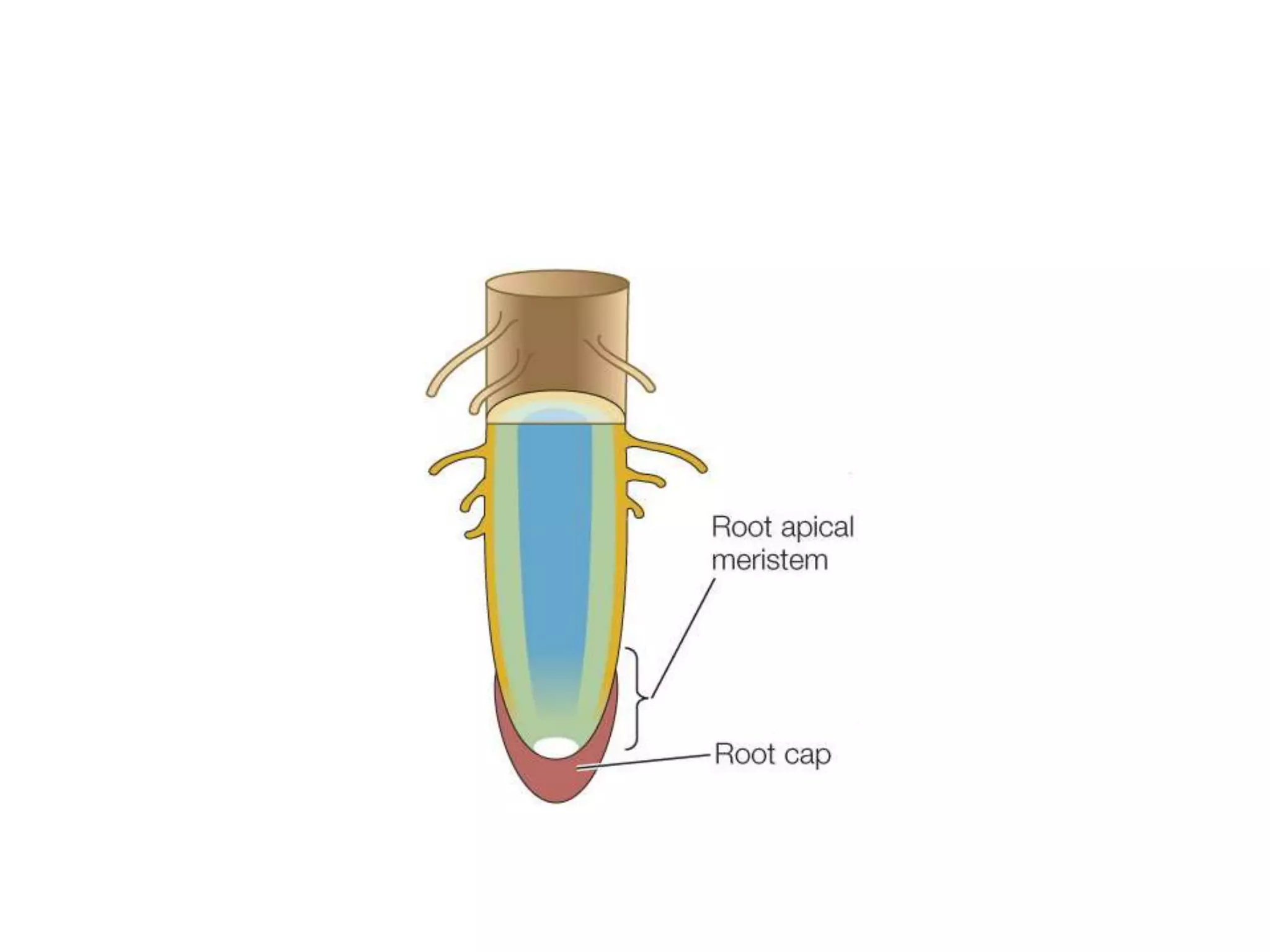
• 2- Root apical meristem (RAM):
Present on the apex of root . Which
provides the meristematic cells for
future root growth.
Root Apical Meristem
Structure of Shoot Apical Meristem:
• Shoot apical Meristem is protected by juvenile
leaf.
• It is dome shaped or conical in structure
• Big in size 1 cm.
• Outer part is called summit having very less
mitotic activity.
• Below the summit part is called flank
which has high metabolic activity so high
mitotic division.
• Periodic cyclic changes occur in flank
• Flank forms leaf primordia
• The distance between two leaf primordia
is called plastochron.
• When cells divide they are added towards
the base they will give rise the axillary
buds.
• Outside part is called protoderm
• Inside the protoderm, ground meristem
which will form cortex and pith tissues
• Procambium which will form vascular
tissues
• Because of the axillary buds alternate nodes
and internodes are developed, its branches will
be exogenous in origin
• High degree of differentiation is absent in
SAM.
• SAM goes high degree of changes during
reproduction.
• Theories of Meristem Organization and
Function:
• Many anatomists illustrated the root and shoot
apical meristems on the basis of number and
arrangement of cells , proposed the following
theories.
1-Apical Cell Theory:
• Apical cell theory is proposed by Hofmeister
(1852) and supported by Nageli (1859).
• A single apical cell is the structural and
functional unit.
• Hofmeister Nageli
• This apical cell governs the growth and
development of whole plant body.
• It is applicable in Algae, Bryophytes and in
some Pteridophytes.
2-Histogen Theory :
• Histogen theory was proposed by Hanstein (1868) and
supported by Strassburgur.
• The shoot apex comprises three distinct zones.
1.Dermatogen: It is an outermost layer. It gives rise to
epidermis.
2. Periblem: It is a middle layer. It gives rise to cortex.
3. Plerome: It is innermost layer. It gives rise to stele
•
Strassburgur
3- Tunica Corpus Theory :
• Tunica corpus theory was proposed by A.
Schmidt (1924).
• Two zones of tissues are found in apical meristem.
•a. The tunica: It is the peripheral zone of shoot
apex, that forms epidermis. Single layer of cells. It
forms dermatogen which give rise to epidermis of
stem and leaf.
•b. The corpus: It is the inner zone of shoot apex ,
that forms cortex and stele of shoot.
• Schmidt
• Root Apical Meristem:
• Root apex is present opposite to the shoot
apex. The roots contain root cap at their apices
and the apical meristem is present below the
root cap.
• Structure and Position of Root Apical
Meristem:
• Sub terminal in position
• Small size less than 1mm
• At the apex there is root cap
• Behind the root cap is apical root meristem
• The different theories proposed to explain root
apical meristem organization is given below.
1- Apical Cell Theory:
• Apical cell theory is proposed by Nageli.
• The single apical cell or apical initial composes
the root meristem.
• The apical initial is tetrahedral in shape and
produces root cap from one side. The remaining
three sides produce epidermis, cortex and vascular
tissues. It is found in vascular cryptogams.
2- Histogen Theory
Histogen theory is proposed by Hanstein (1868)
and supported by Strassburgur. The shoot apex
comprises three distinct zones.
•1. Dermatogen/ Calyptrogen: It is an outermost
layer. It gives rise to epidermis.
•2. Periblem: It is a middle layer. It gives rise to
cortex.
•3. Plerome: It is innermost layer. It gives rise to
stele
3- Korper Kappe Theory :
• Korper kappe theory was proposed by Schuepp
in 1917.
• It is similar to the tunica-corpus theory of the
shoot apex. It is based on differences in the planes
of cell division.
• There are two zones in root apex – Korper and
Kappe
•1. Korper zone forms the body.
•2. Kappe zone forms the cap.
4- Quiescent Centre Concept:
• Quiescent cell theory was given by Claws in
1961 in maize.
• These are the cells that are present in roots is a
region of apical meristem that does not
multiply or is divide very slowly but these
cells are able to restore division where it is
required or when the cells around them get
damaged. .
• These centre is located between root
cap and differentiating cells of the
roots.
• Quiescent centre is the site of
hormone synthesis and also the
ultimate source of all meristematic
cells of the meristem.
3-APICAL MERISTEM.pptx

3-APICAL MERISTEM.pptx

  • 1.
  • 2.
    Definition: The meristemat the tip of a stem or root that gives rise primary tissues and is responsible for increase in length rather than girth of the axis.
  • 3.
    Origin of ApicalMeristem: Seed has two parts • 1- Plumule • 2- Radicle • On germination • Plumule forms shoot, shoot forms a full shoot system ,shoot tip has shoot apical meristem which is terminal in position. • Radicle forms root which form a full system root tip has root apical meristem which is sub-terminal in position.
  • 4.
  • 6.
    Characteristics of ApicalMeristem • 1. They are composed of immature cells which are in a state of division and growth. • 2. Usually the intercellular spaces are not found among the cells.
  • 7.
    • 3. Thecells may be rounded, oval or polygonal in shape they are always living and thin walled. • 4. Each cell of meristematic tissue possesses abundant cytoplasm and one or more nuclei in it.
  • 8.
    • 5. Thevacuoles in the cells may be quite small or altogether absent.
  • 9.
    Types of ApicalMeristem: • There are two types of apical meristem • 1- Shoot apical meristem (SAM): Present on the apex of shoot . Which gives rise to organs like the leaves and flowers.
  • 11.
    • 2- Rootapical meristem (RAM): Present on the apex of root . Which provides the meristematic cells for future root growth.
  • 12.
  • 13.
    Structure of ShootApical Meristem: • Shoot apical Meristem is protected by juvenile leaf. • It is dome shaped or conical in structure • Big in size 1 cm. • Outer part is called summit having very less mitotic activity.
  • 14.
    • Below thesummit part is called flank which has high metabolic activity so high mitotic division. • Periodic cyclic changes occur in flank • Flank forms leaf primordia • The distance between two leaf primordia is called plastochron.
  • 15.
    • When cellsdivide they are added towards the base they will give rise the axillary buds. • Outside part is called protoderm • Inside the protoderm, ground meristem which will form cortex and pith tissues • Procambium which will form vascular tissues
  • 16.
    • Because ofthe axillary buds alternate nodes and internodes are developed, its branches will be exogenous in origin • High degree of differentiation is absent in SAM. • SAM goes high degree of changes during reproduction.
  • 18.
    • Theories ofMeristem Organization and Function: • Many anatomists illustrated the root and shoot apical meristems on the basis of number and arrangement of cells , proposed the following theories.
  • 19.
    1-Apical Cell Theory: •Apical cell theory is proposed by Hofmeister (1852) and supported by Nageli (1859). • A single apical cell is the structural and functional unit.
  • 20.
  • 22.
    • This apicalcell governs the growth and development of whole plant body. • It is applicable in Algae, Bryophytes and in some Pteridophytes.
  • 23.
    2-Histogen Theory : •Histogen theory was proposed by Hanstein (1868) and supported by Strassburgur. • The shoot apex comprises three distinct zones. 1.Dermatogen: It is an outermost layer. It gives rise to epidermis. 2. Periblem: It is a middle layer. It gives rise to cortex. 3. Plerome: It is innermost layer. It gives rise to stele
  • 24.
  • 27.
    3- Tunica CorpusTheory : • Tunica corpus theory was proposed by A. Schmidt (1924). • Two zones of tissues are found in apical meristem. •a. The tunica: It is the peripheral zone of shoot apex, that forms epidermis. Single layer of cells. It forms dermatogen which give rise to epidermis of stem and leaf. •b. The corpus: It is the inner zone of shoot apex , that forms cortex and stele of shoot.
  • 28.
  • 30.
    • Root ApicalMeristem: • Root apex is present opposite to the shoot apex. The roots contain root cap at their apices and the apical meristem is present below the root cap.
  • 31.
    • Structure andPosition of Root Apical Meristem: • Sub terminal in position • Small size less than 1mm • At the apex there is root cap • Behind the root cap is apical root meristem
  • 33.
    • The differenttheories proposed to explain root apical meristem organization is given below. 1- Apical Cell Theory: • Apical cell theory is proposed by Nageli. • The single apical cell or apical initial composes the root meristem. • The apical initial is tetrahedral in shape and produces root cap from one side. The remaining three sides produce epidermis, cortex and vascular tissues. It is found in vascular cryptogams.
  • 34.
    2- Histogen Theory Histogentheory is proposed by Hanstein (1868) and supported by Strassburgur. The shoot apex comprises three distinct zones. •1. Dermatogen/ Calyptrogen: It is an outermost layer. It gives rise to epidermis. •2. Periblem: It is a middle layer. It gives rise to cortex. •3. Plerome: It is innermost layer. It gives rise to stele
  • 36.
    3- Korper KappeTheory : • Korper kappe theory was proposed by Schuepp in 1917. • It is similar to the tunica-corpus theory of the shoot apex. It is based on differences in the planes of cell division. • There are two zones in root apex – Korper and Kappe •1. Korper zone forms the body. •2. Kappe zone forms the cap.
  • 39.
    4- Quiescent CentreConcept: • Quiescent cell theory was given by Claws in 1961 in maize. • These are the cells that are present in roots is a region of apical meristem that does not multiply or is divide very slowly but these cells are able to restore division where it is required or when the cells around them get damaged. .
  • 40.
    • These centreis located between root cap and differentiating cells of the roots. • Quiescent centre is the site of hormone synthesis and also the ultimate source of all meristematic cells of the meristem.