Root and tuber crops
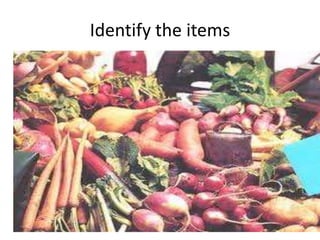
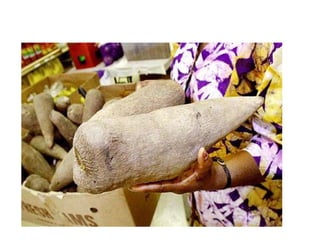
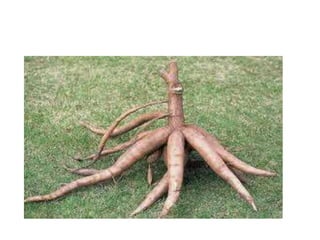
Identify the items
cocoyam
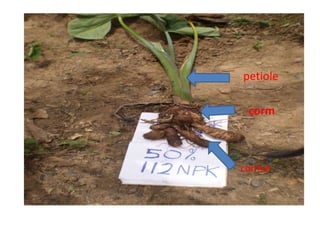
petiole
corm

cormel
• Cocoyams (Colocasia and Xanthosoma spp.)
are stem tubers that are widely cultivated in
both the tropical and subtropical regions of
the world.
• the two species mostly grown in West Africa
are Colocasia esculenta and Xanthosoma
sagittifolium
• Cocoyams can be processed into several
industrial inputs, food and feed products,
similar to products from potatoes in the
Western world.
• The processing of the crops include boiling,
roasting, frying in oil, pasting, milling and
conversion into ‘fufu’, soup thickeners, flour
for baking, chips, beverage powder, porridge,
and special food for gastro-intestinal disorders
uses
• Cocoyam leaves are used in many homes as a
leafy vegetable (pot herb) and can also be fed to
poultry as greens
• It is also reported to be one of the most
promising forages because of its re-growth
capacity, high yield and palatability.
• leaves could be fed to growing pigs, while the
petioles are considered to be more appropriate
for feeding to pregnant sows, which need lower
levels of protein in the diet and are able to
tolerate bulky feeds as well
uses
• The Neat Food Company, uses cocoyam to
make fufu flour
• Akwaba Food Company which exports
chopped cocoyam leaves and chips to Europe
Nutritinal value
• The young leaves and petioles which are
occasionally used for food contain about 23%
protein on a dry weight basis.
• They are also rich a source of
calcium, phosphorus, iron, Vitamin
C, thiamine, riboflavin and niacin, all of which
are important constituents of the human
Importance
• In Ghana the crop is grown on a small scale
and usually as an intercrop together with
cocoa, plantains, oil palm and cassava.

• Evidence exists that although cocoyam is
cultivated on a small scale, it has been able to
contribute significantly to the national food
baskets. They also serve as a source of income
for many families
adaptation
• Xanthosoma Sagittifolium is a tropical rain forest plant
and requires an annual rainfall of about 1800mm per
annum.
• It prefers a well drained soil with pH 5.5 – 6.5
(Owueme, 1991). Although in their natural habitat they
grow under the forest canopy
• they can be cultivated in areas with full exposure to
sunlight (Owueme, 1991).
•
• Most tuber crops including cocoyam grow and yield
well in soils that are ploughed to a depth of about 2040cm especially on clay soils.
Cultivation of the crop
• Planting materials
• The major planting material for cocoyam is the
main stem (corm), although cormels can also be
used.
• Selected corms are cut into pieces of about 100
to 200 grams with each piece having at least a
bud (Karikari,1971).
• For rapid field multiplication, fresh, healthy
cocoyam corms and cormels are cut into pieces of
about 5 to 10 grams (microsetts
•
• treated with (fungicide) and
• nursed in black polybags containing steam-sterilized
2:1 top soil: sand potting mixture
• Plantlets developed by the rapid field technique are
kept under shade for about three months before they
are planted out in their permanent fields.
• Planting materials raised from microsetts during the
dry season and planted at the onset of the rains yield
about twice more than plants grown from 100-200g
cut corms at the beginning of the rainy season (Osei,
2003).
Fertilizer application
• When cocoyams are grown in high moisture
regimes, fertilizers applied to them are
subjected to leaching and should therefore be
applied in split doses.
• The first application is done at planting whiles
the second application is done three or four
months after planting (Owueme and Sinha,
1991).
Fertilizer application
• Most farmers in tropical Africa cultivate
cocoyam without applying any chemical
fertilizers.
• They rely mostly on the native fertility of the
soil, which is very high when virgin forest is
used to establish cocoyam.
• They may sometimes place compost or
farmyard manure in the planting holes before
planting
HARVESTING AND STORAGE
• Cocoyam is ready for harvesting after 9-11 months
after planting. Maturity indicator for cocoyam is
yellowing of the leaves.
• For. X saggitifolium, multiple harvesting is done thus
only the cormels are removed at each harvest while
the corm is left to produce new generations of cormels,
which will be harvested latter.
• Harvesting is usually by hand or hand tools.
Alternatively the crop may be ploughed out after which
the corm and cormels are picked manually.
HARVESTING AND STORAGE
• Cocoyam can be stored for up to four months when kept
under 7oC at a relative humidity of 85% (Owueme and
Sinha, 1991).
• Storage under high temperatures increases
respiration, rotting and sprouting, shortening storage life of
cocoyams.
• Too low temperatures also cause corm decay (Owueme and
Sinha, 1991).
• Traditional storage methods include storage in underground
pits or on open platforms. Some farmers also leave the crop in
the field and harvest it as needed
processing
•
•
•
•
•

Cocoyam chips
Cocoyam flour
Fufu
Chopped leaves
dried petioles for silage
Cassava grater
Root and tuber crops.pptx vvu

Root and tuber crops.pptx vvu

  • 1.
  • 2.
  • 5.
  • 6.
  • 7.
    • Cocoyams (Colocasiaand Xanthosoma spp.) are stem tubers that are widely cultivated in both the tropical and subtropical regions of the world. • the two species mostly grown in West Africa are Colocasia esculenta and Xanthosoma sagittifolium
  • 8.
    • Cocoyams canbe processed into several industrial inputs, food and feed products, similar to products from potatoes in the Western world. • The processing of the crops include boiling, roasting, frying in oil, pasting, milling and conversion into ‘fufu’, soup thickeners, flour for baking, chips, beverage powder, porridge, and special food for gastro-intestinal disorders
  • 9.
    uses • Cocoyam leavesare used in many homes as a leafy vegetable (pot herb) and can also be fed to poultry as greens • It is also reported to be one of the most promising forages because of its re-growth capacity, high yield and palatability. • leaves could be fed to growing pigs, while the petioles are considered to be more appropriate for feeding to pregnant sows, which need lower levels of protein in the diet and are able to tolerate bulky feeds as well
  • 10.
    uses • The NeatFood Company, uses cocoyam to make fufu flour • Akwaba Food Company which exports chopped cocoyam leaves and chips to Europe
  • 11.
    Nutritinal value • Theyoung leaves and petioles which are occasionally used for food contain about 23% protein on a dry weight basis. • They are also rich a source of calcium, phosphorus, iron, Vitamin C, thiamine, riboflavin and niacin, all of which are important constituents of the human
  • 12.
    Importance • In Ghanathe crop is grown on a small scale and usually as an intercrop together with cocoa, plantains, oil palm and cassava. • Evidence exists that although cocoyam is cultivated on a small scale, it has been able to contribute significantly to the national food baskets. They also serve as a source of income for many families
  • 13.
    adaptation • Xanthosoma Sagittifoliumis a tropical rain forest plant and requires an annual rainfall of about 1800mm per annum. • It prefers a well drained soil with pH 5.5 – 6.5 (Owueme, 1991). Although in their natural habitat they grow under the forest canopy • they can be cultivated in areas with full exposure to sunlight (Owueme, 1991). • • Most tuber crops including cocoyam grow and yield well in soils that are ploughed to a depth of about 2040cm especially on clay soils.
  • 14.
    Cultivation of thecrop • Planting materials • The major planting material for cocoyam is the main stem (corm), although cormels can also be used. • Selected corms are cut into pieces of about 100 to 200 grams with each piece having at least a bud (Karikari,1971). • For rapid field multiplication, fresh, healthy cocoyam corms and cormels are cut into pieces of about 5 to 10 grams (microsetts •
  • 15.
    • treated with(fungicide) and • nursed in black polybags containing steam-sterilized 2:1 top soil: sand potting mixture • Plantlets developed by the rapid field technique are kept under shade for about three months before they are planted out in their permanent fields. • Planting materials raised from microsetts during the dry season and planted at the onset of the rains yield about twice more than plants grown from 100-200g cut corms at the beginning of the rainy season (Osei, 2003).
  • 16.
    Fertilizer application • Whencocoyams are grown in high moisture regimes, fertilizers applied to them are subjected to leaching and should therefore be applied in split doses. • The first application is done at planting whiles the second application is done three or four months after planting (Owueme and Sinha, 1991).
  • 17.
    Fertilizer application • Mostfarmers in tropical Africa cultivate cocoyam without applying any chemical fertilizers. • They rely mostly on the native fertility of the soil, which is very high when virgin forest is used to establish cocoyam. • They may sometimes place compost or farmyard manure in the planting holes before planting
  • 18.
    HARVESTING AND STORAGE •Cocoyam is ready for harvesting after 9-11 months after planting. Maturity indicator for cocoyam is yellowing of the leaves. • For. X saggitifolium, multiple harvesting is done thus only the cormels are removed at each harvest while the corm is left to produce new generations of cormels, which will be harvested latter. • Harvesting is usually by hand or hand tools. Alternatively the crop may be ploughed out after which the corm and cormels are picked manually.
  • 19.
    HARVESTING AND STORAGE •Cocoyam can be stored for up to four months when kept under 7oC at a relative humidity of 85% (Owueme and Sinha, 1991). • Storage under high temperatures increases respiration, rotting and sprouting, shortening storage life of cocoyams. • Too low temperatures also cause corm decay (Owueme and Sinha, 1991). • Traditional storage methods include storage in underground pits or on open platforms. Some farmers also leave the crop in the field and harvest it as needed
  • 20.
  • 21.