PRESENTED BY,
S. SHARVESH,
M.Sc. HORTICULTURE,
DEPARTMENT OF HORTICULTURE,
FACULTY OF AGRICULTUR,
ANNAMALAI UNIVERSITY.
What are Temperate Fruit Plants ?
• Temperate fruit plants are specific in the climatic
requirement.
• They can tolerate both diurnal and seasonal wide
fluctuation of temperature and are grown only in place
where winter is distinctly cold.
• They require exposure of specific chilling temperature for
certain period to break bud dormancy and initiate bud
break.
• These fruit plants are generally deciduous and suitable of
higher elevation as they can withstand frost.
• Examples: apple, pear, plum, apricot, almond, peach,
strawberry, walnut, pecan nut and cherry.
Horticultural classification of temperate fruits
•Classification is a system of placing an individual or a
number in various groups, or to categorizes them
according to a particular plan or sequence which is in
conformity with the nomenclature
Classification helps :
• To identify and name them
• To find some idea of the closeness of their
relationship
• To suggest with what other kind they possibly may or
may not be interbred or crossed
• To suggest the kind with which they possibly may or
may not be intergrafted
• To suggest soil and cultural requirements and
climatic adaptations.
1.Classification on the basis of plant stature:
1.Temperate tree fruits: Fruits borne on the
trees growing in the temperate climates such as
apple, pear, stone fruits etc.
2.Temperate small fruits: Fruits generally borne
on the vines, brambles or herbaceous plants
grown under temperate climate like strawberry,
craneberry, blackberry, blueberry etc.
3.Temperate nuts: Nuts are characterized by
the hard shell outside, separating the kernel and
husk of the fruit. Pecan nut, hazel nut and walnut
are good examples of temperate fruit plants
producing nuts.
2. Classification based on fruit
morphology
Depending on number of ovaries involved in fruit
formation, fruits are classified into three groups.
(i) Simple fruits
(ii) Aggregate fruits
(iii) Multiple (composite) fruits
Simple fruits:
Simple fruits are derived from a single ovary of
one flower. Developed from single flower with or
without accessary organ
Simple fruits are further classified as fleshy and dry fruits.
Simple Fruits
1. Dehiscent (No fruit crop)
2. Indehiscent e.g. Nut
3. Schizocarpic e.g. lomentum (Temarind)
4. Fleshy
A. Fleshy fruits
1. Pome 3. Berry/Becca 5. Balausta
2. Drupe 4. Hesperidium 6.Amphisaria
B. Dry fruit (Indehiscent)
1. Nut
A.Fleshy fruits
• These are the fruits whose
pericarp (ovary wall) becomes
fleshy or succulent at maturity.
• The temperate fleshy fruits may
be either pome or drupe.
1. Pome
• The pome is an inferior, two or more
celled fleshy, syncarpous fruit
surrounded by the thalamus.
• The fruit is referred as false fruit as
the edible fleshy part is not derived
from the ovarian tissues but from
external ovarian tissue thalamus.
• Examples of temperate pome fruits
are apple, pear and quince
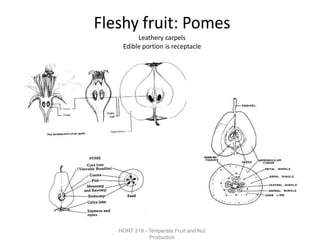
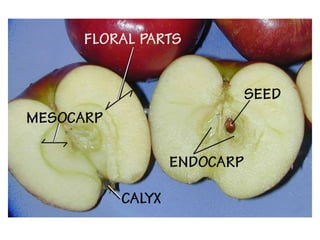
Fleshy fruit: Pomes
Leathery carpels
Edible portion is receptacle
HORT 319 - Temperate Fruit and Nut
Production
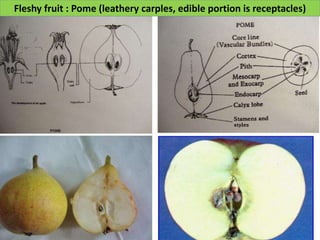
Fleshy fruit : Pome (leathery carples, edible portion is receptacles)
b. Drupe (stone)
• This type of fruit derived from a single carpel,
• However, the olive is an exception in that the
flower has two carples and four ovules but
one carpel develop.
• Two ovules are borne in most of drupes but
one seed develops.
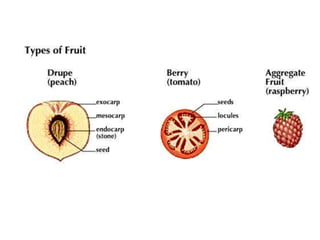
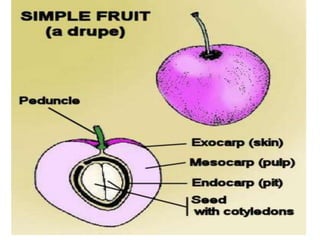
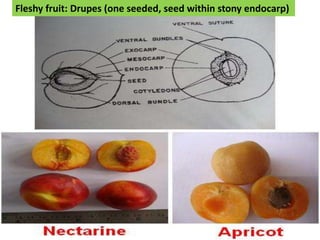
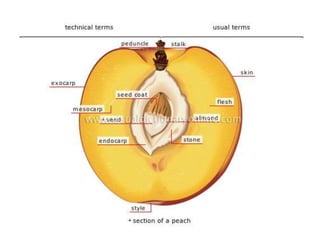
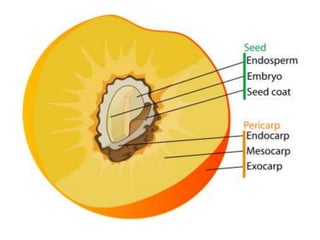
• In this type of fruit, the pericarp is
differentiated into three distinct layers; thin
exocarp or peel of the fruits.
• The mesocarp which is fleshy and hard and
stony endocarp, enclosing seed.
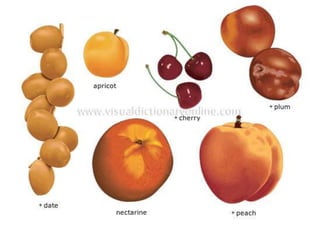
•Examples of temperate drupe fruits
are cherry, peach, plum and apricot.
•In almond at maturity exocarp and
mesocarp get separated as leathery in
volucre and are removed before
marketing, only endocarp containing
the edible seed is used hence it is nut.
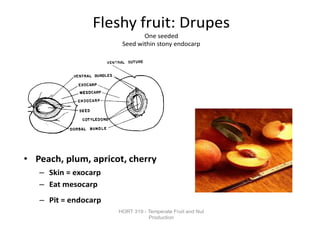
Fleshy fruit: Drupes
One seeded
Seed within stony endocarp
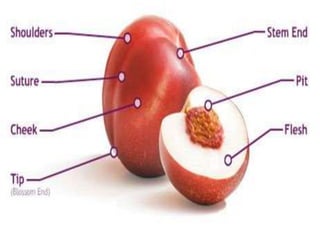
• Peach, plum, apricot, cherry
– Skin = exocarp
– Eat mesocarp
– Pit = endocarp
HORT 319 - Temperate Fruit and Nut
Production
Fleshy fruit: Drupes (one seeded, seed within stony endocarp)
B.Dry fruits:
• This type of fruit has been classified on
the basis of pericarp (ovary wall) at
maturity.
• The entire pericarp becomes dry and
often brittle or hard at maturity.
• They are dehiscent ( in which the seeds
are dispersed from fruit at maturity) and
indehiscent (not split open when ripe)
• Nuts are typical example of indehiscent
dry fruits
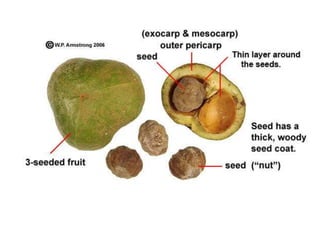
1. Nut
• A fruit in which carpel wall is hard or bony in texture.
• Fruit is derived from an hypogynous flower ( filbert)
or an epigynous one ( walnut) and is enclosed in dry
involucres (husk).
• It is only one seeded, but in most cases in derived
from two carpels.
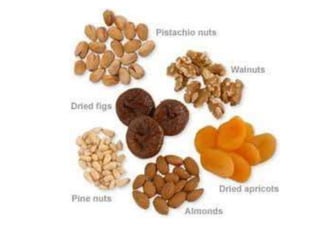
• Examples are walnut, almond, chestnut, hazelnut and
pecan nut.
• Dry fruits are not juicy or succulent when mature and
ripe.
• When dry, they may split open and discharge their
seeds (called dehiscent fruits) or retain their seeds
(called indehiscent fruits).
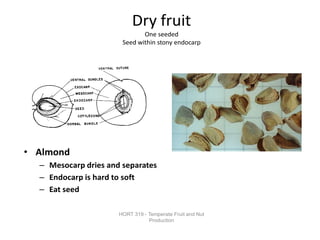
Dry fruit
One seeded
Seed within stony endocarp
• Almond
– Mesocarp dries and separates
– Endocarp is hard to soft
– Eat seed
HORT 319 - Temperate Fruit and Nut
Production
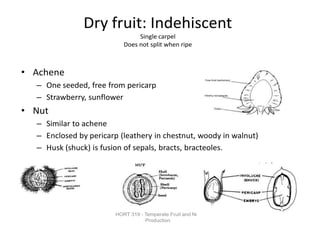
Dry fruit: Indehiscent
Single carpel
Does not split when ripe
• Achene
– One seeded, free from pericarp
– Strawberry, sunflower
• Nut
– Similar to achene
– Enclosed by pericarp (leathery in chestnut, woody in walnut)
– Husk (shuck) is fusion of sepals, bracts, bracteoles.
HORT 319 - Temperate Fruit and Nut
Production
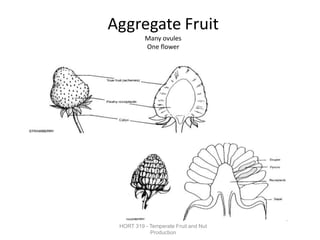
ii. Aggregate fruits
• Aggregate fruits develop from numerous
ovaries of the same flower.
• Fruit developed from apocarpus pistil
• It is aggregation simple fruits born by single
flower
• Individual ovary may be drupe or berry.
e.g. etario of achense (strawberry)
etario of berry (C’apple),
etario of drupes (raspberry, black berry,
longan berry etc.)
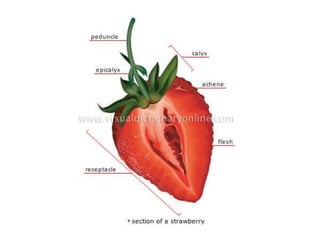
Achene
• A one seeded fruit in which
the seed is attached to ovary
wall at one point.
• Example is strawberry.
Aggregate Fruit
Many ovules
One flower
HORT 319 - Temperate Fruit and Nut
Production
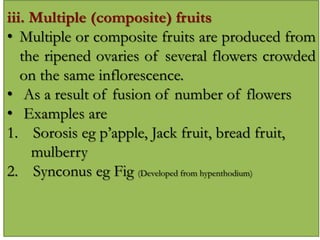
iii. Multiple (composite) fruits
• Multiple or composite fruits are produced from
the ripened ovaries of several flowers crowded
on the same inflorescence.
• As a result of fusion of number of flowers
• Examples are
1. Sorosis eg p’apple, Jack fruit, bread fruit,
mulberry
2. Synconus eg Fig (Developed from hypenthodium)
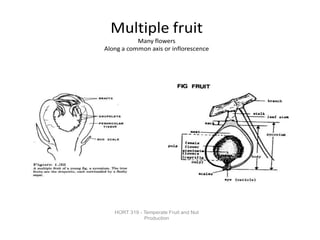
Multiple fruit
Many flowers
Along a common axis or inflorescence
HORT 319 - Temperate Fruit and Nut
Production
3.Classification based on bearing habit
• The flower bud is either terminal or lateral.
• Based upon the location of fruit buds and type
of flower bearing structure to which they give
rise, the temperate fruits are classified as
under.
1.Terminal bearer:
• Flower buds mixed, flowering shoot with
terminal inflorescences.
• Examples are apple, pear, walnut (pistillate
flowers) and pecan (pistillate flowers)
2. Lateral bearer:
(a) Flower bud containing flower parts only
e.g.peach, apricot, plum, cherry, almond,
walnut (staminate catkin) and pecan
(staminate catkin)
(b) Flower buds mixed, flowering shoot with
terminal inflorescences e.g blackberry,
raspberry, blueberry, apple and
pear(occasionally)
(c ) Flower buds mixed, flowering shoot with
lateral inflorescences e.g. persimmon,
chestnut, pistachio nut, craneberry.
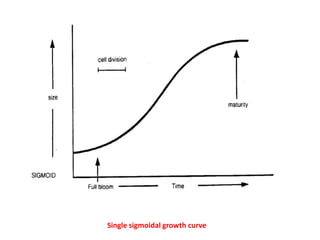
4. Based on Fruit Growth Pattern:
Sigmoid pattern:
• The combined growth of fruit results from
cell division, cell enlargement and air
space formation results in sigmoidal ( S-
shaped) curve when fruit weight is plotted
as function of time.
• Examples are apple, walnut, pecan,
strawberry and pear
Single sigmoidal growth curve
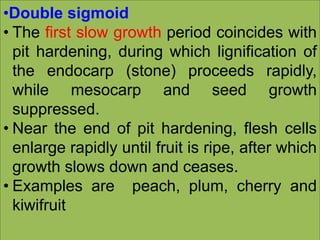
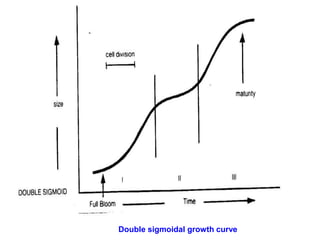
•Double sigmoid
• The first slow growth period coincides with
pit hardening, during which lignification of
the endocarp (stone) proceeds rapidly,
while mesocarp and seed growth
suppressed.
• Near the end of pit hardening, flesh cells
enlarge rapidly until fruit is ripe, after which
growth slows down and ceases.
• Examples are peach, plum, cherry and
kiwifruit
Double sigmoidal growth curve
Classification of temperature fruits

Classification of temperature fruits

  • 1.
    PRESENTED BY, S. SHARVESH, M.Sc.HORTICULTURE, DEPARTMENT OF HORTICULTURE, FACULTY OF AGRICULTUR, ANNAMALAI UNIVERSITY.
  • 2.
    What are TemperateFruit Plants ? • Temperate fruit plants are specific in the climatic requirement. • They can tolerate both diurnal and seasonal wide fluctuation of temperature and are grown only in place where winter is distinctly cold. • They require exposure of specific chilling temperature for certain period to break bud dormancy and initiate bud break. • These fruit plants are generally deciduous and suitable of higher elevation as they can withstand frost. • Examples: apple, pear, plum, apricot, almond, peach, strawberry, walnut, pecan nut and cherry.
  • 3.
    Horticultural classification oftemperate fruits •Classification is a system of placing an individual or a number in various groups, or to categorizes them according to a particular plan or sequence which is in conformity with the nomenclature Classification helps : • To identify and name them • To find some idea of the closeness of their relationship • To suggest with what other kind they possibly may or may not be interbred or crossed • To suggest the kind with which they possibly may or may not be intergrafted • To suggest soil and cultural requirements and climatic adaptations.
  • 4.
    1.Classification on thebasis of plant stature: 1.Temperate tree fruits: Fruits borne on the trees growing in the temperate climates such as apple, pear, stone fruits etc. 2.Temperate small fruits: Fruits generally borne on the vines, brambles or herbaceous plants grown under temperate climate like strawberry, craneberry, blackberry, blueberry etc. 3.Temperate nuts: Nuts are characterized by the hard shell outside, separating the kernel and husk of the fruit. Pecan nut, hazel nut and walnut are good examples of temperate fruit plants producing nuts.
  • 5.
    2. Classification basedon fruit morphology Depending on number of ovaries involved in fruit formation, fruits are classified into three groups. (i) Simple fruits (ii) Aggregate fruits (iii) Multiple (composite) fruits Simple fruits: Simple fruits are derived from a single ovary of one flower. Developed from single flower with or without accessary organ
  • 6.
    Simple fruits arefurther classified as fleshy and dry fruits. Simple Fruits 1. Dehiscent (No fruit crop) 2. Indehiscent e.g. Nut 3. Schizocarpic e.g. lomentum (Temarind) 4. Fleshy A. Fleshy fruits 1. Pome 3. Berry/Becca 5. Balausta 2. Drupe 4. Hesperidium 6.Amphisaria B. Dry fruit (Indehiscent) 1. Nut
  • 9.
    A.Fleshy fruits • Theseare the fruits whose pericarp (ovary wall) becomes fleshy or succulent at maturity. • The temperate fleshy fruits may be either pome or drupe.
  • 10.
    1. Pome • Thepome is an inferior, two or more celled fleshy, syncarpous fruit surrounded by the thalamus. • The fruit is referred as false fruit as the edible fleshy part is not derived from the ovarian tissues but from external ovarian tissue thalamus. • Examples of temperate pome fruits are apple, pear and quince
  • 11.
    Fleshy fruit: Pomes Leatherycarpels Edible portion is receptacle HORT 319 - Temperate Fruit and Nut Production
  • 12.
    Fleshy fruit :Pome (leathery carples, edible portion is receptacles)
  • 14.
    b. Drupe (stone) •This type of fruit derived from a single carpel, • However, the olive is an exception in that the flower has two carples and four ovules but one carpel develop. • Two ovules are borne in most of drupes but one seed develops. • In this type of fruit, the pericarp is differentiated into three distinct layers; thin exocarp or peel of the fruits. • The mesocarp which is fleshy and hard and stony endocarp, enclosing seed.
  • 15.
    •Examples of temperatedrupe fruits are cherry, peach, plum and apricot. •In almond at maturity exocarp and mesocarp get separated as leathery in volucre and are removed before marketing, only endocarp containing the edible seed is used hence it is nut.
  • 16.
    Fleshy fruit: Drupes Oneseeded Seed within stony endocarp • Peach, plum, apricot, cherry – Skin = exocarp – Eat mesocarp – Pit = endocarp HORT 319 - Temperate Fruit and Nut Production
  • 17.
    Fleshy fruit: Drupes(one seeded, seed within stony endocarp)
  • 26.
    B.Dry fruits: • Thistype of fruit has been classified on the basis of pericarp (ovary wall) at maturity. • The entire pericarp becomes dry and often brittle or hard at maturity. • They are dehiscent ( in which the seeds are dispersed from fruit at maturity) and indehiscent (not split open when ripe) • Nuts are typical example of indehiscent dry fruits
  • 27.
    1. Nut • Afruit in which carpel wall is hard or bony in texture. • Fruit is derived from an hypogynous flower ( filbert) or an epigynous one ( walnut) and is enclosed in dry involucres (husk). • It is only one seeded, but in most cases in derived from two carpels. • Examples are walnut, almond, chestnut, hazelnut and pecan nut. • Dry fruits are not juicy or succulent when mature and ripe. • When dry, they may split open and discharge their seeds (called dehiscent fruits) or retain their seeds (called indehiscent fruits).
  • 28.
    Dry fruit One seeded Seedwithin stony endocarp • Almond – Mesocarp dries and separates – Endocarp is hard to soft – Eat seed HORT 319 - Temperate Fruit and Nut Production
  • 29.
    Dry fruit: Indehiscent Singlecarpel Does not split when ripe • Achene – One seeded, free from pericarp – Strawberry, sunflower • Nut – Similar to achene – Enclosed by pericarp (leathery in chestnut, woody in walnut) – Husk (shuck) is fusion of sepals, bracts, bracteoles. HORT 319 - Temperate Fruit and Nut Production
  • 33.
    ii. Aggregate fruits •Aggregate fruits develop from numerous ovaries of the same flower. • Fruit developed from apocarpus pistil • It is aggregation simple fruits born by single flower • Individual ovary may be drupe or berry. e.g. etario of achense (strawberry) etario of berry (C’apple), etario of drupes (raspberry, black berry, longan berry etc.)
  • 34.
    Achene • A oneseeded fruit in which the seed is attached to ovary wall at one point. • Example is strawberry.
  • 35.
    Aggregate Fruit Many ovules Oneflower HORT 319 - Temperate Fruit and Nut Production
  • 37.
    iii. Multiple (composite)fruits • Multiple or composite fruits are produced from the ripened ovaries of several flowers crowded on the same inflorescence. • As a result of fusion of number of flowers • Examples are 1. Sorosis eg p’apple, Jack fruit, bread fruit, mulberry 2. Synconus eg Fig (Developed from hypenthodium)
  • 38.
    Multiple fruit Many flowers Alonga common axis or inflorescence HORT 319 - Temperate Fruit and Nut Production
  • 39.
    3.Classification based onbearing habit • The flower bud is either terminal or lateral. • Based upon the location of fruit buds and type of flower bearing structure to which they give rise, the temperate fruits are classified as under. 1.Terminal bearer: • Flower buds mixed, flowering shoot with terminal inflorescences. • Examples are apple, pear, walnut (pistillate flowers) and pecan (pistillate flowers)
  • 40.
    2. Lateral bearer: (a)Flower bud containing flower parts only e.g.peach, apricot, plum, cherry, almond, walnut (staminate catkin) and pecan (staminate catkin) (b) Flower buds mixed, flowering shoot with terminal inflorescences e.g blackberry, raspberry, blueberry, apple and pear(occasionally) (c ) Flower buds mixed, flowering shoot with lateral inflorescences e.g. persimmon, chestnut, pistachio nut, craneberry.
  • 41.
    4. Based onFruit Growth Pattern: Sigmoid pattern: • The combined growth of fruit results from cell division, cell enlargement and air space formation results in sigmoidal ( S- shaped) curve when fruit weight is plotted as function of time. • Examples are apple, walnut, pecan, strawberry and pear
  • 42.
  • 43.
    •Double sigmoid • Thefirst slow growth period coincides with pit hardening, during which lignification of the endocarp (stone) proceeds rapidly, while mesocarp and seed growth suppressed. • Near the end of pit hardening, flesh cells enlarge rapidly until fruit is ripe, after which growth slows down and ceases. • Examples are peach, plum, cherry and kiwifruit
  • 44.