VALLEY VIEW UNIVERSITY-TECHIMAN CAMPUS

RESEARCH PROPOSAL ON:

COST BENEFIT ANALYSIS OF SWEET PEPPER
PRODUCTION UNDER DIFFERENT FERTILIZER
REGIME
“A CASE STUDY AT VVU TECHIMAN CAMPUS”

BY

OPOKU ERIC DAVID
(AGRIBUSINESS DEPARTMENT)
OUTLINE OF PRESENTATION
INTRODUCTION
BACKGROUND AND JUSTIIFICATION
LITERATURE REVIEW
PROBLEM STATEMENT
AIMS AND OBJECTIVES
METHODOLOGY
EXPECTED OUTCOME
CONCLUSION

INTRODUCTION
Sweet pepper (solanum annum) as a crop is a warm season crop which belongs to the Solanaceae
family. Peppers are a member of the solanaceae which include potato (solanum tuberosum),
eggplant (solanum melongena) and cherry (solanum pseudocapsicum)
Sweet peppers are sensitive to light frost and grow poorly when temperatures are in the 40-60F
range .Extreme summer heat prevents fruit set in most sweet peppers. A well-drained, sandy
loam soil is ideal for pepper production. Peppers may be "hot'' or "sweet''. The fruit size varies
from 1 to 30 cm in length, from thin to thick fleshed, conical to blocky or flattened, both yellow
and green, at an immature stage, and with, red, yellow and brown mature fruits. This plant is a
perennial in warm climates but grows as an annual in northern climates.

BACKGROUND AND JUSTIFICATION
Efutu municipal is known to be one of the leading producers of sweet pepper with higher yields
in Ghana. Sweet pepper has a high demand in Ghana and the western part of the world.
Local production is unable to meet demand since most of the produce does not do well on poor
soils as a result of poor soil amendment and poor soil fertility in the production area. A chemical
fertilizer is defined as any inorganic material of wholly or partially synthetic origin that is added
to the soil to sustain plant growth. Organic fertilizers are substances that are derived from the
remains or by products of organisms which contain the essential nutrients for plant growth.
The main objective of the study is to improve upon the production of sweet pepper in Ghana by
employing the right amendments (inorganic and organic fertilizer regimes) to improve upon the
soil organic matter and fertility to increase production.

LITERATURE REWIEW
Sweet pepper is one of the most varied and widely used foods in the world. It was originated in
the Mexico and Central America regions and Christopher Columbus encountered it in 1493.
Its fruit are harvested and consumed at different maturity stages; green, red and not fully ripe.
Fruit weight was ranged from 128-210 gm depending upon cultivars. Number of fruit and yield
was significantly higher under integrated nutrient (INM) compared with organic nutrient supply.
The yield reduction in the latter was 22.1% in 2005 and 21.7% in 2006 compared with the INM.
Addition of manure increased sweet pepper plant size, number of flowers and number of
marketable fruits compared to the unamend soil. Amending soils with composted materials has
been reported to increase sweet pepper yields .However, combining compost and inorganic
fertilizer has generally been more effective in producing a positive plant response than separate
application of either material alone.
Sweet pepper have straight, woody stem and single, star-shaped, white flowers in the axils of the
leaves. The flowers are followed by juiceless berries or pods, which vary in shape and size.When
ripe, the fruit is red, yellow or brown but immature fruit of the large mild types are often picked
while still green for use in salads. These generally species generally bear large fruit
Compared to green peppers, red peppers have more vitamins and nutrients and contain the
antioxidant lycopene. The level of carotene, like lycopene, is nine times higher in red peppers.
Red peppers have twice the vitamin C content of green peppers. Also, one large red bell pepper
contains 209 mg of vitamin C, which is three times the 70 mg of an average orange.
Store sweet peppers at 7 to 12 °C and 90 to 95% relative humidity. Sweet or bell peppers are
subject to cold damage at temperatures below 7 °C, and temperatures above 12 °C encourage
ripening and spread of bacterial soft rot. Bell peppers should not be stored longer than 2 to 3
weeks even under the most favorable conditions. At 0 to 2 °C peppers usually develop pitting in
a few days.
REASONS WHY THE SWEET PEPPER PRODUCTION SHOULD BE ENCOURAGED:
•

It is very low in calories and fats

•

It is found to reduce triglycerides and LDL cholesterol levels in obese individuals

•

It is a rich source of vitamin C and the vitamin helps the human body against scurvy,
develop resistance against infectious agents and harmful scavenge

NUTRITIVE VALUE OF SWEETPEPPER
•

It is a rich source of vitamin A and B-complex group of vitamins such as niacin,
pyridoxine (vitamin B-6), riboflavin and thiamin (vitamin B-1) which facilitates cellular
metabolism through various enzymatic functions.

•

Sweet pepper has adequate levels of essential minerals and the minerals are iron, copper,
zinc, magnesium, manganese, potassium and selenium which essential for the
development and the growth of the human body.

EFFECTS OF INORGANIC FERTILIZER ON SWEET PEPPERR PRODUCTION
Application of NPK fertilizer has been reported to increase vegetative growth, yield and quality
attributes Height and leaf number increase have been reported with the application of nitrogen
fertilizer (Akanbi and Adeniran, 2010)

EFFECTS OF ORGANIC FERTILIZER ON SWEET PEPPER PRODUCTION
The use of organic manure has been reported to enhance soil productivity, increase the soil
organic carbon content, soil micro-organism, improves soil structure, the nutrient status of the
soil and enhance crop yield). Aliyu (2000) reported increase in seed and fruit yield in sweet
pepper as a result of poultry manure application

EFFECTS OF ORGANIC AND INORGANIC FERTILIZER ON SWEET PEPPER
PRODUCTION
The mixture of poultry manure and NPK on sweet pepper production results on increased in the
number of leaves, height and fruit. Yield of sweet pepper is best attained when there is a mixture
of organic (poultry manure) and inorganic (NPK) since it improves the fertility of the soil as well
as the growth and the quality of the sweet pepper.

PROBLEM STATEMENT
Sweet pepper has the ability that can significantly contribute to the alleviation of food security in
Ghana and West Africa as a whole.
The problem statement is to access the cost benefit analysis of sweet pepper under various
fertilizer regimes.

AIMS AND OBJECTIVES
AIMS AND OBJECTIVES
The main aim is to evaluate the performance of the various fertilizer regimes on sweet pepper
production
SPECIFIC OBJECTIVES
To improve upon the soil conditions of sweet pepper production
To increase sweet pepper production using the right fertilizer regime
To access the cost and benefit on the right fertilizer regime on sweet pepper production.

METHODOLOGY

MATERIALS AND METHOD
MATERIALS NEEDED.
For successful production of sweet pepper, the following materials will be obtained.
 Land for production







Sweet pepper seeds namely (Yolo Wonder) and (California Wonder)
Inorganic fertilizer
Organic fertilizer
Irrigation system
Weedicides and pesticides
Knapsack sprayer

TREATMENTS
The four treatments are as follows;





T1 – no fertilizer
T2 – chemical fertilizer
T3 – organic fertilizer
T4 –mixture of the chemical and organic fertilizer

The two varieties to be used are as follows;
 V1 – Yolo Wonder
 V2 – California Wonder
Two varieties (Yolo Wonder and California Wonder) will be used with 4 treatments and 4
replications under the Randomized Complete Block Design. The treatments will be V1T1, V1T2,
V1T3, V1T4, V2T1, V2T2, V2T3, and V2T4 because of the two varieties.










V1T1 – Yolo wonder with no fertilizer
V1T2 – Yolo wonder with chemical fertilizer
V1T3 – Yolo wonder with organic fertilizer
V1T4 – Yolo wonder with mixture of the chemical and organic fertilizer
V2T1 – California wonder with no fertilizer
V2T2 – California wonder with chemical fertilizer
V2T3 – California wonder with organic fertilizer
V2T4 – California wonder with mixture of the chemical and organic fertilizer

NURSERY
The seeds will be nursed until they are ready for transplanting on the soil when soil conditions
are favorable for easy establishment of the seedlings
SOIL PREPARATION
Fields should be prepared thoroughly by plowing and harrowing and removing the different
types of plant debris. It should also be pulverized and leveled; furrows are made 2 m apart
whether meant for fertilizer application or not.

WEEDING
The purpose of the weeding is to control weeds that compete with the crops and prevent the
spread of diseases and pests. After 2 weeks, the first weeding is done and the second weeding is
done from 3 weeks going.

FERTILIZATION
The two forms that will be employed to amend the sweet pepper production are the organic and
the inorganic fertilizers.
 THE ORGANIC FERTILIZER
Poultry droppings will be used to amend the sweet pepper. The purpose of the application
is to improve the physical properties of the soil and its chemical properties to enhance
growth.
 THE INORGANIC FERTILIZER
NPK 15-15-15 or 23-1-5 will be used to fertilize the sweet pepper

IRRIGATION
The sweet pepper will be watered on 2 times daily (morning and evening).Water holes or
watering can will be used as a means of irrigation to the sweet pepper.

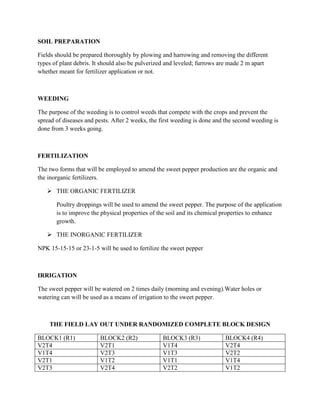
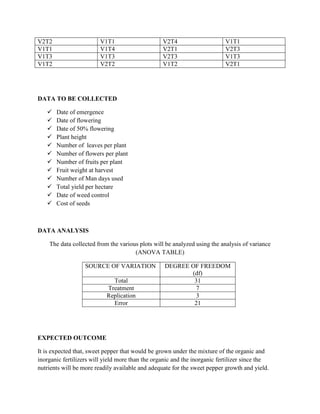
THE FIELD LAY OUT UNDER RANDOMIZED COMPLETE BLOCK DESIGN
BLOCK1 (R1)
V2T4
V1T4
V2T1
V2T3

BLOCK2 (R2)
V2T1
V2T3
V1T2
V2T4

BLOCK3 (R3)
V1T4
V1T3
V1T1
V2T2

BLOCK4 (R4)
V2T4
V2T2
V1T4
V1T2
V2T2
V1T1
V1T3
V1T2

V1T1
V1T4
V1T3
V2T2

V2T4
V2T1
V2T3
V1T2

V1T1
V2T3
V1T3
V2T1

DATA TO BE COLLECTED













Date of emergence
Date of flowering
Date of 50% flowering
Plant height
Number of leaves per plant
Number of flowers per plant
Number of fruits per plant
Fruit weight at harvest
Number of Man days used
Total yield per hectare
Date of weed control
Cost of seeds

DATA ANALYSIS
The data collected from the various plots will be analyzed using the analysis of variance
(ANOVA TABLE)
SOURCE OF VARIATION
Total
Treatment
Replication
Error

DEGREE OF FREEDOM
(df)
31
7
3
21

EXPECTED OUTCOME
It is expected that, sweet pepper that would be grown under the mixture of the organic and
inorganic fertilizers will yield more than the organic and the inorganic fertilizer since the
nutrients will be more readily available and adequate for the sweet pepper growth and yield.
CONCLUSION
The expected result from the project is foreseen to help improve the production of sweet pepper
in Ghana.

REFERENCES
http://www.doa.agric.za/docs/Brochures/sweetpepper.pdf
HATUTALE, G 2010, ‘The Effect of Plant Population and Mulching on Green Pepper
(Capsicum annuum L.) Production under Irrigation’, M.Sc. dissertation, University of the Free
State, accessed 13 January 2013 from etd.uovs.ac.za/ETDdb/theses/available/etd.../HatutaleG.pdf
(Jadczak, D., M. Grzeszuczuk and D. Kosecka, 2010.
Quality Characteristics and Content of Mineral Compounds in Fruit of Some Cultivars of Sweet
Pepper (capsicum annum L.). The Elemental Journal, 15(3): 509-515)
Vegetable Production Handbook. 1994. Cornell Cooperative Extension, Cornell University.
www.wayneword.palomar.edu/ecoph21.htm
www.nutrition-and-you.com/bell-pepper
http://pods.dasnr.okstate.edu/docushare/dsweb/Get/Document-1041/F-6030web.pdf
http://www.caes.uga.edu/applications/publications/files/pdf/B%201309_2.PDF
http://en.wikipedia.org/wiki/Fertilizer#Organic_fertilizers
http://pods.dasnr.okstate.edu/docushare/dsweb/Get/Document-1041/F-6030web.pdf

Opoku eric david sweet pepper

  • 1.
    VALLEY VIEW UNIVERSITY-TECHIMANCAMPUS RESEARCH PROPOSAL ON: COST BENEFIT ANALYSIS OF SWEET PEPPER PRODUCTION UNDER DIFFERENT FERTILIZER REGIME “A CASE STUDY AT VVU TECHIMAN CAMPUS” BY OPOKU ERIC DAVID (AGRIBUSINESS DEPARTMENT)
  • 2.
    OUTLINE OF PRESENTATION INTRODUCTION BACKGROUNDAND JUSTIIFICATION LITERATURE REVIEW PROBLEM STATEMENT AIMS AND OBJECTIVES METHODOLOGY EXPECTED OUTCOME CONCLUSION INTRODUCTION Sweet pepper (solanum annum) as a crop is a warm season crop which belongs to the Solanaceae family. Peppers are a member of the solanaceae which include potato (solanum tuberosum), eggplant (solanum melongena) and cherry (solanum pseudocapsicum) Sweet peppers are sensitive to light frost and grow poorly when temperatures are in the 40-60F range .Extreme summer heat prevents fruit set in most sweet peppers. A well-drained, sandy loam soil is ideal for pepper production. Peppers may be "hot'' or "sweet''. The fruit size varies from 1 to 30 cm in length, from thin to thick fleshed, conical to blocky or flattened, both yellow and green, at an immature stage, and with, red, yellow and brown mature fruits. This plant is a perennial in warm climates but grows as an annual in northern climates. BACKGROUND AND JUSTIFICATION Efutu municipal is known to be one of the leading producers of sweet pepper with higher yields in Ghana. Sweet pepper has a high demand in Ghana and the western part of the world. Local production is unable to meet demand since most of the produce does not do well on poor soils as a result of poor soil amendment and poor soil fertility in the production area. A chemical fertilizer is defined as any inorganic material of wholly or partially synthetic origin that is added
  • 3.
    to the soilto sustain plant growth. Organic fertilizers are substances that are derived from the remains or by products of organisms which contain the essential nutrients for plant growth. The main objective of the study is to improve upon the production of sweet pepper in Ghana by employing the right amendments (inorganic and organic fertilizer regimes) to improve upon the soil organic matter and fertility to increase production. LITERATURE REWIEW Sweet pepper is one of the most varied and widely used foods in the world. It was originated in the Mexico and Central America regions and Christopher Columbus encountered it in 1493. Its fruit are harvested and consumed at different maturity stages; green, red and not fully ripe. Fruit weight was ranged from 128-210 gm depending upon cultivars. Number of fruit and yield was significantly higher under integrated nutrient (INM) compared with organic nutrient supply. The yield reduction in the latter was 22.1% in 2005 and 21.7% in 2006 compared with the INM. Addition of manure increased sweet pepper plant size, number of flowers and number of marketable fruits compared to the unamend soil. Amending soils with composted materials has been reported to increase sweet pepper yields .However, combining compost and inorganic fertilizer has generally been more effective in producing a positive plant response than separate application of either material alone. Sweet pepper have straight, woody stem and single, star-shaped, white flowers in the axils of the leaves. The flowers are followed by juiceless berries or pods, which vary in shape and size.When ripe, the fruit is red, yellow or brown but immature fruit of the large mild types are often picked while still green for use in salads. These generally species generally bear large fruit Compared to green peppers, red peppers have more vitamins and nutrients and contain the antioxidant lycopene. The level of carotene, like lycopene, is nine times higher in red peppers. Red peppers have twice the vitamin C content of green peppers. Also, one large red bell pepper contains 209 mg of vitamin C, which is three times the 70 mg of an average orange. Store sweet peppers at 7 to 12 °C and 90 to 95% relative humidity. Sweet or bell peppers are subject to cold damage at temperatures below 7 °C, and temperatures above 12 °C encourage ripening and spread of bacterial soft rot. Bell peppers should not be stored longer than 2 to 3 weeks even under the most favorable conditions. At 0 to 2 °C peppers usually develop pitting in a few days.
  • 4.
    REASONS WHY THESWEET PEPPER PRODUCTION SHOULD BE ENCOURAGED: • It is very low in calories and fats • It is found to reduce triglycerides and LDL cholesterol levels in obese individuals • It is a rich source of vitamin C and the vitamin helps the human body against scurvy, develop resistance against infectious agents and harmful scavenge NUTRITIVE VALUE OF SWEETPEPPER • It is a rich source of vitamin A and B-complex group of vitamins such as niacin, pyridoxine (vitamin B-6), riboflavin and thiamin (vitamin B-1) which facilitates cellular metabolism through various enzymatic functions. • Sweet pepper has adequate levels of essential minerals and the minerals are iron, copper, zinc, magnesium, manganese, potassium and selenium which essential for the development and the growth of the human body. EFFECTS OF INORGANIC FERTILIZER ON SWEET PEPPERR PRODUCTION Application of NPK fertilizer has been reported to increase vegetative growth, yield and quality attributes Height and leaf number increase have been reported with the application of nitrogen fertilizer (Akanbi and Adeniran, 2010) EFFECTS OF ORGANIC FERTILIZER ON SWEET PEPPER PRODUCTION The use of organic manure has been reported to enhance soil productivity, increase the soil organic carbon content, soil micro-organism, improves soil structure, the nutrient status of the soil and enhance crop yield). Aliyu (2000) reported increase in seed and fruit yield in sweet pepper as a result of poultry manure application EFFECTS OF ORGANIC AND INORGANIC FERTILIZER ON SWEET PEPPER PRODUCTION The mixture of poultry manure and NPK on sweet pepper production results on increased in the number of leaves, height and fruit. Yield of sweet pepper is best attained when there is a mixture
  • 5.
    of organic (poultrymanure) and inorganic (NPK) since it improves the fertility of the soil as well as the growth and the quality of the sweet pepper. PROBLEM STATEMENT Sweet pepper has the ability that can significantly contribute to the alleviation of food security in Ghana and West Africa as a whole. The problem statement is to access the cost benefit analysis of sweet pepper under various fertilizer regimes. AIMS AND OBJECTIVES AIMS AND OBJECTIVES The main aim is to evaluate the performance of the various fertilizer regimes on sweet pepper production SPECIFIC OBJECTIVES To improve upon the soil conditions of sweet pepper production To increase sweet pepper production using the right fertilizer regime To access the cost and benefit on the right fertilizer regime on sweet pepper production. METHODOLOGY MATERIALS AND METHOD MATERIALS NEEDED. For successful production of sweet pepper, the following materials will be obtained.  Land for production
  • 6.
          Sweet pepper seedsnamely (Yolo Wonder) and (California Wonder) Inorganic fertilizer Organic fertilizer Irrigation system Weedicides and pesticides Knapsack sprayer TREATMENTS The four treatments are as follows;     T1 – no fertilizer T2 – chemical fertilizer T3 – organic fertilizer T4 –mixture of the chemical and organic fertilizer The two varieties to be used are as follows;  V1 – Yolo Wonder  V2 – California Wonder Two varieties (Yolo Wonder and California Wonder) will be used with 4 treatments and 4 replications under the Randomized Complete Block Design. The treatments will be V1T1, V1T2, V1T3, V1T4, V2T1, V2T2, V2T3, and V2T4 because of the two varieties.         V1T1 – Yolo wonder with no fertilizer V1T2 – Yolo wonder with chemical fertilizer V1T3 – Yolo wonder with organic fertilizer V1T4 – Yolo wonder with mixture of the chemical and organic fertilizer V2T1 – California wonder with no fertilizer V2T2 – California wonder with chemical fertilizer V2T3 – California wonder with organic fertilizer V2T4 – California wonder with mixture of the chemical and organic fertilizer NURSERY The seeds will be nursed until they are ready for transplanting on the soil when soil conditions are favorable for easy establishment of the seedlings
  • 7.
    SOIL PREPARATION Fields shouldbe prepared thoroughly by plowing and harrowing and removing the different types of plant debris. It should also be pulverized and leveled; furrows are made 2 m apart whether meant for fertilizer application or not. WEEDING The purpose of the weeding is to control weeds that compete with the crops and prevent the spread of diseases and pests. After 2 weeks, the first weeding is done and the second weeding is done from 3 weeks going. FERTILIZATION The two forms that will be employed to amend the sweet pepper production are the organic and the inorganic fertilizers.  THE ORGANIC FERTILIZER Poultry droppings will be used to amend the sweet pepper. The purpose of the application is to improve the physical properties of the soil and its chemical properties to enhance growth.  THE INORGANIC FERTILIZER NPK 15-15-15 or 23-1-5 will be used to fertilize the sweet pepper IRRIGATION The sweet pepper will be watered on 2 times daily (morning and evening).Water holes or watering can will be used as a means of irrigation to the sweet pepper. THE FIELD LAY OUT UNDER RANDOMIZED COMPLETE BLOCK DESIGN BLOCK1 (R1) V2T4 V1T4 V2T1 V2T3 BLOCK2 (R2) V2T1 V2T3 V1T2 V2T4 BLOCK3 (R3) V1T4 V1T3 V1T1 V2T2 BLOCK4 (R4) V2T4 V2T2 V1T4 V1T2
  • 8.
    V2T2 V1T1 V1T3 V1T2 V1T1 V1T4 V1T3 V2T2 V2T4 V2T1 V2T3 V1T2 V1T1 V2T3 V1T3 V2T1 DATA TO BECOLLECTED             Date of emergence Date of flowering Date of 50% flowering Plant height Number of leaves per plant Number of flowers per plant Number of fruits per plant Fruit weight at harvest Number of Man days used Total yield per hectare Date of weed control Cost of seeds DATA ANALYSIS The data collected from the various plots will be analyzed using the analysis of variance (ANOVA TABLE) SOURCE OF VARIATION Total Treatment Replication Error DEGREE OF FREEDOM (df) 31 7 3 21 EXPECTED OUTCOME It is expected that, sweet pepper that would be grown under the mixture of the organic and inorganic fertilizers will yield more than the organic and the inorganic fertilizer since the nutrients will be more readily available and adequate for the sweet pepper growth and yield.
  • 9.
    CONCLUSION The expected resultfrom the project is foreseen to help improve the production of sweet pepper in Ghana. REFERENCES http://www.doa.agric.za/docs/Brochures/sweetpepper.pdf HATUTALE, G 2010, ‘The Effect of Plant Population and Mulching on Green Pepper (Capsicum annuum L.) Production under Irrigation’, M.Sc. dissertation, University of the Free State, accessed 13 January 2013 from etd.uovs.ac.za/ETDdb/theses/available/etd.../HatutaleG.pdf (Jadczak, D., M. Grzeszuczuk and D. Kosecka, 2010. Quality Characteristics and Content of Mineral Compounds in Fruit of Some Cultivars of Sweet Pepper (capsicum annum L.). The Elemental Journal, 15(3): 509-515) Vegetable Production Handbook. 1994. Cornell Cooperative Extension, Cornell University. www.wayneword.palomar.edu/ecoph21.htm www.nutrition-and-you.com/bell-pepper http://pods.dasnr.okstate.edu/docushare/dsweb/Get/Document-1041/F-6030web.pdf http://www.caes.uga.edu/applications/publications/files/pdf/B%201309_2.PDF http://en.wikipedia.org/wiki/Fertilizer#Organic_fertilizers http://pods.dasnr.okstate.edu/docushare/dsweb/Get/Document-1041/F-6030web.pdf