Maturity and Ripening of
Horticultural crops
MATURITY
 It is the stage of fully development of tissue of fruit and
vegetables only after which it will ripen normally.
 During the process of maturation the fruit receives a regular
supply of food material from the plant.
 When mature, the abscission or corky layer which forms at the
stem end stops this inflow. Afterwards, the fruit depend on its
own reserves.
 A typical flavour and characteristic colour also develop.
Types of Maturity
1. Horticultural maturity / Harvest maturity: It may be defined as
the stage at which a plant or plant part possesses all the
prerequisites for use by consumers for a particular purpose, i.e.
local, distant, export market (shipping maturity) or exhibition or
processing (processing maturity), culinary maturity etc.
Ex. A pod vegetable is matured when it is tender with maximum
size.
Matured
Over matured
2. Physiological maturity: End of developmental stage and
start ripening after this phase even if detached from the
parent plant or the point of origin.
3. Commercial maturity
It is the state of plant organ required by a market. It may
occur at any stage during development.
Eg: Papaya and jackfruit
Ripe papaya
(1) Skin colour: The loss of green colour of many fruits is a
valuble guide to maturity .
Methods to determine Maturity
(2) Shape: The shape of fruit can change during maturation
and can be used as a characteristic to determine harvest
maturity.
(3) Size: Changes in the size of a fruit / vegetable while
growing are frequently used to determine the time of
harvest.
Cross section of
banana fruit
4) Heat Units / Degree days: It is a measure of the time required for
the development of the fruit to mature after flowering by measuring
the degree days or heat units in a particular environment.
The heat unit summation in terms of
Growing Degree Days
GDD=‫{׆‬ T max –T min}/2-Tb
T max= Maximum temperature
T min=Minimum temperature
Tb= base temperature
(5) Aroma: Most fruits synthesize volatile chemicals as they ripen.
Such chemicals give fruit its characteristic odour and can be used
to determine whether it is ripe or not.
(6) Leaf changes: Leaf quality often determines when fruits and
vegetables should be harvested. In root crops, the condition of
the leaves can likewise indicate the condition of the crop below
ground.
(7) Abscission: As part of the natural development of a
fruit an abscission layer is formed in the pedicel.
(8) Firmness: A fruit may change in texture during maturation,
especially during ripening when it may become rapidly softer.
Penetrometer
(9) Juice content: The juice content of many fruits increases as
the fruit matures
on the tree.
Minimum juice values for mature citrus.
Citrus fruit Minimum juice content (%)
Naval oranges 30
Grapefruit 35
Lemons 25
Mandarins 33
(10) Oil content and dry matter percentage: Oil content can be
used to determine the maturity of fruits, such as avocados. The oil
content is determined by weighing 5 -10 g of avocado pulp and
then extracting the oil with a solvent (e.g., benzene or petroleum
ether). It should contains more than 8% of it’s weight.
(11) Sugars:
In climacteric fruits, carbohydrates accumulate during maturation
in the form of starch. As the fruit ripens, starch is broken down into
sugar.
In non climacteric fruits, sugar tends to accumulate during
maturation.
12)Starch Content
(13) Acidity: In many fruits, the acidity changes during maturation
and ripening, and in the case of citrus and other fruits, acidity
reduces progressively as the fruit matures on the tree.
(14) Specific gravity: Specific gravity is the relative gravity, or weight
of solids or liquids, compared to pure distilled water at 62°F (16.7°C).
Specific gravity= relative weight in air
relative weight in water
Maturity
index
Commodity
Peel Colour Citrus, Papaya, pineapple, tomato (breaker
stage), grapes, mango, straw berry and peas
Size Asparagus, cucumber, citrus, apple and pears.
Shape Banana (fullness of fingers, disappeaence of
angularity), mango, pineapple (flattening of eyes) and
litchi(flattening of tubercles)
Drying of
plant parts
Onion, garlic, potato and ginger
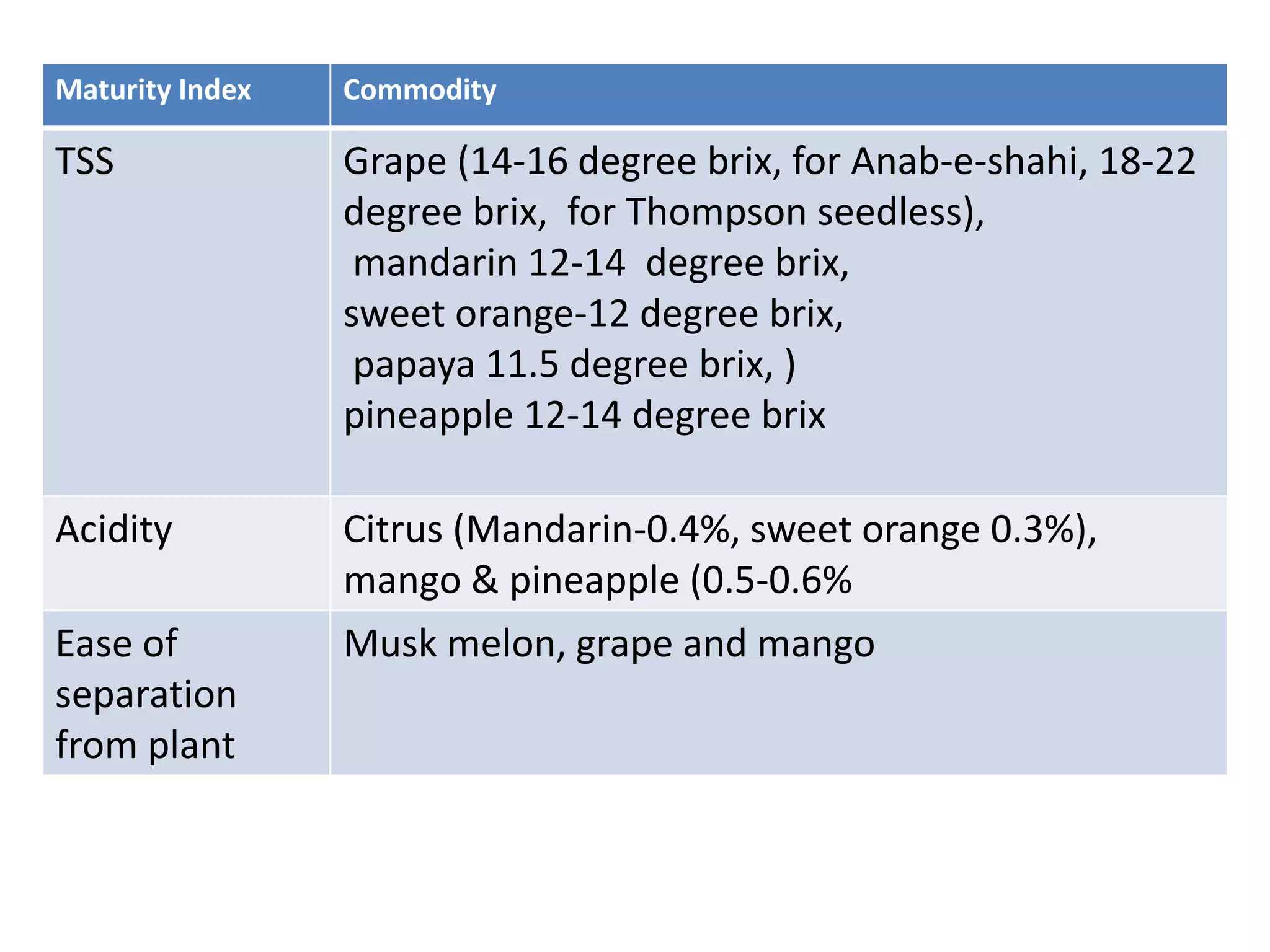
Maturity Index Commodity
TSS Grape (14-16 degree brix, for Anab-e-shahi, 18-22
degree brix, for Thompson seedless),
mandarin 12-14 degree brix,
sweet orange-12 degree brix,
papaya 11.5 degree brix, )
pineapple 12-14 degree brix
Acidity Citrus (Mandarin-0.4%, sweet orange 0.3%),
mango & pineapple (0.5-0.6%
Ease of
separation
from plant
Musk melon, grape and mango
Maturity index Commodity
Tapping Watermelon and jackfruit
Netting Musk melon
Specific gravity Mango 1.0-1.02
potato, pineapple (0.98-1.02) &
guava (1.00).
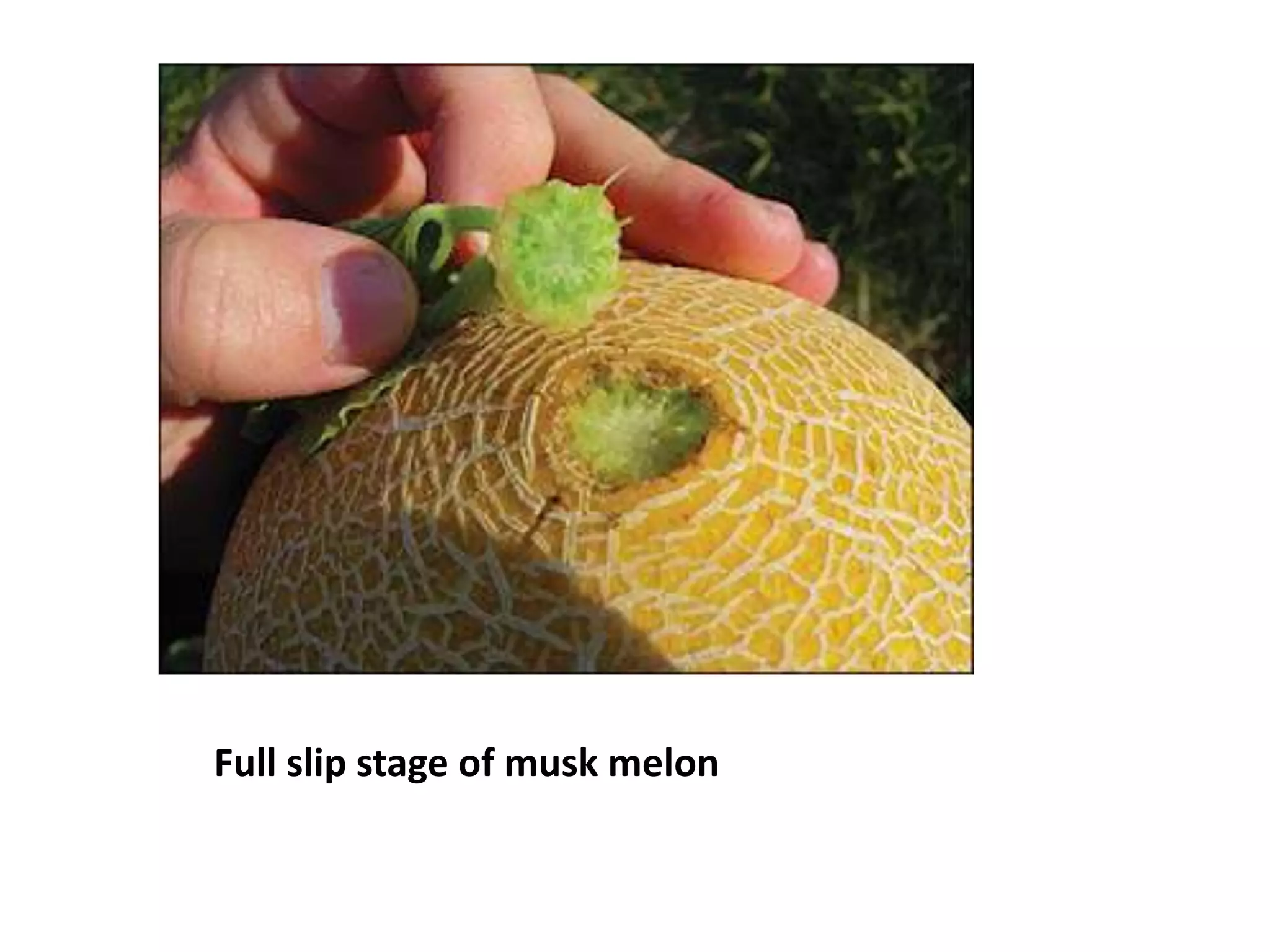
Full slip stage of musk melon
FRUIT RIPENING
Fruit ripening is a highly co-ordinated, genetically programmed,
an irreversible phenomenon involving a series of physiological,
biochemical, and organoleptic changes that lead to the
development of a soft and edible ripe fruit with desirable quality
and attributes.
Climacteric and Non-Cimacteric fruits
Changes during ripening
Changes during Fruit Ripening
1. Cell Wall Changes
The major enzymes implicated in the softening of fruits are pectine esterase,
polygalacturonase cellulase and β- galactosidase.
2. Hydrolysis of Starch
starch is hydrolysed into sugars (glucose, fructose or sugars).
In vegetables like potato and peas on the other hand, sucrose content which
remains high at fresh immature stage, converts into starch with the approach of
maturity.
3. Organic Acids
downward trend in the levels of organic acids.
4. Colour
degradation of chlorophyll and is accompanied by the
synthesis of other pigments usually anthocyanins,
carotenoids or lycopene.
.
5. Flavouring Compounds
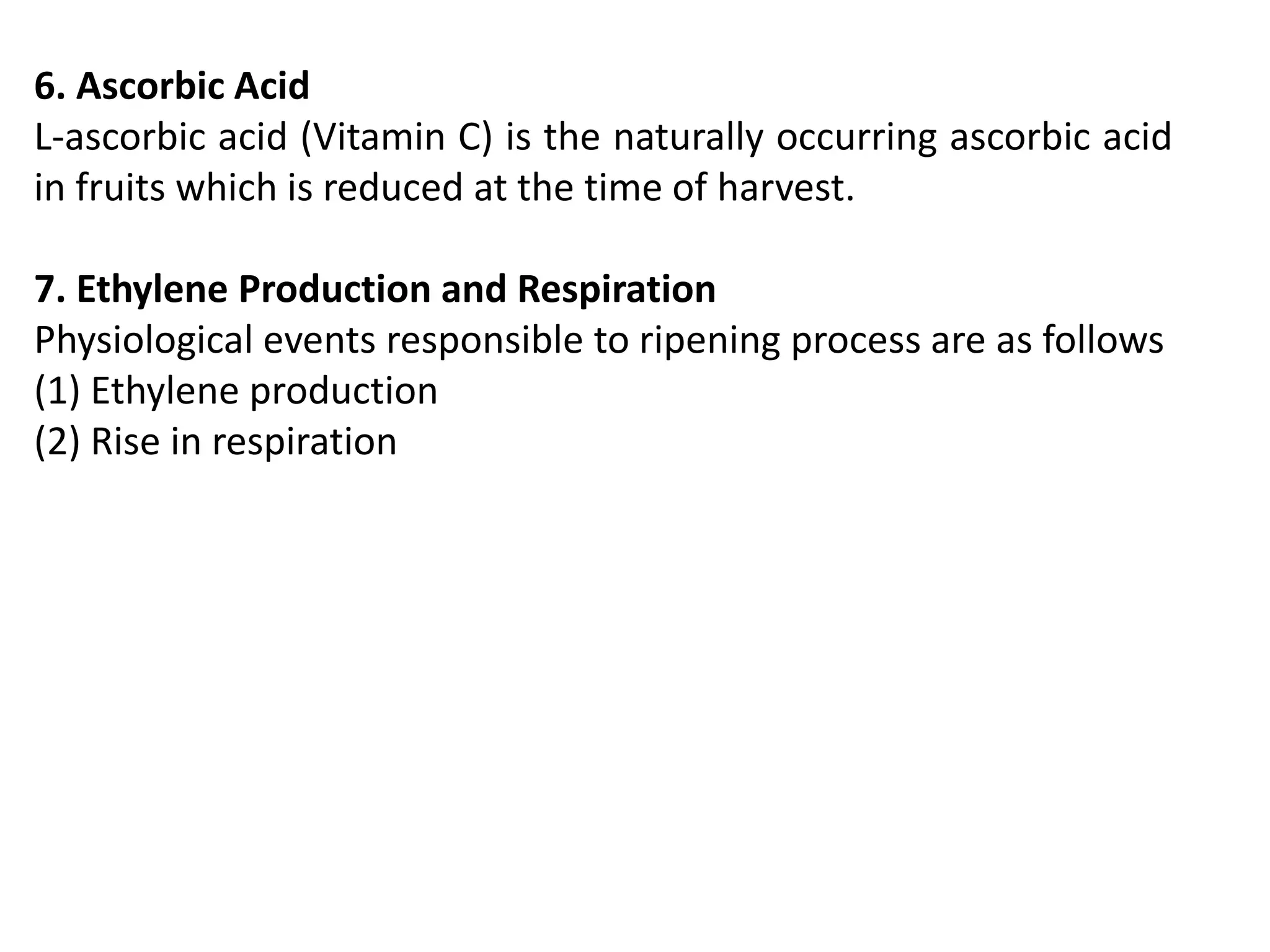
6. Ascorbic Acid
L-ascorbic acid (Vitamin C) is the naturally occurring ascorbic acid
in fruits which is reduced at the time of harvest.
7. Ethylene Production and Respiration
Physiological events responsible to ripening process are as follows
(1) Ethylene production
(2) Rise in respiration
Ethylene production
In climacteric fruits such as mango, banana, ethylene production
increase and causes:
• Rise in respiration
• Rise in temperature
• Rise in activity of hydrolytic enzymes.
Ethylene is produced from an essential amino acid — methionine.
C6H1206 +6O2 6 CO2 + 6 H20 + energy
Fruits Pigment Colouring agent
Papaya
Tamarind
Guava
Grape fruit
Mango
Phalsa
Yellow Pigment
Red Pigment
Yellow orange Pigment
Red fleshed of Solo variety
Red Pigment
Common Brown Pigment
Red colour
Pink colour
Orange-Yellow
Purple
Caricaxanthin
Lycopene
Beta cryptoxanthinpene
Alpha carotene
Anthocyanin
Leucoanthocyanin
Lycopene
Lycopene
Carotenoid
Delphinidine and
Cyanidinide
Fruit Flavouring compound
Apple ( ripe) Ethyl 2- methylbutyrate
Apple ( green) Hexanal, 2- hexenal
Banana ( ripe) Eugenol
Banana ( green) 2- hexenal
Banana ( over ripe) Isopentanol
Grapefruit Nootakatone
Lemon Citral
Orange Valencene
Pineapple Methyl Propionate Ester
Carambola Methyl Anthranilate
Durian Hydrogen Sulphide
Tamarind 2-acetyl furan
Raspberry 1- (α– hydroxyphenyl)- 3- butanone
Cherry Methyl Salicylate and Methyl Anthranilate

maturity and ripening

  • 1.
    Maturity and Ripeningof Horticultural crops
  • 2.
    MATURITY  It isthe stage of fully development of tissue of fruit and vegetables only after which it will ripen normally.  During the process of maturation the fruit receives a regular supply of food material from the plant.  When mature, the abscission or corky layer which forms at the stem end stops this inflow. Afterwards, the fruit depend on its own reserves.  A typical flavour and characteristic colour also develop.
  • 3.
    Types of Maturity 1.Horticultural maturity / Harvest maturity: It may be defined as the stage at which a plant or plant part possesses all the prerequisites for use by consumers for a particular purpose, i.e. local, distant, export market (shipping maturity) or exhibition or processing (processing maturity), culinary maturity etc. Ex. A pod vegetable is matured when it is tender with maximum size. Matured Over matured
  • 4.
    2. Physiological maturity:End of developmental stage and start ripening after this phase even if detached from the parent plant or the point of origin.
  • 5.
    3. Commercial maturity Itis the state of plant organ required by a market. It may occur at any stage during development. Eg: Papaya and jackfruit Ripe papaya
  • 6.
    (1) Skin colour:The loss of green colour of many fruits is a valuble guide to maturity . Methods to determine Maturity
  • 7.
    (2) Shape: Theshape of fruit can change during maturation and can be used as a characteristic to determine harvest maturity.
  • 9.
    (3) Size: Changesin the size of a fruit / vegetable while growing are frequently used to determine the time of harvest. Cross section of banana fruit
  • 10.
    4) Heat Units/ Degree days: It is a measure of the time required for the development of the fruit to mature after flowering by measuring the degree days or heat units in a particular environment. The heat unit summation in terms of Growing Degree Days GDD=‫{׆‬ T max –T min}/2-Tb T max= Maximum temperature T min=Minimum temperature Tb= base temperature
  • 11.
    (5) Aroma: Mostfruits synthesize volatile chemicals as they ripen. Such chemicals give fruit its characteristic odour and can be used to determine whether it is ripe or not. (6) Leaf changes: Leaf quality often determines when fruits and vegetables should be harvested. In root crops, the condition of the leaves can likewise indicate the condition of the crop below ground.
  • 12.
    (7) Abscission: Aspart of the natural development of a fruit an abscission layer is formed in the pedicel.
  • 13.
    (8) Firmness: Afruit may change in texture during maturation, especially during ripening when it may become rapidly softer. Penetrometer
  • 14.
    (9) Juice content:The juice content of many fruits increases as the fruit matures on the tree. Minimum juice values for mature citrus. Citrus fruit Minimum juice content (%) Naval oranges 30 Grapefruit 35 Lemons 25 Mandarins 33
  • 15.
    (10) Oil contentand dry matter percentage: Oil content can be used to determine the maturity of fruits, such as avocados. The oil content is determined by weighing 5 -10 g of avocado pulp and then extracting the oil with a solvent (e.g., benzene or petroleum ether). It should contains more than 8% of it’s weight. (11) Sugars: In climacteric fruits, carbohydrates accumulate during maturation in the form of starch. As the fruit ripens, starch is broken down into sugar. In non climacteric fruits, sugar tends to accumulate during maturation.
  • 16.
  • 17.
    (13) Acidity: Inmany fruits, the acidity changes during maturation and ripening, and in the case of citrus and other fruits, acidity reduces progressively as the fruit matures on the tree. (14) Specific gravity: Specific gravity is the relative gravity, or weight of solids or liquids, compared to pure distilled water at 62°F (16.7°C). Specific gravity= relative weight in air relative weight in water
  • 18.
    Maturity index Commodity Peel Colour Citrus,Papaya, pineapple, tomato (breaker stage), grapes, mango, straw berry and peas Size Asparagus, cucumber, citrus, apple and pears. Shape Banana (fullness of fingers, disappeaence of angularity), mango, pineapple (flattening of eyes) and litchi(flattening of tubercles) Drying of plant parts Onion, garlic, potato and ginger
  • 19.
    Maturity Index Commodity TSSGrape (14-16 degree brix, for Anab-e-shahi, 18-22 degree brix, for Thompson seedless), mandarin 12-14 degree brix, sweet orange-12 degree brix, papaya 11.5 degree brix, ) pineapple 12-14 degree brix Acidity Citrus (Mandarin-0.4%, sweet orange 0.3%), mango & pineapple (0.5-0.6% Ease of separation from plant Musk melon, grape and mango
  • 20.
    Maturity index Commodity TappingWatermelon and jackfruit Netting Musk melon Specific gravity Mango 1.0-1.02 potato, pineapple (0.98-1.02) & guava (1.00).
  • 21.
    Full slip stageof musk melon
  • 22.
    FRUIT RIPENING Fruit ripeningis a highly co-ordinated, genetically programmed, an irreversible phenomenon involving a series of physiological, biochemical, and organoleptic changes that lead to the development of a soft and edible ripe fruit with desirable quality and attributes.
  • 24.
  • 26.
  • 27.
    Changes during FruitRipening 1. Cell Wall Changes The major enzymes implicated in the softening of fruits are pectine esterase, polygalacturonase cellulase and β- galactosidase. 2. Hydrolysis of Starch starch is hydrolysed into sugars (glucose, fructose or sugars). In vegetables like potato and peas on the other hand, sucrose content which remains high at fresh immature stage, converts into starch with the approach of maturity.
  • 28.
    3. Organic Acids downwardtrend in the levels of organic acids. 4. Colour degradation of chlorophyll and is accompanied by the synthesis of other pigments usually anthocyanins, carotenoids or lycopene. .
  • 29.
  • 30.
    6. Ascorbic Acid L-ascorbicacid (Vitamin C) is the naturally occurring ascorbic acid in fruits which is reduced at the time of harvest. 7. Ethylene Production and Respiration Physiological events responsible to ripening process are as follows (1) Ethylene production (2) Rise in respiration
  • 31.
    Ethylene production In climactericfruits such as mango, banana, ethylene production increase and causes: • Rise in respiration • Rise in temperature • Rise in activity of hydrolytic enzymes. Ethylene is produced from an essential amino acid — methionine. C6H1206 +6O2 6 CO2 + 6 H20 + energy
  • 33.
    Fruits Pigment Colouringagent Papaya Tamarind Guava Grape fruit Mango Phalsa Yellow Pigment Red Pigment Yellow orange Pigment Red fleshed of Solo variety Red Pigment Common Brown Pigment Red colour Pink colour Orange-Yellow Purple Caricaxanthin Lycopene Beta cryptoxanthinpene Alpha carotene Anthocyanin Leucoanthocyanin Lycopene Lycopene Carotenoid Delphinidine and Cyanidinide
  • 34.
    Fruit Flavouring compound Apple( ripe) Ethyl 2- methylbutyrate Apple ( green) Hexanal, 2- hexenal Banana ( ripe) Eugenol Banana ( green) 2- hexenal Banana ( over ripe) Isopentanol Grapefruit Nootakatone Lemon Citral Orange Valencene Pineapple Methyl Propionate Ester Carambola Methyl Anthranilate Durian Hydrogen Sulphide Tamarind 2-acetyl furan Raspberry 1- (α– hydroxyphenyl)- 3- butanone Cherry Methyl Salicylate and Methyl Anthranilate