VALLEY VIEW UNIVERSITY -TECHIMAN CAMPUS
RESEARCH PROPOSAL ON:
THE EFFECTS OF INORGANIC AND ORGANIC FERTILIZER APPLICATION ON SWEET
PEPPER PRODUCTION INTERMS OF YIELDS AND COST.
“A CASE STUDY AT VVU TECHIMAN CAMPUS”
BY
SEKYI STEPHEN KWAME
(AGRIBUSINESS DEPARTMENT)
211AB01000015

OUTLINE OF PRESENTATION
 INTRODUCTION.
 PROBLEM STATEMENT.
 AIMS AND OBJECTIVES.
 LITERATURE REVIEW.
 METHODOLOGY.
 EXPECTED OUTCOME.
 CONCLUSION.

SWEET PEPPER (Capsicum annuum)

 INTRODUCTION
 Sweet Pepper (Capsicum annuum) is a crop that belongs to the solanaceous family and a season crop
that can be grown throughout the year.
 Sweet pepper originated from Mexico and Central America.
 In Ghana, Tuobodom District is known to be one of the leading producers of exotic vegetables like
sweet pepper with higher yields in Ghana.
 Sweet peppers are low in Calories.
 It contains plenty of vitamin C which powers human immune system and keeps the skin youthful.
 It contains lycopene and sulphur that lower the risk of prostate, bladder, cervical and pancreatic
cancer.
 The capsaicin in sweet pepper reduces bad cholesterol, control diabetes, bring relief from pain and
eases inflammation (injury, infections).

 PROBLEM STATEMENT
 Sweet pepper has the ability that can contribute to the alleviation of poverty within household
because it is drought, tolerant and can be produce all year round.
 To assess which type of fertilizer regimes(inorganic,N.P.K and organic,Poultry Manure) use will
bring out a maximum yield of the Sweet Pepper.

 AIMS AND OBJECTIVES
MAIN AIMS AND OBJECTIVES
 The main aim is to evaluate the performance of the various fertilizer regimes on sweet pepper
production.

SPECIFIC OBJECTIVES
 To assess the yield levels of California and Yolo wonder, using different fertilizer regimes.
 To assess the cost and benefit on the right fertilizer regime on sweet pepper production.

 LITERATURE REVIEW
 Sweet pepper plant is a perennial in warm climates but grows as an annual in northern climates.
 Peppers grow well under a wide range of soil pH form 5.5 to 7.5.
 Sweet pepper requires cool weather for best fruit quality.
 In low elevations, October to December planting is best. In mid and high elevations, it can be grown
throughout the year.
 Avoid planting in low lying fields next to streams and rivers because these sites are subject to high
humidity and moisture conditions and, therefore, especially prone to bacterial spot epidemics.
 Producers should also avoid fields where long residual corn or soya bean herbicides have been used,
because herbicide carry-over can cause serious damage to peppers.
 Ideally, seedlings should be raised in seedling trays using a sterile sowing medium so that healthy,
vigorous seedlings are produced.
 This provides uniform moisture and fertilization during the growing season. Dry conditions result in
premature small-sized fruit set, which leads to reduced yields (Bosland & Votava, 1999).
 Sweet pepper has a total water requirement of about 600 mm and a weekly water requirement of 25
mm during the first five weeks and 35 mm thereafter (Anon., 2000).
 Excessive rainfall or water supply can negatively affect flower and fruit formation and eventually
lead to fruit rot (Coertze & Kistner, 1994).Unrestricted water supply to the crop can be as harmful as
not enough water.
 Water stress during flowering and friutset can cause flower and fruit drop. Water stress during fruit
development can cause poorly developed, small, misshapen fruit, or blossom end rot.
 During the growing season, pepper should receive 1 to 2 inches of rainfall or irrigation per week,
depending on soil type and stage of growth. Sufficient water during fruiting will result in more
numerous large fruit.
 Water requirements rapidly increase and approach 100% of Evapotranspiration (Eto) as complete
canopy cover and development occur.
 Ideal pepper transplants are 5 to 6 weeks old,5 to 6 leaves, are 6 to 8 inches tall, have a stiff but not a
woody stem strong enough to withstand transplanting, have an intact root system(but are not root
bound),and have not suffered shock from storage or holding.
 They should be slightly hardened but not to the point where they are slow to take off in the field.
 Good weed control in peppers begins similarly to any other crop, before the crop is planted. Control
established perennials before planning to plant peppers in the field.
 Organic fertilizers are derived from living things such as animals and plants. Most common are
manures, bone meal, fish meal etc.
 Poultry manure is a useful source of Nitrogen that plants needs for green leafy growth. It contains
smaller amount of nutrients such as Nitrogen-4%, Phosphorus-2%, and Potassium-1%.
 It contains acidity and alkalinity that varies according to its age, the diet fed to the birds, the age of
the birds and the litteelt (1989) revealed that, stable manure and compost applied at 5, 10, 20 or 30
tons/ha to Capsicum grown in greenhouse stimulated plant growth up to 20 tons/ha, but generally fell
with increasing rates of application from 20 up to 30 tons/ha.
 Corrales et al., (1991) studies on two sources of organic fertilizer at the rate of 4 ton/ha, i.e.,
decomposed chicken manure and compost made of sugar-cane bagasse, sawdust and aches at 2:1:1.
 They found that, leaf area of pepper plants was significantly increased by incorporating both
materials into the plant bed.
 Shehata (1992) reported that the application of farm yard manure as organic manure significantly
increased the dry matter content of sweet pepper plant leaves at both plant stages of 70 and 100 days
after transplanting.
 Whereas, a steady significant increase in dry matter content was recorded with increasing the rate of
FYM from 25, 50, 75 up to 100 m3 / fed.
 Inorganic fertilizers are man made formulas that can be formulated for various speeds of release.
Common are N.P.K.
 After transplanting, fertilize the pepper plants with a starter fertilizer solution.
 A starter fertilizer solution can be prepared by following directions on a water-soluble fertilizer or by
dissolving 2 tablespoons of an all-purpose garden fertilizer, such as N.P.K 10-10-10, in one gallon of
water. Give each plant 1 to 2 cups of the solution.
 Ado(2012) in a study of Sweet pepper response to NPK fertilizer for improved growth and yield
indicate that application of NPK fertilizer within the first two weeks after transplanting produced
higher number of leaves, early flowering time and subsequently produced a highest fruit yield of
pepper.
 Aphids (primarily Myzus persicae), Aphids can make pepper fruit unmarketable because of the
honeydew that is secreted by the aphid and/or associated sooty mould fungi. Infested plants can be
stunted, with deformed foliage.
 Controlling weed hosts around the edges of fields may help to control aphid infestations.
 Soft rot begins in the peduncle and calyx tissues of harvested fruit, but infection can occur through
wounds on the fruit. Internal tissue near the site of infection softens and the expanding lesion reduces
the fruit interior to a watery mass.
 Fruit infected on the plant collapse and hang on the plant like a water-filled bag and when the
content leaks out, a dry shell of the fruit is left behind.
 The disease is severe during rainy periods because the bacteria are splashed from the soil onto the
fruit. The decay can be reduced by harvesting dry fruit, reducing damage during handling and
controlling insects that cause damage to the fruit (Black et al., 1991).
 For best yield and quality, green peppers are harvested when they reach full size, are firm, and have
thick flesh. This is shortly before they begin to change color. Some hot peppers are picked after they
have changed color.
 Harvest peppers twice a week to achieve maximum yields and pick by using a twisting, pulling
motion with part of the stem adhering to the fruit.
 Bell peppers are usually harvested when large and firm in the immature green stage. They also may
be allowed to fully ripen to red, yellow, orange, purple, or other colors.
 Fully ripe bell peppers are slightly sweeter and have higher vitamin content than the immature green
peppers.
 Fresh peppers may be stored for up to 3 weeks in cool, moist conditions (45 to 50°F and 85 to 90
percent relative humidity).
 Start harvesting at 80-100 days from transplanting or 3-6 weeks after flowering. Harvest mature
green fruits.

 METHODOLOGY MATERIALS AND METHOD
 MATERIALS NEEDED.
For successful production of sweet pepper, the following materials will be obtained.
 Land for production.
 Sweet pepper seeds namely (California Wonder) and (Yolo Wonder).
 Inorganic fertilizer(N.P.K)
 Organic fertilizer(Poultry Manure).
 Irrigation system.
 Weedicides and pesticides.
 Knapsack sprayer.
 Quarry dust.
The two varieties to be used are as follows;
 California Wonder.
 Yolo Wonder.

 NURSERY
 The seeds will be nursed until they are ready for transplanting to the field when soil conditions are
favorable for easy establishment of the seedlings.

 SOIL PREPARATION
 Fields will be prepared thoroughly by plowing and harrowing ,removing the different types of plant
debris.
 WEEDING
 The purpose of the weeding is to control weeds that compete with the crops and prevent the spread of
diseases and pests.
 Two( 2) weeks after transplanting, the first weeding is done and the second weeding is done from 6
weeks.

 FERTILIZATION
 The two forms that will be employed to amend the sweet pepper production are the organic(Poultry
Manure) and the inorganic(N.P.K) fertilizers.
 Fertilizer application will be done 2 weeks after transplanting.
Various fertilizer treatments that will be used are follows:
 NPK 15:15:15-100kg/ha.
 Organic (poultry manure)-10 tons/ha.
 Organic( poultry manure)- + Quarry dust-5 tons + 100kg/ha.

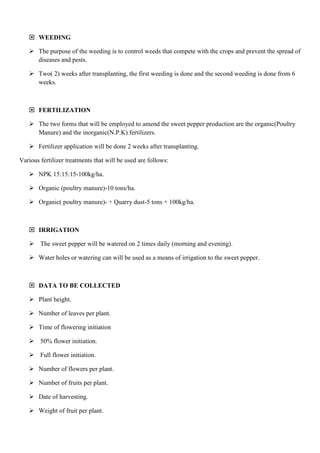
 IRRIGATION
 The sweet pepper will be watered on 2 times daily (morning and evening).
 Water holes or watering can will be used as a means of irrigation to the sweet pepper.

 DATA TO BE COLLECTED
 Plant height.
 Number of leaves per plant.
 Time of flowering initiation
 50% flower initiation.
 Full flower initiation.
 Number of flowers per plant.
 Number of fruits per plant.
 Date of harvesting.
 Weight of fruit per plant.
 Cost of fertilizers.
 Cost of labourers
 Cost of land preparation.

The four treatments are as follows;
 T1 – No fertilizer.
 T2 – Inorganic fertilizer(N.P.K).
 T3 – Organic fertilizer (Poultry manure).
 T4 –Mixture of organic fertilizer and quarry dust.

The two varieties to be used are as follows;
 V1 – California Wonder.
 V2 – Yolo Wonder

 TREATMENTS
 Two(2) varieties (California Wonder and Yolo Wonder) will be used with 4 treatments and 3
replications under the Split Plot Design.
 The treatments will be V1T1, V1T2, V1T3, V1T4, V2T1, V2T2, V2T3, V2T4 because of the two
varieties.

 V1T1 – California wonder with no fertilizer.
 V1T2 – California wonder with inorganic(N.P.K) fertilizer.
 V1T3 – California wonder with organic(Poultry manure) fertilizer.
 V1T4 – California wonder with mixture of organic fertilizer and quarry dust.
 V2T1 –Yolo wonder with no fertilizer .
 V2T2 –Yolo wonder with inorganic fertilizer(N.P.K)
 V2T3 – Yolo wonder with organic fertilizer(Poultry manure).
 V2T4 – Yolo wonder with mixture of organic (Poultry manure) fertilizer and quarry dust.
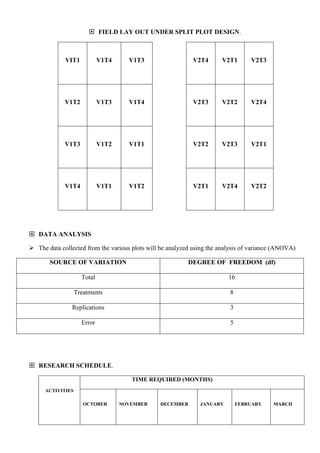
 FIELD LAY OUT UNDER SPLIT PLOT DESIGN.

VIT1

V1T4

V1T3

V2T4

V2T1

V2T3

V1T2

V1T3

V1T4

V2T3

V2T2

V2T4

V1T3

V1T2

V1T1

V2T2

V2T3

V2T1

V1T4

V1T1

V1T2

V2T1

V2T4

V2T2

 DATA ANALYSIS
 The data collected from the various plots will be analyzed using the analysis of variance (ANOVA)
SOURCE OF VARIATION

DEGREE OF FREEDOM (df)

Total

16

Treatments

8

Replications

3

Error

5

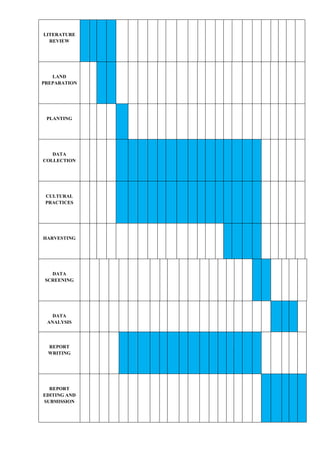
 RESEARCH SCHEDULE.
TIME REQUIRED (MONTHS)
ACTIVITIES
OCTOBER

NOVEMBER

DECEMBER

JANUARY

FEBRUARY

MARCH
LITERATURE
REVIEW

LAND
PREPARATION

PLANTING

DATA
COLLECTION

CULTURAL
PRACTICES

HARVESTING

DATA
SCREENING

DATA
ANALYSIS

REPORT
WRITING

REPORT
EDITING AND
SUBMISSION
 EXPECTED OUTCOME
 It is expected that, sweet pepper that would be grown under the mixture of the organic fertilizers and
Quarry dust will yield more than the organic and the inorganic fertilizer since the nutrients will be
more readily available and adequate for the sweet pepper growth and yield.

 CONCLUSION
 The expected results from my project is foreseen to help improve the production of sweet pepper in
Ghana.

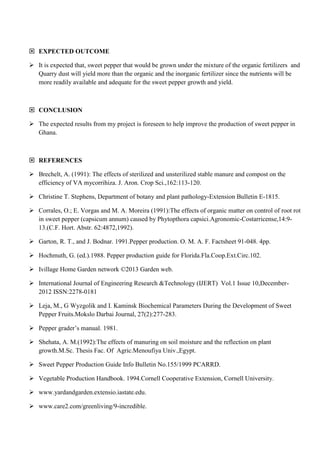
 REFERENCES
 Brechelt, A. (1991): The effects of sterilized and unsterilized stable manure and compost on the
efficiency of VA mycorrihiza. J. Aron. Crop Sci.,162:113-120.
 Christine T. Stephens, Department of botany and plant pathology-Extension Bulletin E-1815.
 Corrales, O.; E. Vorgas and M. A. Moreira (1991):The effects of organic matter on control of root rot
in sweet pepper (capsicum annum) caused by Phytopthora capsici.Agronomic-Costarricense,14:913.(C.F. Hort. Abstr. 62:4872,1992).
 Garton, R. T., and J. Bodnar. 1991.Pepper production. O. M. A. F. Factsheet 91-048. 4pp.
 Hochmuth, G. (ed.).1988. Pepper production guide for Florida.Fla.Coop.Ext.Circ.102.
 Ivillage Home Garden network ©2013 Garden web.
 International Journal of Engineering Research &Technology (IJERT) Vol.1 Issue 10,December2012 ISSN:2278-0181
 Leja, M., G Wyzgolik and I. Kaminsk Biochemical Parameters During the Development of Sweet
Pepper Fruits.Mokslo Darbai Journal, 27(2):277-283.
 Pepper grader’s manual. 1981.
 Shehata, A. M.(1992):The effects of manuring on soil moisture and the reflection on plant
growth.M.Sc. Thesis Fac. Of Agric.Menoufiya Univ.,Egypt.
 Sweet Pepper Production Guide Info Bulletin No.155/1999 PCARRD.
 Vegetable Production Handbook. 1994.Cornell Cooperative Extension, Cornell University.
 www.yardandgarden.extensio.iastate.edu.
 www.care2.com/greenliving/9-incredible.

Stev project

  • 1.
    VALLEY VIEW UNIVERSITY-TECHIMAN CAMPUS RESEARCH PROPOSAL ON: THE EFFECTS OF INORGANIC AND ORGANIC FERTILIZER APPLICATION ON SWEET PEPPER PRODUCTION INTERMS OF YIELDS AND COST. “A CASE STUDY AT VVU TECHIMAN CAMPUS” BY SEKYI STEPHEN KWAME (AGRIBUSINESS DEPARTMENT) 211AB01000015 OUTLINE OF PRESENTATION  INTRODUCTION.  PROBLEM STATEMENT.  AIMS AND OBJECTIVES.  LITERATURE REVIEW.  METHODOLOGY.  EXPECTED OUTCOME.  CONCLUSION. SWEET PEPPER (Capsicum annuum)  INTRODUCTION  Sweet Pepper (Capsicum annuum) is a crop that belongs to the solanaceous family and a season crop that can be grown throughout the year.
  • 2.
     Sweet pepperoriginated from Mexico and Central America.  In Ghana, Tuobodom District is known to be one of the leading producers of exotic vegetables like sweet pepper with higher yields in Ghana.  Sweet peppers are low in Calories.  It contains plenty of vitamin C which powers human immune system and keeps the skin youthful.  It contains lycopene and sulphur that lower the risk of prostate, bladder, cervical and pancreatic cancer.  The capsaicin in sweet pepper reduces bad cholesterol, control diabetes, bring relief from pain and eases inflammation (injury, infections).  PROBLEM STATEMENT  Sweet pepper has the ability that can contribute to the alleviation of poverty within household because it is drought, tolerant and can be produce all year round.  To assess which type of fertilizer regimes(inorganic,N.P.K and organic,Poultry Manure) use will bring out a maximum yield of the Sweet Pepper.  AIMS AND OBJECTIVES MAIN AIMS AND OBJECTIVES  The main aim is to evaluate the performance of the various fertilizer regimes on sweet pepper production. SPECIFIC OBJECTIVES  To assess the yield levels of California and Yolo wonder, using different fertilizer regimes.  To assess the cost and benefit on the right fertilizer regime on sweet pepper production.  LITERATURE REVIEW  Sweet pepper plant is a perennial in warm climates but grows as an annual in northern climates.  Peppers grow well under a wide range of soil pH form 5.5 to 7.5.  Sweet pepper requires cool weather for best fruit quality.  In low elevations, October to December planting is best. In mid and high elevations, it can be grown throughout the year.
  • 3.
     Avoid plantingin low lying fields next to streams and rivers because these sites are subject to high humidity and moisture conditions and, therefore, especially prone to bacterial spot epidemics.  Producers should also avoid fields where long residual corn or soya bean herbicides have been used, because herbicide carry-over can cause serious damage to peppers.  Ideally, seedlings should be raised in seedling trays using a sterile sowing medium so that healthy, vigorous seedlings are produced.  This provides uniform moisture and fertilization during the growing season. Dry conditions result in premature small-sized fruit set, which leads to reduced yields (Bosland & Votava, 1999).  Sweet pepper has a total water requirement of about 600 mm and a weekly water requirement of 25 mm during the first five weeks and 35 mm thereafter (Anon., 2000).  Excessive rainfall or water supply can negatively affect flower and fruit formation and eventually lead to fruit rot (Coertze & Kistner, 1994).Unrestricted water supply to the crop can be as harmful as not enough water.  Water stress during flowering and friutset can cause flower and fruit drop. Water stress during fruit development can cause poorly developed, small, misshapen fruit, or blossom end rot.  During the growing season, pepper should receive 1 to 2 inches of rainfall or irrigation per week, depending on soil type and stage of growth. Sufficient water during fruiting will result in more numerous large fruit.  Water requirements rapidly increase and approach 100% of Evapotranspiration (Eto) as complete canopy cover and development occur.  Ideal pepper transplants are 5 to 6 weeks old,5 to 6 leaves, are 6 to 8 inches tall, have a stiff but not a woody stem strong enough to withstand transplanting, have an intact root system(but are not root bound),and have not suffered shock from storage or holding.  They should be slightly hardened but not to the point where they are slow to take off in the field.  Good weed control in peppers begins similarly to any other crop, before the crop is planted. Control established perennials before planning to plant peppers in the field.  Organic fertilizers are derived from living things such as animals and plants. Most common are manures, bone meal, fish meal etc.  Poultry manure is a useful source of Nitrogen that plants needs for green leafy growth. It contains smaller amount of nutrients such as Nitrogen-4%, Phosphorus-2%, and Potassium-1%.  It contains acidity and alkalinity that varies according to its age, the diet fed to the birds, the age of the birds and the litteelt (1989) revealed that, stable manure and compost applied at 5, 10, 20 or 30 tons/ha to Capsicum grown in greenhouse stimulated plant growth up to 20 tons/ha, but generally fell with increasing rates of application from 20 up to 30 tons/ha.  Corrales et al., (1991) studies on two sources of organic fertilizer at the rate of 4 ton/ha, i.e., decomposed chicken manure and compost made of sugar-cane bagasse, sawdust and aches at 2:1:1.
  • 4.
     They foundthat, leaf area of pepper plants was significantly increased by incorporating both materials into the plant bed.  Shehata (1992) reported that the application of farm yard manure as organic manure significantly increased the dry matter content of sweet pepper plant leaves at both plant stages of 70 and 100 days after transplanting.  Whereas, a steady significant increase in dry matter content was recorded with increasing the rate of FYM from 25, 50, 75 up to 100 m3 / fed.  Inorganic fertilizers are man made formulas that can be formulated for various speeds of release. Common are N.P.K.  After transplanting, fertilize the pepper plants with a starter fertilizer solution.  A starter fertilizer solution can be prepared by following directions on a water-soluble fertilizer or by dissolving 2 tablespoons of an all-purpose garden fertilizer, such as N.P.K 10-10-10, in one gallon of water. Give each plant 1 to 2 cups of the solution.  Ado(2012) in a study of Sweet pepper response to NPK fertilizer for improved growth and yield indicate that application of NPK fertilizer within the first two weeks after transplanting produced higher number of leaves, early flowering time and subsequently produced a highest fruit yield of pepper.  Aphids (primarily Myzus persicae), Aphids can make pepper fruit unmarketable because of the honeydew that is secreted by the aphid and/or associated sooty mould fungi. Infested plants can be stunted, with deformed foliage.  Controlling weed hosts around the edges of fields may help to control aphid infestations.  Soft rot begins in the peduncle and calyx tissues of harvested fruit, but infection can occur through wounds on the fruit. Internal tissue near the site of infection softens and the expanding lesion reduces the fruit interior to a watery mass.  Fruit infected on the plant collapse and hang on the plant like a water-filled bag and when the content leaks out, a dry shell of the fruit is left behind.  The disease is severe during rainy periods because the bacteria are splashed from the soil onto the fruit. The decay can be reduced by harvesting dry fruit, reducing damage during handling and controlling insects that cause damage to the fruit (Black et al., 1991).  For best yield and quality, green peppers are harvested when they reach full size, are firm, and have thick flesh. This is shortly before they begin to change color. Some hot peppers are picked after they have changed color.  Harvest peppers twice a week to achieve maximum yields and pick by using a twisting, pulling motion with part of the stem adhering to the fruit.  Bell peppers are usually harvested when large and firm in the immature green stage. They also may be allowed to fully ripen to red, yellow, orange, purple, or other colors.
  • 5.
     Fully ripebell peppers are slightly sweeter and have higher vitamin content than the immature green peppers.  Fresh peppers may be stored for up to 3 weeks in cool, moist conditions (45 to 50°F and 85 to 90 percent relative humidity).  Start harvesting at 80-100 days from transplanting or 3-6 weeks after flowering. Harvest mature green fruits.  METHODOLOGY MATERIALS AND METHOD  MATERIALS NEEDED. For successful production of sweet pepper, the following materials will be obtained.  Land for production.  Sweet pepper seeds namely (California Wonder) and (Yolo Wonder).  Inorganic fertilizer(N.P.K)  Organic fertilizer(Poultry Manure).  Irrigation system.  Weedicides and pesticides.  Knapsack sprayer.  Quarry dust. The two varieties to be used are as follows;  California Wonder.  Yolo Wonder.  NURSERY  The seeds will be nursed until they are ready for transplanting to the field when soil conditions are favorable for easy establishment of the seedlings.  SOIL PREPARATION  Fields will be prepared thoroughly by plowing and harrowing ,removing the different types of plant debris.
  • 6.
     WEEDING  Thepurpose of the weeding is to control weeds that compete with the crops and prevent the spread of diseases and pests.  Two( 2) weeks after transplanting, the first weeding is done and the second weeding is done from 6 weeks.  FERTILIZATION  The two forms that will be employed to amend the sweet pepper production are the organic(Poultry Manure) and the inorganic(N.P.K) fertilizers.  Fertilizer application will be done 2 weeks after transplanting. Various fertilizer treatments that will be used are follows:  NPK 15:15:15-100kg/ha.  Organic (poultry manure)-10 tons/ha.  Organic( poultry manure)- + Quarry dust-5 tons + 100kg/ha.  IRRIGATION  The sweet pepper will be watered on 2 times daily (morning and evening).  Water holes or watering can will be used as a means of irrigation to the sweet pepper.  DATA TO BE COLLECTED  Plant height.  Number of leaves per plant.  Time of flowering initiation  50% flower initiation.  Full flower initiation.  Number of flowers per plant.  Number of fruits per plant.  Date of harvesting.  Weight of fruit per plant.
  • 7.
     Cost offertilizers.  Cost of labourers  Cost of land preparation. The four treatments are as follows;  T1 – No fertilizer.  T2 – Inorganic fertilizer(N.P.K).  T3 – Organic fertilizer (Poultry manure).  T4 –Mixture of organic fertilizer and quarry dust. The two varieties to be used are as follows;  V1 – California Wonder.  V2 – Yolo Wonder  TREATMENTS  Two(2) varieties (California Wonder and Yolo Wonder) will be used with 4 treatments and 3 replications under the Split Plot Design.  The treatments will be V1T1, V1T2, V1T3, V1T4, V2T1, V2T2, V2T3, V2T4 because of the two varieties.  V1T1 – California wonder with no fertilizer.  V1T2 – California wonder with inorganic(N.P.K) fertilizer.  V1T3 – California wonder with organic(Poultry manure) fertilizer.  V1T4 – California wonder with mixture of organic fertilizer and quarry dust.  V2T1 –Yolo wonder with no fertilizer .  V2T2 –Yolo wonder with inorganic fertilizer(N.P.K)  V2T3 – Yolo wonder with organic fertilizer(Poultry manure).  V2T4 – Yolo wonder with mixture of organic (Poultry manure) fertilizer and quarry dust.
  • 8.
     FIELD LAYOUT UNDER SPLIT PLOT DESIGN. VIT1 V1T4 V1T3 V2T4 V2T1 V2T3 V1T2 V1T3 V1T4 V2T3 V2T2 V2T4 V1T3 V1T2 V1T1 V2T2 V2T3 V2T1 V1T4 V1T1 V1T2 V2T1 V2T4 V2T2  DATA ANALYSIS  The data collected from the various plots will be analyzed using the analysis of variance (ANOVA) SOURCE OF VARIATION DEGREE OF FREEDOM (df) Total 16 Treatments 8 Replications 3 Error 5  RESEARCH SCHEDULE. TIME REQUIRED (MONTHS) ACTIVITIES OCTOBER NOVEMBER DECEMBER JANUARY FEBRUARY MARCH
  • 9.
  • 10.
     EXPECTED OUTCOME It is expected that, sweet pepper that would be grown under the mixture of the organic fertilizers and Quarry dust will yield more than the organic and the inorganic fertilizer since the nutrients will be more readily available and adequate for the sweet pepper growth and yield.  CONCLUSION  The expected results from my project is foreseen to help improve the production of sweet pepper in Ghana.  REFERENCES  Brechelt, A. (1991): The effects of sterilized and unsterilized stable manure and compost on the efficiency of VA mycorrihiza. J. Aron. Crop Sci.,162:113-120.  Christine T. Stephens, Department of botany and plant pathology-Extension Bulletin E-1815.  Corrales, O.; E. Vorgas and M. A. Moreira (1991):The effects of organic matter on control of root rot in sweet pepper (capsicum annum) caused by Phytopthora capsici.Agronomic-Costarricense,14:913.(C.F. Hort. Abstr. 62:4872,1992).  Garton, R. T., and J. Bodnar. 1991.Pepper production. O. M. A. F. Factsheet 91-048. 4pp.  Hochmuth, G. (ed.).1988. Pepper production guide for Florida.Fla.Coop.Ext.Circ.102.  Ivillage Home Garden network ©2013 Garden web.  International Journal of Engineering Research &Technology (IJERT) Vol.1 Issue 10,December2012 ISSN:2278-0181  Leja, M., G Wyzgolik and I. Kaminsk Biochemical Parameters During the Development of Sweet Pepper Fruits.Mokslo Darbai Journal, 27(2):277-283.  Pepper grader’s manual. 1981.  Shehata, A. M.(1992):The effects of manuring on soil moisture and the reflection on plant growth.M.Sc. Thesis Fac. Of Agric.Menoufiya Univ.,Egypt.  Sweet Pepper Production Guide Info Bulletin No.155/1999 PCARRD.  Vegetable Production Handbook. 1994.Cornell Cooperative Extension, Cornell University.  www.yardandgarden.extensio.iastate.edu.  www.care2.com/greenliving/9-incredible.