

RESEARCH PROPOSAL
VALLEY VIEW UNIVERSITY-TECHIMAN
CAMPUS
RESEARCH TOPIC:
ASSESSING INCOME LEVELS AND EXPENDITURE
PATTERNS OF MANGO GROWERS.
“ A CASE STUDY AT EJURA SEKYE DUMASI
MUNICIPALITY”
PRESENTATION BY:

OWUSU-MANU DANIEL
(211AB01000023)
OUTLINE FOR PRESENTATION
1. INTRODUCTION

1.1 Background
1.2 Statement of Problem
1.3 Research Objectives
1.4 Justification
2. LITERATURE REVIEW
2.1 Origin and Distribution of Mango
2.2 Varieties of Mango
2.3 Diseases and Pests Control in Mango
OUTLINE FOR PRESENTATION cont.
3. METHODOLOGY
3.1 The Study Area
3.2 Target Group and Sample Size
3.3Research Design
3.4 Instruments for data collection
3.5 Tested-Try-Out
3.6 Questionnaire Administration
3.7 Data Analysis
4. WORK PLAN FOR PROJECT
5. REFERENCES
1.0 INTRODUCTION

1.1 BACKGROUND TO THE STUDY
 Mango became one of the fruit crops for the food

canneries. This resulted in the establishment of
mango plantations in Ghana to increase the
production of mango, Boadu (1998).
 It was first introduced to Africa in the middle of 19th
Century during the European penetration into
Africa. Further introduction was made by the United
States Agency for International Development
(USAID).
1.0 INTRODUCTION cont
 It was first introduced to Africa in the middle of 19th

Century during the European penetration into
Africa. Further introduction was made by the United
States Agency for International Development
(USAID).
 The ripe fruit contains 84% water, 10 to 20% sugars
and small amount of fruit acid, minerals, fats and
protein. The fruit is also important source of vitamin
B and C.
1.0 INTRODUCTION cont
 The kernel inside the stone of mango is roasted and

powdered, it is then cooked and used in several parts
of India as human food in times of scarcity. Mango
can also be fermented to vinegar, wine and brandy.
 Spacing used for mango varies from 9m x 9m to 10.5
x 10.5m depending on the variety.
1.2 STATEMENT OF THE PROBLEM
 Establishment of mango plantation in Ejura-Sekye

Dumasi Municipal has increased considerably in recent
years as a result of improving climate potentials to
support mango production.
 Farmers in the study area are putting up buildings, their
children are in school as well as improved standard of
living.
 The problem of the farmers in the area is that most
farmers do not document or estimate the income and
expenditure from their mango produce.
 This study seeks to estimate the income and the
expenditure of farmers in order to determine whether
farmers are making profit and loss.
1.2 STATEMENT OF THE PROBLEM cont.
 Others who want to go into mango production will

have a comprehensive information on mango
production and this information can be utilized by
farmers in the study area, investors, government and
non-governmental organizations.
1.3 MAIN OBJECTIVE
 The main objective of the study is to assess the

income levels and expenditure patterns of mango
growers in Ejura-Sekye Dumasi Municipality.
SPECIFIC OBJECTIVE
 Estimate the cost of land acquisition
 Estimate the cost of planting materials and
agronomic practices
 Estimate labour cost
 Demand for and market accessibility of mango
1.4 JUSTIFICATION
 Like any other research the study shall finally come out

with conclusions and recommendations which may serve
as the basis for other future research.
 Such recommendations if adopted could go a long way to
boost mango production in the study area. The study
would come out with sufficient and reliable information
on mango production such as cost of land acquisition,
cost of planting materials, cost of agronomic practices,
demand for mango and accessibility of market.
 Findings would help to increase export of mangoes which
will generate foreign exchange.
2.0 LITERATURE REVIEW
2.1 ORIGIN AND DISTRIBUTION OF MANGO
 Mango (Mangifera indica), from the family Anacardeacea. The
name indica suggests an Indian origin, but it is more likely that the
origin lies in the Burma-Malaysian region (Samson, 1986). India is
the largest single producer of mango. However the fruit is found
throughout the tropics.
 Raemaekers (2001) also reported that mango is one of the oldest
cultivated fruit tree and originated in India or the Malaysian
archipelago.
 Mango was first taken to South Africa from Goa near Bombay by the
Portuguese in the 17th Century, and had spread through out West
Africa by the middle of the 19th Century.
 The major producing countries in Africa are Kenya, Mali, Senegal,
Burkina Faso, Congo, La Coted`ivoire and Ghana (Rice etal 1987)
2.2 VARIETIES OF MANGO
 There are several varieties of mangoes in India (Rao, 2000).

The first West African mango is fibrous with a strong flavor
but improved Indian and West Indian mangoes as well as
varieties from Sri Lanka and Australia have been
introduced. These varieties are large, sweeter and less
fibrous than local varieties.
 In Africa, the cultivars are apple, dodo, keith, palmer,
harries, batawi, kene, julie, kensigton and hardden.
 According to Tweneboa (2001), the United State Agency for
International Development (USAID) has established a budwood garden at Somanya in the Eastern Region of Ghana
with varieties such as alphonse, sunset, rud early gold, kent,
jaffna, sunrise, keitt and springfield. However, varieties
mainly produced in Ghana include; keitt, kent, jaffna and
palmer.
2.3 DISEASES AND PESTS CONTROL IN
MANGO
 The major disease of mango is anthracnose caused

by the fungus Gloesporium mangifera. It affects the
plants by shedding off the flower and young fruits by
spotting the ripe fruits.
 According to Morton (1987), Erwina mangifera and
pseudomomonas mangifera indicae are sources of
bacteria black spots.
 All these diseases affect the leaves, fruits and flowers.
A sequential spraying with Dithane m-45, Kocide
and benlate, control the disease of mango.
2.3 DISEASES AND PESTS CONTROL IN
MANGO cont.
 The major pest of mango include mealybug

(Planococcus citril), fruit piercing moths, thrips
(sclenothrips), scale insects (Appidiostus destructor)
and seed weevil. These pests affect the stem, leaves,
flowers and fruits. The best control is spray with
dimethoate and dieldrin.
 Post harvest diseases are diplodia nantalensis and
Botryodiplodia theobrome. Toxicity tests show that a
mixture of benomyl and quazantine or imazalil is
effective for controlling post harvest diseases
(Huang-Liu, 1995)
3.0 METHODOLOGY

3.1 THE STUDY AREA
 Ejura-Sekye Dumasi Municipal is located in the Ashanti

region of Ghana. The district capital is Ejura which is
located at about 92km from Kumasi the Ashanti Regional
Capital. The District covers an area of 1,782.2km square and
is about 7.3% of the total area of Ashanti Region.
 The District has a population of 101,826, out of which
51.77% are males whiles 48.23% are females (2010
Population and Housing Census). The major occupation of
the people is farming, and it constitutes about 70% of the
human activities in the area. Food crops grown in the area
are; cereals, legumes, and the common tree crops and
mango and cashew.
3.2 TARGET GROUP AND SAMPLE SIZE
 The research will target mango farmers in the study

area.
 A random sample method will be used to select ten
(10) villages among the mango producing
communities.
 In each village, ten (10) farmers will be randomly
selected given a total sample population of 100
farmers as the total sample size for the study.
3.3 RESEARCH DESIGN
 The research will be conducted on the sample

population using a set of questionnaires and survey.
 The data will involve;
 Primary data (questionnaires) and secondary data
(documented information)
3.4 INSTRUMENT FOR DATA
COLLECTION
 The main instrument for data collection will be

questionnaires designed to suit the study. Some of
the issues in the questionnaire include cost of land
acquisition, cost of planting materials, cost of
agronomic practices, cost of labour, demand for
mango and market accessibility.
 Key informants; papaya and mango growers and
exporters association of Ghana.
3.5 TESTED-TRY-OUT
 The questionnaire will be pre-tested in one of the

selected villages to ascertain the bottlenecks that can
hinder the smooth administration of the
questionnaire.
3.6 QUESTIONNAIRE
ADMINISTRATION
 To ensure independent expression of opinions and

ideas on the part of the respondents, the
questionnaire will be administered on individual
basis and the responses will be treated confidentially.
3.7 DATA ANALYSIS
 Every response will be subjected to analysis, tallies

will be formed to determine the frequencies of
responses. The percentage values will be calculated
from the absolute values.
EXPECTED OUTCOME
 At the end of the study others who want to go into

mango production will have a comprehensive
information on mango production and this
information can be utilized by farmers in the study
area, investors, government and non-governmental
organizations
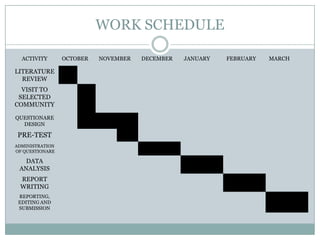
WORK SCHEDULE
ACTIVITY

LITERATURE
REVIEW
VISIT TO
SELECTED
COMMUNITY
QUESTIONARE
DESIGN

PRE-TEST
ADMINISTRATION
OF QUESTIONARE

DATA
ANALYSIS
REPORT
WRITING
REPORTING,
EDITING AND
SUBMISSION

OCTOBER

NOVEMBER

DECEMBER

JANUARY

FEBRUARY

MARCH
REFERENCES
 Boadu D.Q.(1998) plantation crops

production,Accra,Ghana ,st. mary publishers,pp 1720
 Huang,s, and liu, x.(1995 )”control of post- harvest
stem and rot and mango” Tropical science: volume
354,pp231-235
 Morton,J (1987) fruits of warm
climate.www.mangotreeman.com/mangotree.htm.
REFERENCES CONT
 Raemarkers,RH(2001).crop production in Tropical

Africa,Brussels.Geokint Graphic. Pp 596-609.
 Singh L.B(1960)Tropical fruits.New York: longman
Inc. pp217-232
 Tweneboah,C.K(2001)Modern Agriculture in the
tropics.Accra,Ghana:co-wood publishers.pp278-288
 END OF REPRESENTATION.THANK YOU.

Taacom presentation

  • 1.
    RESEARCH PROPOSAL VALLEY VIEWUNIVERSITY-TECHIMAN CAMPUS RESEARCH TOPIC: ASSESSING INCOME LEVELS AND EXPENDITURE PATTERNS OF MANGO GROWERS. “ A CASE STUDY AT EJURA SEKYE DUMASI MUNICIPALITY” PRESENTATION BY: OWUSU-MANU DANIEL (211AB01000023)
  • 2.
    OUTLINE FOR PRESENTATION 1.INTRODUCTION 1.1 Background 1.2 Statement of Problem 1.3 Research Objectives 1.4 Justification 2. LITERATURE REVIEW 2.1 Origin and Distribution of Mango 2.2 Varieties of Mango 2.3 Diseases and Pests Control in Mango
  • 3.
    OUTLINE FOR PRESENTATIONcont. 3. METHODOLOGY 3.1 The Study Area 3.2 Target Group and Sample Size 3.3Research Design 3.4 Instruments for data collection 3.5 Tested-Try-Out 3.6 Questionnaire Administration 3.7 Data Analysis 4. WORK PLAN FOR PROJECT 5. REFERENCES
  • 4.
    1.0 INTRODUCTION 1.1 BACKGROUNDTO THE STUDY  Mango became one of the fruit crops for the food canneries. This resulted in the establishment of mango plantations in Ghana to increase the production of mango, Boadu (1998).  It was first introduced to Africa in the middle of 19th Century during the European penetration into Africa. Further introduction was made by the United States Agency for International Development (USAID).
  • 5.
    1.0 INTRODUCTION cont It was first introduced to Africa in the middle of 19th Century during the European penetration into Africa. Further introduction was made by the United States Agency for International Development (USAID).  The ripe fruit contains 84% water, 10 to 20% sugars and small amount of fruit acid, minerals, fats and protein. The fruit is also important source of vitamin B and C.
  • 6.
    1.0 INTRODUCTION cont The kernel inside the stone of mango is roasted and powdered, it is then cooked and used in several parts of India as human food in times of scarcity. Mango can also be fermented to vinegar, wine and brandy.  Spacing used for mango varies from 9m x 9m to 10.5 x 10.5m depending on the variety.
  • 7.
    1.2 STATEMENT OFTHE PROBLEM  Establishment of mango plantation in Ejura-Sekye Dumasi Municipal has increased considerably in recent years as a result of improving climate potentials to support mango production.  Farmers in the study area are putting up buildings, their children are in school as well as improved standard of living.  The problem of the farmers in the area is that most farmers do not document or estimate the income and expenditure from their mango produce.  This study seeks to estimate the income and the expenditure of farmers in order to determine whether farmers are making profit and loss.
  • 8.
    1.2 STATEMENT OFTHE PROBLEM cont.  Others who want to go into mango production will have a comprehensive information on mango production and this information can be utilized by farmers in the study area, investors, government and non-governmental organizations.
  • 9.
    1.3 MAIN OBJECTIVE The main objective of the study is to assess the income levels and expenditure patterns of mango growers in Ejura-Sekye Dumasi Municipality. SPECIFIC OBJECTIVE  Estimate the cost of land acquisition  Estimate the cost of planting materials and agronomic practices  Estimate labour cost  Demand for and market accessibility of mango
  • 10.
    1.4 JUSTIFICATION  Likeany other research the study shall finally come out with conclusions and recommendations which may serve as the basis for other future research.  Such recommendations if adopted could go a long way to boost mango production in the study area. The study would come out with sufficient and reliable information on mango production such as cost of land acquisition, cost of planting materials, cost of agronomic practices, demand for mango and accessibility of market.  Findings would help to increase export of mangoes which will generate foreign exchange.
  • 11.
    2.0 LITERATURE REVIEW 2.1ORIGIN AND DISTRIBUTION OF MANGO  Mango (Mangifera indica), from the family Anacardeacea. The name indica suggests an Indian origin, but it is more likely that the origin lies in the Burma-Malaysian region (Samson, 1986). India is the largest single producer of mango. However the fruit is found throughout the tropics.  Raemaekers (2001) also reported that mango is one of the oldest cultivated fruit tree and originated in India or the Malaysian archipelago.  Mango was first taken to South Africa from Goa near Bombay by the Portuguese in the 17th Century, and had spread through out West Africa by the middle of the 19th Century.  The major producing countries in Africa are Kenya, Mali, Senegal, Burkina Faso, Congo, La Coted`ivoire and Ghana (Rice etal 1987)
  • 12.
    2.2 VARIETIES OFMANGO  There are several varieties of mangoes in India (Rao, 2000). The first West African mango is fibrous with a strong flavor but improved Indian and West Indian mangoes as well as varieties from Sri Lanka and Australia have been introduced. These varieties are large, sweeter and less fibrous than local varieties.  In Africa, the cultivars are apple, dodo, keith, palmer, harries, batawi, kene, julie, kensigton and hardden.  According to Tweneboa (2001), the United State Agency for International Development (USAID) has established a budwood garden at Somanya in the Eastern Region of Ghana with varieties such as alphonse, sunset, rud early gold, kent, jaffna, sunrise, keitt and springfield. However, varieties mainly produced in Ghana include; keitt, kent, jaffna and palmer.
  • 13.
    2.3 DISEASES ANDPESTS CONTROL IN MANGO  The major disease of mango is anthracnose caused by the fungus Gloesporium mangifera. It affects the plants by shedding off the flower and young fruits by spotting the ripe fruits.  According to Morton (1987), Erwina mangifera and pseudomomonas mangifera indicae are sources of bacteria black spots.  All these diseases affect the leaves, fruits and flowers. A sequential spraying with Dithane m-45, Kocide and benlate, control the disease of mango.
  • 14.
    2.3 DISEASES ANDPESTS CONTROL IN MANGO cont.  The major pest of mango include mealybug (Planococcus citril), fruit piercing moths, thrips (sclenothrips), scale insects (Appidiostus destructor) and seed weevil. These pests affect the stem, leaves, flowers and fruits. The best control is spray with dimethoate and dieldrin.  Post harvest diseases are diplodia nantalensis and Botryodiplodia theobrome. Toxicity tests show that a mixture of benomyl and quazantine or imazalil is effective for controlling post harvest diseases (Huang-Liu, 1995)
  • 15.
    3.0 METHODOLOGY 3.1 THESTUDY AREA  Ejura-Sekye Dumasi Municipal is located in the Ashanti region of Ghana. The district capital is Ejura which is located at about 92km from Kumasi the Ashanti Regional Capital. The District covers an area of 1,782.2km square and is about 7.3% of the total area of Ashanti Region.  The District has a population of 101,826, out of which 51.77% are males whiles 48.23% are females (2010 Population and Housing Census). The major occupation of the people is farming, and it constitutes about 70% of the human activities in the area. Food crops grown in the area are; cereals, legumes, and the common tree crops and mango and cashew.
  • 16.
    3.2 TARGET GROUPAND SAMPLE SIZE  The research will target mango farmers in the study area.  A random sample method will be used to select ten (10) villages among the mango producing communities.  In each village, ten (10) farmers will be randomly selected given a total sample population of 100 farmers as the total sample size for the study.
  • 17.
    3.3 RESEARCH DESIGN The research will be conducted on the sample population using a set of questionnaires and survey.  The data will involve;  Primary data (questionnaires) and secondary data (documented information)
  • 18.
    3.4 INSTRUMENT FORDATA COLLECTION  The main instrument for data collection will be questionnaires designed to suit the study. Some of the issues in the questionnaire include cost of land acquisition, cost of planting materials, cost of agronomic practices, cost of labour, demand for mango and market accessibility.  Key informants; papaya and mango growers and exporters association of Ghana.
  • 19.
    3.5 TESTED-TRY-OUT  Thequestionnaire will be pre-tested in one of the selected villages to ascertain the bottlenecks that can hinder the smooth administration of the questionnaire.
  • 20.
    3.6 QUESTIONNAIRE ADMINISTRATION  Toensure independent expression of opinions and ideas on the part of the respondents, the questionnaire will be administered on individual basis and the responses will be treated confidentially.
  • 21.
    3.7 DATA ANALYSIS Every response will be subjected to analysis, tallies will be formed to determine the frequencies of responses. The percentage values will be calculated from the absolute values.
  • 22.
    EXPECTED OUTCOME  Atthe end of the study others who want to go into mango production will have a comprehensive information on mango production and this information can be utilized by farmers in the study area, investors, government and non-governmental organizations
  • 23.
    WORK SCHEDULE ACTIVITY LITERATURE REVIEW VISIT TO SELECTED COMMUNITY QUESTIONARE DESIGN PRE-TEST ADMINISTRATION OFQUESTIONARE DATA ANALYSIS REPORT WRITING REPORTING, EDITING AND SUBMISSION OCTOBER NOVEMBER DECEMBER JANUARY FEBRUARY MARCH
  • 24.
    REFERENCES  Boadu D.Q.(1998)plantation crops production,Accra,Ghana ,st. mary publishers,pp 1720  Huang,s, and liu, x.(1995 )”control of post- harvest stem and rot and mango” Tropical science: volume 354,pp231-235  Morton,J (1987) fruits of warm climate.www.mangotreeman.com/mangotree.htm.
  • 25.
    REFERENCES CONT  Raemarkers,RH(2001).cropproduction in Tropical Africa,Brussels.Geokint Graphic. Pp 596-609.  Singh L.B(1960)Tropical fruits.New York: longman Inc. pp217-232  Tweneboah,C.K(2001)Modern Agriculture in the tropics.Accra,Ghana:co-wood publishers.pp278-288
  • 26.
     END OFREPRESENTATION.THANK YOU.