 Elephant Foot Yam
Scientific name: Amorphophallus campanulatus ( Roxburg )
Blume ( Amorphophallus paeoniifolius
Common name: Suran , Zamikand , whitespot gaint aurm
Family: Araceae
Chromosome number : 2n=2x=28
Centre of origin: India and south east Asia
Mode of pollination: cross pollinated crop
Progenitor: Amorphophallus paeoniifolius
Edible part: corms (modified stem)
Edible species found in india : A.companulatus
A.rievieri
A.oncophyllus , A. variabilis
 Nutritive value and medicinal uses
• Its corms are mainly used for preparation of curries,
Gulab jamuns, pickles and baked to uses in different
ways
• The petioles also used after boiling as like asparagus
• Its tubers are cheapest source of carbohydrates 24
starch 18 4 g), 1 5 protein( 1 2 g), 0 1 g fat and rich in
minerals and vitamins A 434 IU& Bcomplex leaves
contains 2 3 protein 3 carbohydrates and 4 7 crude
• this it has variety of medicinal uses and widely prescribed
by ayurvedic physicians
• It is also recommended for piles, dysentery, asthma,
swelling of lungs, vomiting, abdominal pain and as a
blood purifier The pasted made form corms are applied
externally to minimize pain in arthritis
 Botany
• Plants are grown upto a height of about 1 –1.25
m
• Roots it is a shallow and fibrous rooted crop
• The aerial pseudo stem which is round with
characteristic irregular blotches is botanically a leaf
petiole
Climatic requirements
• EFY is a warm season vegetable crop grown in
both sub tropical and tropical climate
• It prefers humid and warm weather during
vegetative growth with temperate of 25-35֯C
• The crop can be successfully grown at a
temperature range of 20 35 ֯C with optimum
soil temperature of 22 3030֯C
• The plant growth is reduced when
temperature falls below 20֯C
• Partial shade of about 50 60 is known to
promote tuber production
 Soil requirements
• It requires well drained, friable, fertile, sandy
loam soils
• Heavy soils are not suited for its cultivation
Varieties
• First genetically improved variety in the
world: Sree Athira
• Non acrid varieties :Gajendra Santhragachi
Kovuur
• Acrid varieties : Sree Padma, Bidhan
Kusum
• Sree Athira First genetically improved variety with
very ​
• Sree Padma : Non acrid tubers, generally have one
mother corm and a few cormels Variety has
developed at CTCRI, Trivandrum It has a yield
potential of 40 tonnes per hectare
• Bidhan Kusum This variety was developed by
Vidhan
ChandraKrishi Viswavidyalaya West Bengal
• Palam Zimikand 1 Released from C.S.K.H.P.K.V.
Palampur
Propagation
• Elephant foot yam is commercially propagated vegetatively
by using either whole tuber(corm) or cut tubers
• Whole tubers should be preferred over cut tubers to
minimize rotting
• Whole tubers having 500 1000 g weight used for
cultivation to get higher yield
• Corms weighing 400 500 g are found to be optimum
planting material for commercial crop
• Before planting whole corm/corm pieces are treated in thick
slurry comprising of 0 2 mancozeb, 0 05 monochrotophos,
Trichoderma formulation and cow dung
 Planting time, seed rate and method of planting
• In most parts of India generally planted in March and
April under irrigation facility
The seed rate varies from 5 7 tones /ha depending upon
spacing and variety
• Corms weighing 500 g and planted at a distance of 90 cm x
90 cm, thus thereby require the seed corms of about 6 t/ha
• Corm weighing 250 300 g and planted at 60 cm x 60 cm
distance will requires the seed corms of about 7 t/ha
• The distance of pits depends on the size of planting
material and variety used
• Corms weighing 500 g, 600 g, 750 g and 1 kg should
be planted in pits of 50 cm x 50 cm, 60 cm x 60 cm, 75
cm x 75 cm and 90 cm x 90 cm, respectively
• Depth of the planting 10 - 12 cm
 DISEASES & PESTS
• collar rot : caused by the soil-borne
fungus Sclerotium rolfsii
• Mosaic disease: Caused by the Dasheen mosaic virus
(DsMV)
• Anthracnose: Caused by Colletotrichum siamense
• Mealybug (Rhizoecus amorphophalli)
 Harvesting
• The crop is harvested after 6 7 months from
planting
• Yellowing and drooping down of the leaves are the
signs of maturity of the crop
• It can be stored for several months in well
ventilated rooms without any damage
• The average corm yield ranges from 12 to 22 tonnes
per hectare, depending on the weight of seed corm,
soil type and nutrition applied
 Yield
Elephant foot yam is a profitable stem tuber crop and the
name its self derived from its huge, heavy solitary tubers
that look like elephant foot it is gaining its popularity as a
cooked vegetable due to its shade tolerance, easiness in
cultivation, high productivity, less incidence of pest and
diseases, steady demand and reasonably good price
Three species are mainly cultivated in India :
 YAMS
Greater yam/Winged yam/Water yam/Ratalu :
Diascoria alata
Lesser yam/Chinese yam/Sweet yam/Sutani : Diascoria
esculenta
White yam/African yam/Guinea yam : Diascoria
rotundata
Origin : Indo-Burma region
Edible part : Tubers
Chromosome number: 2n=4x-
40
It is a staple food crop as well as a cash crop in Western
Africa, especially in Nigeria. It is a rich source of
carbohydrates, certain vitamins and has high calorific value.
In India, yams, particularly greater yam is grown in the
States such as Kerala, Tamil Nadu, Andhra Pradesh, Orissa,
Maharashtra, West Bengal, Madhya Pradesh, Gujarat and
North Eastern States
Yam tubers are rich in "carbohydrate" (White yam
contains 25% carbohydrates)
"Diosgenin", an alkaloid extracted from tubers and it is
used to prepare contraceptive drugs, which are used in
family planning
'Fuyu' is a product made from yams Yam flour' is also
used for human consumption as kokonte
Africa alone produces 90% tubers and covers 95% area
Lesser yam is sweeter and matures early compared to
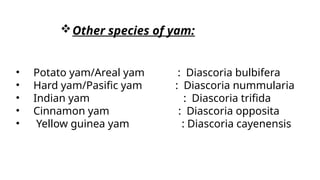
• Potato yam/Areal yam : Diascoria bulbifera
• Hard yam/Pasific yam : Diascoria nummularia
• Indian yam : Diascoria trifida
• Cinnamon yam : Diascoria opposita
• Yellow guinea yam : Diascoria cayenensis
Other species of yam:
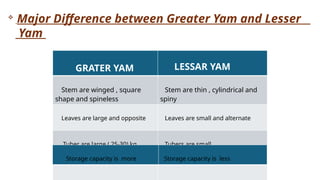
GRATER YAM LESSAR YAM
Stem are winged , square
shape and spineless
Stem are thin , cylindrical and
spiny
Leaves are large and opposite Leaves are small and alternate
Tuber are large ( 25-30) kg Tubers are small
Storage capacity is more Storage capacity is less

Major Difference between Greater Yam and Lesser
Yam
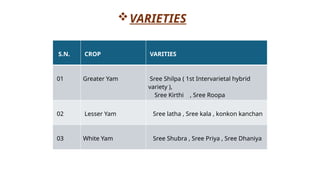
S.N. CROP VARITIES
01 Greater Yam Sree Shilpa ( 1st Intervarietal hybrid
variety ),
Sree Kirthi , Sree Roopa
02 Lesser Yam Sree latha , Sree kala , konkon kanchan
03 White Yam Sree Shubra , Sree Priya , Sree Dhaniya
VARIETIES
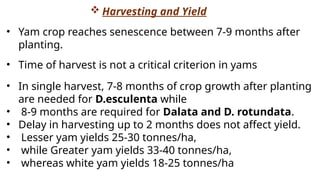
• In single harvest, 7-8 months of crop growth after planting
are needed for D.esculenta while
• 8-9 months are required for Dalata and D. rotundata.
• Delay in harvesting up to 2 months does not affect yield.
• Lesser yam yields 25-30 tonnes/ha,
• while Greater yam yields 33-40 tonnes/ha,
• whereas white yam yields 18-25 tonnes/ha
• Time of harvest is not a critical criterion in yams
• Yam crop reaches senescence between 7-9 months after
planting.
 Harvesting and Yield
• Botanical name = Pachyrrhizus erosus
• Common name = Yam bean, Potato bean.
• Family = Leguminaceae
• Other name =Ahipa , Bunga , Jicama , sankalu (Ind
• Origin =
Mexico and Northern South America
 YAM BEAN
• Yam plants have thick tubers (generally a
development of the base of the stem) which
often have thick, almost bark like skin.
• The long, slender, annual, climbing stems bear
lobed or entire leaves that are either alternate
or opposite.
• The unisexual flowers are borne in long
clusters.
 BOTANY
There are two types of cultivars available in market
Mexican type have larger tubers (500- 700g) in size,
whereas local types have smaller tubers (200-300g).
The Mexican types are less sweet compared to local types.
The Mexican types have tendency to develop cracks on
their tubers.
They are less preferred in the indian markets.
The local types having smaller tubers are more sweet
The flesh is white with less fibre, there is no cracking
 VARITIES
Rajendra Mishrikand-1 (RM-I)
• An improved variety by seedling selection
developed at RAU, Dholi
• . Tubers are good quality and suitable for
intercropping with kharif maize and arhar.
• Duration 110-140 days and it gives an
average yield of 35 tonnes/ha.
• It is recommended for cultivation in Bihar and
West Bengal
Yam bean is propagated usually through seeds the
seed pods are generally 7-15cm long with 8-10cm
brownish-yellow to red seeds, seeds are
dorsiventrally flat.
Plants can also be raised from sprouted roots of
previous crop but normally it is not practised.
The seed rate varies according to spacing of the
crop.
 PROPOGATION
• A seed rate of 20-60 kg/ha is generally adopted.​
• The mature pods containing seeds are source
of a toxic substance insecticidal compound
rotenone and are sometimes harmful for
grazing cattle's in the field.
 HARVESTING
• It can be harvested early or late according to market
demand.
• It is possible to harvest the crop with smaller-sized tubers
after 100 days.
• Otherwise it can be left in the field up to 140 days for
better size.
• Traditionally the trend is to harvest the crop occasion of
Saraswati Puja with the start of spring season because of
• Delayed harvest leads to fibrous flesh along with cracks
in tubers ,
• This causes deterioration in tuber quality in market.​
• A light irrigation should be given to soften the soil
before harvesting.​
• First top vegetative part is removed then tubers are
dug manually ,
• Care should be taken to avoid cuts and bruises on
tubers​
On an average yield of local cultivars 18-20 tonnes/ha,
where as Rajendra Mishri 1, 36- 40 tonnes/ha.
For staggering, the tubers are left in the field after
removing their tops.
The seed crop should be harvested after 240 days
during March April.
After harvesting, tubers are thoroughly washed in
water .

EPY , YAMS, YAM BEAN.pptx and difference

  • 1.
     Elephant FootYam Scientific name: Amorphophallus campanulatus ( Roxburg ) Blume ( Amorphophallus paeoniifolius Common name: Suran , Zamikand , whitespot gaint aurm Family: Araceae Chromosome number : 2n=2x=28 Centre of origin: India and south east Asia
  • 2.
    Mode of pollination:cross pollinated crop Progenitor: Amorphophallus paeoniifolius Edible part: corms (modified stem) Edible species found in india : A.companulatus A.rievieri A.oncophyllus , A. variabilis
  • 3.
     Nutritive valueand medicinal uses • Its corms are mainly used for preparation of curries, Gulab jamuns, pickles and baked to uses in different ways • The petioles also used after boiling as like asparagus • Its tubers are cheapest source of carbohydrates 24 starch 18 4 g), 1 5 protein( 1 2 g), 0 1 g fat and rich in minerals and vitamins A 434 IU& Bcomplex leaves contains 2 3 protein 3 carbohydrates and 4 7 crude
  • 4.
    • this ithas variety of medicinal uses and widely prescribed by ayurvedic physicians • It is also recommended for piles, dysentery, asthma, swelling of lungs, vomiting, abdominal pain and as a blood purifier The pasted made form corms are applied externally to minimize pain in arthritis
  • 5.
     Botany • Plantsare grown upto a height of about 1 –1.25 m • Roots it is a shallow and fibrous rooted crop • The aerial pseudo stem which is round with characteristic irregular blotches is botanically a leaf petiole
  • 6.
    Climatic requirements • EFYis a warm season vegetable crop grown in both sub tropical and tropical climate • It prefers humid and warm weather during vegetative growth with temperate of 25-35֯C • The crop can be successfully grown at a temperature range of 20 35 ֯C with optimum soil temperature of 22 3030֯C
  • 7.
    • The plantgrowth is reduced when temperature falls below 20֯C • Partial shade of about 50 60 is known to promote tuber production  Soil requirements • It requires well drained, friable, fertile, sandy loam soils • Heavy soils are not suited for its cultivation
  • 8.
    Varieties • First geneticallyimproved variety in the world: Sree Athira • Non acrid varieties :Gajendra Santhragachi Kovuur • Acrid varieties : Sree Padma, Bidhan Kusum • Sree Athira First genetically improved variety with very ​
  • 9.
    • Sree Padma: Non acrid tubers, generally have one mother corm and a few cormels Variety has developed at CTCRI, Trivandrum It has a yield potential of 40 tonnes per hectare • Bidhan Kusum This variety was developed by Vidhan ChandraKrishi Viswavidyalaya West Bengal • Palam Zimikand 1 Released from C.S.K.H.P.K.V. Palampur
  • 10.
    Propagation • Elephant footyam is commercially propagated vegetatively by using either whole tuber(corm) or cut tubers • Whole tubers should be preferred over cut tubers to minimize rotting • Whole tubers having 500 1000 g weight used for cultivation to get higher yield • Corms weighing 400 500 g are found to be optimum planting material for commercial crop • Before planting whole corm/corm pieces are treated in thick slurry comprising of 0 2 mancozeb, 0 05 monochrotophos, Trichoderma formulation and cow dung
  • 11.
     Planting time,seed rate and method of planting • In most parts of India generally planted in March and April under irrigation facility The seed rate varies from 5 7 tones /ha depending upon spacing and variety • Corms weighing 500 g and planted at a distance of 90 cm x 90 cm, thus thereby require the seed corms of about 6 t/ha • Corm weighing 250 300 g and planted at 60 cm x 60 cm distance will requires the seed corms of about 7 t/ha
  • 12.
    • The distanceof pits depends on the size of planting material and variety used • Corms weighing 500 g, 600 g, 750 g and 1 kg should be planted in pits of 50 cm x 50 cm, 60 cm x 60 cm, 75 cm x 75 cm and 90 cm x 90 cm, respectively • Depth of the planting 10 - 12 cm
  • 13.
     DISEASES &PESTS • collar rot : caused by the soil-borne fungus Sclerotium rolfsii • Mosaic disease: Caused by the Dasheen mosaic virus (DsMV) • Anthracnose: Caused by Colletotrichum siamense • Mealybug (Rhizoecus amorphophalli)
  • 14.
     Harvesting • Thecrop is harvested after 6 7 months from planting • Yellowing and drooping down of the leaves are the signs of maturity of the crop • It can be stored for several months in well ventilated rooms without any damage
  • 15.
    • The averagecorm yield ranges from 12 to 22 tonnes per hectare, depending on the weight of seed corm, soil type and nutrition applied  Yield
  • 16.
    Elephant foot yamis a profitable stem tuber crop and the name its self derived from its huge, heavy solitary tubers that look like elephant foot it is gaining its popularity as a cooked vegetable due to its shade tolerance, easiness in cultivation, high productivity, less incidence of pest and diseases, steady demand and reasonably good price
  • 18.
    Three species aremainly cultivated in India :  YAMS Greater yam/Winged yam/Water yam/Ratalu : Diascoria alata Lesser yam/Chinese yam/Sweet yam/Sutani : Diascoria esculenta White yam/African yam/Guinea yam : Diascoria rotundata
  • 19.
    Origin : Indo-Burmaregion Edible part : Tubers Chromosome number: 2n=4x- 40 It is a staple food crop as well as a cash crop in Western Africa, especially in Nigeria. It is a rich source of carbohydrates, certain vitamins and has high calorific value. In India, yams, particularly greater yam is grown in the States such as Kerala, Tamil Nadu, Andhra Pradesh, Orissa, Maharashtra, West Bengal, Madhya Pradesh, Gujarat and North Eastern States
  • 20.
    Yam tubers arerich in "carbohydrate" (White yam contains 25% carbohydrates) "Diosgenin", an alkaloid extracted from tubers and it is used to prepare contraceptive drugs, which are used in family planning 'Fuyu' is a product made from yams Yam flour' is also used for human consumption as kokonte Africa alone produces 90% tubers and covers 95% area Lesser yam is sweeter and matures early compared to
  • 21.
    • Potato yam/Arealyam : Diascoria bulbifera • Hard yam/Pasific yam : Diascoria nummularia • Indian yam : Diascoria trifida • Cinnamon yam : Diascoria opposita • Yellow guinea yam : Diascoria cayenensis Other species of yam:
  • 22.
    GRATER YAM LESSARYAM Stem are winged , square shape and spineless Stem are thin , cylindrical and spiny Leaves are large and opposite Leaves are small and alternate Tuber are large ( 25-30) kg Tubers are small Storage capacity is more Storage capacity is less  Major Difference between Greater Yam and Lesser Yam
  • 23.
    S.N. CROP VARITIES 01Greater Yam Sree Shilpa ( 1st Intervarietal hybrid variety ), Sree Kirthi , Sree Roopa 02 Lesser Yam Sree latha , Sree kala , konkon kanchan 03 White Yam Sree Shubra , Sree Priya , Sree Dhaniya VARIETIES
  • 24.
    • In singleharvest, 7-8 months of crop growth after planting are needed for D.esculenta while • 8-9 months are required for Dalata and D. rotundata. • Delay in harvesting up to 2 months does not affect yield. • Lesser yam yields 25-30 tonnes/ha, • while Greater yam yields 33-40 tonnes/ha, • whereas white yam yields 18-25 tonnes/ha • Time of harvest is not a critical criterion in yams • Yam crop reaches senescence between 7-9 months after planting.  Harvesting and Yield
  • 26.
    • Botanical name= Pachyrrhizus erosus • Common name = Yam bean, Potato bean. • Family = Leguminaceae • Other name =Ahipa , Bunga , Jicama , sankalu (Ind • Origin = Mexico and Northern South America  YAM BEAN
  • 27.
    • Yam plantshave thick tubers (generally a development of the base of the stem) which often have thick, almost bark like skin. • The long, slender, annual, climbing stems bear lobed or entire leaves that are either alternate or opposite. • The unisexual flowers are borne in long clusters.  BOTANY
  • 28.
    There are twotypes of cultivars available in market Mexican type have larger tubers (500- 700g) in size, whereas local types have smaller tubers (200-300g). The Mexican types are less sweet compared to local types. The Mexican types have tendency to develop cracks on their tubers. They are less preferred in the indian markets. The local types having smaller tubers are more sweet The flesh is white with less fibre, there is no cracking  VARITIES
  • 29.
    Rajendra Mishrikand-1 (RM-I) •An improved variety by seedling selection developed at RAU, Dholi • . Tubers are good quality and suitable for intercropping with kharif maize and arhar. • Duration 110-140 days and it gives an average yield of 35 tonnes/ha. • It is recommended for cultivation in Bihar and West Bengal
  • 30.
    Yam bean ispropagated usually through seeds the seed pods are generally 7-15cm long with 8-10cm brownish-yellow to red seeds, seeds are dorsiventrally flat. Plants can also be raised from sprouted roots of previous crop but normally it is not practised. The seed rate varies according to spacing of the crop.  PROPOGATION
  • 31.
    • A seedrate of 20-60 kg/ha is generally adopted.​ • The mature pods containing seeds are source of a toxic substance insecticidal compound rotenone and are sometimes harmful for grazing cattle's in the field.
  • 32.
     HARVESTING • Itcan be harvested early or late according to market demand. • It is possible to harvest the crop with smaller-sized tubers after 100 days. • Otherwise it can be left in the field up to 140 days for better size. • Traditionally the trend is to harvest the crop occasion of Saraswati Puja with the start of spring season because of
  • 33.
    • Delayed harvestleads to fibrous flesh along with cracks in tubers , • This causes deterioration in tuber quality in market.​ • A light irrigation should be given to soften the soil before harvesting.​ • First top vegetative part is removed then tubers are dug manually , • Care should be taken to avoid cuts and bruises on tubers​
  • 34.
    On an averageyield of local cultivars 18-20 tonnes/ha, where as Rajendra Mishri 1, 36- 40 tonnes/ha. For staggering, the tubers are left in the field after removing their tops. The seed crop should be harvested after 240 days during March April. After harvesting, tubers are thoroughly washed in water .