Fermented beverages
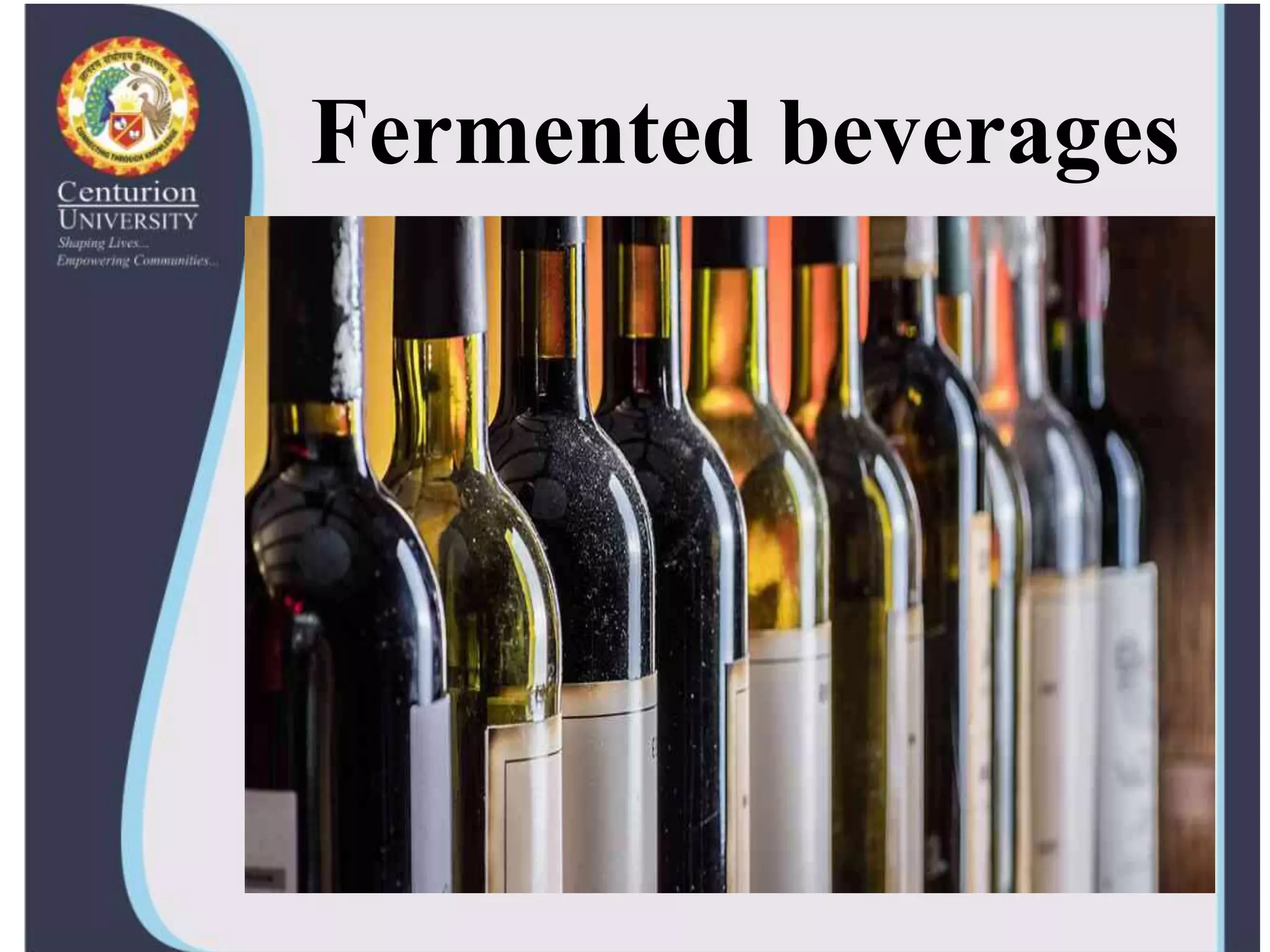
Fermented beverages
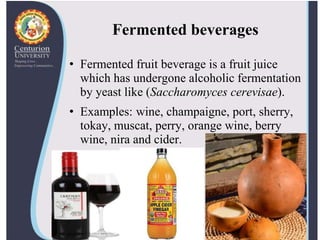
• Fermented fruit beverage is a fruit juice
which has undergone alcoholic fermentation
by yeast like (Saccharomyces cerevisae).
• Examples: wine, champaigne, port, sherry,
tokay, muscat, perry, orange wine, berry
wine, nira and cider.
Why are they prepared.?
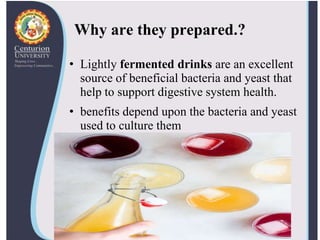
• Lightly fermented drinks are an excellent
source of beneficial bacteria and yeast that
help to support digestive system health.
• benefits depend upon the bacteria and yeast
used to culture them
History.
• Lavoisier(1789)- analyzed the chemical
composition of sugar and its components
like ethanol, carbon di oxide and traces of
acetic acid.
• Louis Pasteur- demonstrated the existence of
other compounds like glycerol and succinic
acids.
• Grape wine is the oldest example.
Wine.
• Wine is a beverage resulting from the
fermentation by yeasts of the grape juice
with proper processing and addition.
• Light wine - 7 to9% alcohol
• Medium wine - 9 to 16% alcohol
• Strong wine - 16 to 21% alcohol
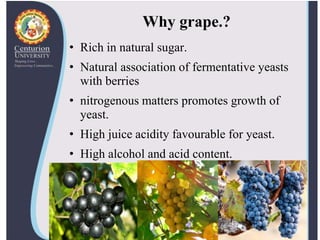
Why grape.?
• Rich in natural sugar.
• Natural association of fermentative yeasts
with berries
• nitrogenous matters promotes growth of
yeast.
• High juice acidity favourable for yeast.
• High alcohol and acid content.
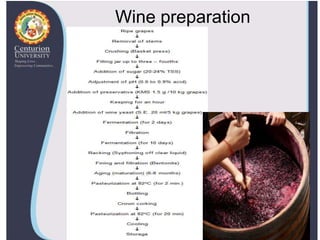
Wine preparation
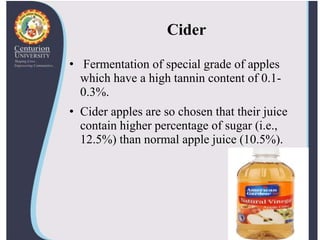
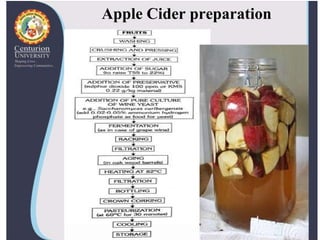
Cider
• Fermentation of special grade of apples
which have a high tannin content of 0.1-
0.3%.
• Cider apples are so chosen that their juice
contain higher percentage of sugar (i.e.,
12.5%) than normal apple juice (10.5%).
Apple Cider preparation
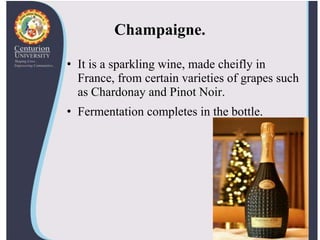
Champaigne.
• It is a sparkling wine, made cheifly in
France, from certain varieties of grapes such
as Chardonay and Pinot Noir.
• Fermentation completes in the bottle.
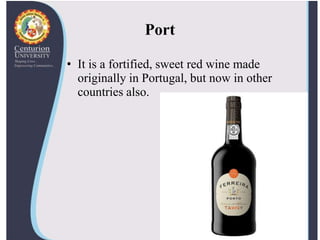
Port
• It is a fortified, sweet red wine made
originally in Portugal, but now in other
countries also.
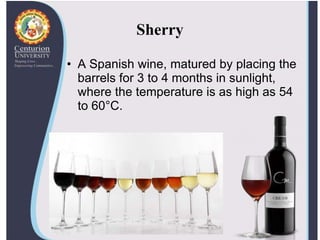
Sherry
• A Spanish wine, matured by placing the
barrels for 3 to 4 months in sunlight,
where the temperature is as high as 54
to 60°C.
Tokay
This is a very famous fortified wine made in
Hungary.
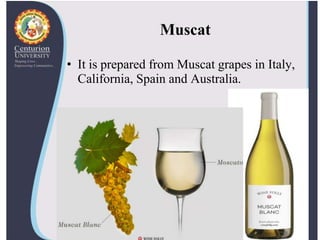
Muscat
• It is prepared from Muscat grapes in Italy,
California, Spain and Australia.
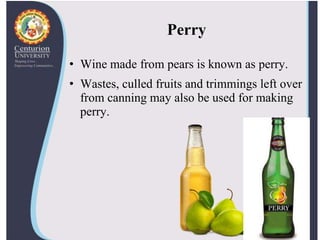
Perry
• Wine made from pears is known as perry.
• Wastes, culled fruits and trimmings left over
from canning may also be used for making
perry.
Orange wine
• Orange juice is sweetened by adding sugar
and then allowed to ferment.
• Orange oil should not be added as it may
hinder fermentation.
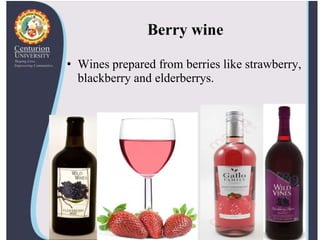
Berry wine
• Wines prepared from berries like strawberry,
blackberry and elderberrys.
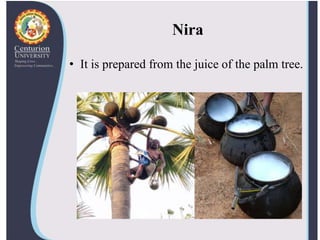
Nira
• It is prepared from the juice of the palm tree.
Feni
• This is a fermented wine made from cashew
apple in Goa.
Advantages
• support the digestive system .
• support liver health.
• Probiotic-rich foods and drinks also support
oral health.
• Probiotic-rich foods helps incombatting
illness and in mitigating autoimmune
disease
Disadvantages
On excessive consumption it may lead to:
• heart problems
• stroke
• fatty liver disease
• liver damage
• mental health conditions
• certain cancers
• pancreatitis
Unfermented
beverages
Unfermented beverages
• Fruit juices which do not undergo alcoholic
fermentation are termed as unfermented
beverages.
• They include natural fruit juices, sweetened,
ready to serve drinks, nectar, cordial, squash,
crush, syrup, fruit juice concentrate and fruit
juice powder.
Preparation and preservation of
unfermented fruit beverages
(i) Selection of fruit
• Only fully ripe fruits are selected.
ii) Sorting and washing
• Diseased, damaged or decayed fruits are
discarded. Dirt and toxins is removed by
washing.
Contd..
iii) Juice extraction
• extracted from fresh fruit by crushing and
pressing them.
• During extraction juices should not be
unnecessarily exposed to air as it will spoil
the colour, taste and aroma and also reduce
the vitamin content.
Contd..
(iv) Deaeration
• Most of the air as well as other gases are
removed by subjecting the fresh juice to a
high vacuum.
(v) Straining or filtration
• Seeds and pieces of pulp and skin which
adversely affect the quality of juice, are
removed by straining through a thick cloth or
sieve.
• improves the appearance but often results in
disappearance of fruity character and flavour.
Contd…..
(vi) Clarification
• Complete removal of all suspended material
from juice.
Different methods of clarification
a) Settling
• Mixed with a chemical preservative to avoid
fermentation.
• Colloidal pectin, gums, proteins.
mucilaginous solids settle down.
• The juice is used for further treatment.
Contd..
(B) Filtration
• Used to remove completely all fine and
colloidal suspensions.
• filter aid is used to reduce clogging. some of
them are supercel, kieselguhr. spanish clay
and bentonite, which are added to the extent
of 0.1-0.2 per cent.
Contd..
(C) Freezing
• The pasteurized juice kept in a carboy is
frozen at -18°C and thereafter stored for 4 to
7 days at room temperature.
(D) Cold storage
• The juice is stored at -2 - -30C for a month
for the residue to settledown.
Contd…
(E) High temperature
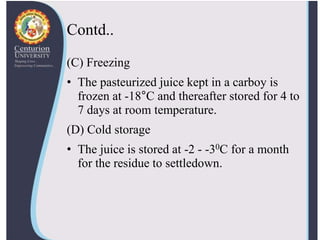
• The juice is heated at
820C for a minute till
the material coagulates
and settle down.
(F) Chemicals
1. Gelatin.
2. Albumen.
3. Casein.
4. Mixture of tannin and
gelatin.
Contd..
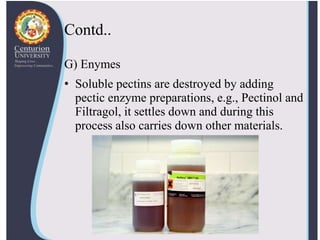
G) Enymes
• Soluble pectins are destroyed by adding
pectic enzyme preparations, e.g., Pectinol and
Filtragol, it settles down and during this
process also carries down other materials.
Contd…
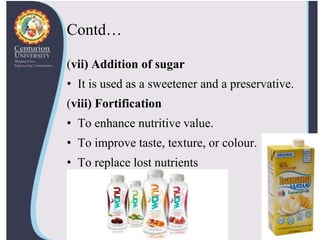
(vii) Addition of sugar
• It is used as a sweetener and a preservative.
(viii) Fortification
• To enhance nutritive value.
• To improve taste, texture, or colour.
• To replace lost nutrients
Contd…
(ix) Preservation
• process of treating and handling food to stop
or greatly slow down spoilage caused or
accelerated by micro-organisms.
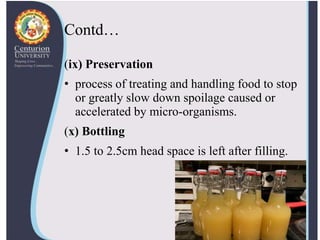
(x) Bottling
• 1.5 to 2.5cm head space is left after filling.
Fruit juice
• It is a liquid product.
• Contains 85% juice and 15% total soluble
solids.
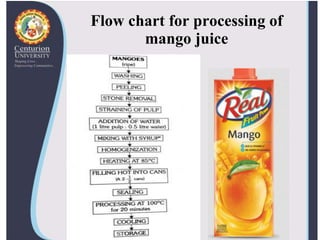
Flow chart for processing of
mango juice
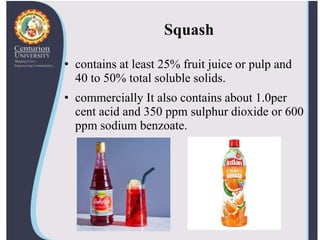
Squash
• contains at least 25% fruit juice or pulp and
40 to 50% total soluble solids.
• commercially It also contains about 1.0per
cent acid and 350 ppm sulphur dioxide or 600
ppm sodium benzoate.
FLOWCHART FOR PROCESSING
OF SQUASH
Ready to serve
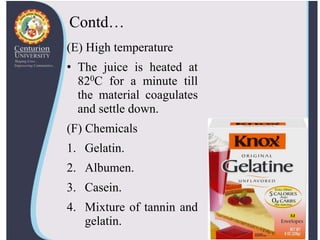
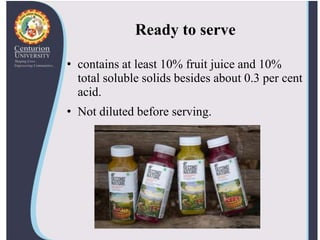
• contains at least 10% fruit juice and 10%
total soluble solids besides about 0.3 per cent
acid.
• Not diluted before serving.
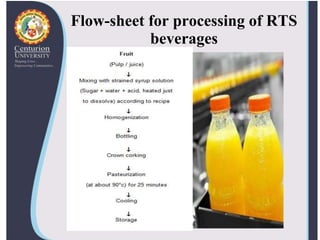
Flow-sheet for processing of RTS
beverages
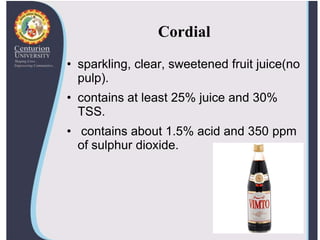
Cordial
• sparkling, clear, sweetened fruit juice(no
pulp).
• contains at least 25% juice and 30%
TSS.
• contains about 1.5% acid and 350 ppm
of sulphur dioxide.
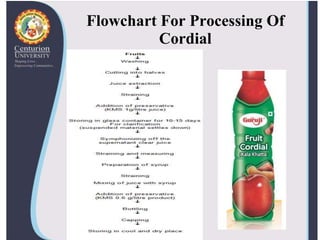
Flowchart For Processing Of
Cordial
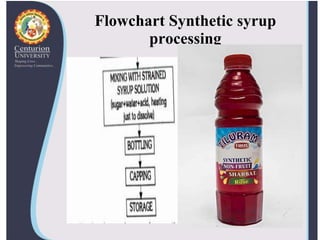
Synthetic syrup
• Contains 75% sugar syrup and 25%artificial
fruit essence.
• Fruit-based syrups do not need preservatives.
• For longer shelflife _350 ppm sulphur
dioxide or 600 ppm benzoic acid (as
required) may be added before bottling.
Flowchart Synthetic syrup
processing
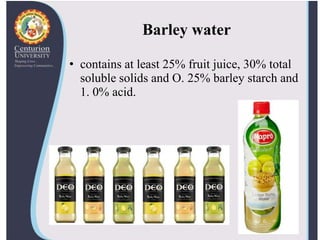
Barley water
• contains at least 25% fruit juice, 30% total
soluble solids and O. 25% barley starch and
1. 0% acid.
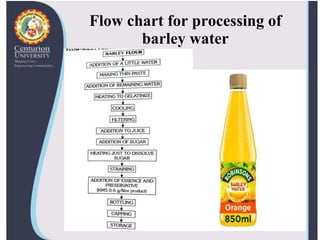
Flow chart for processing of
barley water
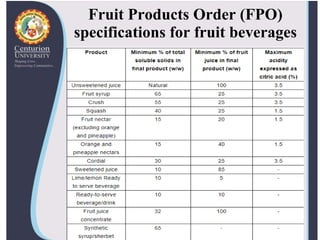
Fruit Products Order (FPO)
specifications for fruit beverages
Fermented-and-unfermented-beverages.pdf

Fermented-and-unfermented-beverages.pdf

  • 1.
  • 2.
    Fermented beverages • Fermentedfruit beverage is a fruit juice which has undergone alcoholic fermentation by yeast like (Saccharomyces cerevisae). • Examples: wine, champaigne, port, sherry, tokay, muscat, perry, orange wine, berry wine, nira and cider.
  • 3.
    Why are theyprepared.? • Lightly fermented drinks are an excellent source of beneficial bacteria and yeast that help to support digestive system health. • benefits depend upon the bacteria and yeast used to culture them
  • 4.
    History. • Lavoisier(1789)- analyzedthe chemical composition of sugar and its components like ethanol, carbon di oxide and traces of acetic acid. • Louis Pasteur- demonstrated the existence of other compounds like glycerol and succinic acids. • Grape wine is the oldest example.
  • 5.
    Wine. • Wine isa beverage resulting from the fermentation by yeasts of the grape juice with proper processing and addition. • Light wine - 7 to9% alcohol • Medium wine - 9 to 16% alcohol • Strong wine - 16 to 21% alcohol
  • 6.
    Why grape.? • Richin natural sugar. • Natural association of fermentative yeasts with berries • nitrogenous matters promotes growth of yeast. • High juice acidity favourable for yeast. • High alcohol and acid content.
  • 7.
  • 8.
    Cider • Fermentation ofspecial grade of apples which have a high tannin content of 0.1- 0.3%. • Cider apples are so chosen that their juice contain higher percentage of sugar (i.e., 12.5%) than normal apple juice (10.5%).
  • 9.
  • 10.
    Champaigne. • It isa sparkling wine, made cheifly in France, from certain varieties of grapes such as Chardonay and Pinot Noir. • Fermentation completes in the bottle.
  • 11.
    Port • It isa fortified, sweet red wine made originally in Portugal, but now in other countries also.
  • 12.
    Sherry • A Spanishwine, matured by placing the barrels for 3 to 4 months in sunlight, where the temperature is as high as 54 to 60°C.
  • 13.
    Tokay This is avery famous fortified wine made in Hungary.
  • 14.
    Muscat • It isprepared from Muscat grapes in Italy, California, Spain and Australia.
  • 15.
    Perry • Wine madefrom pears is known as perry. • Wastes, culled fruits and trimmings left over from canning may also be used for making perry.
  • 16.
    Orange wine • Orangejuice is sweetened by adding sugar and then allowed to ferment. • Orange oil should not be added as it may hinder fermentation.
  • 17.
    Berry wine • Winesprepared from berries like strawberry, blackberry and elderberrys.
  • 18.
    Nira • It isprepared from the juice of the palm tree.
  • 19.
    Feni • This isa fermented wine made from cashew apple in Goa.
  • 20.
    Advantages • support thedigestive system . • support liver health. • Probiotic-rich foods and drinks also support oral health. • Probiotic-rich foods helps incombatting illness and in mitigating autoimmune disease
  • 21.
    Disadvantages On excessive consumptionit may lead to: • heart problems • stroke • fatty liver disease • liver damage • mental health conditions • certain cancers • pancreatitis
  • 22.
  • 23.
    Unfermented beverages • Fruitjuices which do not undergo alcoholic fermentation are termed as unfermented beverages. • They include natural fruit juices, sweetened, ready to serve drinks, nectar, cordial, squash, crush, syrup, fruit juice concentrate and fruit juice powder.
  • 24.
    Preparation and preservationof unfermented fruit beverages (i) Selection of fruit • Only fully ripe fruits are selected. ii) Sorting and washing • Diseased, damaged or decayed fruits are discarded. Dirt and toxins is removed by washing.
  • 25.
    Contd.. iii) Juice extraction •extracted from fresh fruit by crushing and pressing them. • During extraction juices should not be unnecessarily exposed to air as it will spoil the colour, taste and aroma and also reduce the vitamin content.
  • 26.
    Contd.. (iv) Deaeration • Mostof the air as well as other gases are removed by subjecting the fresh juice to a high vacuum. (v) Straining or filtration • Seeds and pieces of pulp and skin which adversely affect the quality of juice, are removed by straining through a thick cloth or sieve. • improves the appearance but often results in disappearance of fruity character and flavour.
  • 27.
    Contd….. (vi) Clarification • Completeremoval of all suspended material from juice. Different methods of clarification a) Settling • Mixed with a chemical preservative to avoid fermentation. • Colloidal pectin, gums, proteins. mucilaginous solids settle down. • The juice is used for further treatment.
  • 28.
    Contd.. (B) Filtration • Usedto remove completely all fine and colloidal suspensions. • filter aid is used to reduce clogging. some of them are supercel, kieselguhr. spanish clay and bentonite, which are added to the extent of 0.1-0.2 per cent.
  • 29.
    Contd.. (C) Freezing • Thepasteurized juice kept in a carboy is frozen at -18°C and thereafter stored for 4 to 7 days at room temperature. (D) Cold storage • The juice is stored at -2 - -30C for a month for the residue to settledown.
  • 30.
    Contd… (E) High temperature •The juice is heated at 820C for a minute till the material coagulates and settle down. (F) Chemicals 1. Gelatin. 2. Albumen. 3. Casein. 4. Mixture of tannin and gelatin.
  • 31.
    Contd.. G) Enymes • Solublepectins are destroyed by adding pectic enzyme preparations, e.g., Pectinol and Filtragol, it settles down and during this process also carries down other materials.
  • 32.
    Contd… (vii) Addition ofsugar • It is used as a sweetener and a preservative. (viii) Fortification • To enhance nutritive value. • To improve taste, texture, or colour. • To replace lost nutrients
  • 33.
    Contd… (ix) Preservation • processof treating and handling food to stop or greatly slow down spoilage caused or accelerated by micro-organisms. (x) Bottling • 1.5 to 2.5cm head space is left after filling.
  • 34.
    Fruit juice • Itis a liquid product. • Contains 85% juice and 15% total soluble solids.
  • 35.
    Flow chart forprocessing of mango juice
  • 36.
    Squash • contains atleast 25% fruit juice or pulp and 40 to 50% total soluble solids. • commercially It also contains about 1.0per cent acid and 350 ppm sulphur dioxide or 600 ppm sodium benzoate.
  • 37.
  • 38.
    Ready to serve •contains at least 10% fruit juice and 10% total soluble solids besides about 0.3 per cent acid. • Not diluted before serving.
  • 39.
    Flow-sheet for processingof RTS beverages
  • 40.
    Cordial • sparkling, clear,sweetened fruit juice(no pulp). • contains at least 25% juice and 30% TSS. • contains about 1.5% acid and 350 ppm of sulphur dioxide.
  • 41.
  • 42.
    Synthetic syrup • Contains75% sugar syrup and 25%artificial fruit essence. • Fruit-based syrups do not need preservatives. • For longer shelflife _350 ppm sulphur dioxide or 600 ppm benzoic acid (as required) may be added before bottling.
  • 43.
  • 44.
    Barley water • containsat least 25% fruit juice, 30% total soluble solids and O. 25% barley starch and 1. 0% acid.
  • 45.
    Flow chart forprocessing of barley water
  • 46.
    Fruit Products Order(FPO) specifications for fruit beverages