o-
h
p
r
o
m
A
s
u
l
l
a
h
p
POTATO AND TUBER CROPS
HVS-302
Presented by:-
DIPIKA BHOI (H/137/22)
DHARA SINGH (H/136/22)
Presented to:-
DR. ARJUN LAL OLA
PAGE
1
Sl.
no
TOPICS Pag
e
no.
01 INTRODUCTION 02
02 SCOPE AND
IMPORTANCE
04
03 USES 05
04 DISTRIBUTION 06
05 AREA & PRODUCTION 07
06 COMPOSITION 08
07 BOTANY 10
08 CULTIVAR 12
09 SOIL 14
10 CLIMATE 16
11 PROPAGATION 17
12 PLANTING MATERIAL 18
13 LAND PREPARATION 20
14 PLANTING 21
15 SPACING 21
16 MANURING & FERTILIZER 22
17 IRRIGATION &
INTERCULTURE
24
INDEX
Sl.
no
TOPICS Pag
e
no.
18 INTERCROPPING 26
19 HARVESTING 28
20 YIELD 30
21 WHOLE SEED CORM
PRODUCTION
30
22 STORAGE 34
23 FUNGAL DISEASES 36
24 VIRAL DISEASES 38
25 INSECT PEST 40
PAGE
3
PAGE
2
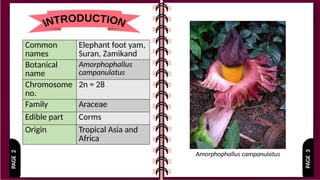
Common
names
Elephant foot yam,
Suran, Zamikand
Botanical
name
Amorphophallus
campanulatus
Chromosome
no.
2n = 28
Family Araceae
Edible part Corms
Origin Tropical Asia and
Africa
Amorphophallus campanulatus
PAGE
5
PAGE
4
• Elephant foot yam is a
remunerative and profitable stem
tuber crop.
• The crop is gaining popularity
due to its shade tolerance,
easiness in cultivation, high
productivity, less incidence of
pests and diseases, steady
demand and reasonably good
price.
• Cultivation of elephant foot yam
is limited to India, Philippines, Sri
Lanka and South East Asia.
IMPORTANCE AND SCOPE
• Chips are made of starch-rich
tubers.
• Tender stem and leaves are also
used for vegetable purpose.
• Corm as a vegetable.
• Preparing curries and pickles.
• Ayurvedic preparations -
recommended for the cure of
piles, dysentery, asthma, swelling
of lungs, vomiting, abdominal
pain and as blood purifier.
• Petioles - cooked as vegetables.
USES
PAGE
7
PAGE
6
DISTRIBUTION
• It has now become a very popular
vegetable in certain areas of the
tropical and subtropical regions.
• It is a crop of South-East Asian
origin, growing wild in the
Philippines, Malaysia, and Indonesia
and South-eastern Asian countries.
• It is commercially grown in India, Sri
Lanka, China, Malaysia, Java,
Philippines and Ceylon.
• In India, it is cultivated on large
scale in Andhra Pradesh, Bihar,
Gujarat, Maharashtra and West
Bengal.
• The genus amorphophallus consist
of about 90 species indigenous to
tropical Asia and Africa.
• About 14 species occur in India.
• The edible species found in India
are A. campanulatus, A.
oncophyllus, A. variabilis, A. rivieri
AREA & PRODUCTION
AREA PRODUCTION
38,000 Ha 874,000 MT
Horticultural statistics at a
glance, 2021
PAGE
9
PAGE
8
COMPOSITION
• Amorphophallus is a cheap source
of carbohydrates and rich in minerals
and vitamin A & B.
• The corms of wild types contain
crystals of calcium oxalate on
account of which they are highly
irritant. In cultivated types, these are
less abundant.
• Tubers contain 18.0% starch, 1-5%
protein and upto 2% fat.
• Leaves contain 2-3% protein, 3%
carbohydrates and 4-7% crude
fibre.
Moisture 78.7 g
Protein 1.2 g
Fat 0.1 g
Carbohydrate 18.4 g
Minerals 0.8 g
Calcium 50 mg
Phosphorus 34 mg
Iron 0.6 mg
Vitamin A 343 I.U
Riboflavin 0.07 mg
Thiamine 0.06 mg
Nicotinic acid 0.7 mg
Composition per 100 gm of edible
portion
PAGE
11
PAGE
10
BOTANY
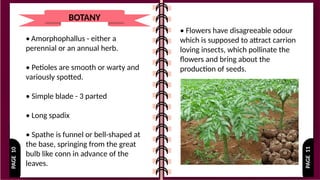
• Amorphophallus - either a
perennial or an annual herb.
• Petioles are smooth or warty and
variously spotted.
• Simple blade - 3 parted
• Long spadix
• Spathe is funnel or bell-shaped at
the base, springing from the great
bulb like conn in advance of the
leaves.
• Flowers have disagreeable odour
which is supposed to attract carrion
loving insects, which pollinate the
flowers and bring about the
production of seeds.
PAGE
13
PAGE
12 CULTIVAR 5)Santragachi -
• Vigorous growth habit
• Corms having slight acridity
• Rough coms with light cream colour
• Bear several daughter corms
• Grown commercially in Eastern India
• Yield about 50-70 tonnes per hectare
6)Kovvur -
• High yielding cultivar
• Vigorous growth habit
• Smooth corns without acridity
• Free from daughter corms
• Grown commercially in the South
India.
• Corm yield exceeds 100 tonnes per
hectare
1)Sree Padma Non- acrid tubers,
generally have one mother corm and
a few cormels. Variety has developed
at CTCRI, Trivandrum. It has a yield
potential of 40 tonnes per hectare.
2)Sree Athira - First genetically
improved variety with very good
cooking quality.
3)Bidhan Kusum- This variety was
developed by Vidhan Chandra Krishi
Viswavidyalaya, West Bengal.
4)Palam Zimikand-1 -Released from
C.S.K.H.P.K.V., Palampur.
PAGE
15
PAGE
14
SOIL
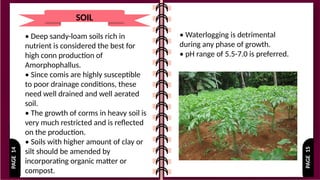
• Deep sandy-loam soils rich in
nutrient is considered the best for
high conn production of
Amorphophallus.
• Since comis are highly susceptible
to poor drainage conditions, these
need well drained and well aerated
soil.
• The growth of corms in heavy soil is
very much restricted and is reflected
on the production.
• Soils with higher amount of clay or
silt should be amended by
incorporating organic matter or
compost.
• Waterlogging is detrimental
during any phase of growth.
• pH range of 5.5-7.0 is preferred.
PAGE
17
PAGE
16
CLIMATE
• lt is a tropical and subtropical
crop.
• lt requires a well distributed rain
fall of 1000-1500 mm, humid and
warm weather with a temperature
of 25-35⁰C during vegetative
growth.
• Hot and humid climate is required
at initial stages of the crop for its
vigorous growth, whereas dry
climate facilitates tuber bulking at
later stage.
• It is usually propagated by offsets
of corms.
• These offsets are the miniature
tubers which grow out of the
parent corms and are called buds
or daughter corms.
• These are initially about 20-25 g
each and take about three to
four seasons to develop into
corms weighing 8-10 kg each.
PROPAGATION
PAGE
19
PAGE
18
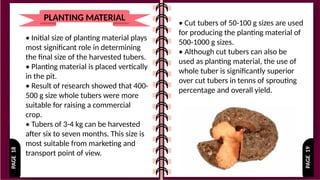
PLANTING MATERIAL
• Initial size of planting material plays
most significant role in determining
the final size of the harvested tubers.
• Planting material is placed vertically
in the pit.
• Result of research showed that 400-
500 g size whole tubers were more
suitable for raising a commercial
crop.
• Tubers of 3-4 kg can be harvested
after six to seven months. This size is
most suitable from marketing and
transport point of view.
• Cut tubers of 50-100 g sizes are used
for producing the planting material of
500-1000 g sizes.
• Although cut tubers can also be
used as planting material, the use of
whole tuber is significantly superior
over cut tubers in tenns of sprouting
percentage and overall yield.
PAGE
21
PAGE
20
LAND PREPARATION
• The land is prepared by ploughing
twice or thrice to a depth of 2022 cm
followed by making pits of size 60 x 60
x 45 cm at a spacing of90 x 90 cm
during February.
• The pits are filled up with sufficient
amount of rotted FYM or cow dung.
• The crop is also grown on flat beds
or broad ridges.
• FYM @ 30 tonnes per hectare
• However, the crop grown on ridges
gives better yield than in flat beds.
• Broad ridge method is generally
practised in high rainfall areas.
PLANTING
South India - February-March
Eastern and other parts of the
country - March-April ,provided
irrigation facilities are ensured as
the crop needs irrigation during
the summer months.
SPACING
The planting should be done at 90 x
90 cm spacing for commercial crop.
PAGE
23
PAGE
22
MANURING & FERTILIZER
 Well-decomposed FYM or
compost is applied @ 25-40
tonnes per hectare.
 80:60:80 kg/ha ofN:P:K is ideal
for commercial crop.
 Fertilizer should be applied in
split doses. The first application
at planting with full dose of P and
half of N and K in the pits along
with FYM helps in the rapid
development at the early stage.
 The second application of
remaining dose of N and K should
be done 60-70 days after
emergence of shoot.
 It should be followed by earthing
up for better bulking of the corm
and good drainage.
PAGE
25
PAGE
24
IRRIGATION &
INTERCULTURE
• Amorphophallus is mainly grown as
a rainfed crop. During periods of late
receipt of monsoon, a light irrigation
is given during early stages of crop.
• Mulching immediately after planting
is the most important operation in
Amorpohophallus.
• When the crop approaches
maturity. irrigation should be light.
• Generally, the crop requires 2-3
weedings before the onset of
monsoon.
• Preplanting application of
Fluchloralin @ 2.0 L per hectare
can replace hand weeding.
PAGE
27
PAGE
26
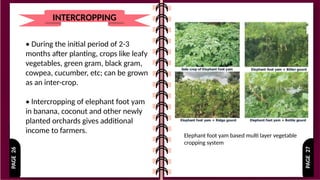
INTERCROPPING
• During the initial period of 2-3
months after planting, crops like leafy
vegetables, green gram, black gram,
cowpea, cucumber, etc; can be grown
as an inter-crop.
• lntercropping of elephant foot yam
in banana, coconut and other newly
planted orchards gives additional
income to farmers.
Elephant foot yam based multi layer vegetable
cropping system
PAGE
29
PAGE
28
HARVESTING
• The crop is harvested after 6-7
months from planting.
• Yellowing and drooping down of
the leaves are the signs of maturity
of the crop.
• The crop can be harvested earlier
before full maturity for early market
and higher price.
• The corms can be retained in the
soil even after full maturity.
• It can be stored for several months
in well-ventilated rooms without any
damage.
• It is better to harvest the crop at
right stage, as the rate of loss of
moisture from the corms for the first
4 days is about 3-4% per day, the
total extending to even 25 % or
more in the first month of storage.
PAGE
31
PAGE
30
YIELD
WHOLE SEED CORM
PRODUCTION
• Inadequate supply of planting
material is a major constraint in
extending the cultivation of
elephant foot yam.
• South Indian smooth type which is
of good quality and commercially
acceptable, does not produce
daughter conns necessary for rapid
multiplication (although plenty of
daughter corms arise in local
irritating type).
• The improved type is usually
propagated by cutting large corms in
small pieces for planting.
• The cut corms may fail to sprout
due to dehydration at high
temperature prevailing during the
planting season and rotting caused by
infection of fungus and bacteria.
The average corm yield ranges from
12-22 tonns per hectare, depending
on the weight of seed corm, soil type
and nutrition applied.
PAGE
33
PAGE
32 • These hazards can be avoided by
planting whole seed corms which not
only sprout early and show better
growth rate but also produces higher
conn yield as compared to cut seed
corms of same weight.
• The whole seed corm can be
produced by planting mini corm setts
obtained from apical portion of
mother corm which sprouts readily.
• For obtaining desirable size of seed
corm, 100 g setts should be planted at
a distance of 30x30 cm.
• The basal portion of the seed corm
is not commonly used as planting
material due to low percentage of
sprouting.
• The fully matured seed corms are
lifted from the ground when the
leaves tum yellow or become dry,
particularly in the month of
November.
• Whole seed corm thus produced
from about 0.15 ha in nursery IX.'O is
sufficient for planting on I ha of land.
The corm sett requirement per
hectare is about 100 q which
ultimately increases to 500 to 600
q/ha at the end of the season.
PAGE
35
PAGE
34
STORAGE
• Harvested corms are cleaned and
spread out under a shade cover for
two days prior to storage, which
helps in healing the injuries and
bruises on the corm.
• The corms could be safely stored
on racks in well-ventilated
storehouse facilitating diffused light.
• If corms are to be stored for seed
purpose, the cut corms should be
immediately treated with Mancozeb
(0.2%).
• If the storage is for planting
purpose, the corms should be
treated with Fenitrothion (0.05%)
+ Mancozeb (0.2%).
PAGE
37
PAGE
36
FUNGAL DISEASE
Collar Rot / Foot Rot
Causal organism – Sclerotium rolfsii ,
Rhizoctonia solani
• Symptoms: It appears when the
plant is about 2-3 months old. Collar
region is atllleked by the pathogen.
Water soaked lesions appear on the
stem. The whole plant soon turns
yellow. Stem shrinks and collapses
due 10 roning of the collar region.
• Causes: Heavy rains and high
relative humidity Heavy soils, high
organic matter and poor drainage.
• Control: Crop rotation, removal of
plant debris. Improvement of
drainage. Apply biocontrol agents
like Trichoderma harzianum @ 2.5
kg/ha mixed with 50 kg of FYM.
Drenching soiJ with Caplan (0.2%) or
Brasicol (0.1 %) .
PAGE
39
PAGE
38
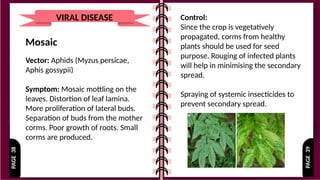
VIRAL DISEASE
Mosaic
Vector: Aphids (Myzus persicae,
Aphis gossypii)
Symptom: Mosaic mottling on the
leaves. Distortion of leaf lamina.
More proliferation of lateral buds.
Separation of buds from the mother
corms. Poor growth of roots. Small
corms are produced.
Control:
Since the crop is vegetatively
propagated, corms from healthy
plants should be used for seed
purpose. Rouging of infected plants
will help in minimising the secondary
spread.
Spraying of systemic insecticides to
prevent secondary spread.
PAGE
40
INSECT PEST
• Aphids
• Spider-mites
• Thrips
• Caterpillars
• Mealy bugs - Control - Use of pest-
free seed corms. If mea.1y bug
infestation is noted during storage
of seed corms, dipping in 0.05%
Monocrotophos should be done to
check the pest in field.
K
N
A
H
T
U
O
Y

Amorphophallus cultivation [Autosaved].pptx

  • 1.
    o- h p r o m A s u l l a h p POTATO AND TUBERCROPS HVS-302 Presented by:- DIPIKA BHOI (H/137/22) DHARA SINGH (H/136/22) Presented to:- DR. ARJUN LAL OLA
  • 2.
    PAGE 1 Sl. no TOPICS Pag e no. 01 INTRODUCTION02 02 SCOPE AND IMPORTANCE 04 03 USES 05 04 DISTRIBUTION 06 05 AREA & PRODUCTION 07 06 COMPOSITION 08 07 BOTANY 10 08 CULTIVAR 12 09 SOIL 14 10 CLIMATE 16 11 PROPAGATION 17 12 PLANTING MATERIAL 18 13 LAND PREPARATION 20 14 PLANTING 21 15 SPACING 21 16 MANURING & FERTILIZER 22 17 IRRIGATION & INTERCULTURE 24 INDEX Sl. no TOPICS Pag e no. 18 INTERCROPPING 26 19 HARVESTING 28 20 YIELD 30 21 WHOLE SEED CORM PRODUCTION 30 22 STORAGE 34 23 FUNGAL DISEASES 36 24 VIRAL DISEASES 38 25 INSECT PEST 40
  • 3.
    PAGE 3 PAGE 2 Common names Elephant foot yam, Suran,Zamikand Botanical name Amorphophallus campanulatus Chromosome no. 2n = 28 Family Araceae Edible part Corms Origin Tropical Asia and Africa Amorphophallus campanulatus
  • 4.
    PAGE 5 PAGE 4 • Elephant footyam is a remunerative and profitable stem tuber crop. • The crop is gaining popularity due to its shade tolerance, easiness in cultivation, high productivity, less incidence of pests and diseases, steady demand and reasonably good price. • Cultivation of elephant foot yam is limited to India, Philippines, Sri Lanka and South East Asia. IMPORTANCE AND SCOPE • Chips are made of starch-rich tubers. • Tender stem and leaves are also used for vegetable purpose. • Corm as a vegetable. • Preparing curries and pickles. • Ayurvedic preparations - recommended for the cure of piles, dysentery, asthma, swelling of lungs, vomiting, abdominal pain and as blood purifier. • Petioles - cooked as vegetables. USES
  • 5.
    PAGE 7 PAGE 6 DISTRIBUTION • It hasnow become a very popular vegetable in certain areas of the tropical and subtropical regions. • It is a crop of South-East Asian origin, growing wild in the Philippines, Malaysia, and Indonesia and South-eastern Asian countries. • It is commercially grown in India, Sri Lanka, China, Malaysia, Java, Philippines and Ceylon. • In India, it is cultivated on large scale in Andhra Pradesh, Bihar, Gujarat, Maharashtra and West Bengal. • The genus amorphophallus consist of about 90 species indigenous to tropical Asia and Africa. • About 14 species occur in India. • The edible species found in India are A. campanulatus, A. oncophyllus, A. variabilis, A. rivieri AREA & PRODUCTION AREA PRODUCTION 38,000 Ha 874,000 MT Horticultural statistics at a glance, 2021
  • 6.
    PAGE 9 PAGE 8 COMPOSITION • Amorphophallus isa cheap source of carbohydrates and rich in minerals and vitamin A & B. • The corms of wild types contain crystals of calcium oxalate on account of which they are highly irritant. In cultivated types, these are less abundant. • Tubers contain 18.0% starch, 1-5% protein and upto 2% fat. • Leaves contain 2-3% protein, 3% carbohydrates and 4-7% crude fibre. Moisture 78.7 g Protein 1.2 g Fat 0.1 g Carbohydrate 18.4 g Minerals 0.8 g Calcium 50 mg Phosphorus 34 mg Iron 0.6 mg Vitamin A 343 I.U Riboflavin 0.07 mg Thiamine 0.06 mg Nicotinic acid 0.7 mg Composition per 100 gm of edible portion
  • 7.
    PAGE 11 PAGE 10 BOTANY • Amorphophallus -either a perennial or an annual herb. • Petioles are smooth or warty and variously spotted. • Simple blade - 3 parted • Long spadix • Spathe is funnel or bell-shaped at the base, springing from the great bulb like conn in advance of the leaves. • Flowers have disagreeable odour which is supposed to attract carrion loving insects, which pollinate the flowers and bring about the production of seeds.
  • 8.
    PAGE 13 PAGE 12 CULTIVAR 5)Santragachi- • Vigorous growth habit • Corms having slight acridity • Rough coms with light cream colour • Bear several daughter corms • Grown commercially in Eastern India • Yield about 50-70 tonnes per hectare 6)Kovvur - • High yielding cultivar • Vigorous growth habit • Smooth corns without acridity • Free from daughter corms • Grown commercially in the South India. • Corm yield exceeds 100 tonnes per hectare 1)Sree Padma Non- acrid tubers, generally have one mother corm and a few cormels. Variety has developed at CTCRI, Trivandrum. It has a yield potential of 40 tonnes per hectare. 2)Sree Athira - First genetically improved variety with very good cooking quality. 3)Bidhan Kusum- This variety was developed by Vidhan Chandra Krishi Viswavidyalaya, West Bengal. 4)Palam Zimikand-1 -Released from C.S.K.H.P.K.V., Palampur.
  • 9.
    PAGE 15 PAGE 14 SOIL • Deep sandy-loamsoils rich in nutrient is considered the best for high conn production of Amorphophallus. • Since comis are highly susceptible to poor drainage conditions, these need well drained and well aerated soil. • The growth of corms in heavy soil is very much restricted and is reflected on the production. • Soils with higher amount of clay or silt should be amended by incorporating organic matter or compost. • Waterlogging is detrimental during any phase of growth. • pH range of 5.5-7.0 is preferred.
  • 10.
    PAGE 17 PAGE 16 CLIMATE • lt isa tropical and subtropical crop. • lt requires a well distributed rain fall of 1000-1500 mm, humid and warm weather with a temperature of 25-35⁰C during vegetative growth. • Hot and humid climate is required at initial stages of the crop for its vigorous growth, whereas dry climate facilitates tuber bulking at later stage. • It is usually propagated by offsets of corms. • These offsets are the miniature tubers which grow out of the parent corms and are called buds or daughter corms. • These are initially about 20-25 g each and take about three to four seasons to develop into corms weighing 8-10 kg each. PROPAGATION
  • 11.
    PAGE 19 PAGE 18 PLANTING MATERIAL • Initialsize of planting material plays most significant role in determining the final size of the harvested tubers. • Planting material is placed vertically in the pit. • Result of research showed that 400- 500 g size whole tubers were more suitable for raising a commercial crop. • Tubers of 3-4 kg can be harvested after six to seven months. This size is most suitable from marketing and transport point of view. • Cut tubers of 50-100 g sizes are used for producing the planting material of 500-1000 g sizes. • Although cut tubers can also be used as planting material, the use of whole tuber is significantly superior over cut tubers in tenns of sprouting percentage and overall yield.
  • 12.
    PAGE 21 PAGE 20 LAND PREPARATION • Theland is prepared by ploughing twice or thrice to a depth of 2022 cm followed by making pits of size 60 x 60 x 45 cm at a spacing of90 x 90 cm during February. • The pits are filled up with sufficient amount of rotted FYM or cow dung. • The crop is also grown on flat beds or broad ridges. • FYM @ 30 tonnes per hectare • However, the crop grown on ridges gives better yield than in flat beds. • Broad ridge method is generally practised in high rainfall areas. PLANTING South India - February-March Eastern and other parts of the country - March-April ,provided irrigation facilities are ensured as the crop needs irrigation during the summer months. SPACING The planting should be done at 90 x 90 cm spacing for commercial crop.
  • 13.
    PAGE 23 PAGE 22 MANURING & FERTILIZER Well-decomposed FYM or compost is applied @ 25-40 tonnes per hectare.  80:60:80 kg/ha ofN:P:K is ideal for commercial crop.  Fertilizer should be applied in split doses. The first application at planting with full dose of P and half of N and K in the pits along with FYM helps in the rapid development at the early stage.  The second application of remaining dose of N and K should be done 60-70 days after emergence of shoot.  It should be followed by earthing up for better bulking of the corm and good drainage.
  • 14.
    PAGE 25 PAGE 24 IRRIGATION & INTERCULTURE • Amorphophallusis mainly grown as a rainfed crop. During periods of late receipt of monsoon, a light irrigation is given during early stages of crop. • Mulching immediately after planting is the most important operation in Amorpohophallus. • When the crop approaches maturity. irrigation should be light. • Generally, the crop requires 2-3 weedings before the onset of monsoon. • Preplanting application of Fluchloralin @ 2.0 L per hectare can replace hand weeding.
  • 15.
    PAGE 27 PAGE 26 INTERCROPPING • During theinitial period of 2-3 months after planting, crops like leafy vegetables, green gram, black gram, cowpea, cucumber, etc; can be grown as an inter-crop. • lntercropping of elephant foot yam in banana, coconut and other newly planted orchards gives additional income to farmers. Elephant foot yam based multi layer vegetable cropping system
  • 16.
    PAGE 29 PAGE 28 HARVESTING • The cropis harvested after 6-7 months from planting. • Yellowing and drooping down of the leaves are the signs of maturity of the crop. • The crop can be harvested earlier before full maturity for early market and higher price. • The corms can be retained in the soil even after full maturity. • It can be stored for several months in well-ventilated rooms without any damage. • It is better to harvest the crop at right stage, as the rate of loss of moisture from the corms for the first 4 days is about 3-4% per day, the total extending to even 25 % or more in the first month of storage.
  • 17.
    PAGE 31 PAGE 30 YIELD WHOLE SEED CORM PRODUCTION •Inadequate supply of planting material is a major constraint in extending the cultivation of elephant foot yam. • South Indian smooth type which is of good quality and commercially acceptable, does not produce daughter conns necessary for rapid multiplication (although plenty of daughter corms arise in local irritating type). • The improved type is usually propagated by cutting large corms in small pieces for planting. • The cut corms may fail to sprout due to dehydration at high temperature prevailing during the planting season and rotting caused by infection of fungus and bacteria. The average corm yield ranges from 12-22 tonns per hectare, depending on the weight of seed corm, soil type and nutrition applied.
  • 18.
    PAGE 33 PAGE 32 • Thesehazards can be avoided by planting whole seed corms which not only sprout early and show better growth rate but also produces higher conn yield as compared to cut seed corms of same weight. • The whole seed corm can be produced by planting mini corm setts obtained from apical portion of mother corm which sprouts readily. • For obtaining desirable size of seed corm, 100 g setts should be planted at a distance of 30x30 cm. • The basal portion of the seed corm is not commonly used as planting material due to low percentage of sprouting. • The fully matured seed corms are lifted from the ground when the leaves tum yellow or become dry, particularly in the month of November. • Whole seed corm thus produced from about 0.15 ha in nursery IX.'O is sufficient for planting on I ha of land. The corm sett requirement per hectare is about 100 q which ultimately increases to 500 to 600 q/ha at the end of the season.
  • 19.
    PAGE 35 PAGE 34 STORAGE • Harvested cormsare cleaned and spread out under a shade cover for two days prior to storage, which helps in healing the injuries and bruises on the corm. • The corms could be safely stored on racks in well-ventilated storehouse facilitating diffused light. • If corms are to be stored for seed purpose, the cut corms should be immediately treated with Mancozeb (0.2%). • If the storage is for planting purpose, the corms should be treated with Fenitrothion (0.05%) + Mancozeb (0.2%).
  • 20.
    PAGE 37 PAGE 36 FUNGAL DISEASE Collar Rot/ Foot Rot Causal organism – Sclerotium rolfsii , Rhizoctonia solani • Symptoms: It appears when the plant is about 2-3 months old. Collar region is atllleked by the pathogen. Water soaked lesions appear on the stem. The whole plant soon turns yellow. Stem shrinks and collapses due 10 roning of the collar region. • Causes: Heavy rains and high relative humidity Heavy soils, high organic matter and poor drainage. • Control: Crop rotation, removal of plant debris. Improvement of drainage. Apply biocontrol agents like Trichoderma harzianum @ 2.5 kg/ha mixed with 50 kg of FYM. Drenching soiJ with Caplan (0.2%) or Brasicol (0.1 %) .
  • 21.
    PAGE 39 PAGE 38 VIRAL DISEASE Mosaic Vector: Aphids(Myzus persicae, Aphis gossypii) Symptom: Mosaic mottling on the leaves. Distortion of leaf lamina. More proliferation of lateral buds. Separation of buds from the mother corms. Poor growth of roots. Small corms are produced. Control: Since the crop is vegetatively propagated, corms from healthy plants should be used for seed purpose. Rouging of infected plants will help in minimising the secondary spread. Spraying of systemic insecticides to prevent secondary spread.
  • 22.
    PAGE 40 INSECT PEST • Aphids •Spider-mites • Thrips • Caterpillars • Mealy bugs - Control - Use of pest- free seed corms. If mea.1y bug infestation is noted during storage of seed corms, dipping in 0.05% Monocrotophos should be done to check the pest in field.
  • 23.