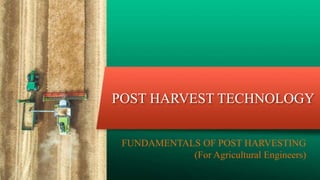




POST HARVEST TECHNOLOGY
FUNDAMENTALS OF POST HARVESTING
(For Agricultural Engineers)
Presented By
ARUL.S
MRT22PGMAT001
Department of Agricultural Technology
SHOBHIT UNIVERSITY
Meerut,UP.
Contents
1. Post Harvest Technology
2. Introduction
3. Objectives
4. Post Harvest Losses of Cereals, Pulses
and Oilseeds
5. Importance
6. Optimum Stage of Harvest
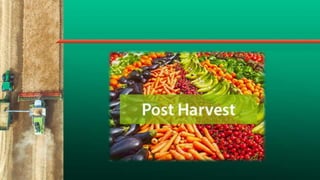
Post Harvest Technology
Post-harvest technology refers to the various methods,
techniques, and practices employed in the handling, storage,
processing, and transportation of agricultural products after
they have been harvested from the field. The primary goal of
post-harvest technology is to preserve the quality and
freshness of the harvested crops, minimize losses, and
enhance the overall value of agricultural produce.
Contd
This field of study encompasses a wide range of activities,
including sorting, cleaning, grading, packaging, cooling,
and storage of crops. Additionally, post-harvest
technology involves the application of various processing
methods, such as drying, milling, and preservation, to
extend the shelf life of perishable commodities and reduce
spoilage.
Contd
Efficient post-harvest technology is crucial for ensuring
food security, reducing waste, and maximizing the
economic returns for farmers. It plays a vital role in
maintaining the nutritional quality of food products and
facilitating their distribution from farms to consumers in
a manner that minimizes losses and meets market
demands.
Introduction
 Post Harvest Technology plays a pivotal role in preserving and enhancing the
quality of agricultural produce after harvesting.
 It encompasses a range of techniques and technologies designed to minimize losses,
maintain freshness, and extend the shelf life of crops.
 From proper storage and transportation methods to innovative processing
approaches, Post Harvest Technology is crucial for ensuring food security and
economic sustainability in the agriculture sector.
 By addressing the challenges of handling harvested crops, this field contributes
significantly to reducing food waste and increasing overall food availability.
OBJECTIVES
1) Enhance Food Preservation
2) Improve Quality
3) Reduce Losses
4) Enhance Market Value
5) Ensure Food Security
1. ENHANCE FOOD PRESERVATION:
Implementing effective post-harvest technologies aims to prolong
the shelf life of agricultural produce, reducing spoilage and
minimizing food wastage.
2. IMPROVE QUALITY:
Objectives include maintaining the nutritional content, flavor, and
overall quality of harvested crops through careful handling,
processing, and storage methods.
3. REDUCE LOSSES:
Minimize post-harvest losses by implementing efficient and
sustainable technologies, ensuring a higher percentage of the
harvested produce reaches consumers in optimal condition.
4. ENHANCE MARKET VALUE:
Implementing post-harvest technologies that improve the
appearance, taste, and overall marketability of agricultural
products can lead to increased demand and better prices for
farmers.
5. ENSURE FOOD SECURITY:
The primary goal is to contribute to global and local food security
by implementing technologies that enable a more reliable and
consistent supply of high-quality, nutritious food throughout the
year.
Post Harvest Losses of Cereals,
Pulses and Oilseeds
Post Harvest Losses of Cereals
 Post-harvest losses of cereals, such as rice, wheat, and maize,
remain a significant challenge in agriculture. These losses occur
during the storage, transportation, and processing stages, leading to
reduced food availability and economic impact.
 Factors like inadequate storage facilities, pest infestations, and
improper handling contribute to these losses. Addressing post-
harvest management through improved storage practices and
technology is crucial to minimize cereal losses and enhance food
security.
Post Harvest Losses of Pulses
 Post-harvest losses of pulses, including lentils, chickpeas, and beans,
are a significant challenge in the agricultural sector.
 These losses occur during storage, transportation, and processing
stages, leading to reduced overall crop yield.
 Factors such as inadequate storage facilities, pest infestations, and
poor handling contribute to these losses. Addressing post-harvest
management practices is crucial to ensure food security and
sustainability in pulse production.
 Implementing proper storage and transportation methods, along with
pest control measures, can help mitigate these losses.
Post Harvest Losses of Oilseeds
 Post-harvest losses of oilseeds result from inadequate storage and
handling practices, leading to spoilage and reduced quality.
 Exposure to moisture, pests, and improper storage conditions
contribute to significant losses in oilseed crops.
 These losses impact both quantity and oil content, affecting overall
profitability for farmers and the oilseed industry.
 Implementing effective post-harvest management strategies, such as
proper drying and storage techniques, is crucial to minimize these
losses and ensure a sustainable supply chain.
 Addressing post-harvest challenges is essential for maximizing the
economic potential of oilseed production.
IMPORTANCE
 Post-harvest technology plays a crucial role in preserving the quality
and nutritional value of agricultural produce.
 It helps extend the shelf life of crops, reducing post-harvest losses
and ensuring food security.
 Efficient post-harvest practices also contribute to improved
marketability and economic viability for farmers.
 By minimizing spoilage and waste, these technologies promote
sustainability and resource conservation in the agricultural sector.
 Ultimately, investing in post-harvest technology enhances the
overall efficiency of the food supply chain, benefiting both
producers and consumers.
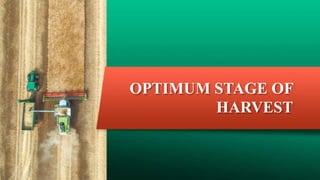
OPTIMUM STAGE OF
HARVEST
The optimum stage of crop harvesting varies
depending on the type of crop and its
intended use. Different crops have different
maturity indicators that farmers use to
determine the best time to harvest. Here are
some general guidelines for common types
of crops:
GRAINS
(wheat, rice, corn, etc…)
Harvesting is typically done
when the grains reach
physiological maturity,
which is the stage when they
have achieved maximum dry
weight. The crop is often
harvested when the moisture
content is within a specified
range to ensure good quality
and ease of processing.
FRUITS AND VEGETABLES
Harvesting times vary
widely for different fruits
and vegetables. Generally,
the optimum time for
harvesting is when the
produce is mature but still in
the early stages of ripening.
This ensures good flavor,
nutritional content, and
quality.
ROOT CROPS
(potatoes, carrots, etc…)
Harvesting is usually done
when the roots have
reached the desired size.
The timing may also
depend on factors like
weather conditions and
market demand.
Leafy Greens
Leafy vegetables are often
harvested when the leaves
are young and tender,
before they become too
fibrous or bitter. However,
the specific timing may
vary based on the type of
leafy green.
OILSEEDS
(soybeans, sunflower, etc…)
Harvesting is typically
done when the seeds reach
physiological maturity.
The moisture content of
the seeds is an important
consideration to ensure
proper storage and
processing.
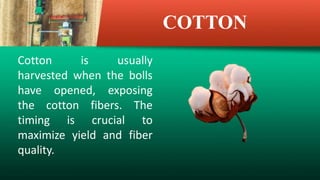
COTTON
Cotton is usually
harvested when the bolls
have opened, exposing
the cotton fibers. The
timing is crucial to
maximize yield and fiber
quality.
Contd…
Farmers may use a combination of visual cues, such as color
changes in the crop, as well as technological tools like
moisture meters to determine the optimal time for harvesting.
Additionally, local climate conditions, weather forecasts, and
market demands can influence the decision to harvest. It's
important for farmers to strike a balance between maximizing
yield and ensuring the quality of the harvested crop.
CONCLUSION
In conclusion, optimizing post-harvest practices is essential
for preserving the quality and shelf life of agricultural
produce, ensuring sustainable food supply chains and
reducing post-harvest losses. Implementing efficient
technologies and best practices can significantly enhance the
overall profitability and resilience of the agricultural sector.
POST HARVEST TECHNOLOGY.pptx

POST HARVEST TECHNOLOGY.pptx

  • 1.
    POST HARVEST TECHNOLOGY FUNDAMENTALSOF POST HARVESTING (For Agricultural Engineers)
  • 2.
    Presented By ARUL.S MRT22PGMAT001 Department ofAgricultural Technology SHOBHIT UNIVERSITY Meerut,UP.
  • 3.
    Contents 1. Post HarvestTechnology 2. Introduction 3. Objectives 4. Post Harvest Losses of Cereals, Pulses and Oilseeds 5. Importance 6. Optimum Stage of Harvest
  • 4.
    Post Harvest Technology Post-harvesttechnology refers to the various methods, techniques, and practices employed in the handling, storage, processing, and transportation of agricultural products after they have been harvested from the field. The primary goal of post-harvest technology is to preserve the quality and freshness of the harvested crops, minimize losses, and enhance the overall value of agricultural produce.
  • 5.
    Contd This field ofstudy encompasses a wide range of activities, including sorting, cleaning, grading, packaging, cooling, and storage of crops. Additionally, post-harvest technology involves the application of various processing methods, such as drying, milling, and preservation, to extend the shelf life of perishable commodities and reduce spoilage.
  • 6.
    Contd Efficient post-harvest technologyis crucial for ensuring food security, reducing waste, and maximizing the economic returns for farmers. It plays a vital role in maintaining the nutritional quality of food products and facilitating their distribution from farms to consumers in a manner that minimizes losses and meets market demands.
  • 7.
  • 8.
     Post HarvestTechnology plays a pivotal role in preserving and enhancing the quality of agricultural produce after harvesting.  It encompasses a range of techniques and technologies designed to minimize losses, maintain freshness, and extend the shelf life of crops.  From proper storage and transportation methods to innovative processing approaches, Post Harvest Technology is crucial for ensuring food security and economic sustainability in the agriculture sector.  By addressing the challenges of handling harvested crops, this field contributes significantly to reducing food waste and increasing overall food availability.
  • 10.
    OBJECTIVES 1) Enhance FoodPreservation 2) Improve Quality 3) Reduce Losses 4) Enhance Market Value 5) Ensure Food Security
  • 11.
    1. ENHANCE FOODPRESERVATION: Implementing effective post-harvest technologies aims to prolong the shelf life of agricultural produce, reducing spoilage and minimizing food wastage. 2. IMPROVE QUALITY: Objectives include maintaining the nutritional content, flavor, and overall quality of harvested crops through careful handling, processing, and storage methods.
  • 12.
    3. REDUCE LOSSES: Minimizepost-harvest losses by implementing efficient and sustainable technologies, ensuring a higher percentage of the harvested produce reaches consumers in optimal condition. 4. ENHANCE MARKET VALUE: Implementing post-harvest technologies that improve the appearance, taste, and overall marketability of agricultural products can lead to increased demand and better prices for farmers.
  • 13.
    5. ENSURE FOODSECURITY: The primary goal is to contribute to global and local food security by implementing technologies that enable a more reliable and consistent supply of high-quality, nutritious food throughout the year.
  • 14.
    Post Harvest Lossesof Cereals, Pulses and Oilseeds
  • 15.
    Post Harvest Lossesof Cereals  Post-harvest losses of cereals, such as rice, wheat, and maize, remain a significant challenge in agriculture. These losses occur during the storage, transportation, and processing stages, leading to reduced food availability and economic impact.  Factors like inadequate storage facilities, pest infestations, and improper handling contribute to these losses. Addressing post- harvest management through improved storage practices and technology is crucial to minimize cereal losses and enhance food security.
  • 17.
    Post Harvest Lossesof Pulses  Post-harvest losses of pulses, including lentils, chickpeas, and beans, are a significant challenge in the agricultural sector.  These losses occur during storage, transportation, and processing stages, leading to reduced overall crop yield.  Factors such as inadequate storage facilities, pest infestations, and poor handling contribute to these losses. Addressing post-harvest management practices is crucial to ensure food security and sustainability in pulse production.  Implementing proper storage and transportation methods, along with pest control measures, can help mitigate these losses.
  • 19.
    Post Harvest Lossesof Oilseeds  Post-harvest losses of oilseeds result from inadequate storage and handling practices, leading to spoilage and reduced quality.  Exposure to moisture, pests, and improper storage conditions contribute to significant losses in oilseed crops.  These losses impact both quantity and oil content, affecting overall profitability for farmers and the oilseed industry.  Implementing effective post-harvest management strategies, such as proper drying and storage techniques, is crucial to minimize these losses and ensure a sustainable supply chain.  Addressing post-harvest challenges is essential for maximizing the economic potential of oilseed production.
  • 21.
  • 22.
     Post-harvest technologyplays a crucial role in preserving the quality and nutritional value of agricultural produce.  It helps extend the shelf life of crops, reducing post-harvest losses and ensuring food security.  Efficient post-harvest practices also contribute to improved marketability and economic viability for farmers.  By minimizing spoilage and waste, these technologies promote sustainability and resource conservation in the agricultural sector.  Ultimately, investing in post-harvest technology enhances the overall efficiency of the food supply chain, benefiting both producers and consumers.
  • 23.
  • 24.
    The optimum stageof crop harvesting varies depending on the type of crop and its intended use. Different crops have different maturity indicators that farmers use to determine the best time to harvest. Here are some general guidelines for common types of crops:
  • 25.
    GRAINS (wheat, rice, corn,etc…) Harvesting is typically done when the grains reach physiological maturity, which is the stage when they have achieved maximum dry weight. The crop is often harvested when the moisture content is within a specified range to ensure good quality and ease of processing.
  • 26.
    FRUITS AND VEGETABLES Harvestingtimes vary widely for different fruits and vegetables. Generally, the optimum time for harvesting is when the produce is mature but still in the early stages of ripening. This ensures good flavor, nutritional content, and quality.
  • 27.
    ROOT CROPS (potatoes, carrots,etc…) Harvesting is usually done when the roots have reached the desired size. The timing may also depend on factors like weather conditions and market demand.
  • 28.
    Leafy Greens Leafy vegetablesare often harvested when the leaves are young and tender, before they become too fibrous or bitter. However, the specific timing may vary based on the type of leafy green.
  • 29.
    OILSEEDS (soybeans, sunflower, etc…) Harvestingis typically done when the seeds reach physiological maturity. The moisture content of the seeds is an important consideration to ensure proper storage and processing.
  • 30.
    COTTON Cotton is usually harvestedwhen the bolls have opened, exposing the cotton fibers. The timing is crucial to maximize yield and fiber quality.
  • 31.
    Contd… Farmers may usea combination of visual cues, such as color changes in the crop, as well as technological tools like moisture meters to determine the optimal time for harvesting. Additionally, local climate conditions, weather forecasts, and market demands can influence the decision to harvest. It's important for farmers to strike a balance between maximizing yield and ensuring the quality of the harvested crop.
  • 32.
    CONCLUSION In conclusion, optimizingpost-harvest practices is essential for preserving the quality and shelf life of agricultural produce, ensuring sustainable food supply chains and reducing post-harvest losses. Implementing efficient technologies and best practices can significantly enhance the overall profitability and resilience of the agricultural sector.