VALLEY VIEW UNIVERSITY-TECHIMAN CAMPUS
RESEARCH PROPOSAL ON:
COST BENEFIT ANALYSIS OF LETTUCE PRODUCED
WITH ORGANIC AND INORGANIC FERTILIZER AT
TECHIMAN MUNICIPALITY.

BY

ABIGAIL AYEW AMPOFOAH

211AB01000011
(AGRIBUSINESS MANAGEMENT DEPARTMENT)
OUTLINE OF PRESENTATION






INTRODUCTION.
LITERATURE REVIEW.
PROBLEM STATEMENT.
AIMS AND OBJECTIVES.
METHODOLOGY.
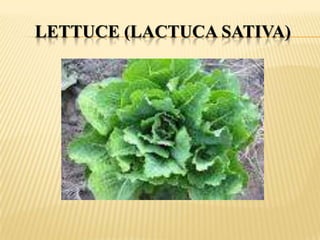
LETTUCE (LACTUCA SATIVA)
INTRODUCTION


Lettuce (Lactuca sativa) is the most popular amongst the
salad vegetable crops. It is most often grown as a leafy
vegetable but sometimes for its stems and seeds.



Lettuce is an annual crop which belongs to the family
Compositae or sunflower family and genus Lactuca and
species Sativa.



Lettuce was first cultivated by the ancient Egyptians
who turned it from a weed, whose seeds were used to
produce oil, into a plant grown for its leaves
INTRODUCTION


Generally grown as a hardy annual, lettuce is easily
cultivated, although it requires relatively low
temperatures to prevent it from flowing quickly.



Lettuce contains vitamin A and potassium as well as a
minor source of several other vitamins and nutrients.



Lettuce has a relatively high water requirement.
Inadequate moisture will seriously stunt growth and head
quality.
INTRODUCTION


Successful production of lettuce depends on vigorous
growth.



A wide range of well-drained soils can be used;
however, the crop does best on fertile, high organic
matter soils that have good water-holding capacity.



Adequate nutrients and a continues moisture supply are
essential to vigorous growth. The pH should be 6.0 to
6.7.
INTRODUCTION


Generally grown as a hardy annual, lettuce is easily
cultivated, although it requires relatively low
temperatures to prevent it from flowing quickly.



Lettuce contains vitamin A and potassium as well as a
minor source of several other vitamins and nutrients.



Lettuce has a relatively high water requirement.
Inadequate moisture will seriously stunt growth and head
quality.
PROBLEM STATEMENT


Soils in Techiman is mostly characterized by clay parts,
which have poor drainage capacity. They are very
compact during the dry season. Yet in the rainy season,
they are water logged and hence lettuce cultivation is
unsuccessful in these areas.



Because the soil nutrients are not made available for the
plant use, it is important therefore to evaluate the cost
and benefits on the use of organic and inorganic fertilizer
in lettuce production.
AIMS AND OBJECTIVES
General Objectives:
 To evaluate the cost benefit involved in producing lettuce
using organic and inorganic fertilizers.
Specific Objectives:
 Assess the cost per acre of producing lettuce.
 Assess the yield levels of lettuce using the different
fertilizer application.
LITERATURE REVIEW


Lettuce (Lactuca sativa) is an annual crop of the aster or
sunflower family Asteraceae.



It is most often grown as a leaf vegetable but sometimes
for its stem and seeds.



It is easily cultivated although it requires relatively low
temperature to prevent it from flowing quickly.
LITERATURE REVIEW


It can be plagued with numerous nutrient deficiencies, as
well as insect and mammal pests and fungi and bacterial
diseases.



L. sativa crosses easily within the species and with some
other species within the Lactuca genus although this trait
can be a problem to home gardeners who attempt to save
seeds.
LITERATURE REVIEW


Lettuce is most often used for salads, although it
is also seen in other kinds of food, such as soups
sandwiches among others.



Lettuce is a good source of vitamin A and
potassium as well as a minor source for several
other vitamins and nutrients.



Despite its beneficial properties, lettuce when
contaminated is often a source of bacterial, viral and
parasitic outbreaks in humans.
LITERATURE REVIEW


The best type of soil to be use when producing lettuce is
the loamy soil.



Lettuce is a cool- season crop. Start seeds indoors 4-6
weeks before last spring frost date for earliest crop.
LITERATURE REVIEW
IMPORTANCE OF LETTUCE
Serves as source of employment to people.
 Generation of income.
 Controls soil erosion
 For preparing soups.
 Helps in weight loss.
 Serve as food.

LITERATURE REVIEW


Aphids: These pests are problems, especially
when the weather is cool, because they emerge
earlier and tolerate colder temperatures than
many of their predators.



Tip burn: Inconsistent watering contributes to the
problem.



Flea beetles; lettuce will be shot through with tiny
holes.
LITERATURE REVIEW

Bacterial leaf spot and head rot.
 Bacterial soft rot.
 Root knot.
 Bottom rot.
 stunt

METHODOLOGY
MATERIALS AND METHODS
MATERIALS NEEDED

For successful production of lettuce the following
materials will be needed








Land for production
Lettuce seeds
Organic fertilizer (poultry manure)
Inorganic fertilizer (N. P. K)
Irrigation system
Weedicides and pesticides
Knapsack sprayer
METHODOLOGY
METHOD

The variety I will use is Eden
NURSERY
The seeds will to be nursed until they are ready to be
transplanted onto the field.
SOIL PREPARATION
Fields will be prepared thoroughly by plowing, hallowing
and removing plant debris from the soil surface.
METHODOLOGY
METHODS
WEEDING
This is mainly done to control weeds that will compete
with lettuce for its nutrients, air and water as well.
METHODOLOGY
DATA TO BE COLLECTED
 Plant height.
 Plant leave area.
 Number of leaves per plant.
 Time of flowering initiation
 50% flower initiation.
 Full flower initiation.
 Number of flowers per plant.
 Date of harvesting
 Cost of fertilizers.
 Cost of labourers
 Cost of land preparation.
METHODOLOGY
The six treatments are as follows;
 T1 – No fertilizer.
 T2 – Poultry manure and Ammonia.
 T3 –NPK and Poultry manure.
 T4 –Poultry manure.
 T5-Ammonia.
 T6-NPK
The one variety to be used is Eden
 V1 – Eden
METHODOLOGY
TREATMENTS


One(1) variety (Eden) will be used with 6 treatments
and 3 replications under the Complete Randomized
Block Design.



The treatments will be V1T1, V1T2, V1T3, V1T4,
V1T5, V1T6, because of the one variety.
METHODOLOGY
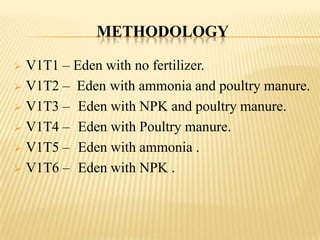
V1T1 – Eden with no fertilizer.
 V1T2 – Eden with ammonia and poultry manure.
 V1T3 – Eden with NPK and poultry manure.
 V1T4 – Eden with Poultry manure.
 V1T5 – Eden with ammonia .
 V1T6 – Eden with NPK .

METHODOLOGY


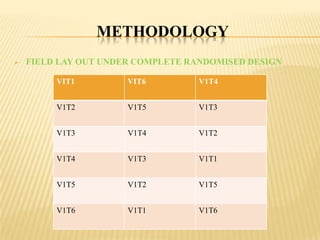
FIELD LAY OUT UNDER COMPLETE RANDOMISED DESIGN
VIT1

VIT6

V1T4

V1T2

V1T5

V1T3

V1T3

V1T4

V1T2

V1T4

V1T3

V1T1

V1T5

V1T2

V1T5

V1T6

V1T1

V1T6
METHODOLOGY
DATA ANALYSIS


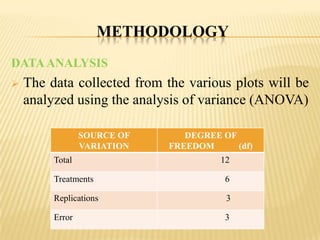
The data collected from the various plots will be
analyzed using the analysis of variance (ANOVA)
SOURCE OF
VARIATION
Total

DEGREE OF
FREEDOM
(df)
12

Treatments

6

Replications

3

Error

3
RESEARCH SCHEDULE
ACTIVITY

•Land
Preparation
•Nursing
•Transplanting
•Cultural
practices
•harvesting
LITERATURE
REVIEW
DATA
COLLECTION
DATA
ANALYSIS
REPORT
WRITTING

DECEMBER

JANUARY

1

CULTIVATION

NOVEMBER

1

1

2

3

4

2

3

4

2

3

FEBRUARY
4

1

2

3

MARCH
4

1

2

3

4
REFERENCES
Lactuca Sativa Kew Royal Botanical
Gardens. Retrieved 2012/04/02
 Lactuca Sativa United States Department of
Agriculture Retrieved 2012/04/02


Research proposal on

  • 1.
    VALLEY VIEW UNIVERSITY-TECHIMANCAMPUS RESEARCH PROPOSAL ON: COST BENEFIT ANALYSIS OF LETTUCE PRODUCED WITH ORGANIC AND INORGANIC FERTILIZER AT TECHIMAN MUNICIPALITY. BY ABIGAIL AYEW AMPOFOAH 211AB01000011 (AGRIBUSINESS MANAGEMENT DEPARTMENT)
  • 2.
    OUTLINE OF PRESENTATION      INTRODUCTION. LITERATUREREVIEW. PROBLEM STATEMENT. AIMS AND OBJECTIVES. METHODOLOGY.
  • 3.
  • 4.
    INTRODUCTION  Lettuce (Lactuca sativa)is the most popular amongst the salad vegetable crops. It is most often grown as a leafy vegetable but sometimes for its stems and seeds.  Lettuce is an annual crop which belongs to the family Compositae or sunflower family and genus Lactuca and species Sativa.  Lettuce was first cultivated by the ancient Egyptians who turned it from a weed, whose seeds were used to produce oil, into a plant grown for its leaves
  • 5.
    INTRODUCTION  Generally grown asa hardy annual, lettuce is easily cultivated, although it requires relatively low temperatures to prevent it from flowing quickly.  Lettuce contains vitamin A and potassium as well as a minor source of several other vitamins and nutrients.  Lettuce has a relatively high water requirement. Inadequate moisture will seriously stunt growth and head quality.
  • 6.
    INTRODUCTION  Successful production oflettuce depends on vigorous growth.  A wide range of well-drained soils can be used; however, the crop does best on fertile, high organic matter soils that have good water-holding capacity.  Adequate nutrients and a continues moisture supply are essential to vigorous growth. The pH should be 6.0 to 6.7.
  • 7.
    INTRODUCTION  Generally grown asa hardy annual, lettuce is easily cultivated, although it requires relatively low temperatures to prevent it from flowing quickly.  Lettuce contains vitamin A and potassium as well as a minor source of several other vitamins and nutrients.  Lettuce has a relatively high water requirement. Inadequate moisture will seriously stunt growth and head quality.
  • 8.
    PROBLEM STATEMENT  Soils inTechiman is mostly characterized by clay parts, which have poor drainage capacity. They are very compact during the dry season. Yet in the rainy season, they are water logged and hence lettuce cultivation is unsuccessful in these areas.  Because the soil nutrients are not made available for the plant use, it is important therefore to evaluate the cost and benefits on the use of organic and inorganic fertilizer in lettuce production.
  • 9.
    AIMS AND OBJECTIVES GeneralObjectives:  To evaluate the cost benefit involved in producing lettuce using organic and inorganic fertilizers. Specific Objectives:  Assess the cost per acre of producing lettuce.  Assess the yield levels of lettuce using the different fertilizer application.
  • 10.
    LITERATURE REVIEW  Lettuce (Lactucasativa) is an annual crop of the aster or sunflower family Asteraceae.  It is most often grown as a leaf vegetable but sometimes for its stem and seeds.  It is easily cultivated although it requires relatively low temperature to prevent it from flowing quickly.
  • 11.
    LITERATURE REVIEW  It canbe plagued with numerous nutrient deficiencies, as well as insect and mammal pests and fungi and bacterial diseases.  L. sativa crosses easily within the species and with some other species within the Lactuca genus although this trait can be a problem to home gardeners who attempt to save seeds.
  • 12.
    LITERATURE REVIEW  Lettuce ismost often used for salads, although it is also seen in other kinds of food, such as soups sandwiches among others.  Lettuce is a good source of vitamin A and potassium as well as a minor source for several other vitamins and nutrients.  Despite its beneficial properties, lettuce when contaminated is often a source of bacterial, viral and parasitic outbreaks in humans.
  • 13.
    LITERATURE REVIEW  The besttype of soil to be use when producing lettuce is the loamy soil.  Lettuce is a cool- season crop. Start seeds indoors 4-6 weeks before last spring frost date for earliest crop.
  • 14.
    LITERATURE REVIEW IMPORTANCE OFLETTUCE Serves as source of employment to people.  Generation of income.  Controls soil erosion  For preparing soups.  Helps in weight loss.  Serve as food. 
  • 15.
    LITERATURE REVIEW  Aphids: Thesepests are problems, especially when the weather is cool, because they emerge earlier and tolerate colder temperatures than many of their predators.  Tip burn: Inconsistent watering contributes to the problem.  Flea beetles; lettuce will be shot through with tiny holes.
  • 16.
    LITERATURE REVIEW Bacterial leafspot and head rot.  Bacterial soft rot.  Root knot.  Bottom rot.  stunt 
  • 17.
    METHODOLOGY MATERIALS AND METHODS MATERIALSNEEDED For successful production of lettuce the following materials will be needed        Land for production Lettuce seeds Organic fertilizer (poultry manure) Inorganic fertilizer (N. P. K) Irrigation system Weedicides and pesticides Knapsack sprayer
  • 18.
    METHODOLOGY METHOD The variety Iwill use is Eden NURSERY The seeds will to be nursed until they are ready to be transplanted onto the field. SOIL PREPARATION Fields will be prepared thoroughly by plowing, hallowing and removing plant debris from the soil surface.
  • 19.
    METHODOLOGY METHODS WEEDING This is mainlydone to control weeds that will compete with lettuce for its nutrients, air and water as well.
  • 20.
    METHODOLOGY DATA TO BECOLLECTED  Plant height.  Plant leave area.  Number of leaves per plant.  Time of flowering initiation  50% flower initiation.  Full flower initiation.  Number of flowers per plant.  Date of harvesting  Cost of fertilizers.  Cost of labourers  Cost of land preparation.
  • 21.
    METHODOLOGY The six treatmentsare as follows;  T1 – No fertilizer.  T2 – Poultry manure and Ammonia.  T3 –NPK and Poultry manure.  T4 –Poultry manure.  T5-Ammonia.  T6-NPK The one variety to be used is Eden  V1 – Eden
  • 22.
    METHODOLOGY TREATMENTS  One(1) variety (Eden)will be used with 6 treatments and 3 replications under the Complete Randomized Block Design.  The treatments will be V1T1, V1T2, V1T3, V1T4, V1T5, V1T6, because of the one variety.
  • 23.
    METHODOLOGY V1T1 – Edenwith no fertilizer.  V1T2 – Eden with ammonia and poultry manure.  V1T3 – Eden with NPK and poultry manure.  V1T4 – Eden with Poultry manure.  V1T5 – Eden with ammonia .  V1T6 – Eden with NPK . 
  • 24.
    METHODOLOGY  FIELD LAY OUTUNDER COMPLETE RANDOMISED DESIGN VIT1 VIT6 V1T4 V1T2 V1T5 V1T3 V1T3 V1T4 V1T2 V1T4 V1T3 V1T1 V1T5 V1T2 V1T5 V1T6 V1T1 V1T6
  • 25.
    METHODOLOGY DATA ANALYSIS  The datacollected from the various plots will be analyzed using the analysis of variance (ANOVA) SOURCE OF VARIATION Total DEGREE OF FREEDOM (df) 12 Treatments 6 Replications 3 Error 3
  • 26.
  • 27.
    REFERENCES Lactuca Sativa KewRoyal Botanical Gardens. Retrieved 2012/04/02  Lactuca Sativa United States Department of Agriculture Retrieved 2012/04/02 