Roman Sculpture
Is there such a thing as a Roman style of sculpture?
•Romans have reputation as imitators- copied many Greek
sculptures, vast quantities of work are adaptations and
variations of Greek models
•Roman demand for sculpture was high- attributed to
ANTIQUARIANISM (the love of antiquities) and their
desire for interior design- Greek and Egyptian copied were
in vogue at the time
•The slides that follow focus on wholly Roman subjectsportraiture and narrative relief
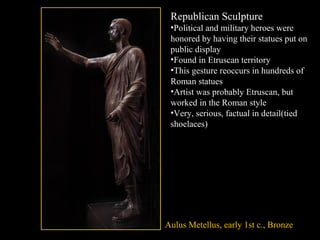
Republican Sculpture
•Political and military heroes were
honored by having their statues put on
public display
•Found in Etruscan territory
•This gesture reoccurs in hundreds of
Roman statues
•Artist was probably Etruscan, but
worked in the Roman style
•Very, serious, factual in detail(tied
shoelaces)

Aulus Metellus, early 1st c., Bronze
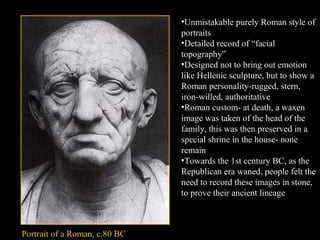
•Unmistakable purely Roman style of
portraits
•Detailed record of “facial
topography”
•Designed not to bring out emotion
like Hellenic sculpture, but to show a
Roman personality-rugged, stern,
iron-willed, authoritative
•Roman custom- at death, a waxen
image was taken of the head of the
family, this was then preserved in a
special shrine in the house- none
remain
•Towards the 1st century BC, as the
Republican era waned, people felt the
need to record these images in stone,
to prove their ancient lineage

Portrait of a Roman, c.80 BC
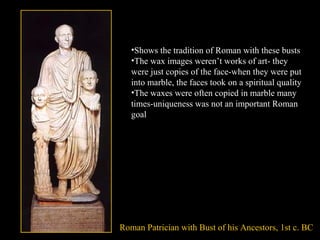
•Shows the tradition of Roman with these busts
•The wax images weren’t works of art- they
were just copies of the face-when they were put
into marble, the faces took on a spiritual quality
•The waxes were often copied in marble many
times-uniqueness was not an important Roman
goal

Roman Patrician with Bust of his Ancestors, 1st c. BC
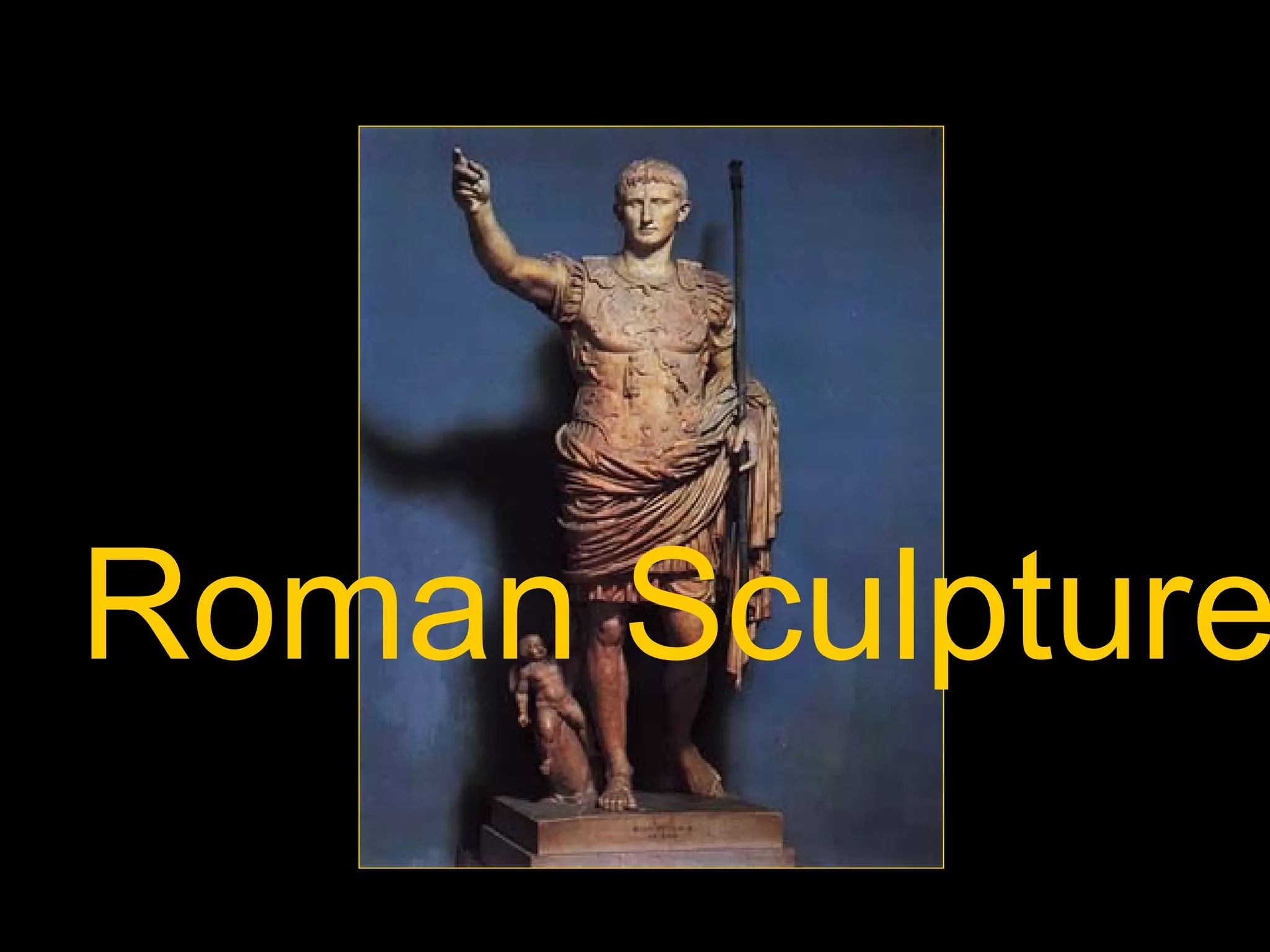
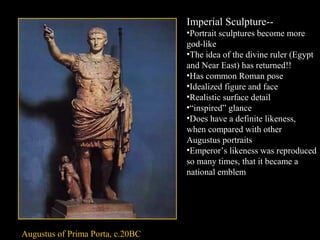
Imperial Sculpture-•Portrait sculptures become more
god-like
•The idea of the divine ruler (Egypt
and Near East) has returned!!
•Has common Roman pose
•Idealized figure and face
•Realistic surface detail
•“inspired” glance
•Does have a definite likeness,
when compared with other
Augustus portraits
•Emperor’s likeness was reproduced
so many times, that it became a
national emblem

Augustus of Prima Porta, c.20BC
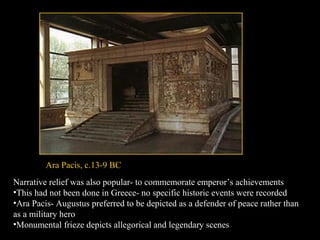
Ara Pacis, c.13-9 BC
Narrative relief was also popular- to commemorate emperor’s achievements
•This had not been done in Greece- no specific historic events were recorded
•Ara Pacis- Augustus preferred to be depicted as a defender of peace rather than
as a military hero
•Monumental frieze depicts allegorical and legendary scenes
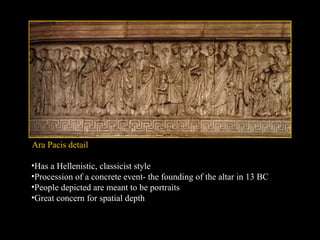
Ara Pacis detail
•Has a Hellenistic, classicist style
•Procession of a concrete event- the founding of the altar in 13 BC
•People depicted are meant to be portraits
•Great concern for spatial depth
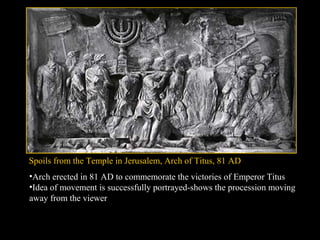
Spoils from the Temple in Jerusalem, Arch of Titus, 81 AD
•Arch erected in 81 AD to commemorate the victories of Emperor Titus
•Idea of movement is successfully portrayed-shows the procession moving
away from the viewer
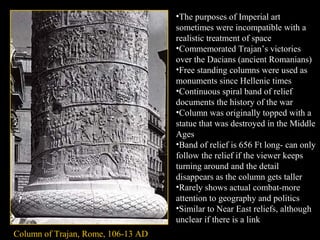
•The purposes of Imperial art
sometimes were incompatible with a
realistic treatment of space
•Commemorated Trajan’s victories
over the Dacians (ancient Romanians)
•Free standing columns were used as
monuments since Hellenic times
•Continuous spiral band of relief
documents the history of the war
•Column was originally topped with a
statue that was destroyed in the Middle
Ages
•Band of relief is 656 Ft long- can only
follow the relief if the viewer keeps
turning around and the detail
disappears as the column gets taller
•Rarely shows actual combat-more
attention to geography and politics
•Similar to Near East reliefs, although
unclear if there is a link
Column of Trajan, Rome, 106-13 AD
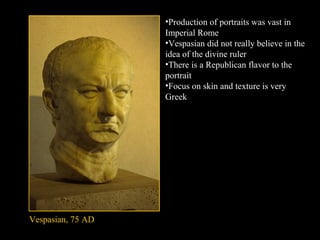
•Production of portraits was vast in
Imperial Rome
•Vespasian did not really believe in the
idea of the divine ruler
•There is a Republican flavor to the
portrait
•Focus on skin and texture is very
Greek

Vespasian, 75 AD
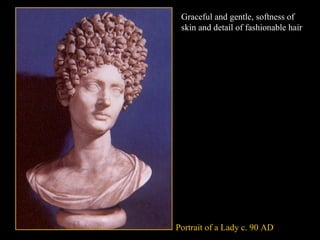
Graceful and gentle, softness of
skin and detail of fashionable hair

Portrait of a Lady c. 90 AD
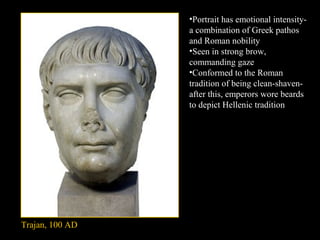
•Portrait has emotional intensitya combination of Greek pathos
and Roman nobility
•Seen in strong brow,
commanding gaze
•Conformed to the Roman
tradition of being clean-shavenafter this, emperors wore beards
to depict Hellenic tradition

Trajan, 100 AD
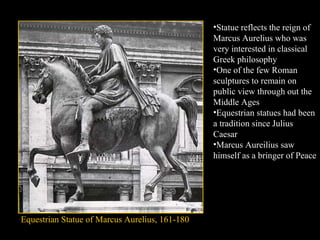
•Statue reflects the reign of
Marcus Aurelius who was
very interested in classical
Greek philosophy
•One of the few Roman
sculptures to remain on
public view through out the
Middle Ages
•Equestrian statues had been
a tradition since Julius
Caesar
•Marcus Aureilius saw
himself as a bringer of Peace

Equestrian Statue of Marcus Aurelius, 161-180
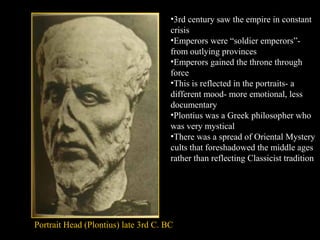
•3rd century saw the empire in constant
crisis
•Emperors were “soldier emperors”from outlying provinces
•Emperors gained the throne through
force
•This is reflected in the portraits- a
different mood- more emotional, less
documentary
•Plontius was a Greek philosopher who
was very mystical
•There was a spread of Oriental Mystery
cults that foreshadowed the middle ages
rather than reflecting Classicist tradition

Portrait Head (Plontius) late 3rd C. BC
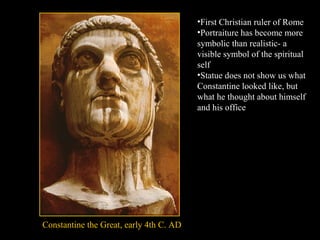
•First Christian ruler of Rome
•Portraiture has become more
symbolic than realistic- a
visible symbol of the spiritual
self
•Statue does not show us what
Constantine looked like, but
what he thought about himself
and his office

Constantine the Great, early 4th C. AD
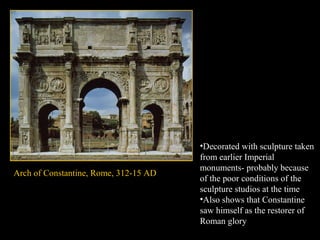
Arch of Constantine, Rome, 312-15 AD

•Decorated with sculpture taken
from earlier Imperial
monuments- probably because
of the poor conditions of the
sculpture studios at the time
•Also shows that Constantine
saw himself as the restorer of
Roman glory
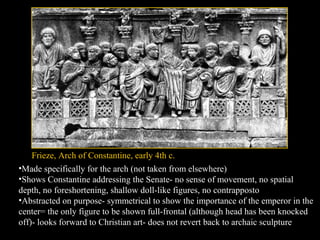
Frieze, Arch of Constantine, early 4th c.
•Made specifically for the arch (not taken from elsewhere)
•Shows Constantine addressing the Senate- no sense of movement, no spatial
depth, no foreshortening, shallow doll-like figures, no contrapposto
•Abstracted on purpose- symmetrical to show the importance of the emperor in the
center= the only figure to be shown full-frontal (although head has been knocked
off)- looks forward to Christian art- does not revert back to archaic sculpture

Ancient Rome Part 3

  • 1.
  • 2.
    Is there sucha thing as a Roman style of sculpture? •Romans have reputation as imitators- copied many Greek sculptures, vast quantities of work are adaptations and variations of Greek models •Roman demand for sculpture was high- attributed to ANTIQUARIANISM (the love of antiquities) and their desire for interior design- Greek and Egyptian copied were in vogue at the time •The slides that follow focus on wholly Roman subjectsportraiture and narrative relief
  • 3.
    Republican Sculpture •Political andmilitary heroes were honored by having their statues put on public display •Found in Etruscan territory •This gesture reoccurs in hundreds of Roman statues •Artist was probably Etruscan, but worked in the Roman style •Very, serious, factual in detail(tied shoelaces) Aulus Metellus, early 1st c., Bronze
  • 4.
    •Unmistakable purely Romanstyle of portraits •Detailed record of “facial topography” •Designed not to bring out emotion like Hellenic sculpture, but to show a Roman personality-rugged, stern, iron-willed, authoritative •Roman custom- at death, a waxen image was taken of the head of the family, this was then preserved in a special shrine in the house- none remain •Towards the 1st century BC, as the Republican era waned, people felt the need to record these images in stone, to prove their ancient lineage Portrait of a Roman, c.80 BC
  • 5.
    •Shows the traditionof Roman with these busts •The wax images weren’t works of art- they were just copies of the face-when they were put into marble, the faces took on a spiritual quality •The waxes were often copied in marble many times-uniqueness was not an important Roman goal Roman Patrician with Bust of his Ancestors, 1st c. BC
  • 6.
    Imperial Sculpture-•Portrait sculpturesbecome more god-like •The idea of the divine ruler (Egypt and Near East) has returned!! •Has common Roman pose •Idealized figure and face •Realistic surface detail •“inspired” glance •Does have a definite likeness, when compared with other Augustus portraits •Emperor’s likeness was reproduced so many times, that it became a national emblem Augustus of Prima Porta, c.20BC
  • 7.
    Ara Pacis, c.13-9BC Narrative relief was also popular- to commemorate emperor’s achievements •This had not been done in Greece- no specific historic events were recorded •Ara Pacis- Augustus preferred to be depicted as a defender of peace rather than as a military hero •Monumental frieze depicts allegorical and legendary scenes
  • 8.
    Ara Pacis detail •Hasa Hellenistic, classicist style •Procession of a concrete event- the founding of the altar in 13 BC •People depicted are meant to be portraits •Great concern for spatial depth
  • 9.
    Spoils from theTemple in Jerusalem, Arch of Titus, 81 AD •Arch erected in 81 AD to commemorate the victories of Emperor Titus •Idea of movement is successfully portrayed-shows the procession moving away from the viewer
  • 10.
    •The purposes ofImperial art sometimes were incompatible with a realistic treatment of space •Commemorated Trajan’s victories over the Dacians (ancient Romanians) •Free standing columns were used as monuments since Hellenic times •Continuous spiral band of relief documents the history of the war •Column was originally topped with a statue that was destroyed in the Middle Ages •Band of relief is 656 Ft long- can only follow the relief if the viewer keeps turning around and the detail disappears as the column gets taller •Rarely shows actual combat-more attention to geography and politics •Similar to Near East reliefs, although unclear if there is a link Column of Trajan, Rome, 106-13 AD
  • 11.
    •Production of portraitswas vast in Imperial Rome •Vespasian did not really believe in the idea of the divine ruler •There is a Republican flavor to the portrait •Focus on skin and texture is very Greek Vespasian, 75 AD
  • 12.
    Graceful and gentle,softness of skin and detail of fashionable hair Portrait of a Lady c. 90 AD
  • 13.
    •Portrait has emotionalintensitya combination of Greek pathos and Roman nobility •Seen in strong brow, commanding gaze •Conformed to the Roman tradition of being clean-shavenafter this, emperors wore beards to depict Hellenic tradition Trajan, 100 AD
  • 14.
    •Statue reflects thereign of Marcus Aurelius who was very interested in classical Greek philosophy •One of the few Roman sculptures to remain on public view through out the Middle Ages •Equestrian statues had been a tradition since Julius Caesar •Marcus Aureilius saw himself as a bringer of Peace Equestrian Statue of Marcus Aurelius, 161-180
  • 15.
    •3rd century sawthe empire in constant crisis •Emperors were “soldier emperors”from outlying provinces •Emperors gained the throne through force •This is reflected in the portraits- a different mood- more emotional, less documentary •Plontius was a Greek philosopher who was very mystical •There was a spread of Oriental Mystery cults that foreshadowed the middle ages rather than reflecting Classicist tradition Portrait Head (Plontius) late 3rd C. BC
  • 16.
    •First Christian rulerof Rome •Portraiture has become more symbolic than realistic- a visible symbol of the spiritual self •Statue does not show us what Constantine looked like, but what he thought about himself and his office Constantine the Great, early 4th C. AD
  • 17.
    Arch of Constantine,Rome, 312-15 AD •Decorated with sculpture taken from earlier Imperial monuments- probably because of the poor conditions of the sculpture studios at the time •Also shows that Constantine saw himself as the restorer of Roman glory
  • 18.
    Frieze, Arch ofConstantine, early 4th c. •Made specifically for the arch (not taken from elsewhere) •Shows Constantine addressing the Senate- no sense of movement, no spatial depth, no foreshortening, shallow doll-like figures, no contrapposto •Abstracted on purpose- symmetrical to show the importance of the emperor in the center= the only figure to be shown full-frontal (although head has been knocked off)- looks forward to Christian art- does not revert back to archaic sculpture

Editor's Notes